This is topic "Digital projection" at renovated Elsinore Theatre in forum Ground Level at Film-Tech Forum ARCHIVE.
To visit this topic, use this URL:
https://ft-forum.com/ft/cgi-bin/ubb/ultimatebb.cgi?ubb=get_topic;f=5;t=001306
Posted by William Hooper (Member # 71) on 11-17-2004, 01:01 AM:
News story at gazettetimes.com
Salem, Oregon
"This year, the Elsinore and Chemeketa have combined their efforts for the "Wednesday Evening Film Series" presented twice monthly at the newly restored Elsinore Theatre, 170 High St. S.E."
[...]
"Films in The Wednesday Evening Film Series will be digitally presented via a new projector on a new screen. While the projection quality does not yet match film, it is also true that most of the film prints available to the Elsinore were often not up to par either. Going digital, in comparison, will still most likely offer a superior viewing experience than the former film presentations."
Marcellus was right.
LHAT is undoubtedly the force telling historic theaters this, & telling the theaters to do this. It's pretty much the same line coming from a bunch of other historic theaters that have used switching from film to, in all cases I've seen, crappy conference room projectors.
The beauty of it is that they all have the same safeguard against the public embarassment of being proven wrong. Switch to a video projector, attendance falls, management says, "Well, people just don't come out to see these old movies." They can only work this way at non-profits where the driving force is expressing ignorance & ego, not putting butts in the seats.
Posted by Leo Enticknap (Member # 534) on 11-17-2004, 03:52 AM:
Not only are they crappy conference room projectors, but they're probably being fed with a VHS or, if you're lucky, a DVD.
We were discussing this trend quite a bit at AMIA, with many archives noticing a big decline in the number of non-profit venues (e.g. arts centres and universities) screening 35mm prints and a equivalent rise in instances of these venues requesting DVDs for group screenings.
IMHO there is no one simple reason for this: rather a number of factors at work. Firstly, the combination of DVDs and cheap data projectors which have emerged in the last 3-5 years has given the management of underfunded venues the idea that whereas previously the expense of maintaining film projectors, operators and print transport was unavoidable, there is now an option which is both cheaper and doesn't take a quality hit to the extent that video projection did in the past. Secondly there is the 'd-word' propaganda which we all know and are frustrated about. Actually, I'd say that this statement:
quote: Salem theatre owner?
While the projection quality does not yet match film, it is also true that most of the film prints available to the Elsinore were often not up to par either.
...is remarkably honest, and is a blessed relief from the misinformed bullcrap spouted by the likes of the UK Film Council (known as FCUK to its friends) when they try to pull the wool over technical illiterates' eyes by doggedly insisting that 1.3k DLP projection is vastly superior to 35mm. The sense I get here is that a pragmatic decision was made between losing money on a series of film-based screenings with prints that were usually knackered, or trying to put in place a sustainable programme based on electronic projection of some sort (precisely what sort the article doesn't tell us).
Thirdly, there is the inescapable fact that many archives are just too plain restrictive on who can show their film prints and how. The cost of striking prints and the fact that some archival viewing copies are unique elements in themselves (e.g. an original IB release print from the '50s which was acquired as a viewing copy alongside pre-print elements for preservation) has understandably made archives cagey about the film handling standards in some projection booths, leading to a 'better safe than sorry' approach of refusing the majority of requests for print loans. With the rapid advance of d-cinema this logjam needs to be broken more than ever if we're going to stop the decline in the number of opportunities for people to see older titles in the medium they were meant to be seen in, and looking into how this might be done this is one of the reasons Katie Trainor and I have formed a projection group within AMIA.
In the meantime, I think there is a need for a 'mid-range' digital system to fill the gap in the market illustrated by this theatre in Oregon. In other words, we need a replacement for 16mm - something which offers a substantially better picture than a VHS or DVD player hooked up to a cheap data projector, but is nowhere near as expensive as full-scale HD. An S-XGA projector fed from a laptop via DVI using a very high bitrate programme stream (e.g. 20-30kbps as distinct from the 9.8 limit on consumer DVDs) would be one possibility. The total kit cost would come to around $30k at a guess, though archives and distributors would probably be worried about the piracy implications of providing film data in this form. But there's no technical reason why digital projection as an intermediate solution couldn't happen with off-the-shelf kit here and now, if all involved in arthouse, rep and archive programming were willing to play ball.
Posted by John Hawkinson (Member # 1135) on 11-17-2004, 08:21 AM:
Realistically, one has to face the fact that if you book an old 35mm print, it might be better quality than a DVD, but it might not. I don't see how you solve this problem in today's market. (Other than getting both, prescreening the 35 print, and running the one that looks the best.)
--jhawk
Posted by Leo Enticknap (Member # 534) on 11-17-2004, 08:58 AM:
If a mid-range '16mm alternative' digital system were to be developed and supported by distributors, then they could potentially get a little more proactive in withdrawing 35mm prints from circulation once wear and damage had passed a certain point. Furthermore I wouldn't mind betting that the majority of damage caused to rep, arthouse and archive prints happen in the part-time, amateur-run and underfunded venues which would be the keenest to go digital, were such a mid-range setup to exist on the market. When 16mm disappeared from widespread use here in the late '80s/early '90s, most of the venues which had previously showed it either started projecting VHS or installing cheap and nasty 35 setups, often based on second-hand, badly maintained projector heads. If these were taken out of circulation the result would be that the existing stock of 35mm art/rep/archive prints would stay in better shape for longer, as they'd only go to venues which are able to handle them properly.
Yes, such a scenario probably would lead to an overall reduction in the number of places showing film - but if this takes out bad film presentation and high levels of print damage from the system, then maybe that isn't an entirely negative prospect.
Posted by William Hooper (Member # 71) on 11-18-2004, 01:09 AM:
But you haven't solved the problem, you've just reached a resolution for only the aspects that you haven't been forced to disregard.
Running 16mm will be only slightly less crappy in these venues than low-res video. These are theatrical venues, requiring theatrical-quality presentation to satisfy the audience, & that means what they have to use at the other theaters in town - 35mm.
Customers don't come back to theatrically-projected video in venues that require the resolution of film. It's shown not only in venues that have switched to video, reducing audiences to just handfuls, and also as I've seen in a theater that couldn't get one title in a series on film, ran a video that weekend, and the next weekend LOST the building audience in the series.
Like the old saying goes: bad publicity can't hurt you, but a bad show can ruin you.
Those PAC's which are just paying lip service to "we also provide exposure to classic films" by running them on video that looks crappy & no one comes back to see aren't doing anything for the films OR the people who would like to see them. When it gets to that point, the programming dwindles to just "Family fare" because the only folks who come out are a handful of families who'd take the kids to see any junk anyway. The film buffs, who are half the people who want to see them, don't come back, & the folks who are going out for a good evening's entertainment, who are pretty much the other half who buy tickets, don't come back to the crummy shows either.
The projectors' resolution on those screens is lower than watching the CRT on the TV at home! It becomes a maturation of the EXACT the argument of "why go there, when I can see it at home" to "and it looks better!"
Most titles in "classic" series are available in decent prints, & they ALL look better than conference-room projector video, & certainly better than 16mm.
The bit from the Elsinore about
quote: William Hooper
While the projection quality does not yet match film, it is also true that most of the film prints available to the Elsinore were often not up to par either.
is huge misdirection, since the "not up to par" prints may not have been up to par with better prints, but they still had better color saturation, contrast, resolution, & audience appeal than the video "projection quality".
Looking at the Elsinore's "film" programming at
http://www.elsinoretheatre.com/events/film_series.html
They're all available in good prints, except for perhaps "Robin Hood" which I think I read somewhere did not have a print struck of the restoration.
Apparently they've still got their 35mm & 16mm equipment, & something which might interest Scott Norwood since he was asking about charges for running projection for one-nights in facilities like this, the new regime at the Elsinore is charging an additional $100/hr to anyone who wants to use them when renting the venue.
http://www.elsinoretheatre.com/rental/rental_rates.html#equip
And anyone who rented the venue to show a 35mm film in that venue now would be crazy & would take a huge loss. The folks from that area which you'd have to attract for an audience would already know what movies look like at the Elsinore (video), & would not go there.
Just putting something up on the screen may satisfy some need to say "There, we have done our part & shown it, damn the Philistines who don't appreciate it". But it doesn't serve any other purpose than that & just getting some blob up on the screen.
Nobody's coming back to see something that looks that poor, & the degraded technical quality is certainly not doing justice to the material.
I'll buy this:
quote: Leo Enticknap
IMHO there is no one simple reason for this: rather a number of factors at work. Firstly, the combination of DVDs and cheap data projectors which have emerged in the last 3-5 years has given the management of underfunded venues the idea that whereas previously the expense of maintaining film projectors, operators and print transport was unavoidable, there is now an option which is both cheaper and doesn't take a quality hit to the extent that video projection did in the past. Secondly there is the 'd-word' propaganda which we all know and are frustrated about.
and add that LHAT is obviously pushing it.
quote: Leo Enticknap
Thirdly, there is the inescapable fact that many archives are just too plain restrictive on who can show their film prints and how.
These venues aren't running archive prints, they're running fare from classic libraries, these titles often have new prints. It's not hard to program for them & get prints. The silents the Elsinore is running are Kino titles which are available in prints they send out to multiplexes, etc.
These are not archive print issues, but studio library print issues.
Posted by Carl Martin (Member # 1146) on 11-18-2004, 03:34 AM:
quote: John Hawkinson
Realistically, one has to face the fact that if you book an old 35mm print, it might be better quality than a DVD, but it might not.
quote: William Hooper
the "not up to par" prints may not have been up to par with better prints, but they still had better color saturation, contrast, resolution, & audience appeal than the video "projection quality".
i'm with william here. we're talking about two things here. first there's the quality of the rendering of the picture. then there's the "negative quality" of the defects in the picture like dirt, scratches, etc.
in the first instance, film wins hands down, with some obvious exceptions like prints from video, several-generation dupes, bad lab problems. in the second, dvd wins since it (in theory) doesn't accrue damage, though there may be artifacts.
the totality of the film image is superior, with only localized defects. the totality of the dvd is worse, but uniformly so. as a whole, looking at the big picture, as it were, film is better. i don't want to trivialize print damage, but i don't want to blow it out of proportion either.
the problem is, it's easy to pick out a defect. a film viewer will see a scratch, have a worse experience, and attribute this to the scratch (and to film). a video viewer will have a mediocre experience, but fail to realize what was missing. there's no comparison to be made.
"maybe it just wasn't such a good movie."
"eh, those old movies just don't do it for me; i'll watch tv instead."
what they missed was that film glow! that fragile membrane of chemistry dancing on the screen! they just don't know it!
carl
Posted by Scott Norwood (Member # 30) on 11-18-2004, 07:33 AM:
$100/hour??? Damn. I wonder how much of that goes to the operator. Maybe they just set the price high intentionally in order to discourage people from renting out the venue to show films.
I, too, agree with William that it is shameful that a venue that is equipped for 16mm and 35mm film projection would decide to show video with a low-quality setup when good 35mm prints are available.
I can see running video if the available prints are horrible (in which case, I would hope that they would have a note to this effect posted at the box office) or if the venue is unequipped for film and the screening is truly a once-only event and rented equipment is used. I can also see running video when the source material does not exist on film (e.g. festival screening, etc.). Again, I would hope that the screening format would be indicated at the boxoffice and in advertising materials. In cases where video is appropriate, I would also expect that high-quality equipment of suitable resolution and brightness would be used.
I'm not sure I see the motivation here. Film rental is probably in the range of $500 per title for most of what they're showing. Presumably, the rental fee is the same (or similar) for video. By using video instead of film, they're saving probably $100 in shipping. That's it (they already have the film equipment). They still need an operator if they want to attempt "video done right" and they still have all the usual expenses of opening the house (ushers, ticket sellers, cleaners, lights, heat, advertising, etc.). Are they that hard-up for cash that they would compromise quality for the sake of saving a lousy $100? ![[Confused]](confused.gif)
As for archive prints, I've been sort of surprised lately at the sort of rare one-of-a-kind prints that distributors will send out without actually talking to the operator or even knowing who he is. I've handled a number of "rare" prints which I sometimes didn't know were "rare" until after the screening (not that it makes a difference in how they get treated, of course).
Posted by Steve Guttag (Member # 268) on 11-18-2004, 08:50 AM:
First off I hope this SXGA resolution thing just dies in projection. 1280 x 1024 and a 5:4 ratio...it works for NOTHING. In DCinema, at least anamorphic lenses are used to make it something someone uses (besides some computers).
For cinema use, 1080 is now here in both LCD and DLP form and that should be a good starting point. If the screen is small enough, a 1366 x 1768 XGA-W projector will suffice.
As to source material...16mm versus DVD...the 16mm print often does not win in the comparison. Many 16mm prints are just junk (and previously "enjoyed"). The sound on 16mm is hit and miss too. The DVD of the same title will often win the battle in both picture and sound...depending on one's video set up. If the 16mm print is good and not a 10000th generation dupe then yes the 16mm print will spank the pants off of video.
Heck, I've seen an off-camera original 16mm print spank the pants off of almost all 35mm release prints as they are made today. That certainly is not the norm though.
I think video is already an essential in today's special venue theatre that caters to independant and festival like screenings. The current line of LCD projectors are passible without apologizing and they are getting better every month. Sanyo and Barco both have 1920x1080 LCD projectors coming out (beta testing) and DLP (Barco, Christie) have an installed base of 2044 x 1080 projectors. Things are getting better.
Steve
Posted by Edward Jurich (Member # 1787) on 11-21-2004, 09:32 AM:
quote: Steve Guttag
If the 16mm print is good and not a 10000th generation dupe then yes the 16mm print will spank the pants off of video.
I remember renting a 16mm print of "Bullet" back in the 70's. The picture quality and sound quality were outstanding. I've got a 16mm airline print (back when they ran film inflight movies) of "Oh Heavenly Dog" that also has outstanding picture and sound quality.
On another note, bad scratch on film, line down picture, film still plays. Bad scratch on DVD, you now have a small frisbee.
Posted by Leo Enticknap (Member # 534) on 11-21-2004, 04:21 PM:
Yes, but cost of 16mm print = $2k; cost of DVD = $0.20...
Posted by Bill Enos (Member # 440) on 11-22-2004, 01:33 AM:
In comparison between 16mm and DVD thru the 2K Barco on loan in our booth the DVD almost always wins easily. The DVD is usually sharper and in the correct aspect ratio where the 16 is in 1.33 and not as bright.
Posted by Steve Kraus (Member # 476) on 11-22-2004, 07:06 AM:
Can someone offer an explanation as to why that would be? Is there such a huge lose of resolution from optical reduction? In theory 16mm should have higher rez than anything standard def video has to offer and given that print and intermediate stocks should have greater resolving power than faster camera film you'd think the fact that these are reductions from 35mm ought to help, not hurt. They should blow away standard def video (even up rez-ed to 2K). But apparently they don't.
I wonder if any of the digital intermediate folks have ever spit out a 16mm negative of a feature to serve the small gauge market; it would be interesting what quality such a print would be.
Posted by Mark Gulbrandsen (Member # 72) on 11-22-2004, 07:27 AM:
Here's an installation that was done in the early 60's(1963 I think) and is still running the same(and only)film today. They also have a 35mm print of it that is used only on special occasions. With a decent print and Film Guard on the projector it looks great and due to the Film-Guard the film and plastic skates in the projector last alot longer. With everything tweeked just right it almost makes 14fl. This venue may soon also be converted over to digital projection....... the venue uses digital projection frequently for other events so installing a permanent digital projector makes sense for this customer.
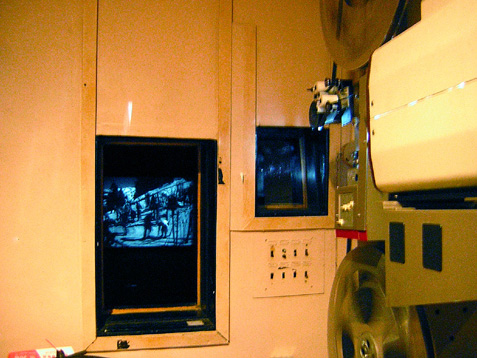
Mark
Posted by Leo Enticknap (Member # 534) on 11-22-2004, 08:03 AM:
quote: Steve Kraus
Can someone offer an explanation as to why that would be? Is there such a huge lose of resolution from optical reduction? In theory 16mm should have higher rez than anything standard def video has to offer and given that print and intermediate stocks should have greater resolving power than faster camera film you'd think the fact that these are reductions from 35mm ought to help, not hurt.
Bill mentioned that the 16mm is 'not as bright', suggesting that some of the detail and contrast information in the print is getting lost through underlit projection. There's also the issue of picture stability - a less than accurate intermittent mechanism, perf damage or slightly mistimed shutter will all visibly degrade the projected picture. And although a good 16mm print struck from properly timed internegative struck from a 35mm f/g should in theory blow a DVD out of the water, many of the 16mm feature prints in circulation are umpteenth generation and poorly struck.
Similarly I've found that when projecting DVDs, the quality of the telecine transfer and the bit rate of the encoded programme stream makes a big difference, often revealing detail which you wouldn't see on a 15" monitor. So, if you're comparing a 9mbps DVD transferred on a Spirit from specially timed fine grain which is being shown on a state of the art LCD or DLP projector with a 16mm one light reversal dupe from a 35mm release print shown on an underlit projector, I can believe that many people would think the DVD looked subjectively 'better'.
Posted by Edward Jurich (Member # 1787) on 11-22-2004, 03:24 PM:
quote: Bill Enos
In comparison between 16mm and DVD thru the 2K Barco on loan in our booth the DVD almost always wins easily. The DVD is usually sharper
Has to be the print, or bad projector optics/lamp/etc. Something that gives me a good laugh is when someone (not anything here) talks about how much better a DVD of a movie is when the DVD was made from film.
Posted by Bill Enos (Member # 440) on 11-22-2004, 06:45 PM:
The mega watt brightness of the digital as compared to the 1000 watt 16 probably makes up a big portion of the difference, plus who knows how many generations from the 35 neg. any 16 print might be. The dead steadiness of the DVD doesn't hurt. A complaint we almost always get when we use the 16 on a film not originally shot in 1.33 is "where's the rest of the picture, it was bigger than this when we saw it last". The format difference is the first thing they complain about. The AM radio mono sound of 16 makes it suck on a movie with big effects or music. The 16 X 21 ft. size of our 16 pic. undoubtedly exceeds the capability of the 1000W lamp, everything else gets checked regularly, the whole rig has less than 500 hrs. A local collector of 16 mm westerns had the comment as Edward. We ran his pristine print of Roy Rogers "Southward Ho" in A/B comparison with the collectors edition DVD, he said hit wasn't possible till he saw it.
Posted by Scott Norwood (Member # 30) on 11-22-2004, 07:19 PM:
I've see the setup that Bill describes (2k DLP with 6kw xenon) and it is indeed awesome. It's not 35mm, but it looks way better than any 16mm reduction print that I have ever seen. It's still a DVD source, but it looks far better than anything else NTSC that I have ever seen.
(Of course, the thing probably is probably far more expensive to buy and maintain than a full three-machine 16/35/35 film booth. And it will be obsolete sooner.)
Posted by Tao Yue (Member # 836) on 11-22-2004, 09:14 PM:
First, a factual correction. William Hopper wrote of themovies that Elsinore was showing:
quote: William Hooper
They're all available in good prints, except for perhaps "Robin Hood" which I think I read somewhere did not have a print struck of the restoration.
Actually, Warners did strike new prints of [em]Robin Hood[/em] just like they did for Singin' in the Rain. However, I didn't notice any publicity about new 35s for Meet Me in St. Louis, the third Technicolor 3-strip film that Warners reregistered digitally.
Scott Norwood wrote:
quote:
By using video instead of film, they're saving probably $100 in shipping ... Are they that hard-up for cash that they would compromise quality for the sake of saving a lousy $100? ... As for archive prints, I've been sort of surprised lately at the sort of rare one-of-a-kind prints that distributors will send out without actually talking to the operator or even knowing who he is.
Shipping can contribute a substantial amount if shipping by air is required. (sometimes by the distributor, sometimes because they've booked it into another theater the Wednesday after you run it) Take as an example Spartacus — 130 pounds from California to Massachusetts by Fedex 3-Day Saver is $250 plus insurance, ditto return. $350 on DVD with 6-track surround or $850 on film with 4-track surround, plus the cost of an operator, plus the worry of damaging the film. Granted, this is an extreme example, but many films are in similar circumstances. A well-funded PAC may still go for the film, but with budgets stretched the way they are, the DVD really begins to look appealing.
As for the practice of sending out really high-quality prints without a peep, perhaps this is because the studios' rep divisions consider this to be the last hurrah for viewing classics on film and figure that they might as well show off those prints to someone while they still can? Just speculation.
Posted by William Hooper (Member # 71) on 11-23-2004, 02:15 AM:
As it's been pointed out elsewhere, 16mm is inadequate for these venues. When it's run, there has to be the "We could only get this movie in 16mm", the sigh, the poor-quality movie. If it's a one-time or once in a blue moon thing, it doesn't affect attendance, as the expectation is that there will be a theatrical-quality presentation next time.
So 16mm doesn't really solve the problem; like video on cheap video projectors, it's a resolution only to those aspects of the whole problem which have not been disregarded for expedience. Attendance, audience satisfaction, etc. are disregarded for easier title availablility, not having to run film, etc.
These venues aren't running 2K Barco projectors, either. They're running crummy conference room projectors with image quality *worse* than 16mm. What problems are they solving, & what aspects of the situation are they choosing to disregard? The biggest one is ticket sales; they're not important to some of these non-profits that operate exclusively on grants & can afford to show contempt for the audience. It either doesn't matter to them if they come back or not, or they can create & use irrelevant ideas like "old movies don't work well in this town" to spuriously maintain their own self-esteem & credibility.
As far as rental costs, most PAC's that don't program film regularly but just run a series have a sponsor pick up the rentals for ad space. The rental cost is pretty much inconsequential to the choice of running film or (legally) video.
Leo's more attuned to archive titles, & I can see how it would be tempting & perhaps the only feasible way for some archives to get some material out to avoid damage - LOC or BFI could start up a program of issuing PD titles in their collections out on DVD for theatrical use. They'd be the only ones, though, & the selection would be small & not particularly marketable to general audiences: copyright term still extends back to 1927 now.
Easily the ugliest thing, on any quality video projector, is watching that damn menu screen projected until the film starts. If you've had to sit through the menu screen's looping audio on some theater's screen, you'll know that it may be one of the only things worse than Movie Tunes.
Although I've never quizzed anyone or overheard anyone say it, I'm pretty sure that *anything* that gives away the fact that a DVD is being run - menu screen, "Warner Home Video" title, final DVD credits, etc. - reinforces in folks minds the whole "Well we could have stayed home & just rented the DVD" disinclination to return to a non-current release program.
quote: Tao Yue
As for the practice of sending out really high-quality prints without a peep, perhaps this is because the studios' rep divisions consider this to be the last hurrah for viewing classics on film and figure that they might as well show off those prints to someone while they still can? Just speculation.
Of course they don't want to spend more money than they have to, as far as I can tell & have heard from one studio rep division guy, they strike new prints of popular library titles all the time, as a matter of course, this week even. They still send a level of pre-crappied prints to venues that they've learned wreck prints, are platter houses, cut leaders on "Do Not Platter" prints, etc.
Posted by Leo Enticknap (Member # 534) on 11-23-2004, 02:31 AM:
I'm becoming increasingly convinced that the major problem with digital projection for arthouse/rep/archive titles is not going to be the cost of the projectors - Moore's Law seems to be kicking in with a vengeance now and forcing down prices while increasing performance - but the cost of producing HD scans of film originals. I understand that a 2k 24p HD scan of a 35mm feature costs around $10k (assuming a one-light scan from a specially timed interneg or f/g pos - the cost goes up quite a bit if you have to time the scan).
For a Hollywood studio that's a drop in the ocean, especially given that once you've had the film scanned you've got your theatrical, TV and DVD masters, and also that subsequent copies can be made virtually for nothing. So a $10k mastering cost versus a seven-figure sum for a big print run to release a blockbuster looks very attractive. But if you're an archive or a small, specialised distributor (e.g. Kino or Milestone in the US, or Artificial Eye or Metro-Tartan in Britain) which would only have struck one or two prints in the first place, this could be a significant economic barrier. The risk, of course, is that a low-res format such as digibeta (or even worse, bogstandard DVDs) will replace 35mm for theatrical projection by default in this market; and so when we go to the theatre a few years down the line, we'll see proper HD versions of mainstream titles, but low-res digital video copies of more specialised films.
Powered by Infopop Corporation
UBB.classicTM
6.3.1.2