This is topic Picture size determined by old screen frames? in forum Ground Level at Film-Tech Forum ARCHIVE.
To visit this topic, use this URL:
https://ft-forum.com/ft/cgi-bin/ubb/ultimatebb.cgi?ubb=get_topic;f=5;t=001352
Posted by Andrew McCrea (Member # 674) on 02-02-2005, 02:36 PM:
Hey everyone!
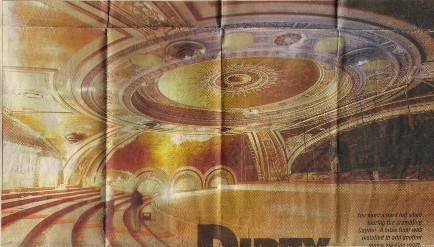
I just wanted to know that if you see pictures from inside an old theatre, and the screen frame is the usual rectangle, with lets say 4 vertical pieces, can you tell how big that screen probably use to be?
Here's an example (sorry for the poor quality):
Also, lets say the screen frame looks like this:
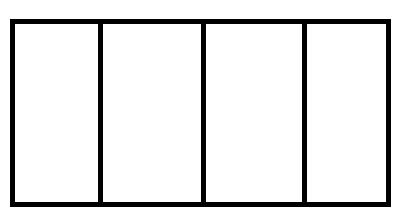
Is it possible to believe that that screen was/is 40 ft.?
Thanks!
Posted by John Walsh (Member # 168) on 02-02-2005, 06:22 PM:
If I understand your meaning, the answer would be no... you need something in the picture that you know how big it is, to use as a reference. Often, there is something else in a photograph that you can find out how wide it is, then use it as a scale.
Posted by William Hooper (Member # 71) on 02-03-2005, 01:49 AM:
That picture is giving me a headache!
It looks more like the back of the house at the top of the balcony than the front end, & the seats have been removed from the risers in the balocony. The bright white lighted areas could be hallways or vestibules brightly lighted by worklights or open windows, blowing out the exposure. They could even be just something as bright as fluorescents (although the wrong color), if there's little light in the auditorium. I'm baffled by what looks like a flat floor forward of the risers in the balcony that extends to the concave "sounding board" construction over the proscenium & orchestra pit. If it were scaffolding for ceiling restoration, it wouldn't be so closely matched & finished at the walls.
That flat floor-looking thing is more than 25' feet above the main floor: above the top of the proscenium!
The more I look at it, the rake of the balcony really doesn't match typical balcony rake for theaters of that age. I wonder if this is a restoration job where they've re-raked the balcony, screwing up the sightlines? Shoot, you can't even see the stage at that angle! Are they creating a new auditorium with stadium seating by chopping the top off of an existing older theater?
Somebody stole their chandelier!
quote:
Also, lets say the screen frame looks like this:
I'm with John, if you're referring to something that you see in the picture, you can't draw a conclusion from it.
If the screen frame is really the screen frame onstage (not pictured), then yes, allowing 6" or so for lacing around all edges, & without knowing whether there was moveable horizontal masking attached which even when pulled all the way out would have taken up a couple of feet at the ends of the screen frame, you can sort of estimate from that frame.
But if it's REALLY old, from when the theater was a silent movie theater, the screen only went in the center 20' or so, & the ends had attached decorative material to provide a "stage setting" for the screen. That's very unlikely, that the screen wasn't changed or removed from the silent days.
Does it really have a center vertical bracing member, right where the center speaker should go?
Posted by Thomas Procyk (Member # 1170) on 02-03-2005, 10:57 AM:
Yes, looks like they're chopping the top off of an old theater to make another auditorium in the balcony. ![[Frown]](frown.gif)
If you look on the right-fourth of the top picture, you can barely see the screen frame Andrew is talking about. If you look at the cieling above where the person is standing (on the right-most crease of the picture) you can see a bar across the top and the vague outline of the screen frame.
That would be one crazy-looking auditorium! There's more blank floor space in front of the screen than there is seating area! And the way the walls arch on the sides would make me feel like I'm just floating above the theater below. Strange... why do they have to ruin places like this?
=TMP=
Posted by Mike Blakesley (Member # 26) on 02-03-2005, 12:25 PM:
It doesn't even look like a movie theatre. Looks more like a stage theater, given the size of that stage. Is it maybe a "legitimate" theater that showed movies once in a while? In that case, the screen could be just about any size depending on the height of the proscenium.
Posted by Jim Spohn (Member # 1547) on 02-03-2005, 01:28 PM:
The so called screen frame appears to me to be a painted border above the procenium arch then alot of contour curtain, so that the actual sightline opening may be much lower than what we can see.
Posted by Andrew McCrea (Member # 674) on 02-03-2005, 04:06 PM:
That's the Capitol Theatre in Winnipeg. It opened February 14, 1921, in an attempt to put the Allen Chain under. it was built on one side of Portage Avenue, and the Allen was on the other. The Allen was renamed the Metropolitan, and its been kept standing. Unfortunately, the The Cap that you'll see in an upcoming picture gallery, was demolished in 2001 or 2002.
It showed movies up until it closed on September 3, 1990. It required steam heating, and Winnipeg shut its plant in the spring of 1990, so the theatre operated until it got too hold. Thus, it was completely stripped (The left the seats and speakers at the Met) and sat with no heat until the city acquired both properties from Famous Players in exchange for a $775,000.00 tax receipt (They were mad that the city wanted to designate both of them). When the city took them over, they put furnaces into the Capitol. Unfortunately, by 2001, most of the fake ceilings Famous Players put up had fallen to the floor, making the place look worse than it was. The Capitol was subsequently delisted as a heritage building (WHAT'S THE BLOODY POINT OF LISTING IF IT CAN BE TAKEN OFF WITH A SIMPLE VOTE) and torn down.
It was designed by Thomas W. Lamb and originally had a seperate building for its entrance with an enclosed bridge over the backlane to the theatre. In 1964, that entrance was closed and demolished for development. In 1979, the theatre was split horizontally at the balcony instead of vertically (there were protests).
Its unfortunate, but after the gallery goes up, I'll post some picture prior to the split from the Winnipeg archieves. As for the chancelier, it fell to the floor one night (while closed) and was never replaced.
Posted by Richard C. Wolfe (Member # 431) on 02-04-2005, 12:56 AM:
Quote: [It doesn't even look like a movie theatre. Looks more like a stage theater, given the size of that stage. Is it maybe a "legitimate" theater that showed movies once in a while? In that case, the screen could be just about any size depending on the height of the proscenium.]
No it wasn't a legitimate theatre, it was a movie palace. That's the way MOST movie theatres looked back in the 1920s. I grew up in a town of about 35,000 people. Back in the 50s, we still had 3 large ornate movie palaces downtown, and several other smaller less ornate ones as well.
Those theatres were usually always built with full stage facilities, so they could also run vaudeville acts or live prologues that were themed to the storyline of the feature film. They generally sat any where from 1000 to 3000 people, even more in larger cities. The New York Roxy had about 6,000 seats, the Atlanta Fox 5,000 and so on. One reason for adding live entertainment to movie shows was to legitimize the movies for all classes of people. During the early years from 1908 thru the teens, movies were considered entertainment only for the poor and generally for men. It was through the efforts of Marcus Lowe, William Fox, Sid Grauman, and particularly Samuel (Roxy) Rothafel that movie presentations were upgraded to where they were accepted by all people, and particularly by the church, and the schools. By adding the opulence usually found only in hotels, banks, and other large public buildings, and even out doing legitimate theatres, and with the addition of the live acts, movies became accepted as a form of the arts.
About a hundred of those movie palaces have been saved and restored as performing arts centers thoughtout America. It's a shame that most young people today when attending shows at those theatres don't even realize that they were just normal movie theatres back when they were new.
If you have one in your area, make a point to visit it and see what is missing in our theatres today. Movie theatres over the past decade have improved greatly, but still for the most part don't come near what us older folks experienced during our younger years at our local movie palace.
Posted by William Hooper (Member # 71) on 02-04-2005, 04:40 AM:
quote: Andrew McCrea
In 1979, the theatre was split horizontally at the balcony
Can you imagine the intrusion into the sidewalls & firewall at the front of the house for the support members?
quote: Andrew McCrea
As for the chancelier, it fell to the floor one night (while closed) and was never replaced.
Yeah, right, have them tell you another. Thomas Lamb always did them the same way, hung with steel cable about 1/2" to 3/4" thick on a windlass that doesn't need a brake or ratchet, mounted on the girders in the ceiling. None of his chandeliers have fallen. Somebody cut it loose. Whether it was cut loose for fun by vandals or by someone who just wanted it out of the way is an interesting question. But not a hard one.
Posted by Bill Enos (Member # 440) on 02-04-2005, 05:34 PM:
Our chandelier and a couple others described to me are pinned to the structure once hoisted into place and the cable then slacked. No way it could unintentionally fall.
Powered by Infopop Corporation
UBB.classicTM
6.3.1.2