This is topic Does THX Matter Anymore??? in forum Ground Level at Film-Tech Forum ARCHIVE.
To visit this topic, use this URL:
https://ft-forum.com/ft/cgi-bin/ubb/ultimatebb.cgi?ubb=get_topic;f=5;t=001444
Posted by Lyle Romer (Member # 1266) on 05-20-2005, 11:45 AM:
For anybody in an area that still has THX certified theatres, do the patrons care anymore or has all the Home/PC THX stuff diminished the brand name? Do people go to an older THX certified theatre over a new megaplex?
Posted by Aaron Mehocic (Member # 15) on 05-20-2005, 12:54 PM:
To me as a film viewer, its never been an issue. In fact, in my area there was only one theater (Regal) who was THX certified. In 1996 during our first expansion/remodeling project it was suggested we redesign for certification, but that was quickly quashed when it came to the final budgeting process.
Posted by Mark Lensenmayer (Member # 134) on 05-20-2005, 01:24 PM:
The early THX theatre here certainly did have superior sound. I was especially impressed with the quieter sounds and the wonderful musicallity of the system. Wow, did it sound good.
Marcus installed 6 THX units in a multiplex. They advertised moderately. The theatres sounded very very good, but Marcus never used any of the sound system trailers, which was disappointing. They have now dropped THX certification, but the theatres continue to have excellent sound.
We now have a downtown, independent 8-screen that proudly advertises being the only all-THX theatre in Ohio. They advertise this fact regularly ("See it in THX on a 62' screen!). These theaters are competing with huge chain multi-plexes, so they need SOMETHING to get people to drive downtown, driving past the moster-plexes. (Note that they also charge only $1 for parking in a very convenient location.)
Posted by Jesse Skeen (Member # 586) on 05-20-2005, 01:30 PM:
A 16-screen theater here that supposedly has all auditoriums THX-Certified has been open for about 2 years, and so far it's been disappointing. Several times I have heard bass coming from the theater next door, and once I even heard noise from outside! Weren't these the main problems THX design was supposed to eliminate?
It's painfully obvious that THX standards don't include competent booth personnel either.
THX-certification for video releases is of course a COMPLETE joke.
Posted by John Walsh (Member # 168) on 05-20-2005, 02:48 PM:
To answer Lyle's question, I feel patrons do care, but not *that* much. The THX brand name has diminished, partly because it's on too many products. People go to the theater playing the film they want to see, almost regardless of the quality.
THX was a good idea, but no so necessary today. THX put many construction details on paper and tested equipment so they knew what an amp or speaker could really do. This looked at the construction of a theater as a whole system, and provided complete engineering data to build the best possible result. It was hard to do this 20 years ago, but is sort of easy today. Really, many people today semi-copy THX spec's they got from a previous job and apply them to their new job.
Posted by Darryl Spicer (Member # 711) on 05-20-2005, 06:28 PM:
A couple of things that came out of the THX specifications, that I would say carried over to the current builds.
Air conditioning units on the roof are now installed so that they are not directly over the auditoriums. The return vents, at least with cinemark, are now below the screens far away from the units and I have never noticed any noises coming from them.
Posted by Cam Jones (Member # 2684) on 05-22-2005, 02:23 AM:
THX seems like just another way for Lucas to make some money now, I have seen (or heard in this case) many non THX theatres that have better sound.
The Lowes Sony Metreon in SF claims all of its theatres are THX, however when I went there I heard noise from the booth (projectors, people talking etc.)
Posted by Aaron Sisemore (Member # 145) on 05-22-2005, 02:42 AM:
quote:
THX seems like just another way for Lucas to make some money now,
Lucasfilm spun off the THX division a few years ago, it is now a totally independent privately held corporation.
-Aaron
Posted by Mark Gulbrandsen (Member # 72) on 05-22-2005, 09:34 AM:
quote: Aaron Sisemore
Lucasfilm spun off the THX division a few years ago, it is now a totally independent privately held corporation.
Aaron, Not totally true... They are owned by Creative Sound Labs... hence the foray into computer speakers and junk market stuff. Creative is really nothing more than a marketing company. Indeed they might have been better off had they been bought by someone important like Maytag.....
My experience is that THX no longer matters at all. The public is today capable of recognizing really good sound reproduction and will typically frequent a cimema with excellent sound no matter whats playing down the street. In fact names like Dolby Digital and DTS are the more important names to advertise on today.
In several cases where I was involved with one or two THX screens in a complex it actually caused a problem in which patrons would not buy a ticket UNLESS the film they wanted to see was playing in the THX house.
Of course the best thing to come out of the THX technology was the R-2.
Mark
Posted by Dave Macaulay (Member # 813) on 05-22-2005, 01:15 PM:
THX is useful if you really want to build a good cinema and you're willing to pay what it costs. The "certification" passes the minimum standard which is rather low, but if you actually build to the THX specs you'll have a room with pretty good acoustics and pretty good isolation and with sound equipment capable of presenting digital sound at the proper level without anything breaking.
You can build a better sounding and better isolated room without THX if you know what you're doing. From the new theatres I visit, the architects designing them don't know how... or they get building budgets that force them to avoid doing it right.
Posted by Brad Miller (Member # 2) on 05-22-2005, 01:26 PM:
quote: Mark Gulbrandsen
Of course the best thing to come out of the THX technology was the R-2.
But Mark, you forget about the D-2. ![[Razz]](tongue.gif)
Posted by Aaron Sisemore (Member # 145) on 05-22-2005, 05:25 PM:
I thought Creative Labs owned them, but I couldn't find any information to prove same. Thus I went with the release from THX's own site that specifies that they were independent from Lucasfilm.
-Aaron
Posted by R. Andrew Diercks (Member # 1725) on 05-24-2005, 10:42 AM:
Many customers believe that THX is a different type of digital sound and are surprised when I explain that the crossover is the only equipment difference. I have EX in my Star Wars auditoriums and we are not THX certified. I thought ours sounded better than the THX theatre that we had the trade screening. How often do you have to re-certify? If the theatre isn't properly maintained, it probably isn't always up to THX standards.
Posted by Steve Anderson (Member # 364) on 05-25-2005, 08:21 PM:
I know in Nashville THX doesn't mean ![[bs]](graemlins/bs.gif)
I have been to several independent houses in small communities around here that puts the "Big Boys" to shame.
Posted by Aaron Garman (Member # 1653) on 05-26-2005, 12:34 AM:
We have one THX screen locally at Notre Dame, and it certainly means something. The sound there is perfect, and the image extremely bright. I forget which kind of projectors, but the manager there said they were made in India. Sound is through a CP650, with Crown amps. Not sure about the speakers. They are having a mini movie festival here in June, and they are finally getting some films with amazing sound mixes. The cinema usually has indie fair, but this time, we get some cool blockbusters like Titanic and The Matrix. I'm stoked!
AJG
Posted by Manny Knowles (Member # 1171) on 05-26-2005, 01:24 AM:
THX meant a whole lot during the decade beginning in 1983 when it debuted and 1993 when it was eclipsed by the advent of digital sound.
You could really see and hear a difference. Part of that noticeable difference was the fact that there were many theatres that fell far short of industry standards. It was this lack of adherence to the standards that created the need for some kind of certification system in the first place.
Theatre owners who could not afford THX certification found that they could make great improvements by simply bringing themselves in line with the published SMPTE standards. So, in a very real way, THX can be credited with the improvement of many cinemas that never got certified.
To this day, there are a lot of people who admittedly never knew what THX was all about.
"Digital Sound" is a more familiar, more marketable concept.
Posted by Martin Brooks (Member # 1269) on 05-27-2005, 11:33 AM:
Digital sound may be a more viable marketing concept than THX, but a properly built THX house will also make digital sound better. I know it's possible to build a great sounding house without THX certification, but at least the certification declares that the house meets some minimum standards.
Digital sound does not make up for weaknesses in house acoustics or in weaknesses in the B-chain. While not every THX screen I've been to has sounded spectacular, overall, THX certified houses sound better than those that aren't.
Having said that, I am shocked to read that there are THX certified houses that have booth noise and leakage from another screen. I find that difficult to understand considering that in the past, houses lost certification when the HVAC systems got noisier over time.
IMHO, the biggest weakness of the THX program was the fact that it was never marketed properly. Here in NYC, newspaper ads did not indicate THX screens. As a result, there is not one THX certified screen left in Manhattan, a shocking failure on the part of THX, IMO.
As a side note, I've noticed a trend in newspaper advertising where many ads no longer list which digital format (or if indeed digital sound is even being used) for the presentation.
Posted by Brad Miller (Member # 2) on 05-27-2005, 03:24 PM:
These days some form of digital sound is pretty much expected.
Posted by Manny Knowles (Member # 1171) on 05-27-2005, 05:32 PM:
quote: Martin Brooks
I know it's possible to build a great sounding house without THX certification, but at least the certification declares that the house meets some minimum standards.
Trouble is that the THX standards seem to have become... "flexible."
And, besides, people who can appreciate good sound will know it when they hear it. I certainly don't need a badge on a marquee to "tell" me that a theatre sounds good. I'd rather be the judge of that myself. As for those who aren't so concerned about image and sound quality... Who's to say that the presence or absence of the THX logo would be a very compelling decision-making factor them? To clarify, I'm speaking only of the present situation, not the past.
quote: Martin Brooks
IMHO, the biggest weakness of the THX program was the fact that it was never marketed properly.
I guess "properly" is the operative word because there certainly was a considerable amount of hype back in the day. Lucasfilm marketed it to theatres as a marketing tool and THX theatres were clearly identified as such in newspaper ads, on theatre marquees and then there were the trailers.
Maybe it should have been marketed as a new set of higher standards, which is what it was intended to be and which it really was for a while. I think so many people thought it was a sound format like Dolby SR or something. That would explain why there was confusion when digital sound came along.
[ 05-28-2005, 12:08 AM: Message edited by: Manny Knowles ]
Posted by Thomas Jonsson (Member # 1902) on 05-29-2005, 02:51 PM:
My experience is THX matters more to people than digital sound.
They seem to take for granted sound is digital these days. It has
been years since anyone asked what kind of sound we played this or
that movie in. But still lots of people ask if we are THX or not.
THX, on the other hand, seems to have no other interest than the
yearly re-certification dollars. They don´t care if I have the
auditorium tuned or not (it´s up to me), as long as they get their
money. There seem to be no devolopment at all. Sad, because it was a very good intention.
Thomas
Posted by Bobby Henderson (Member # 840) on 05-29-2005, 07:09 PM:
Customers will choose a THX-certfied auditorium over a non-certfied house, even if both have exactly the same equipment. Still, most really don't understand what THX is. I think many theater chains are aware of that marketing problem and see that as one reason for dropping THX from their theater designs. They figure stadium seating and digital sound is good enough for any new theater.
But here's the thing. Customers no longer consider digital sound and stadium seating to be luxury items. They're now standard features since they're found in so many theaters. 5.1 surround is common to many millions of home setups. When a commercial theater has an out of tune or badly maintained audio setup customers are going to be more likely to notice it, and then conclude their home setup is better.
Good theaters with excellent equipment and presentation quality need to have some way to distinguish themselves from the rest of the pack. I'm not sure if THX is the way to do that, or if something else needs to be done.
Posted by Manny Knowles (Member # 1171) on 05-29-2005, 08:34 PM:
quote: Bobby Henderson
Customers will choose a THX-certfied auditorium over a non-certfied house, even if both have exactly the same equipment.
This certainly used to be the case but that research data is so old now. It might still be true but I'm not going to swallow this statement automatically these days.
Would THX and non-THX theatres have *exactly* the same equipment? Isn't there an issue of proprietary crossovers?
quote: Bobby Henderson
When a commercial theater has an out of tune or badly maintained audio setup customers are going to be more likely to notice it, and then conclude their home setup is better.
A lot of people think this even when they're in a good theatre. People can (and do) conclude whatever they want; it doesn't make it so. I can't tell you how many times some "home-theatre-phile" has asked if we could make the surrounds louder. Then there are those that ask why we don't get the "letterboxed version" of every movie. I've done a lot of work on home-theatre systems where the speakers were not in the right places and/or were incorrectly wired.
People are naturally inclined to prefer their version of something, even if it's crap. This is especially true if it's something they spent a lot of money to have.
Something else to consider: all those screwed-up home theatre "systems" contribute heavily to the miscalibration of the audience's ears: they don't know what sounds good anymore. And it doesn't help matters when the THX logo is plastered all over their equipment.
As for the THX cinema program... There have been no training sessions (including "refresher" courses) for cinema technicians in years. I wonder how many "THX-certified" technicians are still doing things "the THX way."
No doubt about it, THX was a great idea. I'm proud to have met Tom Holman. He's a great guy, an excellent teacher and a brilliant engineer. The original THX cinema program proved itself to be a winner technically and economically. As a set of standards, there is no argument that THX remains relevant.
The major problems with THX:
(1) The original confusion among moviegoers as to what THX actually was/is;
(2) Further confusion caused when the THX logo was applied to home-theatre product;
(3) Apparent relaxation of the standards for THX cinemas (esp. recertification);
(4) Reduction in number of THX-certified theatres (lapse in certification) leads to a decline in visibility of the logo;
(5) THX theatres not being advertised as such -- contributes further to the decline in visibility of the logo;
(6) No more training --> no new THX technicians;
(7) Competition from non-THX houses. Theatre sound systems are much, much better nowadays so the difference in sound quality won't be as dramatic as when THX was first introduced;
(8) Theatre owners often complain that THX-certification (and recertification) is cost-prohibitive.
It would be interesting to see a graph showing the number of THX theatres annually from its inception right up to the present. I would expect there to be a steady increase from 1983 up until the early 1990s, followed by a plateau, followed by a gradual decline beginning around 1998 or so.
Could THX make a comeback in the cinema market? I suppose anything is possible but the first question that comes to mind is whether the "new THX" managed to retain any of the brilliant minds that used to be associated with original THX...
Posted by Mark Gulbrandsen (Member # 72) on 05-29-2005, 08:51 PM:
quote:
Competition from non-THX houses. Theatre sound systems are much, much better nowadays so the difference in sound quality won't be as dramatic as when THX was first introduced;
Yes, but we have THX and Thomlinson Holman to thank for setting the standards that many are building todays systems to.
The pisser is that now that THX is even on some computer stuff I've got to wonder if folks are thinking that a THX cinema system will sound like their computers sound system....
quote: Bobby Henderson
Customers will choose a THX-certfied auditorium over a non-certfied house, even if both have exactly the same equipment.
Bobby,
You are absolutely correct! I've been through this one where we do a couple of houses out of 8 or so. Patrons leave the ticket line when they find out the film they came to see is not in the THX houses..... Bad for exhibitor-parton relations.
quote: Brad Miller
But Mark, you forget about the D-2.
Brad, I'm just living in a great "vintage world"..... R-2's and DP-70's ![[thumbsup]](graemlins/thumbsup.gif) . Of course the D-2 is better than the R-2 and alot more practical, am looking forword to getting one very soon. The weight savings alone will make it worth the price...... which is about half what my R-2 cost.
. Of course the D-2 is better than the R-2 and alot more practical, am looking forword to getting one very soon. The weight savings alone will make it worth the price...... which is about half what my R-2 cost.
Now if they only made some cool crank up spools for those damed mics cables!
Mark
Posted by Bobby Henderson (Member # 840) on 05-29-2005, 11:12 PM:
quote: Manny Knowles
Would THX and non-THX theatres have *exactly* the same equipment? Isn't there an issue of proprietary crossovers?
The area where this occurs is in multiplex sites that had at least two or more THX houses and allowed certifications to lapse -mainly to save money on the annual fee. Carmike did this with a bunch of their theaters. Their location here in Lawton was originally built with two THX screens, but now screen #4 is the only one carrying certification. House #5 has all the same equipment. Big event releases, such as the current "Star Wars" installment, will often have two prints taking up both houses. When #4 is filling up and fixing to sell out, some customers insist on waiting for the next show on #4 instead of seeing it at an earlier time on #5. Management will tell them the equipment is the same in both houses, but they will still wait. The only difference they encounter is seeing a THX trailer before the show begins.
I'm hoping a resurgence of interest in things like THX occurs. Fat chance on that happening, right? I would be really happy if Carmike renewed the certification on house #5 and then be pretty elated if they added on a couple more screens (hopefully THX as well). Sadly, it seems like the THX thing is fading away. Oklahoma never had a lot of THX screens. But now there are none in Oklahoma City or Tulsa. Lawton has one screen, and this tiny 2000 resident town (Cordele) has one. That's it for the state.
The folks behind THX need to get something done about keeping THX alive in commercial theaters. It would be pretty sad for it to diminish into nothing more than a home video kind of thing.
Posted by David Stambaugh (Member # 1102) on 05-29-2005, 11:26 PM:
When Cinemark built Movies 12 here in Springfield, 2 screens were allegedly THX-certified. This was around 1989. They were the most disappointing THX-certified theatres I'd ever experienced. Those 2 screens were "barely acceptable" by any standards. There was nothing special about them at all. And the other 10 houses were all downhill from there. That place has always seemed like a terrible place to see a movie. Cinemark dropped the THX certification fairly early on, maybe a couple years after the opening.
Luckily Cinemark's technical standards were much higher when they built Cinemark 17 in the same mall, in 1999. They're not THX, but they're capable of pretty good presentation, FAR better than the 12-plex (which is now a $1.50 bargain theatre).
Posted by Michael Schaffer (Member # 1204) on 05-30-2005, 03:23 AM:
The answer to the original question is "no".
Posted by John Walsh (Member # 168) on 05-30-2005, 07:47 AM:
I never heard any difference between the THX crossover and a properly-tweeked x-over in a DCM. I don't doubt the THX is better, but if no one can hear it .....
THX has placed themselves in the awkward position of trying to get tough with the hand that feeds them.
Posted by Steve Guttag (Member # 268) on 05-30-2005, 08:28 AM:
Oh, I'd take the THX crossover (the two varities I've heard) over the DCM.
Posted by John Walsh (Member # 168) on 05-30-2005, 11:37 AM:
Yes, but can you get customers to hear enough of a difference that they pay the additional $$?
I'd gladly install a SGX (Steve Guttag eXperiment) system over a THX system since it'd be cheaper, use standard equipment, and probably sound just as good
Posted by Paul Linfesty (Member # 214) on 05-30-2005, 12:38 PM:
quote: Bobby Henderson
The area where this occurs is in multiplex sites that had at least two or more THX houses and allowed certifications to lapse
But don't theatres who lose certification have to turn in their THX crossovers?
Posted by Bobby Henderson (Member # 840) on 05-30-2005, 07:31 PM:
THX doesn't always take back the crossovers. My understanding is some circuits actually buy them. THX can still take back those crossovers anyway. But here's my guess. Maybe they have the same hopes as I that the exhibitor will eventually renew the certification on those screens. Such a possibility of renewing certification (and getting that annual fee) would be ruined if the theater had buy a new crossover for a former THX screen. What does a good crossover equal in quality to the THX model cost? The corporate bean counters certainly won't like that extra cost. And that factor could actually be an additional reason why some theater chains have dropped the THX program entirely. If their air conditioning system gets too loud they suddenly have to spend so and such many thousands of dollars on replacement crossovers for failing the recertification test.
I've heard others mention crossover models they thought were superior to the THX crossover. Why not just have something like that included in approved components list? The theater buys it, they keep it. Period. THX can still remove certifications as they see fit. I don't think removing some piece of equipment that was there in the rack for years is a very constructive policy. It certainly doesn't bode well for customer relations -with the theater chain being the customer.
Lord knows, the way THX is disappearing in commercial theaters, THX needs to be doing something to help itself survive. It is a horribly tough balance to manage. I think a lot more needs to be done to beef up presentation standards. But there also has to be some way to keep cash-strapped theaters from taking a cost hickey from something like that crossover thing. The way most theater chains see it, THX is little more than a marketing gimmick that can barely even justify its right to exist. If they have to deal with the threat of losing equipment with a certification failure that's just going to sour them on the deal even further.
Posted by Paul Linfesty (Member # 214) on 05-30-2005, 08:22 PM:
quote: Bobby Henderson
I've heard others mention crossover models they thought were superior to the THX crossover. Why not just have something like that included in approved components list?
I THINK I remember the reason given once was so that THX would actually own one piece of equipment as a way of "control." It doesn't seem to make much sense to me, though.
quote: Bobby Henderson
THX is little more than a marketing gimmick that can barely even justify its right to exist.
And dropping fast. I was in Hollywood yesterday to catch the 2K digital presentation at the Cinerama Dome (with sound rivaling the best THX houses I've heard), and I walked by the Chinese Theatre. They actually have a placard in the forecourt encouraging people to experience the biggest Hollywood hits in their historic state-of-the-art theartre with excellent projection and...
this is a theatre with THX certification and all digital sound formats (including SDDS-8), and yet the sound component that they were hyping weren't any of these. They were trumpeting the Academy award winning JBL speaker system! (This theatre even has a JBL snipe that runs right along one for THX and Dolby Digital).
Posted by Evans A Criswell (Member # 381) on 05-31-2005, 03:47 PM:
quote: Manny Knowles
Something else to consider: all those screwed-up home theatre "systems" contribute heavily to the miscalibration of the audience's ears: they don't know what sounds good anymore. And it doesn't help matters when the THX logo is plastered all over their equipment.
I agree. Most people adjust their home systems to add too much bass and treble and have their surrounds run up too high as well. Teenagers and people in their young 20s are the worst about this. It makes things sound better to them, like it did to me at that age, but the older I got, the more I liked having a system good enough to play a flat signal into and have it reporduce it as faithfully as possible. After doing so for a while, and hear a system with too much bass or treble in a store, it bothers me. But to the majority of the young people, that's what they want. They want overemphasis on so many aspects of the sound.
When people spend the money on surround speakers and the equipment to drive them, they tend want noticeable sound coming out of them, whether it's accurate or not. Most people's ideas of what sounds good have been tarnished. Don't even get me started on those people who have the subwoofers in their cars that cause everything they listen to to have more bass than anything else.
Posted by Martin Brooks (Member # 1269) on 05-31-2005, 06:55 PM:
quote: Evans A Criswell
Most people adjust their home systems to add too much bass and treble and have their surrounds run up too high as well. Teenagers and people in their young 20s are the worst about this. It makes things sound better to them, like it did to me at that age, but the older I got, the more I liked having a system good enough to play a flat signal into and have it reporduce it as faithfully as possible. After doing so for a while, and hear a system with too much bass or treble in a store, it bothers me. But to the majority of the young people, that's what they want. They want overemphasis on so many aspects of the sound.
Consumers have been striving for inferior sound for a long time. I remember the days when people strove to have a great sounding hi-fi system in which the accuracy you describe was the objective. As a kid, I used to visit the AR listening room in Grand Central Station every chance I got. To hear the AR turntable playing back through the Dyna preamp and D-70 power amps into the AR-3 speakers was absolutely phenomenal. And later, the clean and crisp sound from Advent typified the objective of a good sound system.
But the 8-track tape and the compact cassette format started us down the path to inferior sound. Even with Dolby B, C or S noise reduction and the massive improvements in tape formulations and recording/playback heads, the cassette format was not very good.
Once relatively high-powered and cheap ICs were developed, that gave us the era of the boombox and the car radio that provides 100% distortion of the signal (even not counting the fact that the car doors are audibly vibrating.)
The CD improved things for a while, although it took a while to get the mastering right. Even though the Redbook format permits a dynamic range of 96db, everyone compressed the hell out of the levels anyway. It’s hard to believe now, with the advent of MP3s and other lossy compression schemes, that the CD was criticized because 16bit/44.1 Khz recording was considered to not be good enough.
So now we’ve got everyone listening to MP3 players that have about a half-watt of power, tiny transducers, and lossy compression schemes. Everyone has a perception that it’s high quality because it’s “DIGITAL”. And I have to admit, if I plug my daughter’s i-Pod into my car stereo, it subjectively sounds damned good. But when I plug it into my stereo system, it sound like crap, as does satellite radio (listen to the out-of-phase signal on a satellite radio broadcast – it sounds like a sound effect for a science-fiction movie.)
If anyone cared about audio quality, formats such as DVD-Audio and SACD would be much more successful than they are. But like much else in our society, we only care about convenience, cost and perception.
One other reason for the decline in audio quality is the fact that almost everyone is deaf. Baby boomers are deaf because of their age and all the years of rock concerts. But today, SPLs of the stage monitor system are actually higher than the house PAs from the 1960s and 70s. Levels in the audience cause permanent hearing damage after 20 minutes of exposure. So between ridiculously loud levels in live music and having pods in their ears all the time, today’s generation will be deaf at a lot younger age than we were. Who needs high frequency response when you can no longer hear it anyway?
Posted by Scott Jentsch (Member # 1681) on 06-01-2005, 01:35 PM:
It's very unfortunate that elements like THX that were intended to raise the quality bar are being ignored (by theater chains), neglected (by THX), and even disdained (by its detractors).
When Marcus bought the Cinemark Movies 10, their THX certification went away. When AMC bought the GCC Mayfair Mall, their THX certification went away. Then, a few years ago, Marcus must have decided that THX was unnecessary in their remaining certified screens and (I think) are completely THX-free. Maybe that was a result of not wanting to do what it took to stay certified, or that the revenue just didn't justify the cost, I don't know.
As a movie enthusiast and movie-related web site publisher who's been following the industry for 10+ years, I can say that THX could still matter if the parties involved wanted it to.
Perhaps the original tenets of THX have served their purpose and raised the bar across the board, so that the average theater today is better than it was back in 1983. However, the advent of digital sound only increased the need for some of the core things that THX stood for in my mind.
Proper isolation between theaters keeps the action blockbuster from bothering people in the romantic drama next door. Having a low noise level keeps people from being bothered by the air conditioners rattling over their heads. Hearing the projector during a quiet passage is inexcusable.
Is THX certification required to accomplish these things? Of course not. Many people here will be happy to brag about how a certain non-certified theater meets or exceeds the performance of such-and-such THX certified theater. But how are people looking at a list of movies on a web site distinguish between the two?
Avid moviegoers may know where the good screens at which theaters are, but a majority of people are not avid moviegoers. In fact, in a 2004 survey, 46% surveyed said that they attended movies occasionally, which means at least once in six months. This fits the profile of most people I know.
Marketing 101 says that people respond to effective marketing messages. A THX designation next to a showtime is a marketing message that people can use to distinguish one presentation from another.
Previous posts by Bobby and Mark support that if given a choice, people would rather see a movie in a THX screen. In those cases, the theater is fortunate enough to have those people already in the door, so they have a chance to save the customer and get them to buy a ticket and fill up on concessions. When a potential customer is looking at 10-20 showtimes on a web site, they're going to naturally be drawn to those presentations that stand out.
Digital sound is assumed by many, but should still be advertised in my opinion. Many times it is not. On a weekly basis, I have to pursue getting the proper data for those designations, but it's largely hit and miss. Smaller theaters are much better at this than the chains. It's been a very long time since I've seen a digital sound trailer before a movie. Another marketing opportunity lost because someone didn't want to be inconvenienced by placing the trailer ahead of the film.
It baffles me to see THX-certified theaters not include the THX designation in their showtimes, whether that be online, on phone recordings, or in the newspaper ads. It's a selling opportunity, and to not take advantage of that is just bad marketing. Anyone who pays for THX certification and all that goes with it, but doesn't take advantage of it by playing the trailers, displaying the logo, and other steps to inform and educate the public, and then whines about how it's not worth the cost... they just shouldn't be doing what they're doing. They're not cut out for it, and should find a different line of work.
On my site, I have distinct columns where digital sound, stadium seating, and THX graphics will appear, if they are designated by theaters. Here is an example:
http://www.bigscreen.com/NowShowing.php?movie=11329&show=nearby&zip=53719
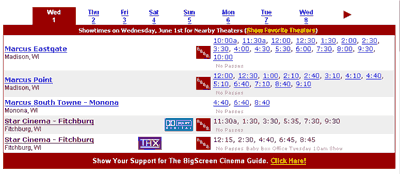
As you can see, I can't get a theater to designate both the THX logo and the digital sound at the same time, and many theaters don't even bother with indicating digital sound.
In my opinion, the industry is all about showmanship. Theatrical exhibition cannot be about selling the movie, because that's a losing proposition to tightening DVD windows and piracy. It has to be about selling the experience. The circus doesn't put up signs, then just trot out the elephants with no introduction in the middle of an empty field. They call it "The Greatest Show on Earth" and the ringleader makes you excited about the neat tricks the performers can do under a huge tent. That's showmanship!
I can't judge the reality of the current THX situation. I don't know if THX is dropping the ball or not when it comes to upholding their standards and supporting their paying theaters.
I can say with all confidence that anything that helps a theater distinguish itself from another will help that theater succeed. All the elements of that theater have to work together to keep the marketing from being hollow, however. If you say you're better by putting a THX logo on a show, you better make sure that it is better, or people will feel cheated and not come back.
THX alone won't make or break a business, but it's a name people can identify with (the THX logo on home theater equipment helps it be recognizable) and theaters should use that to their advantage. The THX brand may be tarnished in the opinions of people here, but I don't think the general public is at all aware of any issues that may exist. They see a logo that conveys a mark of quality or at least of recognition, and that will make a difference.
Posted by Evans A Criswell (Member # 381) on 06-01-2005, 03:22 PM:
I don't think the industry is about showmanship at all anymore, based on what I see in most theatres. One example: I saw Star Wars III recently on Friday afternoon in a sold out show. If the theatre companies cared at all about showmanship, do you think they'd be playing the loud obnoxious "Regal 20" before shows? Do you think they'd be playing the Regal 20 with the projector aimed 2 feet to the right and maybe more than a foot down from where it should be, making it look extremely ugly? Do you think they'd play the movie itself with a foot of aperture shadow on the left edge of the screen? To a sold out show of the most popular movie this year? They don't care! And neither do the customers. maybe less than 1 percent of the customers even care any more.
People are going to go to a theatre if they're convenient and are showing the movie they want to see.
Back in mid April, I decided to stop calculating presentation quality scores (averages) for theatres in my area on my web site. I'm not going to theatres enough for my theatre ratings to be accurate any more and I hadn't gotten a single feedback on that part of my site by email in a year. When I took that off, nobody emailed me to say they missed it.
More and more, I'm waiting for DVDs rather than going to the theatres. I've only seen 4 movies in theatres this year, and it's already June. I blame it on a lack of quality movies to see, coupled with the increase in advertising and the continued decline in showmanship.
I rarely hear anyone mention THX these days. People used to constantly ask me which theatres were the best to see movies in my area. I've maybe been asked that once during the past year.
In my opinion, THX means nothing these days other than a marketing gimmick. When I'm treated to a THX trailer playing in the wrong format (scope set for flat or flat set for scope) without digital sound, in heavily distorted optical sound, what does that say? Now that the last Star Wars movie has been made, I think THX will eventually crumble away into nothing, since most people still associate THX with Lucasfilm in their minds.
Posted by Jesse Skeen (Member # 586) on 06-02-2005, 04:02 PM:
Amen Evans! Sadly this seems to be the case at a lot of places, even the theaters that don't show ads don't seem to care about a quality presentation or employing competent people (as evidenced by the SCRATCHED THX trailers!) I haven't seen Star Wars yet but plan to- unless the overall presentation just blows me away it will probably be the last movie I see at a regular theater for a while.
If the PHONE-THX program is no more, are there any other ways for the general public to report any presentation problems with Episode 3?
Once the Star Wars crowds die down, the "2wenty" will hopefully be running to mostly-empty theaters. People might put up with crap for a big movie, but when the smaller films come out there's got to be a reason for them to bother going.
Posted by Aaron Sisemore (Member # 145) on 06-02-2005, 04:43 PM:
quote: Jesse Skeen
If the PHONE-THX program is no more, are there any other ways for the general public to report any presentation problems with Episode 3?
There is a number to contact Dolby for SW:EPIII presentation issues (assuming sound-only) that was listed on the sheet that came enclosed in the cans with the print, along with the usual info that Rick McCallum's secretary typed up. ![[Smile]](smile.gif) Not having the sheet with me right now, I don;t know the number off-hand.
Not having the sheet with me right now, I don;t know the number off-hand.
-Aaron
Powered by Infopop Corporation
UBB.classicTM
6.3.1.2