This is topic I get to see a carbon arc setup! in forum Ground Level at Film-Tech Forum ARCHIVE.
To visit this topic, use this URL:
https://ft-forum.com/ft/cgi-bin/ubb/ultimatebb.cgi?ubb=get_topic;f=5;t=001724
Posted by Tony L. Hernandez (Member # 3524) on 06-28-2006, 11:10 PM:
YAAAY! I am so excited I could just die! I am going to finally, after many years of working on 35mm platter systems and 2000' change over systems with xenon lamps, get to watch a movie presented on a carbon arc setup with 2000' change over. I can hardly wait; I have extensively researched the mom and pop/ historic theaters around my state and surounding states and believe this to be the last carbon arc set up around me and one of three total I know of in the USA. This is at the Comanche Drive In in Buena Vista, Colorado. I will also get to visit a small mom and pop twin in a neighboring town and a historic opera house turned single screen theater that is owned by the drive in owners that I have visited once before.
Does anyone else agree that seeing a carbon arc system in operation is a VERY rare treat in this day and age? Now if ony I could get to run one...I can drean, can't I?
P.S. I am running a 35mm print of "Night of the Living Dead" on 2000' change over at my Rialto Theater tomorrow and Friday so I am just on cloud 9!
Posted by Cameron Glendinning (Member # 3516) on 06-29-2006, 01:44 AM:
just keep them well trimmed and make sure they don't burn together.
Posted by John Walsh (Member # 168) on 06-29-2006, 07:50 AM:
It is fun to see or operate carbon arc setups; it reminds you of the days when operators really 'worked.' However, I think many people would not like to actually return to the days of running carbons. Not trying to dampen anyone's enthusiasm, but running carbon (especially with 2000ft reels) was work, and doing it every day for a few years would make you be glad for xenons.
Posted by Robert Throop (Member # 61) on 06-29-2006, 08:07 AM:
The Capitol theatre in Rome, NY and the Stanley theatre in Utica both run Ashcraft Core Lites. They are both performing arts centers so they don't run full time. They both have quite a few screenings in August. The Capitol still has the original Moller pipe organ and frequently shows silents with organ accompaniment.
Bob
Posted by Mitchell Dvoskin (Member # 751) on 06-29-2006, 08:43 AM:
Yawn. I am still running carbon arc's at The Loews Jersey, I wish I could convince them to install the Xenons.
Posted by Steve Guttag (Member # 268) on 06-29-2006, 09:13 AM:
I dunno...I didn't find carbons work...at least not the tinker toy ones like the Peerles. Now when you get into the larger rotating carbons (11mm - 13-6.mm) then the work started to come in since the drives need to be constantly maintained. Also, the rotating carbons are not copper clad and would get all over your hands....those were more like work but so...it is a job...you are supposed to work and it was a superior presentation.
As to running 20 minute reels (carbon or xenon) big deal...that really isn't work...it is a rythmn.
Posted by Mark Ogden (Member # 43) on 06-29-2006, 09:24 AM:
Geez, I never thought of it as work at all, it seemed like a nice easy gig to me. I put myself thru college in various single-screen carbon arc booths, and I got a lot of studying done, wrote a bunch of term papers and fooled around with the occasional concession girl all without missing a single change-over ever. I mean, it wasn’t like moving furniture.
Interesting, though, the original poster’s enthusiasm. Really, the vast majority of people who come to this site have probably never trimmed a carbon, opened a title curtain or made a change over in their lives. That was the pleasure of the job, knowing you put on a nice smooth presentation without any kind of platters or automation whatsoever. The last changeover show I saw was years ago at the old UC Theatre in Berkeley, and it was flawless. I stopped to shake hands with the guy when he came downstairs after the show. It’s great that there is a few places left where the old ways are still in practice.
Enjoy the show, Tony!
Posted by Stephen Furley (Member # 1277) on 06-29-2006, 11:51 AM:
quote: Tony L. Hernandez
Does anyone else agree that seeing a carbon arc system in operation is a VERY rare treat in this day and age?
Very rare now, the last I heard there was still one cinema in Britain regularly running carbons; I don't know if they still are, I've never been to the place. There was another place that still had one of their old machines set up, and could run the odd reel, but that's now closed for major building refurbishment/repair works, and will re-open with all modern equipment.
quote: Steve Guttag
As to running 20 minute reels (carbon or xenon) big deal...that really isn't work...it is a rythmn.
To me, running twenty minute reels just feels 'right' somehow. When I'm ready to put the next reel on, it's ready to go on. I find it much more tiring at the end of a long shift making up and breaking down on 6ks or towers. I don't really know why, the reels are much heavier to handle of course, and there's a big rush to get a print ready to run if it arrives at the last minute. With 2ks you just need to inspect the first couple of reels, and you can do the rest while the show is running.
With towers there's also a rush to get the whole feature rewound if you're running the same film on two consecutive shows, though that's not something I often do.
Running 2ks just feels more 'relaxed' somehow.
quote:
Yawn. I am still running carbon arc's at The Loews Jersey, I wish I could convince them to install the Xenons.
Mitchell, keep the Core-lites running just a bit longer ![[Smile]](smile.gif) . There aren't many of them left now.
. There aren't many of them left now.
The light was much better last month than it was a year ago by the way; have you found some replacement mirrors from somewhere?
Even when you get the DP-70s set up, why not keep one 35mm machine set up with carbons for running odd trailers, shorts etc? There's plenty of room up in that box, and striking a xenon just to run five or ten minutes of film isn't ideal. You could use up odd stubs of carbons for that.
Give my regards to the folks at the loew's when you see them next, and to Peter at the Lafayette. Is Bernie still at the UCAC? I haven't heard anything of him for a couple of years now.
Posted by John Pytlak (Member # 331) on 06-29-2006, 12:20 PM:
quote: Steve Guttag
Also, the rotating carbons are not copper clad and would get all over your hands....those were more like work but so...it is a job...you are supposed to work and it was a superior presentation.
What, you didn't wear "carbon handlers" gloves? ![[Wink]](wink.gif)
At the Grandview Drive-In (1967-1970), we used National Carbon (Union Carbide) 11mm positives, and I recall they didn't leave much carbon dust on your hands. There must have been a cleaning operation after the rods were baked, cut and filled.
Posted by Mitchell Dvoskin (Member # 751) on 06-29-2006, 12:28 PM:
Mark,
You are welcome to come down to The Loews Jersey on Journal Square in Jersey City. We still run carbon and 2000' reels. Our next season will start sometime in late September. If I'm there the night you attend, ask for me and I'll show the booth.
Stephen,
The Ashcraft Super CoreLites are not going anywhere soon. We have enough 13.6mm carbons to last the next few years, still burning old Union Carbides, and we have a cases of new foriegn no-name carbons that we haven't started yet.
No, we have not yet found new or re-silvered the mirrors, but we have been tweeking everything else that we can.
Yes, Bernie is still at the Union County Arts Center. The last film of their this year's series is tomorrow night.
Posted by Richard Fowler (Member # 893) on 06-29-2006, 12:40 PM:
A night with dirty Lorraine carbons and you went home looking like a coal miner ![[Big Grin]](biggrin.gif) When I was a young service tyke most emergency calls where due to arc lamp problems...jackets, water problems, feeding problems et cetera. I remember my arc lamp parts box with jaws, fittings, plumbing parts, cables, emergency jumpers, motors; nice hernia box. The last set of Ashcraft I handled was more than 22 years ago for a film festival. I was the on call service tech and helper in case the projectionist was a little rusty in arc lamp operation. Do I miss carbons....no
When I was a young service tyke most emergency calls where due to arc lamp problems...jackets, water problems, feeding problems et cetera. I remember my arc lamp parts box with jaws, fittings, plumbing parts, cables, emergency jumpers, motors; nice hernia box. The last set of Ashcraft I handled was more than 22 years ago for a film festival. I was the on call service tech and helper in case the projectionist was a little rusty in arc lamp operation. Do I miss carbons....no ![[Razz]](tongue.gif)
Posted by Stephen Furley (Member # 1277) on 06-29-2006, 01:49 PM:
quote: Mitchell Dvoskin
No, we have not yet found new or re-silvered the mirrors, but we have been tweeking everything else that we can.
Well, whatever you've tweaked, it's made a big improvment this year.
quote: Mitchell Dvoskin
Yes, Bernie is still at the Union County Arts Center. The last film of their this year's series is tomorrow night.
I've been to just one show there, about two years ago. I saw Bernie outside the theatre that evening. My main reason for coming over last month was to see 'To Kill a Mockingbird' at the Lafayette, so that set one date when I had to be there. The price of flights varies greatly, a few days difference can more than double the price, so I had to try for various dates, both out and back, to get the cheapest price I could. Then I had to try to match up possible flight dates with days when there were shows at the other theatres, and when I was able to take leave from work. I was able to make it to two shows at the Loew's, plus the students' screening, but it just wasn't possible to be there when there was anything on at the UCAC.
If I remember correctly, there were six public events posted at the loew's on four consecutive days, plus the photo shoot that they had in there one morning; the place seems to be getting quite a bit of use at the moment.
Posted by Monte L Fullmer (Member # 2797) on 06-29-2006, 02:41 PM:
(I've posted thid pix before)
Yea, this IS pretty fun!
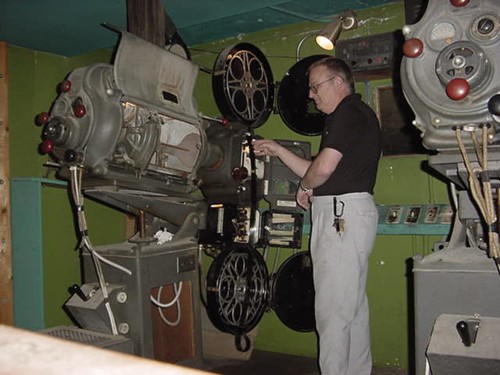
On sweeping out the lamphouses: You would open up the dampers all the way, make sure the exhaust fan was definitely on and sweep the ash that is on the upper insides of the lamphouse, right towards the stack. Anywhere else, you swept carefully towards the copper dripping pan (after you emptied the pan of copper drippings in the coffee can to recycle..)
I remember seeing many-a-lamphouses that had accumulated layers upon layers of ash, one can fill up a large coffee can full of ash after a good cleaning.
Then, the single edge razor blade as always handy to scrape the copper spits off the mirror. Then, make a paste out of Bon-Ami to scrub the mirror after the spit cleaning.. Really made that mirror shine.
....and this was a daily opening procedure that I would always do with the lamphouse along with cleaning the two machines.
Posted by John Pytlak (Member # 331) on 06-29-2006, 04:04 PM:
In hindsight, that carbon ash has "rare earth elements" that may have adverse health effects. Wear a dust mask at the very least to protect your lungs.
Posted by Mike Blakesley (Member # 26) on 06-29-2006, 05:27 PM:
Monte - that pic could have been taken in the Roxy 30 years ago. Even the booth walls were about the same color. (Different lamphouses though.)
I agree it's really a rhythm. The challenge was always to see how quick you could get the reel in the rewinder, and the next reel threaded, in order to get the max amount of sit-down time while watching the running machine.
If I had any complaint about that job, it was the heat in the booth....other than that I really enjoyed it.
Posted by Cameron Glendinning (Member # 3516) on 06-29-2006, 07:33 PM:
A friend of mine just had his stomic removed due to a very rare cancer that seems to occur only with old projectionists. Beware of the carbon dust! It is very dangerous. I wish that I had known about this 20 years ago.
Posted by Steve Guttag (Member # 268) on 06-29-2006, 08:16 PM:
What I mean by rythmn is much closer to what Stephen said...there is no rush at all...you just get into a rythmn of chaning reels, rewinding, focusing, trimming....and in my case studying (yes, both HS and College were spent running changeovers).
I had exactly one carbon feed lock up on me (Strong Futura IIs)...after that they were pulled down weekly and soaked in varsol overnight. Everynight they were soaked down with regular oil to flush out the graphite of the "arc lube"...each day fresh arc lube was applied. This routine resulted in never having another positive feed going bad (The jaws were kept clean too as was the water). All of this and studying too...it was not bad.
Say Hi to the Norelcos for me...they were in my care in the early 80's (81-87). They started life in the K-B Apex, moved to the K-B Cinema in 1980 for Empire Strikes Back and remained their until the theatre closed just a year or so ago. They used to be one of the finest running pair though they looked like they didn't get the care they deserved in the 90s and beyond...hopefully they have a nice home now.
Posted by Floyd Justin Newton (Member # 1316) on 06-29-2006, 10:20 PM:
Everyone above: I concure with everything that all of you have
said. In my 35+ years of operating Ashcraft Super Cinex carbon
lamps (13.6mm @ 180 Amps) and sometimes 195 Amps for Studio
Previews, I've only operated xenon on a couple occasions. I
would rather work with carbon, because that's what I was there
for... to WORK... not to sit on my ass or play with the children
in the concession stand. When I was in the booth we were the
professionals and acted that way. Not like the pimply faced kids who catch tickets and then run to the booth and push a
button and then run back to the lobby and proclaims, "I ARE a
projectionist!" BULLSHIT! Thats one of the reasons why I wait
for the DVD, or catch a picture on HBO. Better than watching
a crooked out-of-focus picture on a screen.
Posted by Charles Greenlee (Member # 3856) on 06-29-2006, 11:59 PM:
Ahh, we have platter stands, and xenon bulbs. Even then, when I was working 11 screens, the show times could land right where it was hard to get a break, sometimes barely even enough time to dust out the gates. Then you get a nice gap and....they send you on a meal break. Of course I did more than most of the other projectionists, which all they ever did was thread and press start. But yeah, once you develop a rhythm for that week's shows, it's easy. I'd love to get back to basics and try my hands at a carbon arc house that runs a changeover. It'd allow me to get a better grasp of where things came from. BTW, how does the carbon arc compare to the xenon as far as picture, brightnes, and color?
Posted by Cameron Glendinning (Member # 3516) on 06-30-2006, 01:18 AM:
I believe that prints are colour corrected for xenon lamps. Personally I think carbon was brighter and whiter, but that is just my opinion.
Posted by Ron Curran (Member # 3631) on 06-30-2006, 02:25 AM:
One curious thing is that you think you have seen certain films. But you haven't. You may have projected them hundreds of times. All those key scenes happened while you were rewinding, trimming or lacing up.
After we changed to Xenon, we retained a carbon arc machine for a while to give us flexibility with trailers.
One memorable night, we received a replacement print for one that had been pre-destroyed (wandering green tramlines). The show was started on time with the damged print. Then the replacement arrived. A changeover was made to spool 3 on thecarbon arc machine and we frantically made up 4-6, then did a changeover back to the Xenon machine.
Pity I didn't have time to compare the image. Those were exciting times.
Posted by Carl Martin (Member # 1146) on 06-30-2006, 04:05 AM:
quote: Mark Ogden
The last changeover show I saw was years ago at the old UC Theatre in Berkeley, and it was flawless. I stopped to shake hands with the guy when he came downstairs after the show. It’s great that there is a few places left where the old ways are still in practice.
unfortunately, that is a place that is not left. the uc closed in 2001 or thereabouts. do you recall when you went there, and what the film was? was rick the projectionist then (wiry mustachioed 'nam vet)?
Posted by Stephen Furley (Member # 1277) on 06-30-2006, 05:13 AM:
quote: Floyd Justin Newton
Everyone above: I concure with everything that all of you have
said. In my 35+ years of operating Ashcraft Super Cinex carbon
lamps (13.6mm @ 180 Amps) and sometimes 195 Amps for Studio
Previews, I've only operated xenon on a couple occasions.
Floyd, what's the difference between the Super Cinex and the Super Core-lite? They look very similar in photographs.
quote: John Walsh
It is fun to see or operate carbon arc setups; it reminds you of the days when operators really 'worked.'
John, mining coal is hard work, stoking a pair of Lancashire boilers was hard work, deal portering was hard work, carrying hods full of bricks up ladders on a building site is hard work and, a bit nearer to home, rigging a stage for a big rock concert is hard work. Lacing up a reel of film and pressing a couple of buttons every twenty minutes, plus occasionally adjusting a lamp cannot be seriously described as hard work. Carrying the prints up several flights of stairs in an old-style theatre could be hard work, but at least with a single screen there were't many prints to deal with.
A projectionist in a modern multiplex, with many screens to look after, sometimes in several different projection rooms, and with possibly dozens of different prints to move about, carry up and down stairs, make up and break down has to work much harder.
[ 06-30-2006, 06:29 AM: Message edited by: Stephen Furley ]
Posted by Mark Ogden (Member # 43) on 06-30-2006, 06:37 AM:
quote: Carl Martin
the uc closed in 2001 or thereabouts. do you recall when you went there, and what the film was?
I saw Picnic at Hanging Rock there the last time it was revived, sometime in the late 90s. The fellow was very thin with a mustache and light wavy hair. We just spoke briefly, he was on his way out to get a bite to eat between shows, but he seemed pleasent. Probably the man you mentioned. I remember walking from there down to the Reel Movie video store afterward, if that helps with the time line. The Act One and Two were still open as well.
Damn shame this place is closed, it was a beautiful venue.
But looking back, I must have had a mind fart when I posted that this was the last changeover show I saw, because in retrospect, I have seen and still do see quite a few. Everything at the Walter Reade theatre at Lincoln Center and the Titus Theatre at MOMA are pretty much run changeover style. Also, the Castro in San Francisco and the Aero in Santa Monica still spin reels, and I get there whenever I can. I'm sure I've seen others.
And Mitch, thanks for the invite re: the Loews Jersey. Weekend nights are tough for me work wise, but I am determined to get there again at some point. I saw Forbidden Planet there years ago, the show with the original Perspecta sound processor, but I was with a gang of people and didn't come up to look.
[ 06-30-2006, 08:23 AM: Message edited by: Mark Ogden ]
Posted by Stephen Furley (Member # 1277) on 06-30-2006, 07:24 AM:
quote: Mark Ogden
And Mitch, thanks for the invite re: the Loews Jersey. Weekend nights are tough for me work wise, but I am determined to get there again at some point. I saw Forbidden Planet there years ago, the show with the original Perspecta sound processor, but I was with a gang of people and didn't come up to look.
Mark, that show was in april 2002, the last weekend of the month, I think; I was there too. I was taken 'upstairs', and also 'downstairs' for a look round one evening, a few days before {looks in passport} I think it was the 23rd, the day I arrived. I've been up in the box there once more since then, I think it was one year later, when Scott Norwood was also there.
I've also been up to the box at the Lafayette, Suffern NY, but not the UCAC, Rahway NJ.
Where is Little Falls, by the way?
Posted by Robert Throop (Member # 61) on 06-30-2006, 07:44 AM:
[QUOTE] Floyd, what's the difference between the Super Cinex and the Super Core-lite? They look very similar in photographs.
Mechanically the lamps were very similar. The Super Core Lite had a working distance of 29 1/2" and the Super Cinex had a working distance of 33".
I run regular Core Lites at the Capitol in Rome. These also have a recommended working distance of 29 1/2". because of the design of the bases (Motiograph) I can't get the lamp closer than 31". The light is still great though.
Bob
Posted by Stephen Furley (Member # 1277) on 06-30-2006, 08:17 AM:
quote: Robert Throop
I run regular Core Lites at the Capitol in Rome.
I wanted to have a look at that place, but Rome doesn't seem to be easy to get to; trains are not very frequent. It would mean an overnight stay; are there any cheap hotels nearby?
Posted by John Pytlak (Member # 331) on 06-30-2006, 12:26 PM:
quote: Stephen Furley
I wanted to have a look at that place, but Rome doesn't seem to be easy to get to; trains are not very frequent. It would mean an overnight stay; are there any cheap hotels nearby?
Rome NY is between Syracuse and Albany, near Utica, and near the Turning Stone Casino and Boxing Hall of Fame. Just drove near there last weekend, on the way back to Rochester from Boston. Driving rainstorm all the way, and as you may have heard, the flooding closed the NY Thruway (US Interstate 90) for a day or so.
Rome would be an easy day trip from Rochester, if you come here to visit the George Eastman House museum.
http://romesentinel.com/apps/pbcs.dll/frontpage
http://www.innsmart.com/newyork/central/html/oneida.html
http://when-in-rome.com/RomeChamber/summary.html
quote:
A city of 72 square miles in upstate New York, Rome is in western Oneida County and part of the Mohawk River Valley.
The city of Syracuse is approximately 50 miles to the west; Utica, about 15 miles to the east; and Albany, about 90 miles to the east.
Part of the gateway to the Adirondack Mountains, Oneida County is situated with three exits (31, 32, 33) on the New York State Thruway (I-90). Other major highways serving the region are New York State Routes 5, 8, 12, 20, 26, 46, 49, 69, 365, and 825; Interstate Routes 81 and 87 provide access north and south with connections via Syracuse and Albany respectively, a short distance away.
Twenty percent of the U.S. population lives within 300 miles of the Mohawk Valley, with four of the most populous U.S. cities within 250 miles: New York, Philadelphia, Boston, and Washington, DC.
Posted by Mark Ogden (Member # 43) on 06-30-2006, 01:29 PM:
quote: Stephen Furley
Where is Little Falls, by the way?
Little Falls is 2.8 square miles of Passaic County, New Jersey, around 17 miles west of New York City on Route 3. On the map, we are bordered by Montclair, Wayne and Totowa (home of Thomas' English Muffins ). It's a nice little piece of America and an easy commute to my job in the big city. There actually are little waterfalls here on the Passaic River where it runs behind an old carpet mill, but with the last two week's rain we are more like Raging Torrent, N.J.
Posted by Rick Raskin (Member # 1561) on 06-30-2006, 02:00 PM:
Remember the little catch bucket in the Futura II or the catch pan in Peerless? The Union would collect copper drippings, cash then in and donate to Will Rogers Hospital.
2000' Reels -- Just seemed natural. 6K reels were boring. Changeovers were like riding a bike. Easy and you never forget how.
Posted by Tim Reed (Member # 137) on 06-30-2006, 03:36 PM:
quote: Stephen Furley
what's the difference between the Super Cinex and the Super Core-lite?
Optical speed. The Corelites were a lot faster. Something ridiculous like f/1.4.
FWIW, the "Super" designation indicated the big "push-pull" blower on top, which directed air down over both the front and back sides of the reflector, around underneath the burner assembly, forward towards the projector, turning up and past the douser opening, and back out the top of the lamphouse to the roof blower.
I loved Ashcrafts. They were SO cool.
Posted by Robert Throop (Member # 61) on 06-30-2006, 07:07 PM:
Here's a link to the Capitol schedule:
Capitol schedule
Bob
Posted by Charles Greenlee (Member # 3856) on 06-30-2006, 09:36 PM:
Yeah, there were times when the schedule kept me working. Of course there were times when I'd wish I brought a pillow and blanket. I don't know what the breaking point is, but I have heard of some plexes staffing 2 projectionist for something as few as 10 screens. I was working 11, by myself. I guess maybe they always showed really short films?
Posted by Monte L Fullmer (Member # 2797) on 07-01-2006, 01:57 AM:
quote: Tim Reed
I loved Ashcrafts. They were SO cool.
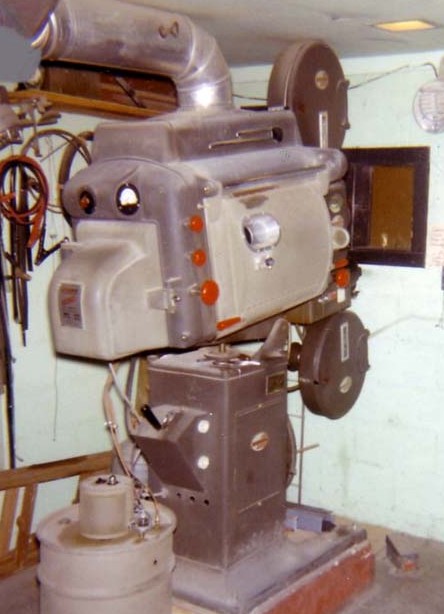
..yes, they are. .. (Good ol' "Ashcans" lol)
So easy to work with, easy to strike up the carbons, easy to change out the silver contacts, easy to clean the mirror..et.al.
What is so interesting that many-a-booth, especially drive-ins, were equipped with the combination of the Motiograph AA machines with the Ashcraft lamphouses. Only thing I can think of why of this "perfect marriage" is of the usage of the barrel shutter that the Motiograph used and the long arc angle that the Ashcrafts emitted.
The light on that drive-in screen was nice and bright coming from this form of setup.
-Monte
Posted by Stephen Furley (Member # 1277) on 07-01-2006, 03:03 AM:
quote: Robert Throop
Here's a link to the Capitol schedule:
Capitol schedule
Bob
I'd like to come to the Capitolfest, but I don't think there's any way I could afford it this year.
Posted by Tim Reed (Member # 137) on 07-01-2006, 02:05 PM:
Monte, maybe the proliferation of one dealer over another in a particular area had some bearing?
Where I grew up (central Kentucky), out of the oh... 20 drive-ins or so in that vicinity, one had Strong 135s, another had Mighty 90s, two small drive-ins had Enarcs, but the rest had Ashcrafts. The most-popular projectors behind the Ashcrafts back home: a tie... Centurys and Brenkerts.
There were no drive-ins with Motiographs in central KY.
Posted by Floyd Justin Newton (Member # 1316) on 07-01-2006, 04:52 PM:
Tim-- When I worked the booth before retirement I visited just about every ozoner in the Phoenix area. With the exception of one or two the booths contained Century CCs with Strong 135s
with generally an RCA Sound System. All put up an acceptable picture. The downtown Fox, Orpheum, and Palms were all Ashcraft Super Cinex.
Posted by Tim Reed (Member # 137) on 07-01-2006, 05:22 PM:
Hi, Floyd! We had a lot of RCA sound in the drive-ins back home, too (hence the Brenkerts and Centurys). And, also that you mention it, the drive-ins didn't have that much light trouble back then. Denser prints, light pollution, xenon, all took their toll.
Oh, for those good ol' days... ![[Cool]](cool.gif)
Posted by Robert Throop (Member # 61) on 07-01-2006, 07:20 PM:
Monte,
I worked a Motiograph booth just like that. Those lamps are Super Highs which had a ratchet to rotate the positive rather than a chain right?
Bob
Posted by Daniel Wright (Member # 1983) on 07-01-2006, 07:43 PM:
The only time in recent memory I have seen anything run on carbons was at the Globe Cinema in Calcutta India. Although the machines were replaced with xenon bulbs shortly afterword. This theatre is OLD having been built as a stage play house sometime in the 1860s. It had been given an UGLY remodel complete with an old GCC shadow box screen.
Posted by Monte L Fullmer (Member # 2797) on 07-02-2006, 01:52 AM:
quote: Robert Throop
Those lamps are Super Highs which had a ratchet to rotate the positive rather than a chain right?
Right, actually ran two separate drive-in booths with the ratcheted positive action.
This drive-in booth pictured use the 10mm x 20" rotators, and the other drive-in booth that I also ran used the 11mm x 10" rotators...and at this one drive-in. I found two cases of threaded positives-so that there was no stubs to worry about.
I remember taking graphite oil to the ratchets on opening of each day during the cleaning procedures..take an emery stick and dress up the silver positive contacts - more of the routine opening maintenance needed..as well as white greased the gears once a week on the Motiographs..
And I was a 18 yr old kid starting to learn all of this...by my owner of this drive-in who showed me how to really take care of equipment and would, then let me go on figuring out more booth tricks and he would then just guide me in the right direction. Worked this drive-in for 5 yrs until I finally ventured into the hardtop world..
-Monte
Posted by James Westbrook (Member # 3690) on 07-02-2006, 05:07 PM:
Monte,
in the Ashcraft picture, on the floor to the right of the soundhead, is that a foot-pedal changeover switch ? Or the remnants of one?
Posted by Monte L Fullmer (Member # 2797) on 07-02-2006, 10:05 PM:
Yeppers...that was a very good working foot dowser..and the sound changeover was the rotation type with the rod link that would run over to the right machine - being a full Motiograph sound system.
I used to finese my changeover tactics in by doing a slight delay of sorts by flipping the sound changeover lever 1/2 second before I would stomp on the floor dowser. This seemed to make more of a smooth changeover transaction than hitting the two at the same time.
When I moved into the hardtop houses, I carried this same changeover delay practice..
Below, is another Motiograph/Ashcraft setup at a Drive-In that I projected at for 4 years (and this was a union booth):
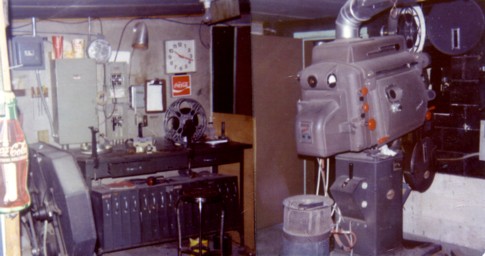
When I took this booth over, they were still using a good ol "gennie" with this setup, but in the middle of the summer, the "gennie" blew up (windings shorted across on the armature), and we installed two rectifers in the back room to feed the two Ashcrafts.
What caused the "gennie" to go is that the arc focus mirror on both lamphouses were way out of alignment and the arc gap was way too close, thus driving the amp range to the limits for the "gennie." When I found out that the mirror was out of alignment, I immediately realigned that mirror to get the proper arc focus to the mirror, but it was too late for the "gennie" which let go while I was doing a shift that night.
With that arc gap too close, the previous operators were trying to get as much light out as possible, but didn't know about the proper arc to mirror focus - just relying on pushing the amps up to get the light out. (and. it's funny, that to this day, I find xenon consoles with their amps cranked up to screaming levels just on the premise of getting the light out and not knowing of doing the simple bulb focus to mirror..)
I really don't know how long these were out of focus, but I can take it that on-one would 'fess up to this that operated previously.
Once again, the stomp dowser is present here. And as always, a full Motiograph sound system..
thx-Monte
Posted by Frank Angel (Member # 248) on 07-03-2006, 03:40 PM:
In the first house I worked full-time, they were burning 55A Peerless powered by a motor/generator. There was only a single generator and when you would strike the second arc while the other lamphouse was still lit, the light would dim a bit on it but it wouldn't go out and for the minute or two while you were waiting for the motor/sync cue, both lamps were burning. The projectionist who trained me in that booth just told me to pay attention to the strike, making it as quick as possible (not keeping the rods touching for more than a second) and to pay attention to the when the reel was running out because the change-over bell was set VERY short -- you couldn't be dilly-dallying off somewhere when that bell rang, you had to be right there ready to fire up.
Was it common to use a single generator in a change-over situation? They were running for years this way so I guess it didn't hurt the generator any...possibly it was oversized and could handle both lamps at once. The little dim-down was barely noticable on the screen with the film running.
The owner also ran a DI in the next town and would send me over there on occasion; they had Ashcrafts and I must tell you, they were pretty scary to a small kid. Running Magnarcs and then going to run Ashcans was like driving a VW Beetle and then told to drive a Mack truck.
Posted by Monte L Fullmer (Member # 2797) on 07-04-2006, 12:09 AM:
quote: Frank Angel
Running Magnarcs and then going to run Ashcans was like driving a VW Beetle and then told to drive a Mack truck.
...good thing I started out with the "Mack" truck. For when I downsized to the Magnarcs, that was some switcheroo to handle - not used to operating pencil carbons that didn't rotate.
Yea, a single "gennie" had a very high limited rating to run two lamphouses for a given amount of time - like a burst rating of sorts. But, the rare trick was to have a "gennie" large enough to easily handle both lamphouse runs on a continual basis - We had a 'gennie' that was originally a spotlight 'gennie' and our Magnarcs had ratings, when running paired, was well below what the maximum output of that spotlight 'gennie.'
That unit was a monster - had a good 15bhp motor and the generator part had windings pretty big with the current heading towards a ballast section to keep things on the steady side.
Plus, the bearings, being sleeved bearings were oiled by a oil tank mounted below each bearing to where a round belt, being around the bearing and rolled with the main, 3 inch shaft, would dip into the oil to keep the bearing lubricated.
Posted by Charles Greenlee (Member # 3856) on 07-04-2006, 03:37 AM:
Generator? I guess running standard current through a power conditioning circuit wouldn't work? Too much power for that? How does it work then? You use the house curent to drive a motor, and then the motor would turn a generator rated at the proper power requirements?
Posted by Stephen Furley (Member # 1277) on 07-04-2006, 03:43 AM:
Xenons weren't common over here until the tripling of existing cinemas; I suppose most of this happened between the late '60s and mid '70s.
ABC had a lot of sites with Philips projectors and converted magnarcs, with horizontal lamps. which seemed to work reasonably well. The original Ross machines were long gone at most of te ABCs.
The first xenon I saw in a cinema was at an Odeon, I can't remember which, sometime in the '60s I think it must have been, I was quite young at the time, where the original BTH lamphouses had been fitted with three electrode vertical lamps. The result was horrible, the colour was poor, and the light was uneven, and different for each projector. I asked to speak to the projectionist after the show, and was shown the new experimental setup. He told me that they had already had one lamp explode. I think there were a lot of problems with those early makeshift conversions; rectifiers with excessive ripple, poor lamps, and problems with both optics and cooling, in lamphouses which weren't designed for use with the vertical xenon lamps. Things have come on a long way since then.
Posted by Robert Throop (Member # 61) on 07-04-2006, 09:22 AM:
[QUOTE]That unit was a monster - had a good 15bhp motor and the generator part had windings pretty big with the current heading towards a ballast section to keep things on the steady side.
The Stanley in Utica still has one of the original Westinghouse generators from 1928. It's rated at 25kw-250 amps continuous at 100 volts. It's driven by a 39 hp motor at 440 volts 3 phase.
There were originally 2 generators but one died some years ago. We now have a pair of rectifiers for backup but they are seldom used.
Bob
Posted by Stephen Furley (Member # 1277) on 07-04-2006, 09:44 AM:
The generators at the Loew's Jersey are still in place, at least they were the last time I went 'upstairs' there, but are not in use. I suspect that they've probably been out of use since the '50s at least for the projectors, since the Ashcrafts were originally installed. I don't think I've ever seen a cinema that was still using generators, though I've seen quite a few disused ones.
Posted by Richard Fowler (Member # 893) on 07-04-2006, 12:25 PM:
Motor generators are electric drive motors on the available current driving a suitable D.C. generator + a ballast to bring it to proper voltage. I had an indoor 500 seat cinema and a drive in with a partner in the early 1970's. we preferred using the generators since their output was more stable than the typical Tugar / selenium rectifiers in use. I remember having to disassemble and remove the armature for service to a motor shop....200+ pounds ![[Frown]](frown.gif) When xenon started to become popular Kneisley had voltage converter kits to allow existing rectifiers and motor generators to be used for xenon use....I remember installing a few of these.
When xenon started to become popular Kneisley had voltage converter kits to allow existing rectifiers and motor generators to be used for xenon use....I remember installing a few of these.
Posted by Rick Raskin (Member # 1561) on 07-04-2006, 02:17 PM:
The first houses I worked were running Peerless lamps with Hertner M/G sets controlled with TransVerter boxes. One genset ran active while the other was for standby emergency use. We'd rotate the gensets about once a month to even out use. What I liked about generators was that the inertia of the flywheel would make them immune to fluctuations in line voltage. They did however, produce a slight dimming when the inbound machine's lamp was struck. I worked other houses that used Strong Futura II lamps with Strong Bi-Power rectifiers. These seemed to be somewhat prone to line voltage changes. As evening hours approached and people began putting more load on the electrical grid we would have to speed up the carbon feed motors to compensate. During the afternoon hours the reverse was true. I would imagine that power control systems have more than made up for that flaw by now, although Xenons would not have as much of an issue with line fluctuations as would carbons.
Posted by Dave Barker (Member # 3864) on 07-04-2006, 02:54 PM:
Hey guys,
New user here, been running projection since 1986 @ Nashville Illinois' "State Theatre". Up until 1992 we were running the carbon arcs and yes it was a rythm most of the time. Back then the reels were a bit more balanced in time so you had an idea how much carbon rod you needed for each reel. Nerves would tighten up if you got ahold of a rod that wanted to burn faster which meant going "lights out" before the next change over. Didnt happen often but a few times remember dousing the lamp, opening the lid, advancing the carbon with pliers, and restriking without stopping the print. Hated doing that even with a small crowd but it was better than waiting for the inevitable. We still have the carbon arc heads (x6) and power supplies (x4) which 1 pair im sure still function. The big thing was finding a supplier for the carbons. We still run dual Simplexes from the late 40's but Im glad at set up and tear down because platters seem to be alot more work prepping.
Posted by Rick Raskin (Member # 1561) on 07-04-2006, 03:36 PM:
Hi Dave, and welcome. As you probably have seen by now there is a wealth of knowledge here. Post a question and I dare say someone will have the answer or go looking for it. Enjoy your time browsing. How about some pictures of your booth and theatre?
Posted by Monte L Fullmer (Member # 2797) on 07-04-2006, 04:24 PM:
This pict if of the theatre I worked at for quite the time - the generator/janitor supply room, which was next to the booth. The large unit was an old Westinghouse, and the smaller grey unit was an General Electric.
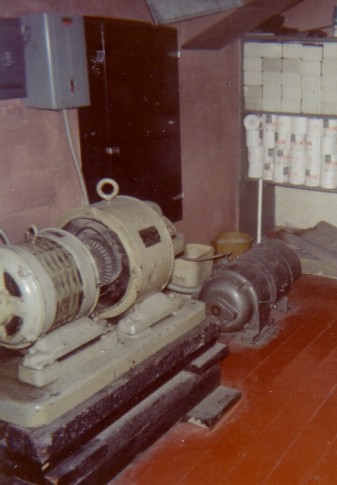
Behind the big generator setup, on the other side of the wall, was the ballast assembly for this unit. The panel behind the smaller generator unit held the switching knives to go between the two units.
Both units sat upon corkboard and rubber sheets to absorb the vibrations that these two units emitted so it wouldn't travel down into the auditorium since this room and booth was actually situated underneath the balcony floor - and the booth floor was above the main auditorium ceiling.
The Large unit had the 15bhp motor and the smaller unit was a 7bhp motor unit - which was far more stable than the older unit. But, once every other week on a shift, I would switch between the two units...
Our rod size were 6mm and 7mm rods when this pic was taken.
Later on, the company who owned this theatre decided that I needed more light on the screen. Thus my rod size went up to 8mm and 9mm .. and the smaller generator unit didn't have the current output to handle these larger rods. Thus, rectifiers were installed in that smaller generator's place.
Yet, the large generator unit could easily handle those larger rods with no problems. Thus, I would rotate from rectifer to the large generator unit once a week.
-Monte
Posted by Tim Reed (Member # 137) on 07-04-2006, 04:47 PM:
quote: Frank Angel
There was only a single generator and when you would strike the second arc while the other lamphouse was still lit, the light would dim a bit on it but it wouldn't go out and for the minute or two while you were waiting for the motor/sync cue, both lamps were burning.
Frank, MG sets were designed to run both lamps. Also, if striking the incoming lamp caused the other to dim, either the generator voltage wasn't being run high enough, there was a problem with the ballast, or both.
Btw, where are your radio spots?
Posted by Charles Greenlee (Member # 3856) on 07-04-2006, 09:28 PM:
You're right, platters do take a bit to set up, but once the print's built, it's just thread and play. No change overs, no rewind,. You just wrap and tuck, puck, strap, or whatever your house prefers, the tail thread it up again (set the payout/rewind switches if your platter doesn't autosense) However, I'd suspect that this'd make a lazy projectionist think that he can walk away, and only come back when he hear the display unit buzz telling him it's finished. While technically, he'd be right, you really need to remember to check periodically on the print, something easy to forget with platters.
[ 07-05-2006, 09:41 PM: Message edited by: Charles Greenlee ]
Posted by Paul Gordon (Member # 3320) on 07-05-2006, 08:30 AM:
I can see a few advantages to setting up a carbon arc setup today though.. the lamphouses you can get for next to nothing, the rods for free, and you don't need 3-phase power. For someone setting up a theatre for part-time shows or summer runs it would be a big cost saver.
Posted by Steve Guttag (Member # 268) on 07-05-2006, 08:42 AM:
quote: Paul Gordon
I can see a few advantages to setting up a carbon arc setup today though.. the lamphouses you can get for next to nothing
Same goes for xenon if you are talking about similar age or even a decade or two newer
quote: Paul Gordon
, the rods for free
Most of which are junk or of questionable quality unless you find some olden UCARS
quote: Paul Gordon
and you don't need 3-phase power.
Xenons do not require 3-phase power...larger ones are advised to for high-reactance rectifiers. With switchers, you can pretty much run what you have so long as power-in = power-out.
quote: Paul Gordon
For someone setting up a theatre for part-time shows or summer runs it would be a big cost saver.
Not too likely. Carbons lamphouses are big and bulky..to get a good light the draft has to be set just right. Depending on how big the system is to be, a xenon based system will be in and out faster and cheaper.
About the only thing carbons have going for them is that their light is much better than Xenon (quality of the light...continious spectrum, matches sunlight pretty well).
Posted by Stephen Furley (Member # 1277) on 07-05-2006, 09:33 AM:
No risk of explosion, though that's much reduced with modern xenons anyway.
You can run carbons for a few minutes, put them out and re-strike without wastage; useful for 2k spools, short extracts of film diring events like lectures and on-stage interviews etc, of for a machine that just gets used to run a few minutes of ads or trailers every few hours.
For very occasional use, somewhere that only runs film once or twice per year, it's probably cheaper to buy a few more boxes of carbons than to convert to xenon.
Most of the cinema rectifiers i've seen, except the smallest, have been three phase, whether for carbon or xenon. Just about any cinema would have three phase power available anyway, so it's not likely to be an issue, except possibly for portable equipment.
If you have a large stock of carbons available there's no problem, but new ones are very expensive, if you can find good ones. Morganite and Ship haven't been made for years; I think the only ones you can get here now are Marble. I had some that seemed ok, but others have had problems with them.
[ 07-05-2006, 10:57 AM: Message edited by: Stephen Furley ]
Posted by Charles Greenlee (Member # 3856) on 07-05-2006, 09:56 PM:
And, if you truely can't get a 3-phase line put in, or access to one on a traveling bit. There are convertors. The work similar to the way you say the carbon arc suppy's do. They take in standard line voltage, 120V 60HZ single phase, use it to run a motor, which in turn, turns a 3-phase generator. I've read that's a idea Fantasia's roadshow used in 1940's, for that exact reason. There are units available today, probably more effecient I'd hope. From what I understand, it's still the most effective and efficent way to convert 1-phase to 3-phase.
Posted by Bernard Tonks (Member # 809) on 07-06-2006, 09:33 AM:
More old pictures!
Who uses motor-generators?
Posted by Charles Greenlee (Member # 3856) on 07-06-2006, 09:23 PM:
So what's a tpyical power usage of a carbon arc setup? Like we have 2500W lamps for our auditoriums, they're xenons. To have a similar effect would require what kind of power in a carbon arc? Also, how long do the carbons typically last?
Posted by Monte L Fullmer (Member # 2797) on 07-07-2006, 04:25 AM:
2500w Xenons ususally run in the range of 80 to 95 amps with 27 to 32 volts.
The carbon arc equivalent would be the 9mm positive with the 8mm negative. Unfortunately, carbon arcs take more voltage to operate within the above DC current range - being into the mid 30's to low 40 volt range.
The efficency factor of a xenon bulb terribly outweighs the operation of carbon arcs in cost to operate in as well the cost of the rods themselves - be it in the past, or the present day.
The duration factor of a common 14inch rod (copper coated, non-rotation type of the 9mm positive above mentioned) would last approx. one hour run per rod.
Each box held 50 rods - both positive and negative rods .Thus, a box of positive rods would last 50 hrs with the one hour burn per rod. The negative rods would last three times as much and the negative rods were only 9 inches long.
There were 5 boxes in a case of carbons, or 250 rods. So, you do the math :
One case of positives would last 250 hrs (approx). Case cost (towards the end the golden age of carbon arcs) would hit the price around $175.00. - for the 9mm variety.
Now, you take that 250hrs per case on a duration of your 2500w xenon bulbs (which usually hits between the 650 to 750 dollar range), which a bulb can last a good 3000 plus hrs (if the cooling is good and good rectification), You'd come up with and avg, of 16 cases of positives to get your 3000 hour run with that one bulb.
Then,you take that 16 x 175.00 per each case of positives to equivalent the maximum that you would want to push a 2500w bulb, you have just spent on an average of $2800 bucks for the same amount of hours of light that just one $675.00 bulb cost and illumination.
(Now, wer're not even including power to run carbon arc - which was the basic reason in itself of the changeout from carbon arc to xenon....tons more effiency in power conservation with xenon..)
-Monte
Posted by Rick Raskin (Member # 1561) on 07-07-2006, 03:25 PM:
quote: Monte L Fullmer
(Now, wer're not even including power to run carbon arc - which was the basic reason in itself of the changeout from carbon arc to xenon....tons more effiency in power conservation with xenon..)
I always thought the reason for the changeout was because of automation. Was I wrong?
Posted by Monte L Fullmer (Member # 2797) on 07-08-2006, 02:27 AM:
Yes, automation was another main factor, but the oil embargo of 1974 also helped this with energy suddenly became costly in some areas...like it did with one theatre that suddenly changed out carbon for xenon when it's power bills took a drastic hike. When the changeout happened, power consumption fell a good deal at this theatre..and money was saved from buying carbons...
Posted by Charles Greenlee (Member # 3856) on 07-08-2006, 04:55 AM:
So carbon setup would be something good to have for a special show. Good color rendering and tone, and overall good picture. But too expensive in carbons and juice to run for every screen and every show. Unfortunatly, it'd be impractical, and cost inefficient to have dual projectors just for this purpose. But it can't be that bad considering alot of places are still using changeovers. Maybe take your best screen and give it an additional carbon setup, or even a tracked system, if a carbon lamhosue would allow for that. Interesting stuff, even if impractical.
Posted by Frank Angel (Member # 248) on 07-08-2006, 03:18 PM:
I once read an article way back in the late 60's, maybe early 70s, comparing carbons and xenon in the very early days when they first started twining single screens. I believe it was either in Boxoffice or possibly International Projectionist, and along with stating all the characteristics of both in terms of light quality, spectral uniformity, etc., they had a graph which showed the operational cost-per-hour of each with the two plotted across a few years' time. I remember it showed that when xenon was first introduced, its operational cost was much higher per hour than carbons. The first couple of generations of xenon bulbs were much more expensive than they are today while carbons were much, much cheaper. Luckily for me, when I got my job in 1972, my first task was to convince them that we needed to install 70mm in a 2500 seat theatre (they only let me put in 35mm) and at that time I bought a huge cabinet full of carbons as part of the "package." I finally ran out of them only about 10 years ago. It wasn't any wisdom on my part....I had no idea carbons would skyrocket once xenons took hold, but there I was sitting on the gold of carbon futures!
According to the article, carbons back then were actually much cheaper to run than xenon. Somewhere around 1976 or so, the lines on the graph crossed and carbons became more and more expensive. Then, of course, even today, with carbons being much more expensive, the very first time that $1000 xenon explodes and takes the reflector out and you have to replace it, that pretty much screws up the whole xenon cost-to-operate equation big time. ![[Eek!]](eek.gif)
My contention is, that had the exhibition industry not been like drooling, lusting, ravenous dogs tearing at a piece of raw meat in rushing back then to convert any theatre they owned into a twin or triplex just so they could get a single projectionist to run multiple screens instead of one projectionist to run a single screen, I think R&D by lamphouse manufacturers would naturally have continued to improve on carbon arc technology so they could last as long as a feature length movie and with more servo feedback to control stability with little or no human intervention. Had that happened, xenon would not have its single most driving advantage: that of allowing automation, which in turn allowed multiplex operation.
Sure, new carbon technology might still have required to change rods after each show, but if you could teach an usher to thread a projector, you could teach him how to stick a rod in a holder. Refined, high-tech carbon arc lamphouses would could easily have been made to accomodate automation, if the industry wasn't so quick to want to run 30 screens and still pay a single salary.
Posted by Tim Reed (Member # 137) on 07-08-2006, 11:18 PM:
Both Ashcraft and Strong were continuing to improve carbon lamphouses into the 70s.
NOW HEAR THIS!! Frank!! Where are those radio spots you said you cut... or did I just dream that?
Posted by Frank Angel (Member # 248) on 07-09-2006, 06:46 PM:
Well, I am flattered that you would like to hear my work. I mostly have done local work and only occasionally over the years. I've done a few regionals, but that was years ago. The only recent national spot I worked on was for Geico (Geico before the gekko) but never got a copy of it. Believe me, the five lines I spoke in the :30 spot weren't all that, unless you like a Brooklyn accent, which was what they needed, so I was a shoe-in.
Recently I just narrated a 5 min promo: Brooklyn Center Gala of Stars. I think that might be going up on the website -- if not, I can have them put an .avi up in a private page so you can see (hear) it. It's boring.
But what is really cool, I will try to get my hands on a promo I did for a production of the opera, Der Freischütz, which I flubbed royally. But the great thing about it is that the producer who, like me, had never heard of the composer and didn't catch the mispronunciation. We did a series of 6 different cuts; in each one I gleefully call the composer Carl Maria von Web-er instead of Carl Maria von Vay-ber. The best thing is, it actually aired that way, gross mispronounciation big as life. I'll see if I can find it and up-load it.
In the meantime, if you are really hell-bent on hearing how well or how poorly (your call) I mask the Brooklyn accent when doing voice-overs, you can call the theatre -- I am the voice menu. Listen to the calendar of events 718-951-4600 prompt 5. But that's all uninteresting stuff. I am most proud of the Von Weber flub that got aired on the classical music station (at the time) WNCN. Seems everyone was asleep, either that or everyone stops listening when they hear Carl Maria. Everyone is going, "Whoe...the guy's name is Maria?!"
Posted by Tim Reed (Member # 137) on 07-14-2006, 02:16 AM:
I was under the impression you did a recent Geico spot, sorry. Yes, anything like that from a FT-er I think we'd all like to check out. Sort of in-the-family type of thing, you know?
That's funny, Frank! Re: mispronounced words in national ads.. there was a recent campaign for old time radio collections on CD, I think it was. Ran during network breaks and such. When the script referred to Jack Benny's show, the announcer said, "And STING-ey Jack Benny..." When it should have been pronounced STIN-gy. It ran that way for a couple of weeks before someone caught it and finally re-cut it.
Posted by Louis Bornwasser (Member # 3063) on 07-15-2006, 01:03 PM:
Have heard the carbon vs xenon that the light "is not all there' now. Wouldn't you think that all films are timed for xenon by now? There are no carbon arc screening rooms left in H-wood. AFAIK. Louis
Posted by John Pytlak (Member # 331) on 07-17-2006, 09:06 AM:
AFAIK, all lab screening rooms use xenon illumination. But it's unlikely the decisions made on the color balance of a print would be different between carbon arc and xenon lamps.
Posted by Frank Angel (Member # 248) on 07-30-2006, 05:32 AM:
My recollection of the graphs that were in the article I refered to showed that although both carbon and xenon are about the same color temperature, xenon arc light had some very narrow spikey stuff going on in the green area of the spectrum. It wasn't nearly as smooth a graph as carbon arc light. I don't think those spectral spikes can be "equalized" out by the printer timing. As yet there is no equivilant of the 1/3 octave equalizer for light.
Posted by Charles Greenlee (Member # 3856) on 07-30-2006, 12:41 PM:
Maybe by feeding the bulb an RF signal that is the same wavelength of the spikes on the spectrim, just 180deg. out of phase? I don't know what I'm talking about really, but I did stay at a Holiday Inn. I mean I did see an areticle once about how you can chage the color of a neon light by injecting RF of certain wavelengths into it. Didn't have much effect, but its a thought.
Posted by John Pytlak (Member # 331) on 07-31-2006, 10:57 AM:
Xenon short arc lamps are a very good light source for motion picture projection, but their "color rendering index" is probably a little lower than carbon arc, which has a more continous spectrum. Experience says you would not "color time" a print differently for either source.
Posted by Stephen Furley (Member # 1277) on 07-31-2006, 01:02 PM:
quote: Monte L Fullmer
Yes, automation was another main factor, but the oil embargo of 1974 also helped this with energy suddenly became costly in some areas...like it did with one theatre that suddenly changed out carbon for xenon when it's power bills took a drastic hike.
It seems hard to believe that the power savings from switching to xenon would be that great; certainly compared to the savings from buying xenon lamps rather than carbons, and savings in reduced maintenance required with xenons.
The luninous efficacy of xenon lamps is not that great, you still need several kilowatts of it to light a typical cinema screen. I don't have figures to hand for typical cinema lamps, but this one, intended for use on a tank, is very similar to the older three-electrode cinema lamps; it only manages 40 lm/W. I doubt if modern cinema ones are much better in this respect, though they are in other ways. Metal vapour lamps tend to have a much higher efficacy; the highest one I have in my collection is a low pressure sodium lamp which gets close to 200 lm/W. Now, the discharge in this lamp is almost three feet long, and it is almost monochromatic yellow, so it would be of no use for film projection, but it does show how relatively inefficient xenon lamps are. They are chosen for film projection because of the quality of their light, not their efficiency.
Where the quality of the light is not the highest priority even other projection light sources, mainly metal halide, can do better than xenon. The old GE Marc 300 lamp had a considerably higher light output than a 300W xenon. The somewhat similar Osram LTI lamps achieve about 75 lm/W. The main problem with metal halide lamps is the inconsistant colour, but they are often used in things like video projectors and certain types of stage lighting equipment. The ultra high pressure mercury lamps often used in the smaller video projectors manage about 60 lm/W, still about 50% better thin xenon. The colour rendering index is not as good, but the very compact light source, and small lightweight power supply is more important for things like data projection.
I can't find luminous efficacy figures for a typical high intensity projection carbon arc; does anyone else have them?
In terms of the total electrical power consumption of a theatre, including things like general lighting, cooking, HVAC etc., is the saving from switching to xenon that great?
Posted by Gordon McLeod (Member # 33) on 07-31-2006, 01:06 PM:
Because of the much higher arc voltage 42volts and up the actual KW for carbon is much higher and many of the rectifiers were very low efficiancy
Posted by Stephen Furley (Member # 1277) on 07-31-2006, 01:24 PM:
The arc Voltage was higher, but the current was often lower, wasn't it? It's often difficult to compare; I can think of quite a few cinemas which were under-lit with carbons; when they converted to xenon they increased their light output, so comparing the meter readings before and after conversion may be misleading. How much of the increase was due to increased lamp power for higher light output, and how much due to the different characteristics of xenon lamps, I'm not sure.
If rectifiers of similiar efficiency were used, how much difference in power consumption would you expect to see, to put the same amount of light on the screen.
As a matter of interest, how does the efficiency of rectifiers compare to that or motor-generator sets?
Posted by Robert Throop (Member # 61) on 08-01-2006, 09:08 AM:
quote: Stephen Furley
As a matter of interest, how does the efficiency of rectifiers compare to that or motor-generator sets?
At the Stanley the generator output is 100v being dropped through a ballast resistor to 55v at the arc. With the lamp pulling 110 amps that's nearly 5kw going up in heat.
Bob
Posted by Patrick Dunn (Member # 3333) on 08-17-2006, 10:00 PM:
My boss told me that pretty much all the people he knows that worked with carbon arc are dead. So I think i'll stick with xenon.
Posted by John Pytlak (Member # 331) on 08-18-2006, 07:48 AM:
quote: Patrick Dunn
My boss told me that pretty much all the people he knows that worked with carbon arc are dead. So I think i'll stick with xenon.
Then we have quite a few zombies here on Film-Tech, including me!
If you can get good carbons, nothing wrong with using carbon arcs in a changeover operation that doesn't need automation.
Posted by Tim Reed (Member # 137) on 08-18-2006, 11:47 AM:
quote: Patrick Dunn
all the people he knows that worked with carbon arc are dead.
Uh-oh! Another walking dead, then. (No comments from the gallery...)
Posted by Mitchell Dvoskin (Member # 751) on 08-18-2006, 12:09 PM:
I run carbon arc's at the Loew Jersey at least once a month, and last I looked, I was not dead yet. Patrick, are you sure your boss is not dead?
Posted by John T. Hendrickson, Jr (Member # 849) on 08-18-2006, 03:19 PM:
Another dead one here. I last ran carbons at the Count Basie Theater in Red Bank NJ (Peerless Magnarcs) until we replaced them with xenon last year.
Posted by James Westbrook (Member # 3690) on 08-19-2006, 12:58 PM:
One of my circuits' booth techs passed away a few years ago. He was barely 30 years old. Ne never ran a carbon arc lamphouse.
Posted by Rick Raskin (Member # 1561) on 08-19-2006, 02:17 PM:
quote: Patrick Dunn
My boss told me that pretty much all the people he knows that worked with carbon arc are dead.
Then I guess your boss doesn't know any of us...
Posted by Kenneth Wuepper (Member # 1174) on 08-19-2006, 03:44 PM:
I ran my first Carbon Arc Lamp in 1950 and am still having to run them to this day. Best light around.
KEN
Posted by Patrick Dunn (Member # 3333) on 08-19-2006, 07:18 PM:
well the ones he knew, i don't think their projectors were working properly and were releasing some kind of fumes.
And i don't think he's been to this website, my GM is the one who told me about it. But i don't think he knows the people in the drive in in dover DE because i hear they work with carbon arc too. I hope their projectors are in good shape.
Posted by Tim Reed (Member # 137) on 08-20-2006, 12:10 AM:
Ahhh, the smell of rare earths in the morning! I loved it!
Btw, the REALLY old timers that a lot of us knew are long gone. These were the men we looked up to, apprenticed under and learned from... they were around during the SILENT days!
I knew several ol' crank twisters! ![[thumbsup]](graemlins/thumbsup.gif)
Posted by Charles Greenlee (Member # 3856) on 08-20-2006, 12:46 AM:
Well I'll have to visit someone on here that runs a carbon arc one of these days. I'd love to see it work, especially if he lets me run a show. Unfortunatly I can't afford to travel much, so it may be a while. I am, however, going to Atlanta labor day weekend.
Posted by Tim Reed (Member # 137) on 08-20-2006, 12:43 PM:
quote: Charles Greenlee
I'd love to see it work, especially if he lets me run a show.
Charles, there's a two-year apprenticeship to learn the craft; the first 6 months of which you're only allowed to rewind.
Posted by Charles Greenlee (Member # 3856) on 08-20-2006, 11:03 PM:
You're kidding? I can already rewind just fine. I takes that long to learn how to work with the carbon arc lamp?
Posted by David Buckley (Member # 2600) on 08-21-2006, 04:18 AM:
I get to do my next carbon show this saturday.
Its not carbons that make the booth fun per se, its changeovers, and as was mentioned above, changeovers are all about rhythm, get it right the night just hums along and you get to see nearly half the movie. Get it wrong, you do build up a sweat and a small pile of unrewound reels...
We almost universally show movies only once, so a big reel or platter arrangement would be a waste of time, far less hassle to do changeovers than to make up / break down a print, so "going xenon" doesnt feature on our horizon, until carbons become unobtainable. No breakdowns also means that on a good night the last reel is rewound (twice) and back in the box and the box taped up and me out the door about ten minutes after the titles end.
I consider myself to be very lucky. I get to do the fun bits of being a "proper" projectionist, in the way that the old-timers talk about the good old days. However, I'm still very much a beginner...
Posted by Monte L Fullmer (Member # 2797) on 08-21-2006, 05:38 AM:
quote:
It takes that long to learn how to work with the carbon arc lamp?
I have a few friends whos fathers showed them how to run a carbon arc setup when they were still in grade school and have to stand on stools to arc up the lamps..
took me two days to get the "rhythm" of arcing a lamphouse up without spitting too much soot on the mirror shield. Where after a while, it was a good "flick of the wrist" to rotate the negative feed knob to just make contact with the positive and then "snap the wrist" to retract the negative (course, the cheating way is to have the arcs no more that a quarter of an inch apart so the wrist action was very short and quick when striking..), especially when dealing with big rotator carbons..
..why Ashcrafts and Peerless lamphouses (and we can't forget the Strong Moguls) were easy to learn on. Enarcs and the Strong Utilities were a bit more challenging to learn carbon striking skills.
..and given the Strongs with the crank handles, one had to learn how much crank to use to bring that negative up to the positive..
-Monte
Posted by Mark Ogden (Member # 43) on 08-21-2006, 12:47 PM:
Tim, being an old old hand like myself, is (I think) referring to the days when if you wanted to get into the projection game in a union shop you got what was called an apprentice card. This was typically a two-year unpaid deal, where you learned the craft under the head projectionist while doing some menial duties. Usually you were the rewind boy, the carbon rod box opener-and-putter-in-the-drawer person, the floor sweeper and (in my case), the “hey kid, run down to the corner and get me a bottle of Canadian Club” person. Only after a while, and if the guy liked you, did you graduate to threading and changeovers. This is how I came in way back in '69, but in my local there was enough retirement and guys passing away to get me off card and working on check-off after only six months, thank God.
Posted by Stephen Furley (Member # 1277) on 08-21-2006, 02:17 PM:
quote: Charles Greenlee
Well I'll have to visit someone on here that runs a carbon arc one of these days. I'd love to see it work, especially if he lets me run a show. Unfortunatly I can't afford to travel much, so it may be a while.
I wouldn't leave it to long if you want to see one Charles; there aren't many left, and they're disappearing fast. Just a few years ago I knew of about ten here in the UK; now they're near enough extinct, there may stil be one place left, I don't know if it's converted yet.
Posted by Charles Greenlee (Member # 3856) on 08-21-2006, 06:26 PM:
Not really my choice, I can't afford to travel that much. I'm still a chain run multiplex, platter, projectionist. I think there was an apporpriate derragatory term for them. Platter monkey's or something. I'm trying my best to rise above it, but till I get some certifications, and a few raises, that's about it for my situation.
Powered by Infopop Corporation
UBB.classicTM
6.3.1.2