This is topic "Wall to wall screens" in forum Ground Level at Film-Tech Forum ARCHIVE.
To visit this topic, use this URL:
https://ft-forum.com/ft/cgi-bin/ubb/ultimatebb.cgi?ubb=get_topic;f=5;t=001836
Posted by Mike Croaro (Member # 3123) on 02-20-2007, 08:57 PM:
Hi Folks:
I know common width screens were discussed extensivuly on the forum as they are used in the newer theatres for the "wall to wall" experience.
Is it not true that in a properly designed theatre that the screen should never go "wall to wall" and instead have a 3-4 foot gap on both sides?
Mike
Posted by Monte L Fullmer (Member # 2797) on 02-21-2007, 12:16 AM:
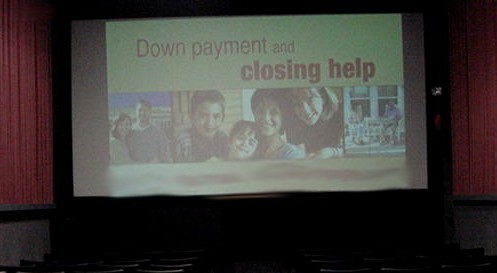
... this is a 75 seat house - shotgun seating with the screen's width wall to wall.
The black on the sides is not the hard screen masking, but the first 10 ft in the front on each side is black soundfold. The screen is a floating screen-unmasked.
Actually, it's the owner's call on with the screen size if spacing merits it. (where this one was constructed in an existing building..) Thus, in what he did here, was the best that could come out in such a limited spacing.
...and this house has 5.1 channel optical stereo, just that the scope presentation was reduced down to a 2.00/1, which is the only setback in this house.
Posted by Louis Bornwasser (Member # 3063) on 02-21-2007, 10:04 AM:
If all the ratios are correct, the screen scope width should be 45-65% of the distance to the rear most seat. In addition, it is bad design to reduce the wall width to less than 130% of the screen width.
The resulting corners could be camouflaged with false, angled walls.
In a perfect world, the auditorium would be made with the side walls angled, like 1920's auditoriums. This, however, is very inefficient in a multi screen theatre. The goal is to have the vanishing point of the side walls occur "behind" the screen center. Louis
Posted by Caleb Johnstone-Cowan (Member # 3710) on 02-21-2007, 10:58 AM:
I worked for UGC in the UK, the cinemas that they built/refurbished while they owned the chain all had screens that were 'wall to wall'. Side walls are usually camoflagued with angled black soundfold. It's fantastic for scope films, but pretty bad for anything in widescreen. They probably did it to save money on masking, ridiculously tight company. Don't know if it is the same in their continental multiplexes (where all the money from the UK went!).
Posted by Gordon McLeod (Member # 33) on 02-23-2007, 08:48 PM:
Caleb you will always have some "exess black masking" wheter you have constant width or constant height systems
the later will always yeild sharper brighter pictures
Posted by Brad Miller (Member # 2) on 02-23-2007, 09:34 PM:
quote: Monte L Fullmer
this house has 5.1 channel optical stereo
Wow, what processor are they using to achieve split surrounds? ![[Razz]](tongue.gif)
Posted by Monte L Fullmer (Member # 2797) on 02-24-2007, 03:43 AM:
USL JS-200
Posted by Mark Hajducki (Member # 1732) on 02-24-2007, 10:27 AM:
quote: Gordon McLeod
you will always have some "exess black masking" wheter you have constant width or constant height systems
UGC (at least Edinburgh and Glasgow) do not have moving masking, so flat films are shown 1:85 unmasked, with blank screen each side.
Posted by Caleb Johnstone-Cowan (Member # 3710) on 02-24-2007, 03:57 PM:
Same with nearly all the cinemas UGC refurbished/built in London. Sorry I didn't make that clear.
Posted by Monte L Fullmer (Member # 2797) on 02-24-2007, 05:22 PM:
A comment here on screens over in the European market that I saw in theatre publications that I saw at one time and wonder if this practice is still being used at some venues over there across the pond:
There were pictures of houses that had true ratio screens for scope, yet when they would show flat, it looks like there were were two 2x6x2 flat black painted boards that were hung across the screen as if these were their versions of movable maskings - that would be moved in for flat presentations.
With this practice, the edges of the flat picture were masked to give a presentation with nice squared-off corners,yet with this arrangement the rest of the screen was still uncovered, yet the usage of the "board maskings" were still appropriate for flat presentations.
Just wondering if this practice was still being used or not anymore - and it looked like this practice was (or, still is) mainly being used in countries on the European mainland, not in the United Kingdom.
thx-Monte
Posted by Gunnar Johansson (Member # 1661) on 02-24-2007, 06:41 PM:
Monte: Yes, I know of at least one cinema (a triple) originally built in the 80´s that has this kind of moveable masking. Before each showing, depending on format, the projectionist walks up to the screen and moves these flaps in or out. Don´t know if it is very common, but some places here in Sweden used it and are still using it. For a scope presentation the trailers in flat would be shown on the big screen, unmasked.
Posted by Charles Greenlee (Member # 3856) on 02-24-2007, 11:29 PM:
quote:
Wow, what processor are they using to achieve split surrounds? [Razz]
Was thinking the same thing. How the heck would you get split surrounds from a 2-channel source. Dolby encoding only encodes a unified surround channel if I'm not mistaken. I know I've heard of it done, and I think even smart as an add-on module that decodes 4 channel surround into 5 channel. Does it somehow compare the existing surround channel with the left and right channels to derive split surround?
Posted by Monte L Fullmer (Member # 2797) on 02-25-2007, 04:07 AM:
quote: Charles Greenlee
"Was thinking the same thing...."
Okey, I know it sounds goofy, but this what the owner of this cinema told me what was contained in this theatre for I didn't go any farther than that in confirming this full house setup.
Thus, I shouldn't have said anything on the sound, but just kept to the topic of this thread about screen setups...my mistake.
Posted by Louis Bornwasser (Member # 3063) on 02-25-2007, 11:07 AM:
The original CP-100 had a possibility of "Pentoptical." Never heard it but was told it was noisy. The original cat 116 had left rear and right rear tied together into mono. (Look at an old CP-50 or 100 book.) Louis
Posted by Frank Angel (Member # 248) on 02-26-2007, 11:20 AM:
Smart makes a Stereo Generator unit to produce pseudo-stereo from mono soundtracks. Theoretically, you could feed the decoded surround channel from an optical processor into the Smart Stereo Generator and let it extract split "stereo" surrounds from that. What it will sound like is anyone's guess, but the Smart unit is pretty sophistocated -- it not only can get front L,C,R, but it gets a surround channel as well -- all out of a single mono track. How it eliminates dialogue from the mono source to get a dialog-free surround channel is anyone's guess, but it does, and it's got a threshold control that lets the projectionist "dial" out the dialog. Pretty nifty.
Posted by Mark Hajducki (Member # 1732) on 02-26-2007, 06:03 PM:
quote: Gunnar Johansson
Before each showing, depending on format, the projectionist walks up to the screen and moves these flaps in or out.
Seen that done, both manual and automatic (where they moved with the lens change)
The main advantage of these is they can be decorated to look like they are part of the room and make the reduction in size less noticeable.
Powered by Infopop Corporation
UBB.classicTM
6.3.1.2