This is topic Switch from common width to common height - trend or aberation? in forum Ground Level at Film-Tech Forum ARCHIVE.
To visit this topic, use this URL:
https://ft-forum.com/ft/cgi-bin/ubb/ultimatebb.cgi?ubb=get_topic;f=5;t=001911
Posted by Paul Linfesty (Member # 214) on 08-08-2007, 12:54 AM:
WHen I went to see THE BOURNE SUPREMECY at Regal's Edwards 14 in Bakersfield, I noticed a major, and most welcomed change. This auditorium always used the good-old stadium design of common width screens since it opened. 1.85 for flat with masking lowered to a cropped scope width of around 2.1 or so. Always looked bad for the video ads "pre-show"entertainment")to be larger than the main feature. Well, they have removed the curtain trim that flanked the screen on the sides and have gone to a full scope width that is dead on correct. In addition, they now have side masking that closes in to 1.85, thereby giving it an image no taller than scope (Scope height stayed the same). Very impressive to watch the side masking open and open after the video ads. I walked into the auditorium next door showing the same movie, and they have done the same thing. This has been done apparently in just the last week. I was wondering if Regal is doing this across their chain or not.
Posted by Dustin Mitchell (Member # 372) on 08-08-2007, 03:29 AM:
Here's a question-if the pre-show wasn't bigger than the feature, what would be the problem with common width (assuming proper aspect ratio, which in this case they didn't have). In your post you even point out that the scope image is only slightly wider than the previous 2:1 ratio screen. Other than improving showmanship by making the preshow smaller all that has been done is to make the flat image smaller.
I'm not trying to attack you or anything. I just get really confused when people rant and rave against common width. What am I missing? A common width screen witht he proper aspect ratio has the largest scope image possible in that auditorium. If a theatre doesn't have a digital pre-show or said pre-show is formated to match the feature....what's the big deal?
Posted by Chris Slycord (Member # 4239) on 08-08-2007, 03:40 AM:
I think the point is that a scope image shouldn't be smaller than the flat one. And with that, they shouldn't be using screens that have "flat" dimensions to begin with.
But making the flat image smaller just to give you side masking is stupid IMO.
Posted by Brad Miller (Member # 2) on 08-08-2007, 04:15 AM:
Sounds like someone at Regal is making changes for the better. What people are quick to forget is that flat is a noticeably larger blowup. So when you blowup flat to a larger screen image than scope, not only do you have more bounce to the image, but also even less resolution and most importantly, a very dim picture assuming the lamp was sized properly for scope.
Common width screens are evil and flat out stupid by definition. Congrats to Regal!!! ![[thumbsup]](graemlins/thumbsup.gif)
Posted by Joe Redifer (Member # 3) on 08-08-2007, 04:16 AM:
Also, remember that a flat image puts out much less light right from the projector. Is projecting a bigger image with less light a proper definition of film done right? No way. Then there is the overall film resolution. There is much less to work with in flat. It's like taking a letterboxed LaserDisc and blowing it up to a proper 16:9 screen, and taking a proper anamorphic 16:9 DVD and displaying it in letterboxed mode on a 4:3 TV. Auditoriums should be designed from the get-go to have as wide a screen as possible.
EDIT: Said basically the same thing as Brad. We must have been typing at the same time. He just pressed "Submit" first. I shall be first next time. Just you wait!!
Posted by John Walsh (Member # 168) on 08-08-2007, 07:13 AM:
Common height is of course perfered, but depending on the design of the theater, not always possible. No owner is going to say; "Well, I can't have common height layout, I guess I won't build anything at all." People want big screens; that's a money-making fact regardless of techinal issues. It makes no sense to have common height, but end up with a tiny flat image.
Posted by David Zylstra (Member # 4230) on 08-08-2007, 09:15 AM:
First off - I personally prefer fixed height over fixed width.
But . . . . . Fixed width is not stupid, it's a business decision by the exhibitor driven by wanting to maximize picture size for each format and thereby impressing the customer base with the huge pictures. I would also hopefully assume a properly set up fixed width screen would have the lamp sized to properly light the flat image (and a qualified operator could adjust lamp power for each format - Christie's digital projector can do this automatically)
Don't forget the flip side of the light issue - instead of improperly lighting flat maybe they are overlighting scope (we don't know how the designers spec'd the lamp size so who are we to assume that they are screwing up the flat picture and not the scope).
Maybe someone at Regal is thinking "smaller flat screen, need less light, smaller lamp, I save money" and not "it's right to do fixed horizontal masking"
The numbers quoted from digital cinema polls show that the US trend is to build more fixed width screens and the European trend is more fixed height . . . . I think the stadium seating trend opened the door wider to fixed width and with good old American competition the theatre with the biggest picture wins.
Unfortunately DCI was seemingly written to economically favor fixed width - i.e. if you have fixed height you need to buy 2 lenses, use a larger lamp and vary lamp power depending on format; but fixed width can be done with 1 lens (all you do is crop 3"-12" of picture).
Bottom line a properly executed fixed width screen will only have the detriment of having to blow up the flat image larger than normal - and right or wrong morally it can still be done technically correct.
Posted by Scott Norwood (Member # 30) on 08-08-2007, 09:45 AM:
For any theatre built after about 1960, there is really no excuse for common-width screens. In older theatres where the procenium was built with a 1.33 or so screen in mind, common-width may be the only option for getting an acceptibly large image for the narrower formats.
Personally, I hate common-width, since it usually requires re-framing when changing formats and also (as Brad mentioned) makes the non-scope formats look really bad due to the increased magnification. I actually know of one venue that is common-width for 1.33 through scope. The Academy image looks like Imax in that room, while the scope image is way too small. When the 16mm image is bigger than the 35mm scope image, something is wrong.
Actually, my preferred masking scheme is common-height for 1.66, 1.85, and scope, and gets slightly taller for 1.33 and 70mm.
Posted by Louis Bornwasser (Member # 3063) on 08-08-2007, 11:41 AM:
Scott; you allude to reframing. This is only required if the vertical is asymmetrical. Most cheapskates who do common width (the work of the Devil) only want to pay to move one masking.
This situation makes what Brad said even worse.
Why not (when designing a new cinema) consult with someone who knows something? Architects!!!? Louis
Posted by Mark Gulbrandsen (Member # 72) on 08-08-2007, 12:04 PM:
quote: Scott Norwood
For any theatre built after about 1960, there is really no excuse for common-width screens.
Actually take the case of the theaters that have 23 foot wide screens or smaller! Its much more beneficial to be able to fill the front wall with the flat image and lower the top masking for scope of the same width. Otherwise you'd have a postage stamp sized flat image.
quote: Scott Norwood
Personally, I hate common-width, since it usually requires re-framing when changing formats
While I am NOT a fan of cinstant width either it can work beautifully if its done correctly.
If your projector has a turret then there is no re-framing required since you can adjust the stopped verticle position of the image with the turret. Also if you use an ISCO or Schneider offset adaptor on one of the lenses you also do not have to re-frame since that lens can be permanently offset the required amount. Its all a matter of how the equipment is spec'd out and installed.
Mark
Posted by David Stambaugh (Member # 1102) on 08-08-2007, 01:47 PM:
Regal's brand-new theater here has some common-width screens. Only the largest houses have side masking. I don't see it as a big issue, except that in at least 1 of the smallest houses, the c-w screen is off-center for some reason. It's in a corner of the building, might be some kind of issue with fire exits, I dunno.
Posted by Bobby Henderson (Member # 840) on 08-08-2007, 02:28 PM:
quote: David Zylstra
But . . . . . Fixed width is not stupid, it's a business decision by the exhibitor driven by wanting to maximize picture size for each format and thereby impressing the customer base with the huge pictures.
Fixed width is indeed stupid. That brings up my favorite phase on the subject: "Driving Miss Daisy should not be bigger than Die Hard.
I understand it is a business decision on the part of exhibitors. Still, it is a business decision that makes absolutely no sense at all. They're assuming most major studio releases are 1.85:1. That was true back in the 1980s. These days, the vast majority of major studio releases are 'scope. There's plenty of weeks where the Carmike 8 in my town is playing nothing but 'scope films. And this is a trend that is already a few years old.
Flat releases seem pretty rare unless you're looking at indie product. And even there many small studio features are shot in 'scope as well. Hell, you even get cropped-to-'scope dimensions for shoestring budget movies shot on mere DV.
Basically, there's no excuse at all for common width screens.
Carmike's Sikes Ten theater in Wichita Falls, TX has some examples of the worst in common width screen design. A disclaimer, Carmike didn't built this theater (I think Plitt built it in the late 1970s). Carmike added 4 more screens in the late 1990s. Anyway, the six original small houses have these fixed 1.85:1 screens with the emergency exit door to the left or right of the screen. These screens have no move-able masking at all. When the theater was showing movies on film, any 'scope image would fall off the left or right end of the screen. It was like a really bad form of pan and scan. I don't know how they've changed things since doing the d-cinema conversion months ago. But the only other solution I can see is just letterboxing that 'scope image to fit in the already small-ish screen. It sucks, but it's better than the method previously used. At least you see the whole image. Carmike really just needs to build a new theater in Wichita Falls outside of Sikes Senter Mall and far enough away from Cinemark's new theater so they can break that allocation flip flop crap between studio releases.
Posted by David Zylstra (Member # 4230) on 08-08-2007, 03:17 PM:
quote: Bobby Henderson
Fixed width is indeed stupid. That brings up my favorite phase on the subject: "Driving Miss Daisy should not be bigger than Die Hard
While morally, philosophically and ethically wrong I still would not call it stupid - I would go only as far as echoing John Pytlak's article from 2004 that it is a "poor practice" . . .
quote: Bobby Henderson
Still, it is a business decision that makes absolutely no sense at all
It makes sense if the maximization of each format size keeps customers coming back (i.e. wow factor).
quote: Bobby Henderson
Anyway, the six original small houses have these fixed 1.85:1 screens with the emergency exit door to the left or right of the screen. These screens have no move-able masking at all
There was a trend a long time ago to do a 2:1 format - i.e. screen was fixed at 2:1 and flat was cropped top/bottom and scope was cropped left/right . . . painful to watch either format when you knew what was wrong with the picture . . . . . I wonder if this location was built during that trend (there were an AMC or 2 in my area that was set up like this) - Carmike should have bit the bullet and retrofitted these with the true formats when they added screens.
It's too bad that the studio driven DCI spec reverses the image and light quality issue brought up here - i.e. since the digital scope height is smaller than flat the scope image has to be blown up to fill the screen on a fixed height screen thereby making the pixels larger onscreen and losing light -- digital scope uses about 18% less pixels over 20% more screen area . . . the math shows a 37% loss of luminance - i.e. flat is 14FL but scope is less than 9FL . . . . .
Posted by Thomas Pitt (Member # 4322) on 08-08-2007, 03:44 PM:
The Vue Leeds Light, as I'm sure I mentioned in other posts, has fixed-width screens for all its auditoriums. For scope, a single blind drops from the top (top masking) to make the screen the correct aspect ratio.
I've never once seen the picture need to be re-framed after a scope changeover; I assume they have the turret set to project the scope image slightly lower - possibly with one of those adapters.
I also remember going to see a movie in Vue Sheffield, and they actually had both vertical and horizontal masking (4 blinds)! For scope, the top and bottom blinds move in a little bit, while the left and right blinds open up to full width. I think this is only in the large auditoriums though - the smaller auditoriums in Vue Sheffield use either top & bottom or side masking.
Vue Sheffield also have curtains in each auditorium that can cover the screen, but they're seldom - if ever - used.
With regards to luminance difference between flat and scope features, there certainly isn't any noticeable gain in brightness when a feature switches over to scope. Perhaps if you had a light meter, or could switch over lenses in mid-feature without dropping the douser, you might notice it. I've heard that some lamphouses actually have a kind of douser that comes down in front of the lamp and limits the amount of light. This can be used to 'dim' the light for scope features, so that they're the same brightness as flat features. Anyone had experience of this?
Posted by Joe Redifer (Member # 3) on 08-08-2007, 08:00 PM:
I really like how movie theaters have common-width screens now. That means my home theater has less to live up to. The movie theaters cannot offer me a super wide picture, only a letterboxed picture. I can do letterbox at home as well. No need to spend money at theaters! I think they should close all theaters since obviously they offer nothing special anymore. They should also flat out fire everyone who works for or services movie theaters. Why exist when they don't offer wide, spectacular images and instead underlight the flat picture?
Seriously, the only people who would justify common width screens are cheapskate morons who know nothing of presentation and not showmen. They deserve fatal full body herpes.
Posted by Mike Croaro (Member # 3123) on 08-08-2007, 08:25 PM:
Hi Folks:
The common with screens are only essential in the old twinned theatres of the 70's where the deminsions are, for example 28 X 90 or 20 X 60.
No reel ![[Wink]](wink.gif) need in modern cinemas. Too many studios think bigger is better.
need in modern cinemas. Too many studios think bigger is better.
My favortie quote is by Louis Bornwasser:
"Largeness on a wall is not showmanship. In fact it can be quite obnoxious".
Posted by David Zylstra (Member # 4230) on 08-08-2007, 08:33 PM:
quote: Joe Redifer
the only people who would justify common width screens are cheapskate morons who know nothing of presentation and not showmen
hmm . . . . scope screen is already as big as it can be (in most cases) so they are making flat bigger - that obviously leads to a slightly higher frame cost; significantly more screen area so significantly higher screen cost; top moveable masking is a little complicated to rig and needs a stronger motor; done right the lamp size will be higher to properly light the flat picture so higher lamp costs . . . . the true cheapskate would insist on the proper configuration of fixed height.
As long as the screen is properly lit, jump & weave is withing tolerance, aperture edges are sharp, focus is perfect, etc where is the presentation issue?
As for showmen - that comes from making sure the picture is in focus, sound is correct, print is clean, cues are properly placed, etc . . . . and it includes checking every reel from the customers perspective for proper focus and sound quality.
Again, fixed width screens are morally, philosophically and ethically questionable - not stupid, moronic or evil.
Posted by Brad Miller (Member # 2) on 08-08-2007, 10:08 PM:
Ok David, are you for real or just brainwashed? In real life you will find that people rarely spec a common width auditorium for flat and that "good enough" is all that matters these days to theaters only concerned with things like "wall to wall screens".
Theaters concerned with presentation will design an auditorium properly in the first place to use a common height design.
And yes, common width is STUPID!
Posted by Michael Brown (Member # 890) on 08-08-2007, 10:19 PM:
quote: Thomas Pitt
The Vue Leeds Light, as I'm sure I mentioned in other posts, has fixed-width screens for all its auditoriums. For scope, a single blind drops from the top (top masking) to make the screen the correct aspect ratio.
I've never once seen the picture need to be re-framed after a scope changeover; I assume they have the turret set to project the scope image slightly lower - possibly with one of those adapters.
I also remember going to see a movie in Vue Sheffield, and they actually had both vertical and horizontal masking (4 blinds)! For scope, the top and bottom blinds move in a little bit, while the left and right blinds open up to full width. I think this is only in the large auditoriums though - the smaller auditoriums in Vue Sheffield use either top & bottom or side masking.
If you travel around alot you'll get to see all kinds of different combinations of masking in use. I've seen side-masking, top-masking, top and side-masking and no masking.
The strangest I have seen was bottom only masking (common width auditorium) Which was weird because after the masking change you suddenly find yourself having to look more upwards to see the screen. I actually got up and switched seats to a row further back.
The worst I have seen was 'scope' shown as letterbox on a 1.85 screen that didn't have masking. Horrible.
Posted by David Zylstra (Member # 4230) on 08-08-2007, 10:42 PM:
Yes, I am for real . . . . . and over the years I have found that there are a lot of exhibitors that settle for "good enough" . . . . but there are many exhibitors out there that want wall to wall screens that meet standards and spec them properly (I worked for one of them years ago - though not in the design capacity).
I just prefer not to jump to the conclusion that all fixed width installs are sub-standard, especially since I know many that can meet or exceed standards easily. (All my current company's screens ARE fixed height and I do think it is correct but I wouldn't call anyone stupid for choosing fixed width since I am not privy to their reasoning)
There are arguments that stadium seating is not correct either, but customers want stadium so they get stadium.
I agree that we disagree, but I respect your opinion and I don't wish "full body herpes" on you for having it.
Posted by Monte L Fullmer (Member # 2797) on 08-08-2007, 10:58 PM:
quote: Michael Brown
The worst I have seen was 'scope' shown as letterbox on a 1.85 screen that didn't have masking. Horrible.
Yep, and I take care of a couple houses that the owner wanted the largest FLAT screens possible.
Thus, the 1.85/1 common width screens and complaints from people who ask why the beginning/end credits are cut off, some scenes lookin so crowded, some characters being cut off,only noses and chins are being projected and no nice wide pictures to be seen esp. with action movies that are made for wide screens - and the employees have to explain this dilemma to the patrons.
Then they have to report to the office of these complaints.
I've recommended longer base lens for the attachment so that a close true scope can be shot on the screen-just that the image will have the black bars on top and bottom.
Owners just turn deaf ears on this idea...so much for professional presentations. Guess, I'm too smart for my own good.
-Monte
Posted by James Westbrook (Member # 3690) on 08-08-2007, 11:34 PM:
Back in 1990 when I was working at UA (and the then new Cinemark Movies 12 with 10 common-width screens were going up),
we had a cropping issue with our scope movies in our biggest house. This theatre had common-height screens, but the 2 smaller houses had side masking: the 2 bigger ones had no masking, and flat presentations had empty screen on each side.
The scope lens in the big house was projecting an image wider than our screen, and was causing cropping of the then-UA policy logo trailer.(it read "nited Artists") It was cheaper to erect a new screen frame (recycled galvenized pipe frame from the then defunct Boman Twin in Tulsa: We cut the pipe to fit our situation) and install a new wider screen. When we were done, we had perfect cinemascope ratio.
George Cisco, the tech who engineered this, told me the newer theatres had cropping problems because 1) most movie releases were coming out flat then and 2) home video and premuim movie channels played scope movies in pan-and-scan, thus the higher-ups didn't want to bother with the expense of playing the scope films right as the customers generally didn't know better anyway.
But that was 1990.
I would be thrilled if my situation could be converted to common-height. I would also be thrilled to be rid of my Rentec consoles and Peavey amps but that's for another thread...
Posted by Ron Curran (Member # 3631) on 08-09-2007, 12:48 AM:
Common width screens are OK for home theatre and for attracting the customers who don’t know any better.
Even on the home theatre scene the aspect might change with those in the know. Lenses on motorised tracks are availalabble for anamorphic dvds (for home theatre, not professional electonic cinema).
Armed with these little gadgets, more perfectionists will opt to watch movies at home, where the image and 5.1 sound quality are seldom in doubt, rather than venture out to exhibitors who think that we are all mugs.
Posted by Cameron Glendinning (Member # 3516) on 08-09-2007, 05:19 AM:
Common width screens are usually not popular with the public! The problem with them is pretty basic. In the 6 or so cinemas that I have worked in that featured them (out of aprox 50) I use to notice the audience mostly sat in the back rows or on the extreme edges of the rows, as far away as possible from the screen the bulk of these auditoriums seats were wasted and the image substandard.
1.85 35mm or 2k digital simply is not IMAX. Many common width auditoriums in 1.85 to me resemble an imax theatre, but 15 perf 70mm is specifically composed and framed very differently to regular film and TV production, the absolutely huge film frame allows it to be seen so close that a sharp clear image can fill your field of view. The tiny 1.85 frame simply can not stand up to the head turning size that it is now filling in only a small percentage of cinemas worldwide.
The film makers tend to shoot 1.85 for the more intimate type of films and EPIC's are in 2.35. If you sit in a common hight screen, when you walk in during the pre show, you find a seat where the screen feels comfortable, when it grows on the sides as say Star Wars starts, the extra image simply fills your peripheral vision and the amount of film real estate increases, it all feels like a bonus.
I tend to find with common width, where the screen shrinks by over 30%, I tend to feel either that I want to move forward or thank god its getting smaller! But who knows what the average customer thinks? Most of the cinemas that I worked at that featured them have closed, I can think of one which had its screen reduced by over 20%.
After saying all of that though, I still believe that some cinemas could be improved or are best off with them! If an existing cinema has a tiny screen. It might be a really good option! Big for Big's sake is just plain stupid! The people who are forcing this on filmgoers..........
quote: Joe Redifer
They deserve fatal full body herpes.
Posted by Mark Gulbrandsen (Member # 72) on 08-09-2007, 08:13 AM:
Cameron,
I don't know how big your common width screens were but all the ones I was involved with were tiny. Hence the audisnce did not have to sit way back from the screen.
MArk
Posted by Brad Miller (Member # 2) on 08-09-2007, 10:53 AM:
quote: Michael Brown
The strangest I have seen was bottom only masking (common width auditorium) Which was weird because after the masking change you suddenly find yourself having to look more upwards to see the screen. I actually got up and switched seats to a row further back.
I have bottom only masking in 3 auditoriums I service. It was that or top masking or a REALLY tiny flat screen. I chose bottom masking because the image was already a couple of feet too low to the ground for the sightlines, and more importantly the "eye line" is 1/4 to 1/3 down from the top of the screen. Let me try and draw something out here...
-----------------------
-.............................-
- X X X X X X X X X X -
-.............................-
-.............................-
-.............................-
-----------------------
Where the Xs are is the eyeline of proper framing. Common width auditoriums with TOP masking completely fuck this up because the customers come into the auditorium and sit in a location that they are comfortable with (some people this is for back or neck reasons) and then once the preshow is over, the screen "falls down" (yes I've got this complaint a lot in my Cinemark days) and the eyeline is now substantially lower...thus the customer ended up with a seat that is no longer comfortable to them. This is where my logic of using bottom masking came into play. At least the eyeline hardly changes at all with the switch, unlike top masking where the eyeline changes drastically!
Stadium seating further aggravates the use of top masking, because the customers are already "looking down" at the screen as it is! Any proper designer shouldn't make them look FURTHER down the screen!
Another thing we do is we ALWAYS reset the masking to scope at the completion of each show. The preshow is "pillarboxed" on that scope screen. Then if we happen to run a flat movie, the picture gets bigger. This is the only good solution I have found.
I've found with bottom only masking, there are far less complaints from customers who don't understand. However that doesn't in any way mean I made the right choice. To this day I and all of the projectionists and anyone presentation-oriented at that theater wishes we had stuck with side masking.
BTW, common width screens are still stupid!
Posted by Thomas Pitt (Member # 4322) on 08-09-2007, 04:27 PM:
Come to think of it, the Vue Leeds Light is a relatively modern cinema, opening in 2001. The original exterior still exists, but the interior has been completely demolished and rebuilt to new specifications. Therefore, auditorium and screen dimensions could have been planned from day one - the only concern being the overall size of the complex (no more than the exterior wall)
In 2001, both scope and flat movies were commonplace - yet, they still chose to use fixed-width screens and top masking. Is it cheaper to install and use top masking?
In my opinion, if you HAVE to use a fixed-width screen, install a double-blind system giving top and bottom masking. This at least keeps the image centered on the screen when changing over; the screen doesn't "fall down" as Brad put it.
The worst I've ever seen is an IMAX cinema; they run 35mm commercials before each IMAX showing. Of course, the 35mm picture only fills a tiny portion of the IMAX screen, and with no masking the soft edges of the projected picture are very noticeable.
Other than that, I went to a Cineworld once and they had fixed-dimension screens with no masking. Flat features were pillarboxed into the middle of the scope screen; scope features filled the whole screen. During the flat format commercials and trailers, the dark edges of the screen were quite noticeable.
Posted by Christopher Meredith (Member # 3767) on 08-09-2007, 04:41 PM:
One aspect of the discussion that can easily be overlooked is the impact of aspect ratio on secondary sales in dvd and rentals. I'd much rather watch a flat transfer than a scope one on my HDTV because, in a sense, those 16:9 TV's are "fixed width" and scope transfers still have letterboxing. I first consciously noticed this difference when going through the new James Bond 4-box collection. The shift from flat to scope somewhere in the 70's was noticeable since we were watching them back-to-back.
I wonder if the continuing rise of the home theater will make film-makers reconsider the idea that "scope is bigger."
Posted by Dustin Mitchell (Member # 372) on 08-09-2007, 04:48 PM:
Don't get me wrong-if I was doing a new build it would be common height. All the screens in my current theatre are like that. The competition has common width, BUT, they are stuck with a 1970ish theatre. To make matters they twinned the large auditorium (was a two screener). Even if they hadn't made this mistake the smaller auditorium is disgustingly long and narrow. Side masking would move the presentation in that auditorium from 'poor' to 'unwatchable except from the front two rows.'
I guess in the end what I was really questioning was the logic of the arguments being used. I can agree with what others are saying, but when people trot our the 'scocpe shouldn't be smaller than flat' argument I start scratching my head. As has been stated your not going to make your scope image any bigger with common height, in fact it may be slightly smaller.
Posted by Mike Blakesley (Member # 26) on 08-09-2007, 06:54 PM:
We have a 30x15 screen (I hate the dimensions, but that's what we have) without movable masking, and in all my years in the biz, I've only had one person (a young teen) ask why the flat picture was "cut off on the sides."
When we ran the reissue of "Gone With The Wind" a few years ago, we masked off the screen to the proper size...I thought it looked really weird, but even then not one person inquired as to why the picture was so narrow.
As for the TV watchers -- I wonder what percentage of them use their controls to make the picture fit the screen, no matter how stretched or squashed it looks. I see this in "public" screens all the time (bars and such).
So for me at least, all this points to the conclusion that most of the public doesn't know/care what size or shape the picture is, as long as they can actually sort of see it.
Posted by Mark Gulbrandsen (Member # 72) on 08-09-2007, 07:24 PM:
Mike is 100% right!
Posted by Steve Guttag (Member # 268) on 08-09-2007, 07:42 PM:
In answer to David's statement about being within spec...here is one for you...as per ANSI/SMPTE 196M, Observers should be seated at a distance of 3 picture heights +/- 1 picture height. So if you have a 15-foot tall 1.85 picture, you should be 30-60-feet away. That would probably put you in the last two rows in a typical common width theatre. Certainly most of the seats will not be optimal.
The problem with common width screens for films is that it throws both image resolution and light completely out of whack. You are magnifying the image more for the lower quality image and providing more light for the more light efficient image. How many of you are actually stopping down your scope image so that both Flat and SCOPE are at 16fL? Don't think about refocusing the lamp to compensate for that big a difference, that will bring about other image problems. You could adjust the lamp current, I suppose if the lamp happens to have that range.
The problem is with the design of these theatres to begin with that people feel the need to use common width maskings. The theatres are poorly designed. The width and even the ceiling should have been designed to accommodate a 2.39 screen, period.
When CinemaScope came out...people by and large (though not all) modified the front end of their 4:3 theatres to accommodate Scope. Drive-Ins added to their screen towers for widescreen.
For more research on how to build a theatre correctly, dig up a copy of SMPTE's EG-18. For legal reasons, it was withdrawn but there is nothing in it that wouldn't help an architect properly design a theatre today.
As for stadium seating...that was only an outgrowth of inept theatre design. Patrons didn't want stadium seating, they wanted to have unobstructed views of the screen. Had the sloped floor theatres been properly deisgned (as they used to be), there wouldn't have been a problem to begin with. Just like with sloped floors, this common width screen stupidity is an answer for other mistakes. Fix the mistakes in the theatre design and you will actually fix the problem rather than throw a stupid bandaid on it.
While you are looking up documents, check out the JSMPTE March 1966 issue on pages 179-182. Now there is someone that is actually trying to improve things.
Posted by Monte L Fullmer (Member # 2797) on 08-09-2007, 07:56 PM:
What I'm beginning to see is the "needed" return of the "magic of the cinema" returning to the entertainment field - Large "full ratioed" screens and sound to go with it.
People at home are now getting tuned into the 16.9 format that the DigTV's are heading into and, by dang, cinemas had better tune their systems to this new format since this, eventally, what the public is going to demand.
(Gee...the threat of TeleVision against the theatre starting all over again....)
-Monte
Posted by David Zylstra (Member # 4230) on 08-09-2007, 09:31 PM:
quote: Steve Guttag
as per ANSI/SMPTE 196M, Observers should be seated at a distance of 3 picture heights +/- 1 picture height.
Finally, a true thinker! You get the prize! . . . . but 196M speaks to measuring luminance and the part about 3 picture heights is for observers in a review room (at least that's what my copy of 196M-2003 says) And now that I re-read 196M it reminded me that the nominal luminance is 16FL but theater environments are allowed a range of 12-22FL. I love playing devil's advocate to get people thinking beyond opinions!
At one point my boss finally convinced our company's owner to watch a movie in one of the smaller auditoriums he insisted have the biggest flat picture possible - very shortly thereafter we were remasking the screens in all similar sized auditoriums for a much smaller picture . . . . . all subsequent buildings had more moderate sized screens and only the smaller houses got fixed width.
Stadium seating definitely had good marketing behind it.
quote: Monte L Fullmer
What I'm beginning to see is the "needed" return of the "magic of the cinema" returning to the entertainment field - Large "full ratioed" screens and sound to go with it.
I fully agree - why do people come to movies? to see the movie, of course - the lobby design & theming should be gravy on top of the magic, not the other way around. (of course the overall experience is what keeps patrons coming back, but the concentration should not be 90% on what they see when the lights are on).
Posted by Jesse Skeen (Member # 586) on 08-09-2007, 09:52 PM:
Although common-height is always the way a screen SHOULD be installed, I would rather have a common-width screen that showed the COMPLETE scope image, since one theater I worked at (now gone) had a common-height screen but for some reason it was installed with about a 2:1 ratio for scope. I don't see how common-width screens give people a reason to go to the theater instead of wait for the DVD, where they'll watch it letterboxed at home.
As I've said before, I'm a firm believer that the screen masking should NEVER change when patrons are in the theater to see it, only exception being if you have 2 movies in the same auditorium with different formats. (That was how I first saw masking change for myself, before I'd entered a projection booth. Ideally in this case it should change the instant the previous movie goes offscreen.) If you're going to show any sort of pre-show material, keep the masking wherever it's going to be for the movie, and size the pre-show on that screen. A lot of theaters with common-width screens are having the masking stay up for the pre-show then go down to scope when the show starts, and this is a bastardization of showmanship. I left my job as booth manager at one theater when I was forced to do this, and I will not work at or patronize any theater that does this. By doing this, you're telling the audience that your precious advertising (which is usually ugly enough on its own) is more important than the movie they paid to see. Also, I tend to sit a couple rows closer if the movie is scope on a top-down screen, and if the masking isn't in place beforehand it's harder to do that. It speaks volumes of the people in charge of many theaters that they know enough about aspect ratios and such to make it "policy" to change the masking for their ad program, but of course not have any policies about keeping the movie properly centered, focused on the screen, and all that stuff.
Since common-width screens are a compromise to begin with, if you're going to have them you should at least make it not so obvious to the average customer. If they don't see the masking move, they might not know that the wider movies are actually smaller on that screen and not care as long as it's presented properly. If it's important for some companies to have their pre-shows on 'the largest screen possible', why the hell do they install common-width screens in the first place???
Posted by Chris Slycord (Member # 4239) on 08-10-2007, 05:16 AM:
quote: David Zylstra
top moveable masking is a little complicated to rig and needs a stronger motor
This statement seems dubious at best.
1) Any moveable masking would be "a little complicated to rig." Top masking, bottom masking, left/right masking, or even if someone had a ridiculous left or right only masking.
2) Unless I'm crazy I think the side maskings would have to be more complicated than the top one. It clearly has to move 2 of them at exactly the same time. Granted, the moveable parts of each masking will pretty much be identical so it'll be somewhat simple but 2 maskings that have to work together is more complicated than 1 that works alongside not much else.
Posted by Monte L Fullmer (Member # 2797) on 08-10-2007, 05:31 AM:
All of my six screen at my theatre have both side and horizontal masking tabs. I get a very nice large, 1.85/1 flat picture and and an absolutely decent sized true scope picture on the other tab settings. Guess one can say that I do have common width screens - just masked accordingly for both formats.
My sides are a snap to adjust - just adjust the turnbuckle from the masking motor for lateral tab settings. BUT, my horizontal settings are more complex that I have to ensure that the pull cables that are attached to the central block (and the motor is centrally located as well) are all equally tight,otherwise, one gets 'droopy' sections across that horizontal plane if the cables are not set evenly.
Then, I have to check motor stop settings for the horizontal so that the bottom edge is at the correct tab settings for both lenses.
Posted by Lyle Romer (Member # 1266) on 08-10-2007, 05:52 AM:
quote: David Zylstra
Unfortunately DCI was seemingly written to economically favor fixed width - i.e. if you have fixed height you need to buy 2 lenses, use a larger lamp and vary lamp power depending on format; but fixed width can be done with 1 lens (all you do is crop 3"-12" of picture).
It was my understanding (I could be wrong) that DC projectors have zoom lenses that can be set to zoom for scope to blow it up for common height screens. That would eliminate needing two lenses.
quote: Jesse Skeen
As I've said before, I'm a firm believer that the screen masking should NEVER change when patrons are in the theater to see it
I couldn't disagree more if you have common height screens. I think the screen getting "bigger" for scope films is great showmanship.
quote: Steve Guttag
As for stadium seating...that was only an outgrowth of inept theatre design. Patrons didn't want stadium seating, they wanted to have unobstructed views of the screen. Had the sloped floor theatres been properly deisgned (as they used to be), there wouldn't have been a problem to begin with.
Wasn't it ADA and the max slope requirements that led to this? i.e. you can't make the slope steep enough for good sight lines and not violate ADA?
Patrons might not have wanted stadium but they want it now. To many "average joe" patrons they wouldn't care if you had the most perfectly desinged slope, they want stadium. My wife can't tell the difference between digital or analog, flat or scope, good picture or bad (unless it's out of focus or excessively jittery) but the one thing she cares about is stadium seating. I could talk till I'm blue in the face about taking her to a properly designed slope theater and she wouldn't care, she wants stadium.
Posted by David Zylstra (Member # 4230) on 08-10-2007, 08:12 AM:
quote: Lyle Romer
It was my understanding (I could be wrong) that DC projectors have zoom lenses that can be set to zoom for scope to blow it up for common height screens. That would eliminate needing two lenses.
At one of the technical meetings in CA there was a very irate person who blasted anyone who called them zoom lenses - i.e. a zoom lens would keep the focus when you zoom, but these are only variable focal length lenses and need to be refocused when you resize the picture.
There currently is not a lens that has the full range to adjust between the flat and scope screen sizes - and I'm told if there was it would be over twice as long . . . . . I have heard that one of the lens manufacturers may have a prototype that is compact enough and has the range with a motorized adjustment, but I'll beleive it when I see it.
The variable focal length lenses are being used because the lens manufacturers don't have a wide selection of individual focal lengths (i.e. lenses for 35mm projectors are made in increments of 2.5-5mm)
A few manufacturers are working on magnifier lenses for use with fixed height screens that should be cost effective, but the lens changer is pretty expensive for the Christie . . . . so far the lens question under DCI is a little vague and subject to many interpretations - i.e. are anamorphics allowed?, is the Christie solution of scaling flat down acceptable? (I don't like scaling because they are reducing flat to a lower resolution - anyone who has watched a flat movie with a fixed height screen using a Christie projector under the AccessIT deal has not seen the full flat resolution).
Posted by Mark Gulbrandsen (Member # 72) on 08-10-2007, 08:16 AM:
ADA had more to do with the large use of stadium than any other factor. ADA limited what the slope of a floor could be to about 1 in 12 which isn't much. That left theater owners with no choice but to go tiered. Older pre-ADA theaters with greater slopes offer excellent sight lines just as stadium theaters do.
Mark
Posted by Steve Guttag (Member # 268) on 08-10-2007, 09:28 AM:
Well David it is refreshing to see someone that has done his homework and has thought of pleasent ways of expressing their views.
Yes, I was referring to the "review room" standars which are more stringent. Why? Because they are based on how to properly see movies where everyone should be in an ideal seat for proper evaluation (review). The standards for common theatres have to be less strict in order to have enough seats to be profitable. A variation of a mere three screen heights (2, 3 or 4 heights) would keep most theatres with no front rows...which would be better for viewing but would hurt the bottom line. Likewise, for screen illumination...review rooms is 14-18fL versus commercial theatres of 12-22fL.
However, the fact remains, that films viewed at 16fL are seeing the film as the DP/Director and whomever else responsible for the visual content saw it and exposed it and timed it. That is the goal. Likewise for the seating area. This is to allow one to see the detail in the image without seeing the mechanics of it. Sure if you go down to the screen you will see the perfs in the screen, the grain of the film (or the pixels of the image now) but those are the mechanics of the image.
The effect of having the flat image be the this horribly oversized screen (common width) is to bring the mechanics of putting the image back into the observer's vision.
An arguement can be made for DCinema that this is not the case since, like much of DCinema, the quality of the image is less in potential. They have perverted the scope image so that it is indeed the smaller image. There were fewer pixels on the source material as with the projector. If one were to use scissors maskings to merely reduce the height for Scope (with a slight width reduction for flat) then the lens could stay put and the quality of the image would remain constant regardless of ratio...however, Scope was never meant to be just wider but BIGGER...you know "draw em back to the theatres" bigger.
As to rigging. It is indeed true that vertical maskings are more complicated to rig, sorry Chris. A side masking typically is done with just a single cord and minumal pullies (as few as 3 if just pulled from the top). Picture a cord that goes from the machine, up to the top, over a pulley, across the track. At the other end of the track there is another pulley that turns the cord around and sends it clear across the track back to a pulley that sends it down to the masking machine. So you have enough cord such that there are two runs in the track. One run the left half clamps onto, the other the right half clamps onto. So if your masking machine is located on the right, clamp the master carrier(s) to the cord that is coming directly from the machine. Clamp the master carrier(s) for the left half to the cord that has gone through the turn around pulley described above. You now have a system where they part and come together at the same time. Some installers use two master carries for each half to force the leading edge to stay taught for a foot or so regardless of where it is in the travel.
While it may have sounded wordy...it is a relatively simple system that has served masking and even home window shades well for many years.
You can complicate it by also clamping the masking at the bottom with another track as well. There are pros and cons to this but that is for another discussion.
A vertical masking system is another story. You have gravity working against you. In the most simple form you will have a wench type machine that will have a single cord that feeds a clew that in turn feeds several cords that via pullies will raise and lower the upper masking. Presumming the upper masking is made up of soft goods, then it must be rigged to stack up (not flop over the batten). This could get yet more complicated if one were to counter balance the masking with weights (better for the machine since the machine only needs to move the cord and not support the drape too). You can then have top and bottom maksing which will often counterbalance itself but again, gravity must be considered in how to rig the two maskings to move up and down without the rigging being visible.
As for zooming...yes a zoom lens by definition also retains focus as it is zoomed. These are variable focal length lenses. However, these machines have the ability to simulate a zoom by adjusting both the focal length and focus to preset positions. A/V projectors have been doing this for some time...believe it or not it seems to be as simple as putting pots on the lens that "measure" where the desired postions are. The controller merely moves the lens until it arrives at the measured position.
However, Barco, with their DP1500 and DP2000 projectors that are now coming out...they will have lenses that will cover the flat/scope difference (they will have many overlapping lens ranges).
I will have to check but I recall that the DCI spec covered the anamorphic lens thing pretty well and I also distinctly remember that the change between format HAS to be automatic to meet DCI spec (regardless how how it is done).
Lastly, ADA did NOT force stadium seating...in fact it was quite opposed to it as it inherently forces the people they represent to sit only in "selected" areas. Now define which seats are good seats. Well that all depends on the viewer doesn't it? Some like watching from the front row...some the rear some like to watch from the middle most will vary their desire based on the screen size and its relative location to the seats (how high up is the thing). EG-18 actually defined an area based on human head motion and eyesight that would be considered optimal. Take a wild guess where ADA sections were in early stadium seating theatres and where the "preferred" seating areas were as defined on physical facts. EG-18 was pulled rather than get into the legal hassles of what are really architects' poor designs for not following a design that would take into account people actually trying to view the image comfortably.
It is certainly possible to design theatres with sloped floors that have unobstructed views of the screen...exhibitors merely chose not to or their architects didn't do their jobs right. That was the only stigma of sloped floor theatres. If they had the good sight lines, stadium seating would not have been customer driven at all.
An arguement could be made that stadium seating saves on theatre depth as one can stack the rows more tightly and retain good sight lines. However, I've see that go wrong too. However, there is no getting around that stadium seating is inherently mor dangerous in a darkened environment, disliked by most of the elderly and inherently restricts the less mobile.
I'm happy to see that some theatres are compromising...part stadium, part sloped. It seems to give more choice to a varied audience (older and other challenged patrons can be in the easy access sloped portion while younger people can gravitate into the stadium section.
Steve
Posted by Scott Norwood (Member # 30) on 08-10-2007, 10:11 AM:
quote: Steve Guttag
the change between format HAS to be automatic to meet DCI spec (regardless how how it is done)
Out of curiousity, why? Does this include motorized masking or just the lens change on the projector? Is the automated lens change actually necessary for some reason (do they have separate flat and scope trailer files for DLP?), or is it just a convenience feature?
And I agree that stadium seating blows. I'll take a good sloped-floor house over a stadium house any day.
Posted by Mark Gulbrandsen (Member # 72) on 08-10-2007, 10:15 AM:
quote: Steve Guttag
Had the sloped floor theatres been properly deisgned (as they used to be), there wouldn't have been a problem to begin with.
Steve,
Slopped foors cannot be properly designed any longer due to ADA Restrictions on floor slope... 1 in 12 maximum allowed at least in the Mountain States and thats not very much slope! Good luck though on your end.... if you can sneak one by them all the better!! I have been in sloped floor theaters that were designed by knowledgable theater architects and "a head in the way" is still likely to result even when properly designed within ADA boundries. Anyway as a result of not enough slope available any longer for building modern theaters you have staduim instead along with expensive elevators to get the handicapped up to their viewing platform. Expensive elevators... no wonder theater owners balked at Stadium ![[Eek!]](eek.gif) . The funny thing here is that Stadium is much more dangerous and accident prone... introduce me to any "Stadium" theater owner that doesn't have at least one "slip and fall" lawsuit going at the moment.
. The funny thing here is that Stadium is much more dangerous and accident prone... introduce me to any "Stadium" theater owner that doesn't have at least one "slip and fall" lawsuit going at the moment.
quote: Steve Guttag
As for zooming...yes a zoom lens by definition also retains focus as it is zoomed.
At least you hope it does... Many times not as well as one would like and the adjustments are extremely touchy when setting up a high qualiity zoom lens on the test bench.
Mark
Posted by Darryl Spicer (Member # 711) on 08-10-2007, 10:55 AM:
quote: Mark Gulbrandsen
Expensive elevators... no wonder theater owners balked at Stadium . The funny thing here is that Stadium is much more dangerous and accident prone... introduce me to any "Stadium" theater owner that doesn't have at least one "slip and fall" lawsuit going at the moment.
Keep them below 300 seats and no elevator required....slip and fall accident lawsuits can happen on slopped floors as well and more often than not it is because they fell in the lobby because someone didn't put up a wet floor sign when it rained or snowed outside. No the reason everyone has stadium seating is because if you don't your stupid and living in the past.
What I would like to see is more space between the front row and the screen for better visibility to see the screen from the first three rows. That way you could sell every seat and hopefully have fewer complaints.
I prefer common height screens in large auditoriums but in small auditoriums common width I feel is better because everyone is already sitting close to the screen.
As far as the pre-shows they are not going anywhere so long as the companies are making money from them. what they should but probably will never do because of cost or something is this. Have both top and side masking to move in and have a more squared image for those TV images the pre-shows consist of and then have the masking move to the setting related to the format flat or scope. Everyone will be like wow!!! look at that picture getting bigger.
Posted by Louis Bornwasser (Member # 3063) on 08-10-2007, 10:57 AM:
Steve; we built the first modern stadium theatre at Goshen Indiana about 18 years ago. It was 50% stadium and had 10" risers only in the back. This is the one that AMC, etc copied. We had over 100 sets of prints and photos made for their convenience.
Somewhere, something went terribly wrong resulting in 14" risers and full-stadioum like the Tinseltowns. I think the architects were just too ego-driven to merely copy a workable design. Louis
Posted by Mark Gulbrandsen (Member # 72) on 08-10-2007, 11:06 AM:
quote: Louis Bornwasser
Steve; we built the first modern stadium theatre at Goshen Indiana about 18 years ago.
Ha? How do you define modern? I define modern as built after WW-2. In fact there were many stadium theaters built after the war both large and small and even before the war that I would still consider to be modern designs or vastly superior to what some think are modern designs.
Mark
Posted by Darryl Spicer (Member # 711) on 08-10-2007, 11:10 AM:
quote: Mark Gulbrandsen
Ha? How do you define modern? I define modern as built after WW-2. In fact there were many stadium theaters built after the war both large and small and even before the war that I would still consider to be modern designs or vastly superior to what some think are modern designs
wasn't some of those theatres built with stages and the idea that they could be both movie and stage production oriented.
Don't forget that your high school gym and auditoriums had stadium seating. It never been a new thing it's just been implemented it different and sometimes incorrect ways. One being the failure to properly place handycap seating in retrofits and early stadium designs. A lot of lawsuits came from that mistake.
Posted by David Zylstra (Member # 4230) on 08-10-2007, 11:16 AM:
quote: Steve Guttag
However, Barco, with their DP1500 and DP2000 projectors that are now coming out...they will have lenses that will cover the flat/scope difference (they will have many overlapping lens ranges).
I will have to check but I recall that the DCI spec covered the anamorphic lens thing pretty well and I also distinctly remember that the change between format HAS to be automatic to meet DCI spec (regardless how how it is done).
The Barco setup could be what I heard about - I'd be interested to hear anyone's impressions if you see these in operation.
Unfortunately DCI does not specifically mention anamorphics and there are some studios that don't want them used since it requires scaling the vertical picture by 1.25X and the onscreen pixels are not square (of course no where in DCI does it mention a requirement for keeping the pixels square).
Once more installs go out the industry will have a better sense of what will be acceptable to all parties involved.
quote: Mark Gulbrandsen
Expensive elevators... no wonder theater owners balked at Stadium . The funny thing here is that Stadium is much more dangerous and accident prone... introduce me to any "Stadium" theater owner that doesn't have at least one "slip and fall" lawsuit going at the moment.
Elevators are why my company no longer wants to build auditoriums larger than 300 seats (i.e. 300(?) is the break point where ADA access to the back row is required).
My previous employer's architect designed the stadium with 14" risers so each step was 7" just like normal stairs so there was no odd steps required to get up to your seat in the dark (i.e. each step up was exactly like walking up a normal stairway, it just required a slightly longer gait - no half steps in between to reach the next step up). This of course made for some tall booths, especially on the 100 seat'ers - those screens were tilted back 5 degrees to help the keystone and viewing angle. And yes, sooo many lawsuits - once you have a popular theatre you see an increase in reported "accidents".
quote: Scott Norwood
Out of curiousity, why? Does this include motorized masking or just the lens change on the projector? Is the automated lens change actually necessary for some reason (do they have separate flat and scope trailer files for DLP?), or is it just a convenience feature?
I think DCI was trying to make sure all the same convenient features of 35mm were available to digital - i.e. since you can do an automatic lens changer for 35mm then digital needs one too . . . . so far we have not been asked to put mixed format trailers on a title (and we wouldn't unless absolutely required by the studio), since the source picture is not squeezed for scope any mistakes of crossing content are not usually noticed by the audience (and they are already used to seeing pillarboxed scope previews in 35mm).
And yes, I have a lot of time on my hands - I'm on vacation and I'm a little bored until I leave town tommorrow . . . .
Posted by David Stambaugh (Member # 1102) on 08-10-2007, 12:10 PM:
Many good points raised in this thread about sloped vs. stadium (and common-width vs. common-height). When it comes down to it though once people experience stadium seating, that's what they will prefer, with few exceptions (elderly, etc.) I know I do. Unfortunately the elderly are not the prime demographic.
Looking at Regal's new build here, their designers clearly understand the difference between a boxy screening room with a common-width screen, and a more "grand" theater with side masking etc. I know I'm stating the obvious but every theater does not need to be "grand" nor can they be in this quick-turnover market where a film opens on your largest screen and by Week 3 you're lucky if you sell 50 tickets to any one show. If you build a 15-screener and all 15 screens are "grand" you've thrown away a lot of money for basically nothing.
Be happy if they get the aspect ratio right on all their screens, large or small. Be even happier if they give their largest houses extra attention toward being "grand". ![[Smile]](smile.gif)
Posted by Steve Guttag (Member # 268) on 08-10-2007, 12:25 PM:
quote: Mark Gulbrandsen
Slopped foors cannot be properly designed any longer due to ADA Restrictions on floor slope... 1 in 12 maximum allowed at least in the Mountain States and thats not very much slope! Good luck though on your end
Sorry Mark...I've been working with 1:12 longer than ADA has been bellyaching. It used to vary from area to area depending on local codes but 1:12 is nothing new.
You statement about not being able to design a theatre with such a slope and with good sight lines is just plain wrong. With ACAD it is pretty easy to set the relationship of the seats/slope and screen such that all are satisfied. It was always an architects mistake that the problem ever existed. Designing a theatre with obstructed views is just plain incompetent. This was especially true when there were such fine guide lines as EG-18 available to guide the way. Heck with the PAC type theatres we work with, you not only have to make the slope floor work but also make sure the overhanging balcony doesn't occlude the picture! Sometimes it is like threading a needle.
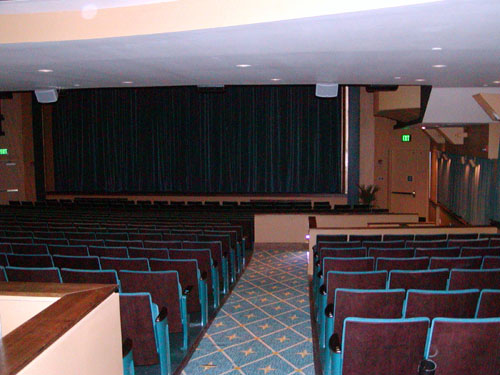
Here is an example of the State Theatre in State College, PA. The "stadium seated" balconey posed the biggest problem to sight lines (as you can see)...one MUST be seated to get a clear view to the top of the screen from the back rows. I don't believe there were any obstructed views to the bottom of the screen.
Posted by Mike Blakesley (Member # 26) on 08-10-2007, 01:29 PM:
Our floor is about 1 to 12 and we've never had any comments like "This theatre would be awesome if only you had stadium seating." Proper row spacing and offset is the key. (Along with a stack of kiddie boosters for the kids, although they're not really necessary in a lot of cases but the kids like'em.)
Posted by Monte L Fullmer (Member # 2797) on 08-10-2007, 02:07 PM:
quote: Steve Guttag
I'm happy to see that some theatres are compromising...part stadium, part sloped.
...doesn't this also contribute to lesser construction costs where the building's roof height can be more lower than a full stadium complex - and still keep the screen viewing at the maximum in the stadium seating area?
Posted by Louis Bornwasser (Member # 3063) on 08-10-2007, 02:40 PM:
The problem here (common width; and stadium problems as well) comes down to architects. Yes, at least 90% are not competent, especially with cinema design. Not something they can find, precanned.
If you've ever seen a booth with a concrete pedestal, you've seen the work of an incompetent artch. Louis
Posted by Brad Miller (Member # 2) on 08-10-2007, 03:56 PM:
quote: Chris Slycord
2) Unless I'm crazy I think the side maskings would have to be more complicated than the top one. It clearly has to move 2 of them at exactly the same time. Granted, the moveable parts of each masking will pretty much be identical so it'll be somewhat simple but 2 maskings that have to work together is more complicated than 1 that works alongside not much else.
I am in no way a "front end" specialist, but side masking is much easier to rig, as you aren't fighting gravity. Besides you can't just hang a pulley in the middle of a top masking and expect it to work anyway. It still requires multiple pulleys to move each side of the masking up and down evenly.
quote: Louis Bornwasser
If you've ever seen a booth with a concrete pedestal, you've seen the work of an incompetent artch.
I couldn't agree more!!! Fortunately I was able to stick my nose into the architect's work on the January install before they became set in stone, because they wanted to have the booth on different levels and projectors up on wooden or concrete blocks. In the end the medium houses have virtually 0 degree tilt, the big house points upward just a tad and the small houses point downward a little bit. Not only did it make day to day operation much easier, but it also saved bucks on construction. The people who are designing these multiplexes where projectors are up on blocks are very much uninformed. (Or to make David happy, they are stupid.)
Posted by David Zylstra (Member # 4230) on 08-10-2007, 04:35 PM:
LOL . . . .
I'll translate that to "completely unfamiliar with efficient booth operation" . . . . . .
I've seen some stadium conversions where the projector had to be raised up on a poured concrete plaform, with low HVAC vents above it was interesting to re-install the equipment . . . . . I felt sorry for the shorter projectionists that had to thread those . . . . conversion shouldn't have been that steep, it didn't need to be . . . .
It's always sad when theatre owners don't bring the technical booth guys in on the design phase.
Posted by Louis Bornwasser (Member # 3063) on 08-10-2007, 08:08 PM:
Some of them have all-the-answers and cannot use anything we help with. Louis
Posted by Mark Gulbrandsen (Member # 72) on 08-10-2007, 10:29 PM:
quote: Steve Guttag
You statement about not being able to design a theatre with such a slope and with good sight lines is just plain wrong. With ACAD it is pretty easy to set the relationship of the seats/slope and screen such that all are satisfied.
Ok, on your A-cad drawings whats the tallest person that can sit in front of you without blocking your view?
Mark
Posted by Steve Guttag (Member # 268) on 08-11-2007, 12:29 AM:
We generally take the eye height of the typical female looking over the head height of the typical male. We also protect to the very bottom of the image to ensure that subtitles are not blocked.
A little trivia there...it appears that the typical theatre seat pan is about the same height off the ground as a typical toilet. We once drew a theatre full of em (in a section view) with a "seat dude" on each one. No one noticed until it was pointed out.
We normally use our "block head" to check sight lines rather than a scale seat dude and dudette. The block head person has the male head height but the female eye height so one dude can be used to check all rows.
Add to that the seats are radiused such that one is typically looking through the immediate row in front and you get yet more headroom.
In most slope floor OR stadium theatres, there are normally only a couple of dicey rows to worry about and often they occur about 2/3rds of the way back. As the risers bring people's eyes up, that tends to lower the field of vision (makes them look more down) which actually can count against the stadium style but again normally only one or two rows will be so affected...depending on the screen height and the height of the risers.
Steve
Posted by Chris Slycord (Member # 4239) on 08-11-2007, 04:07 AM:
quote: Brad Miller
I am in no way a "front end" specialist, but side masking is much easier to rig, as you aren't fighting gravity. Besides you can't just hang a pulley in the middle of a top masking and expect it to work anyway. It still requires multiple pulleys to move each side of the masking up and down evenly.
So the "unless I'm crazy" part of my post was spot on; or more correctly, I was uninformed. Oh well.
Posted by Mike Blakesley (Member # 26) on 08-11-2007, 10:21 AM:
quote: Louis Bornwasser
If you've ever seen a booth with a concrete pedestal, you've seen the work of an incompetent artch.
My theatre was built in 1930 so I had no input on the booth design, but the projector does sit on a 12" high pedestal. But, I like it that way because it's easier to thread at eye-level than having to bend over, and it's also easier to clean the port glass for the same reason. I don't really see why the pedestal would be a problem -- vibration maybe? (That's not a problem here though.)
Posted by Brad Miller (Member # 2) on 08-11-2007, 01:50 PM:
He is speaking of booths that could've had a bunch of projectors all on the same level (or maybe one of 2 levels), but for stupidity (my new favorite word) the architect decided to order some projectors to be an extra 8 inches or 14 inches or whatever higher on pedestals.
The Angelika Film Center Plano is an excellent example of pure, raging stupidity on the part of the architect. I say this not only just looking at the pictures, but I spoke to the architect when he was designing this and trust me, that guy is an absolute fucking idiot who builds pretty lobbies with no concern whatsoever towards the actual moviegoing experience.
Posted by Monte L Fullmer (Member # 2797) on 08-11-2007, 11:52 PM:
Speaking of mounting pedestals on platforms:
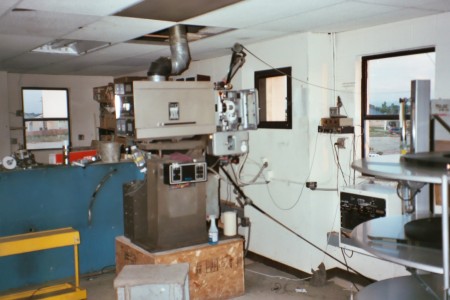
From a Drive-In that I service and work at on occasion. (I know, I need to shoot some picts of this place when I get more pix taken and submit all of this... ![[Big Grin]](biggrin.gif) )
)
When the building was built back in 1979 to replace the old building, the drive-in was converted to a triple screen drive-in and were three machines upstairs in this configuration due to that all machines sat on that blue large reel transport that is noticable behind this Century/XENEX setup.
In 1989, there was a huge fire upstairs (word said it was arson that was the cause of this fire) that literally melted the Left and Right setup, but the middle setup didn't suffer the damage as the other two.
Place was close for a few years, but reopened with just the middle screen with the Century sitting on that large reel transport.
It was just 4 yrs ago that the large reel transport finally took a final rest and the base and platter setup came into play. Thus why this setup sits on that platform .. and we have to stand on that stool behind the setup to lace up the projector.
Posted by James Westbrook (Member # 3690) on 08-12-2007, 02:40 AM:
The Sky-Vue Drive-in in Lamesa, Texas is still running on some kind of reel transport like that.
The Angelika in Houston, if memory serves me correctly...isn't one of their consoles raised by 2 4 by 4 fence posts to allow the picture to shoot to the screen?
(I just realized that I can easily look that up myself...I'm going to be hell on earth when I become an old man...)
Posted by Paul Konen (Member # 41) on 08-12-2007, 11:54 AM:
quote: David Zylstra
Unfortunately DCI was seemingly written to economically favor fixed width - i.e. if you have fixed height you need to buy 2 lenses, use a larger lamp and vary lamp power depending on format; but fixed width can be done with 1 lens (all you do is crop 3"-12" of picture).
David, the thing with D-Cinema and fixed height is having to have the extra anamorph swing into position for scope movies. As far as using a larger lamp, I don't think that is the case. I use the same lamp for scope or flat. That would be silly to change it out for each format. Uggh.
Posted by Darryl Spicer (Member # 711) on 08-12-2007, 12:27 PM:
When I went to one of our theatres in Louisville, Ky to get some initial training before we installed our digital projector at my location. The screen they were using was a common height screen. However they were not using an anamorphic on the lens. I think they had markings on the lens to set for zoom on scope, flat and 3-D but there was no mention of an anamorphic nor did I see one. On ours it is just markings for 3-D and normal settings.
Only time we change bulbs to a different size is for 3-D.
Posted by Paul Konen (Member # 41) on 08-12-2007, 01:52 PM:
I have to change to a different 3D lense because my zoom isn't large enough for that use.
That just doesn't seem right to zoom to scope, you'll be setting the electronic masking such that you are cropping the top and bottom part of the images off, just in an effort to fill the screen side to side.
Darryl, do you have an anamorph?
Posted by Darryl Spicer (Member # 711) on 08-12-2007, 02:44 PM:
No, not on our set up. The Louisville set up was playing a scope image of 300 at the time I was there. I did not notice an anamorphic being used and they did not say one was being used they just had the extra markings on the lens for zooming so I do not know what the flat image looked like. I do know that it did not look like a top masking setup when I watched some of the movie while there. I can find out for sure and let you know what is up on that set up.
Posted by Pravin Ratnam (Member # 1417) on 08-20-2007, 01:08 PM:
I am not an expert in this area. So , my apologies, if I spout stuff that may end up being nonsensical. But let's say you, as a theater owner, are stuck with an auditorium that has very small dimensions and so they go with fixed width. The thing is if they went with fixed height, the scope image would not be any bigger. And you can always tailor your preshow to fit the screen to remove the preshow bigger than the main show factor. Now, the counterargument seems to be that flat images will look dim compared to scope movies on a fixed width. But if the screen size itself is small, how is that different from projecting a flat movie a on similar sized 1.85:1 portion of a fixed height screen in a much bigger auditorium? ANd it's not like the audience is going to watch a scope and a flat movie back to back in the same auditorium to notice the difference. Or do the bigger auditoriums use more powerful bulbs to account for the bigger screen?
Also , why not use the fixed width auditorium to show mostly flat movies and show 2.35:1 movies only as a last ditch scheduling fix. THis way, at least the ratio is not compromised when they are forced to show a scope movie.
Now, onto another point. Idiot managers. They don't seem to take a movie's aspect ratio in mind when scheduling movies in their auditoriums. When Legally Blonde 2 and T3 came out one weekend, this idiotic theater(Regal Perimeter POinte) scheduled them as follows. Legally Blonde 2 was in a slightly bigger house - seating wise, but much bigger screen for 2.35:1. It wsa a fixed height screen. but the movie was 1.85:1. THey put T3 in the fixed width house. Both movies had the same opening weekend with T3 being the bigger grosser. Now let's just assume they thought Legally Blonde would get slightly more people, it clearly was not that much where either house could not accomodate either movie- seating wise. So why not put the movies in the right houses and give both audiences maximum enjoyment? I assume that Legally Blonde 2 would have roughly the same image size in both houses. But T3 had a much smaller image size in the fixed width house.
I have seen too many examples like this.
Posted by Monte L Fullmer (Member # 2797) on 08-20-2007, 01:52 PM:
quote: Pravin Ratnam
Idiot managers. They don't seem to take a movie's aspect ratio in mind
Oh can agree with this one, but sometimes they have to schedule houses like this for house cleanups to be more organized esp if two shows love to get out the same time and those two might be in the same part of the theatre and cause traffic jams on exiting.
Plus, sometimes those house positions have to be done like that for booking contracts from the film studios and instructions from the DM of that area.
Posted by Mike Spaeth (Member # 524) on 08-20-2007, 04:47 PM:
Good analysis - Pravin...
That weekend in question, Legally Blonde did $10,641; T3 did $9,545...so on paper the manager did right, but you make an excellent argument otherwise. Unfortunately, for most managers, stuff like that isn't noticed. I know I've never thought about aspect ratios when doing house placements, gonna have to look at that...
Posted by Brad Miller (Member # 2) on 08-20-2007, 05:13 PM:
quote: Pravin Ratnam
Or do the bigger auditoriums use more powerful bulbs to account for the bigger screen?
Yes...and common width is still stupid.
Posted by Thomas Pitt (Member # 4322) on 08-20-2007, 05:23 PM:
The Vue Leeds Light boasts the 'biggest screens in the region'. This may well be true for flat films, but not for scope...
As I've mentioned before, the top masking causes the screen to fall down and shrink for scope movies, thus making the screen size about the same as other multiplexes in the region
I also had an idea: how about adjusting the projector so the top and bottom of the scope image match the top and bottom of the 'flat' screen? You would, of course, lose some of the image off the left and right, but I haven't seen many scope features that have anything important on the extremes!
In effect you're pan-scanning the scope ratio image to flat ratio (and using the whole fixed-width screen), although you can't pan the image left and right easily.
I don't think this would work very well in practice though - any thoughts?
Posted by Sam Graham (Member # 2889) on 08-20-2007, 06:52 PM:
quote: Monte Fullmer
In 1989, there was a huge fire upstairs (word said it was arson that was the cause of this fire) that literally melted the Left and Right setup, but the middle setup didn't suffer the damage as the other two.
Place was close for a few years, but reopened with just the middle screen with the Century sitting on that large reel transport.
Assuming you're talking about the Terrace, THANK YOU. I've always wondered why they only ran one screen with three on the lot...
Posted by Brian Guckian (Member # 1678) on 08-20-2007, 08:07 PM:
What's interesting is that only Steve Guttag has pointed out that 'Scope is meant to be WIDER (and bigger) than the "flat" ratios.
It's as if theatre designers and / or theatre owners have either forgotten or just don't know what CinemaScope is, and how and why it originated.
Common width is just WRONG:
quote: Pravin Ratnam
But let's say you, as a theater owner, are stuck with an auditorium that has very small dimensions and so they go with fixed width
But that's the problem. One shouldn't get to that point where "one is stuck with" such an auditorium! This is an ERROR which shouldn't happen in the first place.
For example, one could fit out a new multiplex just with mono optical sound! It wouldn't be best practice today, but it's possible. So - just because it's possible to construct common width screens doesn't mean it's right!
Posted by Chris Slycord (Member # 4239) on 08-20-2007, 08:14 PM:
quote: Brian Guckian
What's interesting is that only Steve Guttag has pointed out that 'Scope is meant to be WIDER (and bigger) than the "flat" ratios.
That's because everyone thinks he's right.
quote: Thomas Pitt
I also had an idea: how about adjusting the projector so the top and bottom of the scope image match the top and bottom of the 'flat' screen? You would, of course, lose some of the image off the left and right, but I haven't seen many scope features that have anything important on the extremes!
In effect you're pan-scanning the scope ratio image to flat ratio (and using the whole fixed-width screen), although you can't pan the image left and right easily.
I don't think this would work very well in practice though - any thoughts?
That's a ridiculous idea. Your idea is to crop the image because you assume that most movies don't use the extreme parts of the image. I'm sure that everyone here is in agreement that we are supposed to show the whole picture in the original aspect ratio; not cutting off sections of a scope image to force it to essentially use the aspect ratio of a flat print.
Posted by David Zylstra (Member # 4230) on 08-20-2007, 09:06 PM:
quote: Paul Konen
David, the thing with D-Cinema and fixed height is having to have the extra anamorph swing into position for scope movies. As far as using a larger lamp, I don't think that is the case. I use the same lamp for scope or flat. That would be silly to change it out for each format. Uggh.
Not a lot of 2K installs are using anamorphics (AccessIT is only using them for the largest of fixed height screens - their single lens solution scales flat down to fit the scope pixel height on fixed height screens) - under some interpretations anamorphics violate DCI since it requires the image to be scaled vertically 1.25X, but DCI says you can only scale 2X . . . . . the section on lenses and scaling is wide open to several interpretations.
When you do the math for screen luminance there is about a 2-3FL difference between flat and scope using an anamorphic lens (i.e. scope is about 2-3 FL lower than flat) . . . . when you do the same math using the proposed magnifier scope lens the difference is more like 5FL lower for scope . . . . . If a screen uses the magnifier for scope you need to lamp it to provide the correct luminance for scope and then either overlight flat or turn the power down (the Christie has "lamp per channel" so you can set the power level separately for each format).
I'd be interested to know if anyone has TDC units and if they installed anamorphics on all screens or just the larger ones.
Posted by Evans A Criswell (Member # 381) on 09-10-2007, 03:22 PM:
quote: Thomas Pitt
I also had an idea: how about adjusting the projector so the top and bottom of the scope image match the top and bottom of the 'flat' screen? You would, of course, lose some of the image off the left and right, but I haven't seen many scope features that have anything important on the extremes!
In effect you're pan-scanning the scope ratio image to flat ratio (and using the whole fixed-width screen), although you can't pan the image left and right easily.
I don't think this would work very well in practice though - any thoughts?
R. C. Cobb would have loved you. That was the Cobb Theatres way of doing things in all but their largest auditoriums in the 1980s and 1990s. Cropping 2.39:1 to 1.85:1 was their standard practice. Regal finally fixed the total 18 auditoriums between the Hollywood 18 and the Madison Square 12 back in 2003 by installing top and bottom masking.
Posted by Monte L Fullmer (Member # 2797) on 09-10-2007, 03:49 PM:
quote: Sam Graham
I've always wondered why they only ran one screen with three on the lot...
(sorry on this post being so late to reply on...) Right after the place reopened up in 1991, the left screen was the initial one that began operation - using a Century/ORC 4000 setup with an EPRAD MiniMut for film transport. The center screen setup wasn't fully going yet...I think that it was in the late 90's that the operation was moved over to the present main screen.
The MiniMut was then used for film transport for the center screen until 2003 when the present platter and lamphouse setup was installed.
Pict of the present owner and the MiniMut transport unit.
-Monte
Posted by Cameron Glendinning (Member # 3516) on 09-10-2007, 05:20 PM:
quote: David Zylstra
When you do the math for screen luminance there is about a 2-3FL difference between flat and scope using an anamorphic lens
Just Curious, how much of this difference could be dealt with within film grading? With DCI can gamma be played with to increase the brightness ect, or are these parameters set in stone?
In reference to Rons earlier comments re anamorphics now being used at home web page
Posted by Bill Enos (Member # 440) on 09-12-2007, 12:17 PM:
Post cleared---posted to wrong topic.
Posted by Dennis Benjamin (Member # 1137) on 09-21-2007, 04:10 PM:
quote:
quote: Brian Guckian
--------------------------------------------------------------------------------
What's interesting is that only Steve Guttag has pointed out that 'Scope is meant to be WIDER (and bigger) than the "flat" ratios.
--------------------------------------------------------------------------------
That's because everyone thinks he's right.
He's not always right?
Posted by Thomas Pitt (Member # 4322) on 10-07-2007, 04:05 PM:
Fixed-height screens with side masking have always been (in my opinion) better than fixed-width screens. With a fixed-width screen, it doesn't matter whether you have just top masking or top and bottom masking - the screen is still getting SMALLER when you switch over to scope.
I saw Halloween at Sheffield VUE last week; the screen was fixed-width with top and bottom masking. When it changed over to scope, I overheard someone behind me say "I swear, the screen's just got smaller!"
It's much better if the screen widens and gets bigger when the main movie starts (side masking). Again, when I saw Zodiac I was in an auditorium with side masking, and a few of the other people in the audience went 'Yeah!' when the screen opened up to full width
If you've ever seen This Is Cinerama, after the introduction the tiny 4:3 image in the centre of the screen suddenly changes into a very wide 3-projector image of a rollercoaster ride. You can imagine how it must have awed audiences who were used to seeing all movies in the tiny 4:3 screen format! Fixed height is like that too; making the image bigger for the main movie.
Regarding D-Cinema and fixed height screens, surely it would be better to align the projector so that it fills the full scope area of the screen. For flat features, simply pillarbox the image digitally and have the projector showing black borders (which would be on the masking, so less obvious). Is this what David was trying to say?
The Leeds Light has a single digital projector, but they have fixed-width screens there. The digital projector is set to fill the full flat screen. For scope digital features, the image is scaled down slightly and only projected onto the bottom area of the screen - leaving a large black bar on the top. This, coupled with the top masking, makes the projector do a scope aspect ratio image without having to use an extra anamorphic lens.
I'm still unsure whether most moviegoers would notice that images have been scaled up or down when using a digital projector, though. It's not as if you're sitting right in front of a computer LCD screen, where upscaling is obvious!
Posted by Edwin Graf Diemer (Member # 545) on 10-07-2007, 09:10 PM:
Pravin wrote:
"Also , why not use the fixed width auditorium to show mostly flat movies and show 2.35:1 movies only as a last ditch scheduling fix. This way, at least the ratio is not compromised when they are forced to show a scope movie."
I remember doing that when I was a projectionist at the Eric Concordville 4 (PA). It was a single-screen house that was built in the late 60's, twinned in 1976, and had 2 screens added in a early 80's addition. Sameric was very big on screen curtains (with a big "E" on them), which was neat, and all was retained when UA bought the chain. (It was something having to remove those letters from the curtains!) Anyway, when the original auditorium was twinned, a bowling alley theater of about 330 seats resulted at the left, while 737-seat auditorium #2 was at the right. The smaller house was the only one in the complex to have a fixed-width screen, and 'scope presentations looked so miserable there that we only showed "flat" prints on that screen. At least the image was a bit larger! Like many of you probably had to do, the side masking was moved by yanking a rope at the side.
Posted by David Zylstra (Member # 4230) on 10-07-2007, 09:43 PM:
quote: Thomas Pitt
Regarding D-Cinema and fixed height screens, surely it would be better to align the projector so that it fills the full scope area of the screen. For flat features, simply pillarbox the image digitally and have the projector showing black borders (which would be on the masking, so less obvious). Is this what David was trying to say?
This is exactly what happens in real life . . . . . . but Digital flat and scope has the reverse of film - i.e. with 35mm scope is the brighter of the 2 pictures, but with digital flat is brighter than scope when you use 2 lenses (less so if you us an anamorphic for scope); the current single lens solution that scales flat to fit the scope picture height actually has the same luminance on both formats.
Posted by Monte L Fullmer (Member # 2797) on 10-08-2007, 03:32 AM:
quote: Edwin Graf Diemer
The smaller house was the only one in the complex to have a fixed-width screen, and 'scope presentations looked so miserable there that we only showed "flat" prints on that screen. At least the image was a bit larger! Like many of you probably had to do...
.. 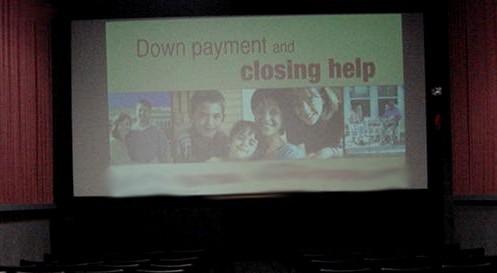
this is a house with a 9x18 ft. screen - simple common width screen (image from a preshow display..). Sad thing is that FLAT is projected at 2.00:1 along with the cropped 2.00:1 for scope vas well.
Posted by Tristan Lane (Member # 1169) on 10-08-2007, 06:12 AM:
quote: David Zylstra
When you do the math for screen luminance there is about a 2-3FL difference between flat and scope using an anamorphic lens
When using a single lens, on common height screens, overall luminance should remain the same between formats. But an anamorphic should increase screen luminance, given the anamorphic lens isn't eating up all of the extra light produced by utilizing the entire chip.
I'm curious as to how you calculated the light loss. Are you claiming that the light is lost in the lens? That's the only reason I can see to have lower light
I don't recall seeing that much of a drop in light levels @ the screen in scope when the anamorphic was used. Were you able to test the math in the field?
quote: Thomas Pitt
it doesn't matter whether you have just top masking or top and bottom masking - the screen is still getting SMALLER when you switch over to scope.
If done correctly the Scope screen size wouldn't be any smaller than if it were set up as common height. Actually, you could probably net an additional foot on each side due to the lack of movable masking. Common height would just reduce your flat screen size.
I've never understood the thinking behind that. I know it seems a little more "grand" to have the Scope image appear larger than the flat image, but why not maximize the screen size for both formats?
Perhaps not moving the masking in front of an audience would keep people from thinking that the screen just got smaller.
Posted by David Zylstra (Member # 4230) on 10-08-2007, 07:31 AM:
So far I have not been able to test in the field since Christie has been dragging their feet installing the anamorphics on our largest screens (we can barely reach 14FL with a new 6K lamp so we need the anamorphics). I have not assumed any light loss from the lens and the field measurements we have done on the single lens solution comes really close to the math.
The basic math for luminance is (Lumens X Gain)/Screen Area . . . . . running the math shows about a 2FL difference between flat and scope with anamorphic (I will be able to take field measurements in November - at least that's when Christie has promised to deliver the needed lenses).
There are a few things to make the above formula work for cinema - Since the approx lumens for the CP2000H lamphouse is based on using the full 1080X2048 (1.9 aspect ratio) chip you need to calculate a theoretical picture size for each format (i.e. if flat is 20 X 37 then when calculating FL you need to use 20 X 38).
Posted by Monte L Fullmer (Member # 2797) on 10-09-2007, 02:07 AM:
quote: Tristan Lane
Perhaps not moving the masking in front of an audience would keep people from thinking that the screen just got smaller.
I used to get that all the time when I was running dbl features at a 14plex and with each film using a different lens.
..and the complain that would come of "making the pict smaller" with the top masking came down due to we had common width screens, one can easilly tell that television (the 4.3 versions) still dominated their viewing experiences.
Also, since I had true scope, my scope picts were tons brighter than the flat ones - to where, if I had a flat pict in one house that was planning on staying there for a good duration, I would refocus the bulb out just a bit to brighten up the screen some, plus mark it on the showsheet that the bulb was focused for a flat aperture and needs to be focused back in for the scope features.
- monte
Posted by James Westbrook (Member # 3690) on 10-09-2007, 11:52 AM:
It's my understanding the newer Christie consoles (circa 1998 and recent) can refocus itself for flat and scope...
Posted by Monte L Fullmer (Member # 2797) on 10-09-2007, 04:00 PM:
True, there is that option for autofocus with the SLC consoles, but ours weren't equipped with that option for it was more desireable to have them operator controlled.
Posted by James Westbrook (Member # 3690) on 10-10-2007, 01:20 PM:
Probably to keep from burning prints when one or the other falls out of adjustment...
Powered by Infopop Corporation
UBB.classicTM
6.3.1.2