This is topic Running a movie with no audience?! in forum Ground Level at Film-Tech Forum ARCHIVE.
To visit this topic, use this URL:
https://ft-forum.com/ft/cgi-bin/ubb/ultimatebb.cgi?ubb=get_topic;f=5;t=001916
Posted by Thomas Pitt (Member # 4322) on 08-20-2007, 05:15 PM:
Today I saw Rush Hour 3, and to my great surprise I was the only person who had come along for the 9:50am showing! I've always wanted to see what a private 1-person screening would be like, but it seemed kinda lonely in there - no audience to enjoy the movie with.
I asked one of the floor staff if they would bother running the film at all if no tickets had been sold for it. They said the film would run anyway, regardless of whether any tickets had been sold.
To me, this seems a waste of projector wear and bulb life, playing to an empty auditorium! I suppose they would be hoping someone comes in late, during the ads and trailers (or beginning of the movie). What do you think?
Incidentally, I asked this question at the Bradford IMAX a while ago - in this case, they would not run the show at all if nobody had got a ticket.
Posted by Wyatt Copeland (Member # 4433) on 08-20-2007, 05:36 PM:
Heck no I wouldn't run it if no one came in.
But before I started working here, they used too. I mentioned it a few times and no one took it seriously- all the box kids thought it would be an annoying neusance to have to call up movies. Buut the GM swung by, mentioned it, and after a lot of mess ups, they got it down at least somewhat.
I think the reason some theatres don't mess with it is because in case there is miscommunication, or if someone shows up late, they don't want the movie to start late and then have showtimes overlap. ![[Roll Eyes]](rolleyes.gif) Ohh well, I think its better than killing bulb hours.
Ohh well, I think its better than killing bulb hours.
Posted by Frank Dubrois (Member # 3042) on 08-20-2007, 05:57 PM:
We usually run them all on the weekends because people usually show up. During the week, we give a 5 minute grace period for people to show up late. If they show up after 5 minutes, we don't show it.
9:50am movie? Who the hell goes to movies at 9:50am??
Posted by Josh Rosen (Member # 4291) on 08-20-2007, 06:05 PM:
we always have to run the show in case people show up late (often happens) so that we don't start late and cause the interval between show times to become to small.
However, if a theater looks empty to me, I call the box office and ask for the sales number. If no one bought a ticket, I will switch the sound of and turn off the bulb so even though I have to run the film, I am at least not wasting bulb hours.
Posted by Jarryd Beard (Member # 2543) on 08-20-2007, 06:14 PM:
I always start movies on time, regardless of ticket sales. Sure you could wait five minutes and turn people away after that. I think that's a good way to loose customers. Kill the lamphouse power and let the film run through. It's not like a projector designed for years of service and thousands of shows will experience excessive wear. The fact that we have digital projectors on all screens with only one 35mm tandem house makes this even an easier situation to handle... a few simple key strokes will shutdown and reload for the next show. The only time I might reconsider is if the show was the last to end considerably later than the other movies. At 9:50am, that certainly isn't the case.
Posted by Mike Blakesley (Member # 26) on 08-20-2007, 06:36 PM:
We'll usually start all shows on time, and if no one is in the theatre by the end of the trailers, we'll stop the film. That way it's easy to break the splice at the end of the trailers and drop the trailers back into the film for the next show.
Even then, if somebody shows up late we'll still run the show for them. If they're somebody we know is from town, we'll ask if they mind coming back another time (and give them a pass); if they're from out of town, we just start the movie and run it for them without asking. Lots of people think it's really cool to get a private showing.
One theatre near here requires 4 or more people in the building to run a show. I think that's crap...if people come out of their house to see a show, then by gum we're going to give them a show.
Posted by Sam Graham (Member # 2889) on 08-20-2007, 06:45 PM:
It is common practice to run the film, sans bulb, to empty houses, in large multiplexes.
I've been told two different things...One, they're "contractually obligated to run the show." So they do, but if nobody's there, they just leave the lamp off. Two...if somebody DOES show up a few minutes in, they can easily and fairly quickly accommodate them.
I've been in a couple of situations where I bought a ticket at the last minute and entered an empty auditorium to full sound and no picture for whatever time it took for the projectionist to fire up the lamphouse.
Posted by Mark J. Marshall (Member # 1409) on 08-20-2007, 08:02 PM:
quote: Mike Blakesley
it's easy to break the splice at the end of the trailers and drop the trailers back into the film for the next show.
Assuming you're using a platter, I don't suggest that. Way too much of an opportunity to mess up the film by improper handling. Trying to stuff it all back in again and risk it not fitting properly, bubbling out, etc... it's just asking for trouble, especially with inexperienced film handlers, or finicky platters.
To each his own, I guess, but like others here have already said, we just let the motor run the film through, turn off the bulb, switch the background music back on, bring the lights up, and open the doors back up to get the auditorium ready for the next show.
Posted by Wyatt Copeland (Member # 4433) on 08-20-2007, 10:39 PM:
Well what usually happens here is if noone shows up within fifteen minutes we wont show it at all. But in this area..if no one shows up within fifteen minutes, no one is showing up!
I suppose a lot depends on the area and market. During the week, even on a summer, attendance is very low and we can get away with not even having to turn some projectors on for a day.
In the words of our Region M, "I aint afraid to cut costs!" (ghost busters theme music playing)
Posted by Chris Slycord (Member # 4239) on 08-20-2007, 11:13 PM:
We regularly get people showing up late, so we'll start them regardless. Exception being the final show of the night, esp one that's going away as a thursday break down. And even then my managers always tell us to wait 30 minutes at that point.
Posted by Mike Blakesley (Member # 26) on 08-20-2007, 11:19 PM:
quote: Mark J. Marshall
it's just asking for trouble, especially with inexperienced film handlers, or finicky platters.
Well since my platter is not finicky and I've got plenty of experience, I'd much rather stop the movie afer the trailers, do five minutes of film-work and go home than have to sit there for an hour (assuming I take the film out of the projector head) waiting for it to wind onto the platter.
There's no "bubbling" or trying to squeeze the trailers back in, because it's a simple matter to let the pack of trailers sit up on the feature film pack on one side. And since we use the Film Tech Platter Ring, there's no chance of a brain wrap or a thrown print when doing this.
As with all "tips," your mileage may vary.
Posted by Mark J. Marshall (Member # 1409) on 08-20-2007, 11:31 PM:
I forgot you're a single screen, Mike. I understand why you would choose to use that method in your situation.
Posted by Monte L Fullmer (Member # 2797) on 08-21-2007, 12:23 AM:
quote: Mike Blakesley
That way it's easy to break the splice at the end of the trailers and drop the trailers back into the film for the next show.
Not to throw this towards an off topic discussion here,but want to make a comment on this: I've done this procedure with 20min on a ring many-a-times and not breaking any splices.
As I easily pull the film out the platter and projector and wind the film on the ring as I go along, with a paper clip holding the rest of the wind on the platter so it doesn't go unravelling everywhere, I, then just drop the partial wind on the ring back in the middle of the main wind - knowing that I can't completely put that partial wind back in the center, I just make sure that the partial wind has a good lean in the middle for the next payout.
But, it's a trick to ensure that when I'm doing this, that I don't lose the ring out of that partial wind, for if I do, then I've got somewhat of a slight mess on my hands. But, I can still manage to recover this and still place this back in the main wind on the platter..
Christie rings are more tolerable for this procedure than the springy STRONG rings, but one can master the STRONG rings if they get some practice on this.
-Monte
Posted by Ron Curran (Member # 3631) on 08-21-2007, 12:33 AM:
Mike is right (it's becoming a habit). Otherwise you'd never change trailers before a feature on a platter. It's a pain but necessary.
We are fortunate that we rarely have no-shows. Multiplex-trained customers arrive 20 minutes into a session to avoid the ads we don't show. I used to be concerned that many people miss the first 15 minutes of a feature; now I just smile and say "You'll know next time."
Posted by Wyatt Copeland (Member # 4433) on 08-21-2007, 12:57 AM:
Hmm I can recall a very few times where a customer has come late to a movie (usually only like 10 minutes though), gone in, saw that the actual movie was playing, and then come out to coplain that our trailers weren't long enough.
![[Mad]](mad.gif) I have a short temper..not with talking to customers, but inside it makes me wish I had started the movie ten minutes earlier. Some people just think they know everything that goes on up there. Because we all know how easy it is to push the rewind button to start the movie over for the one customer who came in late
I have a short temper..not with talking to customers, but inside it makes me wish I had started the movie ten minutes earlier. Some people just think they know everything that goes on up there. Because we all know how easy it is to push the rewind button to start the movie over for the one customer who came in late ![[uhoh]](graemlins/uhoh.gif)
Posted by Mike Blakesley (Member # 26) on 08-21-2007, 01:34 AM:
quote: Monte L Fullmer
I've done this procedure with 20min on a ring many-a-times and not breaking any splices.
I wouldn't be able to do that here because we've got this dumbass gizmo on the platter that's supposed to be a "wrap detector" that you have to feed the film through. Can't slide it out from the side like a normal Christie roller, so breaking a splice is necessary. The thing doesn't work, from what I've been able to tell.
To try to steer back toward the topic...I think we only have maybe 1 or 2 instances a year where nobody shows up. Seems like even if the weather is absolutely terrible, one or two die-hards will come in out of the cold. I can see where in a multiplex with 10 or more movies, no-shows could be a very common thing.
Posted by James Westbrook (Member # 3690) on 08-21-2007, 01:58 AM:
With 16 screens, we are entering that time of year where no-shows on weekdays are a common thing.
Posted by Chris Slycord (Member # 4239) on 08-21-2007, 02:37 AM:
quote: Wyatt Copeland
Hmm I can recall a very few times where a customer has come late to a movie (usually only like 10 minutes though), gone in, saw that the actual movie was playing, and then come out to coplain that our trailers weren't long enough.
That's nothing.
When I first worked at my theater, I was box office one day. Woman came late and I told her she missed about 20 minutes of the actual movie; she told me "No; I've only missed 5" so I sold her a ticket. About 2 minutes later she came back out and said "You were right" and requested a refund.
Posted by Stephen Furley (Member # 1277) on 08-21-2007, 07:54 AM:
I'd never had it happen until recently, but then it happened twice within a few months. Left the film laced up on the machines for about 15-20 minutes after advertised start time, so we could start the show if anybody turned up late. After that time speak to the duty manager, get the ok to cancel the show, put the print away and laced up the film for the next show.
Posted by Scott Norwood (Member # 30) on 08-21-2007, 08:01 AM:
This seems to be pretty much standard in multiplexes. It's just easier to run everything, as it avoids a mad rush to start the show for a latecomer (which would likely also throw off the rest of the day's schedule). No-shows are pretty rare, so it would seem that the extra wear on the equipment should be pretty minimal.
The only exceptions that I could see to this policy are for the last show of the night if (as mentioned above) a particular film ends long after the others or if a print needs to be picked up by a delivery company (or another theatre) that night.
In single-screen houses, no-shows are rather rare, but I normally just hold the show for a few minutes and only run it if someone shows up.
Agreed that requiring a minimum number of attendees to run a show is lame. If one person shows up for an advertised showtime, the film should run.
Posted by Joshua Waaland (Member # 287) on 08-21-2007, 08:42 AM:
When I used to work at a multiplex we would always run day shows. On the last showing of the night we would wait to see if anyone showed up then start the film if they did. Many times people would show up 10-15 minutes late which meant you were at work for another 10-15 minutes or you had to send away a pissed off customer and not show the film.
One night we were running Carlito's Way which was ungodly long and I decided to chance it and hope nobody showed up for it. One guy did show up and we started it almost a half hour late. I was there until 2 AM. Carlito's Way was already scheduled to end an hour after all of the other films did and that is why we took our chances and tried to not have to run it. After that I just started running every show dark and waiting for the box office to tell me if someone showed up. If somebody did show up I just ignited the bulb and never had to worry about being there too late. If nobody showed up to late running films like Carlito's Way we would run the film until the others ended then just shut down the projector and run the rest of the film through the next day when we came in. The only exceptions were on nights when we had to break down films. If someone showed up late we just told them we could not run it.
[ 08-21-2007, 01:16 PM: Message edited by: Joshua Waaland ]
Posted by Scott D. Neff (Member # 185) on 08-21-2007, 01:06 PM:
Josh, that's why you ALWAYS start the last film 10-minutes early to let the previews run and therefore the movie starts at the advertised showtime. It's all the other shows that you don't start so that way, if nobody shows for them, you can go watch the end of the last movie when you're done with your paperwork. ![[Smile]](smile.gif)
Posted by Carl Martin (Member # 1146) on 08-21-2007, 01:17 PM:
quote: Monte L Fullmer
As I easily pull the film out the platter and projector and wind the film on the ring as I go along, with a paper clip holding the rest of the wind on the platter so it doesn't go unravelling everywhere, I, then just drop the partial wind on the ring back in the middle of the main wind - knowing that I can't completely put that partial wind back in the center, I just make sure that the partial wind has a good lean in the middle for the next payout.
but if your platter rollers have keepers then there's really no way to slide the film off them without scuffing it. even pulling the film out of the projector, where the pad rollers pull away from the sprockets, is very risky, imo. it's just too easy to scrape the film against a sprocket tooth.
in mike's situation, i'd break a splice. in any other situation, i'd just let it run through w/ no lamp or sound.
stopping the film mid-way and running the rest through the next day is something i'd never do, unless compelled by a power outage. that's an invitation to dust, and possibly scratching as the sound drum comes up to speed at startup.
Posted by Robert E. Allen (Member # 1351) on 08-21-2007, 02:16 PM:
It was the policy of the GM at the theatre I just left to run the film "dark" (with the lamp off) when no tickets had been sold by start time and then just switch the lamp on if anyone showed up late. It was common practice to start films at 10:00 in the morning and run them for as few as one person. It seemed like a money losing effort to me in the 15 screener. We never had packed auditoriums on weekdays for these early morning shows.
Posted by Wyatt Copeland (Member # 4433) on 08-21-2007, 02:55 PM:
quote: Scott D. Neff
Josh, that's why you ALWAYS start the last film 10-minutes early to let the previews run
I've done that with some of the really long movies. Specially at end of week when we play musical platters with the prints.
Posted by Mike Blakesley (Member # 26) on 08-21-2007, 03:11 PM:
quote: Scott D. Neff
Josh, that's why you ALWAYS start the last film 10-minutes early to let the previews run and therefore the movie starts at the advertised showtime.
I hope you're not serious about this. If I was a regular patron of that theatre and was used to 10 or 15 minutes of trailers, and for some reason I was late to a show, and walked in 10 minutes past the advertised showtime only to find that the feature had started exactly at the showtime, I'd be seriously pissed. You have to be consistent. Going home 10 minutes earlier is not that big a deal.
Posted by Thomas Pitt (Member # 4322) on 08-21-2007, 03:35 PM:
The front ticket collector at the two Vue cinemas I go to often has a projection schedule for all the screens. Interestingly, they have two start times - one for 'advert start' and one for 'feature start' some 15-20 minutes later. The start time of the movie that's shown on the display boards and the website is the 'advert start' time, not the actual start time of the movie.
With an all-digital system, I think it would be dead easy to push the 'restart' button if someone comes in late. It would also be easy to skip the adverts and trailers, much like skipping scenes on a DVD, if the attendance was poor. But you can't do that very easily with 35mm film!
I've been wondering about this for a while now; if movies would run at all with no audience. Leeds Light uses one giant porthole for the projector, preshow slide projector and viewing port so you can see the projector being threaded - I noticed he only started threading the projector at 9:49!
For all I know, they could have suddenly called up the projection room and said "We got one person for the movie, get it threaded!" ![[Big Grin]](biggrin.gif)
I also remembered in the Bradford IMAX - at the show start time, the projectionist looks through the viewing porthole and sees how many people are there. If there are a lot of people, the 35mm advert reel is run before the IMAX presentation. If there are few people, they just launch straight into the IMAX film.
Posted by Scott D. Neff (Member # 185) on 08-21-2007, 04:29 PM:
quote: Mike Blakesley
You have to be consistent.
But every feature doesn't always have 10 minutes of trailers. It really depends on what type of theatre you're going to, but I don't think people should count on there being tons of trailers, especially if they're going to an independently owned theatre. I don't show up 10-minutes after a store closes and expect them to let me in, people shouldn't show up 10-minutes after a movie starts and expect to see the entire thing.
While I agree that to maximize your dollars and cater to customer service, this should be avoided, but I don't think business or theatre owners should have to apologize or cater to customers that can't show up on time.
Posted by Mike Blakesley (Member # 26) on 08-21-2007, 06:18 PM:
quote: Scott D. Neff
But every feature doesn't always have 10 minutes of trailers.
No, but if the first four shows of the day have the feature starting 10 minutes past show time, then the very last showing should be no different.
Posted by Andy Muirhead (Member # 712) on 08-21-2007, 06:46 PM:
quote: Thomas Pitt
The front ticket collector at the two Vue cinemas I go to often has a projection schedule for all the screens. Interestingly, they have two start times - one for 'advert start' and one for 'feature start' some 15-20 minutes later. The start time of the movie that's shown on the display boards and the website is the 'advert start' time, not the actual start time of the movie.
That's what we do. The time given in our adverts are programme start times. The earlier shows can have 10mins of ads, the later ones up to 25mins, although if more than 20mins we start before the advertised time. We have disclaimers that the advertised times are programme start times, and that the feature may start 10-15mins after. It works well.
On a very busy set, usually the projectionist will be instructed to hold the feature until we are sure everyone is in.
As far as running empty goes, the film starts on time. After about 10-15 mins the bulb will be powered off. Box office staff have to phone for permission to admit any latecomers as SOP, so they wouldn't walk into an unlit hall.
Posted by John T. Hendrickson, Jr (Member # 849) on 08-21-2007, 09:02 PM:
I've been through this situation every which way and finally came to the policy of running them all on time for a number of reasons.
First, our 13 screen complex is spread out and is run by one operator. Many operators can't deal with deviations to the schedule. Confusion leads to error. People seem to deal better with a standard routine. Sort of like those people who are trained to sell you with a standard pitch. Interrupt them, and they lose their place and have to start all over again.
Second, it takes coordination between booth and management downstairs to pull off late starts and to hold shows. Misunderstandings and miscommunication lead to bigger problems.
Three, I'm not a fan of dropping cores after a start, because operators are not always careful, and one slip of the hand can bring on a big headache with film on the floor. (a no-no)
Fourthly, we run a tight schedule, and there isn't a lot of time
between the time a show stops and our screenvision preshow begins, so if you delay a start toi wait for latecomers to the first show, you screw up your compliance ratings by running into the next pre-show.
Five, I have found instances of miscommunication between floor and booth. Floor forgets to call up to say that someone has bought tickets. Looking out the port and seeing what you think is an empty auditorium is not foolproof either, as a patron may have left to get concessions or use the bathroom.
Six, striking the lamp and then extinguishing it doesn't prolong your lamp life. (correct me if I'm wrong)
In short, just run the damned show. That's what you're in business for. But if you want to pinch pennies and you feel good doing it, be my guest. Been there, done that. Not for our operation.
Posted by Daryl C. W. O'Shea (Member # 1303) on 08-21-2007, 09:26 PM:
quote: John T. Hendrickson, Jr
Six, striking the lamp and then extinguishing it doesn't prolong your lamp life. (correct me if I'm wrong)
If that were true you could strike a lamp once and then run it forever.
Regardless, in in the grand scheme of things, the ocassional cost of the lamp burning for a couple hours when it doesn't need to is rather insignificant.
In multiplexes I've always started the show as normal, and if I noticed that half an hour later I don't see anyone in the auditorium, I (i) check with the box office computer or staff to see if any tickets were sold AND (ii) actually go in the auditorium to check that nobody is in there before proceeding to kill the lamp.
In smaller theatres (say 4 or less screens) where odds are you're going to spend a good chunk of time downstairs I'll strike the lamp when needed if I'll be around to see when someone comes in.
Posted by David Zylstra (Member # 4230) on 08-21-2007, 10:07 PM:
Some manufacturer techs have claimed that each lamp strike reduces lamp life by 1 hour so technically you could save life by striking the lamp once and leaving it on all day . . . . I don't know how true it is though since lamps still seem to last past warranty . . . .
Based on a 6KW lamp I calculate the approx lamp cost per hour to be between $1.60-$2.00 depending on how far you go over warranty, the lamp PS uses about 12KW/H at about $.08/KWH - so turning the lamp off on a 2 hour show saves a maximum of $6.00 ($4.00 of lamp life and $2.00 in electrical) . . . . not much but every little bit helps . . . . . smaller lamp sizes have significantly lower per hour costs (i.e. down to $.14-$.18/hr for a 2KW)
We always waited until 20 minutes into the show before turning our lamps off, lights up and sound to non/sync - we always started them ontime to ensure the rest of the schedule would not be pushed late - then we would let the projector and automation run out normally.
Posted by Jack Ondracek (Member # 1466) on 08-21-2007, 11:28 PM:
Regarding latecomers:
Our POS system was programmed to sell tickets for the next performance after we got something like 30 minutes into the show. We chose to do this so as to reduce annoyances to people who HAD shown up on time. After that point, selling tickets for the current show was no longer an option for the boxoffice personnel.
We sometimes declare our drive-in fields sold out if we get close to it after dark... again, for safety and the enjoyment of customers who made the time to get here early.
Posted by Wyatt Copeland (Member # 4433) on 08-21-2007, 11:38 PM:
quote: Jack Ondracek
so as to reduce annoyances to people who HAD shown up on time
I praise you! I think a lot of people (in my area) forget that its annoying to have someone seek out their seats, hang up their jackets, rip open their candy, and everything else halfway into the movie!
I've watched people sit down in the theatre from the porthole..it takes most people five minutes to sit their arses down after they've found their seats..even when the movie is running.
Buuut then again you get people who throw a fit. A big fit. When I worked at our little R/C Majestic theatre in town, we were playing Gods and Generals. We had a tourst show up 45 minutes into the movie because for some dumb reason he thought he could get proper showtimes from yahoo..or he saw..well we've all heard the excuses. Anyway, heres a man in his late fourties-at least, with his mother and its his last chance to see this movie in Gettysburg before he goes back home. Now he was late and we generally did not let people in that late even if the show was running (which it was)
This man's retaliation to our policy literally left him jumping up and down, stomping his feet, and whining like my 2 year old son- Insisting he see this movie in Gettysburg...
..we sold him the ticket...
Posted by Monte L Fullmer (Member # 2797) on 08-22-2007, 03:09 AM:
quote: Carl Martin
but if your platter rollers have keepers then there's really no way to slide the film off them without scuffing it. even pulling the film out of the projector, where the pad rollers pull away from the sprockets, is very risky, imo. it's just too easy to scrape the film against a sprocket tooth.
....(sorry, never had any probs that are mentioned above with these areas with my techniques)
Going on the multiplex thingey: like a few years ago when "Armageddon" was playing - we had three prints of the movie. Box people were selling to one house and the house that they should have been selling to was the one that I needed to start. It was sorta odd that the show that I needed to start only had a few patrons in it, but started it on time anywhos.
20 mins later, get a call from the mgr that his boxoffice clowns sold to the wrong house and wonder if I could stop the feature, rewind it and restart it from the beginning after they shooed the patrons into the right house that I started 20 mins before. I told the mgr, "no problem" and did my trick above to keep the patrons happy - and we still had time for cleanup afterwards..
Posted by Jesse Skeen (Member # 586) on 08-22-2007, 07:45 PM:
I've always wondered- when a show plays to NO customers, does it make the higher-ups stop and think that maybe there's something WRONG with their theater, or do they just blame it on the movie?
Posted by Ron Curran (Member # 3631) on 08-22-2007, 09:09 PM:
Jesse, many of the odd empty sessions are the result of stupid distribution policies. When a distributor insists on 2 day sessions for a kid flick prior to holidays. Or 2 evening sessions after 6.30pm when the pic is 142 minutes long. Or a four week season of a title with 2 weeks life in it.
Posted by Chris Slycord (Member # 4239) on 08-22-2007, 10:55 PM:
Or requiring that a horror/slasher flick play early in the day when , at least in Seattle suburbs, none of the people who watch those are even awake.
Posted by Michael Tripp (Member # 4419) on 08-23-2007, 12:36 AM:
The only time I've had a personal showing was at an AMC theater and when the film started it was halfway out of frame. I notified them of this and it was fixed, but about 10 minutes into the movie I realized it was still way off because I started seeing boom mics dip into frame all the time (the movie was soft matte scope). A few weeks afterwards the theater closed and I have to say I'm glad because the only other film I saw there had bad projection problems as well, about fifteen minutes in the sound cut out and they restarted the film from the beginning.
Are most AMC theaters this bad? There used to be another AMC close by that I went to pretty often and the only time I had a big problem with them was when I saw "That Thing You Do" and 10 minutes before the end of the movie the sound cut out and the house lights came up (a grossly misplaced automation cue I assume), and while that was pretty bad, I had seen dozens of movies there without a problem.
Posted by Chris Slycord (Member # 4239) on 08-23-2007, 12:59 AM:
I'm a bit astonished that anyone would ask such a ridiculous question. Seems to border on a hasty generalization.
I work at an AMC (formerly a Loews Cineplex which was formerly a Cineplex Odeon) and I can safely say that no one I work with (even the people who I think are mediocre in booth skills) is bad like that.
And I also remember one of the members here (I believe it was Mark) who works as a Tech for some of the former Cineplex's which are now AMC and he said that the ones in his area improved since the merger when AMC took over (though the location I'm at right now is just as good as before since we already had pretty good practices).
One bad experience clearly can't tell you about even the average experience in the rest of the chain. Especially one in which the theater in question is run by people who know fully well that their days are numbered.
edit: I've had a bad experience at a Regal nearby. But because I am rational, I know that not all (or hopefully even most) Regal cinemas are run by idiots (especially since there's another one a little further away that doesn't suck ass).
2nd edit: Every chain has locations that aren't that good at their presentations. Cinemark, AMC, Regal, Mann, whoever. Finding one of them doesn't tell you anything... other the obvious fact that that location isn't that great.
Posted by Mark J. Marshall (Member # 1409) on 08-23-2007, 08:46 AM:
quote: Michael Tripp
I started seeing boom mics dip into frame all the time (the movie was soft matte scope).
...
Are most AMC theaters this bad?
I don't know. I've worked for AMC for 18 years, and I've never had the pleasure of showing a "soft matte scope" film.
Posted by Thomas Pitt (Member # 4322) on 08-23-2007, 01:48 PM:
I don't believe I've ever seen a 'soft matte scope' movie, though I have seen some 'flat' trailers which actually use the full 35mm film area. Unfortunately, the projectionist adjusted the framing while one of these trailers was on - it appeared to fill the screen, so he didn't notice that it was badly out of frame. Of course, when the scope movie started it was painfully obvious
Don't get me started on bad film handlers though... I've seen things like the final cue placed at the beginning of the tail, so you see and hear the film begin to tail out before the cue triggers the automation! Not to mention most movies I've seen tend to have focus problems...
Posted by Chris Slycord (Member # 4239) on 08-23-2007, 03:18 PM:
Lets stay on topic. This thread is about playing movies for no audience and stuff directly related to that. If you want to complain about bad experiences, take it to the "outing bad film handlers/projectionists" thread.
Posted by John T. Hendrickson, Jr (Member # 849) on 08-23-2007, 04:28 PM:
quote: John T. Hendrickson, Jr
--------------------------------------------------------------------------------
Six, striking the lamp and then extinguishing it doesn't prolong your lamp life. (correct me if I'm wrong)
--------------------------------------------------------------------------------
Daryl C. W. O'Shea wrote:
"If that were true you could strike a lamp once and then run it forever."
Being facitious Daryl? Sorry I didn't phrase that exactly the way I should have. We were talking about running a bulb within the context of a single show, not forever. (or so I thought) When I run a changeover house with Xenon, I leave both bulbs on during the show, rather than turning them off and on and reducing the life of the bulbs.
Thus, one of my reasons for running the show with no one in the house and not turning off the bulb.
Posted by Daryl C. W. O'Shea (Member # 1303) on 08-23-2007, 05:07 PM:
[a little scatter brained... bad ADHD day and in a hurry to get to the drive-in]
Not at all. You said "striking the lamp and then extinguishing it doesn't prolong your lamp life", which implies that the duration that it burns for has no bearing on lamp life.
I said, solely to illustrate that the duration the lamp burns for must have bearing on lamp life, that "if that were true you could strike a lamp once and then run it forever" (a common engineering method to illustrate things that aren't very perceptible in short intervals).
Additionally, we know that manufacturers (and yourself) make a claim that striking a lamp has an effect on lamp life. However, if that were the only factor, lamps would be rated in number of ignition sequences (rather than burning hours) and lamp houses would have ignition counters (rather than hour meters).
Obviously, since I'm not an idiot, and nor are you, you're not going to be running the lamp forever. You are however going to be running it for say 2 hours though. Since we know that burning time does in deed have an effect on lamp life (bulbs are rated in hours, not in number of strikes, electrodes are consumed by burning, etc.) we know that turning it off will prolong its life.
The problem that applies to your situation though, is whether or not you're going to have to turn that lamp back on. If you go by either of the widespread rules of thumb that striking a lamp takes either 1 hour or 1/2 hour off the life of a lamp you can determine whether or not you're better off extinguishing a lamp in a particular situation. Lets use the 1 hour rule of thumb.
In the case where you've already struck the lamp and nobody's shown up you're best off extinguishing the lamp only once you've committed to no longer selling tickets for a show. It doesn't matter when you make this decision as whenever you do you'll immediately be better off than if you continue to let the lamp burn.
If for some reason you'd like to sell tickets say an hour and a half into a show, you're just as well off extinguishing the lamp half an hour in and then striking it again when that ticket is sold 1-1/2 hours later. As a bonus you save an hour of electricity usage and related air conditioning expenses.
In the case of a changeover booth it depends which of the rules of thumb you believe in. If you believe in the 1 hour rule of thumb and you run reels that are approximately an hour long +/- 5 or 10 minutes, you're looking at nearly the same cost (when you factor in electricity, cooling, and lamp life) either leaving the lamp on or turning it off.
If you believe in the 1/2 hour rule of thumb, you're best off extinguishing the lamps if running approximately hour long reels and leaving them on if you're running standard 10-25 minute individual reels.
Personally I base everything by the half hour rule... if it's not needed for half an hour I turn it off... I save electricity, possibly lamp life, and in booths without A/C (typical of many drive-ins) I don't die of heat exhaustion in the summer time.
In a properly air conditioned booth, even if you don't save any lamp life at all (extinguishing the bulb does nothing to save you lamp life theory) you'll save the electricity and cooling costs that you would incur by not extinguishing it.
If you're running 20 minute changeovers in a drive-in booth in Canada or the northern US in the spring or fall, leave both lamps burning regardless of what length reels you're running. It might cost you more but at least you won't freeze to death.
Posted by Gordon McLeod (Member # 33) on 08-23-2007, 09:01 PM:
Daryl said "and lamp houses would have ignition counters "
Actually some lamphouses did have ignition counters at one time
Posted by John Hawkinson (Member # 1135) on 08-23-2007, 09:50 PM:
So, a lot of this depends on your usage pattern. My understanding is as follows:
Striking the bulb shaves off some of the electrodes. If your bulbs fail by becoming unstrikable and you have sufficient no-load voltage to strike your bulb, then the number of ignitions mattered.
If your bulbs fail by becoming dim, flickering, enevelope blackening, exploding, etc., then ignition count didn't have much to do with the failure, and you could strike the bulb more often.
--jhawk
Posted by Jack Ondracek (Member # 1466) on 08-23-2007, 09:56 PM:
OK... time to tune my knowledge of such things up a bit... and sorry to take this slightly off-topic, but it relates... sort of.
My understanding is that the craters in used xenon anodes are largely the result of ripple current from the power supplies (though it still happens with switchers)... yes? The wandering that causes is by far the largest cause of "end-of-life" around here... at least in my experience.
If so, then what are the physical manifestations of "abusive striking", and how does that appear on-screen?
Posted by John Hawkinson (Member # 1135) on 08-23-2007, 10:17 PM:
p.32 of Osram's engineering bulletin:
quote:
Residual lamp current ripple: this is an effect over time. High residual ripple leads to fissuring of the cathode tip (see Fig. 31) and, if it continues, also to distortion of the anode surface. Excessive ripple values can be regarded as the most important cause of inadequate arc stability.
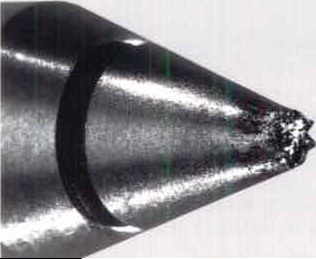
31 Fissuring of the cathode tip as a result of excessive current ripple
Inrush current: excessive inrush current peaks combined with frequent switching of the lamp erode the cathode tip, with consequent cathodic arc instability.
So, I'm not sure, but I think you get smoother erosion of the tip without fissuring from excessive striking.
--jhawk
Posted by Matt Kerekes (Member # 2777) on 08-24-2007, 11:42 PM:
Most theatres I have worked at, and what I recommend, is starting the movie on time and 30 min later if no one has bought stop the projector and motor the remaining film through until the end.
Posted by Chris Slycord (Member # 4239) on 08-25-2007, 12:12 AM:
quote: Matt Kerekes
Most theatres I have worked at, and what I recommend, is starting the movie on time and 30 min later if no one has bought stop the projector and motor the remaining film through until the end.
How's that better than just shutting the bulb off?
You could say "Well, at least with my way I won't need to change the settings of the bulb for the next day" but that has just as much effort needed as shutting off the motor which you'll have to do since you're forcing the motor to stay on. And if something goes wrong (like a brain wrap or whatever), your motor keeps on running which'll damage a large chunk of the film. On the other hand, if I simply shut the bulb off, my automation can still pick up on any alarm situations.
Posted by Kevin Grahams (Member # 4226) on 08-29-2007, 12:00 PM:
If there's a "No show", as in no customers, I stop the projector just before the main feature. If after a 20 minute wait when there's no chance of anyone turning up at all, I reinsert the ring. Saves wear and tear on projector as well as lamp life too.
Powered by Infopop Corporation
UBB.classicTM
6.3.1.2