This is topic 3D Glasses in forum Ground Level at Film-Tech Forum ARCHIVE.
To visit this topic, use this URL:
https://ft-forum.com/ft/cgi-bin/ubb/ultimatebb.cgi?ubb=get_topic;f=5;t=002072
Posted by Poon Limpapun (Member # 4551) on 07-08-2008, 01:23 PM:
Hey guys,
We've just got the new Dolby Digital 3D System retrofitted into our digital projectors and these units comes with expensive 3D glasses that we let the audience borrow while they watch the movie.
As you know, these glasses are really expensive (US$100+)and they are re-useable after proper cleaning, what do you guys do to prevent customers from taking it home with them as a souvenir? We can't afford to lose more than 10 pairs of glasses a day so I need to figure out a solution to prevent this from happening.
Posted by Darryl Spicer (Member # 711) on 07-08-2008, 03:29 PM:
Collect them as they exit and have someone in the theatre making sure no one goes out the exit doors with them. It will probably be a pain in the ass.
Posted by Robert LaValley (Member # 4319) on 07-08-2008, 04:55 PM:
quote: Poon Limpapun
We can't afford to lose more than 10 pairs of glasses a day
man I dont think my theatre could afford to lose 1 pair a day! but tell you what I will personally babysit the theatre for $1,000 a day and garantee no glasses be lost! ![[Big Grin]](biggrin.gif)
Seriously though I worked at an IMAX theatre for a time and we just placed an usher at the exit at the end of the movie to collect 3D glasses since the usher HAD to be there anyway to clean after the show was done. I believe more glasses got broke then lost in the time I was at that theatre.
You could do a preshow annoucement to turn in the glasses to an usher to see if it helps also.
Posted by Bill Enos (Member # 440) on 07-08-2008, 06:52 PM:
I believe he's concerned that he will lose ten or more glasses daily.
Posted by Robert LaValley (Member # 4319) on 07-08-2008, 07:20 PM:
quote: Bill Enos
I believe he's concerned that he will lose ten or more glasses daily.
Yes I realise that. my first part of my last post I was trying to be funny and failing miserably. ![[Wink]](wink.gif)
Posted by Steve Guttag (Member # 268) on 07-08-2008, 07:24 PM:
The Dolby glasses come with an embedded chip to trigger security alarms just like at regular merchandise stores.
You could install alarms on the exits.
Steve
Posted by Louis Bornwasser (Member # 3063) on 07-08-2008, 09:29 PM:
I can assure you that, as a Dolby dealer, the glasses don't cost $100 each. Maybe half that if your dealer is marking up more than average. Louis
Posted by Steve Guttag (Member # 268) on 07-08-2008, 09:34 PM:
My guess is that his dealer is Golden Duck Advance Technology...
The cost of the glasses probably reflect a currency difference plus what it takes (transportation wise) to get the glasses into the country and also any tarriffs.
Things are not always the same everywhere in the world when it comes to commerce.
Steve
Posted by Richard Fowler (Member # 893) on 07-08-2008, 09:56 PM:
The multiplexes I saw in Thailand handle large crowds on a regular basis with seating done quickly and in mass. The price does reflect import duty and lack of competitive options.
Posted by Scott Norwood (Member # 30) on 07-08-2008, 09:59 PM:
quote: Steve Guttag
You could install alarms on the exits.
If it's a multiplex, I'm sure that this would be lots of "fun" whenever someone gets up to use the bathroom mid-show. ![[Roll Eyes]](rolleyes.gif)
Posted by Steve Guttag (Member # 268) on 07-08-2008, 10:07 PM:
Scott,
You wouldn't want to put them at each auditorium...that would be more expensive. You would want to have them at closer to the exit of the complex.
You would be wise to have an employee at the exit where the detectors are placed for each show...think about it...the cost of one hour of employee time is substantially less than just one pair of glasses!
Posted by Sam D. Chavez (Member # 1841) on 07-09-2008, 12:38 AM:
Agree with both Louis and Steve's points. Price for the glasses was lowered at Showest, but currency difference or not, $100 is way high. Maybe a typo or misunderstanding?
Posted by Michael Wilkinson (Member # 2389) on 07-09-2008, 01:19 AM:
Have you guys seen how some shopping carts are coming equipped clutches that activate--locking up one wheel when you cross the boundary line? Maybe you could do a similar thing where when a customer crosses the boundary line the glasses begin to issue a painful electric shock or something of the like... ![[thumbsup]](graemlins/thumbsup.gif)
Posted by Tristan Lane (Member # 1169) on 07-09-2008, 03:32 AM:
quote: Poon Limpapun
We can't afford to lose more than 10 pairs of glasses a day so I need to figure out a solution to prevent this from happening
We have experienced a loss of less than 20 pairs over the course of 3 movies. Currently the only loss-prevention in place is to have floor staff at the exit of the theater as well as at the entrance. Glasses are collected there, and the staff makes sure that everyone drops off their glasses.
As Steve suggested, you can install the detectors at your doors so that an alarm goes off when someone tries to exit the building with glasses. This system isn't cheap though.
Posted by Ramin Hashemi (Member # 2694) on 07-09-2008, 06:46 AM:
for listening assistance devices, we request a drivers license or credit card to be left with us. You could require a drivers license, or credit card imprint, or cash deposit.
Posted by Robert LaValley (Member # 4319) on 07-09-2008, 07:07 AM:
quote: Michael Wilkinson
the glasses begin to issue a painful electric shock or something of the like...
Sounds like mission impossible, "these glasses will self distruct in 5....4....3....2..... ![[scream]](graemlins/scream.gif) "
"
Posted by Mark J. Marshall (Member # 1409) on 07-09-2008, 09:45 AM:
Can someone post a picture of the glasses?
Posted by David Stambaugh (Member # 1102) on 07-09-2008, 10:58 AM:
This must be them:
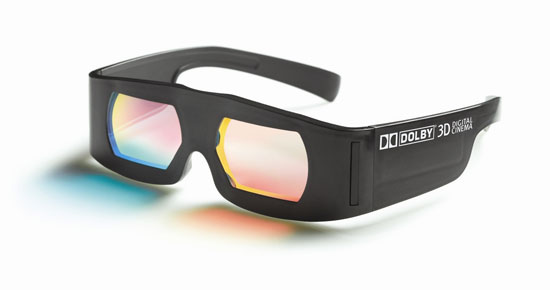
Posted by Mike Blakesley (Member # 26) on 07-09-2008, 12:02 PM:
Somebody who steals glasses could be a person who wants to have their own pair, as opposed to using a set that other people have chewed, drooled and/or gotten their germs on.
A good solution would be to sell the glasses. Hasn't some company come up with designer, more comfortable glasses? If not it would be a great idea - providing 3D turns out to be a big deal, which I'm still not convinced it will.
Posted by Thomas Pitt (Member # 4322) on 07-09-2008, 01:20 PM:
I have been to a few Real-D showings in my time, and been allowed to keep the glasses every time. I guess they're fairly cheap to make with circular polarizers and no electronics - the complex bit is the flickering polarizer in front of the projector.
With IMAX 3D, the glasses are usually not 'disposable' and have to be returned after each showing. For the first IMAX 3D I ever saw (in London), the glasses contained 'headphone' speakers - working via IRDA receivers - in addition to the normal polarizers. This allowed for an extra sound channel with the speakers very close to your ear - for things like CB radio and telephone conversations in the film.
At the exit door, they had a rack for you to return the glasses to and an alarm system in case you tried to sneak one out!
In the Bradford IMAX, even though the glasses look much 'cheaper', you still can't keep them. There's a 'trash can' at the exit for you to put the glasses in, and a member of staff making sure nobody sneaks a pair out
Posted by Kenneth Wuepper (Member # 1174) on 07-09-2008, 02:43 PM:
A permanently attached security tag with the theatre name, like hidden inside large ticket retail items, could be visibly attached to the glasses with the implication that an alarm would sound if the glasses went through any door.
Sensors for these tags are relatively inexpensive and "look alike" dummies (like surveillance cameras) are even less expensive when compared to the cost of even a few pairs of lost glasses.
A useful bit of pre-show entertainment would be to illustrate how the glasses are "sanitized" after each use. Also show how the glasses are useless without the very expensive stuff in the booth to activate them.
KEN
Posted by Tristan Lane (Member # 1169) on 07-09-2008, 11:50 PM:
Dolby thought about this and the tag is already incorporated into the glasses. It's covered by a sticker that says "Security Device installed" or something to that effect.
The cost issue with the Dolby glasses is due to the lenses. They are curved optical glass with coatings that resemble the dicroic coating on a reflector.
Part of the loss mentioned in my previous post included damaged glasses. We have not had any frames break yet, but the lenses have popped out of a few pairs and never recovered.
Posted by Adam Holland (Member # 4539) on 07-11-2008, 08:56 PM:
WalMart is giving away the free through away 3-D glasses this week for the upcoming Hannah Montanna DVD release. Since we haven't gotten our new 35mm equipment and are having to rent from Swank, we are getting we will be showing the film two days after the DVD release and tickets sales are going well at this time for that movie.
I was able to talk our local WalMart manager into giving me 400 pairs of the glasses that I will be using that weekend. We will try to reuse them the best we can each show.
Just thought I would throw that out there to all of you.
Posted by Frank Angel (Member # 248) on 07-13-2008, 03:50 PM:
quote: Kenneth Wuepper
A useful bit of pre-show entertainment would be to illustrate how the glasses are "sanitized" after each use.
So how DO they sanitize these things? I know the idea of putting something on my head that was on othere people's heads isn't exactly appealing to many people, no matter how "sanitized" they say it is. And isn't that an expensive proposition in and of itself....cleaning all those glasses?
Don't all the Real-D systems and the newer IMAX film 3D systems use circular polariod now instead of the expensive active LCD glasses that Thomas is talking about in the older IMAX 3D system?
How do these Dolby glasses work, anyway? They are not active LCD shutters or any other active electronic system, are they?
Posted by Lyle Romer (Member # 1266) on 07-13-2008, 04:02 PM:
The Dolby 3D Galsses are a passive system. The are expensive because the lenses are very expensive tinted color filters.
The glasses are sanitised in a commercial grade dishwasher the same way that silverware and plates are sanitised in a restaurant. If it's not appealing to wear glasses that have been through the process after being on somebody's head then it must really not be appealing to eat in a restaurant.
Posted by Tristan Lane (Member # 1169) on 07-13-2008, 04:11 PM:
I can't remember the term used by the Dolby guys used to describe the technology, but it seems that the filter wheel modifies the light in a similar fashion that polarizing does, but without the need to maintain the effect by using a silver screen. To me the filter and glasses look like dichroics. The lenses have a slight red and green tint. This doesn't affect the viewer's perception of the image because software is used within the Show Player to correct the color of each eye's image. Color correction is set on a screen-by-screen basis to allow for accurate representation of color on different variables within the theater.
On sanitizing: Most theaters get a commercial chemical based dishwasher, and clean the glasses in the same fashion as dishes and glassware in a restaurant. It's a low-temp system and uses a detergent, rinse aid, and sanitizer (bleach solution). A booster heater is added to assist in drying without water spots. We are also pre-treating some glasses with lens cleaner to break down the butter and oils that accumulate from people eating buttered popcorn and touching their glasses. Some of the glasses coming out of the theater are literally covered in fingerprints and popcorn butter.
RealD never used active glasses. The glasses have always been throwaway polarized type.
There was a company called In3 or something that was marketing LCD shutter glass systems for theater use. The glasses were sanitized in the same way other reusables would. But, In3 was suggesting the use of a home use Fisher and Playkel dishwasher.
Posted by Ray Faultless (Member # 903) on 07-13-2008, 04:13 PM:
At the Cineworld cinemas in the UK they let you keep the glasses but charge an extra £2 on every ticket.
Posted by Frank Angel (Member # 248) on 07-13-2008, 05:39 PM:
So these different systems, Real-D polaroid vs Dolby 3D -- the 3D film releases play regardless of which 3D system is being employed, correct?
As for the santitizing issue, it really is just a matter of public perception. People have been going to restaurants for millemia. They know from life experience that they are not going to find head lice on their silverware. On the other hand, reused eyeglasses worn on the head and near the eyes, is a relatively new and different experience and one can certainly understand where people like my mom would be a little uneasy about it.
I think Kenneth's idea of showing how the sets are sanitized would be very helpful in minimizing the discomfort level. I know that when 60 Minutes did an hidden camera expose on the glasswear in hotels and showed the maids just wiping them down with dirty dust rags and then putting the "sanitized" cellophane around them, my mom almost threw up. Needless to say, plenty of people across the country had the same reaction and for the near future will not be so trusting of the hotels' sanitizing methods. You can bet many people including my mom are going to be wash every hotel drinking glass from now on before using it.
Posted by Mark Gulbrandsen (Member # 72) on 07-14-2008, 02:58 PM:
quote: Frank Angel
I think Kenneth's idea of showing how the sets are sanitized would be very helpful in minimizing the discomfort level.
Yea, they could put the sanitization machine on display behind a big glass wall like the Crispy Creame machine. Indeed, it is the cost of this machine that has turned off so many potential customers to the Dolby 3-D system... And its a rather high hidden cost(s) they don't mention in the brochures. It also takes extra employees to operate the sterilizer and circulate the glasses about. Many locations also simply do not have the room for this "extra" contraption.
Mark
Posted by Bill Enos (Member # 440) on 07-14-2008, 03:35 PM:
Just don't show them what really happens---a bunch of employees wiping the glasses off with a rag.
Posted by Jon P. Inghram (Member # 4125) on 07-14-2008, 03:40 PM:
Expanding on Tristans description of Dolby 3D, the filter wheel has two different narrowband RGB dichroic filters which match the same filters in the glasses.
The left and right 3D filters each block all colors except a different set of three narrow frequencies and are chosen so that the filter on one eye can completely block the light from the other eye while still having adequate color reproduction.
Posted by Thomas Pitt (Member # 4322) on 07-14-2008, 03:43 PM:
Regarding selling the glasses... you could get a pair of glasses as normal when you buy a ticket to your first 3D show. You then get to keep the glasses.
How about bringing the glasses back to subsequent 3D showings, and they give you a discount on the ticket price? At least then you'd have your own pair and know exactly who has been wearing them for future viewings ![[Smile]](smile.gif)
When the Leeds Light cinema ran Spy Kids 3D and Sharkboy & Lavagirl (both anaglyph), they only let patrons borrow the glasses for the duration of the show. Like with IMAX, you had to return the glasses at the end - even though they were very cheap cardboard glasses! Most other UK cinemas would just give out the glasses when you bought tickets, and you could keep them after the show.
I'm not sure how best to demonstrate sanitization of the glasses. Perhaps photos in the lobby showing the process? A video running on the lobby monitors in between trailers? A video as part of the pre-show before the movie?
In Bradford IMAX, I'm almost certain that after collecting the glasses at the end of a show, they're just taken straight back to the entrance to be given out again for the next 3D showing - no sanitization at all. In fact, I'm not sure the glasses have EVER been cleaned, given how smeared they were when I saw Cyberworld 3D recently!
Posted by Tristan Lane (Member # 1169) on 07-14-2008, 10:50 PM:
In our theater, the dishwasher used for sanitizing the glasses is located in the Bar so all restaurant/theater customers see us running racks of glasses through the washer. I guess with a theater equipped with a restaurant, it's easier to believe that we have the equipment to properly sanitize the glasses.
I don't know if many customers would opt to pay the steep price of glasses to keep as their own, nor would there be an easy way of telling which customers paid for their glasses and which ones wouldn't. Keep in mind, the glasses cost almost as much as a tank of gas in the states. For many people, it just wouldn't seem like a worthwhile investment.
quote: Jon P. Inghram
narrowband RGB dichroic filters
That's the term!
Posted by Poon Limpapun (Member # 4551) on 07-19-2008, 04:40 PM:
Well, so far we have managed to loose around six pairs of glasses plus around two more which is damaged in the glasses sanitizer machine.
Anyway, we actually did great at advanced sales for this movie so I think we are in quite a good shape. The Sensormatic gate doesnt really work at all as the sensors in the 3D glasses gets rusted when we wash them in the sanitization machine.
Any ideas on this? or shouldn't we wash the glasses in water?
Posted by Bill Enos (Member # 440) on 07-19-2008, 07:19 PM:
How many times can the glasses go thru the dishwasher and still still be in acceptable condition? The glasses I've used at theme parks were all in pretty rough shape and it took trying several at the pick up point to get something usable, even then what was OK for a few minute ride would have totally unacceptable for an hour and a half + movie.
Theatres can't afford to toss pricey glasses because they have a few scratches and the frames are wobbly.
[ 07-21-2008, 10:29 AM: Message edited by: Bill Enos ]
Posted by Steve Guttag (Member # 268) on 07-19-2008, 08:06 PM:
I believe Dolby claims that they are good for about 500 cycles...which sounds like a lot at first...until you realize that with a 5-show schedule...that you get about 1000 shows (each pair only has to be issued, at most, 1/2 of the shows....so with a 5-show/day schedule...if running continious 3-D as the folks would want you to think they are going to do...that amounts to about 200-days of continious use or LESS than 1-year.
Steve
Posted by Frank Angel (Member # 248) on 07-20-2008, 03:21 AM:
At $100 a pop, that STILL sounds like a theatre would be playing very close to the edge of profitability, especially if you ante up the cost of breakage, stealage or the price of oil which might the cost of manufacturing them jump pretty drastically. Dolby better hope that in a few months they don't cost $200 to make.
Did I tell you that petroleum based tuner cleaner -- the stuff we've used for years that was so cheap you never even thought of the cost or conserving it. I used to buy for between $5 and $6 a 22oz can -- it now costs $23. I kept telling the salesman at Newark Electronics that they had to have made a mistake in their on-line catalog. Nope.
Same thing that happened to all plastics during the oil shortage in the 70s. Remember how the price of record albums jumped because the vinyl became so expensive to manufacture?
Posted by Mark Gulbrandsen (Member # 72) on 07-20-2008, 09:15 AM:
One of our customers did the math and this is how he looks at the 3-D thing... He certainly makes sense!!
"Real D is promising that the cost of their glasses will not exceed 75 cents.
Real D prohibits reuse of the glasses. Let's say they are 50 cents and
Dolby is $39 currently, then 500 cycles on the Dolby glasses would be 7.8
cents each. I think the 500 cycles per pair is optimistic.
Lets assume it costs 20 cents per pair in labor, energy and material to
collect and wash the Dolby glasses, then the Dolby cost pretty much equals
the Real D cost at 130 cycles."
"Real D offers either a flat annual license or a per ticket royalty. Each
chain negotiates their own deal, but lets say it is 50 cents per ticket.
Once you have paid for the Dolby color wheel and software, then you are home
free without any additional royalties due. So your total cost per patron is
now $1 each for Real D, and 50 cents (glasses and cleaning over 130 cycles)
on Dolby. If you beat the 130 uses, then the Dolby costs goes down."
"Dual projector has light advantages and no licensing expenses. However
polarized glasses and silver screen are still required. Guess who owns
the polarized glasses company? Real D.
Anybody using Real D or dual projectors better be prepared to FREQUENTLY
replace the silver screen ($10 per foot plus labor). In the real world they
do get attacked and even the smallest scratch or stain is very noticeable.
No matter how much you curve the silver screen or flatten the hot spot, you
are going to lose seating in a wide auditorium. At the Real D screening of
JOURNEY at Showeast, they blocked off the left and right side front seating
in the Paris showroom (wide theatre). Silver is just evil.
Best case solution is for 3-D to go away.
Posted by Darryl Spicer (Member # 711) on 07-20-2008, 01:30 PM:
quote: Mark Gulbrandsen
Best case solution is for 3-D to go away.
You got that right. With today's costs in life going up I don't know how long people are going to take having to pay extra for 3-D. Something that we never had to do in the previous rounds of the format. After the batch of 3-D product that will be coming out over the next year and a half it will be interesting to see how fed up people will be with the process and the extra costs to see it. If anyone out there is using the "the extra cost is going for the glasses" line better watch out because people are going to be bringing there glasses back with them to their next 3-D shoving and demanding that they not have to pay the extra cost because they already have their glasses. Box people should be telling people if asked that the extra cost is for the 3-D experience not the glasses.
Posted by Jack Theakston (Member # 4484) on 07-20-2008, 02:30 PM:
Prices were ALWAYS raised for 3-D whenever it was used, but it was solely for the glasses and nothing else.
The problem with RealD doesn't even start with their glasses policy or the silver screen even. If you're running a number of screens, you're better off putting the RealD installation in one of your narrower, longer theaters with a smaller screen if you have a choice in the matter. Big does not equal better in 3-D.
RealD's biggest problem is a) the resolution on their screens, which are less than HD, b) the amount of light, or lack thereof, that they're getting and c) the problem with both RealD and Dolby is that going into it, you're out of phase, simply because it's a sequential system.
Most everyone won't know or care about these, but if you even have an iota of professionalism, you'll realize that for all of their faults, the days of dual strip and over/under were MUCH better presentations when done right.
Regarding cleaning Polarized glasses (I realize the question was in regards to the Dolby glasses)-- if you are recycling glasses, do not run water on them. If you have to clean them, breath on them and wipe them gently down with a Kleenex (specifically this brand). Because Polaroid material depends on what are essentially scratches on the surface of the glass, any alternating scratches from a rough material can be disastrous.
The cure for the problem is prevention. You have to tell people before the show not to touch the lenses otherwise they won't see 3-D. This is technically a lie, but in a way it's a truth, too, because otherwise they'll be seeing a smudged show. The fear of this consequence I find often gets people not to touch the lenses.
3-D is a viable art-form in the future (as anyone who has seen a proper presentation knows), but there's a lot that Hollywood has to learn about it before they can apply it to films. Unfortunately, the people running these companies are a perfect example of "a little knowledge can be harmful."
Posted by Darryl Spicer (Member # 711) on 07-20-2008, 02:47 PM:
quote: Jack Theakston
Prices were ALWAYS raised for 3-D whenever it was used, but it was solely for the glasses and nothing else.
Not at the locations I worked for back in the 80's when 3-D was being used. The prices were the same as any other movie.
Posted by Jack Theakston (Member # 4484) on 07-20-2008, 02:51 PM:
That is interesting, then. I would suppose those locations were part of the overhead. During the 1950s, it was not uncommon for you to see an extra 10 cents added for glasses.
Posted by Mark Gulbrandsen (Member # 72) on 07-20-2008, 07:44 PM:
quote: Jack Theakston
RealD's biggest problem is a) the resolution on their screens, which are less than HD, b) the amount of light, or lack thereof, that they're getting
The resolution problem will be delt with by the new breed of 1.2" DMD's that can operate at triple flash AND full frame. Look for them in projectors starting in September/October. The studios also want to raise light levels and so on. The colors can be mixed for any 3-D operating light level. Indeed DLP technology goes forword in spite of one Film-Techers very wrong prediction that it'll be going away. A major lens manufacturer is at present scurrying to get an entire line of 1.2" based lenses to market... The glass factory that Konica/Minolta uses is in Shengdu(SP?) China and although not destroyed by the earthquake the power plant that ran it lies in rubble. It'll be down for years. Not to worry though as at least Christie has literally gobs of each lens in stock.
Mark
Posted by Frank Angel (Member # 248) on 07-21-2008, 02:48 AM:
quote: Mark Gulbrandsen
The resolution problem will be delt with by the new breed of 1.2" DMD's that can operate at triple flash AND full frame. Look for them in projectors starting in September/October.
So what do the guys who already purchased the projectors that have smaller namo mirror modules? How much will it cost them to retrofit to the larger DMDs, if they are even backward compatible? How happy can anyone who already has invested in the RealD system be about this next generation of improvements? Aren't those who shouted the praises RealD's low rez DMDs with lower light output in serious danger of getting dragged into dark alleys and pummled roundly?
quote: Mark Gulbrandsen
Indeed DLP technology goes forword
Indeed it does and at the cost of leaving those who were eager to jump on that much hyped earlier roll out, pretty much holding their privates. An exageration? Perhaps (but not by much).... but you get my point.
So with all this forward moving technology -- seemingly going so fast that before one can even plunk down their money on the counter, the box being handed to them contains equipment that is already obsolete or needs upgraded out of the box -- how can one have any confidence in the longevity of digital, and more importantly, in the viability of their investment?
And Mark, let me ask you this; you seem to be downplaying the obvious next move in digital, and that is to go to higher rez -- you are pretty uncharacteristically blaze about 4K projectors (even as there is talk of 8K on the horizon). You seem to be quite content with the 2K generation, even to the point were you sound like those of us who felt that DLP wouldn't become viable for a long time and that film would/will hold on in spite of the digital rollout(s). I get the impression that you feel the same about 2K, that it will hold on inspite of 4K roll-outs, even though at least Sony, Barco and IMAX seem to think 4K is the future. Just wondering about your take on 4K when advances seem to be constantly moving forward, as you point out.
Posted by Tristan Lane (Member # 1169) on 07-23-2008, 01:03 AM:
quote: Mark Gulbrandsen
The resolution problem will be delt with by the new breed of 1.2" DMD's that can operate at triple flash AND full frame. Look for them in projectors starting in September/October.
Mark, all of the .98 chipped machines can already run 6:2 at full resolution.
I've always wondered if TI will come out with an improved EFIB to allow the current 1.2 machines to run full res 6:2.
quote: Frank Angel
Aren't those who shouted the praises RealD's low rez DMDs with lower light output in serious danger of getting dragged into dark alleys and pummled roundly?
Frank, you're such a New-Yorker.
quote: Frank Angel
the box being handed to them contains equipment that is already obsolete or needs upgraded out of the box -- how can one have any confidence in the longevity of digital, and more importantly, in the viability of their investment?
The same words were spoken by many when that new-fangled "Personal Computer" started hitting the stores.
Posted by Mark Gulbrandsen (Member # 72) on 07-23-2008, 08:33 AM:
quote: Tristan Lane
Mark, all of the .98 chipped machines can already run 6:2 at full resolution.
Yes, but the problem there is that they can only take a maximum 3kw lamp before they turn to toast. This is the reason for the on going research and further development into the 1.2" DMD's. The future in 3-D lies not in .98" chips but in the 1.2" chips where the studios can eventually use them to bring up the 3-D light levels.
quote: Frank Angel
So what do the guys who already purchased the projectors that have smaller namo mirror modules? How much will it cost them to retrofit to the larger DMDs, if they are even backward compatible? How happy can anyone who already has invested in the RealD system be about this next generation of improvements?
Don't know yet but there could be something in the works with at least two manufacturers as an upgrade. It will require the light engine to be replaced.
quote: Tristan Lane
Frank, you're such a New-Yorker.
Agreed! He needs to come spend a couple months around the Tetons and leave the muggers at home in NYC .
Mark
Posted by Poon Limpapun (Member # 4551) on 08-02-2008, 07:27 PM:
OK..this may sound a bit weird
BUT we have had two cases of customers
stealing the lenses from the Dolby Glasses.
They didn't take the frames though, only the Lenses.
Somehow, they have managed to get it out from
the frame without damaging them. I suspect CHINESE
PEOPLE wanting to copy them.. hmm.. maybe DOLBIAN
3D DIGITIAN SYSTEIM? or something like that ...eh?
Posted by Tristan Lane (Member # 1169) on 08-03-2008, 01:47 AM:
Ummm, Okay.
You can't be serious?
Powered by Infopop Corporation
UBB.classicTM
6.3.1.2