This is topic Dimmable CFL's in the auditoriums in forum Ground Level at Film-Tech Forum ARCHIVE.
To visit this topic, use this URL:
https://ft-forum.com/ft/cgi-bin/ubb/ultimatebb.cgi?ubb=get_topic;f=5;t=002091
Posted by Bruce McGee (Member # 131) on 08-18-2008, 05:53 PM:
I installed dimmable CFL's in a small auditorium today. Our automation dimmers are the old SCR/Triac type. I cant get the lights to dim more than about 30% even with the setting on the automation turned all the way down. At the down setting, the regular lights would be out. The auditorium is still lit too much.
What are you guys doing to remedy this problem? I cant just turn them off without being there when the movie ends. I sure dont want a customer to fall or something worse because we have to turn the lights off!
Posted by Mark Gulbrandsen (Member # 72) on 08-18-2008, 07:39 PM:
I've done ALOT of work on dimmable florescent systems.... almost too much. The lowest you can go is 5% before wierd things start to happen and this requires some pretty specialized florescent related gear to accomplish.
If you lamps flash and flutter before extinguishing the way to cure that is to set the dimmer low level cut off to occur just before the flutterin and a blinkin occur. As the lamps age they will also begin to dim to different low level amounts before they flutter and go out. It also requires special ballasts and dimmers to do the job properly... which in my book still isn't even working properly nor will it ever be able to dim down to 0%. Both Strand, and Colortran (now owned and totally fucked up by Leviton) make the special dimmer modules. Many ballast manufacturers make the ballasts which are solid state. I don't recommend any of it. The power you saved will be spent in special lamps and ballasts during the life of the building they are in. Low voltage lighting I feel would clearly be the wiser choice.
Probably the biggest florescent farce on record occurred in Cineplex theaters during their last major builds here in the U.S. They installed florescent lights in all auditoriums at all locations(that I know of) connected to those Stanley Ash Canadian Made Dimmers... when you went to dim em down you got a nifty light show as they strobed on and off, flashed, fluttered, like CE3K! Then they finally went out. Can't blame the dimmers for it though.. they weren't made to do it. The dimmers could have been modified for a low cut off point at around 30% which is where the fluttering started to happen. A simple relay that would drop out the dimmer at 30% would have been a very easy fix for these locations.
Edit:
Oops! Left out an important trait of florescents and that is they tend to glow for a while after they have been turned off ![[Eek!]](eek.gif) .
.
Also see Dimming Florescents
Mark
Posted by Bruce Hansen (Member # 281) on 08-18-2008, 09:40 PM:
You might try putting one incandescent lamp in each dimming circuit. This will give the dimmer a more stable load to look into. It may help a little. I don't care what the manufactures say, gas discharge lamps are not really dimmable.
Posted by Paul Mayer (Member # 355) on 08-18-2008, 10:17 PM:
CFLs haven't worked well for me either. I've been looking for dimmable room lighting that will draw much less current than what I'm currently using in my portable projection setup.
Even with available fluorescent dimmers and dimmable ballasts the lamps only go down to about 1/3 brightness, then they cut to black. When I bring them up, even when starting from zero, they snap on to about 1/2 brightness. It's just not a good enough result, given what it cost to assemble and try this system. Might as well just turn the lights on or off - not very professional.
I went back to my original setup - halogen scoops pointed up to bounce light off the ceiling, controlled by a regular triac dimmer. Just have to have a separate 15-amp circuit to power it.
When I recover from the cost of this failed CFL experiment, I next want to look at LEDs and PWM dimmers as a dimmable room lighting solution. More research.
Posted by Mark Gulbrandsen (Member # 72) on 08-19-2008, 08:30 AM:
quote: Paul Mayer
When I recover from the cost of this failed CFL experiment, I next want to look at LEDs and PWM dimmers as a dimmable room lighting solution. More research.
As I mentioned above there are florescent lamps and ballasts that when used in conjunction with the proper dimmers can dim down to 5%. And yes they do pop on and off at that level then dim up or down. Many LED's have similar characteristics as florescents do... in other words they are only dimmable to a certain extent. The best answer is still low voltage lighting which is completely dimmable.
Mark
Posted by Jim Cassedy (Member # 4115) on 08-19-2008, 10:04 AM:
I had a theater employee install a CFL in a rear wall sconce that was connected to an older type autotransformer dimmer.
Later, the bottom of the CFL totally melted and began to smoke before shorting out as the electronic ballast overheated.
I was able to get some consumer grade CFL's to work on an electonic dimmer circuit at my home by installing at least one standard incandescent on the same circuit as someone else mentioned here.
I think the incandescent works as sort of a 'ballast' so the electronic dimmer sees a constant load.
Since CFL's are not in a 'constant-on' state, and the dimmer works by altering the current duty-cycle, without the incandescent all my CFL's would do was to strobe.
A nice effect- - but not what I wanted.
Posted by Frank Angel (Member # 248) on 08-19-2008, 10:46 AM:
quote: Mark Gulbrandsen
Oops! Left out an important trait of florescents and that is they tend to glow for a while after they have been turned off.
AND, they don't come to full brightness until a good minute, minute & half after they are brought up to full.
As far as being dimmable (the ones that say they are made specificially for being able to be dimmed -- forget about the standard ones) it's a joke. THEY SUCK. I didn't do the extensive experimentation that Mark has done on them, all I needed was to have a slew of them either overheat and smoke to death like Jim's, or even when they did work down to that totally unacceptable 25, 30% blink out level, they would die prematurely. CFLs, even when they don't go up in smoke on you are much too unreliable (some of ours even in regular non-dim service die very early on).
The only way CFLs will work in dimming situations with the same effectivness as incandescents, is if they are in fixtures like they have at Radio City Music Hall -- fixtures that have an iris and a small motor controlled by the DMX signals from the lighting console. The iris is what dims the light, not the light source. Such a fixture doesn't have to be elaborate, just an enclosure and a simple vane that can be opened and closed by a micro motor. Yah, it could be done, but there goes any savings you might get from using CFLs, no matter how inexpensive they could make such a fixture.
Posted by Demetris Thoupis (Member # 833) on 08-19-2008, 11:40 AM:
0-10 Ballast dimming
DMX Dimming
DALI dimming
That is the way if you want to actually DIM fluorescents. You will require a special type of dimmer of course (Lutron makes the GXI31xx series if you want which dims 4 circuits of fluorescent). The lowest you might be able to get them is around 7-10% and then they switch off. Different manufacturers offer better ballasts. You might find fluorescents which switch off at 30 or even 40%. It depends on the manufacturer and especially in auditoriums, it's not really worth it. Go for 3 runs of rope light instead.
Demetris
Posted by Bruce McGee (Member # 131) on 08-19-2008, 06:04 PM:
I tried the idea of leaving a standard lamp in the circuit. In fact, I tried one regular lamp on each side of the theatre. Doesent work.
I'm sure when the higher-ups in my company get wind of these problems, something will change.
Its odd how the CFL's continue to glow even when the standard incandescents are completely dark. I'm sending this thread to my tech.
Thanks Guys!
Posted by Bill Enos (Member # 440) on 08-19-2008, 07:05 PM:
I've tried supposedly dimmable compact fluorescents on both resistance and electronic dimmers with the same result---they dim about 20% and blink off.
Posted by Lyle Romer (Member # 1266) on 08-20-2008, 10:37 AM:
Dimmable LEDs could be designed that shut off parts of the led array for different light levels instead of dimming each led.
You could design a fixtue that lets say has 100 LEDs in it and then turns one off for each 1% in dimming. You could do something similar with multi-element CFLs but the bulb would be very expensive.
Posted by Robert Minichino (Member # 3495) on 08-20-2008, 12:19 PM:
But PWM LED dimmers are 90+% efficient and you save the extra wire you'd need to make banks of LEDs. LEDs themselves can be modulated continuously from total dark to full-on with no loss of efficiency and little change in color temperature.
Posted by Mike Blakesley (Member # 26) on 08-20-2008, 07:58 PM:
I've now seen floodlight bulbs that have those twirly bulbs built in....would love to use those in the theatre ceiling but would be leery of how they would behave (or misbehave) with the dimmer.
Posted by Gordon McLeod (Member # 33) on 08-20-2008, 09:44 PM:
I have recently installed a fair number of dimmable CFL made by U Lighting America
They dim smoothly on standard triac and SCR dimmers to 430volts RMS and then flicker and go out
Bruce what make of dimmer do you have some require an adjustment to the trigger ramp circuit depending on load type and amount
Posted by Mark Gulbrandsen (Member # 72) on 08-20-2008, 10:24 PM:
quote: Gordon McLeod
They dim smoothly on standard triac and SCR dimmers to 430volts RMS and then flicker and go out
Well, all the dimmable florescent systems I've worked with do indeed dim smoothly down to where they start to flicker... but they are not supposed to flicker before they go out, they should simply go out right before that flicker begins to happen. Many dimmers just make use of a small contactor to disconnect the lamp from the dimmer just before that flicker point. Some are adjustable and some not... some dimmers are very ballast and lamp specific.
Mark
Posted by Frank Angel (Member # 248) on 08-21-2008, 11:14 AM:
Oh, I forgot to mention how much more difficult it is to get the RF noise they generate from getting into sound systems. Stick 200 of those suckers in a house light array and you can bet it won't be pleasant listening to that BUZZZZZZ.
Posted by Bruce McGee (Member # 131) on 08-21-2008, 06:40 PM:
We have CFS automation. Not sure about the trigger rate change adjustment, Gordon.
I hadn't even thought about noise in the sound system. I will check that out and get back to you guys the first of the week on this.
Posted by Gordon McLeod (Member # 33) on 08-21-2008, 08:27 PM:
We have had no noise issues with the cfl lamps
the lamps we are using are made in china for a company called U Lighting America
The colour temp is very good
The CFS dimmer is the same as the Raven and it may have issues with the amount of inductive load
Posted by Thomas Pitt (Member # 4322) on 08-22-2008, 06:16 PM:
Here's a thought. I read Lyle's post about LED arrays, and thought that idea could be applied to CFL lamps as well. Instead of having a single lamp and trying to dim it, have two or three different lighting circuits - switching them off individually.
Intermission - all lights on
Trailer level - Half the lights on
Movie - all lights off (except maybe one for safety reasons)
It's important to space out the CFL lights evenly like this, so that when you turn off one circuit it doesn't create bright spots and uneven lighting in the auditorium.
Posted by Louis Bornwasser (Member # 3063) on 08-24-2008, 03:32 PM:
I'm pretty sure that I speak for Monte and other old-timers like myself: Almost all the neighborhood theatres used a multi color system like described above. We didn't have a dimmer, "This is where we came in!"
It would be possible to use a white LED array along with zener diodes to switch on another group of LEDs at ever increasing voltages. Dimming LEDs doesn't work very well as any user of AW3 platters can attest. Louis
Posted by Bruce Hansen (Member # 281) on 08-24-2008, 06:16 PM:
LEDs can be dimmed smoothly from full on to full off, but they are diodes, and therefore they are avalanche mode devices. They are current dependent, not voltage dependent. They may not be very happy with an SCR/TRIAC type dimmer.
Posted by Gordon McLeod (Member # 33) on 08-25-2008, 08:13 PM:
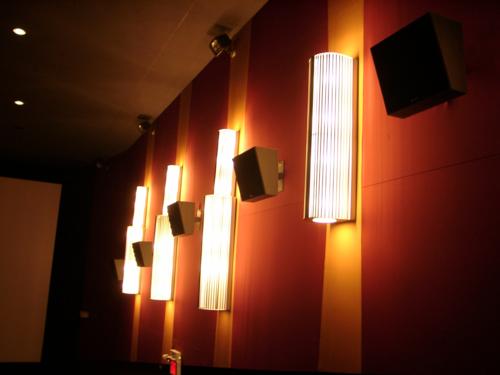
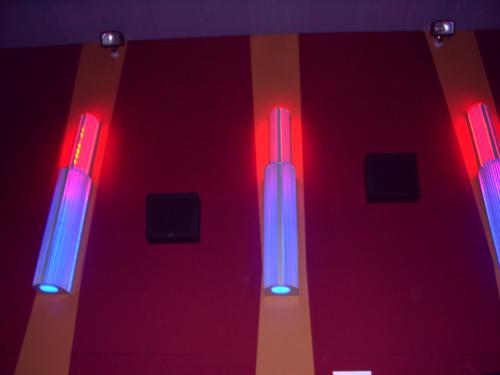
We recently did a 7 plex were we recreated a 1940's fixture getting the original maker (VOIGHT LIGHTING) to build the metal work to our specs and they are using dimmable CFL lamps for the white circuit and Red and Blue LED modules (TEMPO LIGHTING) for the two colour effect
They are controlled by 2 standard TEC8112 Stan Ash dimmiers with no issues at all We had no issues to date with over 1000 modules we used
Posted by Frank Angel (Member # 248) on 08-25-2008, 11:11 PM:
Very sweet Gordon. And they dim out completely without flicker? Who manufactures the CFLs? Are they custom spec-ed or off the shelf. And the LED modules -- same question. We are looking to put dimmable light in our drapped side panels but there is an issue of incandescent fixtures generating heat too too close to the velour. LEDs, even CFLs would be ideal. Tempo carries an off the shelf line of LED modules?
Posted by Gordon McLeod (Member # 33) on 08-26-2008, 10:31 AM:
We use the tempo serries of modules that fit into a track designed for cove lighting
the fade very smoothly right out
The CFL dim smoothly nto 30 volts then drop off
they are from an online source U Lighting America
Posted by Gordon Bachlund (Member # 124) on 08-29-2008, 08:47 PM:
Gordon, it’s gratifying to see someone finally pay attention to the aesthetics of theatre lighting. The fixtures you replicated indeed harken back to the wonderful neighborhood theatres of the 1930s and 40s when atmosphere and showmanship were essential to successful theatre operation.
Recent improvements of the design of CFLs and their efficiency, especially in combination with the efficiency of LEDs, afford opportunities for significant energy savings while creating a pleasant ambience that will welcome customers.
Well done, sir! Well done!!
Posted by Joe Redifer (Member # 3) on 08-29-2008, 11:41 PM:
I recommend using real light bulbs (re: incandescent). They won't pull this type of BS, are loads cheaper and easier to deal with. You are not saving the planet by using CFLs.
Posted by Gordon Bachlund (Member # 124) on 08-30-2008, 02:38 PM:
My endorsement of CFLs and LEDs is not driven by politics but by the hard reality of life-cycle cost.
Most CFLs are rated at about 8,000 hours, while most standard incandescent lamps are rated at about 800 hours. Higher life rated incandescent lamps are available but sacrifice lumen/watt efficiency, and often color temperature, for the added hours.
Most LEDs are rated at about 100,000 hours.
The cost to re-lamp the fixtures (every 800 hours versus every 8,000 hours) and the improved lumen/watt efficiency at a time when energy costs are rising make a compelling case for the use of CFLs.
Posted by Gordon McLeod (Member # 33) on 08-31-2008, 04:03 PM:
The other big issue was heat
Modern laqured coloured lamps fade and loss the hue so that entailed LEDs for the colour circuit
At the same point incadescent white circuit would have generated too much internal heat in the fixture for the LED modules to survive
Posted by Frank Angel (Member # 248) on 09-01-2008, 05:55 PM:
No question, heat is a major consideration in some situations. We have four 20 foot curtains on either sides of the auditorium. They are recessed so that they are flush with the wall. They cover what used to be windows, now bricked up.
We would have liked to light them when we did the refurbishment a few years ago, but the depth of space in which they sit isn't deep enough to put incandescent fixtures which would be too close to the velour material. It is conceivable however, that we might be able to use LED arrays to light these curtains, top and bottom, which could dim with the houselights. The much lower operating temp could make all the difference.
Powered by Infopop Corporation
UBB.classicTM
6.3.1.2