This is topic Keeping ticket stubs in forum Ground Level at Film-Tech Forum ARCHIVE.
To visit this topic, use this URL:
https://ft-forum.com/ft/cgi-bin/ubb/ultimatebb.cgi?ubb=get_topic;f=5;t=002478
Posted by Mike Blakesley (Member # 26) on 03-05-2011, 11:06 PM:
So I was packing up the ticket stubs from last week's shows when I started thinking: Why do we need to keep these dumb things? Our computer has kept track of every ticket we've sold, and if the studio wanted to audit us they can just look at our computer, which breaks down the sales to the minute.
If they did a blind count and found out we had under-sold, the computer would verify it without stubs. In fact, if anything the computer would show MORE results than the stubs would, because occasionally the printer fouls-up and doesn't print the tickets, but they still get included in our count.
So what's the point in keeping ticket stubs? Has anyone on here EVER had a studio rep want to take a look at the stubs?
Posted by Joe Redifer (Member # 3) on 03-05-2011, 11:31 PM:
When I worked at Regency they would fly a guy out from CA once every 4 months or so and he would physically count all of the stubs with the manager and usually that would result in someone getting fired (if the culprit still worked there) for scamming. We didn't always have someone on door ripping tickets, so the person selling them would rip the tickets before handing them to the customer during the weekdays.
Posted by Monte L Fullmer (Member # 2797) on 03-06-2011, 01:21 AM:
True, not so much the studios, but the company auditers checking the stubs for accurate tix sales.
They allow so much percentage of error, but too much error can spell theft to the auditor and investigations do proceed to find the answers.
Posted by Aaron Garman (Member # 1653) on 03-06-2011, 02:48 AM:
We don't keep stubs, and starting soon we will finish implementing ticket scanners. The awesome thing is when we do scanning, we can see who showed up and who didn't.
Although, I've never seen a stand alone cinemas/multiplexes utilize ticket scanners. Anyone know of any?
AJG
Posted by Tom Petrov (Member # 1534) on 03-06-2011, 04:13 AM:
I believe there is some sort of law in place that states that you have to keep a hard copy of financial data for an extended period of time. I think it is 7 years and the proper term is called document retention.
Just imagine if that hard drive or computer program is wiped out or something happens to it.
Now for individual tickets stubs that get torn at the door, I don't see any reason to keep the cinema half of it.
Posted by Frank Angel (Member # 248) on 03-06-2011, 04:49 AM:
quote: Aaron Garman
We don't keep stubs
I don't know Aaron, you'd better check your Master Contracts. I believe you will find they require you to keep ticket stubs for a number of years -- you should check on the exact time frame. The idea is that the studio can send an auditor (also in the MCs) that has legal access to your Box Office records and to the ticket stub box for inspection. The distributor is the exhibitor's contracted partner and like any partner, they have the right to have access to "their" books. That Master Contract that the theatre signs gives the distrib the right to walk into the box offices any time the theatre is in operation and he can inspect your tally sheet, ticket beginning and ending numbers and then check the physical stubs. And they can call for the physical stubs at any time too, for as many years as you are required to retain them. I believe the MC wording is that the physical studs are the distributor's property, not the theatre's. Check it out.
Then in addition to whatever the studio requires, sub retention, as Tom says, can be regulated by states on licensed businesses. You may be required under state laws and regs to retain proof of sales for a certain number of years. We seal our ticket stubs in plastic bags with the box office manager's signature as well as the ticketakers names for each engagement. I think in NYC we are required to keep them for 3 years, but I am not sure of that number, it could be longer.
If you are not keeping ANY stubs, you might want to double check what your obligation is to the distrib and to your local Indiana business laws and regs.
Posted by Louis Bornwasser (Member # 3063) on 03-06-2011, 06:43 AM:
I would keep them for a time. . . maybe 6 months. I would be religious about whatever you do and form an official policy. That way if audited, you "show conformity" to your standard method, If they have a problem they could request a change for the future.
Surely you don't keep them "forever???" Louis
Posted by Connor Kirkwood (Member # 5371) on 03-06-2011, 08:15 AM:
I remember posting about this a few months ago. I got a lot of helpful responses, but I still can't grasp the logic of keeping these stubs around.
If you have a computerized ticketing system, then you have a record and ample opportunity to back it up. If your system is internet-based, as ours, then your ticketing record is automatically stored in two places at once, in real time. The only reason for keeping stubs, that I can surmise, is to keep theaters, box office employees and/or ushers honest, but the only way to determine that is to audit on the current day and date. Once the patrons leave the theater, and there's no head count to check against the ticket record, the stubs mean nothing.
I currently manage an arthouse that keeps it's stubs for exactly one year. A year ago, I was working the booth for a second run theater. The second run place only issued transaction receipts, which left no stub for the theater to keep. I can't really see the difference between the two, except that my current theater has a six-foot tall filing cabinet full of garbage.
Posted by Dustin Mitchell (Member # 372) on 03-06-2011, 12:11 PM:
First, as far as laws go, you never know what kind of archaic laws are still on the books throughout the 50 states but since tickets are basically receipts and stubs are just the merchant copy of that receipt I don't think there is any law saying you must keep them. Stores don't keep copies of sales receipts after all, just whatever they're computer/end of day printouts say.
As far as ticket stubs go, aside from whether your master contract says to keep them or not, another thing to consider is how good one's surveillance system is. If you find someone double selling being able to go back to prior days they worked to check ticket stubs against sales records is the only really reliable way beyond security camera footage to find out how much they've been stealing and for how long.
Posted by Darryl Spicer (Member # 711) on 03-06-2011, 12:25 PM:
Two Weeks, that is what our company policy is. In the 26 years that I have worked in this industry I have never heard of or encountered an instance of a distributor sending someone out to count our ticket stubs. I have encountered situations of film companies sending out people to do head counts for a particular film and then match their counts to what we have sold, but that was years ago. I have assisted company auditors in the past in counting stubs if they have suspected inconsistencies for some reason. Those were hard ticket situations before computer sales.
Posted by Aaron Garman (Member # 1653) on 03-06-2011, 12:42 PM:
Well we do document the stubs for every performance in the center: the house manager has to report this at the end of each and every show, including all films. Also, once we switch over to scanning tickets for all events (we're in a test phase currently), we will not have actual stubs since all we will be doing is scanning tickets.
AJG
Posted by Robert D Hall (Member # 5674) on 03-06-2011, 02:03 PM:
We have never in the past 14 years keep any tickets thay go right in the trash. What we do keep is a box office report from every day printed on paper. They are filed for 7 years. I couldnt see this not being the proper way. Because our owner is a stickler for proper paper work as well as being a lawyer.
Posted by Edward Havens (Member # 4715) on 03-06-2011, 02:16 PM:
The company I currently work for makes us keep ticket stubs for the current month and the three months previous. The previous company I worked for made us keep the current month and the previous month only.
The seven years paperwork Tom is talking about is tied to payroll and personnel files.
Connor, you've already been given the answer of why they need to be kept around. For home office auditing purposes, to prevent scamming.
Posted by Nathan Powers (Member # 3715) on 03-08-2011, 11:00 AM:
Example:
Fred sells tickets at box office, fred also sells collected stubs at box office, fred makes $8.50 per ticket for the cinema, and fred makes $8.50 per ticket for himself. Computer says you have 150 people in cinema #2, actual people in cinema #2 is 250.
The computer would not help you catch this the next day. Unless you count the cinemas every show, you would never know.
Examples like this are why you need to keep them. You need to make sure your not getting scammed by your employees, and the film companies need to make sure your not scamming them.
Posted by Michael Brown (Member # 890) on 03-08-2011, 04:39 PM:
In the UK there are at least a couple of cinemas (one large chain and a couple of independents) who don't even take stubs. On entry to the theatre the staff member makes a tear in the middle of the ticket and hands the whole lot back to the customer. (nothing is kept by the member of staff)
Posted by Frank Angel (Member # 248) on 03-08-2011, 08:59 PM:
Sure, it might sound silly to some, but it's dead serious to the studio issuing the license, and they are not the ones to whom you want to give the idea that you don't take their requirements seriously. Not smart to get on the wrong side of thems who supply you your livelyhood. ![[Eek!]](eek.gif)
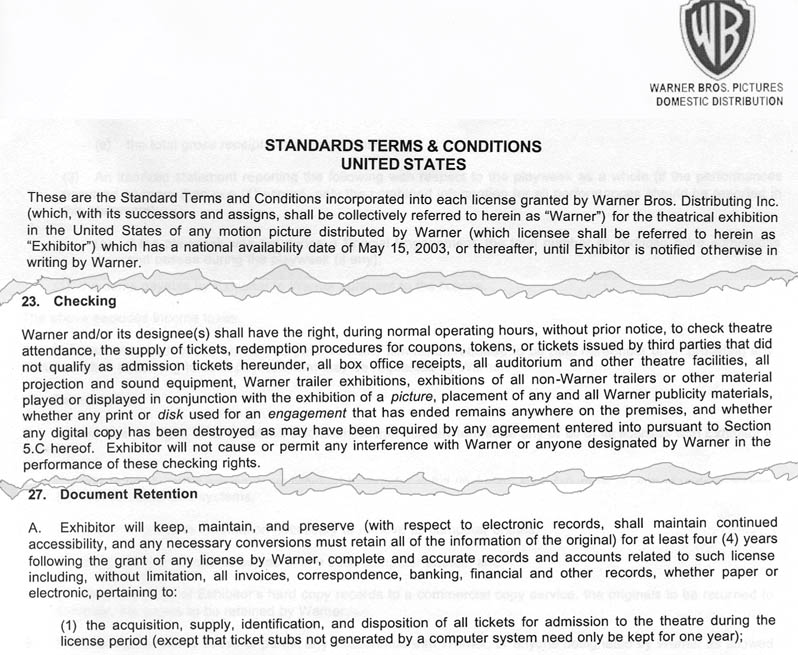
And sure, you may go for years, even decades without distrib henchmen decending on your theatre wanting to inspect the box office and the booth and all your records for the current engagement of theirs on demand as well as all the films of theirs that you might have run in the past as well. They legally are you partners and have the right to do this, as fasciest as it might sound on first blush. But you can see by the master contract below it's all there, signed sealed and delivered by both parties. So just because their policies my not make any sense to us, they are the conditions upon which we get to book their films and underwhich the exhibitor agrees to abide by if it wants to play WB titles. And trust me, if these Master Contracts are not word-for-word across the board from one studio to then next, they are policy-for-policy almost identical -- each says nearly identically the same thing with regard to retention of records including stubs and rights to enter locked doors.
This is from the WB Master Contract:
Posted by Mike Blakesley (Member # 26) on 03-09-2011, 12:01 PM:
Closely reading that paragraph 27, it doesn't seem to say that ticket STUBS need to be retained at all, except ones not generated by computer. If computer-generated, it appears to say that only records need to be kept for 4 years, and then seems to allow for either electronic or paper format --- mainly that they need to be accessible.
Am I missing something?
Posted by Adam Martin (Member # 641) on 03-09-2011, 02:54 PM:
quote: Nathan Powers
Fred sells tickets at box office, fred also sells collected stubs at box office, fred makes $8.50 per ticket for the cinema, and fred makes $8.50 per ticket for himself. Computer says you have 150 people in cinema #2, actual people in cinema #2 is 250.
The computer would not help you catch this the next day. Unless you count the cinemas every show, you would never know.
In this example, every day that Fred was running his scam you would see other indicators that there is a problem:
Your concession per cap would spike compared to other similar days. If you also have someone skimming in concession, the problem would show in your inventory shrinkage instead of the per cap.
Your attendance would be unusually low compared to other similar days.
In situations where everyone is stealing from everywhere, you will see long-term trends of low attendance with high concession per caps or high concession shrinkage.
Posted by Joe Redifer (Member # 3) on 03-09-2011, 03:59 PM:
Fred would be crazy to scam that many tickets. Someone would notice there were more than 150 people in that auditorium. Most kids who do this only need the amount of a carton of cigarettes (because they ALL smoke these days, not sure what's up with that) so they only do it for 5 tickets here, 5 tickets there, not all on the same day. 100 tickets in one shift? Yeah, that'd raise some mighty big flags. But even one ticket one time ever is grounds for immediate termination in my book.
Posted by Brad Miller (Member # 2) on 03-10-2011, 01:47 AM:
quote: Adam Martin
If you also have someone skimming in concession, the problem would show in your inventory shrinkage instead of the per cap.
Or inventory would be normal, yet there would be an amazing amount of items logged into the "damaged" bin (because he pulled them out of the trash).
Posted by Nathan Powers (Member # 3715) on 03-10-2011, 10:10 AM:
Well I was exaggerating a bit...but if he scammed $20 a day, no one would notice.
Your also assuming this is in a cinema where people care about per cap. I have worked for theatres that don't care enough to do inventory, let alone get all kinds of statistics. To the local home town family owned cinema, Fred could so get away with it. The owners typically ask the managers in these theatres 2 things....how much did we make and how much did we spend. A few theatres around here the owners and managers have zero experience running a cinema, so Fred could defiantly get away with it. At Loews Cienplex, no, he would be caught. But the point is that the stubs would prove that Fred was crooked. Per cap isn't enough to prove anything significant. That just says something isn't right, the stubs say, here is where it isn't right.
Posted by Chris Slycord (Member # 4239) on 03-10-2011, 10:15 AM:
Or there'd be a tremendous amount of stuff in the employees cleared sales, where they enter in the items, customer gives them exact change, then they clear out the items, and pocket the money.
I remember one guy who'd apparently been doing this in small amounts got really stupid one day and had $500 in sales but his cleared sales came to $600. Needless to say, his pockets were full of cash and he got fired. I'm not sure why they didn't have him arrested though.
Posted by Nathan Powers (Member # 3715) on 03-10-2011, 10:21 AM:
quote: Chris Slycord
I'm not sure why they didn't have him arrested though.
Employee theft can get pretty costly if it goes to court, and if the employee wins (which can happen), could be a mess of expenses and bad publicity.Probably best to just terminate the guy and move on.
Posted by Jonathan M. Crist (Member # 413) on 03-10-2011, 12:14 PM:
One of the simplest, most effective scams is one that not even having ticket stubs or concession inventory counts can detect.
It is simple underselling by the ticket seller. If you have a doorman he must be in on it but how many theatres have doormen these day. Works best if you have a family with a couple of kids. Lets say you have a family of four come to the boxoffice. Adults are $9.00 and Kids are $6.00. Instead of punching out 2 adult and 2 child, the cashier punches out 1 adult and 3 child but charges for 2 adult and 2 child, pocketing the three dollar difference. The family gets four ticket stubs which they dont even look at. If questioned it was just a "mistake" of the punch out. Do that four or five times a night and make an extra $20.00. The beauty of it is that it doesn't trip the head count or the effect the concession per capita.
Posted by Scott Norwood (Member # 30) on 03-10-2011, 12:21 PM:
I still don't see how saving the ticket stubs would prove anything to the film distributor (versus, say, counting the number of patrons in an auditorium and comparing that number with the number of reported admissions). Is it just supposed to be a way to verify that the start number and end number listed on the boxoffice report are approximately correct? Or is it a way to ensure that the tickets are actually tickets and not passes? Or something else entirely? As Brad said, there would be plenty of other clues about ticket scams; thus, either saving the ticket stubs is totally unnecessary or I am missing something important.
And why would it matter if the tickets are generated by a computer or if they have pre-printed serial numbers? Aren't all tickets sequentially numbered regardless of source? (My day job is in the IT field, but I have never dealt with computerized ticket systems in theatres.)
Also, what does a boxoffice report look like for a multiplex? The ones that I have seen for single-screens (one page per film title per day) have a column for each ticket category (adult, child, senior, free pass) and price and rows for start number and end numbers. There is space below for listing refunds.
Posted by Adam Martin (Member # 641) on 03-10-2011, 09:11 PM:
quote: Jonathan M. Crist
The beauty of it is that it doesn't trip the head count or the effect the concession per capita.
But it does show up in your ticket mix. If "Sanctum" sells 33% Adult, 17% Senior, and 50% Child, you have a problem.
The point is that everything can be seen in the numbers if you are looking at them correctly. An investigation based solely on "weird numbers" can end in a signed confession with restitution or conviction if handled properly.
If you don't care about doing inventory or rectifying claims of mis-punched tickets, then you get what you deserve when Fred skims the tills.
Posted by Chad Souder (Member # 343) on 03-10-2011, 09:46 PM:
Mike - To answer your original question simply, no, you do not need to keep ticket stubs. There is no requirement by law or film contract to do so. You are correct in your review of the document Frank posted. Frank, on the other hand, needs to read it over a couple more times.
quote: Nathan Powers
Employee theft can get pretty costly if it goes to court, and if the employee wins (which can happen), could be a mess of expenses and bad publicity.Probably best to just terminate the guy and move on.
I think you're thinking of a civil suit, which is almost unheard of against a small-time crime like an employee double-selling tickets. There is no charge to call the police and press charges, providing you have collected sufficient evidence. The rest of the prosecution is solely up to the county or state, which is also at no charge. With a guilty plea, restitution is usually ordered, which is also handled through the state, so there would be no need to file a civil suit unless you could make a case for some sort of additional compensatory or punative damages. And what bad publicity would there be?
Chris - I don't know why they wouldn't have had him arrested either. It happens too often. The mall next to me had a video game store employee steal thousands over several months from their games. When caught, the owner said she was going to quit in a week anyway, so not only did he not press charges, he allowed her to finish out her schedule. It absolutely blew my mind. I have had the misfortune of having a few employees walked out in handcuffs over the years. Having that happen in front of other employees is as good a deterrent as you will ever find.
Posted by Jerry D. Cox (Member # 701) on 03-10-2011, 10:13 PM:
Back in the 40ths & 50ths it was not the film co.so much that check your ticket stubs It was the state & Fed.Gov.witch would come by and check it was for tax.When you sold a Ticket the Ticket taker would taer it into and give you part and put the ouher in the ticket Box and it was locked.You had to keep them for a year.Also you had to keep your copper from the carbons, they would come by and pick it up.
Posted by Chris Slycord (Member # 4239) on 03-10-2011, 11:35 PM:
quote: Nathan Powers
Employee theft can get pretty costly if it goes to court, and if the employee wins (which can happen), could be a mess of expenses and bad publicity.Probably best to just terminate the guy and move on.
Bad publicity for having a thief arrested? Surely you jest.
Posted by Chase Pickett (Member # 5975) on 03-11-2011, 02:42 AM:
quote: Chad Souder
I have had the misfortune of having a few employees walked out in handcuffs over the years. Having that happen in front of other employees is as good a deterrent as you will ever find.
I'm not sure that is such a good deterrent because it has happened multiple times.
Posted by Chad Souder (Member # 343) on 03-12-2011, 01:11 PM:
Well I've worked at this building 15 years and it's happened 4 times so if you know anything about movie theatre turnover (especially if you knew anything about Waterloo) that's not very often.
Posted by Nathan Powers (Member # 3715) on 03-14-2011, 09:56 AM:
quote: Chris Slycord
Bad publicity for having a thief arrested? Surely you jest.
I wish I was, there has at least been one incident around here where a dude gets fired and arrested from ye ' olde small time cinema, goes running to the newspaper, newspaper publishes his side of the story and makes the cinema look the like the bad guy. It can defiantly happen.
But if you had a theatre in a high crime town or small town....you defiantly don't want your cinema showing up in the police log every month for employee theft.
Posted by Jamie Glossop (Member # 2180) on 04-25-2011, 05:06 PM:
Problem with computers now days, They can get hacked into, or if a smart member of staff changed something like printing tickets for friends and then deleting it, Always good to have a hard copy of the stubbs ![[Smile]](smile.gif)
Powered by Infopop Corporation
UBB.classicTM
6.3.1.2