This is topic Advertising 35mm! in forum Ground Level at Film-Tech Forum ARCHIVE.
To visit this topic, use this URL:
https://ft-forum.com/ft/cgi-bin/ubb/ultimatebb.cgi?ubb=get_topic;f=5;t=002605
Posted by Eric Hooper (Member # 1730) on 06-23-2012, 12:42 AM:
Got an email today from CinemaSF, which runs the Balboa and Vogue theatres in San Francisco, advertising that they will be the only theatre in San Francisco running the Batman Marathon in 35mm!
Here is an excerpt from the email:
"We have a very exciting Dark Knight announcement: Due to the amazing persistence of Jan Klingelhofer (our booker extraordinaire), we will not only be showing BATMAN BEGINS, THE DARK KNIGHT, and THE DARK KNIGHT RISES all in a row on Thursday, July 19 at the Balboa, but we will have them exclusively in 35mm!!! We will be the only venue in the city to screen the marathon in 35mm. Wooo Hooo!"
They will actually probably be the only theatre in San Francisco running The Dark Knight Rises in 35mm when all is said and done. I'm pretty sure all other venues, including the Presidio and 4 Star, with the exception of a few Landmarks, have gone digital.
Will theatres advertising that they are showing movies using 35mm film be attractive for niche movie goers? Will it bring more patrons to the theatre who might be a bit nostalgic in their movie going experience? Is it something worth advertising?
Posted by Jim Cassedy (Member # 4115) on 06-23-2012, 09:26 AM:
quote: Eric Hooper
I'm pretty sure all other venues, including the Presidio and 4 Star, with the exception of a few Landmarks, have gone digital.
FYI: The Presidio & Marina theaters,'went digital' this weekend.
The 4-Star (which just turned 100 yrs old) is still film.
As for your basic question- - knowing a venue was projecting
35mm would attract my business, especially if it were a
'classic' old film. But that's just "me", and my preference.
Posted by Manny Knowles (Member # 1171) on 06-23-2012, 11:31 AM:
*Yawn*
It wouldn't attract me, since I suspect that all of these 35mm prints were derived from digital intermediates, in which case the DCP is closer to the original source material -- and an exact copy of it -- and not subject to accumulation of dust, scratches and mechanical artifacts inherent in film projection.
(And should I also mention high-speed printing?)
(And isn't it logical to assume that these are likely used prints?)
The way I see it, when you strike a film print from a DI you don't really gain anything except the analog defects which a good projectionist tries his/her best to mitigate. The film-huggers may find those defects to have a certain kind of "charm" but they are simply miscalibrated poseurs.
Real film lovers -- who have seen film at its best -- hate seeing dirt, scratches and splices in a print. And ideally there would never be any jump/weave but that's a practical impossibility with 35mm. So a certain amount is TOLERATED, which is very different from "being in love with it."
And, no -- I don't care if the movie was "shot on film."
And, no -- not even if it was shot in 70mm or IMAX.
Shooting on film is great and all -- but the fact is that a lot of that detail gets "thrown away" when the DI is mastered and, hence, doesn't make it to the final film print. If the DI is 4K then so is the print. Might as well see it "clean" in 4K digital.
At this point, I'd only make a special effort to see a 35mm print if it was struck from an actual cut negative.
Posted by Brad Miller (Member # 2) on 06-24-2012, 01:10 PM:
What Manny said. Also Manny you didn't ask the question, just how good is the film presentation at this particular theater?
Many people are turned off by BAD digital (you know, Sony projectors, underlit screens, poor boresight/Scheimflug, 3D box in the projection path, etc). As a result many people think ALL digital is bad, which is absolutely not true. It is just as easy to do digital wrong as it is to do film wrong. The only difference is that it is up to the salesman and corporate suits trying to shave a few pennies off of the equipment spec, and ultimately the skill, dedication and time permitted to the installation tech as to how good even a properly spec'd system will look. As you know, many "techs" are nothing more than non-techs being sent in with bare minimal training who are instructed to drop the projector on the pedestal, aim, zoom, focus, maybe shoot colors and run. There IS more to it than that...if you want digital to look good, just like how there is more to it than that if you want film to look good.
Few people seem to get this.
Getting back to the topic, I can see how if there is a customer base that has been subjected to bad digital experiences how they would flock to this film theater, even if they weren't the best at presentation, so for that the marketing department has done a very good job. Will it actually be better? Highly doubtful. Just re-read Manny's post above.
In regards to seeing the movie in 15/70 IMAX or digital LIEMAX, wow what a freakin' joke. Its sad to know this will probably be the last IMAX film ever. Past that, the IMAX company has essentially turned themselves into a joke, pulling the next "THX". It will work for a little while, then people will realize the "IMAX" name means about as much as "THX" does now...nothing.
Posted by Steve Guttag (Member # 268) on 06-24-2012, 06:00 PM:
Of course, if they switch to a 4K DI...the film presentations that suffered from 2K DIs get an immediate boost. 2K Digital cinemas...about 80-90% out there will see no benefit...the film theatres SHOULD look better than the 2K Digitals...the problem of late with film resolution has been the digital part dumbing it down. With more 4Ks happening...this should improve.
Posted by Manny Knowles (Member # 1171) on 06-24-2012, 06:19 PM:
quote: Steve Guttag
Of course, if they switch to a 4K DI...<snip>the film theatres SHOULD look better than the 2K Digitals
Only in theory.
In actuality, the film presentations will probably have dust, dirt, scratches and -- if they are plattered -- they will certainly have visible splices too -- all of this on the first day.
How do I know this? Remember when Dolby was doing those inspections way back around 2004? That's how I know. Crap showings already on opening day. Even in Los Angeles, where you'd think they'd know better.
And we all know -- image quality only goes downhill from there with each and every showing.
Digital, on the other hand can look as good on the final day as it did on the first day. And won't have jump/weave -- unless you have a Barco without the lens vibration kit ![[Frown]](frown.gif)
Posted by Joe Redifer (Member # 3) on 06-24-2012, 07:00 PM:
quote: Manny Knowles
*Yawn* I suspect that all of these 35mm prints were derived from digital intermediates, in which case the DCP is closer to the original source material -- and an exact copy of it. *Yawn*
*Yawns even more pretentiously than Manny (which is quite difficult)*
You might want to reword that. The original source material is film and DCP would not be an exact copy of it.
Posted by Scott Norwood (Member # 30) on 06-24-2012, 07:11 PM:
If I had something that no one else in my market had, I would be advertising it, too. Doesn't matter if it's film, DLP, 3D, 2D, etc. Whether or not the thing being advertised is actually "better" is immaterial. The goal is to find the people who want whatever it is that is being sold and get them to spend their money at your business.
Posted by Manny Knowles (Member # 1171) on 06-24-2012, 07:20 PM:
I get that, Scott. Go ahead and market whatever you got.
I was answering the question of "would you go?" And my answer is, "probably not."
Clarification for Joe -- The DCP is an exact copy of the parent of the DI -- even if the project originated on film, a film print struck from a DI is not the closest thing to the original. The DCP is.
Posted by Brad Miller (Member # 2) on 06-24-2012, 09:25 PM:
quote: Manny Knowles
In actuality, the film presentations will probably have dust, dirt, scratches and -- if they are plattered -- they will certainly have visible splices too -- all of this on the first day.
Ummm, excuse me??? Visible splices? Not in MY theaters they didn't! I always used 8 perf splicing tape or usually ultrasonic splices. If you want to get into a platter argument, there was also no loss of frames (better than manual changeovers), no focus drift at the reel changes (as the lens heats up from changeovers), no sloppy Kinoton-type dousers (from changeovers), no color temperature difference (from changeovers), no light uniformity difference (from changeovers), etc. But for the sake of Steve, let's not go there. We don't want him to get too fired up. ![[Razz]](tongue.gif)
quote: Manny Knowles
And we all know -- image quality only goes downhill from there with each and every showing.
Ummm, excuse me again??? Only at the crappy theaters Mr. Manny! At the GOOD theaters each show got BETTER, and yes there were quite a lot of theaters that would run FilmGuard religiously on every single show. That was the ONLY way to obtain an absolutely flawlessly clean presentation with film.
quote: Manny Knowles
How do I know this? Remember when Dolby was doing those inspections way back around 2004? That's how I know. Crap showings already on opening day. Even in Los Angeles, where you'd think they'd know better.
Finally an accurate statement from your post. Crap theaters = crap showings. Sadly this was the norm, and as a field guy for TAP I never saw a single "opening day" show that was as good as the first OR last show at the theaters I projected at.
Not attitude, fact. Some people on this thread like Joe (who could also honestly boast that and not be exaggerating) can vouch for those statements.
Posted by Joe Redifer (Member # 3) on 06-24-2012, 09:29 PM:
quote: Manny Knowles
Clarification for Joe -- The DCP is an exact copy of the parent of the DI -- even if the project originated on film, a film print struck from a DI is not the closest thing to the original. The DCP is.
I know what you were saying it was just poorly worded. Kind of like if I said "Both of my girlfriend's parents have health issues". Do I mean both both parents or do I have two girlfriends? I suppose the apostrophe could give it away but what if I said it out loud? ![[Smile]](smile.gif)
Posted by Manny Knowles (Member # 1171) on 06-24-2012, 09:46 PM:
Brad -- what percentage of theaters -- platter or changeover -- do you think were really doing a great job with film?
Joe -- it was a clarification worth making.
Posted by Brad Miller (Member # 2) on 06-24-2012, 11:03 PM:
quote: Manny Knowles
Brad -- what percentage of theaters -- platter or changeover -- do you think were really doing a great job with film?
Then, probably about 1%.
Now, less than that.
Most theaters that put enough money into their presentations with quality equipment, supplies and professional operators have since thrown money into digital. I would say in the US the odds of there being 5 great film theaters currently projecting film that truly know how to handle film and put on a great show would be generous. The bigger problem is those theaters that do take truly proper care of the films are at the mercy of the previous schmuck who handled the print (assuming some sort of revival house like the AFI). In the case of first run, how many theaters could there really be left with enough money to do film right that hasn't converted to digital? Who cares anyway with the godawful 35mm prints being made?
It's just the reality of it all. I never said I liked it. My fondest memories was running 70mm at GCC Northpark. Not just running 70mm...but there, where everything was spectacular.
Posted by Steve Guttag (Member # 268) on 06-24-2012, 11:05 PM:
Manny...sorry you throw out a lot of information in a 2K image...while you can harp on films failings...but you seem to dismiss low-res digitals too. Film's biggest problem of late, aside from crappy exhibitors...has been the 2K DI...a digital artifact. Then again, as has been noted else where...those that were crappy at film presentations...they are now crappy at digital too!
Posted by Manny Knowles (Member # 1171) on 06-25-2012, 01:13 AM:
I think we're at a transition point where digital is not yet as good as it's going to eventually get.
We are comparing imperfect apples to imperfect apples.
Even at 2K I personally prefer the "average imperfect" digital presentation to the "average imperfect" film presentation. To my taste -- speaking practically -- digital brings more than it takes away.
I have yet to see a digital show that was messed up as badly as MANY of the film shows I've seen over the years. Then again, I have seen way more film shows than digital.
Posted by Ron Curran (Member # 3631) on 06-25-2012, 03:56 AM:
I loved film. As a single screen independent, we took pride in having the best presentation possible. Trained projectionists, curtains, masking, 4-track mag, Dolby Stereo, DTS, Dolby Digital EX/ES, Schneider/Isco lenses, automation, Film-Guard …
But high speed printing, DI and prints from cinemas with untrained projectionists meant that we could no longer guarantee a good show. When the independent movies started to look and sound better on our screen than many of our film presentations, we started to seriously investigate DCI. We thought that if 1.3K e-cinema can embarass film, then we should consider full digital.
It was difficult to justify the expense but it was essential to stay in the business of taking people's money to show them movies.
Although we still have the 35mm set up, we have not shown a film print since November last year (this should be in the "When did you last …" thread) and I am not sorry. The guys at Edge did a great install and our audiance and staff are happy.
My only frustration with DCI is those f…..g keys. Note to distributors: we are not the pirates. Why should I have to wait till public screening day to check the presentation because the movie can't be unlocked the day before? Why lock it up in the first place? We are primarily sub-run, so most people would have access to the movie via pirates before we get the kdm. Sorry for the rant, but the only time we have risked no-shows has been due to key probs.
My wonderful deceased mother-in-law used to say that keys were only to keep honest people out.
Posted by Geoff Jones (Member # 3668) on 06-27-2012, 07:22 PM:
quote:
It wouldn't attract me, since I suspect that all of these 35mm prints were derived from digital intermediates, in which case the DCP is closer to the original source material -- and an exact copy of it -- and not subject to accumulation of dust, scratches and mechanical artifacts inherent in film projection.
The way I see it, when you strike a film print from a DI you don't really gain anything except the analog defects which a good projectionist tries his/her best to mitigate. The film-huggers may find those defects to have a certain kind of "charm" but they are simply miscalibrated poseurs.
And, no -- I don't care if the movie was "shot on film."
And, no -- not even if it was shot in 70mm or IMAX.
Shooting on film is great and all -- but the fact is that a lot of that detail gets "thrown away" when the DI is mastered and, hence, doesn't make it to the final film print. If the DI is 4K then so is the print. Might as well see it "clean" in 4K digital.
At this point, I'd only make a special effort to see a 35mm print if it was struck from an actual cut negative.
FYI, The Dark Knight Rises was shot with both 35mm and IMax 70MM and does not use a DI.
quote:
Nolan’s July 20 release also bypassed the commonly used digital intermediate step for postproduction, a decision which Pfister said “I feel pretty strongly about because it means less manipulation [of the filmed image] and higher resolution.”
http://www.hollywoodreporter.com/news/laff-2012-dark-knight-rises-cinematographer-wally-pfister-imax-341329
Posted by Aaron Garman (Member # 1653) on 06-27-2012, 10:40 PM:
Some more info in regards to the Dark Knight:
The ASC
quote:
A Hybrid Finish
David Heuring
On their previous collaborations, Christopher Nolan and Wally Pfister, ASC chose a traditional photochemical finish over a digital intermediate, but their decision to shoot portions of The Dark Knight in 15-perf 65mm Imax for eventual 35mm and Imax exhibition necessitated a departure from that practice.
David Keighley, executive vice president of Imax Corp. and president of its post subsidiary, DKP 70mm Inc., was integral to Dark Knight’s post path. “David oversaw the process that brought Batman Begins to Imax screens, and he’s not only very proficient technically, he also has a very good eye for color and density,” says Pfister. “Chris and I knew that in David’s hands, our material would not be over-manipulated or taken in the wrong direction.”
During the shoot, the production’s Imax negative was shipped to CFI Technicolor in Los Angeles for processing, and DKP 70mm then made 35mm printdowns, screened them, and discussed the results with Pfister by phone; the printdowns were also shipped to the set and projected as dailies. Occasionally, Keighley made 70mm prints of this footage and checked its quality on an Imax screen.
Front-end lab work for the production’s 35mm material was done at CFI, Astro Labs in Chicago, and Technicolor in London. Technicolor’s Hollywood facility handled the back-end and release prints; Pfister and color timer David Orr timed the 35mm images using the traditional photochemical process.
After shooting was complete, and after the editing process was well under way, DKP 70mm scanned select Imax takes at 8K resolution on a unique Northlight scanner. Then, Pacific Title and other facilities made 2.40:1 extractions from the 1.33:1 Imax negative to conform to the framing and movement decisions made in the Avid by Nolan and editor Lee Smith. That process resulted in a 35mm anamorphic negative, which was combined with effects shots and used to generate 35mm release prints.
To bring scenes shot in 35mm to Imax screens, where images are projected in 1.43:1, DKP 70mm scanned the 35mm interpositive at 4K, and an Imax team in Toronto applied digital DMR (Digital Remastering) processing to degrain and sharpen the images. The process stayed at 4K until the images were filmed out onto 65mm back at Keighley’s facility and combined with the Imax material for print. “The final Imax print combined the 4K DMR filmout, 5.6K and 8K Imax filmouts, and 18K contact prints from the Imax negative,” says Keighley.
“People suggested Chris and Wally should have covered themselves by shooting key sequences in both 35mm and Imax, but the 2.40:1 extraction from the Imax frame looks beautiful,” he continues. “In fact, due to the oversampling, it’s probably the best 35mm anamorphic image we’ve ever seen. If we’d had time to scan the original negative at 6K, we could have produced even higher quality. The information is on the negative — 35mm film captures the equivalent of 6K and a color bit depth of 14 bits plus.”
As they did with the Imax prints of Batman Begins, Keighley and his team screened each of the 80 Imax prints of Dark Knight in real time to ensure quality. “We’re a small group of hands-on people who really care about images,” he says. “We pay attention to all the details all the way to the screen.”
AJG
Posted by Victor Liorentas (Member # 5272) on 06-27-2012, 11:04 PM:
"If we had time to scan the 35mm footage to a 6k scan we would have"
You just don't hear that much in this day and digital age!
I love these guys! Hollywood needs more real men like this!
![[beer]](graemlins/beer.gif)
Posted by Bobby Henderson (Member # 840) on 06-28-2012, 01:19 PM:
Unfortunately "digital" gives bean counters and technicians just as much latitude to water things down into good enough, fast enough and cheap enough territory as it does in raising the quality bar.
This is essentially why the 2K standard remains to hold a sort of tyranny over post production. Computing technology is a lot more powerful than it was a few years ago, but the gains in power are being used to get things done in 2K even faster and cheaper than do 4K in the same amount of time it took to render 2K a couple of years ago.
For years I've had the attitude if a movie was post produced in 2K digital intermediate form then I'd rather see it digitally projected. The viewer is gaining nothing by watching a finished digital project in HDTV resolution duped over to film.
If a studio spends extra to author a feature in 4K or higher resolution then it might make it worthwhile to watch a 35mm show if the theater is good at showing 35mm. I really enjoy film done right, but unfortunately very few places deliver that anymore.
I do intend to see The Dark Knight Rises in 15-perf 70mm IMAX. But the real trick is choosing the right venue that is showing it on film. During this summer various road trips may take me through Dallas, Tulsa, Houston, Austin, Colorado Springs and Denver. That would narrow my potential venue choices down to the following:
Cinemark Carefree Circle IMAX, Colorado Springs
Cinemark Tulsa IMAX, Tulsa
Cinemark 17 & IMAX, Dallas
Regal Colorado Center 9+IMAX, Denver
Regal Houston Marq*e 23+IMAX, Houston
Tomball Santikos Silverado 16 IMAX, Tomball (NW of Houston)
Fort Worth Museum of Science & History, Fort Worth
Bob Bullock Texas State History Museum, Austin
Branson IMAX Entertainment Complex, Branson, MO
Anyone have any comments about IMAX shows at the following places? I've watched a few IMAX shows at Cinemark's Colorado Springs location. Fantasia 2000 is the only IMAX show I've seen at the Cinemark IMAX theater off LBJ & Webb Chapel. The one at the museum over in Fort Worth is dome screened. I'm not sure 35mm sourced 'scope would look good translated to that. I haven't visited any of the other IMAX theaters on that list.
quote: Manny Knowles
The DCP is an exact copy of the parent of the DI -- even if the project originated on film, a film print struck from a DI is not the closest thing to the original. The DCP is.
Actually that's not true.
The imagery in the original digital intermediate file is typically lossless compressed or uncompressed. The DI may also have a deeper color depth, greater pixel count, etc.
The many thousands of still image files in a DCP are lossy compressed in JPEG2000 format. Given the widely varying file sizes in DCPs (from as little as 50GB up to 250GB for a 2 hour movie) it's very clear someone is moving that compression vs. quality slider back and forth.
My fear is the smaller sized DCPs may not be any better than what one would see in a retail Blu-ray disc. In keeping every image frame as a separate JPEG2000 frame fewer compression tricks can be used compared to a video compression format like MPEG-4 AVC. So it's actually pretty important for the DCP to have a much bigger file size than the feature portion of a movie on Blu-ray. In the case of studios like Warner Bros. who make DCPs with small file sizes they squeeze the living hell out of the video portion on their Blu-ray discs as well, often leaving a dual layer 50GB disc with nearly a full layer's worth of unused space.
Posted by Manny Knowles (Member # 1171) on 06-28-2012, 01:33 PM:
Bobby, there's always a way to screw it up.
Even so, refer to your own comment in your last post -- you don't gain anything by going to watch a film-out.
quote:
If a studio spends extra to author a feature in 4K or higher resolution then it might make it worthwhile to watch a 35mm show if the theater is good at showing 35mm. I really enjoy film done right, but unfortunately very few places deliver that anymore.
At this point, if they're going to make a few film prints, I'd want them to do a better job making the show prints. It's not like they have to quickly dupe 3,000 copies anymore.
Alas, I'm skeptical. My suspicion is that the real decision-makers don't have much interest in making film look good -- because then it would undermine the ongoing transition to digital -- which is supposed to be an improvement over "celluloid." I think high-speed printing, DI's and CAP code were all part of a "kill film" conspiracy.
Film -- IMAX or 35mm -- is reserved for "special" releases, like 70mm during the 80's -- it's being reduced to a kind-of a marketing gimmick. Sure, the "Batman" director and DP may really care about image quality -- and maybe not (see below) -- but I think they're really just being humored/tolerated by the studios because the whole package happens to be highly marketable in this case. I'm sure they all regard this movie as a "sure thing."
Okay, maybe -- MAYBE -- the studio believes in the director and his "vision," but that only means he's marketable (for now) and so is Batman (for now). The minute he or Batman start losing money, this whole "film thing" will be revisited.
Of course, I wouldn't put it past some directors and DP's to insist on film out of pure ego, because the pecking order is now defined first by those who are allowed to shoot on film and those who aren't. And Hollywood has no shortage of egos.
Posted by Bobby Henderson (Member # 840) on 06-28-2012, 03:58 PM:
Whatever the situation may be commercial movie theaters will clearly be on the losing end when movie makers and the business people running movie studios use "digital" in the manner of doing things fast, quick and cheap in the interest of tailoring it to HD home video and getting it there as fast as possible.
Honestly, I have less motivation to see a movie that was rendered in 2K within a commercial movie theater setting than I did when movies were mostly produced using "analog" methods in post production.
While you gain nothing by watching a 35mm print duped from a 2K DI, you don't lose much in terms of color & detail by watching a 1080p version of that 2K product at home on Blu-ray. Home viewers may see little if any resolution loss at all since some digital intermediates are really rendered in 1080p and blown up slightly to 2K.
The movie theater does offer the experience of getting away from the house and watching a movie in a communal setting with a bunch of other people. Unfortunately that setting can have lots of drawbacks. Inconsiderate audience members disrupt shows in many ways. While the projection may be digital and better on average that 35mm done wrong, too many theaters suck in regards to sound and other aspects of the presentation. The drawbacks make the price of that ticket (and concessions items we tend to buy with it) seem like a rip-off, especially when one compares what it costs to buy the movie on Blu-ray or merely just rent it.
While 2K digital is better and far more consistent than 35mm film done wrong, there's really nothing remarkable about it either. It kind of feels like watching a big TV in a public place. It takes more manual effort and skill to post produce a movie using old school color timing methods. And it takes more effort and skill to show 35mm done right in a movie theater. The projectionist really needs to know his stuff if he's going to be turned loose on a 70mm print.
Movie theaters need to clearly distinguish themselves from what can be accomplished in a home theater. That's harder to do between d-cinema and HD home theater. The people developing the technology can sell only so many copies of it to commercial movie theaters and are ultimately looking for ways to sell a lot more of it in the home theater space. Even Dolby has plans for getting Atmos into home theaters.
If a movie theater operator can gain customers by advertising 35mm, more power to him.
Posted by Manny Knowles (Member # 1171) on 06-28-2012, 04:13 PM:
I agree with what you say, Bobby.
I guess I'm mostly interested in pointing out that -- in practical terms here and now -- "film" doesn't mean "better" any more than digital does.
It isn't often that I get to quote lyrics from "Miss Saigon" so I will take the opportunity:
"You can sell shit and get thanks. That's what I learned from the Yanks."
Posted by John Wilson (Member # 269) on 07-04-2012, 04:52 PM:
Wow...we haven't had a good 'Platter Vs. Changeover' fight for a while. ![[thumbsup]](graemlins/thumbsup.gif)
![[Wink]](wink.gif)
Posted by Jim Cassedy (Member # 4115) on 07-20-2012, 01:45 AM:
Just FYI- I stopped at the theater that was the subject of the
original topic of this thread on my way home tonight, since
it's only a couple of blocks from my home and all three
shows were sold out & they were turning people away.
(I was returning from downtown San Francisco where I'd
attended a rare 35mm archival print screening of John
Frankenheimer's "SECONDS", which was also pretty packed)
Posted by Jock Blakley (Member # 6552) on 07-20-2012, 08:57 AM:
I may have to gin up some 35mm equivalents to these fellows:
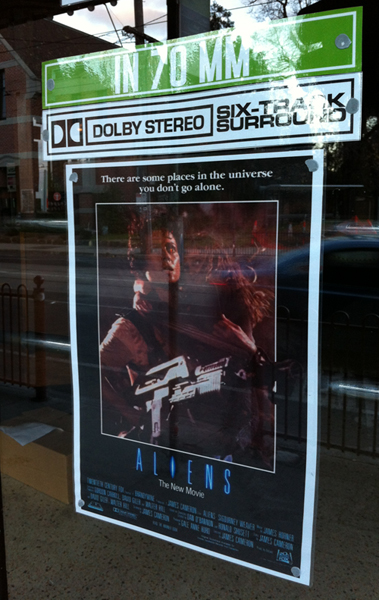
I agree it's not really worth specifically drawing attention to "mainstream" 35mm in our current times of 2K DI and high-speed loop printing, but for rep or if you happen to be getting really nice prints...
Hmm, I'll be needing one for "IN PANAVISION AND TECHNICOLOR".
Powered by Infopop Corporation
UBB.classicTM
6.3.1.2