This is topic Small theaters struggle as Hollywood goes digital in forum Ground Level at Film-Tech Forum ARCHIVE.
To visit this topic, use this URL:
https://ft-forum.com/ft/cgi-bin/ubb/ultimatebb.cgi?ubb=get_topic;f=5;t=002620
Posted by Monte L Fullmer (Member # 2797) on 09-06-2012, 02:51 AM:
The Results of "The Digital Realm" ... in story below:
News Link
quote:
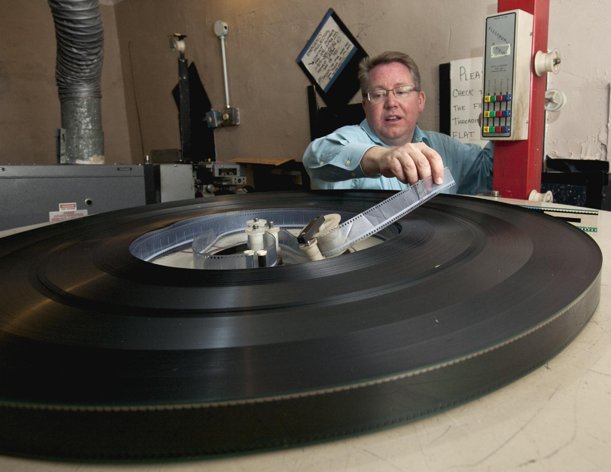
CRETE, Neb. (AP) — The Isis Theatre hasn't changed much since it opened 86 years ago in southeast Nebraska, a stone's throw from the grain elevator and railroad tracks that cut through town.
But in the past few years, the movie industry has changed dramatically, and unless the Isis' owner comes up with $85,000 soon to pay for new digital equipment, residents of Crete, Neb., may have to drive 40 miles to Lincoln for a night at the movies.
It's a prospect that owner Thom Reeves doesn't want to ponder, but like thousands of small-theater operators across the country, he hasn't found a way out.
"This is my passion, to give back to the community," Reeves said. "I love this movie theater. I love what it does for the students I have employed there. We love our patrons. It's such a positive experience going on, and we're just a little sad this conversion is hitting us. How do we survive?"
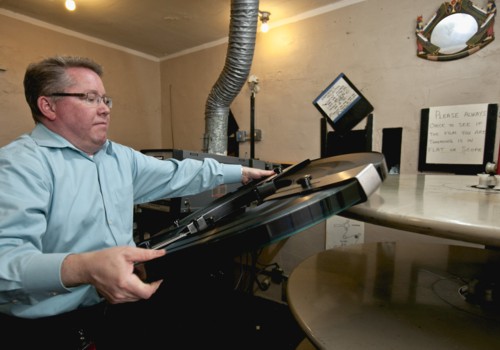
For small-theater owners, the problem is the sudden switch from 35 mm film, an industry standard since about 1910, to digital — a format that's cheaper for both studios and distributors, and doesn't scratch as traditional film will. The switch means theater owners must buy new projection equipment, computers and a sound system.
Film studio 20th Century Fox has said it will phase out 35 mm film altogether by the end of 2013, and other production companies are expected to follow suit. Traditional film is expected to vanish over the next few years, despite the upcoming U.S. release of "The Master," which was shot with the rare but much higher definition 70 mm film.
Big chains can afford the digital transition, which can be cheaper when buying in bulk for multiscreen theaters. But those who own smaller theaters with one or two screens typically must take out a bank loan to pay for the equipment.
A film industry program can refund up to 80 percent of the cost to theater owners, but the payments are made gradually through fees based on the number of movies shown. To qualify for the help, theaters must have certain profit levels and show a minimum number of films, leaving many small operators without help.
Some small, independent theaters created a cooperative, the Cinema Buying Group, to pool their resources and participate in the industry program, but the cooperative also required a review of each theater's financial strength and other factors. Many of the smallest theaters didn't qualify or were hesitant to join.
Patrick Corcoran, a spokesman for the National Association of Theatre Owners, said costs of converting to digital average around $70,000 per screen. About 60 percent of the nation's 5,750 theaters have switched to all-digital equipment, he said.
The switch to digital began with the 1999 release of "Star Wars Episode I: The Phantom Menace," and accelerated with such computer animated films as Disney's "Chicken Little" and the 2009 Hollywood blockbuster, "Avatar," Corcoran said.
"In some markets, it's going to be a tough climb," he said. "But if you want to be in business as a first-run movie theater, you have to go digital."
Reeves, 46, who also is an insurance manager, said he only paid about $100,000 for the entire Isis Theater and never intended to make money from the operation. A good month brings about a $600 profit, he said, and most of that is spent on electrical fixes, carpet cleaning and other maintenance.
In Onarga, Ill., a city of 1,300 about 80 miles south of Chicago, Randy Lizzio is struggling to save his 75-year-old, single-screen Onarga Theater.
Lizzio launched a fundraising drive, including a dinner and auction with a local Mexican restaurant in a park, but after five months he has raised just $8,500 of the $65,000 he needs.
"The window is just about closed for us," Lizzio said. "... It's really tough for single-screen, little theaters, even though we're historic."
At the Ohio Theatre, a two-screen operation tucked into a row of picturesque downtown buildings in Madison, Ind., owner Tony Ratcliff also hasn't been able to raise the $81,000 needed for a digital conversion.
Ratcliff said he's trying to raise $25,000 for a down payment on a bank loan this fall, but he is behind his goal and now has little more than $9,000. Unless he can install digital equipment by next year, the theater may have to close. Ratcliff and other theater owners are looking at other uses for the theater, such live events, or renting it out for community gatherings.
Ratcliff said traditional, 35 mm film has become scarce, making it harder for his theater and others to get the films they need to stay in business. He pointed to one movie, "Courageous," which was released Sept. 30. Ratcliff said he could have received a digital version of the film in November but ended up waiting until late January to receive it in 35 mm because fewer copies were available. Movies often go to larger theaters first.
"It's only going to get worse, especially for small-town theaters," Ratcliff said. "We're the low man on the totem pole."
Allen Hinkle closed his Bonham Theater in Fairbury, Neb., on Aug. 2, after he couldn't sell the operation or attract enough donations.
It would cost $110,000 to install digital equipment in the 86-year-old theater, a brick structure featuring four large arched windows only a half block from the county courthouse.
As the final day neared, Hinkle said parents in the southern Nebraska town of 4,000 asked him what their kids would do now for entertainment. Hinkle said he didn't know how to respond.
On a warm, breezy night last week at the Isis Theater in Crete, few people showed up to see the 7:15 p.m. screening of "Total Recall."
Among the few were Gene and Robin Mignogna, a couple from Pennsauken, N.J., who were visiting relatives. Gene Mignogna said he was taking his wife on a date to celebrate his 57th birthday.
He smiled as he glanced up at the red and white theater marque.
"There's a kind of nostalgia, coming to places like this," he said.
(I used to run film soundtrack down on LP-270's also...)

Posted by Carsten Kurz (Member # 5396) on 09-06-2012, 03:14 AM:
They should sustain a few months and then get one of the new S2k machines with integrated servers. They will sell around or below 30.000US$.
Barco, Christie, NEC already announced them already.
Christie Solaria One, Barco DP2k-10S, NEC NC900S
- Carsten
Posted by Dennis Benjamin (Member # 1137) on 09-06-2012, 07:53 AM:
http://www.dlp.com/technology/dlp-press-releases/press-release.aspx?id=1535
Posted by Edward Havens (Member # 4715) on 09-06-2012, 09:56 AM:
Great, another story about a stubborn movie theatre owner crying because they've been dragging their knuckles for several years over the biggest seismic shift in our industry since the introduction of synchronized sound.
Never get tired of those. ![[Roll Eyes]](rolleyes.gif)
Posted by Bobby Henderson (Member # 840) on 09-06-2012, 10:52 AM:
Yeah, small town movie theaters are such great profit centers that it should be no problem at all for the owners of any such theater to scrape together 80 grand or so for a digital projection conversion in no time.
Some small town theaters have been able to make the switch to digital for reasons that do not exist in every market place. Broad-brushed judgments of some operators "dragging their knuckles" ignore problems those specific operators might have with trying to save up the money. How do you know some of these guys haven't already been trying for several years to save up the money? Banks aren't exactly eager to provide loans either, especially if a theater's P&L numbers aren't totally great.
Different small towns have different demographics, income levels, etc. -which equals different levels of customer traffic. Some theaters get community support for remodeling and equipment upgrades while other communities don't give a hoot if they have a movie theater or not. Some small town theaters are owned by people with deep pockets. I wonder if that's the case for the Palace Theater in Canadian, TX (population 2200). There's some serious oil money in the Texas Panhandle. That little theater is THX certified and has a Sony 4K digital projector.
Basically, unless I'm familiar with how a certain small town or independent theater has been operated I'm not going to be so quick to cast judgment on its ability or lack thereof of switching to digital projection.
Here in Lawton, I expect the Vaska Theater will close once the movie distributors stop shipping film prints. It's the oldest movie theater still in operation in Lawton. It's the last 2nd run/discount theater in town. The theater has a laundry list of improvements its operator has always wanted to make but could never quite get the positive cash flow needed to make it happen. A conversion to digital projection seems like pure fantasy for that place.
Posted by Ron Funderburg (Member # 4561) on 09-06-2012, 11:03 AM:
quote: Bobby Henderson
I wonder if that's the case for the Palace Theater in Canadian, TX (population 2200). There's some serious oil money in the Texas Panhandle. That little theater is THX certified and has a Sony 4K digital projector.
Bobby the theater in Canadian is actually owned by a family trust of one of the original oil baron's and leased to the family that operates (a sweet deal lease). The group buys them whatever equipment they need to keep their high quality ratings. Angel Deal!
Posted by Frank Cox (Member # 6258) on 09-06-2012, 12:06 PM:
Sask. Movie Houses At A Crossroads
I'm on this show, along with a few other Saskatchewan theatre owners.
Posted by Edward Havens (Member # 4715) on 09-06-2012, 01:08 PM:
Bobby, the writing has been on the wall about this industry of ours concerning digital projection for nearly a decade now, so it very much is knuckle dragging in my eyes.
Sure, trying to come up with $50-100k in a matter of months for any small independent theatre operator is going to be tough. But coming up with the same amount over four or five years, waiting for the inevitable duality of a rise in quality and a drop in price that comes with mass acceptance of a new technology, shouldn't have been as hard.
Digital Cinema is not our future. It is our now, and has been for a while. Those who weren't ready for it didn't plan very well.
Posted by Mike Blakesley (Member # 26) on 09-06-2012, 01:38 PM:
As usual, there's a lot of misinformation in that article. Just once I would like to see one of the theatre owners say "I dragged my feet, thinking this whole digital thing would go away, but now we're in the soup because I kept procrastinating." That's the truth for a lot of operators. They are blaming the studios for this "sudden" conversion when it's been happening for a long time. It hasn't exactly been a secret...NATO has been blowing its horn on it for what, about 10 years now?
I think the biggest problem for a lot of small operators is, they haven't "kept up with the times" because they haven't made enough money. And, they haven't made enough money because they haven't kept up with the times.
In my high school years, at my parents' auto parts store, we had a stereo/TV department which I basically managed. This is where I became a "sound nut." When I got into the theatre business (1979) people were just starting to think about the upcoming "marriage" between the home stereo system and the TV set. So, when I started going to theatre conventions and hearing the speakers saying things like "You'd better give people something better than they can get at home, because HOME is what you're competing with, and it's only going to get tougher," I took that to heart. Rather than just keep polishing the same old thing and hoping for the best, we started upgrading the theatre. We're still doing that today, and our local citizens reward our efforts with good patronage.
One big secret, that MANY small operators miss, is to have their prices high enough to where they can make enough profit. I've never understood why small owners think their prices have to be super-cheap. They're showing the same movies, after all, and the popcorn is usually BETTER in a small place. There is one theatre (about 300 miles from us) that shows first run movies about a month off the break, but only charges FOUR DOLLARS for a ticket. No wonder they can't afford to convert to digital. Our prices are lower than a chain theatre, but I'd bet we're higher than the majority of the other small independents out there. And -- we get zero complaints about prices.
If you're in a big enough town, you can have super-low prices and get away with it, but most small operators don't have that luxury. In this day and age, anybody charging less than $7 for an adult ticket is just leaving money on the table...money they COULD be using for their digital conversion or other upgrades.
I guess the other big secret, for us at least, is "have a day job." There are a lot of operators who buy a small theatre and expect to live off of it, or at least be able to hire other people to run it. Usually, that won't work. My wife and I both have fulltime jobs -- the theatre pays its own bills, pays for its upgrades and provides us with some extra income, but if it wasn't for our day jobs, we'd be in the soup too.
So -- if you want to run a small theatre you have to be prepared to work hard, reinvest continuously, and charge what your efforts are worth. It's not rocket science.
Posted by Ron Funderburg (Member # 4561) on 09-06-2012, 01:47 PM:
Mike preach on you got it right!
Posted by Ronda Fitzsimmons (Member # 1418) on 09-06-2012, 04:09 PM:
quote: Carsten Kurz
They should sustain a few months and then get one of the new S2k machines with integrated servers. They will sell around or below 30.000US$.
Barco, Christie, NEC already announced them already.
Christie Solaria One, Barco DP2k-10S, NEC NC900S
- Carsten
Anyone heard anything on when? It does seems like this might be a more affordable option for us. From what I've read and heard, this has the server, lens, and media block built in. What else would be needed?
Posted by Victor Liorentas (Member # 5272) on 09-06-2012, 04:12 PM:
If you early digital adopters had not jumped on this digital bandwagon so quick ![[Big Grin]](biggrin.gif) those of us more loyal to film could have kept on longer with film but noooo.
those of us more loyal to film could have kept on longer with film but noooo. ![[Smile]](smile.gif)
Posted by Scott Jentsch (Member # 1681) on 09-06-2012, 05:42 PM:
From the TI press release about the S2K chipset:
quote:
Texas Instruments (TI) (NASDAQ: TXN) DLP Cinema®, the worldwide leader in digital cinema imaging technology, today announced the new S2K chipset, optimized for theatre screens up to 20 feet (six meters) wide in size for 2D presentations.
Screens measuring 20 feet wide should not be in any self-respecting movie theater that is not built as a screening room with a couple-dozen seats.
To get a 36-degree viewing angle, that puts the back row at just under 31 feet. That gives you, what, about four rows of 8-10 seats?
Posted by Jonathan M. Crist (Member # 413) on 09-06-2012, 06:12 PM:
From what I have heard the new S2K machines with the integrated servers are supposed to be able to handle screens up to 30 feet in width. But that would be sufficent for at least 50% of the screens in the US.
On the downside they are not supposed to be upgradable to 4K but for small auditoriums this seems like a non-issue to me.
These new machines are supposed to be available by the end of this year.
If they will take 30 foot screens and will be available by Christmas, then I then expect this will be fodder for the class action lawyers asserting that the manufactures and the dealers conspired not to tell their customers with screens 30 feet or less that this option was coming so as to sell the higher priced existing stock.
Posted by Doug Willming (Member # 728) on 09-06-2012, 07:25 PM:
Ah, the joys of digital. While you are a third of the way to paying off your increasingly obsolete piece of equipment, something else comes along better and cheaper for half the price...whether it's a digital projector or an Apple IPhone.
Posted by Michael Gonzalez (Member # 593) on 09-06-2012, 07:57 PM:
Now I honestly don't know but, haven't some theater chains already started pulling older Digitals such as early Christie 2Ks? Isn't it not possible for some of those to be had on the cheap (relatively speaking)? You don't have to have a server especially if you only have one or two screens. Just wondering if it is something that is possible.
Posted by Victor Liorentas (Member # 5272) on 09-06-2012, 08:04 PM:
Always possible but then your buying someone elses problem with little or no warranty. ![[Frown]](frown.gif)
Posted by Martin McCaffery (Member # 37) on 09-06-2012, 09:22 PM:
quote: Michael Gonzalez
Isn't it not possible for some of those to be had on the cheap (relatively speaking)?
It's literally buying a used computer. It may be ok for a transition, but it's not going to last long and probably never pay for itself either.
Posted by Mike Blakesley (Member # 26) on 09-06-2012, 10:58 PM:
quote: Michael Gonzalez
You don't have to have a server especially if you only have one or two screens.
I think you're thinking of an LMS (Library Management System) which you don't need unless you're a multi-screen and/or on a VPF program, or working with a NOC. The server is the thing that actually plays the movies into the projector, so you definitely need that.
Posted by Louis Bornwasser (Member # 3063) on 09-07-2012, 09:14 AM:
So "dragging your knuckles" is not only OK, but preferable.
If you are just writing a check, waiting was proper, since you don't care about vpf. This allows you the freedom to buy the latest/greatest at a reduced price.
The trick is not to be first, but to be last. . . and smartest. Louis
Posted by Mike Croaro (Member # 3123) on 09-07-2012, 12:10 PM:
Scott jentsch wrote:
"Screens measuring 20 feet wide should not be in any self-respecting movie theater that is not built as a screening room with a couple-dozen seats."
Belmont (Belmont, CA) #3 aud had 275 seats and more or less a fixed screen sized screen 18 X 9!
Mike
Posted by Mike Blakesley (Member # 26) on 09-08-2012, 12:43 AM:
Yeesh! That's almost twice as many seats as we have (on the main floor) but a screen less than 2/3 as big as ours.
Posted by Jim Henk (Member # 3628) on 09-08-2012, 02:00 AM:
<never mind...>
Posted by Carsten Kurz (Member # 5396) on 09-08-2012, 03:19 AM:
quote: Ronda Fitzsimmons
Anyone heard anything on when? It does seems like this might be a more affordable option for us. From what I've read and heard, this has the server, lens, and media block built in. What else would be needed?
These machines have been shown in public already, datasheets are there. They should be available around october-december this year.
http://www.nec-display-solutions.com/p/dc/en/projectionroom/projectors/nc900c.xhtml
http://www.nec-display-solutions.com/p/dc/en/projectionroom/projectors/nc900c.xhtml
http://www.barco.com/en/News/Press-releases/gdc-technology-is-partnering-with-barco-to-showcase -a-groundbreaking-s2k-projection-utilizing-gdc-te.aspx
These all come with an integrated server. The Christie will need a (cheap) external business grade RAID array, NEC and Barco come with a Doremi IMS which has it's own local storage.
They have digital audio outputs, so you either need an external DAC oder digital audio processor like Dolby 750, another 600-2500US$ depending on your needs.
8000-9000 DCI Lumens should be enough for 8-10m screen size. Of course, no 3D at these screen dimensions, although they are 3D and HFR capable for smaller screen sizes.
Installation is also a lot easier compared to existing systems, so I would expect a really attractive system/install price.
Yes, for small independent theaters with limited resources, it certainly was smart to wait...
- Carsten
Posted by Scott Norwood (Member # 30) on 09-08-2012, 07:58 AM:
The smaller machines seem like a win for screening rooms and small theatres, but I see that the NEC does not use a xenon lamp. I assume that it uses metal-halide or mercury lamps instead. Won't this a) increase the cost of operation and b) reduce color fidelity by using a non-full-spectrum light source? Also of concern would be the inability to upgrade the server separately from the projector in the future.
Also, if the lens is part of the projector, does this mean that the machine will only be available with lenses for popular screen size and throw distance combinations?
Still, it seems like a step in the right direction for smaller houses.
Posted by Steve Guttag (Member # 268) on 09-08-2012, 10:51 AM:
I'm not sold in the new machines...there isn't that much of a cost difference and a whole bunch of restrictions.
My guess is the IMBs will remain interchangeable. I see that Barco has boasted about partnering with both GDC and Doremi for their machine. I think DCI compliance would preclude making it brand specific though I have no doubt that Christie's will use a Christie IMB since they are trying to get into the IMB market anyway.
Posted by Robert E. Allen (Member # 1351) on 09-08-2012, 01:36 PM:
The obvious contempt of the small town theatre owner by some in this thread is despicable. It might interest you to know there is life outside the big cities and their multiplexes. If the small town operators go down there will be hundreds of thousands of people without easy access to a movie theatre and a great part of the exhibition industry will be lost. It is after all the single screen operator who pioneered exhibition and introduced color, cinemaScope, 3D and stereo surround sound to the movie going public along with showmanship. All the multiples operators have done is multiply the number of screens on which to show those innovations while stripping the theatre of showmanship and customer service.
Posted by Victor Liorentas (Member # 5272) on 09-08-2012, 01:45 PM:
![[beer]](graemlins/beer.gif)
Posted by Mike Blakesley (Member # 26) on 09-08-2012, 01:48 PM:
^^ True words there.
However I don't think there is contempt of small theatres in general, just those operators who from the beginning have refused to plan for the digital conversion even after being told repeatedly that it was really going to happen.
Some of them are probably just waiting and hoping for a lower cost solution to come along, or looking for used equipment to become available. I probably would have been in that group too, if we hadn't been in the position to be able to get a bank loan when we needed it.
When I first joined Film-Tech in the 1990s, a majority of the posters seemed to be multiplex projectionists and at that time, I detected a certain amount of a "what's he doing here" attitude among the members. I think, since then, those members and others have come to acknowledge that there are exhibitors of all shapes and sizes out there, and we're all after the same goal: Putting on a good show for the folks.
Posted by Dave Macaulay (Member # 813) on 09-08-2012, 02:07 PM:
What I've heard is that Barco and NEC will use a common interface (probably similar to the S2 input/decryptor or IMB board socket) and that GDC and Doremi will produce "servers" to fit, basically using about the same space as that input/enigma board or an IMB. These will need an external computer for control probably via a web interface. Christie as apparently using an in-house server module not compatible with any other.
I'm not confident of deliveries before early 2013, although Christie is saying December 2012. The new TI chip is scheduled to be released in early December although manufacturers have obviously had R&D ones for a while. (You may recall that the .98" 4K TI chip has been "scheduled" for a few years now, but I don't think any preproduction ones have surfaced).
Posted by Edward Havens (Member # 4715) on 09-09-2012, 03:59 PM:
Sorry Robert, I have zero contempt for the small town theatre owner. I have contempt for any theatre owner who is still crying in public about not being able to afford to convert to digital after all these years. Several smaller chains (200-400 screens) starting becoming all-digital six and seven years ago. If that wasn't portentous enough for any theatre owner that this was the direction of our industry back then, what would have been? When AMC and Regal starting talking about going all-digital three or four years ago?
Some independent theatre owners got smart and starting saving up for digital projections years ago, since it's much easier to come up with the money for conversion over several years when you plan long-term for it. Some independent theatre owners have gone to sites like KickStarter and successfully gotten public funding for some or all of the cost of conversion. Some have been able to go to their bank and say "I've saved up x for this job, and I need to borrow y to finish it, so I can stay open and competitive" and gotten those loans. Why? Because those owners aren't sitting on their asses, dragging their knuckles and crying to reporters about their woes. They are active in finding solutions in order to stay relevant.
In a few hours, the Parma Theatre in Parma OH is closing its doors for good. In articles about the impending closing, the owner says he's been looking to sell for the past seven years but he never once says it had anything to do with not being able to afford to convert to digital. Maybe it does, maybe it doesn't.
I remember the Parma in my youth, when I would spend summers with my grampa in Parma, and its closing leaves this community without a theatre within its borders.
Posted by Tony Bandiera Jr (Member # 2365) on 09-09-2012, 06:02 PM:
quote: Mike Blakesley
Some of them are probably just waiting and hoping for a lower cost solution to come along, or looking for used equipment to become available. I probably would have been in that group too, if we hadn't been in the position to be able to get a bank loan when we needed it.
Mike, I want to preface this post by saying I am not accusing you of anything. Your post, and in particular what I bolded above, is the point I am going to make to someone in particular.
Edward, your posts read as contemptuous...even if that is not your intent.
Having provided service calls to MANY independent cinemas here in California, I can state emphatically that the majority of those who haven't made the conversion yet aren't dragging thier feet on anything..there is simply not enough positive cash flow to allow for putting aside upgrade money.
Let me repeat that again:
There is simply not enough positive cash flow to allow for putting aside upgrade money.
As you yourself know there are a lot of factors that apply to any given location, including lease costs, mortgage costs (for those who are buying/have bought the land the theatre is on), utilities (which vary widely depending on location), insurance costs, demographics, other maintenance issues, etc.
And with the economy being so crappy for so many years far too many banks are not willing to provide loans even for a capital equipment upgrade.
In Mike's case, he was able to obtain the loan he needed to do his upgrade. I would say he ranks as being the 10% or less of independents who are able to get a bank loan. Easily 90% or more of the independents have unfavorable cash flow and would not qualify for a loan.
So everyone here needs to chill out with the "dragging their feet" attacks.
Posted by Edward Havens (Member # 4715) on 09-09-2012, 07:01 PM:
I'm not hiding my contempt, Tony. It's just not strictly for small town theatre owners.
But the question is, why was Mike able to get a bank loan in the middle of a strong recession in order to upgrade his equipment? He too is a small town theatre owner. One would venture that he is a smart enough entrepreneur to understand how his chosen field of business is evolving, and maintain a good rapport with his customers. I'm looking at his theatre's blog from Summer 2009, and this is what he wrote when he needed to raise his ticket prices by fifty cents...
quote:
We're currently in major saving mode for Digital Cinema, which will revolutionize the types of entertainment we'll be able to present. It isn't cheap though; Digital will cost us in the neighborhood of $90,000.00. Being in the movie business isn't for sissies!
Mike, when did you finally go digital, and if you don't mind answering, how much of the cost of conversion were you able to raise yourself before you went to the bank?
I'm curious because, believe it or not, my wife and I are planning on opening our own independent art-house movie theatre, wherever we settle after she graduates from law school.
Posted by Carsten Kurz (Member # 5396) on 09-09-2012, 07:52 PM:
quote: Scott Norwood
I assume that it uses metal-halide or mercury lamps instead. Won't this a) increase the cost of operation and b) reduce color fidelity by using a non-full-spectrum light source?
NEC and Sony use UHP lamps with full-spectrum. It's different from xenon spectra, but it can be corrected to DCI colour space, with some light loss.
quote: Scott Norwood
Also of concern would be the inability to upgrade the server separately from the projector in the future.
They still have HD-SDI input boards, some even Enigma or standard series II IMB options, so you can even hook up a 'traditional' server later. Technically, aside from the more expensive Sony SRX-R515, these are still series 2 projectors. Of course, some limits still apply, but at half the price of typical existing series 2 systems, there is little to complain, as they also offer interesting options not so common with existing projector/server combinations, e.g. support for 3D BluRay/Live event over HDMI, as well as HDMI audio passthrough to the cinema audio system, and HFR.
quote: Scott Norwood
Also, if the lens is part of the projector, does this mean that the machine will only be available with lenses for popular screen size and throw distance combinations?
While lenses seem to be more integrated, the choice of lenses is still the same as for existing projectors. Lenses are motorized as well, although for the christie Solaria One there will also be a cheaper non-motorized version for screens without movable masking.
These machines may also be interesting for dual-projection 3D systems on small to medium sized screens.
quote: Steve Guttag
My guess is the IMBs will remain interchangeable. I see that Barco has boasted about partnering with both GDC and Doremi for their machine. I think DCI compliance would preclude making it brand specific though I have no doubt that Christie's will use a Christie IMB since they are trying to get into the IMB market anyway.
Why should DCI demand brand independence? Christies IMB works only in Christie projectors, yet has achieved CTP compliance in June.
The Solaria One contains a dedicated version of this IMB, without expansion slots, 'single panel'.
- Carsten
Posted by Tim OBrien (Member # 5605) on 09-09-2012, 08:47 PM:
You're right, Edward. I won't complain about being denied financing for the digital conversion because I don't meet the necessary criteria. I won't whine that my theatre, in which I've invested everything I own and twenty-two years of my life, may well be one of those "left behind" when the dust settles on this thing.
But don't complain when the theatre you so fondly recall from your youth closes for good and leaves a gaping hole in the community. The Parma will likely be in good company.
Posted by Louis Bornwasser (Member # 3063) on 09-09-2012, 09:24 PM:
There are now, and probably always have been, cinemas that never really made money. They lived because someone loved them. These people do not live forever.
Those are the perpetually marginal theatres that will close soon. Digital was not the cause of the closing, but it sure didn't help. A case could be made that they would have eventually closed anyway or that they should have never opened. "Build it and they will come," fine, but not enough and less now.
Now you guys know why I retired, myself. Louis
Posted by Mike Blakesley (Member # 26) on 09-09-2012, 11:38 PM:
quote: Edward Havens
Mike, when did you finally go digital, and if you don't mind answering, how much of the cost of conversion were you able to raise yourself before you went to the bank?
Our changeover was in June 2010. I think we were somewhere between 10 and 15% with the down payment. The bank would have liked 20% but we had a very low "debt load" at the time (fortunately) and of course, our 30+ year track record helped too so they were willing to work with us.
Posted by Edward Havens (Member # 4715) on 09-10-2012, 12:36 AM:
Tim, the theatres from my youth have been gone for years. Turned in to racquetball clubs (The Belmont Theatre, Long Beach CA, closed 1977) and medical offices (Loyola Theatre, Los Angeles CA, closed late 1970s) and live music venues (The Rio Theatre, Santa Cruz CA, closed late 1990s) and indoor swap meets (Fox Venice Theatre, Venice CA, closed 1987) and parking lots (The Capitola Theatre, Capitola CA, closed 2006).
Posted by Tony Bandiera Jr (Member # 2365) on 09-10-2012, 12:49 PM:
All of the post above proves my point...there have been and always will be smaller theatres that struggle and ultimately die.
Edward, a famous quote would be well heeded by you:
"Mozart (Edward), a little humility might suit you better."
Karma is a bitch, and your attitude on this thread is gonna come back and bite you big-time when your theatre hits hard times.
Posted by Edward Havens (Member # 4715) on 09-10-2012, 01:14 PM:
Tony, if I fail as a businessman (and I already have one in this life), that's my fault and all the humility in the world won't change that. This is why, in my mid-40s, I have gone back to school and get a business management education, so I have that much more of an advantage when I start my next business, and I hope I will recognize seismic shifts in my chosen field when they show themselves several years in advance.
Posted by Victor Liorentas (Member # 5272) on 09-10-2012, 02:11 PM:
For those of us who really love the art and craft of film these are dark times.
To me digital is an expensive boring synthetic imitation of movies.
It eliminates my current worth as a projectionist so forgive me for fighting it till the bitter end.
Posted by Shawn Arndt (Member # 7159) on 09-10-2012, 02:33 PM:
Digital is most certainly, a sad state of affairs, especially for those in the small communities where watching the grass grow is a multi-generational & sacred pass-time. I remember when the Southgate Theater closed down by me way back when. Watching a 70mm presntation on that huge theater screen was awesome, as was the entire experience. It finally fell to "progress" and the theater that replaced it isn't near as fun to visit. In the end....everything comes down to money...even contempt.
Posted by Martin McCaffery (Member # 37) on 09-10-2012, 03:39 PM:
quote: Edward Havens
I'm curious because, believe it or not, my wife and I are planning on opening our own independent art-house movie theatre, wherever we settle after she graduates from law school.
I'll give you some advice. There's a reason there are so few art houses and so many of them (like mine) are 501(c)(3) non-profits: They Don't Make Money.
There's a reason art films rarely play in the multiplexes: Not enough people want to see them.
Nonetheless, we will welcome you with open arms and honest wishes of "Good Luck" into the weird world of art house movies.
And as I have posted in other threads: Some people show movies to make money. Some people make money to show movies. ![[Wink]](wink.gif)
Posted by Robert E. Allen (Member # 1351) on 09-10-2012, 05:16 PM:
I'm with you Victor. Hang in there as long as you can. I honestly believe the "cheap imitation" is not noticed by the average theatre-goer and is only for the benefit of the studios. We now have 60% of the theatres in this country under the control of the distributors.
Posted by Mike Blakesley (Member # 26) on 09-10-2012, 06:58 PM:
quote: Robert E. Allen
We now have 60% of the theatres in this country under the control of the distributors.
Well THAT has been true for several decades, and even more now that they take product that used to be ours exclusively for a year or more and "monetize" it into multiple other platforms within 60 to 90 days or less.
I don't agree that "showmanship" died with digital. There's still an art to putting together a program, making it flow (don't put the "OZ: The Great and Powerful" trailer right after the "Frankenweenie" one, for example), selecting pre-show music that fits the feature audience, picking snipes that fit the audience, having the lights go on and off at the right times, setting the volume properly for the trailers and then raising it to the right level for the feature, etc etc etc. The ONLY thing that's changed is the way the picture gets to the screen. Also I have fewer back-aches.
Posted by Jim Henk (Member # 3628) on 09-10-2012, 11:05 PM:
Did you ever notice that showmen, artists, and other creative people are very often terrible when it comes to business? A left-brain, right-brain thing I think.
To say that somebody deserves what they get because they didn't do the cold hard thing and dumpster their artistry and love of media for the pure pragmatics of economics is pretty Scrooge-like to me. And that's *not* a good thing.
And the early comment criticizing the early enthusiastic band-wagon jumpers and the big exhibitor corporations was spot on. They didn't just allow it to go full-steam, they piled on the fuel. It was NOT an eventuality. (it is now...) It was allowed.
Posted by Louis Bornwasser (Member # 3063) on 09-11-2012, 07:16 AM:
Jim: Early on I thought there might be some hope of having both 35mm and digital. Alas, you are correct in that it is now a done deal.
Still: those who waited bought better, cheaper machines and benefitted from the "learning curve." Many of us know where literally HUNDREDS of obsolete video projectors stand in dark corners, unable to be used.
Right now I see some who converted who now have to reinvest, some who waited and can convert with some confidence, and those who will simply close or sell rather than invest at a bad time.
The human carnage is not pretty. Good people who had long careers are on the street. Louis
Posted by Bobby Henderson (Member # 840) on 09-11-2012, 11:42 AM:
quote: Mike Blakesley
However I don't think there is contempt of small theatres in general, just those operators who from the beginning have refused to plan for the digital conversion even after being told repeatedly that it was really going to happen.
There may be some theater operators out there who simply refused to see the proverbial writing on the wall and refused to plan for a mandatory digital cinema conversion even though they had the ability to do so. I'll agree that one is on them for not planning ahead.
However quite a few small town theaters have simply not been generating enough cash flow to finance a digital cinema conversion.
All of us know full well there is a LOT more that costs money hand over fist in operating a movie theater than simply buying some new electronics gear for the booth rack. The Vaska Theater here in Lawton is a really old building. Old buildings have lots of maintenance issues. Add to that the wear and tear customers will do to the seats, the screen, bathrooms and anything else in the theater they can touch. All of that other crap bleeding away positive cash flow takes away the ability to do all sorts of much desired upgrades.
The guy who runs the Vaska has been wanting to install a digital surround sound system for more than a decade, but has never been in a good enough position to do it. A full d-cinema conversion is a far more expensive thing to install. That's why I'm very pessimistic about the future of that theater. Someone with deep pockets would have to take a major leap of faith and completely overhaul that theater and possibly make changes to its bargain/2nd run business model in order for the theater to survive (assuming the movie-going public in Lawton will visit the place enough to make the effort profitable). I don't see that happening.
Any theater lives and dies by the quality and quantity of its customer traffic. You need enough customers buying tickets and enough high quality customers who will pay for things from the snack bar and not tear up the damned theater.
One huge fact of small towns: most have aging populations with few young people and more in the way of retired people. Most movie-goers are in the younger demographic. Most movies are made for and marketed to younger crowds. Few movies are made to appeal to the middle aged and older demographic that makes up a big part of small town populations. It's anecdotal at least to say I personally know some middle aged and older people who seem to brag they've not been to the movie theater in many years. I never hear those kinds of comments from people in their 20's or 30's.
There is also a larger issue of many small town governments having serious financial situations, which can place more tax pressure on local businesses. A growing number of small towns here in my region of Oklahoma no longer have any police departments, putting even more pressure on county sheriffs and the highway patrol.
Small town theaters have unique pressures on them that big multiplex sites in big cities just don't experience in nearly the same way.
quote: Edward Havens
In a few hours, the Parma Theatre in Parma OH is closing its doors for good. In articles about the impending closing, the owner says he's been looking to sell for the past seven years but he never once says it had anything to do with not being able to afford to convert to digital.
Two possibilities: 1: the owner no longer has any love of that business. 2: the business wasn't making enough money to be worth the trouble.
quote: Edward Havens
But the question is, why was Mike able to get a bank loan in the middle of a strong recession in order to upgrade his equipment?
Because you can't compare apples to oranges. One theater's financial/market situation and relationship with a bank/lender is not the same as that of another theater.
Posted by Mike Blakesley (Member # 26) on 09-11-2012, 12:19 PM:
quote: Bobby Henderson
The guy who runs the Vaska has been wanting to install a digital surround sound system for more than a decade, but has never been in a good enough position to do it. A full d-cinema conversion is a far more expensive thing to install. That's why I'm very pessimistic about the future of that theater. Someone with deep pockets would have to take a major leap of faith and completely overhaul that theater and possibly make changes to its bargain/2nd run business model in order for the theater to survive
I guess I'd ask "why" hasn't he been in a position to do a sound upgrade? Maybe his ticket prices were too low.
The last sentence may sum up the problem with that place. The business model. If he wasn't doing enough business over a decade to do ANY upgrades, then maybe he could have figured out some other way to increase business. The 2nd run market is being squeezed out by the studios who are eager for quick video sales. Guess there's more money in video than in 2nd run.
Posted by Bobby Henderson (Member # 840) on 09-11-2012, 01:16 PM:
Yeah, the arguably short "window" between theatrical release and home video release makes it pretty easy for lots of people to merely wait for the Blu-ray, DVD, VOD, PPV, Netflix, etc. They watch from the comfort of their home, pay less to pop their own popcorn and pause the movie when they need to pee. I'm certain it has had a big effect on the Vaska's business. By the time the Vaska is playing some movies the video release may be just a month or even less than a couple weeks out from arriving on store shelves.
The other problem with the Vaska's bargain/2nd run model: it attracts more low income customers who arguably are less likely to buy a bunch of things from the snack bar. I'm pretty sure a bargain priced theater is going to be even more dependent on concessions sales than a 1st run theater.
The Vaska might be able to do better as some kind of first run theater, but that kind of change would require some big upgrades in addition to the change to digital projection. The two first run theaters in Lawton have at least some kind of stadium seating in every auditorium. The 12-plex at Central Mall just converted the rest of its screens to digital projection. 5.1 surround would be a requirement. More than that, the decor in the Vaska would have to be updated. New carpet, new seats, probably a new HVAC system, etc. etc. It would probably be just as easy to close the theater for a period of time, gut the insides and build something completely new inside that space.
Unfortunately Lawton is not a very big market and doesn't have the greatest income demographics. The Vaska is also a single screen theater. Potential lenders might see that as a negative. I wonder if the studios do as well.
Posted by Scott Jentsch (Member # 1681) on 09-13-2012, 11:22 AM:
It's almost like the guy from "Restaurant Impossible" needs to do a version of the show for movie theaters.
Take a struggling operation, have someone from the outside come in and take a hard look with a pair of fresh eyes and no personal relationship with the owner. Update the decor, change the ticket prices, rehab the concession stand and its items, and generate some excitement where before there was coma-inducing depression.
Posted by Edward Havens (Member # 4715) on 09-13-2012, 01:12 PM:
quote: Bobby Henderson
The other problem with the Vaska's bargain/2nd run model: it attracts more low income customers who arguably are less likely to buy a bunch of things from the snack bar. I'm pretty sure a bargain priced theater is going to be even more dependent on concessions sales than a 1st run theater.
The first theatre I was a GM at was a four screen dollar house in San Jose CA, in the late 1980s/early 1990s. Now, maybe it was the location, even though San Jose has regularly had a higher rate of people living under the poverty line than the national level, but within six months of arriving, I got the CPC at my location up about fifty cents from where it was in years past, and about a dollar higher than the company's national average. I believe in part it was because I would listen to what my customers were asking for that I wasn't carrying, and replacing low-selling items for those requested items. As much as I loved Sweetarts, they just didn't sell there, so I dumped them in place of Milk Duds, which I don't like myself and never really sold at the locations I was an assistant at, but became my second best selling candy item soon after I introduced them.
Does the owner of the Vaska engage his customers at all? Does he ask them what things he can do better? I can speak only for myself, but I know that when I do my welcoming announcements, I finish with telling the audience that this is their theatre, and if they have any comments, good or bad, to please find me or any manager after the show or the next time they are here and let us know what we can do to make their visits better. We've gotten a wealth of great feedback, not always positive, and we've made adjustments based on that feedback, and worked to get certain products previously unavailable to us made available to us. And maybe it's merely coincidental, but both our paid attendance and CPCs are up 15% this year over the past three years.
For me, even if one has a great working model, I'm still certain it can be made better. But if one does not have a great working model, one must find other ways of making it work better.
Posted by Mark Hajducki (Member # 1732) on 09-13-2012, 01:51 PM:
The Vaska does not seem to have any internet presence, none of the on-line listing sites give its showtimes.
Given the minimal cost of web hosting it seems inexcusable not to have a basic website with showtimes. If customers cannot easily find out what is showing then they are less likely to go.
Posted by Martin McCaffery (Member # 37) on 09-13-2012, 02:56 PM:
quote: Scott Jentsch
It's almost like the guy from "Restaurant Impossible" needs to do a version of the show for movie theaters.
And do it in 3 days with a $10k budget!
![[evil]](graemlins/evil.gif)
Posted by Scott Jentsch (Member # 1681) on 09-19-2012, 01:45 PM:
Except for the projection/sound equipment, I think a lot could be done in 3 days of hard work and a $10,000 budget. Is that realistic?
- Refine ticket selling/pricing structures
- Refine concession stand offerings/prices
- Separate the chaff from the wheat on the staff
- Upgrades to the concession stand to make it more inviting if necessary
- Fix problems in bathrooms (there is a connection between the condition of restrooms and food sales)
- Replace/upgrade broken and tired seats
I kinda doubt that $10k would be enough for some theaters that haven't been cared for since Back to the Future was released, especially for multi-screen theaters that might need a lot of rehab in the auditoriums...
quote: Edward Havens
I can speak only for myself, but I know that when I do my welcoming announcements, I finish with telling the audience that this is their theatre, and if they have any comments, good or bad, to please find me or any manager after the show or the next time they are here and let us know what we can do to make their visits better. We've gotten a wealth of great feedback, not always positive, and we've made adjustments based on that feedback...
That sounds like a great way to engage your audience and make them feel like they're part of your operation. I applaud your approach, and it would be the way I would want to run a theater!
Posted by Scott Norwood (Member # 30) on 09-19-2012, 03:28 PM:
quote: Scott Jentsch
Except for the projection/sound equipment, I think a lot could be done in 3 days of hard work and a $10,000 budget.
Agreed, and I think that there is something to be said for having a set of fresh eyes to look at any operation and suggest improvements, without being constrained by preconceived notions about how things "should" be.
I am a big fan of having theatre managers personally introduce screenings. Even if it goes no further than "Thanks for coming, please turn off cell phones, we will be showing some trailers for some upcoming moves that might interest you, and enjoy the film," this sort of personal connection is important for customers, and helps to distinguish the cinema experience from the home experience. Similarly, as a patron, I respect theatre managers who make themselves visible as patrons are leaving after a screening. This provides a perfect opportunity for customers to make comments about the presentation or suggestions about how the theatre can be improved. Having an usher or other employee do this is fairly useles...the manager himself needs to be visible (in a suit or other respectable manager-like clothing).
Posted by Mike Blakesley (Member # 26) on 09-19-2012, 06:00 PM:
I would like to do the introductions but I'm totally not a public speaker. I would stumble all over myself! Plus, about half the time I'm selling tickets when the show starts -- so at least I get to greet the folks as they come in. And we (my wife or I) almost always do exit-greets, which has become even more necessary since we started showing 3-D movies.
Posted by Martin McCaffery (Member # 37) on 09-19-2012, 06:44 PM:
I do exit greets after every show I'm here for, though not in a suit;>
Someone has to be there to answer the question "What did that mean?"
Proper response: "Whatever you want it to."
Posted by Mike Blakesley (Member # 26) on 09-19-2012, 08:37 PM:
What's the proper response when somebody comes out saying, "Well, THAT was different!"
(I think it's code for "I hated it.")
Posted by Martin McCaffery (Member # 37) on 09-19-2012, 09:11 PM:
Inasmuch as we are an art theatre the proper response is "That's why we are here." ;>
Posted by Mike Frese (Member # 4361) on 09-28-2012, 04:41 PM:
I do not believe you guys realize how low grossing many theaters are and they are nice places. The problem is they do not have enough people in their community to support the cost to convert. Here is a case in point:
Higginsville, MO - Davis Theater (open for 14 years)
Posted August 29th on their Facebook page:
WE ARE SO VERY SORRY:
BUT DUE TO THE MOVIE INDUSTRY’S ON-GOING DIGITAL CONVERSIONS, THE PROCESSING/ AVAILABILITY OF 35MM PRINTS IS BEING FELT BY THEATRES LIKE “THE DAVIS“. IT HAS BECOME INCREASINGLY HARDER TO OPEN A NEW FILM AND THE WAIT TIME FOR MOVIES THAT WE HAVE NOT OPENED HAS STRETCHED
ON FOR SEVERAL MORE WEEKS THAN “NORMAL“ FOR US. THIS, UNFORTUNATELY, WILL BECOME MORE THE ‘NORM’ FOR SMALL TOWN THEATRES LIKE OURS UNTIL 35MM PRINTS WILL CEASE TO BE MADE.
WE ARE HOPING TO RE-OPEN SEPTEMBER 20TH BUT NOTHING IS A ‘FOR SURE’. WE UNDERSTAND THAT WE ALL HAVE CHOICES BUT PLEASE KNOW THAT WE WILL NEED ALL THE HELP THIS COMMUNITY CAN MUSTER TO KEEP THE ‘DAVIS’ FROM BEING ANOTHER CASUALTY OF THE DIGITAL REVOLUTION.
WE ARE SO VERY SAD, BUT WE WANT TO THANK YOU FOR YOUR PATIENCE, UNDERSTANDING AND, OF COURSE, YOUR PATRONAGE WHICH HAS SUSTAINED OUR COMMUNITY THEATRE FOR 14 YEARS. GEORGE, FRANI & STAFF
Posted Today on Facebook:
It breaks our hearts but as of 9/28/12, the Davis Theatre 4 is officially closed. We will be checking into other alternatives and will try to keep you posted. Thanks for your patronage and friendship over the last 14 years. We will miss all of you!! George & Fran
(Ticket prices are within $.25 of Mike B's.)
Posted by Brad Miller (Member # 2) on 09-28-2012, 05:28 PM:
Mike, it isn't that WE don't understand. It is that the studios just don't care. To them a little theater like that isn't worth the hassle (meaning they don't make enough money in their eyes to bother with).
I have always said the way VPFs SHOULD have been done is "starting today we will permit the theater to deduct $x amount of money from their grosses for playing the movie in digital, and that offer will continue up until X year/month/day at which point 35mm prints will cease to be manufactured.
Yes that is a greatly simplified version of what the reality could've been, but had the studios done that, the entire digital conversion would've happened faster and NOBODY would've been left behind.
Posted by Mike Blakesley (Member # 26) on 09-28-2012, 06:50 PM:
quote: Mike Frese
It breaks our hearts but as of 9/28/12, the Davis Theatre 4 is officially closed.
According to Wikipedia, the town of Higginsville has a population of 4682 people. Without knowing anything else about the place (and possible competition in the area), it's hard to judge why it closed. But, in a town of that size I would think they'd be able to make a go of it.
I mean, we have only 1900 people in this town and we're still here. We have another town of 2900 nearby that supports us well, but it's 37 miles away. The total population of the two towns is close, in total, to what Higginsville has right in the city limits.
Questions pop into my mind such as: Were they playing current product? Was the place well-run? Was the owner there daily (or at least frequently) or was the place run by teenagers? Was it clean, well-lit, friendly? Were they community-involved? Was the popcorn fresh and reasonably priced? What's the local economy like? Did they start thinking about digital ten years ago when it was first announced, or did they wait until last spring (or last week)? And, perhaps the most important question of all, is there a 24-screen monsterplex within a half-hour's drive?
Posted by Mike Frese (Member # 4361) on 09-28-2012, 07:07 PM:
quote: Mike Blakesley
Questions pop into my mind such as: Were they playing current product? Was the place well-run? Was the owner there daily (or at least frequently) or was the place run by teenagers? Was it clean, well-lit, friendly? Were they community-involved? Was the popcorn fresh and reasonably priced? What's the local economy like? Did they start thinking about digital ten years ago when it was first announced, or did they wait until last spring (or last week)? And, perhaps the most important question of all, is there a 24-screen monsterplex within a half-hour's drive?
2 first run theaters within 20 miles: a 6 screen B&B, and a 10 screen Carmike. This was a seasonal first run theater. 4 screens to convert not just 1.
The community liked it enough to vote often enough to get them $25,000 from Reader's Digest.
With just a 10% profit margin, they would have needed 12 years to save up by my best guess.
Posted by Mike Blakesley (Member # 26) on 09-28-2012, 08:18 PM:
quote: Mike Frese
2 first run theaters within 20 miles: a 6 screen B&B, and a 10 screen Carmike.
Wow, that is a tough situation.
It's too bad they are (were) seasonal....every year they forced their moviegoers out of the habit of going to their theater. That alone probably cost them a lot of business.
Posted by Mike Frese (Member # 4361) on 09-28-2012, 11:40 PM:
quote: Mike Blakesley
It's too bad they are (were) seasonal....every year they forced their moviegoers out of the habit of going to their theater. That alone probably cost them a lot of business.
"They" are the studios. The studios are the ones who decides who gets the movies on the break.
Posted by Dave Macaulay (Member # 813) on 10-03-2012, 10:05 AM:
Recently I've been hearing that single/dual screen cinemas that did go digital are having a hard time getting first run releases in the first week, even though they had expected that because delivering a DCP was so much cheaper it would become easier to book first run. The reason? They don't have high enough grosses (these are in smaller markets of course) so they would pull down the "per screen gross" number that's published for opening weekend.
So, obviously, theatres are now just a marketing tool for the studios' non-theatrical market. A high opening weekend theatrical per-screen gross is so important when negotiating pay-per-view and home video deals that smaller town cinema patrons don't get to see first run movies on the first weekend. And the local cinema owners lose business to the nearest multiplex when their patrons really want to see something on opening weekend. Bend over again, time for another shafting.
Posted by John T. Hendrickson, Jr (Member # 849) on 10-03-2012, 11:22 AM:
It has been awhile since I have posted, and quite frankly, I have not visited Film-Tech for some time.
There is, of course, a reason for this. Back in May, the independent I worked for was no longer able to keep up with his lease and was forced out. The company that took over the theatre shall go unnamed. I knew I was toast when they came in and their management addressed our staff with two basic questions: "What do you do?" and "How much do you make?" At that point I knew that my position as a part-time projectionist/ tech/ booth overseer, and general advisor to the general manager was at an end.
I can truthfully say that the loss of the business was TOTALLY the owner's fault. He refused to accept good advice while at the same time taking far too much out of the business and putting practically nothing in.
Now that the dust has settled, I feel I can look back objectively on the 40 plus years I have been associated with the business. While my primary career was teaching high school, projection and theatre work was a part-time job and my second love. I have seen a lot over those years.
To me, it is not the digital revolution that has done in so many independents in the industry. It is the use of the digital conversion by the studios that has been one of the vehicles to administer the coup de grace to small theatres everywhere.
As Brad said, they just can't be bothered with small change. As I look back, there was a time when studios took about 45% of the gross on a film. Exhibitos were treated as partners. Now it is far greater than that, and I watched as fixed costs went up and profit margins decreased. Exhibitors are no longer "partners", they are subjects.
There is also the DVD revolution, as many on this forum have stated so often before. Just look at the overall trend of theatre attendance over the years- down, down,down. Then look at the DVD release window- shorter,shorter, shorter.
Basically, there no longer is much of a business model for owning and operating a small theatre, unless you are one of a lucky few who can stay open by not having to rely on your theatre as a principal source of income.
Here on the Jersey shore, there are a number of small theatres in beach communities that plan on going dark at the end of the season. The investment in digital will not help their cash flow, and loans to small businesses in this area are non-existant.
I can not accept the argument that they are going dark because they failed to plan for digital. They are going dark because they don't produce enough cash. They are a microcosm of the industry in general.
I marvel at how the big chains in this area stay in business. They cut staff and services to the bone, offer poor concession fare, and put on a terrible presentation. How long can that last?
I fear a time is coming when the exhibition business will be almost non-existant. The studios want more and more of the pie while they keep cranking out inferior product. And I ask again, how long can that last?
I applaud folks like Mike Blakesley, who have been able to put up with this ![[bs]](graemlins/bs.gif) for so long and have been able to maintain their business. I applaud Richard Wolfe, who makes his operation of the Roxy in Northampton, PA such a unique experience. You guys deserve all the credit in the world as you shovel against the tide of the studios.
for so long and have been able to maintain their business. I applaud Richard Wolfe, who makes his operation of the Roxy in Northampton, PA such a unique experience. You guys deserve all the credit in the world as you shovel against the tide of the studios.
I feel bad for Paul and Susan Geissinger, owners of Shankweiler's Drive-In in Orefield PA. They may be going dark after this year, and the oldest drive-in theatre in America will be no more. Why? Digital conversion costs and studio rental terms.
Yes, there are cutthroat operators in the exhibition business that will get what they deserve, but there will also be a lot of good people who get what they don't.
Thanks to all you good people on this site who have put up with my posts over the years. I'll be around and stop by from time to time, but unfortunately I will not have too much to post about. In the meantime, I will keep in touch with a few close friends in the industry and enjoy being totally retired.
Posted by Mike Blakesley (Member # 26) on 10-03-2012, 02:15 PM:
quote: Dave Macaulay
Recently I've been hearing that single/dual screen cinemas that did go digital are having a hard time getting first run releases in the first week, even though they had expected that because delivering a DCP was so much cheaper it would become easier to book first run. The reason? They don't have high enough grosses (these are in smaller markets of course) so they would pull down the "per screen gross" number that's published for opening weekend.
This might be a regional thing. In this part of the country I can tell you that our bookings have barely changed since we went to digital. In some cases we've been able to get a print maybe a week sooner than we did before.
The cost of delivery is a moot point because the exhibitor pays the freight anyway. The studios certainly save money on print costs (or they will, once the VPF thing goes away).
I have heard cases where the studios would not book a print due to not wanting to pay the VPF, which that situation is being discussed this week at a meeting between the studios and NATO indie reps. But in our case here, nothing's really changed. There are some movies that will play just about any location that's willing to run it for two weeks, and others that you have to gross an average of $X per week to get the movie.
Remember when digital was first gaining steam, one big "selling point" was that a movie could open EVERYWHERE at once, not just in the big cities. Well, that didn't happen because studios are still deciding, just before release, on how many "prints" they will have out there and they're so worried about "screen count" and seem unable to make decisions on the fly. They're stuck with that finite number of "prints" throughout the run of the picture even though they could easily make thousands more copies in no time if they wanted to.
My theory is that their booking departments are operating with antiquated software. Once they've got the "print" count finalized, they can't go in and change it easily. They're stuck with that number. It's probably something to do with the way rentals and averages and flash grosses are tabulated....something like that.
Just a theory, but the way things often go in this business, I wouldn't be too surprised if something like this was going on and that's why a movie can't ever seem to "open everywhere."
Posted by Pravin Ratnam (Member # 1417) on 10-08-2012, 02:37 PM:
You would think studios would have paid for small town operators to convert because with digital , they have the opportunity to make a single screen theater a virtual multiscreen since they could alternate showings of different movies. They could come up with creative schedules. Weekends get the big movies. Weekdays you get a multitude of different movies with different showtimes and maybe even have couple of the days devoted to the movies two to three weeks into their run.
Posted by John Wilson (Member # 269) on 10-08-2012, 04:29 PM:
That's sad to hear about Shankweiler's Drive-In. I hope they can sort something out.
Posted by Adam Fraser (Member # 1074) on 10-08-2012, 04:47 PM:
Pravin, too bad the studios just write us off and give us the same or worse terms than the majors.
I would love to be more creative with scheduling films now that I am digital but I still have to abide by the "clean screen" terms that all first and sub runs have to.
Posted by Mike Blakesley (Member # 26) on 10-08-2012, 05:55 PM:
Exactly. If the studios would get off of the "week" and "screen" mentality, things could be scheduled intelligently and a small venue could make good money for all concerned.
Posted by Edward Havens (Member # 4715) on 10-09-2012, 02:42 AM:
quote: Pravin Ratnam
You would think studios would have paid for small town operators to convert because with digital , they have the opportunity to make a single screen theater a virtual multiscreen since they could alternate showings of different movies.
I wouldn't think that, for that's not the business the studios are in anymore. Maybe this would have worked in the 1970s, when corporate synergy wasn't even a concept in some MBA's eyes, but in this day and age, the studios are in the business of making as much money as possible on each release as quickly as possible. It's why we are going to start seeing more Thursday 9pm and 10pm shows being allowed, becoming the new Friday 12:01am, and why we'll see more mid-week openers as time goes on. Start that clock as quickly as possible.
For me, the way small theatres should stand out from multiplexes down the road is by reviving the revival route. Move forward by going back to the past. Create that nostalgia for single screen theatres and the movies of their customers' youth back on the big screen, and get rights holders to go through the trouble of creating 2k or even 4k masters of their movies for the revival circuit. I own movies like Harold and Maude on Blu-Ray, but I'd get off my ass and see a 2k print in a theatre if it was less than an hour drive from home and the theatre charged a decent price, and I'm sure there are enough geeks in even the smallest towns who would support a double feature of The Dark Knight and Inception.
Small theatre owners are in the drivers' seat of their theatres, and have so many ways to connect with other small theatre owners to create that network of operators who could bring revival cinema back, for people will go see Superman at a theatre for the same reason they'll see Man of Steel at theatres next year. It's the freakin' experience, man.
Posted by Robert E. Allen (Member # 1351) on 10-09-2012, 03:02 AM:
Brilliant advise Edward.
Posted by Monte L Fullmer (Member # 2797) on 10-09-2012, 04:14 AM:
Could be something since you can't charge admits on DVD presentations if they're licenced for private viewing, but one can still get the income from the snakbars...and that's your money, not any lease or fee money.
Also, there is a plus with digital: you've got satellite broadcasts of practically anything available that can be presented - from "Fathom Events", Wrestling matches, the Oscars and the similar that can be presented on your big movie screens, which is a lot larger than the biggest home theatre system..and sound to go along with it.
People will come out to watch these and you know they're going to hit the snakbar for the snacks to munch on during the presentation.
Just some ideas to throw at to keep the "magic in the cinemas"
-Monte
Posted by Martin McCaffery (Member # 37) on 10-09-2012, 07:56 AM:
quote: Monte L Fullmer
Could be something since you can't charge admits on DVD presentations if they're licenced for private viewing, but one can still get the income from the snakbars...and that's your money, not any lease or fee money.
You can't SHOW a DVD publicly unless you license it.
Most of the studios now encourage you to show DVD's of their rep catalog. But they also charge for it and warn you not to show any of the additional footage on the DVD because that is not licensed for exhibition. They also make you buy your own DVD/BluRay, and yes, you have to relicense it every time you show it whether you are charging admission or not. Actually, if you are not charging admission they will often charge you more to license it.
Posted by Mike Blakesley (Member # 26) on 10-09-2012, 10:14 AM:
That is a good idea, Edward, except it's not affordable except possibly in big cities.The studios will charge at least $250 for an "old movie", but there's no way enough people would ever attend in a small town to make that pay.
Posted by Jonathan Goeldner (Member # 4854) on 10-09-2012, 10:24 AM:
@ Martin: thanks for clarifying that, because at where my Mom works (at a senior center) they didn't realize the fact that even showing a DVD without admission price was a problem - what is amount to license such screenings?
Posted by Scott Norwood (Member # 30) on 10-09-2012, 09:40 PM:
Figure $250 and up per screening. You would have to license these as "nontheatrical" screenings, which typically means dealing with Swank Motion Pictures and Criterion Pictures for the major US distributors.
The minimum guarantee will likely be the same regardless of whether you charge admision., but the terms may change to something like "$250 vs. 35%" if you do charge admission, in which case you would owe the distributor $250 (the guarantee) or 35% of the boxoffice gross, whichever is greater.
Posted by Martin McCaffery (Member # 37) on 10-10-2012, 07:52 AM:
Jonathan: there is such a thing as an institutional license, libraries have them. I don't really know how they work but it is my understanding that they are renewed year to year and allow the institution to show DVD's non-theatrically to the public. I think Swank can issue one. Again, not sure of the details.
OTOH: The chances of a nursing home getting hit for showing DVD's to their residents is pretty slim, though Disney has done it in the past.
Posted by Mike Frese (Member # 4361) on 11-02-2012, 08:28 AM:
Mike, know this theater at all? Sounds like they made a poor decision to purchase in 2009 if they did not include the cost to convert to digital at that time.
http://www.therepublic.com/view/story/e0bd4bccca7c4dddb60855d9127f0241/MT--Rural-Theaters
KALISPELL, Mont. — Part movie theater, part cafe and part home, Lincoln Theatre owner Tina Moore admits her Troy business is "small town." Now her theater and other rural movie houses are facing an uncertain future as Hollywood studios change formats from film to digital.
According to Patrick Corcoran of the National Association of Theatre Owners, major studios will stop printing movies on film sometime in the next year. After that, the newest films will only be available digitally. The conversion is expected to save the studios $1 billion annually.
The problem for small movie houses, like the Lincoln Theatre, is the digital projection equipment can cost an average of $70,000.
"We're definitely going to try and change (to digital), but it's going to depend on money," Moore said.
Built in 1924, the Lincoln Theatre was the first playhouse in the area to show a moving picture, according to Moore. In its 88-year existence, the theater has gone through many hands and in 2009 Josh and Tina Moore purchased it. Moore says the theater covers itself, but changing over to digital will be an expensive project, especially when movie tickets are sold for $4 to $6. She said she doesn't plan on going into debt to buy the new equipment.
Instead, Moore has been applying for various grants and is fundraising for the new equipment. So far, she has gathered about $500, far short of the $65,000 to $100,000 she believes she'll need for the full conversion. But even if it's expensive going digital, she is embracing the change. She thinks in the long run it will be better for movie theaters and the film industry.
Tina Moore, owner of the Preview Cafe and the Lincoln Theatre, laughs while chatting with customers May 1, 2012, in Troy, Mont. in 2009 Josh and Tina Moore purchased the theater in 2009. Moore says the theater covers itself, but changing over to digital will be an expensive project, especially when movie tickets are sold for $4 to $6. She said she doesnÃt plan on going into debt to buy the new equipment. Instead, Moore has been applying for various grants and is fundraising for the new equipment. So far, she has gathered about $500, far short of the $65,000 to $100,000 she believes sheÃll need for the full conversion. (AP Photo/Flathead Beacon, Lido Vizzutti)
"I can (complain) about it all day long, but that's not going to change anything," she said. "It'll happen or it won't."
Corcoran said if a theater doesn't change, it could close. Of the 5,732 movie theaters across the country, 3,649 have gone to digital. Corcoran estimates that 120 to 150 screens are being converted every week, but admits it might be tougher in smaller markets.
"(Smaller theaters) may be able to get older films, they may be able to sell to someone who can make the conversion, or they may just close down," he said. "It's hard to know for certain. Some small-town theaters will do well, if they have the capital, but others may not."
Moore hopes her theater is in the former group. But even if the conversion doesn't happen right away, she's not too worried. She plans on diversifying the shows her theater hosts, and is hoping to have plays and standup comedy.
"When the technology gets too expensive, you go back to what worked," she said.
Another temporary option she is considering is showing DVDs on her smaller projector. Although the quality may not be as good, she thinks people will still come to her 160-seat theater for the experience. She also has no doubts that the people of Troy will come out and help her raise the necessary funds.
"We just started fundraising and planning and plotting and praying — a whole lot of praying," she said.
Posted by Mike Blakesley (Member # 26) on 11-02-2012, 12:03 PM:
quote: Mike Frese
Mike, know this theater at all?
No, I've heard of it but have never been to Troy. In Montana, just about everything is "off the beaten path" but that town is WAY off the beaten path!
Posted by Randy Riddle (Member # 3989) on 02-01-2013, 08:38 PM:
Martin asked about institutional licenses, such as those offered by Swank and how those work.
I work for a university and it's a bit complicated. Swank is considered by the studios as a distributor for the secondary "non theatrical" market. They define that as educational institutions, churches, prisons, and even places like oil rigs.
As an educational institution, we have the right to show films in classroom settings without paying anyone - it has to be part of class, unadvertised, and limited only to members of the course.
For advertised showings that are for the campus community or open to the public, that's where Swank comes in. You can purchase a license for an individual showing. Or, if you obtain a title on vhs, dvd or blu-ray, the library can purchase an institutional license that allows you to have these types of showings as long as the media for the print lasts. And, if you really want to spend some money, they offer a deal where they offer streaming of large catalogue of films to anyone on your campus, whether it's used in a classroom setting or just for research or pleasure viewing by students.
Swank represents the major studios in this market. Our library has to deal with other distributors for many foreign, indie or art house films.
One of my projects at work a couple of years ago was to do an analysis of the films used by faculty in their courses to see if Swank's streaming made sense for us. While faculty show material in class, students like to watch the titles outside the class when preparing their papers and finals - there's a constant rush to check out the same title by twenty people at the library. The thinking was that Swank's streaming deal might be a better deal than the library buying multiple copies of different titles.
I found that only about 25% or 30% of the films used by faculty in our courses were represented in Swank's catalogue. Most of our faculty were using foreign or small indie films and docs that originated from a wide range of distributors.
This whole system of distribution with three different markets - theatrical, non-theatrical, and home - first came about in the 1930s when 16mm first started being used in schools and churches and the market for "Show at Home" rental and personal purchased prints developed. It's been that way ever since.
Posted by Michael Marini (Member # 3490) on 04-13-2013, 03:09 PM:
By John Liberty | jlibert1@mlive.com
Follow on Twitter
on April 01, 2013 at 12:00 PM, updated April 01, 2013 at 5:53 PM
Email
MOVIE THEATERS GOING DIGITAL
'Convert or die': Digital movie projection a financial strain but a necessity for independent theaters, drive-ins
Drive-in theaters could pay biggest price for movie industry's digital projection conversion
When did you last visit a drive-in theater? Will digital projectors make you more likely to go? (poll)
Allegan's historic Regent Theatre closing in on $75,000 goal for digital projection conversion
Paw Paw couple 'nervous' about $60,000 investment to take The Strand into digital age
Will small-town historic theaters be able to compete with larger chain movie theaters? (poll)
With digital conversion underway, food and alcohol are next in the movie-going experience
Independent theaters, drive-ins can thrive on nostalgia, indie movies and customer relationships
KALAMAZOO, MI -- Glenda and Neal Edwards wish they had their $40,000 back.
The Paw Paw couple invested that sum two years ago to upgrade the 35-millimeter projector at the Five Mile Drive-In in Dowagiac, one of two Southwest
Michigan drive-in theaters they own, along with Sunset Drive-in in Hartford. The 35-millimeter projector is soon to be obsolete, as the movie industry
pushes the digital projection conversion by year's end. The couple face a ticking clock and a price tag of up to $230,000 to go digital.
Most of the major movie studios have said they will stop distributing 35-millimeter film by the end of this year, leaving theaters and drive-ins two
options: Find a way to upgrade to digital projectors or, in all likelihood, close. The digital conversion is estimated to save the studios about $1 billion a
year in the cost of making and distributing films, according to the National Association of Theatre Owners. For family-owned theaters, converting is a
"huge expense."
"It's a tough decision. With two of them, it's double the expense for us and we're having trouble breathing with it at the moment," Glenda Edwards said
of the deadline.
She recently contacted digital projection companies to find out her options. A digital projector for a drive-in theater -- a piece of equipment that wasn't
available when Edwards and he husband invested their $40,000 in 2011 -- will cost $60,000 to $80,000 each. Beyond that, the buildings that house
the projectors will need to be renovated to make them temperature controlled. Most projectors must be stored at between 52 and 83 degrees.
If you go
Southwest Michigan Drive-In Theaters
Capri Drive-In
Where: 119 W. Chicago Road, Coldwater
Hours: Expected to open in April
Contact: 517-278-5628, www.capridrive-in.com
5 Mile Drive-In
Where: 28190 M-152, Dowagiac
Hours: Unknown
Contact: 269-782-7879; Find it on Facebook
Sunset Drive-In
Where: 69071 Red Arrow Highway, Hartford
Hours: Unknown
Contact: 269-621-4194; Find it on Facebook
Edwards said it's possible at least one of the couple's two theaters may close. She hopes the drive-ins -- the family has owned Sunset since 2003 and
Five Mile since 2006 -- will be able to get 35-millimeter film through the summer.
"We'll do it for as long as we can hold on, as long as we can get prints," she said.
Will drive-ins survive?
There are about 5,700 for-profit movie theaters with 39,888 screens in the United States. A little more than 3,900 theaters, accounting for 33,618
screens, already made the move to digital, according to the Patrick Corcoran, the director of media and research for the National Association of Theatre
Owners. Most of remaining theaters are independently owned and in small towns, he said.
The digital deadline is particularly intense for the drive-in theaters, the numbers of which have steadily declined for the last 25 years.
There were almost 2,100 drive-in screens in 1987. There were 357 drive-ins and 604 screens in the country in 2011, according to NATO. The number
is expected to decline, in part due to the digital projection deadline, John Vincent Jr., president of the United Drive-In Theatre Owners Association told
the Los Angeles Times for a January story.
NATO said there are eight drive-ins and 18 screens in Michigan, including three drive-ins in Southwest Michigan. The local drive-in owners said they
expect the numbers to drop this year. The question is how much.
"I cannot imagine that the drive-ins will not survive. It doesn't make sense to me," Glenda Edwards said.
'It's what we do'
Susan and Tom Magocs are the co-owners of Coldwater's Capri Drive-In. It was built by Tom's father, John, and opened in 1964.
John Magocs grew up during the Great Depression, and his family said he made it a point to pay for everything with cash. His son, Tom, who spent much
of his childhood serving popcorn and loading film, followed his father's financial philosophy.
When it became clear the digital conversion threatened the survival of the family's drive-in, they decided to put their lake home up for sale two years
ago.
"I thought I'd have it my whole life," Susan said of the home. "I thought it would be in the family forever."
It sold last spring and paid for most of the $144,000 it cost to upgrade to Barco digital projectors, which were installed March 20. They named them
"Rose" and "Treasure Cove." The couple's lake house was located off Treasure Cove on Rose Lake in Coldwater.
It's hard not to second guess themselves about the move, Susan said.
“The other day I woke up after the guy was here and installed the projectors. I said to Tom, 'Are we the people who live in the trailer and just bought two
Cadillacs? Is this what we should’ve done?'" she said.
Weather permitting, on April 12 the Capri Drive-In will open for its 49th year. It will celebrate its 50th anniversary next August. The Capri was John
Magocs' "passion," something his grandchildren shared in for much of their lives.
"It's what we do," Susan said.
She said the family's theater outlasted some traditional movie theaters and video stores, that this is just the next hurdle.
"Somehow, every time something like this has happened, we've made it," she said.
Worth the investment?
The digital upgrade means a substantial improvement in image and sound quality at the Capri, Susan Magocs said. She had already watched a few
trailers on the new equipment and gushed about the results on its biggest, 120-foot-by-75-foot screen -- "our own little IMAX outside."
"The picture is amazing. The sound is amazing. It's a big step up for the drive-in. No more dark prints. That's been the case the last few years," she
said.
The equipment also provides some new revenue options. Susan Magocs said the projector can display "anything that can be downloaded." The family is
still trying to understand the projector's full capabilities, but they're considering showing free Blu-Ray films, hosting video game tournaments and
showing sporting events and concerts. She said these types of events would be held in the spring and fall, not the peak summer movie months.
The projectors could allow them to extend their season and earn more money from concessions.
"We opened ourselves up to a lot more things and we'll have to do that to make it," she said.
But upkeep and maintenance costs also caught their attention. Susan Magocs said she expects those costs to at least double with the new equipment.
For example, the 6,500-watt bulb used to "throw" the image to the screen cost $1,800 apiece. The old bulbs cost $500 and typically ran all season. The
new bulbs run for around 500 hours, she said. Capri shows back-to-back films on its two screens, or around five hours per night on each bulb. This
gives them about 100 nights of life on one bulb, or around three-quarters of a season, she said.
They also signed up for a service contract that includes a set number of visits, as opposed to risk paying around $3,000 per visit from a technician.
But Magocs said they try not to dwell on the numbers. "We're in it," she said of the commitment.
If other drive-in theaters opt not to convert to digital and close, the Capri becomes one of the last options in Michigan and could potentially grow their
base of customers who are seeking the drive-in experience, she said.
While the Capri made the leap, the picture isn't as clear for Paw Paw's Edwards family.
"We're going to do whatever we can to get this done. I just don't know how it's going to happen. But I haven't given up yet," Glenda Edwards said.
Posted by Edward Havens (Member # 4715) on 04-14-2013, 11:21 AM:
I stopped reading after it was claimed digital projection wasn't available in 2011.
Posted by Mike Blakesley (Member # 26) on 04-14-2013, 09:03 PM:
It doesn't say that at all. It says the projector they would need wasn't available till 2011. Meaning a machine that meets the needs of that drive-in. It could be any number of parameters.
Posted by Edward Havens (Member # 4715) on 04-15-2013, 12:36 AM:
That's not what it says, Mike.
quote: Michael Marini
A digital projector for a drive-in theater -- a piece of equipment that wasn't
available when Edwards and he husband invested their $40,000 in 2011
"A digital projector for a drive-in." Not "a digital projector that suited this drive-in's specific needs."
Posted by Mike Blakesley (Member # 26) on 04-15-2013, 11:11 AM:
Whatever - you're just interpreting it differently than I am, is all. I'm reading it as if the writer is not an expert, and you're expecting the writer to be knowledgeable about digital projection equipment. I'm guessing the owner probably is looking at a specific MODEL that wasn't available back then. Not the specific TYPE of equipment.
Either way it doesn't make sense to dismiss a whole article because of one vaguely worded sentence.
Posted by Jack Ondracek (Member # 1466) on 04-15-2013, 12:36 PM:
Any way you look at it, drive-ins are probably the most-challenged single group, as relates to conversion.
The worst of us have been running antique projectors in barely-heated, likely un-air conditioned cinderblock rooms. Add to the necessary remodeling the likely rebuilding of the sound system. Then, the most expensive projectors out there, because most of us need all the light we can get. It's a real challenge for the small community drive-in.
Right now, the most obvious choices are the Barco 32B and 23B, and their Christie equivalents (don't know much about NEC). A very few may get by with smaller machines and possibly used gear, like a DP100. When they (and the necessary lenses) became available doesn't matter. The choices are few and the need is really a black-and-white issue.
From our experience, I can say that we almost could have bought our drive-in twice on what we spent in booth and screen upgrades over the past year. Other than the undeniable improvement in our presentation, the obvious result is... we survive.
Posted by Edward Havens (Member # 4715) on 04-15-2013, 03:14 PM:
I'm sorry, Mike, that I expect basic journalistic standards like fact-checking when it comes to the news and those who report it. It's quite probable the subjects of the article claimed something that wasn't true, the writer didn't fact-check the statement and didn't question the subjects when it was discovered a drive-in in Idaho had installed a Barco digital projector at their location the previous July.
Posted by Chris Slycord (Member # 4239) on 04-15-2013, 08:34 PM:
It's pretty ironic to yell about journalistic credibility when your own here is extremely suspect.
The guy said "Digital projectors for drive-in didn't exist." And while that is not exactly the same as the more accurate "digital projectors that met my needs didn't exist", it is clearly not the same as your interpretation of "digital projectors didn't exist."
Posted by Edward Havens (Member # 4715) on 04-16-2013, 09:01 AM:
Sorry, Chris, I did not alter the quote. Point of order, you did.
Posted by Martin McCaffery (Member # 37) on 04-16-2013, 11:41 AM:
quote: Michael Marini
She recently contacted digital projection companies to find out her options. A digital projector for a drive-in theater -- a piece of equipment that wasn't
available when Edwards and he husband invested their $40,000 in 2011
There actually is no quote, at least not from the theatre operators. It's a paraphrase by the reporter. If you've had any experience with reporters, especially small town papers, you know facts and words mangled all of the time.
The actual paraphrase if vague at best, and could mean any of the things that have been suggested. So, unless someone wants to call the reporter and see if there's a tape, there's no resolution here.
Posted by Mike Frese (Member # 4361) on 04-16-2013, 01:21 PM:
Why did they had to spend $40,000 when they knew they would need to convert very soon? To me, they made a mistake spending that much and they are trying to cover their ass.
I have showed many times where theater operators will say about anything to get sympathy. This is another example.
Seriously....why did they have to spend $40,000 in 2011 for a film projector?
Posted by Frank Cox (Member # 6258) on 04-16-2013, 01:45 PM:
Good question -- I gave my film projector (and platter and everything else) away for free in 2011. Actually, I "sold" it all for $100, but close enough.
Posted by Chris Slycord (Member # 4239) on 04-16-2013, 03:53 PM:
quote: Edward Havens
Sorry, Chris, I did not alter the quote. Point of order, you did.
If all you got out of that is that I paraphrased it instead of directly copying it, then you totally fail at reading comprehension.
Posted by Edward Havens (Member # 4715) on 04-16-2013, 04:02 PM:
Fine, Chris. You are the shit and I am just a shithead. You win. That's all that apparently matters to you in all this discussion.
Posted by Chris Slycord (Member # 4239) on 04-16-2013, 04:25 PM:
Fair enough. I was in the middle of rewriting that to be a lot less dickish before realizing you'd already responded.
So, my issue was that you, in my estimation, inserted meaning not by changing the quote but by the interpretation of it.
Guy says "A digital projector for drive-ins was unavailable in 2011."
You interpret that as "No digital projectors were available."
While your interpretation could be what the owner meant, I think it is more likely that it isn't what the owner meant. And as has been pointed out, it's quite common for authors in these situations to not give an accurate description of what the party meant to have written.
Posted by Frank Cox (Member # 6258) on 04-16-2013, 05:24 PM:
Yer damn tootin', Toots!
The local weekly paper here does a "Man on the Street" thing where they camp out at the post office and grab the next half-dozen people who walk in, taking their picture and getting their answer to a question about something that's happening around town. I got nabbed last week and what they printed in this week's paper was shortened and paraphrased to an extent that it lost all meaning. After reading that, I thought that I should have known better than to talk to those guys -- they've done that to me before, too.
Posted by Steve Guttag (Member # 268) on 04-17-2013, 09:09 AM:
If I'm not mistaken, the Christie CP2230 was available in 2010 as was the NC3200C so, in fact a "suitble" projector did exist in 2010 so the complaint about non-availability of a suitable projector was false to begin with. I don't consider it the reporter's job to fact check that in this sort of story. They are reporting on what the owner claimed, not the validity of the claim.
Powered by Infopop Corporation
UBB.classicTM
6.3.1.2