This is topic Durability of film vs digital equipment in forum Ground Level at Film-Tech Forum ARCHIVE.
To visit this topic, use this URL:
https://ft-forum.com/ft/cgi-bin/ubb/ultimatebb.cgi?ubb=get_topic;f=5;t=002646
Posted by Terry Lynn-Stevens (Member # 7349) on 01-07-2013, 03:48 PM:
Hello, I need some help, I have basic 35mm knowledge and I am in a good argument with somebody in regards to 35mm vs digital cinema. I hope I have posted in the right forum, I am new around here.
Basically, I have stated that a well done 35mm set up will last longer, and turn out to be more efficient than a digital set up. With basic maintenance, 35mm parts could last decades before needing replacement.
Can someone give me a basic idea of how long a brand new, well done, high quality 35mm set up will last "all things considered" versus a brand new digital set up "all things considered"?
Posted by Mike Blakesley (Member # 26) on 01-07-2013, 04:18 PM:
You are correct that 35mm equipment will last longer, is easier to fix, and is cheaper than digital equipment. There are lots of projectors out there that are 50 or more years old and still running fine -- but if you want to be in the movie business these days (and not run old movies) you pretty much have to go digital, because in not too many months the studios won't be providing film anymore.
The whole reasoning for the change to digital is:
Cheaper for the studios
3-D and high-frame-rate capability
Less manpower for the theatres
Picture not susceptible to scratches and damage
In a lot of places, brighter and sharper picture and better sound
Posted by Manny Knowles (Member # 1171) on 01-07-2013, 04:42 PM:
Film or digital: Maintenance is a cost of doing business. No getting around that.
Yes, a digital projector requires maintenance but that's the projector that will give you a return on the investment because it will actually get used to show the movies that sell the tickets. So, who cares?
Meanwhile, your new film projector remains a virgin forever, requiring ZERO maintenance because it is never used. So, technically, you could win this argument but it would be a hollow victory because there is no wisdom or value in this option. Realistically speaking.
Even if you're a repertory cinema, you'll likely arrive at that point where you wish for a digital projector due to (a) more and more titles are digital-only; (b) many available film prints are worn out and you'll wish you could show a DCP or Bluray; (c) the good archival prints become off-limits, as film becomes a rarity. Even if you're committed to the notion of running film "whenever possible," you'll still need digital for those times when film is not a viable option.
So, you see, it's really less a question of the longevity of the actual equipment per se, and more about technological obsolescence:
Film is dead. You'll have to face this fact sooner or later.
But digital isn't exactly sitting pretty. It's still an evolving technology. The equipment may last but, if the formats keep evolving, that gear will need upgrades from time to time. That's the kind of cost I'd be more concerned about. Not maintenance.
Posted by Martin McCaffery (Member # 37) on 01-07-2013, 04:43 PM:
Just to answer the second part of the question, the digital projectors are supposed to last 10 years -- tops. We'll see if they do.
DCI projectors are just computers with really big light sources. How long does your average computer last?
Posted by Mike Frese (Member # 4361) on 01-07-2013, 10:55 PM:
Yes Terry you win hands down.
Unfortunately, it is a worthless victory. That reliable 35mm film equipment is worth scrap prices these days.
Posted by Randy Stankey (Member # 64) on 01-07-2013, 11:13 PM:
The 35mm projector in my theater was installed over 15 years ago with only oil changes and regular maintenance. We bought it as used equipment, over 30 years old when we got it.
I have no doubt that it could last another 50 years with proper care.
Posted by Alan Plester (Member # 852) on 01-08-2013, 03:50 AM:
2 bth projectors i worked with were nearly 50 years old when the cinema shut and were sold on, as far as i know, they still be cranking out shows.
Posted by Brad Miller (Member # 2) on 01-08-2013, 04:47 AM:
Hi Terry, I realize this is your first post, but you need to read the rules of these forums and fix this thread, as it will be deleted very soon and your posting privileges removed if you don't attend to it.
We have a very high signal to noise ratio here and that is because we are strict with the rules. Your participation requires that you read and follow them. Thank you.
Posted by Stephen Furley (Member # 1277) on 01-08-2013, 05:21 AM:
quote: Mike Blakesley
The whole reasoning for the change to digital is:
Cheaper for the studios
3-D and high-frame-rate capability
Less manpower for the theatres
Picture not susceptible to scratches and damage
In a lot of places, brighter and sharper picture and better sound
Also gives you the ability to do things which you cannot do with film, such as to show live events, e.g. opera from the Met, or sporting events.
Posted by Dennis Benjamin (Member # 1137) on 01-08-2013, 10:09 AM:
The film studios are ending the argument for you.
They are stopping commercial production of 35mm prints by the end this year in the U.S.
Film will live only in the archives.
Posted by Edward Havens (Member # 4715) on 01-08-2013, 10:54 AM:
The best way to end an argument where both parties are "right" in certain aspects of the disagreement is to agree to disagree and move on.
Posted by Mitchell Dvoskin (Member # 751) on 01-08-2013, 01:40 PM:
Terry, what Brad is referring to is that "teaser" subject lines are not permitted here. Subject lines must describe what the thread is about in a meaningful way. For example, "End an argument" is a teaser. "Durability of film vs digital equipment" would be meaningful subject.
Posted by Brad Miller (Member # 2) on 01-08-2013, 03:58 PM:
Mitchell...what are the odds that Terry will actually read through the rules now since the quick answer was just spoon fed? People are lazy these days ya know.
Posted by Michael Putlack (Member # 6523) on 01-13-2013, 03:45 PM:
I think there is a rule about undermining Brad's master plan somewhere in the rules too... ![[Big Grin]](biggrin.gif)
Posted by Marin Zorica (Member # 1716) on 01-13-2013, 04:43 PM:
I think major question on topic start isn't that he want to go with 35mm because that's jst can't be done
Question is just simple comparasion between 35mm and dlp......in my opinion as many said allready and we know there are some machines running 50 years now and they could do another 50 without problem....but they wont, ehh ![[Frown]](frown.gif)
On DLP, i think some life-span on projector which are run in multis with everyday 7 shows or so is like 10 years. Maybe more or less, depends how fast studios and others will have another upgrade and similar, but today series 2 machinea are probably here to stay in next 6-8 years for sure?
Posted by Manny Knowles (Member # 1171) on 01-13-2013, 10:14 PM:
I understood the question just fine. I didn't think it was a very useful one. That's all.
Posted by Terry Lynn-Stevens (Member # 7349) on 01-14-2013, 11:05 AM:
quote:
I think major question on topic start isn't that he want to go with 35mm because that's jst can't be done [Big Grin]
Question is just simple comparasion between 35mm and dlp......in my opinion as many said allready and we know there are some machines running 50 years now and they could do another 50 without problem....but they wont, ehh [Frown]
On DLP, i think some life-span on projector which are run in multis with everyday 7 shows or so is like 10 years. Maybe more or less, depends how fast studios and others will have another upgrade and similar, but today series 2 machinea are probably here to stay in next 6-8 years for sure?
Hi, my question was not whether a film projector if installed today would be able to play 35mm going forward or not. I wanted some clarification of the long term durability of a 35mm film projector vs a digital projector. I was under the impression that a 35mm would need less upgrades, fixes, and long term maintenance compared to a digital projector.
Posted by Randy Stankey (Member # 64) on 01-14-2013, 11:48 AM:
A modern film projector can play a movie that was made 50 or more years ago and a 50 year old movie projector can play film that was made only yesterday.
With proper sound readers and correct maintenance/adjustment, nearly any 35mm film projector can play almost any movie on 35mm film if the operator knows what he's doing.
Different lenses, aperture plates, sound readers, sprockets, gears or variable speed drives might be needed in order to do all this but, with work and know-how, it can be done.
It would be a stretch for me to imagine that a digital video projector made 20 years from now could play a digital movie made today. I would be willing to bet that some digital video projectors made only a few years ago would have trouble playing current movies, made today.
Fifty years from now, I have serious doubts as to whether those projectors, made in the future, will be anything like what we have today.
Yet, still, those old "film klunkers" keep on ticking and, assuming the availability of film to run on them, will keep working well on into the foreseeable future.
Posted by Terry Lynn-Stevens (Member # 7349) on 01-14-2013, 12:06 PM:
Randy, very informative response.
Here is a question for you?
If I had the original digital release of Star War Episode II, would I be able to play it today on a modern digital projector without any issue?
Posted by Mark J. Marshall (Member # 1409) on 01-14-2013, 02:25 PM:
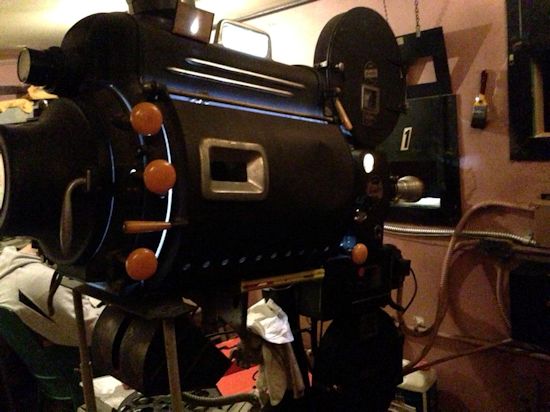
Installed in the 1940's.
They were installed used (as in "not new").
Still running.
Skyfall is scheduled to run the weekend of Feb 1st and 2nd.
Posted by Tom Tomlinson (Member # 703) on 01-14-2013, 02:37 PM:
Hi,
a general question about digital playback.
Do you think the servers would be the first to fail?? I was wondering if HFR media put on a server that wasn't exactly new----would a server --showing its age---start skipping playback of frame sequences it was unable to playback?
thanks for any feedback
TomT
Posted by Randy Stankey (Member # 64) on 01-14-2013, 03:22 PM:
Digital movie servers are just big boxes full of computer disk drives. They are supposed to be "enterprise quality" disk drives which is supposed to mean that they are more reliable but, in the end they are still disks covered with iron oxide.
How reliable are digital movie servers? To answer a question with a question; how reliable are those disk drives?
Yes, they use RAID as a way to make sure that the data comes through as it should. I'm sure that there is also some kind of error correction system built in. Checksums? FEC? Whatever?
I can't say that a digital video projector will break down any more or less frequently than a real projector but, to answer the question of long-term reliability and longevity, ask yourself, "How much do I trust those disk drives?"
Personally, I trust disk drives pretty well but I don't trust them THAT much. Not fifty years worth. Certainly not 100.
Posted by Mark J. Marshall (Member # 1409) on 01-14-2013, 04:25 PM:
Randy is right. Those servers are basically big computers - only a slight bit beefier and faster. Ask yourself this question - how old is the oldest computer that you have working, and how well does it work?
The oldest server I have running is probably 10 years old. And we consider it an antique that we only keep around so that it can run the antique accounting software on it for historical purposes.
The oldest film projectors I have running are 70+ years old, and they run like tops. Both of them.
Posted by Mark Hajducki (Member # 1732) on 01-14-2013, 06:28 PM:
quote: Randy Stankey
How reliable are digital movie servers? To answer a question with a question; how reliable are those disk drives?
Yes, they use RAID as a way to make sure that the data comes through as it should. I'm sure that there is also some kind of error correction system built in. Checksums? FEC? Whatever?
The drives are known to be the least reliable part of computer server hardware and are designed to be easily replaced (treated as semi-disposable). RAID is used to minimise the impact of a drive failing (a screen will not be down unless a second drive fails before the first has been replaced).
35mm systems had parts that needed replaced at intervals (lamps, belts, oil etc.) so digital is not much different (although the parts may cost more).
The total life of a digital system will depend on how long support and parts remain (economically) available. Due to steady advances in computer hardware (in 10 years computer chip speed will be 5 or 6 times faster according to Moore's law, hard drive storage will have increased by about the same amount) a complete replacement of the server will be necessary more often than with film kit.
Posted by Marcel Birgelen (Member # 6801) on 01-14-2013, 06:37 PM:
quote: Tom Tomlinson
Do you think the servers would be the first to fail?? I was wondering if HFR media put on a server that wasn't exactly new----would a server --showing its age---start skipping playback of frame sequences it was unable to playback?
A server will very probably not fail in that way. If a server fails, it is probably a "hard fail", so it won't playback anything at all.
A playback server will never last 50 years, it is simply not designed to do so. The disks in such a server will probably start failing after about 3 to 7 years. Your mileage may vary but it is unlikely that they will last longer than that.
But, those disks aren't really the expensive parts and can be easily replaced. Other stuff that will probably break before the end of the decade are cooling fans and power supplies.
I guess it is clear enough that in the "digital age", stuff won't last another 50 years, even if it would be as reliable as 35mm equipment has proven to be, it will be outdated by then.
Studios will now start pushing 3D HFR, which is already unsupported by practically all first-generation DCI compliant equipment. So, what's next? 4K 3D? And then 4K HFR 3D? And since high end TVs are already pushing 4K, will we see 8K in the foreseeable future?
Posted by Randy Riddle (Member # 3989) on 02-01-2013, 08:16 PM:
As a hobby, I work with vintage sound equipment and do sound restoration. Some of that involves equipment that has some level of computerized parts.
Generally with most electronics, the components can be quite robust. Right now, some of the studio or high quality home equipment made in the 1980s that include some computerized components are starting to fail, but you would be surprised how much is still working just fine.
The weak link in solid state (and tube based) electronics are capacitors. Those are filled with chemicals that can change over time - if capacitors start to go, it can throw off specs and cause something else to blow in the circuits.
Mechanical parts will fail first - the hard drives in the RAID arrays - and are considered disposable. Switching out playback and record heads, belts, and other parts on pro audio or video equipment is expected. There were tv stations and video production facilities still using 2" Quad videotape machines from the early 60s in the late 70s or early 80s.
One thought that occurred to me is the big business that might happen in a decade or two is when the round of equipment installed in theaters for the digital switch start to fail. High end equipment, like servers, are usually made modular so that parts can be switched out like hard drives or boards.
At least with audio or video, pro equipment lines don't change very much over the years and spare parts are around for much longer than consumer level devices, like off the shelf computers or home tvs and stereos. You might find that digital cinema equipment has a longer life span and, unlike a five year old computer that's dumped because it can't be fixed, can be repaired or upgraded longer than you think.
Posted by F. Hudson Miller (Member # 5318) on 03-18-2013, 04:36 PM:
Question 1: How long was the DP70 designed to run?
Answer: Forever - Planned non-obsolesence.
Question 2: How long is a digital projector designed to run?
Answer: Until the next format comes along.
Posted by Bobby Henderson (Member # 840) on 03-18-2013, 09:45 PM:
Anything "digital" is really not meant to last. That especially goes for ALL forms of computer gear.
Hard disks tend to be the least reliable component, but just about anything else in a server, projector or any other digital piece of gear in the booth can fail. Getting a replacement part on a fairly new system is no sweat. Getting spare parts for what amounts to a very glorified personal computer that's 10 years old might be a real pain in the ass or just dead in the water impossible.
Software is another big problem. Are the service providers going to keep making the software updates backward compatible with that aging hardware? Even if the service providers strive to make their software backward compatible with an old system they will at some point be forced to stop supporting it. The developers have to move forward and engineer their software for the newer generations of hardware.
None of this is new to anyone who has used personal computers or other digital devices for more than a few years.
Lots of people are still using old PCs running Windows XP, but Microsoft will end their support of that old OS next year. Ask anyone with an Android phone that isn't a Google Nexus how they like waiting months on end for Android OS upgrades or see phones less than a year old get cut off from any future OS updates. Apple's iPhone is better in this regard, but not perfect. You can't run the latest version of iOS on a first generation iPhone. Another nasty thing about smart phones: most have non-removable batteries. Any decent battery is going to be limited to a few hundred re-charge cycles before the battery starts to degrade. Eventually you'll be forced to buy a new phone unless you want to make all your calls with the phone tethered to a wall outlet.
I know a couple guys here in Lawton, twin brothers actually, who have quite a collection of old coin-operated video games. They buy and sell these things among other collectors. It's very challenging to find a 30+ year old coin-op game that's still in great working condition. Often they have to get a machine to work by cannibalizing good parts from other game cabinets. Some people cheat by installing a modern computer in the cabinet and have the game emulated via MAME. These guys must have a lot of fun if a CRT monitor goes out in one of those classic games; it's gonna be an ever worse challenge finding a replacement CRT that will work.
Powered by Infopop Corporation
UBB.classicTM
6.3.1.2