This is topic Viability of a boutique movie theater in forum Ground Level at Film-Tech Forum ARCHIVE.
To visit this topic, use this URL:
https://ft-forum.com/ft/cgi-bin/ubb/ultimatebb.cgi?ubb=get_topic;f=5;t=002680
Posted by Scott Jentsch (Member # 1681) on 06-04-2013, 11:30 AM:
An idea that's been bouncing around in my head for some time is the idea of a "boutique" movie theater.
It's the best term I can come up with for the concept of not building traditionally-size auditoriums, but rather smaller rooms that feature the correct viewing angles and other performance features of a properly designed movie theater.
Along with creating a more intimate experience, it would allow for placing a multi-screen theater in a smaller building, and I would think that there would be some cost savings to not having to heat/cool larger volumes of air. With less space to furnish, more time and money could be spent on the appointments, such as some interesting styling (just look at what high-end home theaters can look like, with a budget that is a fraction of what I'll bet it costs to outfit a standard, plain-jane auditorium), a curtain, and a really good sound system. Basically, a high-end home theater open to the public.
This can't possibly be an original idea, and to a certain extent, it's being done in iPic and the former Gold Class Cinema locations, but they take it a step further than I would with the super-wide seating and food service, etc.
I don't think a 40-50 seat theater is large enough to be economically viable, plus the seating in the locations creates poor viewing lines, both horizontally and vertically. The screens are too small and too high, so by the time you get far enough back to not be looking up at the screen, you're too far away to have a decent viewing angle.
I would imagine that the hardest thing about such an operation would be economy of scale. The more butts in the seats, the better the margins. But there has to be a crossover point somewhere, and it feels like many theaters do not come close to filling their capacity on a regular basis, so all that extra infrastructure is going to waste just to handle a few peak periods that might be better handled by more screens that can take on the extra butts when necessary.
I've been hearing about DCP-compliant projectors breaking the $30k barrier, which would help with the cost-per-screen issue. There are still sound systems and screens to be purchased, of course.
Is it possible to build out a boutique style theater with a certain number of screens with a seating capacity of, maybe, 80-100, in a smaller space than a traditional multiplex, and have it be economically viable?
Posted by Mike Blakesley (Member # 26) on 06-04-2013, 11:47 AM:
While it is true that having very few empty seats is good from the money standpoint, there is a definite crowd of people who like to come on the slow nights so they DON'T have to sit near other people. They like the experience of going to the movies but they like having their own space too, for the obvious reasons plus possible other reasons. Or many people are picky about where they sit, and get annoyed if "their" seats are taken.
With mini-sized auditoriums you might be looking at full houses every night which could turn-off alot of people -- not just the ones I mentioned above but also those who show up exactly at showtime and continually find the show "sold out."
Of course once the area moviegoers got used to the idea, and if it really was a super-high-end experience, people would start coming early, or reserved seats could be offered online, etc. so they could be sure to get in. Combine that with extra-large, extra-comfy seats and a high enough price tag to keep out the riff raff and it could be a winner.
Posted by Scott Norwood (Member # 30) on 06-04-2013, 11:54 AM:
National Amusements more-or-less just opened one of these:
http://www.showcasesuperlux.com/
Get ready for $20 movie tickets.
I have not seen this place, except from the outside. It will probably do "boffo biz" (as Variety would say), at least initially.
My personal opinion is that anything that results in ticket prices that rise faster than inflation (3D surcharges, Lie-max surcharges, "premium seating," etc.) is bad for the long-term health of the industry. The exhibition business has survived for over one hundred years by providing inexpensive out-of-home entertainment. The last thing that the industry needs is for there to be a public perception that movies are not a good value for the dollar. Even $10 tickets are marginal when bargain-bin DVDs are going for $5.
Posted by Aaron Garman (Member # 1653) on 06-04-2013, 12:01 PM:
If it was something like the F-T screening room perhaps but I could pay to go and see first run features? Hell yeah I'd go!
AJG
Posted by Mitchell Dvoskin (Member # 751) on 06-04-2013, 01:00 PM:
> seating capacity of, maybe, 80-100, in a smaller space than a traditional multiplex, and have it be economically viable?
I would suspect not, but then I don't know your market. The smaller auditoriums mean less unused space, not more business. However, this is more a matter of arithmetic than guesswork.
Figure out the cost to run the place per month (including the servicing of any debt for construction and equipment), and that will give you an idea of how many butts you will need to seat each week/month to make money. If you think that you can meet that, then it is a viable project.
Also remember that any advantage you get by fill the smaller auditoriums on off nights will be offset by customers being turned away on busy nights, some of whom will never come back.
Posted by Bobby Henderson (Member # 840) on 06-04-2013, 03:35 PM:
Warren Theaters' Directors Suites are along the lines of this concept:
http://www.warrentheatres.com/mooredsuites.asp
Tickets are $22. Ages 21 and up only.
quote: Scott Norwood
My personal opinion is that anything that results in ticket prices that rise faster than inflation (3D surcharges, Lie-max surcharges, "premium seating," etc.) is bad for the long-term health of the industry.
I agree with this in principal. Theater operators are fooling themselves if they don't think customers are comparing the cost of a movie theater visit with that of buying/renting to watch at home.
I think a movie theater that puts forth a great deal of effort to maximize luxury aspects of the experience might be justified in charging a premium price. I certainly see more value in that than I do the IMAX concept of merely installing two video projectors, a slightly bigger floor-to-ceiling wall-to-wall screen and running the volume louder.
Honestly, there should be a check list of requirements all commercial movie theaters should satisfy in order to justify the standard ticket price (good quality picture & sound, clean auditorium, comfortable seats, decent sight lines, minimal disruptions to the show, etc.). Customers shouldn't be paying a premium for those things.
I paid a standard admission price to watch movies in General Cinemas Northpark 1-2 theater back in the 1990s. I have yet to hear a sound system from one of these premium theaters, be it IMAX digital or anything else, match the dynamics and overall high quality the Northpark maintained.
If it makes a big enough quality difference above the best of what other theaters can do, I could be happy paying a premium for dual 4K laser projection in an IMAX digital theater or paying extra to listen to a movie with an Atmos sound system configured to maximum specifications. I'm talking quality differences that set a new high standard. Regular single projector, 5.1 surround theaters can boast great quality sound and projection and do so for a standard price.
I'll consider an age 21 and up only policy to be a luxury item. Customers shouldn't have to put up with crying babies and disruptive teens. Unfortunately both are often standard fare in a normal movie theater environment. Giant, plush, reclining seats with so much leg room it's impossible for the feet to touch the seat back in the next row: luxury item. Most of these boutique luxury screening rooms often involve waiter/concierge service to provide food and mixed drinks. That's definitely not standard movie theater fare.
quote: Scott Norwood
Even $10 tickets are marginal when bargain-bin DVDs are going for $5.
Bargain bin Blu-rays can be had for as little as $5. I've seen them at Walmart as well as online stores.
Posted by Scott Jentsch (Member # 1681) on 06-04-2013, 04:51 PM:
The Superlux and Director's Suites look very similar to iPic and the former Gold Class Cinemas. A low number of super-sized seats with wait service.
Here are some photos that I took of the Gold Class Cinemas - South Barrington, IL:
http://www.bigscreen.com/Marquee.php?theater=12644&view=photos
The last photo illustrates the problem with screen height in relation to the seating. The Warren Theatres site shows that a little, but it's hard to tell if it's as extreme.
Experiences like that are really nice, but at $20-$30 per ticket, it's not something people will do on a regular basis (I think). I would imagine that means that you have to be in a high population area to get enough butts in those seats on a consistent basis.
Those large seats also mean that not very many butts will be filling each auditorium. I actually felt like the Gold Class seats were too large to be comfortable. You could probably double the seating capacity in those rooms and still have very comfortable seats. The seating in the opening-tomorrow Carrollwood Villagio Cinemas in Tampa look about right:
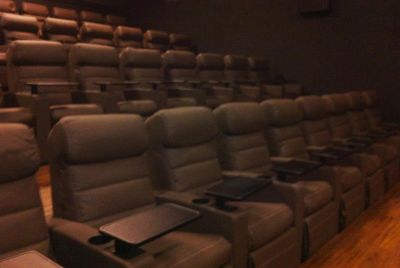
While the armrests are still shared, there is substantial distance that should help to minimize concerns about sitting right next to other people (I prefer to have one seat's worth of spacing myself, so I get this).
Mike's comment about the super high-end experience is spot on, in my thinking. What I would like to see in a movie theater is high-end performance without all of the high-end amenities, but still delivering an experience that is better than what is too often bland and unremarkable at best, and downright sad on average.
When faced with the prospect of the usual movie-going experience, people can't help but to compare the experience against just staying home and renting something off Netflix or Vudu.
I'd like to think there's a middle ground between the average experience and these high-end, super amenity laden experiences that cost a lot of money.
Posted by Martin McCaffery (Member # 37) on 06-04-2013, 08:32 PM:
From friends I've talked to about the "High End Experience" it's a bit like 3D for groups. They'll try it once on a special occasion, but repeat business is going to be really tough to get.
Posted by Scott Norwood (Member # 30) on 06-04-2013, 10:02 PM:
On the topic of seats: why do all of these "premium cinemas" have such ridiculous seats? What is so wrong with normal movie seats, anyway? I could stand to lose (more than) a few pounds and I have never found a theatre seat to be too narrow. I can see the advantage of super-nice seats for long airline flights and such, but are people really too fat to spend a couple of hours in a regular-size movie seat?
As for the idea that smaller auditoria will sell out regularly: this might not actually be as big a problem as one would think _if_ audiences can be trained to buy tickets in advance and if those tickets are for reserved seats. One way to do this would be to allow advance ticket sales by phone or web without adding a surcharge for the privilege. I wouldn't try this in a touristy area or if the programming were targeted toward the over-50 crowd, but I could see it working in an area with a regular group of young-ish customers.
Posted by Brad Miller (Member # 2) on 06-04-2013, 10:28 PM:
I would much rather have double armrests than wider seats. It's the space between the stranger that I would appreciate most. Plus I like my own armrest.
Posted by Mike Blakesley (Member # 26) on 06-04-2013, 10:38 PM:
quote: Scott Norwood
why do all of these "premium cinemas" have such ridiculous seats?
It's to make them seem as much as possible like your home recliner. Which is kind of dumb really, since a recliner is designed almost as much for napping as it is for sitting.
Our original seats here from 1930 were 18" wide. The current seats are a mix of 22s and 24s, and even then we have a few patrons who find it necessary for two people to put up the armrests and occupy three seats. I think it's helped business a little to have those wider seats actually.
I'm with Brad about the wider armrests though. I'm kind of surprised nobody's done a small table-ish thing in between every pair of seats, rather than just the cupholder.
Posted by Bobby Henderson (Member # 840) on 06-04-2013, 11:30 PM:
One thing I like about those super-sized seats (and the wider row spacing): it's impossible for some jerk to kick the back of your seat or rest his legs on the top of it.
I keep any urges of physical violence well in check, but when someone in the row behind me kicks the back of my chair on anything more than an accidental basis the thought of punching him in the teeth at least crosses my mind.
It's sad to think it takes spending over $20 per ticket for a premium/luxury experience just to eliminate many of the aggravations that shouldn't be part of the standard movie-going experience in the first place.
Posted by Brad Miller (Member # 2) on 06-05-2013, 12:33 AM:
quote: Mike Blakesley
It's to make them seem as much as possible like your home recliner. Which is kind of dumb really, since a recliner is designed almost as much for napping as it is for sitting.
So what's the problem? Have you not seen some of the movies being released these days? ![[Wink]](wink.gif)
Posted by Frank Cox (Member # 6258) on 06-05-2013, 12:38 AM:
I used to have a guy here who would come to the movie every Tuesday night. He would sit in the back row and sleep until the movie was over. I would wake him up after everyone else was gone and he would leave.
He never bothered anyone -- didn't snore or anything. That went on every Tuesday for several years, then one day he didn't show up and I haven't seen him since.
Posted by Scott Jentsch (Member # 1681) on 06-05-2013, 10:26 AM:
I like the idea of individual armrests, because I don't like bumping into someone's elbow that I don't know, and it would give you your own sense of space.
I just measured the very comfortable, but not huge, chairs that I have in my home theater, and the seat cushions are 24" wide. The most comfortable chair in my house has a 21" cushion. I think part of the extra-wide furniture in those luxury cinemas is to reinforce that this isn't a standard theater. I don't know what they measured, but the seats in the Gold Class were too wide. I do know that when iPic took over, they did replace the seats with smaller ones so they could get more in each auditorium.
The seats in Marcus' UltraScreens in Brookfield, WI are not super-sized, but they are comfortable. Even when it's packed, you don't feel like you're packed in. The VIP seating does have small tables that put a little more distance between people as well.
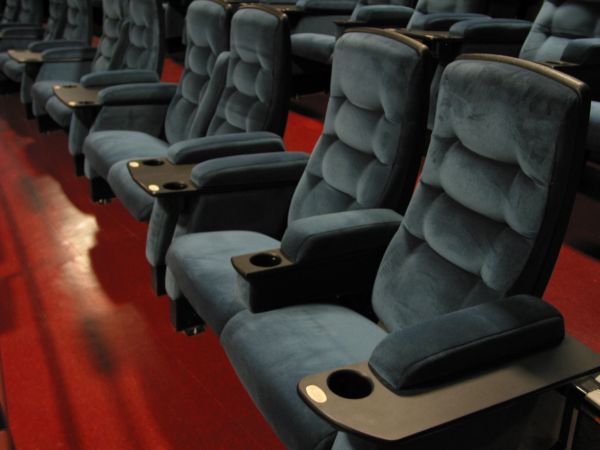
They have more leg room, so Bobby's concern about kicking seats would be resolved, and getting into the middle of a row past people isn't an exercise in gymnastics. I've never sat in these seats because they are too far back in the auditorium for my taste and they are reserved seating with a $5 upcharge over and above the $1 upcharge for the UltraScreen. If they were in the prime seating locations in the auditorium, I would probably pay the $16 price tag. The next time I go to that theater, I'll measure the seat widths as well as the row spacing.
I don't know what the rule of thumb is now for theater seating, in order to accommodate a majority of patrons with some room for the larger audience members, but I would think a 24" wide cushion with separate armrests would provide that "nice touch" upgrade without going too extreme and having to double ticket prices to make up for the loss in seating.
The ticket prices are really the rub in the whole discussion though. How to structure the prices so that they don't put it out of reach for the general public looking for "something better" but not willing to go to the extremes that are out there?
In the Milwaukee market, an adult evening ticket is right around $10 with no addons for 3D, UltraScreen/IMAX, etc. With that as a baseline, I could see a 25% upcharge to $12.50 but the ideal would be to keep the price the same so that it would be a competitive advantage.
Can you lose 15-20% of your seating capacity and still have the numbers work out if the ticket prices are the same as the competition? My thinking is that if people become aware of a consistently elevated moviegoing experience, word will get around and it's likely that more people would attend, so even though the capacity is lower, elevated overall attendance rates may compensate.
The Superluxes of the world have their place, but I think there is a potential for offering people better than what has become the de facto (sub)standard experience without going to that extreme and the upcharges that come with it.
The alternative is the continuation of the apathy shown by audiences, which is a reflection of the apathy that many theaters show towards their customers. I think an investment in providing customers with a better experience would be rewarded with positive reviews, which should generate more loyalty in the form of repeat business as well as more new attendance from the positive word-of-mouth advertising it would generate.
Posted by Mark Hajducki (Member # 1732) on 06-05-2013, 03:06 PM:
quote: Scott Jentsch
It's the best term I can come up with for the concept of not building traditionally-size auditoriums, but rather smaller rooms that feature the correct viewing angles and other performance features of a properly designed movie theater.
The thread seems to have moved towards discussing the luxury cinema market, rather than building smaller cinemas.
The small cinema market may work best as part of another business (hotel, cafe, restaurant, bar) rather than being stand alone.
A small cinema may be able to make use of unused space above or below other uses such as shops only using a small amount of street frontage. The HMV Curzon in Wimbledon, London was built in the empty stockrooms above a music retailer, and neighbouring sports shop. It has three screens (103, 91 and 71 seats).
On a larger scale, when Odeon rebuilt their Edinburgh Lothian Road site (previously ABC) the cinema was moved into the basement with retail and offices above. They have applied for permission to convert most of the upper foyer level into a pizza restaurant which would give them minimal street frontage. It has four screens (299, 228, 77 and 177 seats). The site is not particularly busy as it has competion from a nearby 13 screen multiplex and two 3 screen art cinemas. For a new build it does not have a lot of legroom.
The Traverse Theatre (live action "art" theatre) was built in the basement of an office block, again having almost no street frontage. It has two venues, one seating 216-270, the other seating upto 100 people.
Posted by Scott Jentsch (Member # 1681) on 06-06-2013, 12:40 PM:
I think the discussion of premium movie theaters is relevant to hash out what can make a smaller auditorium attractive in its own right. Arguably, seating is an important detail to get right.
I've come across web sites for very small "back room" theaters when they get added to our site, and I've yet to see any that evoke what I was looking for. Many of them seem to be a room tucked away in a building somewhere with little more than a smallish screen and a couple dozen seats (sometimes folding chairs).
Using an example of a theater built around, say, a 26-foot wide screen, we can work some numbers from there. I chose 26 feet since that seems to be a common screen size for the majority of non-descript theaters I've been in. Admittedly, some theaters try to get away with smaller, but I think if you get much smaller than 25 feet, you're losing the impact necessary to create a good first impression. Personally, I'd like to see something in the 30-foot range instead, but let's stick to 26.
Allowing for 2 feet on each side of the screen for things like a curtain to be pulled back, that puts the minimum width of the room at 30 feet.
To keep the viewing angles good (36-degrees, using the THX recommendation), the back row of seats can be just 40 feet back. So that the back row doesn't slam up against the back wall and destroy any hope of decent surround back there, let's give 10 feet to the back wall, so that makes it a 50 foot deep room.
One local theater (built in 2007) has several rooms about this size, with seating for about 100 people. These rooms are noticeably small, and they're about the smallest I'd want to go into and still have it feel like a commercial theater environment. Some of the auditoriums in that same theater are even shallower at 36 feet, with a 27 foot wall-to-wall screen, and 71 seats.
My guess is that if we applied some of the seating preferences that are being talked about, we'd lose about 30% of those seats, bringing the total seating down to 50-70. I think that's still a fair number of butts in seats, especially if the smaller room size means that more auditoriums can be used to handle peak periods.
Posted by Gavin Lewarne (Member # 5397) on 06-06-2013, 04:38 PM:
our place probably fits, in a strict sense, what you mean by a boutique theatre.
61 seats
11m throw
6mx2m screen in scope, constant height
5.1 with just 2 surrounds per Ls/Rs channel due to smallness of the room.
We have lots of problems when we screen mainstream or locally important films due to sellouts and having to turn other people away. The saving grace is that we are the ONLY cinema in the city, possibly even a large part of the whole region that screens certain films, since we are an arthouse place mostly. Most turn-aways come back or book tickets for another show if its a sell out. If its really popular we get the film back for a second week long run after a short break.
Lots of our regular customers prefer our place to the local multiplex because its "cosy" and more comfortable. We also have old fashioned always-present ushers and if you look behind the back row you can actually look right into the projection room and see us and the projectors. Lots of comments, from young and older people that they like the "human" element to it compared to the sterile environment of the competition.
We are very poor with very limited budgets. some of the décor may be a little tired but we keep everything thoroughly clean, fresh, warm and comfortable. With our small throw and small screen we can compete with the big boys in terms of image quality and sharpness even with just a 2k,. and our sound is rich, full and detailed - probably helped by the small room.
Even after proper calibration, anything above fader 6 is WAY too loud in there, which has lead to another group of loyal customers who appreciate not having their eardrums mutilated by the overly loud harshness of the other places around here.
If a customer askes an usher to increase or decrease the volume im happy to oblige of there are just a few customers in.
I sometimes feel embarrassment at the (slightly) shabby décor but with so little money to work with my priority has to be picture and sound.
Posted by Terry Lynn-Stevens (Member # 7349) on 06-07-2013, 02:47 PM:
quote: Scott Jentsch
An idea that's been bouncing around in my head for some time is the idea of a "boutique" movie theater.
It's the best term I can come up with for the concept of not building traditionally-size auditoriums, but rather smaller rooms that feature the correct viewing angles and other performance features of a properly designed movie theater.
Along with creating a more intimate experience, it would allow for placing a multi-screen theater in a smaller building, and I would think that there would be some cost savings to not having to heat/cool larger volumes of air. With less space to furnish, more time and money could be spent on the appointments, such as some interesting styling (just look at what high-end home theaters can look like, with a budget that is a fraction of what I'll bet it costs to outfit a standard, plain-jane auditorium), a curtain, and a really good sound system. Basically, a high-end home theater open to the public.
This can't possibly be an original idea, and to a certain extent, it's being done in iPic and the former Gold Class Cinema locations, but they take it a step further than I would with the super-wide seating and food service, etc.
I don't think a 40-50 seat theater is large enough to be economically viable, plus the seating in the locations creates poor viewing lines, both horizontally and vertically. The screens are too small and too high, so by the time you get far enough back to not be looking up at the screen, you're too far away to have a decent viewing angle.
I would imagine that the hardest thing about such an operation would be economy of scale. The more butts in the seats, the better the margins. But there has to be a crossover point somewhere, and it feels like many theaters do not come close to filling their capacity on a regular basis, so all that extra infrastructure is going to waste just to handle a few peak periods that might be better handled by more screens that can take on the extra butts when necessary.
I've been hearing about DCP-compliant projectors breaking the $30k barrier, which would help with the cost-per-screen issue. There are still sound systems and screens to be purchased, of course.
Is it possible to build out a boutique style theater with a certain number of screens with a seating capacity of, maybe, 80-100, in a smaller space than a traditional multiplex, and have it be economically viable?
A boutique cinema would never work in 2013. From everything I have been seeing, people do not care whether the cinema has proper angles or a 35mm screen. People want the largest cinema possible, faux leather chairs, and loudest ear drum shattering sound. The generation of today has no problem paying a premium for a ticket nor they have a problem paying $20 for a ticket.
Whether or not people on here will agree or not, IMAX does the above best...they clearly have the best branding for this.
When the average person has to pay $12-$15 for a ticket, they will naturally want to see the movie in the larger cinema with the louder sound.
Posted by Robert E. Allen (Member # 1351) on 06-07-2013, 04:34 PM:
Ear shattering sound is not entertaining. Sound that is loud enough for one to hear all the dialog and all the music responses IS. Ear shattering sound is what has given us a generation of hearing impaired young people.
Posted by Mark Hajducki (Member # 1732) on 06-07-2013, 05:12 PM:
I don't fine the "premium" multiplex seats any better than the regular ones. They have a bit more width and when retrofitted into sections of existing screens, less legroom.
The worst part, for me, is the "leather" seat fabric, I find this uncomfortable and sticky. The local bus company moved over to cloth seats a decade ago.
The built as premium screens (now converted back to regular) still feel like normal multiplex screens. A well designed small cinema could give a better atmosphere than them.
Posted by Mike Blakesley (Member # 26) on 06-07-2013, 06:20 PM:
quote: Robert E. Allen
Ear shattering sound is not entertaining. Sound that is loud enough for one to hear all the dialog and all the music responses IS. Ear shattering sound is what has given us a generation of hearing impaired young people.
Loud sound can indeed be entertaining if it's played on a good system. It's overly loud dialog that grates on the ears, no matter what kind of system. Too many cinemas just set it at "7" and don't consider whether the dialog is overly loud or not. I set the sound to where the dialog sounds good and the rest takes care of itself.
It'd be nice if movies were at least sort of the same from one to the next, regarding loudness. We just played "Epic" which required a volume of 6.5, but if we'd used that setting for Iron Man 3 we'd be still be picking up hunks of window glass from the sidewalk.
We have a good system here and it can get plenty loud, but we virtually never get any complaints about loudness. Occasionally I'll hear people saying "wow, that was loud!" on their way out but it's always with a big grin on their face. And we have lots of "senior citizens" in our regular audience.
Some movies (Michael Bay's, especially) are just one long action set piece after another from start to end. It's when you have constant noise with no breaks from start to finish -- THAT'S annoying to me, no matter what kind of sound system I'm hearing.
Don't blame movie theaters for the hearing impaired kids -- headphones are causing that problem, mostly.
Posted by Terry Lynn-Stevens (Member # 7349) on 06-07-2013, 11:01 PM:
quote: Robert E. Allen
Ear shattering sound is not entertaining. Sound that is loud enough for one to hear all the dialog and all the music responses IS. Ear shattering sound is what has given us a generation of hearing impaired young people.
I never said it was entertaining. But it sure is what most people want.
Posted by Bobby Henderson (Member # 840) on 06-08-2013, 10:31 AM:
One potential drawback I see with premium priced, acronym labeled theaters (ETX, XD, RPX, etc.) as well as the luxury boutique kind: it might give customers the impression the standard theaters are crap. Unfortunately in a lot of cases the customers would be right, but I still see this as a potential marketing problem.
This is why I believe ALL commercial movie theaters should offer great quality projection and sound. That's just a very basic thing. Unfortunately great quality projection and sound -or rather projection and sound done right- are being marketed as premium items. And not all these premium priced theaters are actually delivering sound and projection done right.
So a customer could end up thinking if he pays the standard fee he'll see sound/picture done wrong and has to pay extra for the theater to do its job right. Any movie theater should be working hard to fill all of its theater screens, not just the ones with the fancy acronyms.
I suspect if we see this premium priced screen trend continue we'll also start seeing new multiplex builds with fewer "plain" screens and more of the higher priced variety. Maybe we'll even see a multiplex with only a handful of these big, higher priced houses and no "plain" standard-priced theaters.
Posted by Scott Jentsch (Member # 1681) on 06-10-2013, 02:27 PM:
That's pretty much what I'm thinking; no "premium" auditoriums, because all the auditoriums are "premium" but without the distinction. I think when you go to a theater with premium auditoriums, it's like you're being told that "unless you pay extra, you're going to get a middling to substandard experience, so pay up!"
I saw this happen with quite a few theaters that had one or two THX screens. The managers said that people were so concerned about what was playing in the THX houses, that they were disappointed when the movie was not playing in one of them. That made the decision to move a movie all that more difficult.
My response is "why only have one or two premium auditoriums?"
The answer must be because it is not economically feasible to do a 6-10 screen theater with every auditorium done right. Otherwise, why wouldn't a theater want to deliver the best possible presentation consistently across the board?
And that's the genesis of the start of this thread. Instead of a theater with one or two premium screens, and 6-8 bland screens, why not spread the wealth and equip all of the auditoriums properly? Sure, you can have some big houses that seat 200-300 people or more, but the smaller screens can be good on their own, smaller, scale.
In my naive perspective, such a theater would be distinctive in its own right. If marketed properly, people would drive out of their way to check it out, and if run properly, they would come back, driving past competing theaters. Some people won't, but the bland multiplexes have to pay their bills, too.
In regards to sound and picture quality, I think most complaints about sound that is too loud is from the fact that the sound is not too loud, but distorted. Either the mix is done wrong, the equipment is broken or miscalibrated, or the room isn't built and/or tuned correctly.
I think people still want quality, and they'll know what it is when they get it (albeit perhaps with a little education). To quote The American President:
quote:
People don't drink the sand because they're thirsty. They drink the sand because they don't know the difference.
I would modify that for this discussion by saying that people have been fed substandard experiences for so long, they've learned to expect nothing more. The theater industry has now taught them that the only way to get something better is to pay another $3-8 for the pleasure; making it a "special" experience that you don't do all the time. So then it becomes a value judgement about whether a movie is worth paying for the special experience or just waiting for it to hit the dollar houses or just a little bit longer and get it on Blu-ray with its HD picture and lossless sound.
In a sense, the industry is training their customers to expect less, to make a value judgement based on the expected quality of the movie instead of the quality of the experience that a theater can deliver (no matter what the movie is), and to wait for something to be released on video.
Posted by Mike Blakesley (Member # 26) on 06-10-2013, 08:53 PM:
I don't really agree with this; just about every industry has "good, better, best" options available. Think of a hotel; you can pay $100 for a plain old room, or you can pay $300 or more for a deluxe experience, or $1000 (or $20,000 in some places) to be treated like a king.
Or you can go to a Motel 6, pay $50 and get the bare minimum.
The movie industry IS slightly different because of the shelf life of the items. The most popular items are going to be the newest ones. Even if a movie is six weeks old doesn't mean it's not a great movie; but it's now playing in the 50-seat craptacular auditorium at the end of the hallway, while a piece of crap like "After Earth," being brand new, is in the premium house even it it doesn't deserve to be.
The WORST thing that's happening is, aside from money issues, the industry is training people to expect a crappy experience if you don't see the movie in the opening week. Thankfully here in single-screen-land we don't have that problem at least!
Posted by Mark Hajducki (Member # 1732) on 06-11-2013, 02:15 PM:
Most of the small multiplex screens are badly designed (as are some of the larger ones). They do seem to be fitted into the leftover space (similar to the case when large cinemas were split) giving rise to some strange layouts.
Unlike the hotels mentioned above the ticket price is normally the same for the small auditoria as it is for the large (non IMAX etc.) screens.
Powered by Infopop Corporation
UBB.classicTM
6.3.1.2