This is topic RealD enters into size contest with Imax in forum Ground Level at Film-Tech Forum ARCHIVE.
To visit this topic, use this URL:
https://ft-forum.com/ft/cgi-bin/ubb/ultimatebb.cgi?ubb=get_topic;f=5;t=002691
Posted by Terry Lynn-Stevens (Member # 7349) on 06-26-2013, 04:59 PM:
Watch out Imax, there's another big screen that may be coming to town. RealD, the company that likely brings you your 3D experience in your local theater, is testing out a new premium large screen format in London called "LUXE: A RealD Experience."
The new large format theatrical experience is intended to compete with the biggest name in big screens, Imax. RealD is calling it “ultimate out-of-home entertainment experience."
“Disparate premium large format brands have limited the potential of today’s high-end cinema offerings,” said Joseph Peixoto, RealD president of worldwide cinema. “With an alphabet soup of brands and differing amenities in each auditorium, moviegoers have been left unable to truly equate their PLF experience with a single offering."
“’LUXE: A RealD Experience,’" Peixoto continued, "intends to solve this puzzle by unifying the exhibition community under one brand with one set of industry leading technology standards for an exceptional entertainment experience moviegoers will seek out for years to come.”
Auditoriums will be equipped with screens that are at least 16 meters in width and feature 3D sound. Karo Film in Russia and Arena Cinema in Bulgaria will partner with RealD to install the screens. RealD is currently talking with other exhibitors in the U.S. and Europe to feel out possibilities for a launch in larger markets.
Theaters are looking for innovative way to attract customers back to the theater in the era of busy schedules and quality home entertainment systems. Large format screens provide an experience that the home currently doesn't provide -- although Imax is now servicing wealthy clients who want an Imax in their home. However, theaters might be looking for a competitive alternative to Imax which currently dominates the large screen market.
RealD already has solid relationships with the nation's exhibitors, with its 3D technology in approximately 22,700 theaters in 68 countries. http://www.bizjournals.com/losangeles/news/2013/06/24/reald-enters-into-size-contest-with-imax.html
Posted by Frank Cox (Member # 6258) on 06-26-2013, 06:28 PM:
3d sound?
Posted by David Zylstra (Member # 4230) on 06-26-2013, 07:32 PM:
I assume by 3D sound they mean Barco Auro 3D, Dolby Atmos, or other immersive audio format yet to come.
Posted by Geoff Jones (Member # 3668) on 06-26-2013, 10:01 PM:
16 meters is considered large?
![[Frown]](frown.gif)
Posted by Brad Miller (Member # 2) on 06-26-2013, 11:11 PM:
Big flippin' deal. ![[Roll Eyes]](rolleyes.gif) I've yet to see a branded (public or private label) "mega-gargantuan-awesome-X" screen that was done right.
I've yet to see a branded (public or private label) "mega-gargantuan-awesome-X" screen that was done right.
Posted by Jarod Reddig (Member # 6363) on 06-26-2013, 11:37 PM:
Yawn
Posted by Frank Angel (Member # 248) on 06-27-2013, 10:52 AM:
IMAX at this stage of the game can only claim to have BIG screens if you compare them to some of the matchbox screens in many multiplex operations. But they are only RELATIVELY large from that standpoint; but if you compare them for what counted as big screens in days of single screen movie theatres where really large 70mm screens were commonplace, today's LIEMAX is no IMAX.
So now we are going to be asked to pay MORE for quality presentation? Since when did theatres charge by the screen foot? Oh...I guess since now. So will these new screens just be bigger or will the RealD 'luxe experience" include dual projectors so the image isn't just the same light spread out over a larger screen....fewer "lux"? The size of the screen is irrelevant -- anyone can increase the size of the screen -- what kind of image will be thrown up on it is what matters. And what does a theatre owner need RealD for (other than marketing hype...like coming up with that great logo 'LUXE and the unique phrase "ReaD Experience" -- you know, like IMAX's trademarked moniker)? Anyone can put in larger screens if they choose; anyone can install dual projectors if they want that bigger screen to be reach decent "'lux" levels and color saturation. What has ReaD to do with it?
Besides, hasn't there been a slew of big screen "X" marketing attempts before? Wasn't it AMC that tried a big screen premium gimmick awhile back?
Posted by Mark Hajducki (Member # 1732) on 06-27-2013, 04:32 PM:
Any cinema with RealD can advertise "a RealD Experience" The LUXE branding would have to be strong to promote any difference over a regular RealD screen.
This is similar to the brand issue Dolby had as cinemas could still claim to have "Dolby Sound" with outdated equipment. I worked at a site that had a dual 35mm/Dcinema booth still running Dolby A-Type NR. The company's website boasted "state of the art equipment" even though some of their 35mm projectors were over 50 years old!
Posted by Lyle Romer (Member # 1266) on 06-27-2013, 05:10 PM:
I wonder if this means Real-D is predicting a large decline in 3D (let us pray) and they are trying to stay relevant.
Posted by Jarod Reddig (Member # 6363) on 06-27-2013, 11:31 PM:
Lyle I'd say thats prolly a good guess.
Posted by Monte L Fullmer (Member # 2797) on 06-28-2013, 01:57 AM:
Gonna see huge megapixel display resolutions with this "RealDumb" process?
Posted by Aaron Garman (Member # 1653) on 06-28-2013, 10:45 AM:
Why can't they just give us a 100 foot 2.40:1 curved screen, with masking and curtains, and Dolby Atmos? I'd much rather see that than IMAX, unless it's native 15/70.
AJG
Posted by Frank Angel (Member # 248) on 06-28-2013, 11:42 AM:
I'll second that...but I'd even settle for a 60 footer given the size of most auditoria. And it better be dual projection or the DCI "consortium" bunch will probably reduce the brightness "standard" to 1.5FtL; you know, that ol make-the-standard-meet-whatever-the-equipment-can-manage scam they use for 3D.
As for the 3D haters, don't hold your breaths waiting for 3D to go away when the biggest record-breaking money-making tent poles this season are 3D titles. Sure, sure, I know the "the reason they are money printing machines for the studios is not because they are in 3D" argument, but try to convince studios bean-counters not to continue mimicing whatever it is that turns them big profits. So those of us who love 3D are quite comfortable knowing 3D is not going away; and in case you haven't noticed, 3D has gotten MUCH better in the last few years, especially the 3D-from-a-computer-in-post titles; as it's matured, 3D is mostly used only as an enhancement, not a gimmick. And for LOTS of people, it's IS an enhancement, probably as much as color or multi-channel sound or wide screen. Is 3D NECESSARY to tell a good story? Is color, or a scope ratio? Probably not...but none of that is going away because the public wants and expects those "enhancements."
3D is about as likely to go away as is digital projection -- it's just not going to happen, even if you can argue aesthetic reasons why it should. 3D is too intimately associated with blockbuster money-makers -- that alone guarantees that it will have longevity. It is here to stay, like it or not; best thing to do is to just get used to it because where money is concerned, Lyle, praying won't help. When I walk into a newly built theatre, I pray that it will have a sizable curved screen, proper masking and a screen curtain...my prayers only get me one out of three and only if I am lucky.
Posted by Aaron Garman (Member # 1653) on 06-28-2013, 11:54 AM:
Now this could be cool with proper illumination.
That's a big screen experience.
AJG
Posted by Bobby Henderson (Member # 840) on 06-28-2013, 12:06 PM:
I'm sorry, but applying the term "large format" to any digital projection based system is unadulterated horse shit.
These so-called "large format" theaters aren't breaking any records in terms of screen size. I've seen plenty of 35mm film based theaters use screens just as big. Example: the UA Galaxy theater in Garland, TX. Its biggest house had a screen 80' wide, labeled "the biggest screen in Texas" no less. The sound system was THX certified. Yet that theater didn't charge customers a premium over any of the other screens in the complex. It wasn't advertised as "large format" either.
Or maybe we can look at it in "digital" terms.
The two Grand Auditoriums at the Moore Warren 14 in Moore, OK have screens around 75' or 80' in width. To me, they look every bit as big or maybe even a bit bigger than the screen in their IMAX Digital house on the North end of the complex. The only aspect of the Grand Auditoriums that commands a price premium: the balcony seating.
A couple weeks ago I watched Man of Steel on Harkins' Cine Capris screen in Bricktown, downtown Oklahoma City. That screen is at least 70' wide. The movie was shown in 2D (the screen was too big for any single projector 3D process). The sound was Dolby Atmos. I paid a standard admission price for that big screen experience, with a new state-of-the-art sound process no less.
To me "large format" is strictly a film-based term -meaning anything bigger than standard 35mm.
In order for companies like IMAX, RealD, as well as the various theater chains doing their own in-house "large format" branding, they need to either come up with a different term or make some radical improvements to the projection technology -improvements that would only be used in the biggest houses. I don't think installing a pair of DLP video projectors is enough. I see, at best, a negligible difference between an IMAX Digital show and the same movie using a single projector on a smaller screen. The screen size is the only primary difference. With a lot of IMAX branded houses the size isn't even much of a difference either.
I'm still waiting to see what IMAX rolls out in regard to laser projection. A laser based, dual projector setup with both projectors sporting 4K resolution (and fed nothing but 4K native resolution content) might be a good start. Even if that turns out to deliver a big improvement in image quality IMAX still has to do something about that sound system.
Posted by Scott Jentsch (Member # 1681) on 06-29-2013, 03:35 PM:
I applaud the concept of branding a set of features that delivers a known level of performance, except that I'm not sure that this does that.
RealD has branded itself as a 3D company with their "See it in RealD 3D" taglines on movie posters and many movie showtimes that say "RealD 3D" (as if anyone cared about which company provided the 3D technology). So there is probably some level of brand awareness for the RealD company, but it's completely tied to 3D product. It's going to take money and/or time to broaden their brand to be more encompassing.
I find it interesting that they are referring to it as the “ultimate out-of-home entertainment experience." Their point of reference is home theater, not commercial exhibition. I would think that they could aim squarely at the likes of IMAX and all the RPX, ETX, XD, etc of the industry by saying that it's the "ultimate moviegoing experience."
Such a tagline would promise great things, as it would be the best experience one could get to watch a movie, whether at home or in a theater. Perhaps that would be biting off more than they can chew?
16 meters (52.5 feet) is about the minimum that I would consider to be a "large-screen" experience. While that pales in comparison to the size of 70-80 ft screens, I'd much rather watch a movie in a correctly-sized auditorium with a nicely-lit 55' screen, than a larger auditorium that has all kinds of compromises. This is especially true if it means that instead of just one 70' screen, a theater might have two or three 50' screens, or more.
Give me a brand that concentrates on delivering a solid set of performance points, and I'll get behind it. Make sure that the screen is lit properly, with impressive sound will make an impact whether it's delivering a blow-em-up action movie or a quiet drama, and have a mechanism for regular calibrations of both, and you have something that I can get behind.
I dare RealD or anyone to do that, but to date, no one has. Why is it so difficult to achieve (and maintain) excellence in this industry?
Posted by Terry Lynn-Stevens (Member # 7349) on 06-29-2013, 04:19 PM:
quote: Frank Angel
IMAX at this stage of the game can only claim to have BIG screens if you compare them to some of the matchbox screens in many multiplex operations. But they are only RELATIVELY large from that standpoint; but if you compare them for what counted as big screens in days of single screen movie theatres where really large 70mm screens were commonplace, today's LIEMAX is no IMAX.
IMAX still can claim big screen, many of their stand alone/museum locations are showing Hollywood movies.
quote: Frank Angel
So now we are going to be asked to pay MORE for quality presentation? Since when did theatres charge by the screen foot? Oh...I guess since now. So will these new screens just be bigger or will the RealD 'luxe experience" include dual projectors so the image isn't just the same light spread out over a larger screen....fewer "lux"? The size of the screen is irrelevant -- anyone can increase the size of the screen -- what kind of image will be thrown up on it is what matters. And what does a theatre owner need RealD for (other than marketing hype...like coming up with that great logo 'LUXE and the unique phrase "ReaD Experience" -- you know, like IMAX's trademarked moniker)? Anyone can put in larger screens if they choose; anyone can install dual projectors if they want that bigger screen to be reach decent "'lux" levels and color saturation. What has ReaD to do with it?
IMAX is huge right now, and for a new tent pole to be released, it often needs the IMAX Experience to help it. RealD is smart to cash in on the current trend of big screen/big sound.
I just saw an advertisement for The Wolverine, at the end it stated "In RealD, RealD 3D and Large Format Theatres"
This is reality of the cinema right now, and it will be like this going forward.
Posted by Ken Lackner (Member # 1002) on 06-29-2013, 04:40 PM:
quote: Terry Lynn-Stevens
"In RealD, RealD 3D and Large Format Theatres"
So there's a RealD process that isn't 3D?
![[Confused]](confused.gif)
Posted by Chris Slycord (Member # 4239) on 07-01-2013, 03:21 AM:
I bet it actually said RealD, Imax 3D, and Large Format Theaters" with the latter referring to the big screen options from the various chain theaters. But of course, I could be wrong and the studio messed up their trailer (which isn't unheard of).
Posted by Frank Angel (Member # 248) on 07-01-2013, 10:12 AM:
Large Format digital? "Large format has always refered to the projection system -- a big screen size but MUCH more importantly, a higher resolution image source to go along with it, be it 5/70mm or 8/70mm or 15/70mme -- not just an increase in the screen size without a corresponding higher resolution image source. Which is why no one called a DriveIn using 35mm on a 120 foot screen a Large Format Theatre. Similarly, just blowing up the same DLP image chips with the same number of pixals isn't "large format," it's dog poo.
"RealD 'Lux Experience," "Large Format Theatres" and anything else they decide to call 2K source blown up on a bigger(ish) screen are nothing but nonsense words that they are just pulling out their asses.
Posted by Terry Lynn-Stevens (Member # 7349) on 07-01-2013, 12:04 PM:
quote: Frank Angel
Large Format digital? "Large format has always refered to the projection system -- a big screen size but MUCH more importantly, a higher resolution image source to go along with it, be it 5/70mm or 8/70mm or 15/70mme -- not just an increase in the screen size without a corresponding higher resolution image source. Which is why no one called a DriveIn using 35mm on a 120 foot screen a Large Format Theatre. Similarly, just blowing up the same DLP image chips with the same number of pixals isn't "large format," it's dog poo.
"RealD 'Lux Experience," "Large Format Theatres" and anything else they decide to call 2K source blown up on a bigger(ish) screen are nothing but nonsense words that they are just pulling out their asses.
I think, big screen and big sound is the changing face and reality of what large format is. Sure we had 15/70 and 70mm, but the generation that is paying for IMAX Digital and ETX really do not care that there was once a 70mm format. Most people would not be able to tell or know what to look at when they compare the difference between film/digital, sad, yes but that is the changing face of what people are willing to pay for and more importantly, accept.
Some people of the current younger generation will never know that there were once 100 feet screens or 7 storey IMAX screens.
Posted by Bobby Henderson (Member # 840) on 07-01-2013, 01:55 PM:
I think large format digital belongs in the same oxymoron category as jumbo shrimp.
The growth of IMAX Digital and other premium priced big screen theaters doesn't qualify them as large format. The general public's lack of knowledge on what truly makes a theater experience large format doesn't qualify big screen digital as large format either. Most of the general public probably couldn't name the state capitol of South Dakota. The town of Pierre still exists despite that lack of general public knowledge. Sioux Falls can't just become the state capitol simply because it is better known and has more residents.
For digital to be large format it must rise to a level of extravagance or excess that would be cost prohibitive or impractical to install in a standard auditorium with only so many seats. Notice I didn't say anything about quality. 2K on a giant sized screen isn't anymore 2K than 2K shown on a more modest sized screen, it's just going to be bigger and more blurry.
quote: Terry Lynn-Stevens
IMAX still can claim big screen, many of their stand alone/museum locations are showing Hollywood movies.
Given the choice between watching IMAX Digital on a modest Lie-MAX sized screen or shown on a screen originally made for real 15/70mm film projection, I'd rather watch it on the smaller screen. That limited 2K pixel grid won't be blown up to such a massively blurry scale. But if I'm going to watch the 2K movie on a more modestly sized screen, I'd rather not have to pay a big price premium to see it.
Maybe things will get better when the dual 4K laser projectors begin deployment. But we're not there yet.
quote: Scott Jentsch
I find it interesting that they are referring to it as the “ultimate out-of-home entertainment experience." Their point of reference is home theater, not commercial exhibition. I would think that they could aim squarely at the likes of IMAX and all the RPX, ETX, XD, etc of the industry by saying that it's the "ultimate moviegoing experience."
The single projector 3D processes are just not suitable for large screens. This is essentially the only separator between standard theaters and certain premium priced big screen theaters. They need 2 projectors to do 3D reasonably well on a big screen. As dim as some 3D shows can be on even regular sized screens one could make a good argument that dual projector systems need to be used in a lot more auditoriums. And why not? Customers are already paying a hefty premium for 3D in the standard sized houses.
With film, it was a whole lot easier and more simple to draw a line between standard and large format projection. With "digital" the situation is only getting more confusing for customers. I don't see companies like Real-D helping simplify this mess either. They may further pollute the problem IMAX largely created.
Posted by Scott Jentsch (Member # 1681) on 07-02-2013, 02:24 PM:
A steadily decreasing percentage of people have experienced what true "large format" is like. How many people have seen an IMAX movie in a huge IMAX screen? Probably more than those who have seen an epic movie in 70mm on a suitably wide screen. I think if you ask people what "large format" means to them, they'll respond with an IMAX screen, which will usually be an MPX LieMax screen and not even one of the original large screens. That's the segment I think RealD is going after here.
Aside from the challenges that RealD faces, one could see their play from two different perspectives:
- A successful company looking to expand their brand into new categories
- A company diversifying its portfolio in an attempt to stay relevant should their existing core product diminish in the marketplace
I think RealD has done an amazing job of getting their brand out in front of people. They've almost gotten to the point of associating "RealD" and "3D" to the point of "Dolby" and "Surround". If 3D starts to decline, it makes sense to expand into other areas so that they aren't a one-trick pony.
I will be interesting to see where they go with this, but what I've seen so far, it will not make a big impact on the industry.
Personally, I'd prefer if they would take the approach of "Size Matters Not" and go for quality over quantity. Make it great, then make it big (if they can).
Posted by Bobby Henderson (Member # 840) on 07-02-2013, 02:47 PM:
All any viewer needs to do is start researching the numbers & details related to the technology. It doesn't even require any previous exposure to large format film presentations. When it comes to "large format digital" there is no Retina Display™ aspect to it. The theater is just taking a HDTV resolution image and blowing it up bigger. That's all.
This is why much of the business model for these premium screen efforts is pretty shaky. If customers start deciding "hey I'll save a few bucks and watch the movie in one of the standard sized houses; the image quality is no different after all" then these premium priced houses are going to be in trouble.
Posted by Chris Slycord (Member # 4239) on 07-03-2013, 01:34 AM:
quote: Terry Lynn-Stevens
I just saw an advertisement for The Wolverine, at the end it stated "In RealD, RealD 3D and Large Format Theatres"
Btw, I saw the same ad and it actually says "In RealD, 3D and Large Format Theaters."
Posted by Terry Lynn-Stevens (Member # 7349) on 07-03-2013, 06:30 PM:
quote: Bobby Henderson
The theater is just taking a HDTV resolution image and blowing it up bigger. That's all.
quote: Bobby Henderson
The single projector 3D processes are just not suitable for large screens. This is essentially the only separator between standard theaters and certain premium priced big screen theaters. They need 2 projectors to do 3D reasonably well on a big screen. As dim as some 3D shows can be on even regular sized screens one could make a good argument that dual projector systems need to be used in a lot more auditoriums. And why not? Customers are already paying a hefty premium for 3D in the standard sized houses.
quote: Bobby Henderson
With film, it was a whole lot easier and more simple to draw a line between standard and large format projection. With "digital" the situation is only getting more confusing for customers. I don't see companies like Real-D helping simplify this mess either. They may further pollute the problem IMAX largely created.
Bobby, I am not sure if you get what is driving the marketplace for cinemas right now. It is not resolution and won't be for a while. It is the premium experience in which people are willing to pay for, and the experience is just not resolution related. Eventually, once 4K and possible higher frame rate become popular, 4K will be added to this experience. People are seeking out experiences such as D-Box, IMAX, VIP, AVX (or whatever your area has) and then just standard 3D, this is the changing face of the cinema experience at the current time, right now resolution is not a factor in what people are willing to pay for.
In my area, when you attend an IMAX or a AVX screening, you get an experience you sre not getting in a standard theatre, with IMAX you are getting reserved seating, a unique sound and speaker layout, no corporate trailers, no pre-show ads, and upgraded seats. You are also getting two projectors with that conversion thing they have and you sometimes get the unique IMAX ratio. And for the most part, with IMAX or AVX you usually get the largest screen in complex. Now some people actually feel that these things are worth the premium, I don't really care for it and you have made it clear you do not.
Once Cineplex started offering reserve seating with AVX, IMAX jumped on board with reserved seating.
The only reason why I would pick IMAX over non-IMAX is that they have reserved seating, or I will just go on a quiet night. To be honest, I would probably go to more movies if they made reserve seating in every theatre, and I would seek out and watch 35mm over digital.
What was interesting was that Cineplex charged a $3 premium for 70mm The Master, but did people really care?
Posted by Mike Blakesley (Member # 26) on 07-03-2013, 06:57 PM:
quote: Frank Angel
nonsense words that they are just pulling out their asses
That's a pretty good definition of advertising right there.
Posted by Marcel Birgelen (Member # 6801) on 07-04-2013, 11:07 AM:
I'm wondering... although a HUGE screen really is impressive to look at, how important is screen size for an immersive experience?
I mean, you could easily just take a smaller screen and sit closer to it and have the same level immersion. The limiting factor here isn't screen size but resolution. At 2K, this is already becoming a problem in the first rows of an average movie theater...
Posted by Frank Angel (Member # 248) on 07-04-2013, 12:21 PM:
Bottom line, I go to IMAX and an willing to pay premium only because they've got two projectors and their 3D image is brighter than any other theatre around here and I'll only go for 3D movies where brightness is such a bitch at standard theatres. And at least here at the Regal LieMAX in Brooklyn, it's not reserved seats and they DO have preshow gack; would I rather they not, sure and if I were king, they wouldn't; for $17 a ticket, they would have curtains too....and a usher massage me during the preshow. I ONLY go to the LieMAX for their demonstrably brighter 3D image, otherwise not a chance.
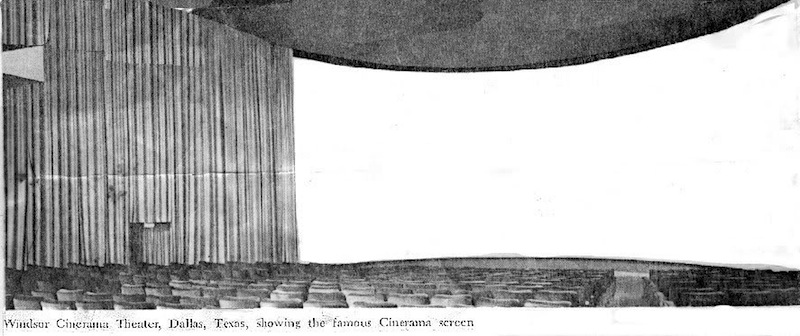
The immersive experience as it's call is nothing new (just newly coined nomenclature); it's been around since three panel Cinerama. And you are right Marcel, it really is simply a matter of sitting so the screen fills most of your vision. That has always been the way I watch movies since I first saw THIS IS CINERAMA when I was a kid; THAT was immersive (times 3) and ever since I try to get an approximation of that same effect by sitting where my peripheral vision pretty much included the far right and left sides of the screen...any screen in any theatre. Sit in the back rows and you might as well be watching a 19in TV set in some of these multiplex boxes. And, if I venture out to see a movie in a cinema, I know which houses have decent presentation, a decent size screen and brightness. And I ALWAYS go at the tail-end of a run after the unwashed have lost their fleeting interest in it, and I go on a Monday or Tuesday night for the last show -- then I don't need reserved seats...I pick wherever I want. Other than that, they can have their "experience."
By the way, this gives you some insight into why I was sooo incredibly put off of the first digital, when I sitting really close to the screen in my usual spot and here comes this image from the first non-DCI, 1.3K digital presentation and I am watching aghast at globs of blocky pixels and garish cartoon color and no so little detail that hair looked like globs of paint on people's heads, yet I'm hearing the digivangelists saying it was better than film. Well maybe ten years later it might be "better" in some ways, but 10 years ago? Not if you had eyes. As far as I was concerned, trying to get my "immersive experience" in the forth and fifth rows with digital, I figured they would need to hand out free barf bags with every ticket. Of course, had I been sitting a mile away, it might have looked better; as I said, it's all about relative size and where you are sitting.
Posted by Bobby Henderson (Member # 840) on 07-05-2013, 09:55 AM:
quote: Terry Lynn-Stevens
Bobby, I am not sure if you get what is driving the marketplace for cinemas right now. It is not resolution and won't be for a while. It is the premium experience in which people are willing to pay for, and the experience is just not resolution related.
I'll tell you what's driving the marketplace for cinemas right now: bullshit.
Putting it bluntly, the average customer doesn't know squat about the details. If he knew any of the specifics other than "big screen," "big sound" and an acronym throwing in the letter "X" somewhere he wouldn't be forking over the extra money above a standard ticket price for the so-called "premium" experience. A bunch of the "premium" window dressing sales points are features that have previously been used in standard priced theaters.
I didn't have to pay extra for sound and projection done right in the past. Now customers are expected to pay extra for sound done big and loud but not necessarily done right. Still, there are plenty of theater screens showing movies big and loud and not charging extra.
There's a lot of inconsistency going on with d-cinema. It's possible to pay extra to watch a movie shown huge and blurry in 2K IMAX or pay less to watch it with a sharper 4K picture in a more modestly sized house.
It didn't always cost extra to sit in a balcony.
Posted by Victor Liorentas (Member # 5272) on 07-05-2013, 11:02 AM:
YES I agree! It's a big (like Michael Bay is in charge) mess!
Posted by Aaron Garman (Member # 1653) on 07-05-2013, 12:24 PM:
This is why I wish something akin to THX was still around and relevant: a standard seal of approval that a particular cinema has met certain criteria for showing films in the most optimal way, and without charging a higher than normal ticket price.
Sadly, the only reason these "premium" experiences are selling is because the uninformed populace has bought the marketing BS hook, line, and sinker.
The only premium experience still actually worth an extra price is a 15/70 IMAX presentation of a native 15/70 feature.
It's almost as if the market is ripe for someone to bring order to the chaos. Anyone want to help me fund such an endeavor? ![[Smile]](smile.gif)
AJG
Posted by Bobby Henderson (Member # 840) on 07-05-2013, 01:53 PM:
I'd be in favor of bringing back the THX concept and doing it right -which translates into not certifying a lot of theaters who fall under the bar.
Unfortunately it would take a movie theater circuit going the extra mile to do sound and projection right as well as be willing to hammer that over the heads of their competitors.
It would also demand the general public wise up about these things rather than blindly pay a few dollars of up charge on amenities like great projection and sound quality that should have been included in the standard ticket price.
Basically I don't like these premium priced theaters. Much of what they're selling is not worth the up-charge. And it makes the "standard" theaters seem even more badly designed and maintained.
Posted by Marcel Birgelen (Member # 6801) on 07-06-2013, 01:12 PM:
quote: Frank Angel
The immersive experience as it's call is nothing new (just newly coined nomenclature); it's been around since three panel Cinerama. And you are right Marcel, it really is simply a matter of sitting so the screen fills most of your vision. That has always been the way I watch movies since I first saw THIS IS CINERAMA when I was a kid; THAT was immersive (times 3) and ever since I try to get an approximation of that same effect by sitting where my peripheral vision pretty much included the far right and left sides of the screen...any screen in any theatre. Sit in the back rows and you might as well be watching a 19in TV set in some of these multiplex boxes. And, if I venture out to see a movie in a cinema, I know which houses have decent presentation, a decent size screen and brightness. And I ALWAYS go at the tail-end of a run after the unwashed have lost their fleeting interest in it, and I go on a Monday or Tuesday night for the last show -- then I don't need reserved seats...I pick wherever I want. Other than that, they can have their "experience."
It always amazes me how the back rows of ANY theater are commonly the first ones to fill up... Even in those Digital IMAX houses, people tend to cluster at the back of the theater...
Maybe my vision has not yet deteriorated enough, but the shift to digital has haunted me for quite some time now, since getting close to the screen now usually gives ugliness, unless you're watching at a 4K picture. The 4K actually even helps for 2K content, not seeing this ugly screen door effect actually helps a lot.
quote: Bobby Henderson
It didn't always cost extra to sit in a balcony.
At least in Europe, tiered pricing for seat locations has been around as long as I remember. In Germany, even multiplexes have tiered pricing in almost all theaters. Luckily, you usually pay more for the seats further in the back ![[Wink]](wink.gif) .
.
Tiered pricing for *special deluxe screenings* is something relatively new, but is also fast approaching around here. Some are going the IMAX route, others are inventing their own *special bullshit label*.
quote: Bobby Henderson
I'd be in favor of bringing back the THX concept and doing it right -which translates into not certifying a lot of theaters who fall under the bar.
One of the biggest problems of THX was that it always did a bad job at explaining itself. Most people thought (and still think) of it as some kind of sound system, not as a "seal of approval".
But I'm in favor of bringing back some well understood and well-known "seal of approval" that also covers all aspects of Digital Cinema and modern digital sound formats. It's important that it has a catchy name, some cool trailers and a nice logo though. Maybe we should start a new initiative right here? ![[Razz]](tongue.gif)
Posted by Claude S. Ayakawa (Member # 1401) on 07-06-2013, 02:51 PM:
Frank, like you, I also love 3-D and agree with you about it not going away. All the previous 3-D formats died only because movies were shown in 3-D only in specially equipped theatres. Movies can be shown today in the same auditorium in 3-D and 2-D and that is a excellent compromise and good for everyone.
I do not care too much for animated movies as well as the low budget horror and action films released in 3-D and have avoided seeing them but have enjoyed big films like THE LIFE OF PI, HUGO, THE GREAT GATSBY and 2-D films converted into 3-D like JURASSIC PARK and TITANIC. It is unfortunate some recent big budget films like THE MAN OF STEEL and other action hero films did not utilize good post production 3-D conversion making more people dislike the format even more. Despite seeing many poorly post converted 3-D films, I will still continue to choose 3-D if I had a choice with movies offered in both formats because I know some of them will be great.
-Claude
Posted by Scott Jentsch (Member # 1681) on 07-08-2013, 12:19 PM:
quote: Bobby Henderson
Basically I don't like these premium priced theaters. Much of what they're selling is not worth the up-charge. And it makes the "standard" theaters seem even more badly designed and maintained.
I think what ends up being the case is that the "standard" theaters in the same building as the premium theaters are badly designed and maintained. If the theater can't get the premium theater right, they certainly aren't getting the smaller screens right, because they are chasing the money that the larger screen is attracting.
If they aren't getting the big one right, the small ones are really done wrong, so people are almost forced into choosing the least crappy option.
Excellent moviegoing experiences have to come from the top as part of the company's mission. Individual theaters in a chain of any size only have so much ability to control what is delivered to the audience. Granted, that shouldn't be minimized, as they can do a whole lot to make the best of a theater equipped with mediocre equipment, but if the company doesn't maintain the equipment and the facility through calibration and repairs, their efforts can only go so far.
A theater chain could shake up the business by establishing a set of standards for presentation and customer service that is above and beyond what others provide. Then brag about it to no end, and have the fortitude to keep it up over the long haul.
Independents could do it, too, but its impact would be limited to just their single geographic area. However, they could band together to establish a set of standards, give it a name that can be marketed, and then leverage that against the competition.
Powered by Infopop Corporation
UBB.classicTM
6.3.1.2