This is topic Can a theater do well without having a website? in forum Ground Level at Film-Tech Forum ARCHIVE.
To visit this topic, use this URL:
https://ft-forum.com/ft/cgi-bin/ubb/ultimatebb.cgi?ubb=get_topic;f=5;t=002755
Posted by Mike Frese (Member # 4361) on 01-31-2014, 08:55 AM:
It amazes me that so many theaters do not have a working and current website. I see some just try to use their Facebook page. I assume they are doing so because it is free. But it is pretty inexpensive to maintain a nice website.
If you are intimidated by the technology why not farm it out to a patron probably for the cost of a few tickets each month?
Posted by Leo Enticknap (Member # 534) on 01-31-2014, 11:03 AM:
Not specifically about theaters, but I've been surprised at the number of small businesses around here that don't have their own web presence at all. We're currently trying to arrange to have a tree removed, the roots of which are pushing up the patio slab. The businesses that will do this and have websites tend to be branches of regional and national chains. The smaller businesses that employ only a few people and only serve the locality in which they're based tend not to - you find out about them from flyers put in the mailbox, recommendations from friends and relatives, and sometimes reviews on Yelp.
I'm guessing that like these businesses, the theaters that tend not to have websites are independents in smaller communities, where people find out what's playing through word of mouth, the local paper or just walking/driving past the place; and have concluded that the cost of running a website simply isn't worth the likely return. If your business is a geographically specific one, I can see the logic in this. If you are a theater or an arborist in Colton, CA, there is no advantage to you in telling the world outside, say, a 20-mile radius that you exist. If you already have effective ways of marketing yourself within that radius, there needs to be a convincing business case for investing in another one.
As you point out, the cost of creating and maintaining a simple site is very low (i.e. the cost of a couple of days of your time to learn the basics of a content management system such as Wordpress or Drupal, plus, say, $50 a month for hosting and a domain name). But if you want online ticket sales functionality as well, and/or the ability to host multimedia content (e.g. trailers for the movies you're playing), the time and money input is going to increase significantly.
Posted by Justin Hamaker (Member # 2165) on 01-31-2014, 02:13 PM:
In today's business world, I would view a web site like a business care. Even if you don't have a detailed presence, you should at least have something which lists the services you offer, with contact information.
As for theatres, I think a web presence is vital. When we've surveyed customers, approximately 75% were getting showtimes from the internet. My theatre has done a pretty good job at branding and promoting our web site, so most of that traffic does come to our site. However, a fair amount is through Fandango and Google.
The problem with using third party sites is you have to rely on someone else accurately entering your information, and you make it too easy for your customers to see what your competition is doing.
Outside of major metro markets, I don't know if there is much advantage to on-line ticketing. But having the presence so people can get your showtimes is critical.
As for social media, I think it's a great tool to use, but not depend on. Facebook may be free, but it's only going to push your posts to about 5%-10% of your fans unless you pay for your posts. Boosted posts, aren't a bad way to spend your marketing money as long as you're smart about it. But you have to be willing to do so.
I don't really have experience with Twitter and other sites.
As for the surveying I mentioned above: We found that only 5% of our customers were using the newspaper - and those were almost exclusively senior citizens. About 15% were using our recording line, and about 75% were using the internet (I would need to go back and look up the breakdown of sites). The remaining ~5% were using other methods such as word of mouth or driving by the theatre.
Posted by Martin McCaffery (Member # 37) on 01-31-2014, 02:51 PM:
Of course, the problem with the user base "using the internet" is that may not be your site. There are so many sites which have local showtimes. Showtimes that aren't always accurate. I can't even begin to count the number of times people say they saw something on our website that wasn't there, or just told me "the internet said...".
At least in this town, they also can't be expected to figure out which site is ours and which is the AMC. It it all "at the movies" for them.
Posted by Jason McMillan (Member # 5542) on 01-31-2014, 03:30 PM:
quote: Martin McCaffery
I can't even begin to count the number of times people say they saw something on our website that wasn't there, or just told me "the internet said...".
Yes, this, exactly. For us, we seem to get more people looking for showtimes at fandango or movietickets.com than our own homepage.
Posted by Justin Hamaker (Member # 2165) on 01-31-2014, 03:42 PM:
As for the accuracy issue, I have a comma delimited file I send to Cinema Source so all they have to do is import the times. This has resulted in virtually 100% accuracy on Google, Yahoo, and their other subscriber sites for close to 10 years.
For Fandango, IMDb, Flixter, on others, Tribune Media Services has a program where you can input your times yourself. This way you're not dependent on some monkey to get the correct times off the fax or email.
Using these two methods, our internet times are virtually 100% accurate every week. The only issue we have is people not looking at the right theatre when they look at Fandango, Google, and other third party sources.
Posted by Frank Cox (Member # 6258) on 01-31-2014, 05:52 PM:
I pretty much live and die by my website. In years past, I used to send about 5000 flyers out in the mail every month but that had two drawbacks: I had to try to book all of my movies a month in advance, which meant I was playing older stuff that I could have otherwise, and also it got pretty expensive -- close to $1000 per month for postage alone. I sold ads to other businesses on my flyer and that helped to defray some of the cost but it was still a hefty chunk of change.
My main advertising medium now is my website, which actually costs me nothing since my web and mailserver lives about six feet behind where I'm sitting right now.
I discontinued the flyers when I got my digital cinema setup. I had 10,000 fridge magnets printed with my website and "movie hotline" phone number, and put them in envelopes with a write-up about how wonderful the digital cinema is. I mailed the magnets out to everyone in the area and that sort of gave everyone the push to start checking for showtimes on my website. I had a website for some years prior to that, of course, but the traffic really took off after I sent out the magnets.
I also have an email mailing list with a few hundred people on it -- they get an automatic email ever time I have a confirmed booking for a movie.
And, of course, my app, which apparently has 40-some users at the moment.
I don't do online ticketing or anything like that -- it seems like a useless thing for a small theatre to do. Heck, I don't even accept credit or debit cards here at all. That saves lot of hassle, too: everyone who comes here knows that they have to bring actual money; if they don't they find out soon enough.
Posted by Sam Graham (Member # 2889) on 02-05-2014, 12:57 PM:
While everyone really should make sure their showtimes are showing up on the major ticket websites regardless of whether or not you are set up to actually sell tickets through them, I still consider websites relevant.
The site I do for Newberg (99w.com) still generates hundreds of unique visitors per day, and our weekly showtimes e-mail subscription list has 3,500 subscribers. That's 3,500 people who might not think to look up what's showing at all (let alone planning on going to the movies) if we didn't send it to them.
Personally, I usually go to the website of the specific theatre I want to see a movie at for showtimes unless I'm either traveling in a city I'm unfamiliar with or the movie is a small independent that won't be playing everywhere. Then I'll go to Fandango and search by movie and ZIP code.
Posted by Mike Blakesley (Member # 26) on 02-05-2014, 09:00 PM:
We've had our website since around 1990 and it's by far the best advertising we have, except possibly our marquee (since we're right on the main drag). I did a very informal survey and at least half of the respondents said they get our showtimes from the site. Onoy a couple people mentioned the newspaper. We don't get all that many phone calls anymore...used to be, we could predict how busy a movie would be by how many calls would be on our phone in the daytime. These days, even a blockbuster movie will only generate a few calls a day.
Our site is hosted locally and costs $15 a month, which is the best advertising money we spend.
Keeping a site updated isn't all that hard -- it all depends on how fancy your site is. Ours is nice looking, but not flashy or fancy at all, so it loads fast and looks good on phones. At the very least, a theater site should have pictures of the theater, a list of shows and times, and onesheet images. Those basics will cover about 97% of what site visitors want to see.
Posted by Martin McCaffery (Member # 37) on 02-05-2014, 10:50 PM:
1990? Wow, you were an early adopter ![[Wink]](wink.gif)
from Wikipedia:
quote:
By Christmas 1990, Berners-Lee had built all the tools necessary for a working Web: the HyperText Transfer Protocol (HTTP) 0.9, the HyperText Markup Language (HTML), the first Web browser (named WorldWideWeb, which was also a Web editor), the first HTTP server software (later known as CERN httpd), the first web server (http://info.cern.ch), and the first Web pages that described the project itself.
Posted by Mike Blakesley (Member # 26) on 02-06-2014, 01:25 AM:
Yeah, that was a typo....I meant to put 1999 and even that was a guess. Didn't catch it until after the edit time was up.
Posted by Scott Jentsch (Member # 1681) on 02-06-2014, 01:11 PM:
There was a time when a business virtually didn't exist if it couldn't be found in the Yellow Pages. Now, a business doesn't exist to a great many people if at least basic information about its goods and services cannot be found on the Internet. There may be a lucky few that are serving a particular demographic and/or in a particular area where a web site is not necessary, but that's a very slim minority.
A movie theater should not only have their own domain to call their own (so they can control the official source of information that they can point their customers to), but they should also make sure that their information is current and up to date on the various services that list them.
Some theaters dismiss this notion, and say that their customers know to go to their web site for their showtimes and information, but that's ignoring the people that don't do that, and that number could be huge in relation to the number that actually do it. Making sure that CinemaSource and Tribune are getting your showtimes accurately is the very least that any theater should be doing.
Facebook will not be popular forever, but many theaters seem content to use it as their only online presence. I would be curious to hear thoughts on that.
Posted by Andrew Thomas (Member # 7000) on 02-06-2014, 02:24 PM:
We use facebook a lot, but we also have our own website, and are listed on all the major showtimes sites. We also have a hotline. One thing we have so far refused to do is advertise in the local paper. The people over there basically said they won't even write a story about the cinema being open if we don't advertise.
Posted by Justin Hamaker (Member # 2165) on 02-06-2014, 03:19 PM:
quote: Scott Jentsch
Some theaters dismiss this notion, and say that their customers know to go to their web site for their showtimes and information, but that's ignoring the people that don't do that, and that number could be huge in relation to the number that actually do it.
We are currently in the process of surveying customers on where they get show times. We started last Friday and will continue for 2 weeks, so I'll have some actual data from the theatre in about a week.
One of the things we frequently see is customers come in at the wrong time, or looking for a movie we aren't playing. The reason is not that our times were listed incorrectly, it's that they were misreading the results from Google. The problem with Google is that when someone searches your theatre and a movie title, Google will present them with all theatres within a certain radius (something like 30 miles). But the way the listings are presented, other theatres may be listed first. And if you're theatre is not listing the movie, there is no indication you aren't playing the movie (see the following graphic).
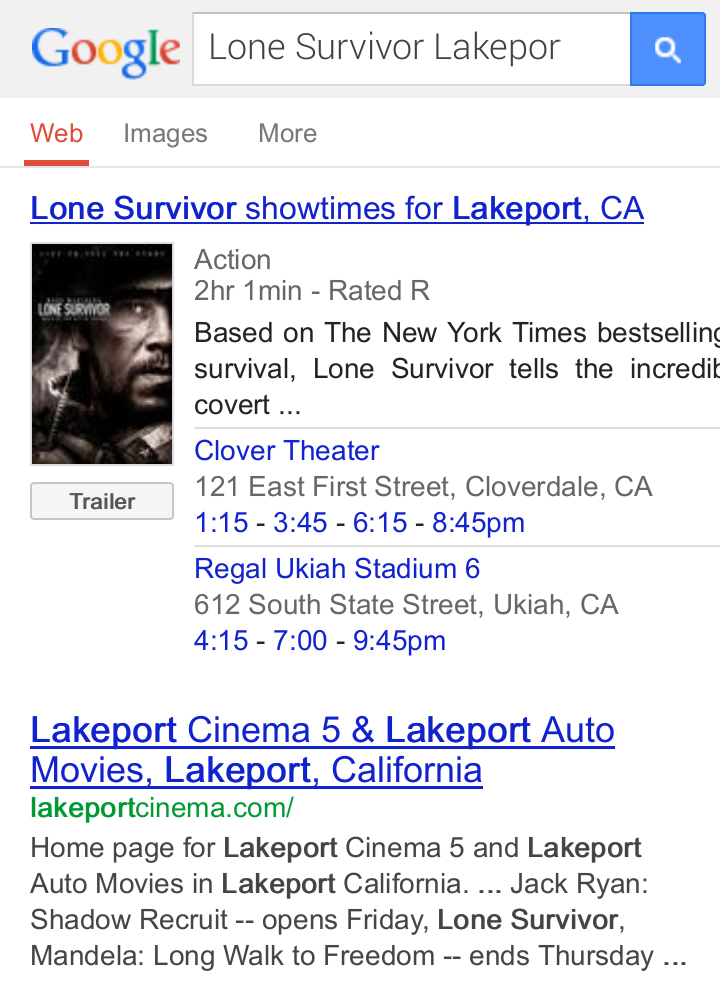
The search string for the image above was "Lone Survivor Lakeport". As you can see, the heading on the page says "Lone Survivor Showtimes for Lakeport, CA", then lists the times for the Clover Theatre and the Ukiah Stadium 6. There is no listing for Lakeport Cinema 5, with a notation "Not showtimes available for this theatre".
Right below that is our web site, but they have a cached version which lists movies that have been off screen for more than a week.
I'm actually trying to get in touch with someone at Google to see about getting this changed.
Posted by Frank Cox (Member # 6258) on 02-07-2014, 02:13 AM:
You don't need to get in touch with anyone at google to tell them to not cache your website. Just add the noarchive directive to your robots.txt file and that's all there is to it.
Posted by Justin Hamaker (Member # 2165) on 02-07-2014, 02:23 AM:
Frank, I'm not really worried about what Google has cached for our site. Someone who goes to our web site will see the correct schedule information. What I want Google to fix is they way they list showtimes. If there is a theatre in the specific town the person is searching for, that theatre should be displayed first. And if that theatre is not playing the title the customer is searching for, it should list the theatre with a notation "This title is not listed for this theatre", or something to that effect.
Google (seems) to pride it's self on accurate and meaningful search results. The example above is neither accurate, nor meaningful.
Posted by Terry Lynn-Stevens (Member # 7349) on 02-08-2014, 10:03 PM:
I can't see why anyone would not want to have a website for their theatre.
Posted by Justin Hamaker (Member # 2165) on 02-09-2014, 09:33 PM:
We did some customer surveying from January 31 - February 9 to ask customers where they were finding the show times. We would ask customers at the time they were purchasing their tickets, and the responses were entered into our POS system. While we did not sample 100% because we didn't sample when it was very busy, I would say the statistics are generally representative.
What we found is that 78% of our customers were getting show times from some internet source - whether it was our web site or another source. 7% by driving by the theatre and 7% from our recording. Only 4% said the newspaper, and this matched the number who said word of mouth.
I can't guarantee my employees were all being diligent to ask followup questions when customers answered the web, but our web site was definitely the primary source. After that it was Google, Flixster and Fandango.
Powered by Infopop Corporation
UBB.classicTM
6.3.1.2