This is topic Selling your parking lot to your city to finance digital in forum Ground Level at Film-Tech Forum ARCHIVE.
To visit this topic, use this URL:
https://ft-forum.com/ft/cgi-bin/ubb/ultimatebb.cgi?ubb=get_topic;f=5;t=002785
Posted by Mike Frese (Member # 4361) on 04-27-2014, 01:34 PM:
I ran across this interesting way to finance a theater's digital conversion. (The following was written by someone at the local newspaper)
"The **** Town Council is currently mulling whether to purchase a piece of land from **** Theatre owner Joe Poe of *****. The sale is something that the theatre owner and town officials have discussed off and on for at least the past two years, but nothing concrete had ever materialized.
At a March 24 town council meeting, Town Manager presented a plan for the town to purchase the parking lot (next door to the theater) for $91,000. That figure came from an independent third-party appraisal.
It was stated that funds for the purchase would come from money sitting in the town’s Downtown TIF account, so no new tax dollars would be used.
Change is needed at the **** theatre as the movie industry has shifted away from producing 35 mm film in favor of digital systems. From the moviemaker’s standpoint, the change made perfect sense. Why continue producing movies on celluloid film that can become damaged or deteriorate when they can be stored on a hard drive and shipped at a fraction of the cost?
How many people still use VCRs or 35mm film cameras? I have a couple of cameras sitting on a bookshelf at home and another at the office, but displaying them for nostalgia is about all they are good for these days. Meanwhile, the VCR and boxes of movies on tape acquired back in the days of Columbia House Movie Clubs are stored away in the basement, likely never to see the light of day again.
The ****** Theatre is in a similar situation. Eventually, sooner rather than later, movies will simply no longer be put on film. What happens then? Unless the theatre converts, there will be yet another iconic empty building in our downtown.
Some may question why the town would spend money to aide in a local business. It’s a valid concern. But something else to consider is that the theatre owner is not simply selling the parking lot to pocket a quick buck. The money received from the sale is going to be reinvested into the ***** Theatre to ensure movies will remain a part of **** for many years to come.
Where would the town be without its movie theatre? People already complain there is nothing to do in the town. Taking away yet another form of entertainment doesn’t seem to be a step in the right direction.
Other theatres around the state and the nation have looked to their communities to help keep them open. Some have done fundraisers, while other have sought tax breaks to free up needed cash to purchase the digital projector systems."
My understanding of TIF projects is that they are designed to be used to create more tax revenue for the entity involved. In my region, they have been largely used to build new retail developments.
If the city buys the parking lot, the parking lot will no longer be assessed property taxes. A decrease in taxes collected would result.
This particular city has no sales tax so the theater remaining open will not add to the sales tax revenue vs being closed.
It would seem that the only positive cash flow would be an increase in business assets (new projectors and sound equipment) which would result in more business personal property taxes being collected. Is that enough to support this decision?
This theater has been for sale for years. Maybe as long as 3 years. Having the theater converted would certainly make the theater more appealing to a new buyer. So the seller could benefit with a subsequent sale.
This is also the same owner/operator who at another theater seeked public donations while receiving a VPF. This has been the only time I have seen a theater seek VPFs (the plans offered before Sept 2012) and donations. I recall a decent donation from the town's friends of the library group.
More power to any theater owner who can swing such a deal. Seems like a questionable deal to me.
Posted by Jim Cassedy (Member # 4115) on 04-27-2014, 02:03 PM:
Wow!! Only $91k?
The tiny parking lot down the street from one of the theaters I take care of
sold last year for just over $3million. Not only wasn't it very large, it had
also been poorly maintained, based on the condition of the surface & pole
lights (almost all of which were burned out)
They shouldda got more money!
Posted by Martin McCaffery (Member # 37) on 04-27-2014, 02:26 PM:
Jim: Location, location, location ![[Wink]](wink.gif)
Posted by Frank Cox (Member # 6258) on 04-27-2014, 02:30 PM:
Any particular reason why the specifics in the story are all ****?
Posted by Lyle Romer (Member # 1266) on 04-27-2014, 02:49 PM:
quote: Frank Cox
Any particular reason why the specifics in the story are all ****?
I was wondering the same thing. Is it the Temple Theatre in Houlton, ME? That's my best guess doing some very quick detective work.
Posted by Bobby Henderson (Member # 840) on 04-27-2014, 03:09 PM:
If the theater has to go to those lengths to finance the purchase of a digital projector system what are they going to do for continual maintenance costs? What are they going to do 10 or so years in the future when much, if not the whole thing, has to be replaced?
Posted by Mike Frese (Member # 4361) on 04-27-2014, 03:57 PM:
Yes, it is the Temple Theatre in Holton, ME.
Posted by Leo Enticknap (Member # 534) on 04-28-2014, 02:07 PM:
If this is a published news story, I can't see any need to redact it - the information is already in the public domain.
The one thing that strikes me here is that if the city buys the lot, it can then start to charge the theater's customers to park on it. Those customers may then start to look for places to park on nearby residential streets, thereby p!ssing off the local inhabitants. Some customers may be ticketed, and then storm off vowing never to see a movie in that theater again. In short, they could be trading a short-term problem for a long-term one.
A small theater I worked at in England in the late '90s had a tiny car park - it could take about 15 vehicles in total. To start with we didn't police it at all: the staff always arrived long before the first customers, and so we never had a problem parking there. But eventually we would get so many complaints from customers unable to find a space, either in our little car park or the surrounding streets, that we just had to put a gate and a "staff only" notice on it, and tell customers that if they wanted to come by car, they had to park in the nearby multi-story at £1.50 an evening. Paradoxically, the complaints diminished to almost zero: because it was made clear to customers that we could not provide parking for them, period - even the small chance of getting a spot - they accepted that and didn't even try.
Posted by Chris Slycord (Member # 4239) on 04-29-2014, 05:41 AM:
I think it's more likely for the theater to get charged rent for the lot.
Posted by Leo Enticknap (Member # 534) on 04-29-2014, 11:08 AM:
Good point. It looks like this deal wouldn't be potentially on the table at all if the city didn't want to help the theater survive, and therefore that they wouldn't want to do anything that would hit its customer base seriously.
The problem is that whoever wins the next election (or even several elections down the line) might not feel the same way.
Bobby has a valuable point, though, and it boils down to this. Either the theater is a fundamentally viable business that is trying to find a way to cope with a major one-time cost (or, more likely, the prospect of a major, one-time cost every 5-10 years, given the likely lifespan of digital projectors and servers), or it's not and this issue is simply forcing the bigger one to the surface.
If it is fundamentally viable, I'm wondering why a commercial loan wouldn't be an option. Maybe it would take adjustments to the business model to cope with (e.g. more screenings, a ticket price rise, rentals for special events, etc. etc.), but might it be preferable to the irreversible loss of an asset that makes a positive contribution to the bottom line at present? If, however, the place is on the edge of viability and the digital issue is just highlighting that, then this won't solve the problem: it'll just delay the day on which it has to be faced. In that scenario, the town council might achieve more by investigating subsidising the place like an arts center type venue, or getting a grantwriter in to see if any philanthropic money could be secured to help keep the place going, or infrastructural investments (rather than sell-offs) to being costs down; that sort of thing.
Posted by Louis Bornwasser (Member # 3063) on 04-29-2014, 08:30 PM:
Commercial loans are not always available to smaller cinemas. Reason? Primarily the bank's fault since they think a car or tractor is a big loan; small town.
Posted by Terry Lynn-Stevens (Member # 7349) on 04-29-2014, 08:46 PM:
I would close the theater and then demolish it and then pave a parking lot.
Posted by Bobby Henderson (Member # 840) on 04-29-2014, 11:06 PM:
Turn the theater into a parking lot for what? Just more parking? A parking lot just by itself isn't cheap, especially if you put in a proper steel re-bar reinforced concrete parking lot. Those materials are damned expensive -thanks to so much rising demand in "emerging markets" for those materials in recent years.
If the old theater building was demolished the town might as well tear up the parking lot as well and convert the whole site into a park or green space. Or better yet, just let some other business buy the property and convert the building into something else.
Posted by Michael Gonzalez (Member # 593) on 05-01-2014, 03:38 AM:
quote: Mike Frese
Town Manager presented a plan for the town to purchase the parking lot (next door to the theater) for $91,000.
Kind of sounds to me that it is not the parking lot to the movie theater but an adjacent lot that the owner of the theater also happens to own. But I could be wrong.
Posted by Terry Lynn-Stevens (Member # 7349) on 05-01-2014, 01:37 PM:
quote: Michael Gonzalez
Kind of sounds to me that it is not the parking lot to the movie theater but an adjacent lot that the owner of the theater also happens to own. But I could be wrong.
And its a really stupid move to sell the parking lot to buy a projector. Assuming that the guy owns the property out right, why sell an asset to fund what is clearly a business that is not viable.
I say bulldoze the theatre and build a community garden ![[Big Grin]](biggrin.gif)
Posted by Mark Gulbrandsen (Member # 72) on 05-01-2014, 02:04 PM:
I had one customer sell a house and some property that was on his drive in property in order to get the $$ to buy the digital for his indoor theater just a mile away. The house was vacant for a number of years and was out front of the D.I. I thought it was a nifty way actually. Shed paying taxes on a vacant house and gain the indoor conversion. His indoor theater does pretty well. They still have not converted the D.I. yet. They will run film this summer and work on the monies for that conversion for next year.
Mark
Posted by Leo Enticknap (Member # 534) on 05-01-2014, 02:46 PM:
quote: Terry Lynn-Stevens
Assuming that the guy owns the property out right, why sell an asset to fund what is clearly a business that is not viable.
To be fair we don't know that business is not viable, though the story which started this thread certainly begs the question. There are lots of small businesses that are perfectly viable, but which could not absorb a $90k one-time investment that they need to make just to be able to carry on doing what they're doing. A small business is very unlikely to have that sort of money lying around in cash, and the conversion to digital is not the sort of thing you can insure against.
At the risk of veering slightly OT, it would be interesting to see an in-depth study (a potential university dissertation for someone!) about how and over what timescale the "long tail" of smaller, independent theatres financed the conversion to sound in the early '30s (or didn't); and specifically the proportion that did so through bank loans, selling off capital assets, diversifying their income base, cost savings in other areas (e.g. not having to hire musicians anymore), and what proportion were effectively forced out of business because of that conversion. It's the best historical comparison we have to the digital conversion, IHMO: a non-optional technological upgrade that theatres have to find the money for in order to stay in business.
Posted by Mike Blakesley (Member # 26) on 05-01-2014, 02:49 PM:
quote: Terry Lynn-Stevens
its a really stupid move to sell the parking lot to buy a projector.
No it isn't. It's very possible this theater could be a viable location. Maybe his ticket prices are too low, for example. Maybe a good house-cleaning is in order, or some fairly cheap improvement such as new seat covers or re-foaming. Maybe they've got a bad booker.
Given everything else is good to go, it's way smarter to sell off an asset you're not using to finance an improvement than it is to go into debt to finance it. Also in the article it says the theater is for sale; if it's converted, it might be sellable, but nobody would buy it knowing they're going to immediately need to spend another 60 grand to update the equipment.
Posted by Terry Lynn-Stevens (Member # 7349) on 05-01-2014, 04:57 PM:
quote: Leo Enticknap
To be fair we don't know that business is not viable, though the story which started this thread certainly begs the question. There are lots of small businesses that are perfectly viable, but which could not absorb a $90k one-time investment that they need to make just to be able to carry on doing what they're doing.
The IMO, it should close. To me, the $90,000 asset is more important than keeping a likely older cinema open when more than likely the business is not doing well enough to be able to pay for such equipment long term.
quote: Leo Enticknap
At the risk of veering slightly OT, it would be interesting to see an in-depth study (a potential university dissertation for someone!) about how and over what timescale the "long tail" of smaller, independent theatres financed the conversion to sound in the early '30s (or didn't); and specifically the proportion that did so through bank loans, selling off capital assets, diversifying their income base, cost savings in other areas (e.g. not having to hire musicians anymore), and what proportion were effectively forced out of business because of that conversion. It's the best historical comparison we have to the digital conversion, IHMO: a non-optional technological upgrade that theatres have to find the money for in order to stay in business.
I think it would interesting to read something like that.
Posted by Mike Blakesley (Member # 26) on 05-01-2014, 06:23 PM:
quote: Terry Lynn-Stevens
The IMO, it should close. To me, the $90,000 asset is more important than keeping a likely older cinema open when more than likely the business is not doing well enough to be able to pay for such equipment long term.
Wow, good thing you're not a banker. If my banker had been as short-sighted as that, I probably wouldn't be in the business today. My theater was struggling financially when we bought it in 1979 and we have managed to stay in business, with a good credit rating, and upgrade to digital in the process. We did it by employing the exact process I mentioned above (fix the prices, upgrade the presentation, clean up the place and get a more agressive booker).
Posted by Mike Frese (Member # 4361) on 05-02-2014, 12:53 PM:
The owner has withdrawn his proposal.
One of my points was that a TIF project should generatee much more tax money than it costs. Or increases the number of jobs.
In this example the following was going to occur IF the city bought the parking lot:
1) property taxes collected would decrease since the parking lot would not longer generate property taxes.
2) Business property taxes would increase with new equipment. Would it be enough to give the project a good ROI? I doubt it would.
3) The city has no sales tax. So sales tax revenue would remain the same.
4) no new employees would be hired with the switch to digital. In fact a reduction in hours might happen as the booth would not require as much babysitting while the theater is open. The projectionist could be selling tickets or popcorn vs threading movies.
Mike B.
How is you theater being booked aggressively? I think you book your theater pretty well and can see no reason why numerous people could not perform the same job including yourself.
Posted by Mike Blakesley (Member # 26) on 05-02-2014, 04:26 PM:
When we bought it, the previous owners had wanted to not pay anything over 35 or 40%, so we were playing movies far too late. We just told the booker we wanted to play popular movies while they were still "hot," regardless of the percentage, so that enabled us to get a lot of stuff within 3 to 5 weeks of the break. Then, that booker retired and the new guy was able to get us movies on the break. (He's been booking us about 14 years now.)
This same booker handles all of the theaters around us so I think we get slightly better results than we would if I did it myself, plus I have a day job so I don't really have time to do it myself.
Posted by Terry Lynn-Stevens (Member # 7349) on 05-03-2014, 12:09 AM:
quote: Mike Frese
The owner has withdrawn his proposal.
Good! Now he should bulldoze the theatre.
Posted by Marcel Birgelen (Member # 6801) on 05-03-2014, 02:41 AM:
quote: Terry Lynn-Stevens
Good! Now he should bulldoze the theatre.
Terry will never miss an opportunity for a good troll.
And sure, let's just bulldoze it, because there is absolutely no value left in a 95 years old building...
Posted by Mike Blakesley (Member # 26) on 05-03-2014, 09:10 AM:
It's probably like Charlie Brown's Christmas tree... all it needs is a little love.
Posted by Terry Lynn-Stevens (Member # 7349) on 05-03-2014, 11:17 AM:
quote: Marcel Birgelen
Terry will never miss an opportunity for a good troll.
Great first post in the thread Marcel ![[thumbsup]](graemlins/thumbsup.gif) I would say you are the one who is trolling.
I would say you are the one who is trolling.
quote: Marcel Birgelen
because there is absolutely no value left in a 95 years old building...
There sure is no value in selling a $90k asset to fund a digital conversion for a theatre that more likely cannot pay for this conversion with its current ticket sales and attendance. Eventually, some theatres just need to close.
quote: Mike Blakesley
Wow, good thing you're not a banker. If my banker had been as short-sighted as that, I probably wouldn't be in the business today. .
And you are running one show a day, a mat on weekends and you have a day job, is your theatre really that viable? I would of twinned the balcony back in 79
Posted by Mark Gulbrandsen (Member # 72) on 05-03-2014, 12:32 PM:
If he has a parking lot worth 91K Christie would lease him a Solaria 1 and use that as collateral and he could still use the lot! What a lucky man he would be...
Mark
Posted by Mike Blakesley (Member # 26) on 05-03-2014, 01:20 PM:
quote: Terry Lynn-Stevens
And you are running one show a day, a mat on weekends and you have a day job, is your theatre really that viable? I would of twinned the balcony back in 79
Wow, here I thought I had gotten lucky and you were just ignoring me lately. Now you have the nerve to come on here and disparage my business even though you know nothing about it, and you call somebody ELSE a troll?
Shouldn't it be up to the owner of a business to decide if it's viable or not? It so happens that I'm in the theater business because I like it. It makes me feel good when people tell me how much they appreciate the job we do. My wife and I could probably live off of it if we had to, but having day jobs makes it possible for us to afford a better lifestyle, do something we enjoy doing in the evenings, and be able to upgrade the theater from time to time.
The bottom line is, if a business brings satisfaction and profit to its owner, and shows growth over time, then it's viable.
We run the schedule we do because it's the smartest schedule to run for the size of market we are in.
And, the balcony is not large enough to twin, plus the projection booth is behind it.
Posted by Monte L Fullmer (Member # 2797) on 05-03-2014, 02:06 PM:
Course, Mike is always weary of opposition coming into his town being he's the only screen in the community.
Thus, he has to stay open along with doing the conversion just to stay one step ahead of the game at all times.
Posted by Terry Lynn-Stevens (Member # 7349) on 05-03-2014, 02:46 PM:
quote: Mike Blakesley
Wow, here I thought I had gotten lucky and you were just ignoring me lately. Now you have the nerve to come on here and disparage my business even though you know nothing about it, and you call somebody ELSE a troll?
Calm down, in my area Cineplex and Empire Theatres (now sold off) recently abandoned the late shows and afternoon shows at a few of their under performing locations. It was the sign of death that the closure of the theatre was imminent. On May 1st, Silver City Mississauga (10 plex) closed their doors, as they were winding down operations, for the last two years they had no 9pm shows and they only ran one matinee on the weekends. Canada's largest multiplex (Interchange 30) no longer runs first matinees/late show during the week. I find it very hard to believe that a small town theatre that needs a $90k upgrade is viable on a single screen.
quote: Mark Gulbrandsen
If he has a parking lot worth 91K Christie would lease him a Solaria 1 and use that as collateral and he could still use the lot! What a lucky man he would be..
Mark
Realistically, what would the monthly cost be to lease one of these machines?
Posted by Marcel Birgelen (Member # 6801) on 05-03-2014, 03:09 PM:
quote:
Great first post in the thread Marcel [thumbsup] I would say you are the one who is trolling.
Getting one someones nerve with arguments without any substance is one of your specialties.
Repeatedly calling for an almost 100 year old theater, you know absolutely nothing about, to get bulldozed because they cannot currently afford the conversion to digital. Questioning other people's business you know nothing about... If you're not a troll, then you're just a genuine asshole.
quote: Terry Lynn-Stevens
There sure is no value in selling a $90k asset to fund a digital conversion for a theatre that more likely cannot pay for this conversion with its current ticket sales and attendance. Eventually, some theatres just need to close.
You know what? You're just guessing... We don't know if the business is viable with current attendance levels. And why is it stupid to pay for an investment by selling off stuff that you don't need otherwise? Even big businesses often sell parts of their business or other assets to buy into new opportunities...
quote: Terry Lynn-Stevens
I find it very hard to believe that a small town theatre that needs a $90k upgrade is viable on a single screen.
Newsflash! It's actually a twin in it's current configuration, so the upgrade probably covers both screens...
Posted by Terry Lynn-Stevens (Member # 7349) on 05-03-2014, 03:15 PM:
quote: Marcel Birgelen
And why is it stupid to pay for an investment by selling off stuff that you don't need otherwise?
Its a bad idea because the parking lot (assuming it is owned) is likely worth more than the business (movie theatre). If viable, this theatre should have appropriate levels of revenue and thus profit to be able to pay (finance or lease) for the digital equipment required for the upgrade. Selling off a $90k asset is probably the worst possible thing the owner could do.
It is as simple as that.
Posted by Mike Blakesley (Member # 26) on 05-03-2014, 03:35 PM:
quote: Terry Lynn-Stevens
If viable, this theatre should have appropriate levels of revenue and thus profit to be able to pay (finance or lease) for the digital equipment required for the upgrade.
So then you've seen the financial records of this particular theater? You must have, because nowhere in the article does it say they can't afford to convert without selling the parking lot. Don't be so judgmental without knowing all the facts.
I finally had a chance to Google the pictures of the building -- it's a nice looking place. Maybe the owner is up in years and doesn't want to get into debt right now.
quote: Terry Lynn-Stevens
Calm down
I am calm. You're the one who can never admit when he's wrong.
Posted by Marcel Birgelen (Member # 6801) on 05-03-2014, 05:23 PM:
quote: Terry Lynn-Stevens
Its a bad idea because the parking lot (assuming it is owned) is likely worth more than the business (movie theatre).
Since you want him/her to bulldoze the building, I assume you assume he/she owns the building. So, according to you, that building isn't worth at least $90K? Including the current movie theater business?!
And after bulldozing this building, the value of the property also magically increases?
quote: Terry Lynn-Stevens
If viable, this theatre should have appropriate levels of revenue and thus profit to be able to pay (finance or lease) for the digital equipment required for the upgrade.
And even if it currently isn't turning in sufficient profits, who are you to judge his/her plans to sell one of his/her assets to turn his/her theater around?
Business according to the Laws of Terry would look something like this:
Hey, this joint hasn't seen any profits the last few months! Bring in the dynamite and blow this place up! It will be worth more in little pieces!
quote: Terry Lynn-Stevens
Selling off a $90k asset is probably the worst possible thing the owner could do.
If I could choose between selling an asset that I don't really need or paying back some sleazy bank or lease corporation the next few years to finance an important investment for my business, I would choose the former any given day...
And I seem to remember that quite a lot of businesses are actually based on buying and selling assets...
Posted by Frank Cox (Member # 6258) on 05-03-2014, 05:42 PM:
"Bulldozing the building" also isn't free. Labour, equipment and disposal costs add up fast when doing any demolition. Taxpayers here recently paid $164,200 to demolish an old skating rink. Now it's a vacant lot.
Posted by Leo Enticknap (Member # 534) on 05-03-2014, 10:12 PM:
Hence all the Gold Rush ghost towns dotted along the central belt of California and Oregon: when the industry that sustained their existence (gold mining) petered out, demolishing the buildings and returning the land to its natural state cost money that the last remaining inhabitants didn't have. So they just walked away, leaving these little towns behind them.
Posted by Terry Lynn-Stevens (Member # 7349) on 05-04-2014, 11:54 AM:
quote: Marcel Birgelen
If I could choose between selling an asset that I don't really need or paying back some sleazy bank or lease corporation the next few years to finance an important investment for my business, I would choose the former any given day...
You have some poor thinking Marcel. My hunch is that you are somewhere in your young 20s with very little life experience.
Selling the $91k asset is one of the dumbest things this owner could do. This business should be able to generate enough revenue to finance the upgrade, if it can't then the the owner should close the doors. Sometimes you have to know when to pull the plug.
Posted by Buck Wilson (Member # 5885) on 05-04-2014, 01:00 PM:
I'd say whatever the theater can do to stay open would be better for the community. Maybe they could buy it back someday.
As has been said, If you can make the conversion without a giant loan, it's certainly an avenue worth considering.
Posted by Marcel Birgelen (Member # 6801) on 05-04-2014, 03:14 PM:
quote: Terry Lynn-Stevens
You have some poor thinking Marcel. My hunch is that you are somewhere in your young 20s with very little life experience.
I'm not sure where you bought that hunch of yours, but if it's still under warranty, you really should have that fixed.
Heck, even if it's not covered anymore, let someone have a look at it. Your current hunch is a danger to society...
quote: Terry Lynn-Stevens
Selling the $91k asset is one of the dumbest things this owner could do.
I agree with your perfectly substantiated reasoning, you're obviously the business consultant overlord! The best thing he/she can do is: Screw those unused assets, close the doors and bulldoze the theater! Because you know, that would obviously benefit him, the community, etc.!
Or wait! Why not blow it up Vegas style? With grand fireworks and all? The neighbors surely wouldn't mind at all! And you could sell tons of tickets for the show!
Posted by Martin McCaffery (Member # 37) on 05-04-2014, 04:27 PM:
quote: Frank Cox
"Bulldozing the building" also isn't free.
Especially with old buildings. Last year we had our old boiler and ac scrapped for free, but it cost us $16,000 in asbestos abatement. And that was just for a small part of the building.
Posted by Frank Cox (Member # 6258) on 05-04-2014, 05:38 PM:
You got that right.
There is an old building downtown here that actually used to be a theatre way back when. You can still see a poster case on the front wall:
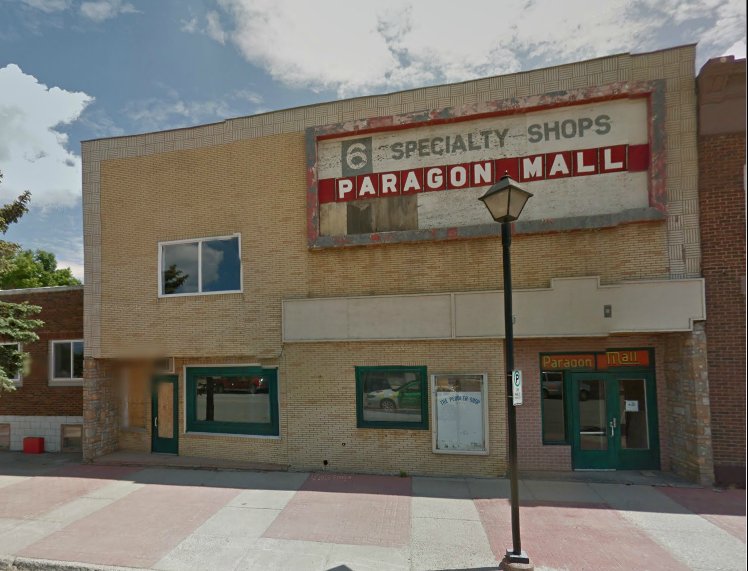
This building appears to be a true white elephant. The city has taken it for unpaid taxes a couple of times, and then sold it for a token amount to someone who figures he'll renovate it and make it into something. A year or two later, the current owner stops whatever renovations he's been doing and puts it up for sale. Some time after that the city seizes it for unpaid taxes and the cycle starts again. Right now it's at the "for sale sign" stage. I've watched this cycle repeat a few times over the past several years.
I'm not entirely sure of the specifics, but it appears that everyone who buys it eventually discovers that it will cost far more than it's worth to fix it up, and that tearing it down is almost impossible due to the location of those other buildings right up against it. The building is really quite big, and as far as I know the only way to safely demolish it would be to take it apart by hand, brick by brick; I hate to think what that might cost.
The lot that it sits on is probably worth something, but with that building on it I believe it currently has a negative value.
Posted by Terry Lynn-Stevens (Member # 7349) on 05-04-2014, 06:24 PM:
@Frank, this location has some tenants living in it.
quote:
Rare opportunity, with endless options, to own a commercial building for the price of a house. Within the building there is a recently finished 4 bdrm apartment on the second floor with an equal size shop/garage below it. Currently rented for $1500 per month on a month to month lease. Tenants willing to stay. Total 12,000 sq ft plus a partial, solid concrete basement with high ceilings. Some of the electrical has already been upgraded and all plumbing is roughed in so the space could be finished by a handyman. There is already $3,000 in commercial drywall throughout the building ready for install. Great opportunity to live mortgage free and enjoy the tax breaks. Some of the upgrades include: new roof, h.e furnace, central air, water heater, added insulation etc. This property presents an opportunity to have enough rental (once finished) to sustain a comfortable living, however this is a commercial property so please keep in mind that your financial institution will likely require a 30% down payment. Serious inquiries only. Qualified buyers will be provided with further info on the building as well as photos.
web page
Posted by Leo Enticknap (Member # 534) on 05-04-2014, 11:06 PM:
Giggle. Reminds me of a story I was told last week, about a guy whose business did reasonably well. Desiring a status symbol, he bought an 1890s mansion that is a famous local landmark at a price he thought was a steal. But within a few months he'd found out the hard way why: the place was costing him around $40k a month in property taxes and the maintenance required for a registered historic building alone. He tried to sell it for almost a year thereafter, without any buyers. Eventually he donated the property to an unsuspecting religious organization, and ended up making more from the tax write-off that donating the property to a 501(c) landed him than he'd originally paid for it.
Posted by Chris Slycord (Member # 4239) on 05-05-2014, 07:26 AM:
quote: Terry Lynn-Stevens
Selling the $91k asset is one of the dumbest things this owner could do. This business should be able to generate enough revenue to finance the upgrade, if it can't then the the owner should close the doors. Sometimes you have to know when to pull the plug.
I think one looming fear here is that even if he were able to save the revenue, is it a guarantee that he could save enough while still getting prints? Because, there's a not-insignificant chance that the owner stops making money simply due to non-availability of prints.
And as mentioned, he may have multiple lots and possibly selling off only one or have worked out a deal where he sells them the lot and after conversion, buys it back at a price not massively larger than what he's selling it for after saving the revenue they make then (which doesn't have as much immediacy in the transaction compared to converting to digital).
Posted by Chris Daigle (Member # 7347) on 05-05-2014, 04:58 PM:
I just happened to go onto the Temple Theater website and found out that the owner is selling all of the property including the theater itself. I'm sure that responsibility to convert to digital will be with anyone who may be interested in buying it. From the website:
"The historic Market Square property: including the Temple Theatre, the Temple building, Zippy’s seasonal restaurant and take out, and the large parking lot which overlooks the Meduxnekeag River is available for purchase.
The theatre was fully renovated in 2002 from the basement up. Concessions, restrooms, theatres, carpeting, lighting, walls, counters, projection equipment, etc. were all renovated or replaced. Most of the “front of the house”(public space) equipment and facilities is in “brand new” condition. New screens, seating, speakers, details, and some projection and sound equipment were installed to make the theatre going experience enjoyable and professional. Dolby sound was added in 2009.
The theatre building is the heart of downtown Houlton’s historic Market Square and with the parking lot has nearly 500 feet of frontage directly on the Square.
The Temple Theatre re-opened on November 1, 2002 to rave reviews and higher than expected attendance. The theatre has consistently exceeded projections and does well. As a two screen theatre we show the best of first run films. We can’t “open” them all but if it was big in the world it will be big in Houlton. There is room to add one more screen in our “backstage” area.
In 2003 we purchased the adjacent “Key Bank” parking lot. In 2004 we purchased the Masonic Temple building from our landlords; the Masonic Lodge. The building purchase includes the 2nd floor with over 6500 square feet of rental/lease office space including an owners/managers apartment. The 3rd floor of the Temple building is privately owned in condominium arrangement with the Masonic Temple Lodge Assoc. The purchases combined the parking lot, the building, and the theatre business into one large and significant property.
In 2008 we opened “Zippy’s” a casual outdoor dining and take out restaurant (see photos). Zippy's has added a great dimension to our property and Houlton.
In 2008 we sold the back portion of our property to Coastal Enterprises and they are building a beautiful 28 unit senior housing facility. (See photo)
The 2nd floor office space is now fully leased. There is also a new 7 room apartment occupied by our manager.
In 2008-09 we added 18” of insulation in our roof to conserve on heat, replaced one of our boilers with a brand new boiler and added new efficiency controls, added energy conservation applications throughout the building, and replaced the 3rd floor windows with new energy efficient windows.
The property extends to a point high above the Meduxnekeag River edge and has a commanding view of the river, the exciting new Houlton pedestrian bridge, the Riverfront Park, and River Walk project. There is great potential for further commercial or residential development on the property.
The building, leased office space, theatre, restaurant, and parking lot real estate is offered separately or in whole. The building, theatre, and apartment/office space is available separately. Entire property and businesses including Zippy's $349,000.00. Entire property not including Zippy's is $299,000.00. Buyers interested in purchasing the property fully leased: please ask to discuss lease terms.
Partial financing is available. Further reduction in price available if entire property is not purchased."
Posted by Leo Enticknap (Member # 534) on 05-06-2014, 11:05 AM:
Sadly, it would seem like the owners did a major, once every 20-30 years refurbishment at just the wrong time. If it had been done in 2012 rather than 2002, putting in digital projection would have been part of the bigger project and probably a relatively small line item in among all the other work that was done.
This kind of upgrade is always a lot easier if done as part of a bigger project than as a one-off purchase. When I was designing the projection and sound installation at the University of Leeds theatre in 2008, I was encouraged to include a wish list of everything I could envisage the venue using over the next 10-20 years, even if we didn't really need it there and then. My boss's thinking is that asking for a machine costing five figures as one line item in a £3m building refurbishment project stood a much better chance of success than trying to justify buying it individually.
Posted by Mike Blakesley (Member # 26) on 05-06-2014, 12:20 PM:
That's kind of what we did here. There are always projects in the pipeline -- this summer we are replacing some windows and doing a re-paint on the outside, and some work on the roof. But I already have a separate "savings account" started for the next digital upgrade since it's probably going to be a bigger expense than most projects.
Powered by Infopop Corporation
UBB.classicTM
6.3.1.2