This is topic LOOK vs AMC in forum Ground Level at Film-Tech Forum ARCHIVE.


To visit this topic, use this URL:
https://ft-forum.com/ft/cgi-bin/ubb/ultimatebb.cgi?ubb=get_topic;f=5;t=002838

Posted by Brad Miller (Member # 2) on 10-18-2014, 02:10 PM:
 
Interesting article, but the author REALLY needs to let go of the pathetically overused mispelling of "reel" in movie related articles.

A reel fight? LOOK Cinemas accuses AMC Theatres of trying to hoard first-run movies

quote:
By Robert Wilonsky
rwilonsky@dallasnews.com
7:21 am on October 18, 2014

LOOK Cinemas, the self-proclaimed “luxury” multiplex on Belt Line Road, is accusing the mighty AMC Theatres of trying to poach its product — first-run movies. And what for now is just a war of words could serve as a teaser-trailer for the main attraction: a lawsuit.

The Chinese-owned chain, the world’s largest, is days away from opening the AMC Village on the Parkway 9 at Belt Line and the Dallas North Tollway. That’s less than a mile from the LOOK location, which opened March 2013.

According to LOOK founder Tom Stephenson, AMC, which has 350 theaters in the U.S. alone, has told distributors to choose between AMC or LOOK, which Stephenson finds especially troubling since LOOK has but the single location in North Dallas. He says it’s already impacting business: Lionsgate, he says, has told LOOK it’s putting The Hunger Games: Mockingjay Part 1 at the AMC multiplex when the film bows in mid-November, while Disney’s taking its Big Hero 6 to the Village on the Parkway on November 7.

“We played The Hunger Games: Catching Fire last year, and it was a hugely successful movie for us,” Stephenson says. But now, he says, “We’ve been told we can’t book it this year. AMC insisted on this clearance issue, so now you can’t see it here.”

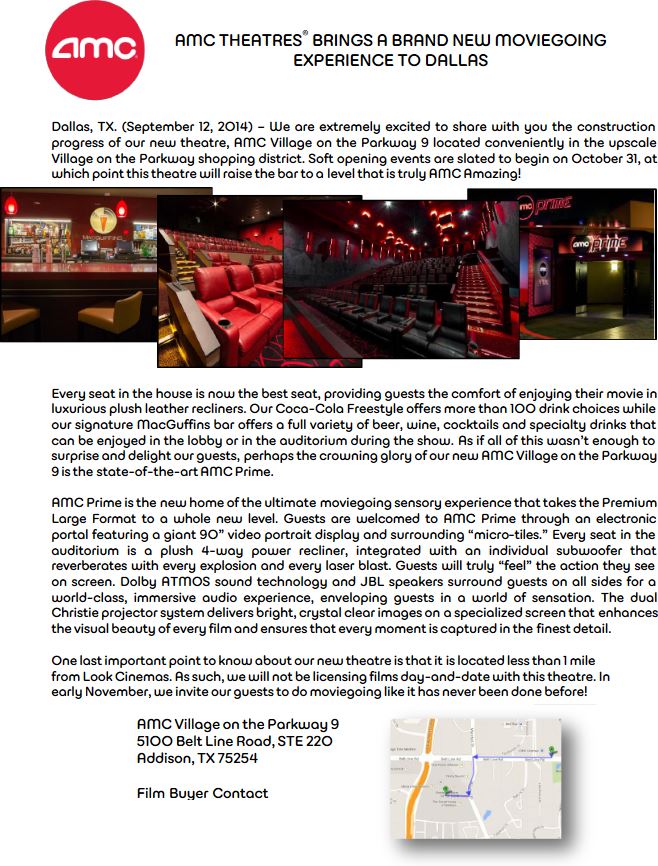
Stephenson says he first found out about AMC’s campaign when he received a flier one of the chain’s film buyers sent to distributors in September. The flier, which is below, announces the October 31 soft-opening of the AMC Village on the Parkway 9, touts its amenities (“luxurious plush leather recliners,” a bar, etc.) and concludes by noting the existence of the LOOK just down the street.

“One last important point to know about our new theatre is that it is located less than 1 mile from Look Cinemas,” says the note from buyer Debbie Pennie. “As such, we will not be licensing films day-and-date with this theatre. In early November, we invite our guests to do moviegoing like it has never been done before!”

“And our interpretation of that statement is that AMC is trying to strong-arm the film distribution companies into giving them exclusivity with films,” says attorney Brett Johnson, a principal at Fish & Richardson. “They have a superior size not only here in Dallas but throughout the U.S., and they are raising the film distribution companies’ awareness that size matters.”

AMC’s director of corporate communications Ryan Noonan disputes LOOK’s allegations.

“The point that ‘AMC has told distributors not to give them first-run films’ is false,” he says via email. “For decades, standard industry practice has dictated that distributors allocate their movies between theatres that operate in close proximity to each other and compete for the same customers. Exhibitors and distributors have long agreed this practice ensures superior guest experience and film profitability. … These two theatres, located a mile away from each other, were in development at the same time and it should have been everyone’s expectation that this standard industry practice would apply. That’s the way the industry works.”

But this isn’t the first time AMC’s been accused of anti-competitive conduct.

In January Georgia-based Cobb Theaters filed a federal antitrust lawsuit that alleges AMC “has used its worldwide and national circuit power and its market power in a substantial number of geographic markets to coerce film distributors to deprive Cobb, its only competitor in one of the relevant geographic and product markets, of fair competitive access to films to exhibit to the public at its competing theater.” The suit alleges AMC is engaged in a “ruthless campaign” to crush the competition. AMC has denied the allegations and said the suit was brought solely because Cobb was “unable to best AMC in the marketplace.”

Johnson and Stephenson say they sent AMC a letter outlining their concerns.

“We told them such an agreement was anti-competitive and not in the best interest of the moviegoing public in Dallas,” Johnson says. “We also told them we hoped they would cease and that we’d have to consider all legal actions to protect the client and their customers.” He says AMC denied the allegations.

“But they also justified” trying to get the first-run films, Johnson says. “They said even if they were, it’s perfectly permissible. They also claimed, somehow, that it enhances competition.”

In the end, says Stephenson, he wants LOOK and AMC to have all the movies and let the customers decide where they want to see go. Do they want a chain experience, says Stephenson, or do they want to go to a place where they can wash down their sushi and steak with a Blackberry Bourbon Lemonade?

“Ours is a completely difference experience than going to NorthPark and buying popcorn,” says Stephenson. “Consumers have real choice. You can choose what kind of experience you want. We have as much market share from Highland Park as we do from around here [in far North Dallas]. Why should you tell someone they can’t have wine and a steak when they see a movie if that’s the movie they want to see?”

 -
 
Posted by Rusty Gordon (Member # 2210) on 10-18-2014, 02:24 PM:
 
I can't imagine why, now that film print production costs are gone, that in this situation these theatres shouldn't be able to play day and date with one another. If the article is correct and both knew of the other circuit's plan to open in this market, neither expected to operate for long without the other. No real purpose is served by splitting up the product other than to entitle one company to profit at the expense of the other.
 
Posted by Brad Miller (Member # 2) on 10-18-2014, 03:03 PM:
 
AMC has a history of this sort of behavior. They're big and they like to throw their weight around to squash anyone they can.

The studios REALLY need to dump this whole nonsense with sharing product. Let anyone have the movie who is willing to play it for the minimum booking term and let the PUBLIC decide which theater it wants to patronize. Doing so would just increase opening weekend's grosses anyway since there would be more available seats, and that seems a high priority for the studios.

I'll bet AMC is pissed that they didn't get Interstellar since LOOK is playing it in 70mm. [Razz]
 
Posted by Terry Lynn-Stevens (Member # 7349) on 10-18-2014, 03:44 PM:
 
A blackberry bourbon lemonade at the AMC sounds delicious.
 
Posted by Brad Miller (Member # 2) on 10-18-2014, 04:13 PM:
 
Wow Terry. Turn your brain on.
 
Posted by Andrew Thomas (Member # 7000) on 10-18-2014, 04:29 PM:
 
This is one of the reasons that I like being in small towns. Pretty much no chance of an AMC or similar coming to town.

I try and spread the word that AMC in particular really likes to use anti-competitive practices to win. I know Cinemark sometimes goes for clearance, but I know they aren't nearly as aggressive about it.
 
Posted by Terry Lynn-Stevens (Member # 7349) on 10-18-2014, 04:54 PM:
 
At the end of day Andrew, competition is a good thing for the customer, perhaps not for LOOK cinemas who had the market to themselves, but they simply need to respond to a competitor entering a marketplace. I'm sure their 70MM engagement was brought upon by the fact that they knew AMC was coming.

Ideally LOOK needs to split the product with AMC (AMC gets some movies, while LOOK gets some movies) or otherwise the distributor will gain all the power.

I think AMC is going to win this battle.
 
Posted by Allan Barnes (Member # 5178) on 10-18-2014, 05:08 PM:
 
Time to call the Government Lawyers... ANTI-TRUST
 
Posted by Andrew Thomas (Member # 7000) on 10-18-2014, 05:14 PM:
 
Except that this isn't competition. AMC is circuit dealing. They are gobbling up the A product from the studios while leaving the B-product for the other theater.

Competition would be to allow each theater to play the product and let consumers choose which experience they prefer.
 
Posted by Terry Lynn-Stevens (Member # 7349) on 10-18-2014, 05:21 PM:
 
quote: Andrew Thomas
Competition would be to allow each theater to play the product and let consumers choose which experience they prefer.
Competition would be if each company could bid on the product and then somebody gets it. It would also help keep ticket prices nice and stable. Allowing each theater to have the same product would do nothing, the distributor wins. The best case is for both LOOK and AMC to split the available product.
 
Posted by Brad Miller (Member # 2) on 10-18-2014, 05:24 PM:
 
Wow, two instances back to back where I have to say this. Terry, turn your brain on. [Roll Eyes]
 
Posted by Terry Lynn-Stevens (Member # 7349) on 10-18-2014, 05:31 PM:
 
Brad, it makes no sense to have the same product at both theaters. Please explain how it could possibly benefit anyone other than the distributors?
 
Posted by Andrew Thomas (Member # 7000) on 10-18-2014, 05:39 PM:
 
It is bad an anti-competitive because it means the different theaters don't need to incentivize consumers choosing their location over the competitor. Just get big enough and you can force the studios to supply you with product and not the other.
 
Posted by Steve Guttag (Member # 268) on 10-18-2014, 06:01 PM:
 
If you offer a superior experience and the customer base recognizes one theatre as superior to the other...they will gain market share over the other. With a clearance practice, the customer (patron) no longer benefits from competition and is forced to see the product at a quality level that the biggest chain sets as "good enough."

I have seen this sort of thing before...with an AMC theatre where there was another location within a mile or two...the little theatre did sue and, in the end, won and can play day-and-date with AMC.

If LOOK's lawyer is good...odds are, they will prevail. The thing is...you do have to be as good or better than the monopolistic chain, AMC in this case.

I can actually see this from many vantage points. You have AMC that will put forth its resources to locate a theatre in an ideal, yet under-served location (or one they reasonably believe will be under-served based on expansion predictions). Then a small chain or mom-pop just has to open a theatre next to the AMC and put their resources into that one location. Odds are, the local guy can better serve the needs of his location than a chain viewing it all on a spreadsheet.

This sort of thing is done in fast food and even hotels...there is a reason they tend to "clump." If McDonalds thinks a spot is a good location...a smaller fast-food chain will plan on moving near by without having to expend near the resources.

In movie theatres, however, unlike fast-food, they are competing over the exact same product and all they have to differentiate themselves is the quality of service and perceived "experience."

However, antitrust laws came about not to help the big guy but to protect the little guy. The consumer is almost always better off with more real competition then if a monopoly gets to dictate terms/quality (anyone really like their "cable bill?" When a large entity throws down the gauntlet and effectively says pick us or them...they are acting in a monopolistic way because the little guy couldn't effectively say the same thing...the studio has to think about the ramifications of the big guy not getting his way in more than just one location.

When you have nothing BUT little guys competing...if the same situation were to happen (Mom and Pop open a theatre and another mom and pop open one down the street)...both theatres run the risk of diluting their own market share to point neither business is profitable or stable if they both get the same product.

It really isn't cut-and-dried.
 
Posted by Joe Elliott (Member # 4006) on 10-18-2014, 09:19 PM:
 
quote: Terry Lynn-Stevens
Brad, it makes no sense to have the same product at both theaters. Please explain how it could possibly benefit anyone other than the distributors?
Because it is not the every day variety of movies that the two would be fighting over. Yes, having those split would help consumers, giving them more variety of choices. It is the big blockbusters that should be at both that will be used as fighting pieces, when really they should show at both. I agree that back with film, they had to do it that way, because there was a HUGE investment on the part of the film company in the prints themselves. Now there is not. There is no reason to limit theaters. And larger chains will take advantage of their buying power. Especially corporations, where there is no personal responsibility to be a human being. In a fight like this not only does the smaller theater get hurt, so does the consumer. Instead if it were fair, both sides would have to try to provide the better service, atmosphere, sound, etc. Still the larger chain has the advantage, but at least it is better for the consumer.
 
Posted by Frank B. McLaughlin (Member # 6683) on 10-19-2014, 06:33 AM:
 
Just out of curiosity: Are either one or both on the VPF dole? If so this would invite the argument that the distributors don't want to pay for two prints within a mile of each other.
 
Posted by Joe Elliott (Member # 4006) on 10-19-2014, 11:52 PM:
 
That's a good point. And since the AMC is new and most likely not under a VPF, would the film company screw the company that is under a VPF, just to keep from paying it? Or would it work the other way around, they could justify paying a VPF on a blockbuster, but not a smaller movie, so they try to shove it down AMC's throat so they don't have to pay?
 
Posted by Pravin Ratnam (Member # 1417) on 10-19-2014, 11:58 PM:
 
These days, when a single multiplex shows a single movie on anywhere from 4 to 8 screens because the name of the game is to frontload movies, and with digital distribution being so cheap since you don't have to send prints to multiple multiplexes, how does a distributor lose by letting both multiplexes have the same movie? Instead of one big blockbuswter movie being shown on 6-8 screens opening weekend in one multiplex in that area, it will be shown on 2-5 screens in each multiplex in that area. And this way, there are still room for a lot of other movies to be shown in each multiplex. The neighborhood wins with more choices.
 
Posted by Frank B. McLaughlin (Member # 6683) on 10-20-2014, 08:00 AM:
 
Thank you, I think you have hit upon the real issue.

First the film companies asked to have digital installed so they could save money. They offered a VPF fee as compensation. They were saying that this support for you and your operation would continue in this manner until the equipment was paid for. The theater owner is now in partnership with the film company. Now we find one partner saying that it is no longer interested and refusing to support the commitment made. Here is where we pull out the secret contracts and discover just what it was that everyone agreed to.

Secondly, as far as competition goes the original argument that the prints cost a lot of money, are limited in number, and must be placed where maximum revenue can be derived is no longer true. This is clearly a case of anti-competitive treatment.

If you want a very good example: AMC operated a 6 and a 5 unit complex in a shopping center in Northwest Denver area. AMC wanted to open a 24 unit a few miles away. As an inducement to the shopping center owner to let AMC out of the lease (which may have even contained an anti-competitive clause) AMC guaranteed that the film companies would make day/day product available to anyone operating the shopping center units. This continued until the center was scraped.

If you take a good look around I am sure you will find many places in the US where AMC does not seem to care about distance to the next theater. In Denver you can look Southwest where Regal, AMC, Hollywood, and Alamo are very close.
 
Posted by Steve Kraus (Member # 476) on 10-20-2014, 08:30 AM:
 
Isn't this always the case that they're not going to give the same movie to two theatres that are close to each other? But, yeah, it with the low cost of "prints" (non VPF anyway) it would be interesting to stop doing that and let the theatres fight it out.
 
Posted by Edward Havens (Member # 4715) on 10-20-2014, 09:11 AM:
 
Several years ago, I was a manager at two theatres in the Los Angeles area, sister theatres a block apart (a 10 and a 4), that had a new competitor open right across the street. The competitor was not a top three chain, but had some pull with the studios because of their "premium" brand. At first, we had to split product (they'd open Iron Man, we'd open Indiana Jones and the Kingdom of the Franchise Destroyer), but within two months, we were day and date. Our locations were "older" (built in the early 1990s) but at our four screen theatre, our smallest house still sat more and had a larger screen than their biggest house. We were chugging along just fine for a while, but in the end, the other theatre "won" because audiences were fooled by the newness of the theatre and the glitzy new shopping center it was in. Now that there is no real competition in the area (the 10 screener was recently converted to an ultra-premium location by another company, but to not much success), the customers are getting [sex]
 
Posted by Mitchell Dvoskin (Member # 751) on 10-20-2014, 09:27 AM:
 
In the long run, bidding for product never works for the independent. A major chain with hundreds of locations can afford to take a loss and bid so high that whoever wins the film will lose money. The major chain just has to wait until the independent gives up or goes bust.
 
Posted by Mike Blakesley (Member # 26) on 10-20-2014, 11:31 AM:
 
Here's a timely Wall Street Journal article we just got from NATO today.

quote:
Big Chains Put a Lock on First-Run Movies
Independent Theaters Can End Up With Older Films When Powerful Exhibitors Press Hollywood

By ERICH SCHWARTZEL and BEN FRITZ

Oct. 19, 2014 2:47 p.m. ET

When Mickey Altman opened Viva Cinema in Houston in 2013, he thought the theater was a blockbuster investment. A 42,000-square-foot complex designed to appeal to the region’s growing Hispanic population, it featured eight auditoriums, a cantina serving Mexican dishes and a party room.

But it turned out he was lacking a key ingredient: Popular new releases.

AMC Entertainment Holdings Inc., the nation’s second-largest exhibitor, told major Hollywood studios that it wouldn’t play most new movies at its location about three miles away if they also played at Viva Cinema.

It was no contest: The studios agreed to AMC’s exclusivity requests on title after title, leaving Mr. Altman’s theater with scraps. Viva opened in May, when “Fast & Furious 6” was driving ticket sales. Viva’s marquee movie? Two-month old animated comedy “The Croods.” Time and again, Viva had to play out-of-date movies, such as “World War Z” in September, when it had been released in June.

Viva closed last November, after Mr. Altman said he lost millions of dollars in business on the theater.

From Atlanta to the San Diego suburb of La Jolla, more cinema operators say they are being blocked from booking hot new releases.

Called “clearance” in industry parlance, the exclusivity practice allows theater chains to tell Hollywood studios they will screen a movie in a particular market only if nearby competitors can’t.

Once widespread, clearance practices faded in the 1990s as the industry came to be dominated by a few large multiplex operators. But in the past few years, a small but growing class of independent movie-theater companies has risen, targeting specific groups such as Latinos and affluent customers. The owners of several of these cinemas claim their growth is being hampered because too often they can’t get the best movies.

“The use of clearances had been slowing in the movie industry,” said Jack Foley, a veteran studio distribution executive. “But recently they’re making a comeback.”

The practice affects millions of Americans by limiting where they can see popular movies. According to theater operators and distribution executives, the tactic has been used particularly aggressively by the nation’s three largest theater chains—AMC, Regal Entertainment Group and Cinemark Holdings . Collectively, they control about 42% of the nation’s movie screens.

The big chains argue that the trend merely follows the rules of the road for the exhibition industry and that in competitive areas, exclusivity requests are to be expected.

A spokesman for AMC said the company requests exclusivity on certain titles for only 28 of its 341 locations. In the majority of cases, he said, it is competing with locations owned by fellow titans Regal or Cinemark—not the smaller newcomers.

In a statement, Regal said exclusivity agreements allow studios to “cost-effectively distribute their movies [and] allow exhibitors to compete for film content.

Cinemark didn’t respond to requests for comment.

The renewed use of these arrangements has generated lawsuits and even government scrutiny: Two theater executives said they recently spoke with the Justice Department’s Antitrust Division, which has been seeking information on the issue. The practice isn’t the subject of a formal DOJ investigation, according to people familiar with the matter.

Defenders of the practice point out that it is ultimately up to the studios whether to grant a theater chain’s request for exclusivity. Distribution executives—the people at studios who book movies into theaters—say they typically would prefer to play a new release on as many screens as possible. When clearance requests force them to choose between multiple theaters in a market, executives say they go with the location they believe will generate the highest ticket sales—regardless of its owner.

But independent operators maintain they are too often on the losing end of such battles.

Cobb Theatres, which operates 20 theaters including one near two AMC locations in Atlanta, sued AMC in January in U.S. District Court in Georgia, accusing the theater chain of violating antitrust law and using its “world-wide and national circuit power” to “deny their competitors... fair competitive access to films so as to drive them out of business.”

AMC declined to comment on pending litigation.

Cinépolis Luxury Cinemas, a major Mexican luxury chain breaking into the U.S. market, estimates it has walked away from one-third of the 200 sites it has scouted for theaters because of clearance concerns, said the chief executive of its U.S. operation, Adrian Mijares Elizondo.

Exclusivity agreements have traditionally been most common during booms in building or renovating theaters. To protect their investments, theater owners sometimes seek to limit nearby competition, usually within a radius of three miles or so.

In recent years, a number of independent exhibitors such as iPic Theaters, Reading International Inc.’s Angelika Film Center, and Landmark Theatres, owned by billionaires Mark Cuban and Todd Wagner, have been building new high-end locations that compete for moviegoers willing to pay sometimes more than $20 a ticket, plus extra for gourmet food and drinks delivered to their seats.

AMC, meanwhile, isn’t sitting still. Fueled by cash after being acquired by China’s Dalian Wanda Group Corp. in 2012 and a public stock offering last year, it is in the midst of a $600 million effort to upgrade 1,800 of its 5,000 auditoriums with leather recliners and other amenities.

Exclusivity, as AMC points out, doesn’t always involve a David vs. Goliath scenario. Regal, for example, is currently trying to “clear” a theater under construction by Cinemark in a coastal Los Angeles neighborhood, according to people familiar with the situation.

Independents are trying the tactic against each other, too. Landmark is currently engaged in one such battle against a soon-to-launch ArcLight Cinemas location in Bethesda, Md., according to people familiar with the matter.

Still, theater operators like Rudyard Coltman often end up being the underdogs. Mr. Coltman delayed by a week the May opening of his Cinetopia 18 multiplex in Overland Park, Kan., after hearing from Time Warner Inc. ’s Warner Bros. that AMC had already requested exclusive rights in the neighborhood to “Godzilla,” the only major new release the weekend he’d planned to open.

While the studios haven’t kept every new release out of Cinetopia, they do alternate their biggest titles between it and AMC Town Center 20—a renovated multiplex about three miles away. Mr. Coltman said he has missed out on hits like “Guardians of the Galaxy,” keeping box-office revenues 30% to 50% lower than he had projected. Hamid Hashemi, CEO of the iPic luxury chain, said he was in negotiations this July to build a new location in Dallas when AMC sent a letter to studios saying it would request exclusivity on certain titles if the theater was built.

That same day, Mr. Hashemi was told by studio distribution executives, Regal called to say it would seek films exclusively if he went through with plans to build a separate iPic theater in Houston. Mr. Hashemi added that such notifications make it harder to convince real-estate developers that leasing to him will be worthwhile.

Gerry Lopez, chief executive at AMC, said representatives from his company often talk with landlords eyeing potential development and will make it known if they think a site would be subject to clearance.

In a statement, Regal said exclusivity agreements allow studios to “provide consumers with the variety of movies that they enjoy,” adding it expects the practice to continue “for many years to come.”

Link
 
Posted by Bobby Henderson (Member # 840) on 10-21-2014, 09:34 AM:
 
quote:
In a statement, Regal said exclusivity agreements allow studios to “provide consumers with the variety of movies that they enjoy,” adding it expects the practice to continue “for many years to come.”
Regal, AMC and any other chain involved in this unethical horseshit just need to shut their mouths when claiming exclusivity agreements are beneficial to customers. Baloney. It's only bad for customers. They're insulting our intelligence by suggesting otherwise.

The money these big chains kick back to studios in order to put the "little guys" out of business stretches already thin profit margins. It's race to the bottom economics. It puts even more pressure on them to spend as little as possible on their operations, on things like adequate staffing at ticket booths and snack counters as well as making sure they have enough people to keep auditoriums clean and orderly. Narrow margins get in the way of them properly maintaining equipment and installing upgrades to stay ahead of advances in home theater. Basically they're happy to let their customer service and movie going experience quality go to shit just to prevent a neighboring theater from playing the same movie.

I've never visited a Cinetopia location before, but I'd be willing to bet the new Cinetopia theater in the Kansas City metro is a damned sight better than the AMC location nearby that's screwing it out of a lot of first run movies.

Another news flash for chains like Regal and AMC: we don't have to see movies at those theaters. There's already a huge number of people only too happy to watch movies at home. It's expensive to watch first run movies in movie theaters. If the big chains want to apply a Walmart style business model to their strategy the results will give paying customers more reasons to stay at home.

I don't expect the DOJ to intervene and stop this anti-competitive nonsense. I certainly don't expect them to enforce a sensible solution, such as allowing all theaters to show which movies they really want to show and compete directly against each other in terms of putting on the best show and/or providing the best level of value and service to customers. Y'know, the free market, right?

Ultimately, looking at the long term big picture: I suspect movie studios are only going along with these deals that really don't benefit them in the short term as a means of slowly bleeding out the entire movie theater industry for their own ends. They would like one of two outcomes. Outcome #1: theaters go out of business and movie studios sell their movies direct to home viewers with as few retail/distribution partners in between. Outcome #2: the movie studios end up owning all the movie theaters once again.

I can actually see Outcome #2 being plausible. For the past couple decades the US government has been wishy-washy at best when it comes to enforcing anti-trust laws. The movie studios can allow the big theater chains to kill off smaller competitors and then cut each other off at the ankles until they're all in bankruptcy. When the movie theater industry is on the brink of ruin the movie studios (with the aid of their giant media corporation parents) can come riding to the rescue. They'll make a compelling case to overturn all the anti-trust legislation that split movie studios and theaters apart. Once acquisition of theater chains is complete the studios will have even more of a strangle-hold on controlling content.

When that comes to pass reading books might turn into a more appealing activity for more Americans.
[Razz]
 
Posted by Mitchell Dvoskin (Member # 751) on 10-21-2014, 12:51 PM:
 
> They'll make a compelling case to overturn all the anti-trust legislation that split movie studios and theaters apart.

There is no anti-trust legislation requiring the that movie studios and theatres be separate. There were at one time a bunch a consent decrees against specific (not all) studios that were the result of court actions against them for specific alleged anti-trust violations. Essentially, those studios settled out of court. In the 1990's, when Sony bought Loews Theatres while still owning Columbia Pictures, they asked the Justice Department to let them out of their consent decree arguing that the business is so different today with multiplexes that one studio could not monopolize the business. The Justice Dept agreed and has let everyone else who has asked out of those settlements.
 
Posted by Bobby Henderson (Member # 840) on 10-21-2014, 01:30 PM:
 
In that case major movie distributors can pursue either of the end games I mentioned regarding movie theaters without any interference from the US government. The studios will slowly, deliberately suffocate the theater business so their product can get on TV screens that much faster, or they will be the ones who own all the theaters in the long term. Eventually it's going to go all the way in either direction.

I just wonder if any of the executives at those big theater chains have imagined those possible scenarios for themselves. If they want to Walmart their smaller competitors out of business and consolidate the movie theater industry into less than a handful of owners the movie theater industry will be vulnerable to either one of those outcomes.

Movie studios could literally and easily force movie theaters out of business completely by eroding away enough of the window between theatrical and home video release. Simultaneous theatrical and home video releases would do it immediately. But I'm not so sure the movie studios want that. They might actually prefer to keep theatrical releases around if they owned their own movie theaters outright.

A diversified theater industry with large and small chains as well as independent operators is far better for the movie industry and far better for the customers. I can't think of anyone other than stock investors who would benefit from the theater industry becoming consolidated, merged, vertically integrated and ultimately monopolized. It sure wouldn't benefit anyone who paid to park his butt in one of those cushy auditorium seats!
 
Posted by Mike Blakesley (Member # 26) on 10-21-2014, 02:53 PM:
 
I think you are over-reacting a bit on this, Bobby. It's not like this is some new thing that the studios have just come up with. It's been going on forever. It's about one theater chain protecting its territory.

AMC just says, "If you won't give us exclusivity, we won't play your movie." So if anybody is dealing shady, it's the chains. If the studios are at fault for anything, it's just that they are too spineless to stop it.
 
Posted by Martin McCaffery (Member # 37) on 10-21-2014, 03:54 PM:
 
quote: Bobby Henderson
I can't think of anyone other than stock investors who would benefit from the theater industry becoming consolidated, merged, vertically integrated and ultimately monopolized.
Well, as long as you realize who ultimately matters [evil]
 
Posted by Steve Guttag (Member # 268) on 10-21-2014, 04:16 PM:
 
Wouldn't it be a hoot if a studio sued a chain like AMC for Monopolistic practices?
 
Posted by Bobby Henderson (Member # 840) on 10-21-2014, 04:16 PM:
 
I could be reaching, and agree theaters playing dirty pool against each other isn't a new thing. However, the dynamics of the movie industry and entertainment industry overall are very different now.

It's been obvious for many years movie studios don't give a damn over how well or poorly movie theaters are presenting their shows to the public. That's consistent with them willing to screw superior quality theaters like Look Cinemas in North Dallas or the new Cinetopia location in Metro Kansas City. They'll give a lesser quality AMC location the better movies and more of them in return for AMC kicking back some of their cut of box office revenue. It's all about the money.

AMC has been in bankruptcy before. Some of the other big chains have as well. They can wind up in bankruptcy yet again. They're at the mercy of Hollywood studios for content. Some people say AMC is even more powerful with its ownership in China with the Wanda group. That situation can be a double-edged sword. Just look at what is going on with private businesses in Russia lately. The central government can wade in there and upend the whole thing on a political whim.

More and more of big business is obsessed with vertical integration and either buying out or eliminating competition. Physical media (optical movie discs) have been a cash cow for Hollywood, but now it seems like Hollywood studios have soured on it. Now they want to sell movies directly to consumers via downloads. They don't have to bother with brick and mortar retail partners and the inventory to supply them. Cut out as many middle men as possible and push those stock prices higher.

I think the same thing can happen with movie theaters. I think the movie studios would be willing to let the theater chains cut their own throats with race to the bottom economics tactics. Then the studios could decide what to do with the remains.

Actually, I hope I'm reaching on all this. Because if the movie distributors followed through on either plan (eliminating theaters or buying them out) it wouldn't turn out well for them in either respect.
 
Posted by Buck Wilson (Member # 5885) on 10-21-2014, 04:41 PM:
 
quote: Bobby Henderson
I've never visited a Cinetopia location before, but I'd be willing to bet the new Cinetopia theater in the Kansas City metro is a damned sight better than the AMC location nearby that's screwing it out of a lot of first run movies.
And you would be correct!!

That's what upsets me the most. Any given high quality independent with such luxuries as masking get screwed out by generic, advertising laden, nasty wal-martplexes.
 
Posted by Bobby Henderson (Member # 840) on 10-21-2014, 09:15 PM:
 
The situation reminds me a little of the allocation arrangement that existed here in Lawton back in the 1990's and early 2000's between the Carmike 8 and the older Cache 8 (which changed hands between Litchfield, United Artists and Hollywood Theaters over the years).

That allocation setup had movie studios booking their movies evenly between the two theaters for the most part. A studio like Paramount would release one movie at the Cache 8 and then place its next release at the Carmike 8. Once in awhile a movie that was supposed to go to the Carmike 8 would end up at the Cache 8. One theory why was the Cache 8 had more seats even though the Carmike was a much better theater. The Carmike sometimes got movies that might have gone to the Cache 8 if the rotation was followed strictly. For instance, all the Star Wars special edition movies and prequels played at the Carmike since it had two THX certified auditoriums at the time.

Anyway, I hated the Cache 8 theater with a passion. If a movie I wanted to see played there I either saw that movie at a theater in Oklahoma City, Dallas or elsewhere -or I just waited to watch it on DVD at home. I refused to endorse that bad theater's standards of practice with my dollars.

Unfortunately, in the case of chains like AMC, Regal and others using unfair Walmart style tactics against smaller yet superior quality competitors: most movie theater customers don't care. They'll drive to the nearest theater showing the movie they want to see regardless of the presentation quality. The customers don't seem to care that they're screwing themselves by not being more informed and discriminating about where they spend their money.

OTOH, movie theater customers do get affected by poor customer service and they do remember that. Couple poor customer service with the high prices we're seeing for tickets and concessions and that's a great recipe to get customers to stay at home in droves.
 
Posted by Buck Wilson (Member # 5885) on 10-21-2014, 09:26 PM:
 
I like to think that people don't know what they're missing. I have a dream of opening a brand new second run theater in town with all the proper presentation fixins, no ads, etc etc. I dream of handily outgrossing the first run theater. I dream of content staying only the absolute minimum amount of time in the first run before coming my way because everyone is waiting for it to go the better theater.
 
Posted by Marcel Birgelen (Member # 6801) on 10-22-2014, 08:04 AM:
 
If you open it next door to me, you already got one customer [Wink]

quote: Steve Guttag
Wouldn't it be a hoot if a studio sued a chain like AMC for Monopolistic practices?
Wouldn't it be better if a large bunch of those independents that are affected by those selective release tactics to sue the studios and AMC?

As I see it, it's primarily the fault of the studios for giving in to those kind of tactics. It sure is foul play by AMC, but they are "just" fighting their competition. The studios are, in my opinion, even more at fault for giving in to those bluffing games.

Because that's what it is, a bluff. Even if AMC would boycott new releases in those locations, how long do you think they will be able to maintain it? And how much money will the studio actually lose? Those who cannot see it at AMC will surely find their way to the theaters that are showing it...

I guess it's this what those anti-monopoly laws were actually made for, so maybe it's time for action?
 
Posted by Frank B. McLaughlin (Member # 6683) on 10-22-2014, 09:19 AM:
 
Now take a look at the studio side: these megaplex chain locations can play EVERYTHING right down the release schedule. All the chain has to do is tell the studio that if they don't behave in a manner friendly to the chain the studio can forget about a film being played by the chain anywhere. Just what can your small complex do? There are no longer enough indies in the various markets to fill any void - the chains have blown them all out. And just try proving that in court.
 
Posted by Edward Havens (Member # 4715) on 10-22-2014, 10:53 AM:
 
quote: Frank B. McLaughlin
All the chain has to do is tell the studio that if they don't behave in a manner friendly to the chain the studio can forget about a film being played by the chain anywhere. Just what can your small complex do?
Nothing... expect hope the studios got smart and stood up to the bullies.

Can you imagine AMC saying they wouldn't play "Avengers: Age of Ultron"? Neither can I, especially with all those IMAX digital screens. Disney has all the power. If AMC doesn't like how Disney is allocating playdates for "Avengers," AMC isn't going to say "Well, then, we're not going to play 'Tomorrowland' or 'Inside Out' or 'Ant-Man' or 'The Jungle Book.'" AMC isn't going to watch as 100% of the area gross goes to LOOK for every one of these movies in this one area. If push came to shove, and Disney said "Fine, if you don't like that your new theatre is going to day and date with this already established theatre in this area, then you don't get the product," AMC will go "Oh, okay. We'll day and date with LOOK." Because 40-60% of the area gross is better than 0%.
 
Posted by Terry Lynn-Stevens (Member # 7349) on 10-22-2014, 11:19 AM:
 
quote: Frank B. McLaughlin
Now take a look at the studio side: these megaplex chain locations can play EVERYTHING right down the release schedule. All the chain has to do is tell the studio that if they don't behave in a manner friendly to the chain the studio can forget about a film being played by the chain anywhere. Just what can your small complex do? There are no longer enough indies in the various markets to fill any void - the chains have blown them all out. And just try proving that in court.
I highly doubt that is going to happen. All the studio cares about is which theater (AMC vs LOOK) is going to make them more money on each release they have. Having the movies play day and date at both theaters is a really stupid idea, it just gives the studio even more power and effectively ends long play runs(an advantage for the exhibitor) at a given location and it will further increase the studios take at the box office. It will also drive prices lower and one of the theaters (most likely LOOK) will be out of business soon than later. Also, people are not going to choose LOOK over AMC if the AMC prices are lower.

The LOOK prices are pretty high, $15.00 for 70mm IMAX in (Evolution) with a $1.50 ticket convenience fee. The LOOK 70MM screen seats 156 people, the other auditoriums are smaller at 136 seats, and 56 seats for Interstellar on opening night, to me this looks like a slam dunk case where the studio will simply prefer AMC over LOOK.

quote: Frank B. McLaughlin
All the chain has to do is tell the studio that if they don't behave in a manner friendly to the chain the studio can forget about a film being played by the chain anywhere.
This only works if there is no competition as well as limited or at capacity screens across a network or region. The power is then in the exhibitors hands.
 
Posted by Marcel Birgelen (Member # 6801) on 10-22-2014, 04:31 PM:
 
quote: Edward Havens
Nothing... expect hope the studios got smart and stood up to the bullies.
I'm pretty sure what they're doing is anti-competitive and rather illegal. They're clearly dividing the market and making illegal arrangements about it.

The problem is, you need to be able to stand up against it and I think it will only work if affected theaters unite in some kind of class action suit. You're never going to sit this out as a lonely player.

quote: Terry Lynn-Stevens
All the studio cares about is which theater (AMC vs LOOK) is going to make them more money on each release they have.
What?! Shouldn't they care about making the most money with any given release in a certain area? How would they make less money if multiple competing theaters play the same movies?

quote: Terry Lynn-Stevens
Having the movies play day and date at both theaters is a really stupid idea, it just gives the studio even more power and effectively ends long play runs(an advantage for the exhibitor) at a given location and it will further increase the studios take at the box office.
Care to explain what extra magic powers appear for studios from this more open playing field for competing movie theaters?

Also, this is your idea of competition and a free market? Our lords and masters decide who get's what, because of what? The greater good?

quote: Terry Lynn-Stevens
It will also drive prices lower and one of the theaters (most likely LOOK) will be out of business soon than later. Also, people are not going to choose LOOK over AMC if the AMC prices are lower.
So, this whole premium PLF and D-IMAX stuff you've been defending is also bullshit then? Because people are not going to spend the extra dime for a "better" experience, price is the only differentiating factor?
 
Posted by Terry Lynn-Stevens (Member # 7349) on 10-22-2014, 04:52 PM:
 
quote: Marcel Birgelen
What?! Shouldn't they care about making the most money with any given release in a certain area? How would they make less money if multiple competing theaters play the same movies?
Marcel, you read too much into what I said. If the studio has to choose between two locations, they would choose the location that grosses more.

quote: Marcel Birgelen
Care to explain what extra magic powers appear for studios from this more open playing field for competing movie theaters?

The two locations are too close together, that is the biggest problem and the other is issue is LOOK is a luxury cinema with a limited number of available seats, AMC did the correct thing by saying that they will not be licensing the same movies as LOOK. AMC has the potential to move more people in and out of their theater just by seat count alone, when Avengers 2 comes out, the studio is going to want the max seats available. This gives AMC an advantage. The leverage is in the AMC court.

quote: Marcel Birgelen
So, this whole premium PLF and D-IMAX stuff you've been defending is also bullshit then? Because people are not going to spend the extra dime for a "better" experience, price is the only differentiating factor?
Marcel, AMC has the power to offer lower prices and lower concession prices than LOOK, even though it could be considered predatory pricing, AMC could drive LOOK out of business pretty quickly. LOOK would have to eventually lower their prices as would clearly not be able to maintain their market share by offering the same films as AMC.

The PLF thing is irrelevant, LOOK does not have anything that would be considered PLF compared to AMC Prime.
 
Posted by Pravin Ratnam (Member # 1417) on 10-22-2014, 05:02 PM:
 
It's not just the digital low cost of distribution that should change the model to allow neighboring theaters to show the movie. It's about single multiplexes these days showing new movies on a LOT of screens in the first week. So obviously, there is enough demand in the first week to support many screens in the same neighborhood. So why should one multiplex have to hog all those screens? with digital, is it really much different from Blockbuster video and Hollywood video in the same neighborhood stocking the same movie in the 90s?

As far as studios, it is in their interest to encourage these luxury chains because that would increase their revenue indirectly by making the final product more appealing to the consumer.

But Congress has been slacking off in recent years in terms of regulating anti competitive practices in all media(look at how few companies control so many cable channels). Time to encourage more competition. With what AMC is doing, doesn't it make a farce of the whole spirit of competition. I mean how would AMC like it if studios were allowed once again to own theaters?
 
Posted by Marcel Birgelen (Member # 6801) on 10-22-2014, 05:30 PM:
 
quote: Terry Lynn-Stevens
Marcel, you read too much into what I said. If the studio has to choose between two locations, they would choose the location that grosses more.
And, why exactly, besides those anti-competitive arrangements everybody here is talking about, would the studio even have to choose between two locations in the same area? Are we close to running out of bits? Does the presence of multiple hard disks containing the same movie increase the risk of uncontrolled black holes appearing out of nowhere?

quote: Terry Lynn-Stevens
The two locations are too close together, that is the biggest problem and the other is issue is LOOK is a luxury cinema with a limited number of available seats, AMC did the correct thing by saying that they will not be licensing the same movies as LOOK. AMC has the potential to move more people in and out of their theater just by seat count alone, when Avengers 2 comes out, the studio is going to want the max seats available. This gives AMC an advantage. The leverage is in the AMC court.
And if both theaters would get a copy of The Avengers 2, some people that would have shown up at AMC would show up at LOOK, because they like it better. LOOK might even attract customers that would otherwise not go to AMC. The end result will be: at least the same amount of tickets sold in the same period, probably even a few more.

So, what leverage exactly?

quote: Terry Lynn-Stevens
Marcel, AMC has the power to offer lower prices and lower concession prices than LOOK, even though it could be considered predatory pricing, AMC could drive LOOK out of business pretty quickly. LOOK would have to eventually lower their prices as would clearly not be able to maintain their market share by offering the same films as AMC.

The PLF thing is irrelevant, LOOK does not have anything that would be considered PLF compared to AMC Prime.

Last time I checked the only requirements for PLF seem to be unmasked screens, 2K projectors, someone pushing the volume a little too far and some whiz bang, bullshit marketing.

Many theaters stay in business despite competition of some major chain, especially because they tend to be cheaper on both tickets and concessions and actually care about the service they're offering. But if they're denied access to certain important first run features, no wonder they're getting squashed by Evilcorp themselves.
 
Posted by Mike Rivest (Member # 5500) on 10-22-2014, 05:38 PM:
 
Looked what happened to AMC in Canada!. Cineplex always had the better movies.
 
Posted by Bobby Henderson (Member # 840) on 10-22-2014, 06:05 PM:
 
quote: Terry Lynn-Stevens
The PLF thing is irrelevant, LOOK does not have anything that would be considered PLF compared to AMC Prime.
Terry, you ought to look up the specifics about LOOK Cinemas before making claims about what they have and don't have in their theaters. This speciality theater is serving 3 different niches: small luxury "director's suite" style screening rooms, in theater dining rooms and big screen experiences. LOOK's two "Evolution" screens are comparable to other digital big screen theater concepts. Both Evolution screens happen to feature Dolby Atmos, making LOOK Cinemas the only theater in the Dallas-Fort Worth metro to have more than one Atmos-equipped screen under the same roof. There's a lot of so-called "PLF" screens that don't have any next-gen sound format. The new AMC location opening nearby will have only one "Prime" screen.

BTW, the "PLF" label is a crock of shit. None of the digital concepts going around anywhere qualifies as "large format." Film based IMAX? Yeah, that's large format. Even 5-perf 70mm can be considered "large format." Nothing about digital is large format. It's the same HDTV resolution image just blown up on a bigger screen.
 
Posted by Terry Lynn-Stevens (Member # 7349) on 10-22-2014, 06:19 PM:
 
@ Mike R, AMC did split product at three GTA locations while one was clear and the flagship was blocked on 90% of titles. Empire was also blocked at Square One.

You obviously remember when Cineplex split distributors with Famous Players? Everything was better back then as THX, 70mm, digital sound was much more compelling.
 
Posted by Mike Blakesley (Member # 26) on 10-22-2014, 06:24 PM:
 
quote: Terry Lynn-Stevens
The two locations are too close together, that is the biggest problem
There are some locations where it doesn't matter. I remember reading once about two complexes in New York, I think, that were less than a block from each other...but both played the same movies. They competed on their actual merits, not by forcing the public to choose one or the other.

This is all about one chain, AMC, trying to corner the market. If both cinemas get the same movies, then everyone else (moviegoers, LOOK Cinema, the studios) benefit but AMC loses out on some ticket sales. The studios will not lose one red cent UNLESS AMC decides to not play their movie in some other locations as "punishment." Thus the only thing AMC has going for it is sheer size.
 
Posted by Bobby Henderson (Member # 840) on 10-22-2014, 06:42 PM:
 
quote: Mike Blakesley
This is all about one chain, AMC, trying to corner the market. If both cinemas get the same movies, then everyone else (moviegoers, LOOK Cinema, the studios) benefit but AMC loses out on some ticket sales. The studios will not lose one red cent UNLESS AMC decides to not play their movie in some other locations as "punishment." Thus the only thing AMC has going for it is sheer size.
How many movie-going markets of any significant size does AMC have all to itself? I can't think of any. If AMC wanted to boycott a certain movie in its Dallas-Fort Worth area theaters moviegoers would have plenty of other theaters to visit (SMG, Cinemark, Harkins, UA, etc.).

When I lived in New York I remember movies playing in multiple theaters with some of them not being very far apart. And these weren't big google-plexes either -mostly single screen, twin and 3-plex and 4-plex theaters. That made it even more amazing for the same movie to play at more than one theater location in close proximity.

When all movies were distributed on film I could understand an allocation arrangement or even an exclusive deal with one theater chain over another competing theater. It cost more to put the movie on a lot more screens. With digital it doesn't make any sense for the movie distributor and not for customers either.

Honestly, with digital-based movies the situation over how many theaters are playing the same movie shouldn't be any different than a pay per view company booking the next UFC fight event at sports bars. The more places playing the show is better. In the case of movies the movie will play itself out faster on more screens and get it to home video discs and digital downloads faster. Faster cash flow situation. Big financing loans paid off faster.

If I was running a movie studio the only way I would give a theater chain like AMC an exclusive deal on movies is if they paid quite a bit more for the rental. I'd laugh at any threats from them to block my shows out of their theaters.
 
Posted by Andrew Thomas (Member # 7000) on 10-23-2014, 12:06 PM:
 
quote:
Can you imagine AMC saying they wouldn't play "Avengers: Age of Ultron"? Neither can I, especially with all those IMAX digital screens. Disney has all the power. If AMC doesn't like how Disney is allocating playdates for "Avengers," AMC isn't going to say "Well, then, we're not going to play 'Tomorrowland' or 'Inside Out' or 'Ant-Man' or 'The Jungle Book.'" AMC isn't going to watch as 100% of the area gross goes to LOOK for every one of these movies in this one area. If push came to shove, and Disney said "Fine, if you don't like that your new theatre is going to day and date with this already established theatre in this area, then you don't get the product," AMC will go "Oh, okay. We'll day and date with LOOK." Because 40-60% of the area gross is better than 0%.
You are missing what AMC is actually doing. They are saying "If you don't give us exclusive product against LOOK in Dallas, we won't play your film in any of our theaters."

They don't actually say that, because it is suuuuper illegal, but that is what they mean and the studios know that they need to keep happy the chains that represent damn near 50% of their revenue. Particularly as urbanization drives more of the population into the cities where even less independents can afford to operate.
 
Posted by Mike Blakesley (Member # 26) on 10-23-2014, 01:36 PM:
 
But that's the point....would AMC really do that, with one of the biggest blockbusters of the year? I doubt it. But, they would do it with a smaller movie.

It's just a big game of chicken is all. Considering the studios are now supposedly all about letting people watch their products "when and where they want" no matter what, I'm surprised this clearance issue is still an issue.
 
Posted by Bobby Henderson (Member # 840) on 10-23-2014, 01:40 PM:
 
quote: Andrew Thomas
You are missing what AMC is actually doing. They are saying "If you don't give us exclusive product against LOOK in Dallas, we won't play your film in any of our theaters."
Actually I don't think that's what happening.

I think most big movie studios would call AMC's bluff on any threats to block movies from their screens if not given exclusive bookings to certain movies in certain markets.

North America is seriously over-screened. I doubt AMC has very many markets at all where they have control over most or all of the first run theaters in that market. Most big cities have plenty of alternatives where movies can be booked.

AMC, in public, might be trying to posture itself as if it is some heroic "little guy" standing up against the "big evil movie company corporations" to help out the even little-er consumer folksy folks people. That's even though AMC is a big, international company itself.

Behind the scenes, AMC is likely giving up a significant share of its box office percentage back to the movie studios in return for that exclusive deal. Simply put, they gotta be paying extra for it.

A major movie studio would be nuts to give a chain like AMC any exclusive booking deal based on threats alone. It's always going to be better for a movie distributor to have their new movie playing at more theater locations. That equals much greater convenience and choice as well as shorter drive times to theaters for customers. If they limit a movie to fewer screens some customers will have to drive farther to see the show. That's going to increase the chance of some customers saying "screw it, I'll wait for it on Netflix."

The only way theaters could really get tough with major movie studios is if two or more big theater chains colluded with each other to lock out smaller competitors and force a studio's hand on where to book movies.

Hypothetical example: what if AMC, Regal and Cinemark all made a back room deal to force Paramount & Warner Brothers to book Interstellar only at their theaters and eliminate those 70mm shows booked at smaller rivals like SMG and LOOK? Now that would be a real strong arm tactic and probably very illegal as well.
 
Posted by Terry Lynn-Stevens (Member # 7349) on 10-23-2014, 04:32 PM:
 
quote: Mike Blakesley
It's just a big game of chicken is all. Considering the studios are now supposedly all about letting people watch their products "when and where they want" no matter what, I'm surprised this clearance issue is still an issue.
I agree that it usually is a big game of chicken, but there are many instances where the exhibitor has a lot leverage in negotiating with the studios. If there is a competing exhibitor in the area then the negotiating leverage can diminish, but it still depends of what theater can make the most money for the studio.

Cineplex Queensway in Canada is a 20 plex with 12 auditoriums that are premium priced. The complex grosses north of 15 million per year on average, the chain rigorously defends their 2.5 mile exclusive booking requirement, it shuts everyone out. If a smaller theater across the street with less earning potential (a 1250 seat 7 plex, LOOK) were to open up all of a sudden, would the Queensway lose their negotiating power?

Or how about this? Respectively (we have had our differences), if a 10 seat/one auditorium luxury theater were to open up two doors away from your Roxy cinema, who would still have the negotiating power when a new release (such as Avenger 2) were to open, the small 10 seat luxury theater or your 250+ seat Roxy cinema?

In the case of AMC vs LOOK, the LOOK cinema based on seat counts alone cannot come anywhere near what the grossing potential of the AMC is.
 
Posted by Mike Blakesley (Member # 26) on 10-23-2014, 05:38 PM:
 
quote: Terry Lynn-Stevens
if a 10 seat/one auditorium luxury theater were to open up two doors away from your Roxy cinema, who would still have the negotiating power when a new release (such as Avenger 2) were to open, the small 10 seat luxury theater or your 250+ seat Roxy cinema?
Well we all know that with the studios "money talks," so a 10-seat theater would never be able to out-book a 200-seat one. So that's what the issue is all about. The question is whether AMC really would refuse to book big blockbuster movies in a bunch (or even one) of their locations just to beat up on a studio. My guess is, they would back down.

As has been noted there are probably more "money games" going on behind the scenes than will ever be known by folks like us!
 
Posted by Marcel Birgelen (Member # 6801) on 10-23-2014, 06:20 PM:
 
quote: Terry Lynn-Stevens
Or how about this? Respectively (we have had our differences), if a 10 seat/one auditorium luxury theater were to open up two doors away from your Roxy cinema, who would still have the negotiating power when a new release (such as Avenger 2) were to open, the small 10 seat luxury theater or your 250+ seat Roxy cinema?
The point is, it shouldn't matter. The fact that there would be some negotiating power would already confirm illegal market manipulation.

AT&T, Microsoft, Intel... they all got their collective asses handed to them (mostly outside the U.S. though), for engaging in anti-competitive agreements while operating a quasi-monopoly. Unfortunately, it all came along rather too late for many of the victims...

The Hollywood studios collectively also operate a quasi-monopoly. Being in the first run business, you're entirely dependent on their output. Before digital, they could still play the print-cost card: You're not getting this release, because you'll never gross more than the print will cost us. That argument is now moot, print costs are practically irrelevant, especially if your theater isn't in some kind of VPF program.

A studio should be legally required to provide copies to ALL theaters in the same market under the same conditions, everything else is clearly anti-competitive and will only hurt small (notably American) businesses and consumer choice. Maybe somebody at your congress will wake up after they noted that this AMC beast is actually a Chinese beast nowadays?
 
Posted by Andrew Thomas (Member # 7000) on 10-23-2014, 06:25 PM:
 
quote: Bobby Henderson
It's always going to be better for a movie distributor to have their new movie playing at more theater locations.
The studios disagree. I have a 3 screen, all digital, no competition within 40 miles, with no VPF that averages $7k per movie and gets turned down to open stuff on the break at least once a month [Wink]

I also have a 4 screen, VPF, with three cinemarks within 15 miles west, north, and east that averages $5k per movie and I get turned down to open on the break at about half the rate of my 3 screen.
 
Posted by Terry Lynn-Stevens (Member # 7349) on 10-23-2014, 08:24 PM:
 
quote: Mike Blakesley
The question is whether AMC really would refuse to book big blockbuster movies in a bunch (or even one) of their locations just to beat up on a studio.
I don't think the studios would have any problem giving AMC what they want, around Toronto that was the norm for at least 30 years for all downtown Toronto locations and many in the subs.

I have personally seen Cineplex have disputes with the major distributors in the past and they would refuse to play a few movies, the small independents that are blocked out would get the movie on the rare occasion this happened.

The studio will make more money with the film at AMC rather than LOOK, it sucks to LOOK cinemas. The studio gains all negotiating if neither complex requires an exclusive.
 
Posted by Joe Redifer (Member # 3) on 10-24-2014, 12:52 AM:
 
quote: Lots of people
PLF
What does "PLF" stand for? Pretend Large Format? Patrons Losing Funds? Place of Laughable Features?

Spoiler Alert - Click to Toggle


Posted by Mike Spaeth (Member # 524) on 10-24-2014, 01:31 AM:
 
I agree that in a post-VPF world clearances should not exist. Nowhere else in the world outside of North America does this concept exist. The studios play day and date next door in Europe, India, etc. A comparable situation would be, say, Pepsi. Does Pepsi say only one store in a certain area sell Pepsi, the other guy gets exclusive Diet Pepsi, etc? No. It doesn't make business sense to PepsiCo. Would they have the right to exclusively sell a specific product in a certain store? Sure. See Mountain Dew Baja Blast, which was, until recently, only available at Taco Bell.

Terry, you are incorrect about AMC "having more seats". This is one of the AMC "fat-seat" locations with electric recliners and a seat count about a third of a traditional auditorium. In that respect, LOOK and AMC are in the same ball-park.

An argument can be made that no clearance in this situation would limit the amount of product available to the movie-going public in this area (i.e. the 11-screen LOOK and 9-screen AMC will both play the same mainstream product), but this is in a highly-populated area of the Dallas-Fort Worth Metroplex, and there are plenty of options available to the consumer for alternative titles. Plus, either LOOK or AMC can choose to go after the niche titles and make that part of their business model. That's essentially the beauty of a capitalist society; the entrepreneur can define his product as he chooses. Legally, however, the product is the studios to do with as they choose, and for now, they have maintained that power in court (see Reading International, Inc. et al v. Oaktree Capital Management, LLC et al from 2003). Just because they have the power to do so, however, does not mean, in my opinion, that it makes business sense to do so.

Joe: You were close on PLF. It's "Premium Large Format"
 
Posted by Bobby Henderson (Member # 840) on 10-24-2014, 08:24 AM:
 
quote: Andrew Thomas
The studios disagree. I have a 3 screen, all digital, no competition within 40 miles, with no VPF that averages $7k per movie and gets turned down to open stuff on the break at least once a month
I don't think anyone has ever accused movie studio executives of being smart and logical 100% of the time. Even though they continue to play unfair games with small/independent theater operators the studios are hurting themselves with those games. They're just pushing more potential customers in those markets to watching the movies at home on increasingly cheap platforms, like Netflix.

quote: Joe Redifer
What does "PLF" stand for? Pretend Large Format? Patrons Losing Funds? Place of Laughable Features?
Pretend Large Format would be accurate.

I would prefer the acronym "FLF" instead. Fake Large Format. Pronounced Fluff.

quote: Mike Spaeth
I agree that in a post-VPF world clearances should not exist. Nowhere else in the world outside of North America does this concept exist. The studios play day and date next door in Europe, India, etc.
That's another thing I don't understand about small town and independent theaters in the United States not being able to open a lot of movies on the break. These movie studios are releasing at least some of their movies internationally, simultaneously in as many as 2 dozen or more countries. The studios used to platform it out on a staggered schedule in the days of film print distribution. They're increasingly putting it all out there at once. Maybe the studios are doing that to make the most of the initial marketing campaign, especially with how it plays out internationally on the Internet and social media. Maybe there's also an angle of thwarting piracy. More people will see the movie in theaters rather than on the Internet illegally if the movie is playing in theaters as early as possible. Nevertheless, it doesn't make any sense to have a theater in some small town in the US get a new movie weeks after it opened in many other parts of the world.
 
Posted by Jack Ondracek (Member # 1466) on 10-24-2014, 08:39 AM:
 
quote: Andrew Thomas
... the studios know that they need to keep happy the chains that represent damn near 50% of their revenue.
Wait a second... Are these the same people who insist that sending everything "direct to video" is just around the corner?
 
Posted by Marcel Birgelen (Member # 6801) on 10-24-2014, 04:45 PM:
 
quote: Mike Spaeth
Nowhere else in the world outside of North America does this concept exist. The studios play day and date next door in Europe, India, etc.
And keep in mind: even in the heydays of 35mm, print availability never really was that big of a problem, even for most of the small town cinemas in Europe.

Somehow, I think the considerable distance between the studio execs back in Hollywood and the international market somehow is advantageous for everybody involved. Also, something like "territorial exclusivity" for certain big players would surely raise some eyebrows at a few authorities.

quote: Bobby Henderson
That's another thing I don't understand about small town and independent theaters in the United States not being able to open a lot of movies on the break. These movie studios are releasing at least some of their movies internationally, simultaneously in as many as 2 dozen or more countries. The studios used to platform it out on a staggered schedule in the days of film print distribution. They're increasingly putting it all out there at once. Maybe the studios are doing that to make the most of the initial marketing campaign, especially with how it plays out internationally on the Internet and social media. Maybe there's also an angle of thwarting piracy. More people will see the movie in theaters rather than on the Internet illegally if the movie is playing in theaters as early as possible. Nevertheless, it doesn't make any sense to have a theater in some small town in the US get a new movie weeks after it opened in many other parts of the world.
Like you already put it: for big features, it would be a total waste of marketing efforts to open those features in major markets across the globe with weeks in between.
And, indeed, piracy is also an issue, especially if you're so smart and put a few months between release dates...

quote: Jack Ondracek
Wait a second... Are these the same people who insist that sending everything "direct to video" is just around the corner?
Yeah, the same people. But they would probably also do it via exclusive deals via iTunes, Netflix, the works... Probably as long as the money that doesn't explicitly show up as "motivational fees and services" in any balance sheet keeps flowing in sufficient quantities.
 
Posted by Edward Havens (Member # 4715) on 10-25-2014, 10:01 AM:
 
quote: Andrew Thomas
You are missing what AMC is actually doing. They are saying "If you don't give us exclusive product against LOOK in Dallas, we won't play your film in any of our theaters."
You either completely misread what I wrote, or chose to ignore it to make a point I was already making.

You also forget, or didn't know, that I worked for AMC until May of this year, so I'm kind of aware of what AMC does. I know how much an AMC location can make with certain kinds of films. And I know that AMC cannot afford to go through on a nationwide threat of boycotting Disney or any other studio if they couldn't get their way at one location in one medium-sized market. I also know, thanks to Rentrak access, just how much the LOOK Theatre makes each week, and while respectable, is not worth AMC losing millions of dollars of revenue (from ticket and concession sales) each week.
 
Posted by Pravin Ratnam (Member # 1417) on 10-25-2014, 04:26 PM:
 
It is actually to the studio's benefit to have 8 screens divided among two nearby multiplexes for a single new movie than 8 screens in one megaplex. By dividing it up, you get more showcase screens. Otherwise, you will have something like the multiplex showing the movie in one of the smaller screens due to all the big screens being taken up. let's say two blockbusters release the same weekend. instead of one multiplex playing Film A on 6 screens and the second one playing FIlm B on another 6 screens, you could have each multiplex play both movies on fewer screens each, but more screens in total. More choice of showtimes and theater types for the people in the neighborhood. win - win .
 
Posted by Matt Fields (Member # 3211) on 10-25-2014, 07:30 PM:
 
I've owned theatres in similar situations before. One thing I have not seen mentioned in this thread is that the competing theatres often pay higher film rental. We called it "The Competitive Deal" as opposed to the regular terms for a movie.

The idea is "Pay our terms or the other theatre will".
 
Posted by Brad Miller (Member # 2) on 11-18-2014, 12:00 AM:
 
WFAA news video from tonight.
 
Posted by Martin McCaffery (Member # 37) on 11-18-2014, 08:15 AM:
 
Not a single mention of 70mm. Think the meat puppet had a clue?
 
Posted by Marcel Birgelen (Member # 6801) on 11-19-2014, 06:32 AM:
 
Well, the report wasn't really about film v.s. digital, so it might be forgiven.

quote:
For decades, standard industry practice has dictated that distributors allocated their movies between theaters that operate in close proximity to each other.
Yeah, newsflash: the decades of print scarcity are over. Shouldn't be such a quote alone already be sufficient evidence in court of anti-competitive market manipulation being present?

I was under the impression private cartels were officially outlawed some time ago...
 
Posted by Adam Martin (Member # 641) on 11-19-2014, 09:43 AM:
 
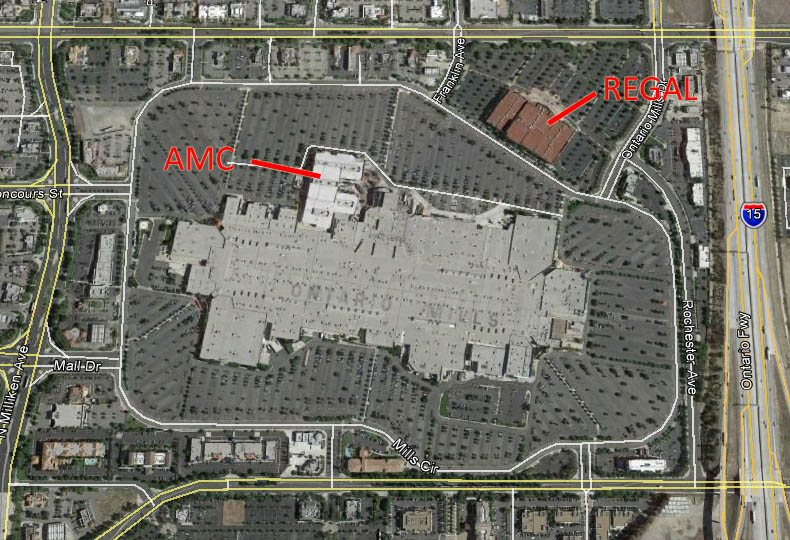
It seems to me the nail in the coffin for AMC's argument is their own Ontario, California, location.

AMC operates the Ontario Mills 30 at Ontario Mills Shopping Center and Regal operates the Edwards Ontario Palace 22 across the street. Both theaters play the same movies.

Your read that correctly. Fifty-two screens at one shopping center.

 -
 
Posted by James Westbrook (Member # 3690) on 11-19-2014, 09:06 PM:
 
Size-wise, that's #1 and #2 facing off with each other there.
 
Posted by Marcel Birgelen (Member # 6801) on 11-20-2014, 06:48 AM:
 
The interesting thing is, they're actually doing a face off. An open confrontation, playing both the same releases apparently.

As Regal and AMC are probably in the same boat, or rather, in the same luxury yacht, they apparently don't need to divide the releases between them in "competing markets".

I guess their argument will be something like: The market there is sufficiently big to support 52 (!) screens within a few yards...
 
Posted by Bobby Henderson (Member # 840) on 11-20-2014, 09:28 AM:
 
That situation with Ontario Mills is very interesting and damning for AMC's argument to support the allocation concept.

AMC could try to say the Dallas-Fort Worth metroplex doesn't have as many people as the LA area, so the Regal & AMC situation with Ontario Mills is a very unique thing and not to be repeated anywhere else, except for maybe Midtown Manhattan in New York City. That argument falls apart when you visit the Dallas-Fort Worth metroplex, realize there's over 6 million people living in that area, and the Addison-North Dallas zone is one of the busiest areas of that whole region. There's more than enough market in that zone to support two rival 30-plex theaters playing the same content.

The only way I see allocation making any sense at all is in smaller markets, but then there are exceptions even there.
 
Posted by Jason Burroughs (Member # 68) on 11-20-2014, 11:20 AM:
 
What I find amusing, and contradictory to AMC's stated position, is that there are 2 other theaters in close proximity to their new location that are already playing day & date with each other for at least a year.

Venitian Cinemas 3.8 miles
AMC Valley View 16 3.2 miles
Look Cinemas .7 miles

Flash back 20 years, all these theaters would be in the same "zone". AMC has not had an issue until they decided to open a location virtually across the street from an established location. What is AMC afraid of? Why be so noncompetitive?
Perhaps they are afraid they over saturated an area that now has 40 screens that 20 years ago could only marginally support 20, without a significant population growth in the area?

I don't have numbers but I would highly doubt that the Valley View theater produces anything but abysmal numbers, considering it is in a dead mall.

With the exception of the Valley View location, all offer an upgraded experience to varying degrees.
 
Posted by Terry Lynn-Stevens (Member # 7349) on 11-20-2014, 01:16 PM:
 
quote: Jason Burroughs
What is AMC afraid of? Why be so noncompetitive?
I don't think AMC is afraid of anything, they just know that the L [Roll Eyes] [Roll Eyes] K cinemas will not be able to sustain operations if they do not have complete access to all of the product. It should be interesting but I think AMC will win the fight.
 
Posted by Jason Burroughs (Member # 68) on 11-20-2014, 01:48 PM:
 
Terry, who do you work for?

I'm not in the industry any more, and have no dog in the fight.
Even your statement lends to AMC being anti-competition in that their express desire is to drive an independent competitor out of business.

I think we could all agree that AMC would not be taking this stance (or even had built this location) if LOOK had been a Cinemark or Regal instead.
 
Posted by Terry Lynn-Stevens (Member # 7349) on 11-20-2014, 02:00 PM:
 
AMC simply said they will not license films day and date with Look. So in essence it is up to the studio to choose either AMC or Look. I don't work for AMC but from the way I see it, AMC will make the studio more money, (just my opinion) and the studios will continue to give the product to AMC.
 
Posted by Marcel Birgelen (Member # 6801) on 11-20-2014, 04:02 PM:
 
Terry constantly complains about the near monopoly of Cineplex in his area, the resulting inflated ticket prices and the mediocre quality which must be a direct result of lack of competition.

Then again, he thinks it's completely OK for the biggest cinema chains to squash their competition via anti-competitive practices.
 
Posted by Buck Wilson (Member # 5885) on 11-20-2014, 05:27 PM:
 
quote: Terry Lynn-Stevens
AMC simply said they will not license films day and date with Look. So in essence it is up to the studio to choose either AMC or Look. I don't work for AMC but from the way I see it, AMC will make the studio more money, (just my opinion) and the studios will continue to give the product to AMC.

The only way this would be a good thing would be if the AMC provides a superior product(presentation). The chances of that are slim to none.

Even in that case, it wouldn't be ideal.
 
Posted by Mike Blakesley (Member # 26) on 11-20-2014, 05:28 PM:
 
quote: Terry Lynn-Stevens
AMC simply said they will not license films day and date with Look.
Which essentially means, "If you give movies to those guys ("Look") then we won't play your movies." I assume it means in their other theaters in that area. So if they've got several complexes in the vicinity and Look only has the one complex, it's easy to see who'll win that fight.
 
Posted by Jason Burroughs (Member # 68) on 11-20-2014, 08:30 PM:
 
If AMC was open to competition they would play day & date and let the consumer choose.

By refusing, they take the choice away from the consumer.

I don't mean to sound like I am singling out one particular exhibitor or another. Since there is no longer a finite number of prints, any exhibitor should have equal opportunity to play any feature that they want.

This arrangement makes room for unethical business practices.

What is there to prevent any large chain from undercutting and underbidding a smaller circuit or independent? The smaller players would not have the critical mass and deeper pockets to support a loss leader.

These practices have been evident in this area before. 20 years ago there were 4 theaters in this area. 2 were General Cinemas, 1 AMC and 1 United Artists. Guess who got ALL (and I mean all) Universal pictures? Hint: Only 1 chain ever got Universal films.
 
Posted by Mark Lensenmayer (Member # 134) on 11-21-2014, 07:15 AM:
 
In Central Ohio, there doesn't seem to be much product splitting...every movie plays at every theatre.

On the far east side, Cinemark has a location about 2 miles from the huge AMC 30-plex at Easton Mall. No product splitting there.

Even on some independent movies, a local independent will frequently run the same picture as the AMC 24-plex about 1 mile away.

There was some splitting before mass booking became prevalent, but not any more.
 
Posted by Martin McCaffery (Member # 37) on 11-21-2014, 08:11 AM:
 
quote: Jason Burroughs
If AMC was open to competition they would play day & date and let the consumer choose.

Why be open to competition when you can operate as a monopoly? Capitalism 101: make all the money you can, any way you can. It's not, and never has been, about the customers.
 
Posted by Bobby Henderson (Member # 840) on 11-21-2014, 08:47 AM:
 
quote: Jason Burroughs
Terry, who do you work for?
Terry is trolling, same as usual.

Since nearly everyone else participating in this thread is sympathetic to LOOK, Terry automatically takes the opposing viewpoint just to stir up some shit. His little "L [Roll Eyes] [Roll Eyes] K" comment earlier just shows what he's trying to do. It also ruins any credibility for anything he says, provided he had any credibility in the first place.

quote: Jason Burroughs
What is there to prevent any large chain from undercutting and underbidding a smaller circuit or independent? The smaller players would not have the critical mass and deeper pockets to support a loss leader.
AMC could do that, but I actually suspect the opposite. Big chains like AMC, Regal, etc. want the entire exhibition business to themselves. They don't want "little guy" independents letting customers realize the biggest chains still have a carbon copy, cookie cutter, fast food approach to the movie-going experience. Small chains like Warren Theaters can kick their ass all over the place in a given market when given a fair chance.
 
Posted by Terry Lynn-Stevens (Member # 7349) on 11-21-2014, 12:57 PM:
 
quote: Martin McCaffery
Why be open to competition when you can operate as a monopoly? Capitalism 101: make all the money you can, any way you can. It's not, and never has been, about the customers.


That is spot on. AMC has no concern about their competition, their goal is to be #1 in the marketplace and if it puts the competition out of business then so be it, as sad as it is that is the goal. The studios do not care either, they will go with the theater that will make them the most money.
 
Posted by Buck Wilson (Member # 5885) on 11-21-2014, 04:24 PM:
 
Terry, the point is that the studios are shooting themselves in the foot by doing that. It's a poor long term business decision.(Oh how good they are at that!) By continuing these shady business deals and not supporting competition, the product(presentation) suffers. What does that mean? Less butts in seats and a continuing decline in the overall reputation of the industry in the consumer's mind. The last thing we all need.
 
Posted by Frank B. McLaughlin (Member # 6683) on 11-22-2014, 06:47 AM:
 
It would seem to me that 1) if the studios are left to pick and chose the venue they would be open to a suite; 2) let AMC refuse to play with LOOK - after a few ten-poles this too will pass.
 
Posted by Bobby Henderson (Member # 840) on 11-22-2014, 09:49 AM:
 
I still think AMC has to be kicking points off their box office take back to the movie distributor, at least in the case of the latest installment of The Hunger Games. Allocation models make no logical sense otherwise now that movies are distributed on cheap, reusable hard discs rather than film prints.

With digital entertainment it's in the distributor's best interest to get its content playing in as many places as possible. I think I mentioned the analogy of sports bars and pay per view fight events earlier. Zuffa Entertainment sure isn't making any exclusive deals with national chains like Buffalo Wild Wings to commercially show its Ultimate Fighting Championship PPV events. Here in Lawton there's at least half a dozen or more sports bars and restaurants showing those UFC events whenever they're available.

The only valid argument I can see in favor of an allocation setup between 2 theaters in close proximity is improving variety of titles. A big tent pole movie release is going to hog multiple screens at any location. If that tent pole movie release is playing only at one of two theaters in close proximity more screens will be available at the other location to play a greater variety of movies.

But the allocation setup only works when the studios are alternating their releases between the 2 theaters in a consistent and fair manner -rather than allowing one of the theaters (AMC in this case) to cherry pick the better titles and leave the other (LOOK) with the lesser titles. The two competing theaters need to be similar in quality to each other so consumers feel like they're getting good value for their money regardless of where the movie plays. For years here in Lawton I had to put up with the crappy UA Cache 8 theater getting a lot of good titles that would have been much better to see down the street at the Carmike 8.
 
Posted by Steve Dailey (Member # 5137) on 11-22-2014, 10:50 AM:
 
Hey there folks - I've never posted here before but wanted to weigh in on this topic. I'm not in the industry but am an avid movie fan. I live near the Overland Park, Kansas AMC theater mentioned earlier (in the similar "fight" between it and the new Cinetopia). The AMC theater isn't playing the "Hunger Games" sequel, but the Cinetopia is, as well as a former Dickinson 16-screen complex barely a mile distant. I guess Cinetopia and Dickinson (now B&B) have no dispute over allocation.
 
Posted by Terry Lynn-Stevens (Member # 7349) on 11-22-2014, 01:05 PM:
 
quote: Steve Dailey
The AMC theater isn't playing the "Hunger Games" sequel, but the Cinetopia is, as well as a former Dickinson 16-screen complex barely a mile distant.
So are these three theaters all within one-mile apart?
 
Posted by Steve Dailey (Member # 5137) on 11-22-2014, 01:28 PM:
 
The Dickinson/B&B is about a mile from Cinetopia, I would guess. The AMC is about 3 miles from the Cinetopia. Interestingly enough, AMC said several years ago that they were interested in the general area where the Cinetopia is (to locate a new theater).
 
Posted by Chris Slycord (Member # 4239) on 11-25-2014, 09:27 PM:
 
quote: Terry Lynn-Stevens
So are these three theaters all within one-mile apart?
Their Ontario, CA 30-plex referred to earlier is 0.24 miles from the Edwards/Regal and not even a distance down the road. That's the distance walking through the parking lot.
 
Posted by Jason Whyte (Member # 1433) on 11-26-2014, 03:02 AM:
 
The only thing that matters and thing that we can all take from this news is that a Blackberry Bourbon Lemonade at the AMC sounds delicious.
 
Posted by Jason Burroughs (Member # 68) on 04-23-2015, 04:23 PM:
 
Apparently the DOJ has begun an investigation to the Clearance practice in the exhibition industry.

Dallas Morning News

Dallas Morning News:

The U.S. Department of Justice is looking into whether the country’s biggest movie-theater chains are keeping smaller competitors from getting first-run films — and at the very center of that investigation is the owner of a single North Dallas movie theater.

Back in October Tom Stephenson, chief executive of the luxurious 11-screen LOOK Cinemas multiplex on Belt Line Road, complained that the Chinese-owned AMC Theatres megachain was blocking LOOK’s attempt to book The Hunger Games: Mockingjay Part 1. At the time, AMC’s Village on the Parkway 9 was under construction at Belt Line and the Dallas North Tollway — less than a mile from the 2-year-old LOOK — and circulating a flier that said “we will not be licensing films day-and-date with this theatre.”

Stephenson said AMC had received “clearance” from Lionsgate to show the Hunger Games sequel — that is, the studio said only AMC could show the movie within a certain radius, cutting LOOK out of the frame. Clearance is an old practice in the movie business, but indie theater owners have long maintained it’s little more than “a tactical anti-competitive weapon” used by the big chains to run their smaller competitors out of business.

Stephenson’s attorney, Brett Johnson, told The Dallas Morning News at the time that “AMC is trying to strong-arm the film distribution companies into giving them exclusivity with films.”

The LOOK owner maintains the practice continues: “We couldn’t show Hunger Games, we couldn’t play American Sniper, 50 Shades of Grey. And we’re not scheduled to get the new Avengers,” he tells The Dallas Morning News today. “These are big-time movies we would have loved to have play, and AMC has not let us have them. AMC is forcing the studios to honor this clearance, and it remains an ongoing problem.”

And according to Stephenson, it’s now an ongoing Justice Department probe. The Los Angeles Times initially reported on Justice’s investigation into AMC, Regal and Plano-based Cinemark — the so-called Big Three exhibitors — last week. The feds will not confirm its existence. Stephenson says today that he was interviewed by federal investigators on April 14.

“They were interested in how the process works, in terms of who declares these clearances and how do we find out about them,” he says. “They asked, ‘Has a studio ever been involved a clearance not asked for by an exhibitor.’ The answer is no. AMC is the one asking for clearance, saying they won’t play day and date with us.”

In an interview with the Los Angeles Times yesterday, AMC Entertainment Chief Executive Gerry Lopez said “clearance” has been around since the dawn of celluloid, and insisted it’s little more than a “quirk that is very specific to this industry.”

He also said LOOK is just one of a handful of theaters complaining about it.

“There are 600-plus exhibitors in this country,” he told the paper. “There are three or four exhibitors who are irritated by it. My guess is they have made some bad business calls and they’re trying to figure out a way out of a bad situation by alleging stuff and in some cases going to court.”

Stephenson called Lopez’s comments “ludicrous” and said he’s “trying to whistle through the graveyard.”

LOOK has launched an online petition that says “you should choose where you see a movie, not AMC.” And a few weeks ago, Stephenson took his fight with AMC to the movie-makers, sending studio chiefs a missive in which he says Paramount has decided to “end clearances in the Dallas, Texas area between Look Cinema and AMC’s Village on the Parkway 9.” He also writes that “AMC is using clearances as a competitive weapon to prevent new market entrants from building near AMC theaters.”

Other theaters have long maintained AMC, Regal and Cinemark have kept the goods out of their theaters. Owners of Boca Raton, Fla.-based iPic Entertainment have also been interviewed by the feds, according to the Times/ And last year Georgia-based Cobb Theaters filed a federal antitrust lawsuit alleging AMC “has used its worldwide and national circuit power and its market power in a substantial number of geographic markets to coerce film distributors to deprive Cobb, its only competitor in one of the relevant geographic and product markets, of fair competitive access to films to exhibit to the public at its competing theater.”

In the end, says Stephenson, studios need to let customers decide where to see their movies, no matter how close multiplexes sit to one another in the market. And, of course, he welcomes the Justice investigation.

“This is serious big-league stuff,” he says, “and people are understanding that.”
 
Posted by Bobby Henderson (Member # 840) on 04-23-2015, 05:31 PM:
 
quote: Gerry Lopez, AMC
“There are 600-plus exhibitors in this country,” he told the paper. “There are three or four exhibitors who are irritated by it. My guess is they have made some bad business calls and they’re trying to figure out a way out of a bad situation by alleging stuff and in some cases going to court.”
LOOK made some bad business calls? What kind of rope was Gerry smoking? LOOK was built in that part of North Dallas first. AMC's location there is the late comer, yet acting entitled to all the choice movie releases.

By the way, AMC's Prime screen at that 9-plex is apparently the only Prime theater AMC has which is not equipped with Dolby Atmos. Two auditoriums at LOOK are equipped with Dolby Atmos. In fact, LOOK is the only theater location in the Dallas-Fort Worth metroplex with multiple Atmos-equipped screens.

That's something to keep in mind with these big event releases like Avengers: Age of Ultron. It would sound better at LOOK since its Atmos mix could be played there. At the AMC Prime screen down the street it's going to be in conventional 5.1 or 7.1, but cost $16 per ticket. LOOK's ticket prices aren't that high.

quote:
LOOK has launched an online petition that says “you should choose where you see a movie, not AMC.” And a few weeks ago, Stephenson took his fight with AMC to the movie-makers, sending studio chiefs a missive in which he says Paramount has decided to “end clearances in the Dallas, Texas area between Look Cinema and AMC’s Village on the Parkway 9.” He also writes that “AMC is using clearances as a competitive weapon to prevent new market entrants from building near AMC theaters.”
I wouldn't be surprised to see Paramount doing LOOK a favor or two. LOOK arguably had one of the best showcases to see Paramount's release of Interstellar in 5-perf 70mm. The theater owner spent a bunch of money altering the booth to fit the 70mm gear alongside the d-cinema gear.
 
Posted by Marcel Birgelen (Member # 6801) on 04-23-2015, 06:39 PM:
 
Since AMC is nowadays owned by China, I have the feeling this blatant anti-competitive behavior could actually be branded "Un-American". [evil]
 
Posted by Joe Redifer (Member # 3) on 04-23-2015, 10:46 PM:
 
That's a card they should start playing soon, then. Just let both theaters have it and see what happens. Is AMC afraid they'll lose? Pussies.
 
Posted by Brad Miller (Member # 2) on 04-24-2015, 10:31 AM:
 
In the age of film, this argument made some sort of sense. After all the prints were expensive to make. Those days are GONE. The cost of adding another "digital print" is so miniscule it doesn't matter.

It isn't in ANYONE's best interest (except the big-boy-bully in this sort of scenario) to not play day and date. The studios will get the movie playing on more screens, at more theaters. The patrons will have more flexibility in their showtime options (which otherwise sometimes mean they have to skip the movie alltogether). The patrons also get the ability to choose which theater they like, which translates to the competing buildings working harder to make their experience BETTER (which translates into more ticket sales for the studio as well).

Sounds to me like AMC simply wants to push their weight around and force the distributors to give them all of the good product so they don't have to spend any money on keeping their quality up. Unfortunately the patrons AND the distributors lose in that model, as I know there are some theaters I (and many others) simply will not watch a movie in for one reason or another (the most common being bad sound, bad chairs or a lack of masking). If that's the only theater within reasonable driving distance playing the movie I want to see, then I just skip it. This is happening more and more with video release windows being so short. The distributors are shooting themselves for not letting everyone play day and date.

quote: Bobby Henderson
I wouldn't be surprised to see Paramount doing LOOK a favor or two. LOOK arguably had one of the best showcases to see Paramount's release of Interstellar in 5-perf 70mm. The theater owner spent a bunch of money altering the booth to fit the 70mm gear alongside the d-cinema gear.
I don't know the final tally of money spent on that, but it was something around $100k I believe to modify that building and such to play that one movie. They will however be in an excellent position to run Tarantino's 2.76:1 ratio 70mm film properly the way their entire front end was redesigned though.
 
Posted by Joe Redifer (Member # 3) on 04-24-2015, 07:47 PM:
 
quote: Brad Miller
The patrons will have more flexibility in their showtime options
This is actually a good argument. Even 10 minutes one way or the other can make a difference. People like to make plans and movies are just one of those plans. If two theaters that were close to each other had the same exact showtimes, then that'd just be dumb.

quote: Brad Miller
The patrons also get the ability to choose which theater they like, which translates to the competing buildings working harder to make their experience BETTER
And this is the best reason. It's actual competition. Competition is good. It would improve the quality of BOTH theaters. Shouldn't studios want their movie to be seen in the best way is can be seen? So it benefits them for sure. If one of the theaters didn't care, they'd likely make a lot less money. And that also is a good thing.
 
Posted by Frank B. McLaughlin (Member # 6683) on 04-25-2015, 08:57 AM:
 
The best way to deal with competition - especially when it is a superior quality venue - is to simply put it out of business.
 
Posted by Lyle Romer (Member # 1266) on 04-25-2015, 12:24 PM:
 
Even in the days of film, I disagreed with exclusive zones. At least the studios could make the argument that they were spending more on prints just to split the same audience.

The problem is that the practice doesn't allow higher quality theatres to win a competition. Their success is reliant on what product split they get.

Back in the early 90's, I worked at a GCC location and there was a Wometco literally across the street. We had much better presentation (except for the mono in the 3 smallest houses), had a newer, nicer, cleaner building and provided MUCH better customer service.

People would go out of their way to tell us how much more they liked our theatre and how much they hated when they had to go to the Wometco. However, due to the anti competitive zone system, we couldn't "win" the competition. I can guarantee if we were allowed to play day and date, our location would have been expanded and they would have ended up closing. Then somebody would have gotten a great location when GCC went bankrupt.

In the digital age, this practice needs to end. If the studio is still making VPF payments, I guess they have some leg to stand on but if somebody wants to build today and pays for all of their digital equipment, they should play whatever they want no matter where else it is playing.
 
Posted by Martin McCaffery (Member # 37) on 04-25-2015, 03:19 PM:
 
quote: Joe Redifer
Shouldn't studios want their movie to be seen in the best way is can be seen?
They should, but as has been the case since about 1895, they don't. [evil]
 
Posted by Paul H. Rayton (Member # 1817) on 05-12-2015, 02:35 PM:
 
This is a pretty big story, and I thought about creating a new thread for it alone, but since it's been chewed on for quite a while here, I'll put it here. So, how's that old expression go ... "Hold on to your hats -- It's gonna be a bumpy ride!" Seems like these little exhibitor altercations have caught the attention of the Big Boys, and now it will play out in Federal court. This could get interesting:

quote:

U.S. steps up scrutiny of movie distribution
By Richard Verrier -- Los Angeles Times -- May 12, 2015

At a time when the box office is booming, the business practices of the nation's largest theater chains are coming under growing scrutiny by the federal government.

The Department of Justice recently ordered Regal Entertainment Group, AMC Entertainment Holdings Inc. and Cinemark Holdings Inc. to supply documents as part of a widening investigation into whether the largest theater chains violated federal antitrust laws, three people familiar with the investigation said.

The government is examining allegations from independent theater owners across the country that the big chains are using their market clout to block smaller rivals from receiving first-run movies.

The issuance of civil investigative demands, or administrative subpoenas, signals a significant escalation in the Justice Department probe, which launched several months ago but has accelerated in recent weeks.

The department also has assembled a task force of attorneys and economists to examine a business practice known as clearances, license agreements in which theaters obtain permission from studios to exclusively show first-run movies in their theaters within certain zones, thereby blocking nearby rivals from playing the same movie at the same time.

Task force members already interviewed executives from at least three independent theaters in Florida, Texas and Kansas, people with knowledge of the probe said. This week they are expected to meet with executives with Cobb Theatres, a Birmingham, Ala.-based chain with 20 theaters.

The investigation is being closely watched in the exhibition industry and in Hollywood because it could force changes in how major motion pictures are distributed and lead to costly fines for the big chains.

"This is the sort of thing that antitrust is particularly worried about," said Mark Lemley, a professor at Stanford Law School and an expert on antitrust law. "Do we have a few dominant players entering into deals that make it harder for independent companies to establish themselves and gain ground?"

Industry insiders expect the government's investigation will last at least six months to a year.

Although violations of the Sherman Antitrust Act are subject to criminal penalties, the Justice Department would more likely file a civil lawsuit against theaters that could be resolved through a consent decree. Such a decree could include fines and possibly an injunction that would bar use of blanket clearances.

The government investigation could also open the door to more antitrust lawsuits, in which plaintiffs can receive treble damages.

AMC, Cinemark and Regal declined to comment. But theater and some studio executives have previously defended the use of clearances, contending they provide an efficient way for studios to allocate movies and protect competing theaters from diluting their grosses by having too many film runs in a given area.

"One has to remember that film clearances, they've existed for many years and we believe they have because they are beneficial to the studios, they are beneficial to exhibition and they are beneficial to consumers," Regal Entertainment Chief Executive Amy Miles said in a recent conference call with analysts.

The use of clearances developed after a landmark Supreme Court decision in 1948 that required studios to divest their ownership in movie theaters. Clearances were initially seen as a way to guarantee that small, independent theaters would gain access to first-run films, allowing the industry to grow rapidly.

But as the industry has increasingly consolidated — about half of all theater screens are owned by three companies — tensions between large chains and independent theater chains have heightened. Because they control so many screens, big chains have more leverage with studios in terms of where and when movies play across their circuits.

In 2006, the owners of the Palme d'Or, a seven-screen specialty theater in Palm Desert, sued Texas-based Cinemark, the nation's third-largest chain.

Flagship Theatres, whose owners include "Breaking Bad" star Bryan Cranston, alleged that Cinemark, which operates a cinema in nearby Rancho Mirage, was "circuit dealing" by threatening to retaliate against movie studios that booked films in the Palme d'Or. The case is pending.

In court filings, Cinemark has argued that its business practices are lawful and that the company did not have sufficient strength in the Coachella Valley market to stifle competition.

Another legal dispute erupted last year when Cobb Theatres sued AMC in U.S. District Court in Georgia. Cobb, which operates 20 theaters, accused AMC of using its "monopoly power" to block some first-run movies from being screened at upscale cinema and dining complex in Brookhaven, a suburb of Atlanta. The suit alleges that AMC convinced studios to give two nearby AMC theaters in Buckhead preferential treatment.

AMC denied the allegations and moved to dismiss the case. A federal judge in March allowed it to proceed.

The chain has been especially aggressive in enforcing clearances in the three years since China's Dalian Wanda Group acquired AMC for $2.6 billion.

AMC sought clearances for a dozen theaters, including cinemas in Harlem and La Jolla, that it viewed as "predatory competitors," according to an internal memo obtained by The Times.

The Leawood, Kan., chain has been investing heavily in upgrading its theaters with new amenities as well as opening cinemas that offer premium food and beverage service. The expansion has put it at odds with new independent theaters that also are targeting affluent customers with luxury services.

Among them is Look Cinemas in Dallas, Texas.

Veteran industry executive Tom Stephenson and his partners invested $20 million to open a luxury 11-screen theater in May 2013 in an affluent suburb of Dallas at which patrons can order food and drinks in plush recliners.

But Stephenson says Look Cinemas, which was included in AMC's list of "predatory competitors," has been starved of blockbuster movies such as "Avengers: Age of Ultron."

In a recent letter to studio executives, he complained that AMC was using clearances to steer business to an AMC venue that opened last fall.

"What AMC has done is say, 'I can use this to help take production away from smaller theaters,'" Stephenson said."They're using it as a weapon."

IPic Entertainment, a Boca Raton, Fla.-based chain that operates 11 luxury theaters — including locations in Pasadena and Westwood — also has contacted the Justice Department. IPic alleges that Regal and AMC have used the threat of clearances to thwart competition.

Hamid Hashemi, CEO of IPic, said he was in negotiations with a developer to open a theater in a suburb of Dallas last summer when he learned that AMC had sent a letter to studio distribution executives saying the proposed IPic theater would be in "substantial competition" with a smaller AMC multiplex two miles away that didn't have similar services. In the letter, AMC asked studios to approve clearances in "that particular film licensing zone."

AMC and Dolby are teaming up to build 100 high-tech theaters

On the same day, Hashemi said studio distribution executives told him they had received a similar clearance request from Regal involving a separate 500-seat theater under construction in Houston.

"Clearances are legal, but the use of clearances as a threat to preempt competition, that's another story," Hashemi said.

Rudyard Coltman opened a state-of-the-art $25-million multiplex in Overland Park, Kan., last May. The Cinetopia-18 includes a restaurant, extra-wide seats where patrons can order food and drinks, and a 75-foot-wide Imax screen. But Coltman says AMC, which operates a theater less than two miles away, is using its buying power to keep premium large format films like "Fast & Furious 7" and "Avengers" away from Cinetopia. As a result, he said, business is 50% below projections.

"All year long we've been denied the majority of these pictures," Coltman said. "We've gotten killed by clearances."

AMC Chief Executive Gerry Lopez defended his company's use of clearances.

"The fact of the matter is we are playing by rules that have been long established," Lopez told The Times last month. "There are 600-plus exhibitors in this country. There are three or four exhibitors who are irritated by it. My guess is they have made some bad business calls."

Original article was here: web page
 
Posted by Mike Blakesley (Member # 26) on 05-12-2015, 02:46 PM:
 
quote:
"One has to remember that film clearances, they've existed for many years and we believe they have because they are beneficial to the studios, they are beneficial to exhibition and they are beneficial to consumers," Regal Entertainment Chief Executive Amy Miles said in a recent conference call with analysts.
I would like to ask Amy: How exactly is it beneficial to consumers to limit their choices of what theater they can see a movie in? And "beneficial to exhibition" -- well, it's beneficial to AMC but what about the other guy? And how is it beneficial to the studios when there are LESS available seats to sell?

I've never been all that impressed with Amy Miles and this quote is a perfect illustration why.
 
Posted by Martin McCaffery (Member # 37) on 05-12-2015, 04:06 PM:
 
The Big Chains, whoever they are at the time, have been doing this since about 1920, and been getting sued over and over. Sometimes the studios/distributors get pulled into the suit, but they, too, always get around it. Most are just able to outlive and outspend the smaller guys.
Can't feel too bad for Cobb, in 1983 they and Carmike and one other Chain (Regal?) split up Alabama. One day there were two or three chains in town, the next day only one. Nothing was ever done about it.
As to Mike's question, who says they are operating for the benefit of the consumer? That sort of thinking went out about 1980;>
 
Posted by Buck Wilson (Member # 5885) on 05-12-2015, 05:20 PM:
 
Oh Amy. DIAF.
 
Posted by Edward Havens (Member # 4715) on 05-12-2015, 09:15 PM:
 
Of course, this is the same Amy Miles who suggested "if we had a movie that appealed to a younger demographic, we could test some of these concepts" during a CinemaCon discussion about texting in movie theatres.
 
Posted by Joe Redifer (Member # 3) on 05-12-2015, 10:04 PM:
 
"Amy Miles is delusional, incompetent and only serves to worsen the industry as a whole."

Direct quote by me.
 
Posted by Steve Dailey (Member # 5137) on 05-13-2015, 12:11 PM:
 
"Rudyard Coltman opened a state-of-the-art $25-million multiplex in Overland Park, Kan., last May. The Cinetopia-18 includes a restaurant, extra-wide seats where patrons can order food and drinks, and a 75-foot-wide Imax screen. But Coltman says AMC, which operates a theater less than two miles away, is using its buying power to keep premium large format films like "Fast & Furious 7" and "Avengers" away from Cinetopia. As a result, he said, business is 50% below projections."

Once again, someone doesn't know what they are talking about. The Cinetopia definitely does not have an IMAX auditorium. Three of the screens are nearly IMAX size though. The AMC he speaks of - the Leawood Town Center 20 - does have an IMAX audtitorium. Was Coltman misdescribing his own complex? But otherwise I wholeheartedly agree that it's wrong what AMC is doing here.
 
Posted by Scott D. Neff (Member # 185) on 05-13-2015, 01:49 PM:
 
I know I'm late to the game, but re: clearances, does it do anybody any good to have the audience split up between every single theatre in a region? If the crappy movie Hollywood made only has X number of people interested in seeing it, can ANY theatre make a profit from showing it if they're only each getting 20% of the audience? And don't tell me the answer is for Hollywood to stop making crap movies, because Hollywood has been making crap movies forever and it's not going to change any time soon.

Furthermore, many of us complain that movie-going isn't an experience anymore and I'd say that's because we are no longer directed to see the movie together in the same place. Giving the general public the option to see it wherever they want to means mostly that they'll see it at the place closest their home, whether it's a good theatre or not.

If clearances were properly managed or distributors actually were to say (and mean) "We don't think this theatre is of a quality worthy of our product." then BAM, problem solved. Of course studios can't say that about the AMC in one town and then expect AMC to be happy about it in another town. It's all the fun of a symbiotic relationship. The same way some of us complain about how dumb your general movie goer is, we still need them to keep the doors open. So studios could complain about how awful a theatre is, but they still need them to sell their movies... or wait... they don't because they're trying to bypass theatres and stream on the internet because everybody keeps bitching about the distribution model.

Oh politics.
 
Posted by Bobby Henderson (Member # 840) on 05-13-2015, 03:26 PM:
 
The game when examined at first glance doesn't make any sense. Why would a theater chain like AMC build a new multiplex location near an existing theater that was already just as good, if not significantly better? LOOK is definitely a better theater than that slightly newer AMC 9-plex in Addison, TX. When two theaters are close to each other they usually have to go back and forth, taking turns playing movies from any Hollywood studio. One Warner Bros. release goes to one theater and the next Warner Bros. release goes to the other theater.

I think the ultimate goal in the game is putting the other rival theater out of business. Pull strings to get a few more of the top movies while the other location gets stuck with B-side garbage. You get Indiana Jones & the Last Crusade and the other theater gets stuck with Star Trek V: The Final Frontier. "Row, row, row your boat, gently down the..." Ugh.
:vomit:

AMC might try to use the following example in their defense:

The folks running Cinetopia in Overland Park are pissed they didn't get The Avengers: Age of Ultron. But this week they're getting Mad Max: Fury Road while the AMC Town Center 20 is not. Mad Max: Fury Road is currently boasting a 99% Tomato Meter score at Rotten Tomatoes, which is a hell of a lot better than the good, but not great 74% score the Avengers sequel was given. I've noticed some of the Mad Max shows this weekend are already sold out. The movie probably won't break opening weekend records, but it is poised to have a very strong opening.

Regarding where people choose to see movies, just about everyone is going to choose the theater nearest home unless another theater farther away gives them a good reason to drive the extra distance. If every theater was able to play whatever they wanted to book movie theaters would naturally be more competitive in terms of providing a good movie-going experience. Too often movie theaters operate the same way as hospitals do, a vertical monopoly that takes its customer base for granted. The theater operators figure if the local customers wants to see a certain movie in a theater the customer is going to visit his theater. So why spend any extra money sprucing up the place and making the sound & picture better? That affects the bottom line.

quote: Steve Dailey
The Cinetopia definitely does not have an IMAX auditorium. Three of the screens are nearly IMAX size though. The AMC he speaks of - the Leawood Town Center 20 - does have an IMAX audtitorium. Was Coltman misdescribing his own complex? But otherwise I wholeheartedly agree that it's wrong what AMC is doing here.
The Cinetopia location in Overland Park may not have an IMAX-branded screen, but two "GXL" screens equipped with Dolby Atmos, a detail the article did not mention. The competing AMC has one Prime screen with Dolby Atmos (soon to be converted to Dolby Cinema). An IMAX-branded theater equipped with twin 4K laser projectors might peak my interest, but the vast majority are using mere 2K based Xenon systems. Cinetopia seems like a much nicer theater than the AMC location.
 
Posted by Jonathan Goeldner (Member # 4854) on 05-13-2015, 04:04 PM:
 
AMC does the same thing with their Mazza Galleria theater and the independent Avalon theater (yet the distance is smaller than Cinetopia and Town Center 20) surprisingly given it's only 1.2 miles away - the studios haven't blinked an eye if a movie is playing at both locations - my money though goes to the Avalon since if a movie is on the main screen and it's 7.1 encoded it will be played back as such. Mazza is only 5.1 on all it's screens.

the two screens in the DC metro area that do seem to be 'too close' in proximity and toggle movie bookings are Cinemark Fairfax Corner 14 and Regal Fairfax Towne Center 10 (of a distance of 2.3 miles separating the two). Regal may tout it's reclining seats and all, but Cinemark has better larger screens, two are Rave's 'Xtreme' screens with 4K/HFR - Auro 11.1 sound - they also have their $5.75 all day Wednesday deals, which is a no-brainer.
 
Posted by Buck Wilson (Member # 5885) on 05-13-2015, 04:25 PM:
 
The overland Park Cinetopia actually has 3 GXL screens, all Dolby Atmos capable... the other 15 screens are 7.1.

The Town Center is all 5.1 with the exception of the one Atmos house(soon to be Dolby Cinema)
 
Posted by Jonathan Goeldner (Member # 4854) on 05-13-2015, 04:59 PM:
 
and I gather tix pricing for Dolby Cinema isn't going to be cheap ... regardless of all the bells and whistles, it's the pricing and which theaters have the amenities (7.1, Atmos, Auro) factor in my decision to which theaters I'll see a movie at. However "reclining seats" are far from what I consider essential (if I wanted those, I would have stayed home)

I honestly don't get the new Starplex Cinema in Ashburn Virginia, they built a brand new building, the auditoriums are 5.1 huh? ALL the auditoriums at the Angelika, Arclight and IPic can playback 7.1; and their 'IDX' screen is only 7.1 - what? no incentive to install an object based audio system on said screen?

Regal has built a couple new theaters in the DC metro area with RPX screens but NOT with Atmos, that's a major head scratcher, (although there was a news blurb from last year that those screens might get the Auro 11.1 conversion.)

I think everyone should have waited til DTS-X's announcement
 
Posted by Buck Wilson (Member # 5885) on 05-13-2015, 06:39 PM:
 
quote:
"One has to remember that film clearances, they've existed for many years and we believe they have because they are beneficial to the studios, they are beneficial to exhibition and they are beneficial to consumers," Regal Entertainment Chief Executive Amy Miles said in a recent conference call with analysts.
Fun fact: On secret shopper reports in that company, Presentation(picture AND sound quality) is worth 3 points out of 100. But clearly more importantly, suggestive/upselling is worth 11 points.
 
Posted by Joe Redifer (Member # 3) on 05-13-2015, 09:06 PM:
 
quote: Scott D. Neff
If the crappy movie Hollywood made only has X number of people interested in seeing it, can ANY theatre make a profit from showing it if they're only each getting 20% of the audience
Not every theater has to have every movie. Let's say I have 8 screens and you have 56. I'm gonna be a lot more selective about what I play whereas you'll be forced to play everything and have 9 prints of it just to fill screens. Sure, sometimes a flop will happen and movies bomb. That's business. But mostly it forces theaters to compete and that is a good thing. Would you want to watch the movie at the corporate megaplex with no life and/or personality or the less-corporate smaller theater that just might care about the customer more than they do about upselling. If this hurts the big boys, then big deal! I really don't care. That's how competition works. That's how it should ALWAYS work.
 
Posted by Bobby Henderson (Member # 840) on 05-13-2015, 11:39 PM:
 
Since everything has gone "digital" I think the UFC rule should apply. Basically that means any sports bar that wants to pay the money it takes to book the big event should be able to carry it, even if there is another damned sports bar right across the street showing the same damned event.

Or do we need a restaurant analogy? Does any restaurant have a "clearance" on being able to serve steak exclusively within a 5 mile radius? Hell no. Same goes for chicken, lobster, hummus and soba noodles!

I'm sure the executives at Dish Network and DirecTV probably make calls to Hollywood studios and other content providers, trying get something like fucking Game of Thrones shown exclusively on their service, but they're getting nowhere with it. Worse yet, HBO has "de-coupled" its exclusive arrangement with cable to offer HBO Now (and GOT) to people without cable subscriptions.

I could understand the clearance situation when it came to producing a limited number of 35mm and 70mm film prints. Those things have to at least pay for themselves. Digital files on reusable hard discs? Not much cost there.
 
Posted by Brad Miller (Member # 2) on 05-14-2015, 09:36 AM:
 
Satellite tv looks like ass on a cinema screen. It's the compression. Few people seem to understand how critical that is and are hung up on the resolution.
 
Posted by Bobby Henderson (Member # 840) on 05-14-2015, 11:20 AM:
 
Satellite TV and digital cable looks pretty bad on normal TV sets, especially ones that are large. It's not much better than Netflix; and I'm watching that on a rather constrained 6Mb or less AT&T Uverse connection. Free, over the air signals usually look a lot better.

The satellite companies try from time to time getting exclusive movies or TV shows to play to one-up each other, but they can't do it on any widespread basis. There's certainly nothing going on like the allocation arrangements and clearances I've seen over the years with movie theaters.

quote: Jonathan Goeldner
Regal has built a couple new theaters in the DC metro area with RPX screens but NOT with Atmos, that's a major head scratcher, (although there was a news blurb from last year that those screens might get the Auro 11.1 conversion.)

I think everyone should have waited til DTS-X's announcement

There are still two big things missing from the DTS-X announcement we still don't know:
1. List of upcoming movies mixed in DTS:X
2. List of theater locations installing DTS:X

Dolby Atmos has been around for nearly 3 years. It still has a very wide lead over Auro in terms of title support, despite Auro going into a lot of Cinemark & Century "XD" rooms.
 
Posted by Tom Mundell (Member # 4555) on 05-14-2015, 11:34 AM:
 
quote: Jonathan Goeldner
Mazza is only 5.1 on all it's screens
Theatre 2 is 7.1, the rest are 5.1 (unless they have made any additional updates though I doubt it).
 
Posted by Mike Frese (Member # 4361) on 05-14-2015, 12:02 PM:
 
Amy Miles of RGC has one goal and that is to maximize shareholder value. On that front she only has to please Philip Anschutz who is in control of over 70% of the company. Returning over $200 million in cash on average the past few years to shareholders is her goal.

Does she have a responsibility to espouse what is good for the industry? Or just what is good for her company?

Buck,

We have seen for many years that many if not most consumers do not care about the presentation that much.
 
Posted by Shawn M. Martin (Member # 6762) on 05-14-2015, 04:11 PM:
 
quote: Jonathan Goeldner
the two screens in the DC metro area that do seem to be 'too close' in proximity and toggle movie bookings are Cinemark Fairfax Corner 14 and Regal Fairfax Towne Center 10 (of a distance of 2.3 miles separating the two).
There's also the Regal Ballston 12 and the AMC Courthouse 8 in Arlington (1.8 miles apart). One of the very few times I can think of that both showed the same movie at the same time was the Oscar buzz re-release of The Departed in January 2007.
 
Posted by Mike Blakesley (Member # 26) on 05-14-2015, 10:37 PM:
 
quote: Mike Frese
We have seen for many years that many if not most consumers do not care about the presentation that much.
What are you doing, taking over for Terry?

As professionals in this industry we should all know that it's NOT THE CUSTOMER'S JOB to care about the presentation. It should be as flawless and impressive as possible in order to "wow" the moviegoer as much as possible.

It is OUR JOB to care about the presentation - not the customer's. The customer should be able to just walk out in awe of the good experience he just had.
 
Posted by Mitchell Dvoskin (Member # 751) on 05-15-2015, 10:41 AM:
 
quote: Mike Frese
We have seen for many years that many if not most consumers do not care about the presentation that much.
I can see why someone who works in a theatre could form that jaded opinion, but it is not correct. The issue is not that they don't care, but that they don't complain no matter how bad the presentation or how seedy the facility. What they do, however, is avoid coming back.
 
Posted by Mike Frese (Member # 4361) on 05-16-2015, 02:57 PM:
 
I never said that I do not care but explaining the thought process for why RGC does not put more weight on the presentation in their evaluations.

Now, the range of good vs. bad presentations has certainly been narrowed greatly with digital presentation. I have been to about 6 different theaters owned by 5 different companies over the past two years. Focus was great, sound was great in all of them. My only complaint was a couple of spots on about 3 different screens that had been damaged (might not be the correct adjective).

As much as seeing those bad spots annoy me, no one else in my family even noticed that they were even there.

I think to all of the tv screens out there in public (bars, restaurants, medical offices, the employee cafeteria, etc) where the signal is not formatted correctly (widescreen broadcast tv with bars at the top and bottom) and no one seems to care. So the public has a lower standard than those on this board is all I am trying to say.

I would say cleanliness and pricing goes further in the eye of the consumer.
 
Posted by Jonathan Goeldner (Member # 4854) on 05-16-2015, 11:54 PM:
 
quote: Mike Blakesley
What are you doing, taking over for Terry?

As professionals in this industry we should all know that it's NOT THE CUSTOMER'S JOB to care about the presentation. It should be as flawless and impressive as possible in order to "wow" the moviegoer as much as possible.

It is OUR JOB to care about the presentation - not the customer's. The customer should be able to just walk out in awe of the good experience he just had.

AMC Tyson's must have hated me - when the ETX screen debuted, there were a lot of bugs about the system - notably during 3D screenings. For every negative aspect I had to point out I felt obliged to also praise them when they got it right.
 
Posted by Joe Redifer (Member # 3) on 05-17-2015, 02:23 AM:
 
quote: Mike Blakesley
It is OUR JOB to care about the presentation - not the customer's. The customer should be able to just walk out in awe of the good experience he just had.
This could best be summed up as "Just because you don't have any complaints doesn't mean that there isn't anything wrong". A lot of theaters seem to thrive on the "no complaints" mentality which is always the wrong mentality to have.
 
Posted by Steve Dailey (Member # 5137) on 05-17-2015, 10:53 AM:
 
quote: Bobby Henderson
The folks running Cinetopia in Overland Park are pissed they didn't get The Avengers: Age of Ultron. But this week they're getting Mad Max: Fury Road while the AMC Town Center 20 is not. Mad Max: Fury Road is currently boasting a 99% Tomato Meter score at Rotten Tomatoes, which is a hell of a lot better than the good, but not great 74% score the Avengers sequel was given. I've noticed some of the Mad Max shows this weekend are already sold out. The movie probably won't break opening weekend records, but it is poised to have a very strong opening.

I was at the Cinetopia last night. They are not running "Pitch Perfect 2" as well as "Avengers: Age of Ultron". I was 30 minutes early but the place was a ghost town (highly unusual for a Saturday night). The big GXL auditorium was 2/3 empty; I have to wonder how packed the AMC theaters were. Cinetopia even had a dude in a "Mad Max"-like getup and a reproduction of his car out front. The promotional extra mile no one gets to appreciate?
 
Posted by Jonathan Goeldner (Member # 4854) on 05-19-2015, 11:17 PM:
 
@ Tom Mundell: got an interesting twitter response from AMC in regards to Mazza Galleria. Auditoriums 3 - 7 are 5.1, #2 is 7.1 and #1 is 6.1 (?? - really?) - got another response in terms of the latter, in that auditorium might get the change over to 7.1 (better late than never I say)
 
Posted by Tom Mundell (Member # 4555) on 05-20-2015, 10:21 AM:
 
Thanks for the update Jonathan. I'm guessing 6.1 in theater #1 is from having Dolby EX from the film days? Either way hopefully they do indeed complete the update to 7.1 soon.
 
Posted by Mike Blakesley (Member # 26) on 05-20-2015, 02:04 PM:
 
quote: Joe Redifer
A lot of theaters seem to thrive on the "no complaints" mentality which is always the wrong mentality to have.
Right. I enjoy it when we get no complaints about things, but I'm our own worst critic. My wife sometimes says (when I am griping about something being wrong) "You're probably the only one who noticed." But that doesn't mean the thing isn't wrong.
 
Posted by Marcel Birgelen (Member # 6801) on 05-20-2015, 05:51 PM:
 
I guess it's this kind of mentality that makes the difference between amateurs and pros.

From the customer side of things, It's also the difference between the restaurant you visit because you like both the food, service and the atmosphere and the restaurant you visit because it's the most convenient option at hand at that time.

quote: Mike Frese
Now, the range of good vs. bad presentations has certainly been narrowed greatly with digital presentation.
I beg to differ, at least around here. Maybe, the situation improved during the big conversion rush, but we're now a few years down the road and it's already going down the drain generally speaking. I'd even say the situation is even getting worse than during the last years of 35mm.

Film at least still required projectionists or at least someone with a basic understanding of the equipment present in the booth. Nowadays, entire multiplexes are being run on remote-control. There's literally no-one even on premise to regularly check if stuff is still running smoothly.

As a result, I've regularly seen stuff like this:

- Omnipresent focus issues
- Convergence so far off, the picture starts to look like anaglyph 3D, but glasses won't fix this crap.
- Flat content presented in scope
- Scope content presented in flat
- Stuck pixels or even pixel clusters in or near the center of the image
- Trailers dubbed in the wrong language
- Trailers containing subtitles in the wrong language
- Defective pre-show content that nobody cares to remove from the playlist
- Features with subtitles in the wrong language
- Advertisements and other pre-show content run in the wrong color space

And don't get me started about masking, or rather the lack of it... I could go on with this list for a while.

The biggest joke is, some of those theaters running those shows with misaligned equipment and just plainly defective playlists are running exactly the same broken shows a week later...

So, while digital might have fixed print-abuse, it also gave us a whole array of new problems, proles which are equally or maybe even more distracting than in the 35mm days.

quote: Mike Frese
I think to all of the tv screens out there in public (bars, restaurants, medical offices, the employee cafeteria, etc) where the signal is not formatted correctly (widescreen broadcast tv with bars at the top and bottom) and no one seems to care. So the public has a lower standard than those on this board is all I am trying to say.
At least you're not paying for the privilege and if you are or if the screens are a central part of the experience like in a sports bar, it better be right or else there simply is no excuse for messing it up.
 
Posted by Bobby Henderson (Member # 840) on 05-20-2015, 08:14 PM:
 
I can't speak for how restaurants, bars, etc. in other areas of the country handle their TV sets. But I do know there has been a dramatic change here in Lawton in the past couple or so years.

Several years ago there was a lot of restaurants, sports bars, night clubs, etc. that bought new flat screen TV sets, but they cut corners and cost where ever they could. So the TV sets were often small, few in number and almost always programmed with SD stretch-o-vision bullshit signals.

Competition changed all of that. Buffalo Wild Wings built a new location and had native HD on their TV sets from the start. Other new restaurants that opened did so as well. That forced existing rivals to upgrade one by one. Lately sports bars around here have been in an arms race, installing bigger and better TV sets. They're covering the walls and all sides of the bar with those things.

One thing is absolutely certain with really big screen TV sets: any SD content on them looks like ass. That especially goes for stretch-o-vision nonsense.

Some customers may not know the difference between native HD content and SD material put in stretch mode. But they can tell it looks terrible on a big TV set. Maybe they don't know why it looks terrible, but either way it is bad for the business showing that crap. I'm knowledgeable enough to tell they don't have native HD service. The customers who don't know any better may only think the business bought a cheap, shitty quality TV set or something is broken in the TV and the business is too cheap to fix it.
 
Posted by Martin McCaffery (Member # 37) on 06-02-2015, 03:45 PM:
 
Department of Justice is on the case:
http://money.cnn.com/2015/06/02/media/amc-regal-antitrust-investigation-doj
quote:
Two of the country's biggest movie theater chains are under investigation by the U.S. Department of Justice.
The DOJ is looking into how both the chains -- AMC (AMC) and Regal Entertainment (RGC) -- use their clout over smaller competitors.
One potential anti-competitive practice being investigated is known as "film clearances."
Under this practice, theaters reportedly tell Hollywood film studios they won't screen certain movies if competitors located in close proximity also screen the film.
Related: Cina tops U.S. at the box office for the first time
Small, independently-owned multiplexes claim big movie powerhouses swipe business away from them by using this technique.
That was the argument used by Viva Cinemas, which filed a lawsuit against AMC in April.
Viva, which served Houston's Hispanic community, claimed that AMC broke antitrust laws by "threatening" major studios to not show films at Viva, and cutting off the flow of first-run films to the theater.
This ultimately caused Viva to go out of business, according to the complaint.
The two chains hold a lot of weight in Hollywood, with AMC operating 4,972 screens and Regal running 7,334 screens nationwide.

Both AMC and Regal revealed the investigations Monday in regulatory filings.
AMC said it did not believe that the company violated any federal antitrust laws and that it is cooperating with authorities. Regal echoed the same sentiment in its filing.
Both AMC Theaters and Regal Entertainment did not respond with further comment.
The Department of Justice also declined to comment.


Posted by Frank B. McLaughlin (Member # 6683) on 06-03-2015, 07:44 AM:
 
Just a passing thought: could this eventually lead to "open" competition and even the breakup of the large chains?
 
Posted by Martin McCaffery (Member # 37) on 06-03-2015, 07:57 AM:
 
As I've been spending a lot of time looking at trade magazines from the 30's and 40's lately, I'd say it looks quite similar to what happened. The chains, which were much smaller then and had a very different relationship with the distributors, were hit with numerous anti-monopoly suits, which they frequently. They were forced to divest some of their holdings.
Ultimately, the divested theaters were bought up by smaller chains, which became bigger chains, which became national chains.
I don't know if there is a good book on it out there, but a history of the rise and fall of Wilby-Kincey and the rise of Martin/Carmike (to pick two power houses from my region) could be fascinating.
 
Posted by Martin McCaffery (Member # 37) on 06-03-2015, 10:08 AM:
 
And now they've got Cinemark in their sites.
 
Posted by Frank Angel (Member # 248) on 06-03-2015, 11:39 AM:
 
Where is NATO in all of this? You would think an org that supposedly represents ALL exhibitors would have been the initiator of this kind of complaint to Justice and at the forefront of such a move instead of some small independent trying to hold on for dear life....and losing. At the very least, NATO should have been gathering stats on this kind of thing for years (this "clearance" scam that the gloiath exhibs in bed with the studios have been using to whack the little guy hasn't just started yesterday) and at the very least, NATO should have filed a "friend of the court" brief and weighed in on this...been leading the charge. As usual, there is deafening silence from the NATO eunuchs.

Oh, and as for Marcel's list of presentation atrocities:
quote:
- Omnipresent focus issues
- Convergence so far off, the picture starts to look like anaglyph 3D, but glasses won't fix this crap.
- Flat content presented in scope
- Scope content presented in flat
- Stuck pixels or even pixel clusters in or near the center of the image
- Trailers dubbed in the wrong language
- Trailers containing subtitles in the wrong language
- Defective pre-show content that nobody cares to remove from the playlist
- Features with subtitles in the wrong language
- Advertisements and other pre-show content run in the wrong color space

And don't get me started about masking, or rather the lack of it... I could go on with this list for a while.

(Let me add GROSS hot-spots of the ill-conceived combination of too large screen sizes, short projection throws, flat, underlit silver screens).

....all those ills are there, and in abundance. And the worst part of it is, NO ONE SEEMS TO CARE. Digital never fixed exhibition's apathy which we all documented here over and over for decades in the Hey You Suck (Outing Bad Film Handlers) thread. NOTHING has changed, just whatever can go wrong with the sloppy use of whatever the presentation technology is that's being used, be it film or digital -- the end result is still the same -- the customer sits there and may not be quite sure what the damn problem is, but somehow in the back of his mind he's thinking how good his TV screen serves up his movies at home and making that "I'll wait for it to come out on DVD" scenario an ever-more desirable option for him.

Last night I sat watching SAN (CAN A MOVIE SUCK THIS BAD) ANDREAS in one of Regal's new RX (CAN A THEATRE SUCK THIS BAD) P screens. Some stagehands dragged me to it, for which they will be severely punished. With about 8 other people in the theatre (after only 5 days and being lauded for its $56M opening) -- word travels faster than light here in Brooklyn -- we were able to sit nearly smack in the middle of the theatre and when I tell you the hot spot was DISGUSTINGLY egregious. And it wasn't even in the middle of the screen where one would expect given our seats, so it means it wasn't even the high gain silver screen that was the problem but a lamp that was severely out of alignment. Even a minimum wage usher or a half-wit assistant manager high school kid would known SOMETHING was VERY wrong. But the question is, does anyone even CARE? Evidently not.

This is the first time I've been unfortunate to see this so-called premium house brand, IMAX wanna-be at this venue. And if this is what they are offering up for an additional $8 surcharge, as their "premium experience" ....then eff em in the eyeballs. At least IMAX has dual projection and whatever proprietary pixel matching BS they do and they are at least able to get their 3D picture, if nothing else, very bright and somewhat evenly lit. And not only did this RXP look like there was an 8FtL difference between the lower left side of the screen and the entire right side of the screen, this sewer presentation had no masking AND really soft focus, if you can call digitized pixilation "soft." Still projecting 2K, and then blowing it up so anything but closeups look like pixelated dog puke and charging extra for it is NOT a "premium experience."

Sorry, but there's no evidence that digital has fixed ANYTHING what was wrong with theatre presentation in the past is still what is wrong and maybe in spades because exhibition seems to think, we just spent umpteem millions on new digital equipment, everything should be PERFECT without intervention of any kind. Apathy which we found with film is now apathy squared. Now it's Hey, You Suck on Steroids. Same set of problems just a different set of technology flaws.

Given this same-o-same-o, any consumer who says, "I'll wait for it to come out on video" and instead saves his money by not going to theatres that charge extra for what they hype as a "premium experience" and puts that money into building his own premium Home Theatre, I say, more power to him for having some right-on cinema street smarts.

Get burned like I did last night once or twice and a savvy person might just say the hell with commercial theatres altogether. Maybe theatres SHOULD go under and let everyone watch movies on their own personal devices. At least that way you get to pick the presentation level you want and it's your OWN "experience," not IMAX's or Regal's or any of the rest of them who shouldn't be in the theatre business but operating fast food franchises (and charging too much at that). And given the nausea-making hot-dogs and stale popcorn served up at this particular Regal, their restaurant expertise doesn't rise much higher than their movie presentation acumen; the only way they would make it in the fast-food franchise business would be if they colluded with some hot-dog conglomerate to get "clearance" on hot-dogs.

Yah, I am that pissed.
 
Posted by Buck Wilson (Member # 5885) on 06-03-2015, 04:31 PM:
 
Best thing I've read in weeks, Frank. Grinning ear-to-ear!
 
Posted by Louis Bornwasser (Member # 3063) on 06-04-2015, 08:51 PM:
 
NATO and Fithian respond only to the maximum dues. Hence, unless you have 1000+ screens, you can forget it.
 
Posted by Mike Blakesley (Member # 26) on 06-04-2015, 10:31 PM:
 
NATO has always said they can't and don't get involved with booking issues.
 
Posted by Sam D. Chavez (Member # 1841) on 06-05-2015, 01:16 PM:
 
NATO is no more/no less than a lobbyist for cinema owners and one of their missions is to look after their interests vs. studios. They take the position of their most powerful members.
 
Posted by Joe Redifer (Member # 3) on 06-06-2015, 02:15 PM:
 
What's the point of even joining if you're not one of those upper-echelon members?
 
Posted by Steve Guttag (Member # 268) on 06-06-2015, 02:27 PM:
 
Discounts at the shows and events, for one. And there are local NATOs that do indeed "fight" for the local cinemas. I know that the Mid Atlantic NATO is very active on any potential legislation in the Mid-Atlantic area that could negatively impact cinemas. Those are just the obvious person like my system can see from the outside...you'd have to ask a participating member as to what the full benefits are.
 
Posted by Mike Blakesley (Member # 26) on 06-06-2015, 03:35 PM:
 
Carmike is the by-far dominant chain in Montana, and for many years they weren't a member of NATO. During most of that time there were no other chains active in the state - Carmike had about half the screens and independents had the rest, and most of them are single-venue owners with one to three screens. Even so, NATO has been very helpful with keeping an eye on state legislation and even a few local issues that have cropped up, they've rallied the troops and sent people in to help. And, they always send at least one person (usually Belinda Judson, but often John Fithian comes too) to our regional convention, even though a lot of the area exhibitors can't be bothered to attend it.
 
Posted by Mike Spaeth (Member # 524) on 06-06-2015, 10:34 PM:
 
They have an awesome credit card processing deal which by itself makes the cost of membership worth it.


Powered by Infopop Corporation
UBB.classicTM 6.3.1.2