This is topic Can I Put Two LAN Circuits On One CAT 5 Cable? in forum Ground Level at Film-Tech Forum ARCHIVE.
To visit this topic, use this URL:
https://ft-forum.com/ft/cgi-bin/ubb/ultimatebb.cgi?ubb=get_topic;f=5;t=002856
Posted by Jim Cassedy (Member # 4115) on 12-05-2014, 10:05 AM:
A 'cash only' theater is wanting to install a couple of credit card terminals
down at the box office & concession stand.
Because of the ancient building construction, pulling another line down from
the router location will would require drilling through several feet of concrete
and a thick plaster & lath wall, which is more work than I'm willing to do,
and that I don't have time for anyway with my busy schedule.
I only have room for one more cable in an existing conduit which contains
some low-voltage wiring that remotely controls the auditorium light dimmers.
So, my question is> Can I get away with pulling one cable and then "split"
the conductors at both ends to give me two, 4-wire LAN circuits for the
credit card terminals?
I haven't measured it yet, but I'd estimate the total cable run to be more
than 50, but less than 75 feet.
Posted by Edgar Prass (Member # 7558) on 12-05-2014, 10:33 AM:
Just use a simple hub or switch, no need to run parallel cabels for such low bandwitdh connections.
But what you want is also possible http://www.instructables.com/id/How-to-make-your-own-Ethernet-%22splitter%22/
Posted by Randy Stankey (Member # 64) on 12-05-2014, 10:42 AM:
Would it be possible to use the existing cable to pull some Siamese Cat-5 through the existing conduit?
Posted by Marcel Birgelen (Member # 6801) on 12-05-2014, 12:07 PM:
If you do not need 100 MBit, you could, theoretically run 2 x 10 Mbit over those wires, but that's utterly nasty and I would advice against it.
Alternatively, you could get some cheap VDSL terminals, which can run on either two or four wires.
But a much cleaner alternative would be running VLANs trunked over the connection. The problem here is though, you would need a switch that can do VLANs on BOTH sides of the connection. Many affordable manageable switches can do VLANs nowadays though, but they're sometimes a little tricky to configure.
Posted by Steve Guttag (Member # 268) on 12-05-2014, 12:34 PM:
Oh stop...don't over think the solution here. Just get a simple 4-port or so switch. Use it as a "splitter" Plug the cable you ran into it and then plug each of your terminals into it. It is going to cost you very little for such a switch and premade cables.
The only possible reason to run a second cable in this application is if you wanted redundancy but that is about it.
Posted by Carsten Kurz (Member # 5396) on 12-05-2014, 12:40 PM:
10/100 in the form of 100Base-TX uses only two of the existing 4 pairs. You can buy simple passive adapters that split from 1 CAT5 connector into two 10/100 capable sockets.
If you connect a now typical 10/100/1000 network card to it, it will negotiate to 10/100 automatically.
Small and cheap local switches are another possibility, as others pointed out.
- Carsten
Posted by Marcel Birgelen (Member # 6801) on 12-05-2014, 01:28 PM:
What isn't clear to me if this concerns to different networks or just one. If so, a simple 4 or 8 ports switch for a few bucks will do just fine.
Posted by Randy Stankey (Member # 64) on 12-05-2014, 02:11 PM:
I just assumed that he wanted two separate networks.
Posted by Scott Norwood (Member # 30) on 12-05-2014, 04:30 PM:
It would still be possible to run two separate networks over a single run of copper if there are switches on either side that support VLAN trunking (802.1Q). At that point, though, the word "cheap" is no longer part of the discussion....
Posted by Marcel Birgelen (Member # 6801) on 12-05-2014, 04:47 PM:
quote: Scott Norwood
It would still be possible to run two separate networks over a single run of copper if there are switches on either side that support VLAN trunking (802.1Q). At that point, though, the word "cheap" is no longer part of the discussion....
VLANs are no longer a high-end feature, they can be found in plenty of reasonably priced gear nowadays.
I've used HP 1700-8 (J9079A) switches for this on small scales. Those do have 8 ports, are web manageable and do support VLANs. They also don't have fans, which is great for in-office solutions, where you don't want noisy switches lying or hanging around.
There might even be cheaper options from Linksys, Netgear, Belkin, Sitecom, you name it. As long as they support 802.1Q VLANs you're fine.
Posted by David Buckley (Member # 2600) on 12-07-2014, 03:11 PM:
quote: Jim Cassedy
So, my question is> Can I get away with pulling one cable and then "split" the conductors at both ends to give me two, 4-wire LAN circuits for the credit card terminals?
Absolutely!
Go to your local Radio Shack (while you can!) and buy this
As noted above, "standard" 100mbit/sec ethernet uses two of the four pairs of a Cat5 cable, so one cable can handle two 100 mbit/sec connections with full compliance of the appropriate standards.
The two LAN "circuits" created by the splitters are entirely independent and isolated from each other, and thus they can be connected to the same LAN, or different LANs.
Posted by Sean Weitzel (Member # 244) on 12-09-2014, 01:48 PM:
Given that the devices are credit card machines I figure they both are on the same physical network. I agree with others just get a 4 port network switch to turn the existing "drop" into 3 drops.
Posted by Carsten Kurz (Member # 5396) on 12-09-2014, 04:01 PM:
quote: David Buckley
Go to your local Radio Shack (while you can!) and buy this
Woah, you can buy a decent 5port Gigabit Switch for that money.
I can buy these passive port sharing adaptors locally for around 3€/piece.
- Carsten
Posted by Marcel Birgelen (Member # 6801) on 12-15-2014, 07:25 AM:
Personally, I wouldn't want to use those "Ethernet splitter plugs", as they're prone to create a highly confusing mess if you forget those things have been used. A switch is something most people are capable of comprehending.
Also, running two 100Base/TX signals over one Cat5(e) wire is cheating the standard and increasing the chance for interference. While it will work in most cases, those standards are there for a reason. ![[Wink]](wink.gif)
Posted by David Buckley (Member # 2600) on 12-17-2014, 03:35 PM:
quote: Carsten Kurz
Woah, you can buy a decent 5port Gigabit Switch for that money.
No, you can't - you can buy a dirt cheap switch for that price, with an ever cheaper power supply.
quote: Carsten Kurz
I can buy these passive port sharing adaptors locally for around 3€/piece.
Thats lucky then. I can get them cheap, but not locally, and, of course, we all support our local retailers, don't we ![[Smile]](smile.gif) And, time being money, I'd rather drive down the road and lose 20 bucks then lose an hour traveling to somewhere cheaper. Your mileage may, of course, vary.
And, time being money, I'd rather drive down the road and lose 20 bucks then lose an hour traveling to somewhere cheaper. Your mileage may, of course, vary.
quote: Marcel Birgelen
Personally, I wouldn't want to use those "Ethernet splitter plugs", as they're prone to create a highly confusing mess if you forget those things have been used. A switch is something most people are capable of comprehending.
OK, I'm an (ex) networking professional, and I can understand port splitters. I didn't realise that you have to be not "most people" to understand them. Perhaps I guessed wrong?
They certainly don't creeate a "confusing mess": under the desk in the kiosk there is less wiring and stuff with a port splitter than there is with a switch. And... less to go wrong.
quote: Marcel Birgelen
Also, running two 100Base/TX signals over one Cat5(e) wire is cheating the standard and increasing the chance for interference. While it will work in most cases, those standards are there for a reason.
If you are aware of a standard that port splitters "cheat", I'd like to hear about it. It certainly doesn't increase the chances of interference, and its a good job really, as there are networking cables with far more than the four pairs of copper that cat 5/6 uses.
Sure, one can put a toy switch under the counter, but it's a single point of failure that when it fails it'll take out both card machines. Or it could just have its wall wort knocked out when a box of ticket blanks is placed under the counter.
Fault-finding is more tedious, as with a toy switch there are two places to look at the blinking lights to figure out what has broken, rather than the one place if a splitter is used. (assuming a non-managed central switch; if the big switch is managed then the argument is even more pervasive)
Bottom line is this: if there were two network ports available then Jim would have used them without a second thought. As this is not possible, the question then becomes one of what is the least bad alternative? Given the circumstances of the installation, any networking professional would advise a port splitter solution. Using a toy switch brings no functional advantages (ie it doesn't work any better than the port splitter) and is more to go wrong. Its a no brainer.
Posted by Carsten Kurz (Member # 5396) on 12-17-2014, 06:23 PM:
Cisco has nice little toys:
http://www.radioshack.com/linksys-se1500-5-port-fast-ethernet-switch/2503726.html#start=14&pmin=10&sz=12&pmax=50
And it offers two more ports for further extension.
That said, I use port doublers regularly and never ran into problems with them, as long as two ports from one cable are enough.
- Carsten
Posted by Marcel Birgelen (Member # 6801) on 12-17-2014, 07:12 PM:
quote: David Buckley
And, time being money, I'd rather drive down the road and lose 20 bucks then lose an hour traveling to somewhere cheaper. Your mileage may, of course, vary.
As an ex-networking professional, don't you have accounts at wholesalers that deliver those things to your doorstep?
quote: David Buckley
If you are aware of a standard that port splitters "cheat", I'd like to hear about it. It certainly doesn't increase the chances of interference, and its a good job really, as there are networking cables with far more than the four pairs of copper that cat 5/6 uses.
As an ex-networking professional, you might know that 100BaseTX (which some ex-networking professionals might see as some kind of standard), which covers about 95% or even more of the Fast Ethernet market out there expects a certain kind of wiring.
As an ex-networking professional you might also know that UTP stands for Unshielded Twisted Pair. Those twisted pairs are there to reduce crosstalk. In 100BaseTX over TIA/EIA-568 every data wire has its unused pair, therefore reducing crosstalk. If you share two connections over the same cable, your crosstalk will increase. Although it will work in most cases, it's something to keep in mind if stuff goes wrong.
Also, as an ex-networking professional, you might know that 802.3af PoE in Mode B actually uses those four otherwise "unused" wires?
Also, as an ex-networking professional, you probably also needed to certify networks, so it conforms to superfluous stuff like ISO/IEC 11801 or whatever your local counterpart is. How did those splitters fit into this?
quote: David Buckley
They certainly don't creeate a "confusing mess": under the desk in the kiosk there is less wiring and stuff with a port splitter than there is with a switch. And... less to go wrong.
As an ex-networking professional, you might know that lowly end-users often expect stuff to work consistently. If they see an RJ45 wall socket which looks like "the network", they will plug stuff into it in and expect it to work. Even the occasional network admin expecting to see a port coming up at the switch might forget or just not know those splitters are still applied at one side.
quote: David Buckley
Sure, one can put a toy switch under the counter, but it's a single point of failure that when it fails it'll take out both card machines. Or it could just have its wall wort knocked out when a box of ticket blanks is placed under the counter.
So, as an ex-networking professional, how many customers did you have with fully redundant networks, up to the links to the office and retail equipment?
Also, if both card readers, connected to the same switch fail, where do you start looking..?
And for the costs of those "toy switches", you can have one or two spares ready, for whenever one fails.
If you want to do it the only right, certified, stamped and approved way, you'll run another wire...
quote:
Cisco has nice little toys:
It's about time those Linksys devices stop using the Cisco brand. It's like putting a Ferrari sticker on a Fiat .
And if I remember correctly, Cisco sold their Linksys business to Belkin about a year and a half ago. They seemingly produced massive overstocks of their Cisco branded products or Belkin still has a license to put Cisco stickers on their hardware.
Then again, those things are really good enough for most non-enterprise applications and sufficiently cheap to keep a few in stock.
Posted by David Buckley (Member # 2600) on 12-17-2014, 09:09 PM:
I'm going to limit the time I take on this reply, and limit it to substantive stuff. I too am somewhat disappointment with the Cisco name on Linksys kit. Nowt wrong with Linksys kit, but it shouldn't be passed off as better than it really is.
You accuse me of violating standards, I ask you for which standards, and you throw some numbers about, specifically TIA/EIA-568 and ISO/IEC 11801. Both of these are wiring standards, and give no mandate to what you may plug into wiring installed in compliance with those standards.
quote: Marcel Birgelen
In 100BaseTX over TIA/EIA-568 every data wire has its unused pair...
Bullshit as written. I think you mean that there are two pairs used, two pairs unused.
quote: Marcel Birgelen
...therefore reducing crosstalk.
Nope.
quote: Marcel Birgelen
As an ex-networking professional, you might know that lowly end-users often expect stuff to work consistently. If they see an RJ45 wall socket which looks like "the network", they will plug stuff into it in and expect it to work. Even the occasional network admin expecting to see a port coming up at the switch might forget or just not know those splitters are still applied at one side.
Well, That is a fair point. However, it is moot, because even if the device end has lost its splitter and the punter just plugs into the wall jack, it'll work just fine with the splitter in place at the hub end. So, no dramas there.
quote: Marcel Birgelen
So, as an ex-networking professional, how many customers did you have with fully redundant networks, up to the links to the office and retail equipment?
None on RJ45. But, again, that isn't the point. Once one gets to the network edge (and most networks only have an edge, there is no core) the links to devices are almost always singular, and subject to failure. But loss of one device at the edge isn't usually the end of the world. So in this example, the kiosk might lose one terminal, and life in the kiosk is annoying. Lose ALL the terminals, its a pain. So there is redundancy, at the device level, but not at the networking level.
quote: Marcel Birgelen
Also, as an ex-networking professional, you might know that 802.3af PoE in Mode B actually uses those four otherwise "unused" wires?
Indeed I do, but mode A doesn't need the "spare" conductors; you can run a couple of Mode A devices with a splitter over a single Cat5, VoIP phones for example. All PoE devices have to be capable of operating on both mode A and mode . If PoE had been mentioned, then I would have been more careful with a recommendation. But in such a case a $20 switch wouldn't have been the answer either!
As I said, some while ago; this is a no brainer situation, use a splitter. You might disagree, and prefer to use a toy hub, and that's fine and dandy, but that is what it is, it's your preference, there is no science or engineering behind it.
Posted by Jim Cassedy (Member # 4115) on 12-19-2014, 11:45 AM:
Ta Dah: It's Done!
While I appreciate all the unsolicited superfluous advice about routers and
splitters, my basic question (Can I Put Two LAN Circuits On One CAT 5 Cable?)
was answered by Edgar in the very first response.
I know about all the other options- - and in a "normal" situation
they would have made perfect sense. But, in this case, all those other
suggestions, while useful, were impractical.
As just one example, - - there is NO SPACE to put a little LAN switch or
router. Really THERE IS NO FRIGGIN' SPACE. Not even a few square inches.
There's also no place to plug it in. The box office & concession area is
already an incomprehensible tangle of power cords, cube taps & soda hoses.
. . and trust me, I can guaran-damn-tee you that if I'd plugged in a
small switch or router box, it would only be a very short matter of time
before one of the box-office bozos unplugged it to charge their i-phone.
So, I did the "2-in-1-cable-split" trick and here's what I wound up with:
This is the end that is connected to their DSL wireless gateway/router.
(Which is actually attached to an upstairs office wall with SCOTCH TAPE!)
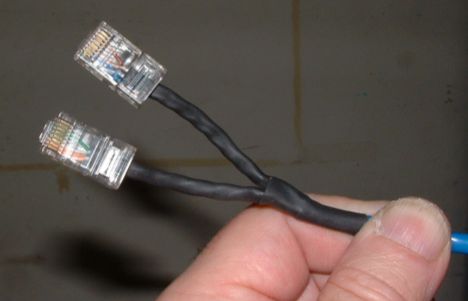
On the other end, I put a dual port RJ-45 jack-box
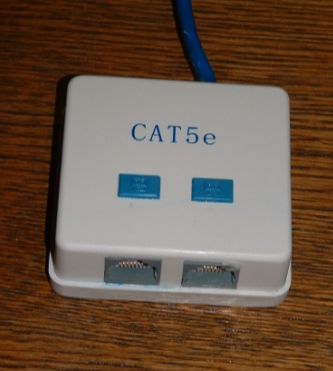
Just for the record, it was wired as follows.
CIRCUIT #1:
Jack & Plug Pin - - - - Wire Color
1.....................White & Orange
2.....................0range
3.....................White & Green
4.....................UNUSED
5.................... UNUSED
6.....................Green
7....................UNUSED
8....................UNUSED
CIRCUIT #2:
Jack & Plug Pin - - - - Wire Color
1.......................White & Blue
2 ......................Blue
3 .................. ...White & Brown
4 ......................UNUSED
5 ......................UNUSED
6 ......................Brown
7 ......................UNUSED
8 ......................UNUSED
> I ran some speed tests from a couple of websites, and the drop in
LAN speed between the gateway router and the end jack is negligible.
(For example, one test read 18.25mb/s at the router & 18.24 at the jack.)
There's only approximately 25 cable-feet between the router & jack.
Right now the jack-box is just "hanging" there at the end of the cable.
Once they decide exactly where they want to shove their credit card
machines (which should only take a few more weeks) I will find a
good place to screw it down permanently.
Posted by David Buckley (Member # 2600) on 12-19-2014, 11:57 PM:
Looks good to me, the plugs looked nicely crimped with the twists maintained.
You are spot on with your reasoning about why additional unnecessary active components in a hostile environment are a really bad idea.
Posted by Steve Guttag (Member # 268) on 12-20-2014, 07:10 AM:
I dunno, it doesn't look BICSI certified If Jim's happy, I'm good with it
Posted by David Buckley (Member # 2600) on 12-20-2014, 06:30 PM:
Not in any way certifiable, as there are no installation standards that cover that arragement! However, I suspect a Cat5 compliance tester might find it OK, other than what it will declare there to be missing pairs. But the pairs are optional anyway, there is still a world of Cat3 installed LAN cable that was two pair, not four. And two pair patch cable is fairly common, particularly in the boxes of DSL routers and the like.
I'm assuming the cable used was stranded not solid, as otherwise it would have been a bit hard to crimp the plugs on. But I am curious to see what is in the box, as its either a pair of punch-down sockets that are not designed for stranded wire, or breakouts to screw terminals, which have electrical issues.
But none of this detracts from the fact that it is in, works, and is likely to work for quite some time.
Posted by Mark Gulbrandsen (Member # 72) on 12-20-2014, 06:33 PM:
The heck with the ticket machines and network. Just go back to peeling tickets off a roll!
Mark
Powered by Infopop Corporation
UBB.classicTM
6.3.1.2