This is topic Cinemas - "not including tax." in forum Ground Level at Film-Tech Forum ARCHIVE.
To visit this topic, use this URL:
https://ft-forum.com/ft/cgi-bin/ubb/ultimatebb.cgi?ubb=get_topic;f=5;t=002930
Posted by Monte L Fullmer (Member # 2797) on 09-09-2015, 03:50 PM:
Is there any locations, especially the big box cinemas, now switching over to where they're charging tax on top of the item - both box and concessions - instead of adding the tax into the price?
Seems like a sneaky way to do a double hit: raise prices and having patrons pay the tax amount that the cinemas don't have to pay out of their pockets.
-Monte
Posted by Martin McCaffery (Member # 37) on 09-09-2015, 04:50 PM:
AMC does it here on their tickets, though they actually slashed the price of their tickets in July. I don't know what they do at the concessions stand. See the fine print here
Posted by Monte L Fullmer (Member # 2797) on 09-09-2015, 04:56 PM:
Heard that some AMC locations and others are slicing tix prices down to a reasonable level.
If the tax rate is 8.25% then the $5.99 tix price becomes a $6.50 ticket.
Just a sneaky way to charge the $6.50 tix price.
Posted by Martin McCaffery (Member # 37) on 09-09-2015, 09:04 PM:
Tax rate is 10% here.
Posted by Lyle Romer (Member # 1266) on 09-09-2015, 10:29 PM:
Around here at least, Regal has stopped making prices come out to even quarters. Tickets are prices like $8.94 including tax.
Posted by Justin Hamaker (Member # 2165) on 09-09-2015, 11:23 PM:
I'm curious to here about the experience of people who have worked for theatres that do it both ways. My feeling is adding the tax afterwards would slow the speed of service and result in more cash outages. It also creates an additional logistic issue by having to stock rolls of change other than quarters.
Posted by Scott Norwood (Member # 30) on 09-10-2015, 07:26 AM:
Agreed with Justin--pricing in "odd" increments will be annoying for the patrons and staff alike. If they do this for concession items, too, it will probably increase line lengths and decrease sales as a result.
As a patron, I have seen a couple of theatres that set prices in .50 increments and provide change in half-dollar coins. This sounds silly, but it is a way to make a memorable impression on customers. Same for giving change in $2 bills (do cash registers even have a slot for $2 bills?).
If the goal of this policy is to show customers how high tax rates really are, it would seem that a sign under the admission price sign saying something like "XX% tax included in above prices" would be sufficient.
Posted by Martin McCaffery (Member # 37) on 09-10-2015, 08:08 AM:
In addition to the odd ticket prices, there are so many levels of pricing at multiplexes now it is difficult to find out how much it will cost you to go. At the above mentioned AMC different movies cost different amounts, they all vary by time of day, sometimes there are kid and senior prices, then 3D charges and big screen charges. Plus tax. The competing Carmike doesn't have quite as many levels and includes the tax in the ticket price, charges more and, for many reasons, is stomping AMC.
Posted by Buck Wilson (Member # 5885) on 09-10-2015, 10:09 AM:
Regal and AMC have both stopped including tax in both concession and Box Office. It is stupid. I cannot understand the logic aside from being able to raise prices more quietly.(You still won't get it past the seniors!!) To be fair though, when we went through the switch at this Regal location, prices remained *roughly* the same, change just became odd one way or the other.
quote: Justin Hamaker
I'm curious to here about the experience of people who have worked for theatres that do it both ways. My feeling is adding the tax afterwards would slow the speed of service and result in more cash outages. It also creates an additional logistic issue by having to stock rolls of change other than quarters.
IT SUUUUUUUUUUUUUCKS.
District manager- "It will only add about 15 minutes total combined for all employees over the course of the day" AHHAHHAA HILARIOUS. I'd say that time is closer to two hours. Plus the cost of a professional coin counter, and the ongoing cost of coin rolls. Decreased accuracy. Increased transaction times.(Gotta love the look on a customers' face when you throw a pile of coin at them.) Plus an IMMENSE level of frustration. Why would you do that. Why would you make something simple infinitely more complicated. I truly have a hard time thinking of anything else cooperate could do that has an equivalent "Haha let's see them deal with this, I mean... we don't have to work on the floor, what do we care?" factor to it. WHAT IS THE REASON?!
Just another nail in the coffin that already looks like a busy street corner telephone pole. Just squeeze it in there somewhere....
Posted by Monte L Fullmer (Member # 2797) on 09-10-2015, 03:18 PM:
quote: Martin McCaffery
Tax rate is 10% here.
$6.59 .. still cheaper than some of the country for an adult ticket.
quote: Buck Wilson
Plus an IMMENSE level of frustration.
And the way kids can do math these days, being so used to their cellphones thinking for them...
Shoot, we put in a new Ast Mgr and this person struggles to count down the drawer to the assigned drawer bank and have to use a calculator to aid with the count, and right now we're just doing the quarter usage.
All of the Ast Mgr's are freaking out on the idea of using and counting the small change when that assigned day comes.
Talk about the complacency syndrome.
Posted by Justin Hamaker (Member # 2165) on 09-10-2015, 05:04 PM:
Monte
I feel your frustration on this one. But I teach every one of my employees how to count change, and never teach them how to have the register calculate it. And when I'm training managers I always teach them how to count drawers by counting up from smallest to largest. I can't say for certain they would all immediately grasp how to apply it with small change, but they have the skills already once they realize you're doing the same thing, just starting with smaller coins.
It is a struggle to teach them. I don't know if it's because they forget basic math once they start doing more complex or if they freeze up when they are dealing with actual money. But it seems to be a difficult concept for many teens to get down - especially those who have never had a job. But my staff gets complements almost every day for counting change, and I have had more than a few former employees tell me it made things so much easier for them in other jobs.
Posted by Mike Blakesley (Member # 26) on 09-10-2015, 05:52 PM:
quote: Justin Hamaker
It is a struggle to teach them. I don't know if it's because they forget basic math once they start doing more complex or if they freeze up when they are dealing with actual money.
Boy I hear that. We have our employees leave exactly $100 in the till drawer each night and turn the rest into the office, where it is counted up. It is AMAZING how they so frequently are a dollar short, or 50 cents over, or whatever. I would say about 2 out of 7 days, on the average, they're right-on. It drives me crazy.
Posted by David Buckley (Member # 2600) on 09-10-2015, 08:54 PM:
I find this all quite entertaining. I've not paid cash for a movie ticket or concessions now probably in over a decade. A survey last week found over 50% of people had no money on them at all.
Has paywave not hit you guys yet? Paywave is gaining popularity here in NZ and I believe also in the UK, from something I read last week. Transactions up to $85 NZD don't need a pin, just wave the plastic at the reader.
The other thing I'd note is that last time I holidayed in a US territory, most volume tills had automated change dispensers, I'm surprised you cash-heavy folks aren't using them, I'd be certain its quicker than a just-out-of-school-minimum-wager at counting out the coins.
Posted by James Wyrembelski (Member # 9037) on 09-10-2015, 10:30 PM:
That's exactly what we do at the restaurant after closing. Count the drawer down to 100, then count the rest and match it to "cash due" according to the POS. Now, of course we're dealing with all types of change. I think during rush hours or stressful periods people tend to "lock up" or get stage fright essentially when confronted with actually having to do math in one's head. It's rare we're ever spot on. Usually a dollar under or over.....
Having even change would be fantastic....especially when everyone at a table of 20 comes up and wants each bill separate...all cash...and pay at the same time while everyone at the bar is trying to get your attention.......
Posted by Andrew Thomas (Member # 7000) on 09-10-2015, 10:56 PM:
I'm guessing what has happened is that the big chains have hit a point where the card vs. cash sales have skewed heavily enough to cards that they will deal with the slight head ache of slower transactions on the cash sales.
My theater is still skewed 60:40 towards cash though.
Posted by Frank Cox (Member # 6258) on 09-11-2015, 01:24 AM:
I don't accept cards at my theatre. At all. Cash only.
That saves me a ton of money on bank charges and transaction fees. There is a bank with a 24 hour machine a half-block down the street from here, so if anyone shows up without any cash they don't have to go far to get some.
I "lose" maybe two people a year who say they're going to get some cash and then fall into a black hole or a time warp somewhere between here and there. But that's a much smaller loss than the cost of taking cards would add up to over the course of a year.
Everyone here knows that they have to bring cash to come to the show and they do. Maybe someday I'll be forced to start accepting cards but that time has not yet arrived.
Posted by Jim Cassedy (Member # 4115) on 09-11-2015, 12:16 PM:
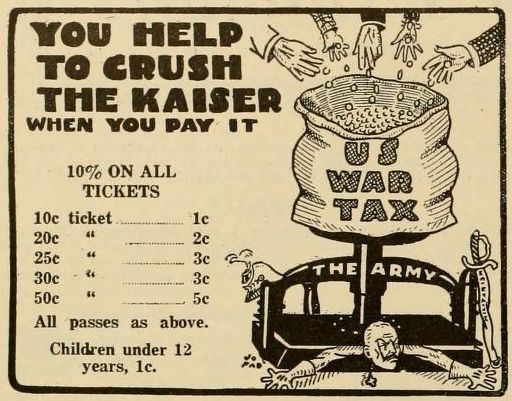
Just as a historical perspective, during WWI a 10%
"war tax" was added to all movie & live theater tickets.
Here's a couple of old movie tix from my collection:
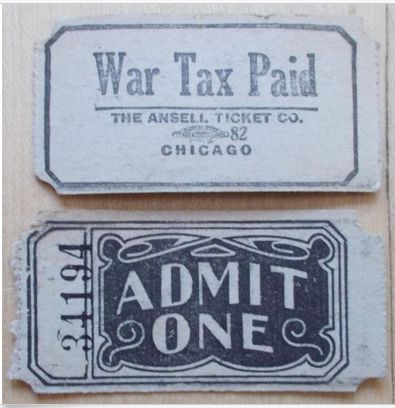
"Funding Wars Through Entertainment"
What a novel idea! ![[Roll Eyes]](rolleyes.gif)
Posted by Martin McCaffery (Member # 37) on 09-11-2015, 12:20 PM:
And that was on top of local taxes. Sometimes the tix tax could be over 20%. I've run across stories of theatres closing down rather than pay the entertainment taxes. They actually have it pretty good now, comparatively.
Posted by Rusty Gordon (Member # 2210) on 09-11-2015, 01:18 PM:
NOT taking credit cards is the most short-sighted thing any theatre owner is doing. People paying with plastic SPEND MORE. They tend to buy LARGER SIZES and BUY MORE ITEMS than those who pay with cash. Those who don't are stepping over dollars to get to the dimes and if you think otherwise, you're fooling yourself. Ask yourself why every large theatre chain accepts plastic and then ask yourself why you think you're smarter than them. When your customers are walking the half a block to the ATM machine they are cursing you and planning their next movie outing at your competitor.
http://www.forbes.com/sites/tjmccue/2013/08/16/why-dont-more-small-businesses-accept-credit-cards/
Posted by Justin Hamaker (Member # 2165) on 09-11-2015, 04:15 PM:
Rusty, my company started taking credit cards about 3.5 years ago. What I've found is that most customers are not spending much differently than when we were cash only. In fact, many of our biggest spenders are cash customers. I've also found that close to 50% of our credit card customers are actually using debit cards, which they are more likely to use as cash.
Prior to accepting credit cards we had a cashless ATM machine which might get 50 transactions in a day on our busiest days.
The main reason we waited so long to start taking cards was because of the expensive fees. It was only when the Vantif program was set up that it became more practical. As I said, we didn't see any significant jump in our per capita when we started taking cards, and it's only now that we are getting close to 30-35% of transactions being CC.
Posted by David Buckley (Member # 2600) on 09-11-2015, 05:34 PM:
Yes, the problem with the big brand name plastic is the "discount" applied, but its just a cost of doing business.
NZ story: Although big brand plastic and paywave is widely used here, the New Zealand EFTPOS system is unique. It works just like a debit card. It was introduced in 1985 to get rid of cheques, in which it succeeded; cheques are no longer used in a shopping context, no shop will accept them. So, like cheques there was no transaction fee, just a monthly admin fee. What the bankers and EFTPOS networks hadn't anticipated was that EFTPOS would not just replace cheques, but replaced cash as well.
Heck, even Saturday flea market sellers have a terminal.
Of course, the bankers and networks are now pushing paywave, a big name plastic, rather than EFTPOS, as there are per transaction fees with big brand plastic...
Posted by Sam Graham (Member # 2889) on 09-11-2015, 07:06 PM:
Definitely seeing this at AMC. As broken down on a ticket 8/8:
ADMISSION: $5.13
TAX: $.34
Cinemark isn't breaking it down, but they are selling tickets for oddball amounts. $5.90 for early bird shows, $8.40 for evening, etc locally.
(Yes, that's cheap. It's an old slope Movies 12.)
I'm on board with Buck. But I suppose as we become an increasingly cashless society and people blindly throw plastic or NFC phones at everything without even knowing how much they're paying until they get their monthly statement, it's really a short-term problem. And by "problem", I mean that it seems low-wage cashiers at all retail levels seem to be getting worse and worse at counting correct change, even when a cash register is showing them how much to dispense.
I would be interested in knowing the real thought behind this, though.
Posted by Scott Norwood (Member # 30) on 09-11-2015, 07:13 PM:
quote: Rusty Gordon
People paying with plastic SPEND MORE.
Isn't that just because people tend to use cash for small purchases and credit cards for large ones? I wouldn't consider charging a $4 bucket of popcorn, but it might make sense to use plastic if I were buying a dozen of them for a group of people. The amount of my average credit card transaction would be higher than the amount of my average cash transaction, but only because I use each form of payment for a different purpose.
As a consumer, one of my pet peeves is standing in line behind people who buy small items (e.g. a $1.79 quart of milk) with credit cards or (ack!) checks. I know that there are credit card machines that work quickly, but not every store has these. In most cases, a credit transaction like that takes twice as long as an equivalent cash transaction. As for checks, I don't think that I have ever used one in a retail store. For me, their only function is for sending money through the mail (e.g. paying bills). Do people really write checks for movie tickets? And do theatres accept them?
Posted by Martin McCaffery (Member # 37) on 09-11-2015, 09:44 PM:
Scott: Yes they write them, and yes we accept them. Though since we started taking credit cards, they write far fewer checks. I don't think anyone under the age of 50 writes checks to us anymore. Maybe it will become retro and the hipsters will start!
And you want annoying? People who come to the $1 kids shows and buy one $1 ticket with credit, then go to to concession stand and want to buy a 50¢ popcorn with the credit card. (we have 50¢ kids sizes at the kids shows).
Posted by Mike Blakesley (Member # 26) on 09-12-2015, 12:16 AM:
We take cards and about 40% of our sales is on cards. Our system is nice and fast (RTS / Vantiv) -- it usually takes 3 or 4 seconds, tops for a transaction to go thru.
The thing I've noticed about credit cards, both at the theatre and at the parts store, is people don't seem to get "sticker shock" when they use a card. If they're paying cash and I say "That's $43.50," Dad will often say "Jeezus!" as he's handing over the bills. But I don't think I've ever heard anybody exclaim like that when using a card. I think it's just not "really" money to them.
Posted by Jack Ondracek (Member # 1466) on 09-12-2015, 12:34 AM:
quote: Justin Hamaker
I've found is that most customers are not spending much differently than when we were cash only. In fact, many of our biggest spenders are cash customers.
Two different worlds. Most of our largest sales are on plastic, and we're well over 50% now.
We're RTS / Mercury, & our plastic transactions are easily as fast as anything that requires change. I thought my way into a bit of a panic over our internet connection. If we lose it over the weekend, we're cooked. Now looking for a wireless alternative for emergency use.
On kids and change: We don't allow our staff to use the RTS terminals for changemaking... don't even talk about how to do it. Anyone who does cashier duties here learns to count change the old fashioned way or they don't work the registers. For those who want to be scheduled at that position, that's motivation enough to learn how to count money or be satisfied with other job functions here.
BTW... there's a method to that madness. Counting change yourself forces you to do it twice (once to you and once to the customer). That nearly assures your numbers will be right at the end of the shift. Once the kids realize that, they buy into the concept pretty quickly.
Posted by Frank Cox (Member # 6258) on 09-12-2015, 12:49 AM:
You can purchase routers that automatically switch to wireless service if the wired service disappears. I have used Cradlepoint brand routers that can do this and it's slick as all hell.
Just get a wireless (cellular) modem from your friendly local telephone company, plug that into the router and hook it up to your standard wired modem as well. Now when the wired connection drops, you're automatically on the cellular service until it comes back. Totally transparent to the end user.
Posted by Lyle Romer (Member # 1266) on 09-12-2015, 05:55 AM:
quote: Scott Norwood
As a consumer, one of my pet peeves is standing in line behind people who buy small items (e.g. a $1.79 quart of milk) with credit cards or (ack!) checks. I know that there are credit card machines that work quickly, but not every store has these. In most cases, a credit transaction like that takes twice as long as an equivalent cash transaction. As for checks, I don't think that I have ever used one in a retail store. For me, their only function is for sending money through the mail (e.g. paying bills). Do people really write checks for movie tickets? And do theatres accept them?
I 100% agree about checks. Every checking account gives you a debit card. Why not use that?
As for using credit cards for small transactions, I'm one of "those people." I use credit cards for all spending possible to build up reward points. The one $1.79 transaction may not be much but 100 of them add up over time. I also hate using cash and getting coins as change.
Also, that $1.79 transaction is a lot slower with cash when you get a person that digs out the 79 cents from their change purse. That takes MUCH longer than a credit card transaction.
Posted by Jim Cassedy (Member # 4115) on 09-12-2015, 10:34 AM:
quote: Rusty Gordon
NOT taking credit cards is the most short-sighted thing any theatre owner is doing.
I respectfully disagree.
I think it all comes down to "knowing your market" and your customers.
For example, I'm aware of a couple of theaters here in SF, whose clientele
are primarily senior citizens, who rarely use credit cards, and who are
completely befuddled by ATM machines. These older folks very much operate
on a "cash only" basis, and are more likely to call the theater for show times
than to look them up on a website.
As the theaters I have in mind operate on a narrow profit margin, installing
credit card readers and paying transaction fees just wouldn't make sense
for the theaters in question.
Yes, some non-regular customers are surprised a the "cash only" policy,
and if they don't have enough money on them, they are referred to an ATM
at a convenience store a few doors down the street from the theater, which,
just coincidentally, has one of the lowest 'transaction fees' in San Francisco.
I don't think they've lost any business due to their 'cash only' policy.
I'll admit situations like this are 'exceptions to the rule' but you can't
make a blanket statement that not accepting credit cards is a short sighted
or stupid policy. It all depends on your market and your customer base.
Posted by Buck Wilson (Member # 5885) on 09-12-2015, 01:21 PM:
quote: Sam Graham
Cinemark isn't breaking it down, but they are selling tickets for oddball amounts. $5.90 for early bird shows, $8.40 for evening, etc locally.
(Yes, that's cheap. It's an old slope Movies 12.)
Cinemark baffles me how cheap their prices can be. The (VERY nice, stadium, well maintained) Cinemark Palace on the Plaza smack dab in a very nice kinda ritzy even shopping center in Kansas City MO only charges $6.90 for adult evening weekend tickets. Matinee, child, senior is $4.40. The absolute most expensive ticket I can find at that theater is a $10.15 VIP(reserved seating) adult evening weekend... which is STILL cheaper than an most theaters standard adult ticket. Tickets are as low as $3.90 on Mondays for seniors. Yes, this is a first run theater. A very nice one. One of my favorites. Even the concessions are noticeably cheaper than most.
Posted by Monte L Fullmer (Member # 2797) on 09-12-2015, 04:28 PM:
quote: Jim Cassedy
I think it all comes down to "knowing your market" and your customers.
True, it's about the market.
Over here, more senior citizens loves their plastic being so much easier to handle than fiddling with the cash.
Our matinees are mainly the senior citizen group that attend and on a breakdown of attendance against total amount and cash in the drawer, we're well over 60% on card sales.
We can have insane per caps during the week and very good per caps for the weekends.
-Monte
Posted by Martin Brooks (Member # 1269) on 10-03-2015, 11:30 PM:
Note that with the new credit card readers for credit cards that have chips, the transactions actually take longer because instead of swiping, you have to leave the credit card in the reader until the transaction is complete.
It will also be even slower until people get used to using them.
Those new credit card readers are now required by the credit card companies. If you don't use them, you could be responsible for any fraud. I think that was effective as of 10/1.
There has been extensive research that shows (at least in the U.S.) that people spend more across the board when they use a credit (or even a debit) card. There's also been some initial research that claims the faster the transaction time, the more people are willing to spend. Apparently, people using smartphones to pay are spending more than those with credit cards. I guess psychologically, it doesn't feel like one is spending money when you can just pass the phone or some other NFC device in front.
It's true that some older people have trouble with ATMs and the like, although I find this astonishing considering that ATMs have been around since about 1973. In my apartment building, they put smart card readers on the washing machines and dryers. It's very simple - you just stick the card in and press the Start button, but many of the very elderly people freaked out - there were even training sessions. They were concerned I wasn't going - I said, "it's not rocket science. Just stick the card in and press the button." Most of these people still drive - that scares me.
I'm really surprised that you have cash registers that don't calculate the change. I haven't seen a cashier not use that function in many years - I think the retailers make them use it even on simple transactions. Most cashiers cannot do basic arithmetic and don't know how to "count up". If for example, the transaction is $20.57 and I give them $21.07, I always get funny looks until they run it and see that they have to give me 50 cents back. (Except in the Korean market - they know how to make change.)
In a movie theater, I usually skip the cashier and go right to the machine if there's no up-charge.
In NYC, every theatre I've been to still advertises the price including tax. I think most do that for concessions as well.
Posted by Pravin Ratnam (Member # 1417) on 10-07-2015, 03:33 PM:
I went to a Regal theater yesterday. Two dollar popcorn night. I handed them two dollars. They said it would be 14 cent tax. I took my two dollars back and gave them a credit card. I am not taking 86 cents back in change to put in my wallet.
This change in making tax separate for the Regals must have been in recent months as I do not remember doing this for a long time.
Posted by Mike Blakesley (Member # 26) on 10-07-2015, 05:40 PM:
quote: Martin Brooks
I'm really surprised that you have cash registers that don't calculate the change. I haven't seen a cashier not use that function in many years - I think the retailers make them use it even on simple transactions. Most cashiers cannot do basic arithmetic and don't know how to "count up"
They CAN do basic arithmetic, they just have to be taught how to do it. We have the "change" function on our POS system but we don't include that in our training at all -- we make them count the change back. (Whether they all do it 100% of the time I can't say, but it's a "must do" in our employee manual.)
Posted by Mike Frese (Member # 4361) on 10-12-2015, 07:15 PM:
You should be taking credit cards for the reasons already mentioned.
I know of many people including myself who avoid cash only businesses even it you have an ATM in the lobby.
It is costing you money not accepting them.
Posted by Monte L Fullmer (Member # 2797) on 10-13-2015, 04:32 AM:
The hidden sting on credit card acceptance is the fees charged..something like 2.5 to 3.5 percent for each credit transaction, whereas the debit card charge is like 50 cents.
AmEx is horrible at this - like almost 9 percent that AmEx charges.
Posted by Mike Blakesley (Member # 26) on 10-13-2015, 07:57 PM:
If you get in on the NATO/Vantiv deal the charge is less than 2%, I think.
Posted by Andrew Thomas (Member # 7000) on 10-18-2015, 02:43 PM:
quote: Monte L Fullmer
AmEx is horrible at this - like almost 9 percent that AmEx charges.
Not even close. AMEX is usually in the 3% range. Most expensive is actually Visa Signature.
Posted by David Buckley (Member # 2600) on 10-18-2015, 07:18 PM:
quote: Andrew Thomas
AMEX is usually in the 3% range
The discount rate depends on what the upstream thinks of you and how good you are at negotiating. Or, perhaps more honestly, what you have to negotiate with.
In my opinion, 3% is a tad low for Amex, 9% is unusually high, but neither number is unreasonable.
Posted by Andrew Thomas (Member # 7000) on 10-19-2015, 02:47 PM:
quote: David Buckley
The discount rate depends on what the upstream thinks of you and how good you are at negotiating. Or, perhaps more honestly, what you have to negotiate with.
In my opinion, 3% is a tad low for Amex, 9% is unusually high, but neither number is unreasonable.
I've never had a merchant services vendor with a total AMEX rate higher than 3.25%. Ever. I own 3 businesses and have previously managed two others. I'm pretty sure the base AMEX rate is around 3.5%, so you can get that without even trying.
Or maybe that is just in the U.S.?
Posted by David Buckley (Member # 2600) on 10-19-2015, 03:33 PM:
quote: Andrew Thomas
Or maybe that is just in the U.S.?
Maybe. I've never worked directly with Amex in the USA, so it is possible they treat Europe and Pacific-ville differently, but I've done online work with US based businesses, albeit online, and they didn't get anything like 3.4%.
Visa and MC rates are pretty universal across the (civilised!) world, so it would be odd why Amex aren't, especially given that Amex are much more international than Visa / MC due to there being less parties in the chain. I've changed countries a few times with Amex ("member since 94"), but I can't do that with Visa/MC!
Powered by Infopop Corporation
UBB.classicTM
6.3.1.2