This is topic Have you ever had the public object to a proposed theater? in forum Ground Level at Film-Tech Forum ARCHIVE.
To visit this topic, use this URL:
https://ft-forum.com/ft/cgi-bin/ubb/ultimatebb.cgi?ubb=get_topic;f=5;t=002934
Posted by Jesse Skeen (Member # 586) on 09-15-2015, 03:27 AM:
This is kind of a weird one, but interested if I can get any answers- has anyone here ever been in or heard of a situation where the floor plans of a proposed new theater are submitted for public view, and one or more members of the public disapprove of the theater's design and try to get it changed or stopped completely? If so, how was it handled? Were those people ignored and hoped they'd go away? Were they reassured that the resulting theater would be great, and offered a tour and screening prior to opening? Told "If you don't like it, don't come"?
I remember seeing the plans for a theater that was eventually built by a company I worked for at the time- it was SUCH a bad idea (and the resulting theater truly is terrible)- I took one look at the plans and wanted to say "Don't do it!" but didn't for fear of losing my job. Now that I'm out of the business, I can speak my mind a little more freely about such things.
Posted by Buck Wilson (Member # 5885) on 09-15-2015, 06:06 AM:
Apparently plans by AMC in the late 90's to expand an existing 6 screen theater in Overland Park KS got nixed due to neighborhood opposition. More details- http://cinematreasures.org/theaters/17487
Posted by Scott Norwood (Member # 30) on 09-15-2015, 06:31 AM:
The AMC Hampton Towne Center 24 in Hampton, VA. was mistakenly granted a building permit, as it was (is) located in a designated "crash zone" for Langley AFB. This was not discovered until after construction had begun. I believe that the deal with the city that was reached was that it could not be re-built if it were destroyed by a plane crash. This is not very re-assuring.
The issue is not quite the same as what was raised above, but there was some objection to completing construction and opening the theatre once this issue was discovered.
Edit: see article here and here
Posted by Mitchell Dvoskin (Member # 751) on 09-15-2015, 08:50 AM:
Neighborhood opposition happens all the time to proposed businesses. The issue is usually over building location, size, parking, noise, traffic, etc. I have never heard of public opposition to the interior design of a business.
Posted by Martin McCaffery (Member # 37) on 09-15-2015, 08:54 AM:
RE: AMC Hampton - How difficult was if for them to get insurance?
Posted by Scott Norwood (Member # 30) on 09-15-2015, 10:07 AM:
No idea. I was living in the area at the time and was amused by the story. I wonder if the insurance company even knew; the area was re-zoned as part of the deal with the city.
Posted by Bobby Henderson (Member # 840) on 09-15-2015, 10:36 AM:
As someone with both knowledge of design and movie theater nuts and bolts I have to say unequivocally it is only an extremely stupid idea to let members of the public armchair quarterback how the interior of a movie theater is designed.
First of all, a lot of people who have little appreciation for art & design, yet think it's something anyone can do really need to stop. They have no business dictating the interior design of a movie theater. They don't have the creative talent. More importantly, they don't have the first clue how to arrange the functional elements of the theater, much less understand how and where the embellishments should be applied.
When it comes to the theater auditoriums themselves members of the public (or more likely a city council) should only have a simple list of things they want or don't want in an auditorium. IMAX house? Surround sound? Stadium seating? Stuff like that. If things get any more specific than that you'll get into some geometric conundrums -shit that just won't fit.
It's usually best for the public or city council to be able to say yes or no about a movie theater project. They shouldn't be able to dictate all sorts of odds and ends that go into it. That kind of bureaucratic hurdle slows things to a crawl and often derails big projects.
Posted by Scott Norwood (Member # 30) on 09-15-2015, 12:28 PM:
Agreed with Bobby. The only valid public concern for the interior would seem to be with issues like fire safety (non-flammable materials, sufficient number of exits for capacity of venue, etc.), code compliance (eletrical, plumbing, etc.), and structural integrity (the building should be built well enough to not collapse on patrons or bystanders). The general public has little or no knowledge of these issues, and there should be public employees (fire marshal, electrical inspector, plumbing inspector, etc.) whose job it is to review building plans and protect the public from shoddy construction. Unless someone in the general public can demonstrate that he is qualified in the area on which he wishes to comment, I cannot think of any reason to accept public comments on interior issues.
I can see where the general public should have a chance to express concerns about location, exterior design, and traffic/pedestrian safety, however.
Note that I am talking about new construction of private buildings here. Public buildings (city halls, courthouses, etc.) are a different issue, as are historic structures and other special cases.
Posted by Bobby Henderson (Member # 840) on 09-15-2015, 01:44 PM:
I don't think the general public should have any input on the exterior design of a building. There isn't very many architects, artists, urban planners, traffic engineers and sign designers in the peanut gallery. As long as the exterior and project site meets zoning requirements and any sign ordinance requirements then it should be all good.
Big theater chains already have corporate identities and sign programs to follow. Those programs keep things looking more consistent, organized and professional. If more cooks are allowed into the kitchen everything goes to disorganized shit very quickly. It would be ridiculous to let some local idiot what font should be used for the channel letters on the building. Even if it is an independent theater the average person doesn't know about size and material limitations that can change just from a simple choice of typeface.
Local governments have to tread carefully in the area of trying to legislate taste. The City of Tempe, AZ lost a very expensive law suit from Blockbuster Video and Video Giant when its city council tried dictating the color of their signs. Blockbuster sued over trademark infringement and won the case.
Posted by Sam Graham (Member # 2889) on 09-15-2015, 01:45 PM:
It would not surprise me if there were objections out there relating to handicap access.
In the early days of stadium seating, there were some really ridiculous designs out there. Cinemark, for example, in some of their really big Tinseltown auditoriums, had the handicap row up front where one would have to look STRAIGHT UP to see the screen, and the view was atrocious. Even sitting in the second row of these rooms required climbing stairs.
Such situations and even far lesser examples led to lawsuits by the ADA. It would not surprise me if the ADA later filed objections on new building proposals to ensure the design had improved access.
Posted by Leo Enticknap (Member # 534) on 09-15-2015, 03:11 PM:
quote: Bobby Henderson
I don't think the general public should have any input on the exterior design of a building. There isn't very many architects, artists, urban planners, traffic engineers and sign designers in the peanut gallery. As long as the exterior and project site meets zoning requirements and any sign ordinance requirements then it should be all good.
That is how the public has an input into the exterior design of buildings: by electing the politicians who determine the zoning and sign requirements. I agree completely that individual complainers should not be treated like Prince Charles whenever anyone comes along with a NIMBY-motivated meow and hiss. But basic principles and guidelines to prevent unregulated sprawl probably are needed.
Getting back to topic, at one theater I worked at from its opening in 2000 until I left the following year, we faced an organized campaign from local residents against late night shows, because they feared drunken yobs roaming the streets, etc. Given that (a) we showed mainly arthouse movies, (b) there was a first run place only 300 yards away that already did late-night shows of mainstream movies, and (c) about the same distance in the other direction was a nightclub that opened until 3am, the patrons of which were lucky to leave in the direction of their homes rather than the hospital, it was all a bit silly. Nevertheless, for the first six months or so we were open, there was a condition on our license stating that the last show had to be over by 11pm. One Saturday evening that was 11.03, thanks to a box office computer crassh delaying the start of the final show. Two nearby residents complained to the council.
Posted by Jesse Skeen (Member # 586) on 09-16-2015, 01:24 AM:
OK, now what about people who say your proposed theater truly SUCKS? I'm in a local battle now with a big chain that is planning to tear down an iconic theater that has been here since the 1960s (they have already torn down part of it) and replace it with a new theater that has LESS than HALF the seating capacity of the old ones. I consider this an insult to what the old theater was when it was new- it was chopped up in the 70s though and personally I'd rather see that one torn down than continue to operate that way, but they should be going all-out with this new theater and it seems severely undersized without anything special about it. I have told these people at public meetings that I worked in the theater business for ten years, including a few months at the theater slated to be torn down, and feel that their new theater is simply inadequate, but they have had literally nothing to say in response. (I emphasized to them that I am also the sort of person who SHOULD be going to a movie at least once per week, and would if there were any theater here worthy of my doing so. These old theaters properly restored would certainly have fit my criteria, but I would settle for a really good new theater in their place as well which the one they have planned is not.) I've been working with others in town who want to save the older theater more than anything else, although that likely isn't too practical at this point.
In the case of the company I worked for, it was a much smaller one in a smaller town. They had run a six-screen theater for about ten years and built a new one with five screens a few blocks from it ten years later, keeping both open as they still are today. The six-screener was a bit cramped, with theater sizes ranging from small-smaller-smallest, but considering what that town had before it was a godsend. The owner was afraid of competition coming in, so I suspect this newer theater was his way of discouraging that- what I objected about that was that first it only had five screens, at a time when other companies were opening 16-screen theaters. Second was that these five screens weren't even any GOOD- the floor plans showed that each auditorium would have FEWER seats than even the smallest ones at the older theater. Even more insulting was that they decided to make all the screens common-width with top-down masking for scope. I felt this was a REALLY bad idea, and it was eventually one of the reasons I left that company. I saw plenty of movies there when it opened, and the screens in fact are embarrassingly small, and when popular movies are shown there it does get quite crowded due to the small capacity.
For the present proposed theater, I got the attention of the local news and I agreed to go on: https://www.youtube.com/watch?v=Z8a3gbvwLZY
To put that clip in context, I had not even yet seen the floor plans for the new theater, but was concerned enough just seeing how much (or more appropriately how little) space on the property it would take up to start making some noise about it. (The announcer incorrectly states that I was once a projector operator at the older theater, but I only worked on floor staff for a few months there. The editing left a bit to be desired, but I was glad that they at least showed me stating that the new theater being built is generic in comparison.)
Now again, I personally am NOT opposed to them building a new theater, but I do think what they're planning is severely inadequate and an insult to the old theater it will be replacing. They could have gone all-out and built something comparable to the older ones up to modern standards, but this seems just quick and easy with nothing special about it at all. I know some will quickly say that large theaters are "no longer profitable" but the seating capacity for this new theater comes out to LESS THAN 200 seats per screen, making even the 6-screener I worked at for many years seem gargantuan in comparison! The largest remaining auditoriums at the old theater are about 500 seats and those consistently sold out for the big movies, I am betting that if this new theater opens people are going to go there and find shows have sold out quickly and end up leaving in frustration. There is also another new theater being built within a few miles of this one which based on the company behind it will probably be better-designed in this one. That same company is also re-opening a big 1930s theater in a nearby small town, keeping its original large auditorium intact with smaller theaters build alongside it. If that comes out well, THAT may be the place I end up going to movies for from now on.
Regardless of how this new theater turns out I will give it a fair shot when it opens, but from everything I've seen so far it'll be a miracle if it turns out to be anything more than adequate.
Bonus clip of part of the old theater being destroyed- it was originally two buildings like this, the one already torn down was the oldest. https://www.youtube.com/watch?v=61INjYBpDOs
Posted by Jesse Skeen (Member # 586) on 09-16-2015, 03:27 AM:
(Can't edit my post now but I meant to say the other new theater will "probably be better designed THAN this one", not "IN this one.")
Posted by Bobby Henderson (Member # 840) on 09-16-2015, 08:41 AM:
It's difficult for me to get excited about a new theater opening anymore. There are so many things that are wrong with the design of modern movie theaters and it starts with the goofed up specs of d-cinema itself. The situation makes it very easy to just stay home and watch there.
We all know common width screens suck. But d-cinema's goofed up take on CinemaScope™ gives that cropped fake-scope image the kind of screen real estate it deserves: letter-boxed and tiny. The smallest, lowest resolution format doesn't need to be blasted up huge. But let's be sure to go J.J. Abrams crazy with all the lens flares and anamorphic bokeh. It's a bunch of pretentious bullshit.
![[fu]](graemlins/fu.gif)
Nevertheless common width screens do suck. They remind me I could be watching the very same kind of letter-boxed image at home for a whole lot less money (and it would probably be more in focus too).
It's rare to find a movie theater that sounds as good as it should. I'm convinced the combination of stadium seating and the habit of theater chain executives buying tiny, under-powered surround speakers has a lot to do with it. This doesn't get into what kinds of systems they're putting behind the screen.
"Immersive sound" could have been turned into a major improvement for movie-going. Instead it's kind of being allowed to turn into a scam. A theater could stick some logo up on the marquee, claiming to support Dolby Atmos, DTS-X or whatever. But is there any way for a customer to check just how many amplifiers and what not the theater has, just to see if they're getting something more than just a slightly spruced up version of 5.1 surround? Nope. There are no standards to control just what gets installed. In the end this will be another area where home theater will end up beating the cinema.
The success of fake large format screens seems to be a statement about the gullibility of the general public and how they're only too happy to fork over extra money just to worship a brand name.
Even really high end installations, like Dolby Cinema, are marred by things like fake scope on a common width screen.
We have a new Carmike theater opening here in Lawton, probably around November. I'm not very excited about it at all. The "IMAX" screen there will almost certainly be of the old HDTV quality 2K variety. The other screens will probably be okay, but I kind of expect the sound and projector brightness to be toned down a bit, that way the IMAX house will seem so much better when it really isn't.
Posted by Frank Cox (Member # 6258) on 09-16-2015, 05:41 PM:
I think that if I was building a new theatre that met the applicable regulations (fire, zoning, etc.) and someone came along to tell me that he doesn't like the design I would be inclined to tell that someone to mind his own business. Same as someone coming into my theatre right now and telling me that I'm doing it wrong. If I didn't solicit that person's advice, and if that person isn't satisfied with an "I prefer to do it this way" response, well... there are other theatres that he can go to. If he did have a good idea, then I might implement it. But there's a big difference between a suggestion or a request, and a demand. Guess which one will get a more positive consideration and response?
What it comes down to is that if you feel that you can do a better job than the other guys are doing, then by all means write a cheque and set up your own theatre and operate it your way.
It's their money, their business and their risk to take. If they set it up and it fails, then yes indeed -- they may have done it wrong, but it's still their failure and not yours. I understand that it fails to meet your personal standards but if they think it is adequate for their customer base then that's their call to make.
There was no theatre in this town for fifteen years before I came along and made this one. Shortly before I opened it, I happened to meet the guy who owned the previous theatre. He said, "Are you the guy who's setting up a theatre?" I said that I was, and he said, "You'll be out of business in two months."
Thanks for the ray of sunshine, guy. I'm still here, twenty years later. ![[Smile]](smile.gif)
That guy's wife used to come to the show here once in a while but he never set foot in the door, ever.
Posted by Mike Blakesley (Member # 26) on 09-16-2015, 07:20 PM:
quote: Frank Cox
he said, "You'll be out of business in two months."
Thanks for the ray of sunshine, guy. I'm still here, twenty years later.
There will always be nay-sayers. I tune 'em out. I can't think of even one incident regarding my theater where somebody told me I shouldn't do something, and then I went ahead and did it anyway and found out they were right.
It's amazing how many experts there are on just about everything.
Posted by Jesse Skeen (Member # 586) on 09-16-2015, 10:19 PM:
Well, you do get feedback from people who are genuinely crazy (asking things like keeping the sound turned way down and the house lights always up, and rewinding the movie whenever anyone asks) but I consider myself at least a bit more knowledgeable than "the average customer". Problem is that I strongly feel the business is heading in the wrong direction, and I KNOW that most higher-ups in the business do NOT like to be told that ANYTHING they do or think is wrong, even when it obviously is. I'm sure most here can agree that designing any new theater with common-width screens is WRONG for example.
I'd like to share the text of the petition that a friend and I came up with, which can be found at: https://www.change.org/p/sywest-development-cinemark-theatres-the-edwards-company-preserve-the-legacy-of-the-century-th eatres
I actually did not expect much to come from this, it was more from the prodding of other more than anything else. The number of signatures is not spectacular but not miniscule either, and it has attracted the attention of the local newspaper as well as the NPR station, a small neighborhood newspaper, and KOVR TV's news.
This is the "main text" for visitors to the petition:
quote:
We invite you to join the many residents of the Sacramento region in
favor of preserving these historically significant venues. We believe the 3 remaining domes should be saved and incorporated into this new development proposal at this Arden-Arcade section.
HISTORY:
The Century 21, with a huge 70-foot curved screen and over 900 seats under a unique dome-shaped ceiling, equipped with 70mm film projection and the latest sound technology, opened in November 1967. Its sister theater Century 22 opened soon afterwards in June 1968. Both showcased Hollywood's biggest movies and were the area's premiere movie venues. They were designed with a space-age theme by architect Vincent Raney, who had already designed several similar theaters in San Jose (originally designed for 3-projector Cinerama), Pleasant Hill, Reno, and Salt Lake City among others. It eventually had two smaller 500-seat dome theaters attached to it, but by 1978 both large domes were split with walls down the middle into awkward half-dome theaters.
RECENT DEMOLITION AND CURRENT PLANS:
Movie fans in Sacramento have hoped for years that the Centurys would someday be restored back to their original glory. Part of that hope was killed on June 2nd, 2015 when Century 21 was demolished. The landowners plan on demolishing the rest of the Century Theatre complex soon, and replacing it with a newly-built theater and other retail buildings. It has been said that efforts were made to restore the old theatres, but were in such poor condition that it was impractical to do so. However, the new theatre planned for the site appears to be nothing special at all and hardly a suitable replacement for the Century domes. Plans from The Edwards Company show it as having a total of 14 screens, but the entire building will occupy LESS space than the current 12-screen Century 22 complex and have only 1650 seats altogether which is an average of less than 120 seats per auditorium! The magnificent Century 21 and 22 domes originally had more than 900 seats each, with the two smaller domes having about 500 each. Based on other recently-built theaters such as the Century Greenback 16 (which replaced the 1980s Cinedomes), these will likely be small, cramped theaters with screens hardly much larger than what many people have at home! It is also very likely that they will not endure for more than 20 years, nor be the source of fond memories for anyone.
The original large Century Theatres introduced many people to the magic of moviegoing- for me personally, they have always been the standard by which I have judged other theaters although very few have lived up to that standard. With home theatre equipment constantly improving and becoming more affordable, consumers expect and deserve something SPECIAL when going out to see a movie. Unfortunately the majority of newer theatres are an embarrassment. Many are designed with common-width screens, meaning Cinemascope movies appear letterboxed as they do at home, rather than on screens made for their full width. (A common criticism has been that "Die Hard" should never be smaller than "Driving Miss Daisy"!) While ideally the Century 22 could be restored to its original glory with any needed additional theatres attached to it, if that is not possible any new theater that replaces it should go all-out to meet or exceed the original theatres' grandeur. Small cracker-box theatres would be an absolute insult to the Century domes' legacy as well as the experiences of future generations. Let's honor and remember what these theatres were and either restore what remains or build a new one that will also be something truly special, and more than just a place to "watch" a movie!
CALL TO ACTION:
Ideally, the remaining Century 22 complex should be restored back to its former glory, including the removal of the wall that divided it in half. It has been an iconic building to the area since 1968; the loss of the Century 21 dome has already drastically altered the appearance of the Arden and Ethan Way intersection. Century 22 should remain the focal point of this area and incorporated into the new development as Hollywood's famed Cinerama Dome was. If the Century 22 building really is beyond repair however, any new theater built in its place should be comparable to it in design and size- not the same sort of embarrassment the Century Greenback 16 was. Sacramento currently does not have any theater worthy of being its "premiere movie venue", but this location should become exactly that!
This is the text that is supposedly emailed to the higher-ups at the company every time somebody signs:
quote:
With the demolition of the original Sacramento Century Theatre complex, we ask that any new theatre built to replace it retain the size and grandeur of the original domes. It seems the current plans are for another small, cramped theatre similar to the Century Greenback 16 which replaced the Cinedome complex, which has been an absolute embarrassment. (A developer's statement referred to them as "screening rooms"!) The Century domes were something very special when they were new, but were unfortunately spoiled by greedy and uncaring owners as well as poorly maintained which is why they are about to be demolished. Let's continue the magic these theaters used to bring by going all-out with the new theater and NOT build another undersized cookie-cutter multiplex with a viewing experience not much different than what we can get at home.
Others in the area are actually a bit unhappy with my wording there, as they want to save the old theater NO MATTER WHAT. I understand the sad realities of the business and realize that truly may not be possible (although if the right people did, it would be something REALLY SPECIAL for this area), and would be happy with a comparable NEW theater in its place. What they're doing here is the same as tearing down a huge supermarket and putting a 7-11 in its place. I'd almost be happier if they built nothing but retail and restaurants on the property with no theater at all.
Yes, I realize businesses can do whatever the hell they want. Even without considering the theater they are replacing though, it just seems severely inadequate for the area- they mentioned that they want it to be an "entertainment destination" but with fewer than 200 seats per screen I don't see how much of a destination that can be. If I were working for that company I would be very embarrassed right now, and if I were in any sort of position where I'd actually be listened to, I would strongly advise against it because it is a potential failure in the long term. Once the newness wears off, I doubt it will be many customers' "favorites" and it certainly won't be one that people from outside the immediate area will seek out and go to. It certainly will not be large enough to host any "gala premieres", and again while the "viability" of another 900-seat theater may be debatable, theaters with fewer than 200 seats each and small screens will not give anyone a reason to go out to that theater rather than stay home. (I'm hoping to upgrade my home system to a projector eventually, which would give me about the same experience at home as one of these theaters. Some consumers are even installing native 2.35 screens in their homes!) People I've shown the plans to have commented "There won't be any protest when it comes time to demolish this one- in fact some may show up to help!" But the attitude of the companies involved seems to be "We can't do anything wrong, this WILL be a great new theater, now just shut up and go spend your money at our properties."
Posted by Buck Wilson (Member # 5885) on 09-16-2015, 11:42 PM:
Unfortunately theaters aren't built to last anymore. Build cheap, defer maintenance until the lease is up, and GTFO
Posted by Barry Floyd (Member # 385) on 09-17-2015, 03:39 PM:
We never got "input" from the public on the design of our drive-in, but got spit-roasted at 3 zoning hearings before we gave up on the first community and went 15 miles down the road to another town.
At our first zoning hearing (October 2001), about 80 people showed up at the courthouse to protest the drive-in. Citing things like, traffic, noise, congestion, on-screen pornography, etc., we got voted down pretty much on the spot.
At our second zoning hearing (April 2002), this time trying to re-open the site of the old existing dead drive-in in the same town - the same 80 people showed up to protest. The county commissioner stood up in the meeting and demanded that I "host a community meeting with the surrounding property owners so that I could tell them how much I was going to ruin their property values". (These are the same people who bought their homes right next to the old drive-in when it was open). I held the meeting (which was like hosting your own lynch mob), and as expected.. no minds were changed about the drive-in.
At our third zoning hearing (May 2002) - about 200 people showed up to the court house to protest the drive-in. People took off work, took their kids out of school, had huge protest banners made, and they brought with them a TV news crew from the CBS affiliate in Nashville. I got interviewed on the courthouse steps as the "drive-in developer trying to infiltrate a rural neighborhood." At the actual zoning hearing, I withdrew my request for zoning so I could retain an attorney before proceeding any further.
Long story short... the mayor and Chamber of Commerce president from a neighboring town 15 miles away saw me on the news that night and called each other on the phone. 3 days later, they rolled out the red carpet to the town, secured our 15 acres for the drive-in, put the zoning in place, and almost 1 year later we opened the doors to our theatre.
First year in business - tax revenue went up 47% in our little town. In the twelve years we've been in business, we've employed over 100 folks, drawn in close to 540 thousand visitors to town and it continues to grow each year.
As far as our protesters.... the old drive-in lot is now a new junk yard / scrap metal recycling place.. which must be really nice to live next door to.
I read articles all the time about drive-ins closing and being sold for development and a group from the community tries starting a petition drive, etc. trying to save it. Nothing cold or heartless, but if somebody wants to save an old theatre (indoor or drive-in) from development.... write a check.
Posted by Martin McCaffery (Member # 37) on 09-17-2015, 05:43 PM:
The more things change...
Film Daily
December 18, 1947 - Birmingham, Ala.—Residents of Homewood, a suburb of Birmingham, are protesting erection of a drive-in under construction on the Montgomery Highway atop Shades Mountain. In a hearing before the City Council, residents did not object to the theater itself but to the "trouble" that might arise after the show when "loving and petting couples" would be left scattered "all over the mountainside."
Posted by Kenneth Wuepper (Member # 1174) on 09-18-2015, 09:26 AM:
Hello Barry,
Welcome to the world of prejudice. It seems obvious that the prior operator of the theater in that town had run some porn and the citizens were very happy to see it close. Now you are proposing to do a theater in that location and they want to prevent a reprise of that unpleasant experience. Not your fault but you are being placed in the same mold as the prior operator.
Your success in the next town bears out your integrity.
So the objecting town prefers mechanical trash to movies. No accounting for the taste of some people.
Posted by Mike Blakesley (Member # 26) on 09-18-2015, 02:32 PM:
Barry's told his drive-in story here before but it's a great story -- it could be a movie itself!
Interestingly, the area of our town that used to have a drive-in now has a funeral home. The funeral building was originally a luxurious pizza/chicken restaurant, built by the same people who had owned the drive in -- they planned to "get rich" in the pizza business. The restaurant tanked and was remodeled into a steakhouse with attached bar. That didn't work either because the building's atmosphere was too "upscale" for this rural town. Finally the owners turned it into a nightclub with a smaller version of the steakhouse. It went great guns at first (in fact, in my DJ days we played there quite a few weekends and had great crowds) and they seemed to have found the right formula. But then, after a year or so the owners retired, and turned it over to their kids and it only lasted another year or so after that. I'm not sure what went wrong, exactly.
Then it was sold to a church who kept it closed up for six months in order to "purge all the devils" who had inhabited the nightclub. The church went belly-up, and then the funeral company bought it and turned it into a very nice funeral home with a beautiful reception area which they also loan out free to the community for wedding receptions and such. The funeral director is a good friend and a frequent moviegoer, so...I guess it turned out OK, but I still miss the drive-in.
Posted by Justin Hamaker (Member # 2165) on 09-18-2015, 05:36 PM:
Jesse, something to think about with regard to the size of the theatre is they may be constrained by the availability of parking in the area or other code specifics. When you build a new building, older code specifications are not grandfathered in - this can affect design in terms of fire codes, ADA codes, water usage, and general building codes.
It may also be that the owners made a calculated decision that a smaller capacity which is more often filled is more desirable than a larger capacity which is not frequently filled.
At my current location, we are considering some different ideas for expansion and remodeling, and all of those ideas involve removing seating capacity to avoid having to add parking capacity. But since we probably have less than 20 showings a year where we even reach 90% of capacity, the idea of having more auditoriums with less seating per auditorium is not really troublesome.
Posted by Scott Jentsch (Member # 1681) on 09-19-2015, 03:25 PM:
Jesse, unfortunately for you, I think your cries are falling on deaf ears. City leaders are limited by what they can do, as they cannot restrict a business that is operating/developing within the constraints established by the municipality.
For example, they can't dictate things that do not fall within the control of the zoning district in question. If there is an overlay district in place, they will have more control over things like parking requirements, visual appearance, etc. but the city can't do anything about how a theater looks on the inside. Basically, it's the business' right to build a bad design, so long as it's not breaking any laws/ordinances.
The best thing I think you can do at this point is to celebrate what made those theaters great in the past. To be honest, after looking at maps and overhead views of the area and looking at the photos that are on CinemaTreasures, I'm still confused as to the history and layout of the place. I'm sure that someone from the area probably knows what's going on, but for someone not familiar (which may include some newcomers to the area), it's difficult to understand why this place was so great. (I'm not saying it was or wasn't)
I recommend creating a "tribute site" to the theater as it was (with as many photos and descriptions as possible) and allow the new design pale in comparison.
Posted by Jesse Skeen (Member # 586) on 09-21-2015, 03:11 AM:
I wasn't sure how much the city could do, but it seems that they'd at least want something that would be in the area's best interest and frankly this new theater is NOT that. The other people I was with were arguing for keeping the old theater, but were told the demolition permits were handled by another committee and was out of their hands.
I was mainly amused at the reaction of the people from the theater company- If *I* were them, I would've tried to convince me that the design was NOT bad at all and that I'd end up LOVING it there. They could've showed me some more detailed designs of how the inside will look, stuff like that, but the only reaction at the initial meeting was "This was designed by a big company that's put lots of capital into it- do you really think they would do this if it wasn't going to be successful?" Well yes, actually I do- I got out of the theater business mainly because it was heading SO FAR in the WRONG direction, and there was nothing I could do about it.
One of them did also give me the "wall-to-wall screens" spiel, but I replied that probably meant common-width screens with scope movies top-masked or letterboxed- the reaction from that was "uhh....." In meetings after that, when I questioned the adequacy of this new theater they had absolutely NOTHING to say.
quote: Justin Hamaker
But since we probably have less than 20 showings a year where we even reach 90% of capacity, the idea of having more auditoriums with less seating per auditorium is not really troublesome.
Well, what could be the REASON for that? Are your screens already too small, not much bigger than what someone could set up in their home these days? Is there anything amiss with your presentation quality- anything possibly set up wrong? (I've certainly seen it happen, and I KNOW for a fact that many managers hardly ever watch the movies at their theaters or even GO INTO THE AUDITORIUMS much when they're on duty- not saying you're like that, but it's possible!) Lights shining on the screen, or Exit signs that are too bright and annoying (I've seen plenty of that too!) Anything at all? Do you show pre-show ads? Are your prices too high? That might be out of your control but that's something the industry definitely needs to work on. I ask all of this because I remember NUMEROUS times when I ran shows to ZERO customers, and that always made me stop and think as to WHY that was so. The higher-ups of course just shrugged and said "oh well", but anytime you get zero customers is a cause for concern. The problem with theaters in general nowadays is that they're giving customers too little for too much money. I know someone always has a good come-back for that, but sadly it's true.
The older theaters on the property haven't been "great" since 1978, when the second of the two big domes was split in half with a wall down the middle. I honestly don't know how they managed to stay in business that way for 37 years, though in 1994 they added 8 much smaller auditoriums onto one building. Sadly I can't find any pictures of the place in its heyday- some in the area say they're "eyesores" now, but that's only because they haven't been kept up well in the past few years and they used to have lights on the outside that lit up at night but those are long gone now. I drove by it at night recently and you could hardly tell it was there; it SHOULD have been lit up like Hollywood's Cinerama dome is. But this just proves that any theater outside of Hollywood doesn't matter. Bottom line is that the old theaters still could be something special in the right hands, and the new theater is nothing special at all. (Of course I'll still check it out once it opens and I'll gladly change my opinion if I'm wrong, but judging from everything I've seen so far it would take an absolute miracle and some violations of the laws of space and matter for it to be anything significant.)
Posted by Bobby Henderson (Member # 840) on 09-21-2015, 09:55 AM:
You could build the nicest, most well run movie theater in the world, yet if the movies are forgettable crap you won't fill the auditorium very often. The movies have to be good to put butts into the seats on a steady basis.
As much as I have enjoyed old premiere class theaters like the Ziegfeld in New York City and the GCC Northpark 1-2 in Dallas, it's really difficult for theaters like that to do well with how movies are currently made, marketed and watched.
20 or more years ago it was common for hit movies to have "legs" and draw crowds for months. Back then a new movie like Jurassic Park, Titanic or Star Wars wasn't going to be playing on some home video format in a matter of weeks. If someone missed seeing a hit movie during its theatrical run he might have had to wait up to a year (or even longer in some cases) before he could buy or rent it on video. Back then home video choices were limited to VHS, Laserdisc and traditional cable. Premiere class movie theaters with just one big 1000+ seat house were able to thrive in that environment.
Back then it was common knowledge the home viewing experience wasn't going to be anywhere near as good as seeing it in the theater. Today that's no longer the case. Movie studios and movie theaters have ditched film for digital. The home viewing experience is all digital. HD is common. Discrete surround sound is common. Things like digital 3D and immersive surround are available to home viewers who want to spend the cash for it. The quality line separating the theatrical experience from the home experience is all but gone. There are still some technical differences, but viewers honestly pay very little penalty at all for waiting just 2-3 months for a digital download or slightly longer for the Blu-ray. Lots of people don't mind streaming it on Netflix (or illegally via things like Popcorn Time).
These business conditions make it very tough for an old, classic movie theater to survive. Modern movie theaters seem to get by now with one or two over-priced big-ish "premium" auditoriums and a bunch of smaller houses so they can cycle content in and out as fast as possible.
The really fatal thing that gets in the way of restoring old movie theaters is building code laws. If you do a significant renovation on an old building it has to be brought up to current code on everything. Electrical, plumbing, handicap access, ADA, etc. That can quickly make a project completely cost prohibitive.
Posted by Mike Blakesley (Member # 26) on 09-21-2015, 06:00 PM:
quote: Bobby Henderson
If you do a significant renovation on an old building it has to be brought up to current code on everything. Electrical, plumbing, handicap access, ADA, etc. That can quickly make a project completely cost prohibitive.
That's the truth. That's why our restrooms are completely awful. Tiny, not very user-friendly and no toilet in the men's, just a urinal. We figured out a plan to renovate them to fit a toilet into the men's room AND keep the nice sized ladies room, but none of the doorways are ADA-wide, and there isn't enough room in either room (even as they are now) for a wheelchair access.
The biggest additional problem was, the building inspector said even if we could figure out the restroom issue, if we rearrange any walls we'd have to bring the WHOLE building up to ADA standards which would mean taking out the antique front doors and pretty much rebuilding the whole concession area of the building. Considering we have exactly two people in town who are in wheelchairs and go to movies (and they're not exactly frequent customers, just occasional) we just can't afford to do it and the historic aspects of the building would be lost if we did. So.... we're stuck with our picturesque but small lobby and our crappy restrooms. Your tax dollars at work.
We just moved my other business (auto parts store) into a different building in a better location. We renovated the building, and I would guess that ADA requirements added at least $25,000 to the total cost, even though we have virtually no wheelchair customers (maybe one or two a year).
Posted by Justin Hamaker (Member # 2165) on 09-21-2015, 07:05 PM:
quote: Jesse Skeen
Well, what could be the REASON for that? Are your screens already too small, not much bigger than what someone could set up in their home these days? Is there anything amiss with your presentation quality- anything possibly set up wrong?
It's not that there is anything wrong with our building or presentation, it's about the realities of the market in 2015. As Bobby pointed out, it's that movies just do not have legs like they used to. Movie watching habits have changed so dramatically over the last 10 years so that it really takes something special to draw in enough people to sell out a showing. Add to that we are in a small market where there just are not enough people to result in sellouts for the average movie.
Even when you have a major blockbuster like Jurassic World, the average showing is not going to be be more than 30-40% full except on the opening weekend. This is why I say smaller auditoriums would not be much of a concern. Although we might sell out more frequently, it would just mean the average showing would fill a larger percentage of a smaller auditorium. Furthermore, if we add several screens while keeping roughly the same number of seats, it would allow us to better deal with the realities of today's market. We could offer multiple screens of top movies more often, and we would be able to show more movies over all - and give more weeks to the average movie.
Posted by Jesse Skeen (Member # 586) on 09-21-2015, 10:25 PM:
quote: Justin Hamaker
Movie watching habits have changed so dramatically over the last 10 years so that it really takes something special to draw in enough people to sell out a showing.
And that's NOT going to happen when theaters are purposefully built that aren't much different than one's own living room. If they can just wait a while to see something at home, what reason do they HAVE to go out to a theater other than a HUGE screen and more powerful sound than what could ever be installed at home? And why even shoot movies in 2.35 anymore if most new screens are just going to letterbox it? A proper BIG 2.35 screen would be reason enough to patronize any theater that has one.
And while there's the issue of "telling someone how to run their business", I was looking through the "Planning Commission Report Addendum" for this project and was surprised by a couple things- One is that they are requiring one parking space per certain number of seats. I worked for a (now-gone) single-screen theater with about 375 seats that was in a regular downtown area with NO adjacent parking at all, and I was once ticketed for parking more than 2 hours after I had parked on the street outside the theater, watched a 7-reel movie and came out to see my car being ticketed! (I fought the ticket and lost, having to pay a fine.)
Another even more baffling thing is that it says: "As part of ongoing business operations: Feature film starting times shall be staggered in the 14 theaters at approximately five-to-15-minutes intervals during the peak evening period between 7:00 and 9:00 PM. No more than three feature films may be scheduled to start at the same time during these hours."
I have to wonder what business it is of anyone other than the theater to say when movies can start. I've always found that megaplexes still schedule most of their shows too close together, so customers deal with crowded lines when people come for more than one movie at a time. If I ran a theater with 16 or so screens I'd space showtimes out so that there was NONE of the usual "dead time" that's usually present from 8 to 9 PM, and you wouldn't have the "rushes" when all 16 movies start within an hour of each other.
But this will be a self-fulfilling prophecy- they're expecting low turnout (despite calling it an "Entertainment Destination") so that's exactly what they'll get. Every good theater should have at least one customer who comes EVERY week (or if it's a single screen, at least once per month or whenever movies are changed), and I'd easily be one of those people but there's just nothing here that's worth my time or money when I've got a decent setup at home. The magic of moviegoing is truly dead.
Posted by Justin Hamaker (Member # 2165) on 09-22-2015, 12:01 AM:
The purpose of going to the movies for most people is to get out of the house. To enjoy some entertainment without having to worry about the phone ringing or whatever housework needs to be done.
Yes, you can argue that for some people the appeal of the movie theatre is lost when the size of the screen is not ginormous compared to their TV at home. But not everyone views things so technically.
Your comment about scheduling a 16 screen venue doesn't really make a lot of sense. By necessity, movies are going to need to be no more than 10 minutes apart, or you are not making full use of your complex. With 10 minute gaps between show times, it would take you 2 hours and 40 minutes to cycle back to the first screen. Unless the movies is longer than about 2 hours and 10 minutes, that would leave an auditorium under utilized and too large of gaps between shows.
When you're talking about multiple screens of the same movie, ideally you want maximum gaps between start times so as to discourage people for simply waiting for the next show and to maximize the number convenient times. When we run a movie on two screens (we wouldn't have demand for more than 2), I always try to separate the times by at least 45-60 minutes. But sometimes with a longer movie it's difficult to get more than 30-40 minutes separation.
The reality when it comes to scheduling show times is the peak times are around 1:00 and around 7:00. So I always start building my schedule from there are try to leave at least 20-25 minutes between shows. There are also some other realities. For example, shows in the 5:00 hour are usually pointless. We schedule them when we have a popular short movie, but most the time would rather have a more desirable time around 4:00.
Posted by Bobby Henderson (Member # 840) on 09-22-2015, 10:07 AM:
quote: Jesse Skeen
And that's NOT going to happen when theaters are purposefully built that aren't much different than one's own living room.
There are some movie theater auditoriums that are designed like a big living room, complete with couches, tables, etc. It makes the "TV in public" experience that much more authentic. The new trend of installing big recliners is basically a costly act of importing part of the living room movie watching experience into the commercial space.
quote: Jesse Skeen
And why even shoot movies in 2.35 anymore if most new screens are just going to letterbox it? A proper BIG 2.35 screen would be reason enough to patronize any theater that has one.
I think the 'scope format is going to be doomed in the long run if the powers that be can't figure out practical ways how to get it un-fucked in theaters. It's now the smallest, lowest resolution, lowest quality format. Scope being letter-boxed on the DCP is WRONG. Letter-boxing 'scope on movie theater screens is WRONG. Arri and Red both have ways to shoot true 4:3 anamorphic on their camera systems, and Arri's new Alexa65 has a 5/65mm size frame. But the post production people and movie equipment people just have to treat 'scope like a letter-boxed TV format instead. Meanwhile there's TV series like Fear The Walking Dead and a few others shooting their footage with anamorphic lenses, yet composing for full screen 1.77:1. It's a bunch of pretentious bullshit, or basically a joke to get people ready for the death of 'scope. They'll still deliver that anamorphic football shaped bokeh and lens flares, but it will all be TV ratio. Once things like the new laser-flavored version of IMAX and its taller screen get established it could add more pressure to movie makers to dump 'scope.
quote: Justin Hamaker
The purpose of going to the movies for most people is to get out of the house. To enjoy some entertainment without having to worry about the phone ringing or whatever housework needs to be done.
I think the movie business is taking its customer base for granted. Hey, let's just re-make more bullshit and throw it on the screen; these dumbass customers will show up anyway! Haw haw! I recently heard a re-make of Mary Poppins is in the works. What's next? E.T.: The Extraunnecessary?
People have more choices of entertainment now than they did 20 or 30 years ago. And a trip to the movie theater just to get out of the house has become pretty freaking expensive. Most new movies aren't worth the high ticket and concessions price. They're certainly not worth owning on Blu-ray either.
Theaters may still be drawing enough customers for now, but there have been some uncomfortable attendance swings. With some of these big theater chains having their finances really stretched it won't take too much of a downturn to get them in deep trouble.
The movie industry would be flat out stupid to underestimate how fickle the general public can be and how quickly an attitude swing can decimate an industry. Look at what has happened to book stores and video stores. Most are gone. A bunch of brick and mortar retail chains are struggling badly due because of losses to online sales. Shopping is a huge just to get out of the house activity for many. But those shoppers clearly show they'll gladly stay at home and click a few buttons for a bargain.
Posted by Jesse Skeen (Member # 586) on 09-23-2015, 01:06 AM:
quote: Justin Hamaker
The purpose of going to the movies for most people is to get out of the house. To enjoy some entertainment without having to worry about the phone ringing or whatever housework needs to be done.
Ironically it seems there's more ringing phones coming from ones people have brought into the theater than there is at home! If I'm SERIOUSLY watching a movie at home I won't even ANSWER the phone- many times I have the sound up so loud I can't even hear it ring and won't know that anyone's called until the movie's completely over. If theaters want to survive they need to go back to being the MAIN way people see movies. The studios have been messing that up by releasing stuff on home video faster- theaters could counter that by showing them on a bigger screen than even the richest person could have in their homes, but instead they're packing in as many small screens they can into the smallest spaces. (Another irony is that some people are actually installing side-masked 2.35 screens at HOME, just so they can watch scope movies without letterboxing, while new theaters continue to install native 1.85 screens with top masking or NO masking at all!)
Digital has its pros and cons vs. film, personally I see it as a step backwards because it's technology that isn't much different than what you have at home. While it's been harder for theaters to mess up than film was, the way scope is handled on it IS a joke. The frame should've been natively 2.35, or used an anamorphic lens (which would probably result in some movies being shown wrong, but at least it'd look better at the places doing it right.) The trend towards framing for narrower IMAX screens is troubling also, whether it's on film or digital- recent films have been promoted as showing "more" picture in IMAX because the regular theater versions were 2.35 but the IMAX version had extra picture on the top and bottom. Movies that shift ratios constantly throughout (like Guardians of the Galaxy and the last Transformers) annoy the HELL out of me- they're shown that way on Blu-Ray also.
It's also funny that "retro" movies seem to be a thing now- I've noticed Cinemark particularly likes to show "Jaws" a lot. These are usually marketed as "See it again, back on the BIG screen!" but there isn't much joy in seeing these on a small top-masked screen rather than just watching it at home. There's a lot of movies I have at home that I'd gladly go out and pay to see on a REAL BIG SCREEN, but not what the industry passes off as one these days.
Posted by Justin Hamaker (Member # 2165) on 09-23-2015, 02:12 AM:
quote: Jesse Skeen
theaters could counter that by showing them on a bigger screen than even the richest person could have in their homes
At this point I thing the argument that screen size matters is completely lost. Young people are increasingly indifferent to where they watch movies. Yes, most people would argue that a movie like Jurassic World demands to be seen on the largest possible screen. But it's an increasingly hard argument to justify when many young people are perfectly content to view it on the screen of their mobile phone.
I don't really know what it is that draws younger people to the movies today. I have seen plenty of movies over the last few years that should have been popular with teens but were not. Then all of the sudden the newest adaptation of a young adult novel will hit the screens and they show up in huge numbers.
I'm inclined to think with today's younger people the main draw to movies is social rather than the actual movie. They either go because they want to get in on whatever everyone else is talking about, or they go because they are meeting friends.
Regardless, I think were are long past the point where screen size is a deciding factor except for with a handful of movies.
Posted by Dave Bird (Member # 490) on 09-23-2015, 10:15 AM:
We certainly have the odd patron ask "why we don't use the whole screen" at our drive-in. With digital, Flat more or less fills our screen, and for Scope we had it set to "fill" the entire top of the screen by shifting all the way up and leaving 7-8 feet "blank" at the bottom. I just figured might as well, the higher the better for people looking over top of other vehicles.
Of course, what these patrons are probably comparing to are the old days with film when Scope was cropped at the sides and Flat at the top and bottom to fit a 2:1 screen. I prefer the way we're doing it now of course, the screen is plenty big and I want to see the entire picture as intended.
We're looking into adding a new screen over the winter, and I'm not sure what would be best. I think Barry Floyd built his screens to Scope specs if I recall correctly. I think that'd look great, we seem to play mostly in Scope, although the questions we'd likely have to field from now to eternity on why the difference in how we presented on the different screens might drive us crazy. Maybe best sticking with 2:1.
Posted by Mitchell Dvoskin (Member # 751) on 09-23-2015, 10:32 AM:
> I don't really know what it is that draws younger people to the movies today.
Has anyone thought to ask them?
Every other industry continually does market research regarding what their target demographic wants and what would motivate them to buy it. Even the movie studios do market research, or at least they think they do, on what their target audience wants to see. Young people still like movies, but I don't think that the exhibition industry has a clue as to what motivates young people to actually go out to a theatre, or what motivates them to stay away.
Posted by Mike Blakesley (Member # 26) on 09-23-2015, 11:47 AM:
quote: Mitchell Dvoskin
Young people still like movies, but I don't think that the exhibition industry has a clue as to what motivates young people to actually go out to a theatre, or what motivates them to stay away.
Who needs a study for that? I can tell you what motivates them.
It is: What the people around them want to do.
The end.
Seriously. If a movie, concert, play, or whatever seems "cool" to teens, then they'll show up in droves. If it seems uncool, or especially if it seems "old," then they won't. They're exceedingly fickle. That's why all teen girls thought Justin Beiber was amazing five years ago, but today he's becoming a joke to increasing numbers of that group. Even if he still does good music, with every day that passes he's becoming more and more uncool (and getting old, too).
The actual quality of what they're seeing can make some difference but it sure doesn't make ALL the difference. That's why they don't care if they watch something on a phone. It isn't cool enough to see it in a theater. But if something seems cool right now, then they'll make the effort -- but only if at least some their friends want to do it.
In three months, the new Star Wars movie will be cool -- for about two weeks. Everybody will want to see it. After that coolness wears off, then only the super fans and repeat viewers will want to see it in theaters. The rest will wait till it becomes available on their phones (if they want to see it at all) because it won't be the cool new thing anymore and even if one kid in a group wants to go see it, if his friends don't want to bother then he won't either.
If the only way to see Star Wars was in a theater, then the coolness would last a lot longer. But the studios and the internet have wrecked that.
It drives me nuts how much money is spent on studies and surveys when plain old common sense will give you the answer most of the time.
Posted by Scott Jentsch (Member # 1681) on 09-23-2015, 01:29 PM:
I think your observations are very astute, Mike. It's surprising to me how quickly teens can turn from fans to detractors, but probably not that surprising, given how fast they communicate via texting, group chats, Facebook, Instagram, Snapchat, etc.
I've seen a group of teens that were giddy about the first installments of Divergent and Maze Runner turn completely apathetic towards the second installments because they were dissatisfied by how the stories they enjoyed were adapted.
Much like the malls that once held them, movie theaters are no longer the destinations they were in years past. My personal experience in observing teen behavior recently is that they tend not to have attention spans long enough to last the 90-120 minute running time of most movies. About an hour in, they're getting restless and reaching for their cell phones to take selfies and to communicate with their friends who aren't there.
Combine that with the incredibly short shelf life of the average movie, and I can imagine that it's very difficult for a movie theater to attract a loyal customer base in sufficient numbers.
As much as I like philosophizing about what's wrong with theaters these days, the fact remains that city staff and elected officials are bound by what they can do within the constraints of ordinances and other rules that are already in place. If they try to go outside those boundaries, they leave themselves open to lawsuits that they won't win, and they get a reputation for being hard to work with, which then squashes future development.
Posted by Bobby Henderson (Member # 840) on 09-23-2015, 04:19 PM:
quote: Justin Hamaker
At this point I thing the argument that screen size matters is completely lost. Young people are increasingly indifferent to where they watch movies.
The movie production business and commercial movie theater industry both ought to be concerned about this. They're out of their minds if they're not.
The cable TV industry is already very worried about viewing habits of millenials. The cable TV industry just booked its first ever year over year net loss in subscribers. Lots of people have been "cutting the cord," disgusted with rampant price increases over the past 5 years and many cable channels filling big parts of the their program blocks with crap. Millenials have been shunning cable in huge numbers. They're opting for much cheaper (and more mobile) options like Netflix, Hulu (and illegal outlets of content too). Unless the cable TV industry makes some major adjustments to its pricing and the content on many its extraneous junk channels they're going to be in big trouble soon.
Not many tweens, twenty-somethings and even thirty-somethings are emotionally attached to any brick and mortar institutions, like movie theaters. The movie industry seems to be treating its customers as if they're idiots who will buy anything. A lot of the best quality dramatic entertainment available can be watched by way of streaming via Netflix, HBO Now, Amazon Prime, Hulu, etc. A bunch of it isn't Hollywood movies either.
quote: Justin Hamaker
Yes, most people would argue that a movie like Jurassic World demands to be seen on the largest possible screen. But it's an increasingly hard argument to justify when many young people are perfectly content to view it on the screen of their mobile phone.
Very often the mobile phone has nearly the same pixel count as the content being projected on the screen. Even though the image is tiny, it looks a lot sharper on the phone, especially if the projected theater screen image is soft or just plain out of focus for any number of reasons.
quote: Mike Blakesley
The actual quality of what they're seeing can make some difference but it sure doesn't make ALL the difference. That's why they don't care if they watch something on a phone. It isn't cool enough to see it in a theater. But if something seems cool right now, then they'll make the effort -- but only if at least some their friends want to do it.
Price and convenience are big factors. The factor of "this movie is cool and I'll be uncool if I don't see it this weekend" can overcome those price and convenience factors. But that factor isn't there for most movies. When someone goes to a movie theater he has to carve out a big chunk of his day or evening and direct his undivided attention at a screen for a couple hours. That's actually too damned much trouble for some people.
I wonder if some people developed ADHD through environmental habits or peer pressure (all my friends are on Ritalin, I should be too).
quote: Scott Jentsch
Combine that with the incredibly short shelf life of the average movie, and I can imagine that it's very difficult for a movie theater to attract a loyal customer base in sufficient numbers.
What all the tweens, teens, twenty-somethings and on probably don't realize is the commercial movie theaters make the movie industry as we know it possible. If business at theaters fizzles enough to make them disappear the traditional movie studios will disappear too. They won't have the business and revenue model present to fund big budget movie productions. Two hour movies too often have the prerequisite happy ending and Save The Cat paint by the numbers plotting. Once they're "stale" and on Netflix they're not as compelling a choice as binge watching a season of Longmire.
Posted by Mitchell Dvoskin (Member # 751) on 09-23-2015, 04:19 PM:
If Mike's observations are correct, and I suspect they are, the next question is what (that is in the power of exhibitors) can be done to happen to make going out to a movie "cool" again?
If the answer is nothing, then movie theatres are going to eventually disappear like men's hat stores did in the early 1960's.
I vaguely remember that a studio (Disney I Think) tried promoting texting during a move, even providing a special app. The idea was rightly savaged here, and failed to impress teens and adults alike.
Posted by Scott Norwood (Member # 30) on 09-23-2015, 04:29 PM:
On the subject of cable TV, I am willing to bet that, in addition to streaming content, digital OTA broadcasting is a factor in the demise of their subscriber base. Many people originally subscribed to cable in order to get the benefits of improved television reception. Now, in may cases, on can get a better HD picture with a regular antenna than from a cable provider. Moreover, the addition of subchannels has provided more variety in OTA programming.
The one thing that cable can do that streaming cannot (yet) is provide high-qualit live sports coverage, which is important to many subscribers (and why ESPN is the most expensive "basic" channel for cable providers to carry).
With respect to the "why people go to movies" question: I remember having this discussion with a patron at the first theatre where I worked (in the late '90s). There are three basic reasons that he gave (all of which still hold true today): to see something that is not available elsewhere, to see films with higher picture and sound quality than is available in the home, and to have the social experience of seeing films with other people.
I don't know much about the current teen market, but where do kids go on dates these days? Movies are pretty much an ideal first date, since the price is reasonable, they are readily accessible in most communities, they don't require that the couple make a lot of small talk, and the back row of a darkened theatre can provide some opportunities for "interesting" activities. Is there something else now that offers these things?
Posted by James Wyrembelski (Member # 9037) on 09-23-2015, 04:45 PM:
For me it was simply habitual. I stopped the movie going habit due to many other entertainment options and I had completely forgotten the theaters for about 4 years. Then on a whim went to the movies....and remembered that its actually fun to get out of the house for a change. I had re-discovered it. Now our family goes to the movies again at least once a month. We're now back in the habit of checking out what's on the big screen again.
I quit my Netflix account simply due to poor selection...and the fact that every time I bookmarked something by the time I went back to watch it they removed it. Now I simply rent a movie from Amazon. But the only thing that really makes a movie "fun" to me is seeing it in a theater. Its nice to get cleaned up after work and feel like you're going to an "event" rather than wasting away on the couch holed up in a dark living room. Perhaps Im just old fashioned.
Posted by Mike Blakesley (Member # 26) on 09-23-2015, 05:43 PM:
quote: James Wyrembelski
on a whim went to the movies....and remembered that its actually fun to get out of the house for a change. I had re-discovered it.
I had a similar experience with my niece. She lives 20 miles out of town and has 5 kids (including a new baby) so she doesn't go to the movies generally, despite having an uncle in the business! But she came to some show recently and afterward she said, "I forgot how much better it is in the theater!"
quote: Scott Jentsch
About an hour in, they're getting restless and reaching for their cell phones to take selfies and to communicate with their friends who aren't there.
Combine that with the incredibly short shelf life of the average movie
And combine THAT with the incomprehensible storylines of so many movies today and you really have a recipe for indifference.
Posted by Justin Hamaker (Member # 2165) on 09-23-2015, 06:47 PM:
quote: Dave Bird
We certainly have the odd patron ask "why we don't use the whole screen" at our drive-in.
We got this more often with film than with digital. But we get the question often enough that I've made sure my staff understands how to explain that the "shape" of the movie is different than that of the screen which is why it either fills top to bottom or side to side.
Posted by Jesse Skeen (Member # 586) on 09-24-2015, 12:40 AM:
quote: Justin Hamaker
At this point I thing the argument that screen size matters is completely lost. Young people are increasingly indifferent to where they watch movies. Yes, most people would argue that a movie like Jurassic World demands to be seen on the largest possible screen. But it's an increasingly hard argument to justify when many young people are perfectly content to view it on the screen of their mobile phone.
So why bother having theaters AT ALL anymore? Amazingly one of the owners of the property where the San Jose Century Theatres still reside (sitting closed for more than a year now) argued in response to those protesting their closure: People are happy watching movies on their cell phones now, so why should we bother keeping these (huge, magnificent and for me life-changing) theaters open? Had I been able to speak directly to her, I would tell her that's all the MORE reason to keep THOSE theaters open- to show people that there's a BIG difference between those and watching a movie on your "f---ing telephone" to quote David Lynch.
Theaters and studios still occasionally promote "See it on the BIG screen!", especially for revival showings of older movies, but I always laugh at that- WHAT BIG screen? We don't HAVE any more BIG screens here! I really laughed at that Regal Cinemas "Go Big" (or something to that effect) campaign- having worked for a year at one of their theaters and seen every movie that played then, there were many where I thought "That would've been really good on a BIG screen instead of these small ones!" The industry simply isn't getting it.
I haven't seen any logical reason to have cable for more than 20 years now- it started out promising but is now largely more of just the same crap as regular TV, and with just as many (and sometimes MORE) commercials, even though you're PAYING to see them. It's good to see others finally waking up to that, but they'll see the same thing with movie theaters if the industry keeps going in the direction it's been going in.
When people come to your theater, you want them to go out thinking "Wow, that was INCREDIBLE- I can't wait to see another movie there!"- EVEN if the movie itself wasn't that great, because you at least presented it the best it could ever look and sound in a unique environment. The last few theaters I've left thinking "why did I waste my time and money there, I could've bought the Blu-Ray disc for about the same price and watched it at home with my cats and no annoying people in the audience." And that ain't right.
Posted by Justin Hamaker (Member # 2165) on 09-24-2015, 02:52 AM:
Jesse, my point was that arguing how big a movie screen should be is pointless in terms of pleasing the public. I'm sure a really big screen will be appreciated when people are actually watching it, but I don't seem many people actually using that as a deciding factor when in choosing to see a movie in the theatre. This isn't to say movie theatres are irrelevent, just that screen size is not the thing that impacts decisions.
As an aside, someone mentioned earlier in the thread that many smart phones have resolutions comparable to cinema projectors. Makes me wonder if there is an maximum ratio of screen size/throw for optimal resolution. The main auditoriums at my theatre have a ~39' screen with about a 55' throw. I have never been able to see pixels - or the screen door effect - when watching movies. I am only able see this when I'm standing within a couple feet of the screen - usually while working on screen files where I have a test pattern on the screen.
Posted by Mike Blakesley (Member # 26) on 09-24-2015, 11:59 AM:
I guess the main thing about theater screens is they need to be big enough to be impressive. But if a screen is TOO big then you can reach a point of diminishing returns. If I'm looking at an 80 foot screen, but can only get 30 feet away from it, that's not going to be much of a movie experience.
I've thought for 30 years that the main thing that should be "bigger" in a movie theater is the sound. Any putz can put a 30' projection screen in his living room, but the room is still probably only 32'x40' or something. Put that same screen in a room 50 or 60 feet wide and 90 feet long, with a high ceiling and an impressive sound system to fill the space effectivly, and you would blow the living room setup away without increasing the size of the screen.
Posted by Bobby Henderson (Member # 840) on 09-24-2015, 01:04 PM:
Large movie screens are a sell-able item. If they were pointless to the public the movie theater chains and technology companies wouldn't be able to get away with marketing fake large format theaters and the premium price attached to them.
quote:
Theaters and studios still occasionally promote "See it on the BIG screen!", especially for revival showings of older movies, but I always laugh at that- WHAT BIG screen? We don't HAVE any more BIG screens here!
The really sad thing is that, now with "digital," there is no valid reason to see the movie on a huge screen. The movie's image, with its fixed grid of pixels, is actually going to look sharper on a more modest sized screen. With digital, when the image is blown up big it ends up being big and BLURRY.
At least with film projection you could see the texture of film grain if the projector was in proper focus, even on some really big screens. That would at least tell you if the projector was working properly even if the movie had some crappy cinematography.
Lately I've seen more and more 4K UHTV displays in stores, and more of them are playing native 4K demo content. I gotta tell you that stuff looks a hell of a lot sharper, more detailed and overall better than anything I've seen in any d-cinema theater. This is despite the super high price of all that d-cinema gear.
IMHO, various cinema product manufacturers have gotta make some damned breakthroughs with the designs of their projectors, projection lenses, screens, etc. It's not going to be long before UHDTV is fairly ordinary thing. It's already in the "affordable" price range now, even with the lack of native 4K content. Wide gamma (REC 2020) TV sets will be out soon. TV manufacturers are working feverishly to bring down the costs of OLED production or exploring other alternatives. Some of those new TV sets may carry Dolby Vision branding. Meanwhile a commercial movie theater has to spend a ridiculous fortune to install a Dolby Cinema screen.
quote: Jesse Skeen
I haven't seen any logical reason to have cable for more than 20 years now- it started out promising but is now largely more of just the same crap as regular TV, and with just as many (and sometimes MORE) commercials, even though you're PAYING to see them.
Commercial breaks on cable TV channels are routinely longer than the breaks on broadcast TV channels. I've seen commercial breaks on cable go longer than 4 minutes. Cable channels like AMC can take a 2 hour movie and stretch it into 3.5 or even 4 hours with all the lengthy, frequent commercial breaks. This has made watching TV shows on my DVR an annoyance. You have to fast-forward through all that ad crap and sometimes over-shoot the break and then have to rewind. If rewind too far then you gotta go forward and -well, it can end up being a pain in the ass. When you watch a TV show on Netflix that hour episode is done in about 42 minutes, with no interruptions and no need to hit any buttons. Hell, the next episode will start without having to hit a button. Binge watching a TV series totally kicks ass.
Cable TV is over-priced and frequently inconvenient.
quote: Justin Hamaker
As an aside, someone mentioned earlier in the thread that many smart phones have resolutions comparable to cinema projectors. Makes me wonder if there is an maximum ratio of screen size/throw for optimal resolution. The main auditoriums at my theatre have a ~39' screen with about a 55' throw. I have never been able to see pixels - or the screen door effect - when watching movies. I am only able see this when I'm standing within a couple feet of the screen - usually while working on screen files where I have a test pattern on the screen.
Much of this depends on the imagery being shown. More technical or geometric looking objects can reveal the pixel grid. Thin diagonal lines can do so too. Type and/or graphics objects are really prone to revealing the pixel grid. In my experience the projected images have been a little too much on the blurry, soft-focused side to do any of that. I have a feeling at least some theaters may be dialing their projected imagery slightly out of focus to hide what would be a large and coarse looking pixel grid. They could be doing that to fight moire. Then again, the softness could simply be due to limitations with the projector's optical performance and/or how good/bad it pairs up to the theater screen.
FYI, my new Samsung Note 5 phone has a 5.7" OLED screen with 2560 X 1440 native resolution. That's better than 2K and 1080p HD. It's 4 times the pixel count of my last phone, a 3 year old HTC Evo 4G LTE with a 1280 X 720 resolution screen. A few other Android phones have that resolution, while 1920 X 1080 is very common. The latest iPhone models (6/6s & 6+/6S+) have 1334 X 750 and 1920 X 1080 resolutions respectively.
Posted by Mike Blakesley (Member # 26) on 09-24-2015, 07:31 PM:
quote: Bobby Henderson
various cinema product manufacturers have gotta make some damned breakthroughs with the designs of their projectors, projection lenses, screens, etc.
Yeah and who's got the gobs and gobs of money it would take to buy all this stuff? Wait till we get the original revolution paid off, willya?
quote: Bobby Henderson
This has made watching TV shows on my DVR an annoyance. You have to fast-forward through all that ad crap and sometimes over-shoot the break and then have to rewind. If rewind too far then you gotta go forward and -well, it can end up being a pain in the ass.
Get a TiVo. It automatically backs up a certain amount of time when you come out of FF. The amount of time it backs up depends on how fast you're FF'ing. Even if you're on the fastest FF, when you see the show you're watching come back on, just hit play and it automatically backs up enough to where you are at the beginning of your show. I'm sure quite a few other DVRs have the same feature.
Posted by James Wyrembelski (Member # 9037) on 09-24-2015, 07:34 PM:
I think you're right Mike. Its gotta be the sound that is the competing factor. Nothing beats the booming sound a theater can produce. (I sure miss the old THX sound test) Sure you can crank it at home, but its still not the same or always something one can do...especially if there are others at home or neighbors to worry about.
I'd say atmosphere and sound are where theaters must focus heavily on. It's too bad single screens couldn't just at least rotate two movies or be allowed to change weekly to be a little more viable. They often feel a little more upscale to me. The "warehouse motif" that makes every building feel like a wal-mart is getting old. Combine a grand, stately atmosphere with larger than life IMMERSING sound. It needs to be something not easily replicated at home.
Posted by Bobby Henderson (Member # 840) on 09-24-2015, 11:17 PM:
A great sound system can make a huge difference in a movie theater. The problem is I haven't heard fundamentally really great sound in a commercial movie theater in a long time, but that's just me. The GCC Northpark #1 screen had it. The theater I visit in Oklahoma City's Bricktown to see movies in Dolby Atmos isn't bad. The surround panning and positioning capability in that theater is great. The downside is it lacks the chest thumping bottom end and some other EQ details I badly miss from the Northpark theater.
Modern big chain movie theaters, IMHO, install under-powered surround sound systems. They'll sort of try to do things better than usual in an auditorium that includes a premium charge on the movie ticket. Too many standard price houses are run with dynamics not much better than the speakers in a damned TV set.
quote: Mike Blakesley
Yeah and who's got the gobs and gobs of money it would take to buy all this stuff? Wait till we get the original revolution paid off, willya?
Most theaters don't have the money to even buy into this first generation of laser-based projectors. Hell, I don't think the IMAX company has the bank to put their new dual 4K laser-based setup into more than just their top tier theaters. Nevertheless, nothing will stop consumer electronics companies from raising the quality bar on the products they're selling. Image quality in home theater is going to keep getting better and better. Commercial movie theaters may be playing back better quality movie files than what is available to consumers. But the soft focus presentations I've been seeing really undermine the perception of that higher quality.
quote: Mike Blakesley
Get a TiVo. It automatically backs up a certain amount of time when you come out of FF. The amount of time it backs up depends on how fast you're FF'ing. Even if you're on the fastest FF, when you see the show you're watching come back on, just hit play and it automatically backs up enough to where you are at the beginning of your show. I'm sure quite a few other DVRs have the same feature.
That does sound good and I'll probably look for that when/if I upgrade my Dish Network DVR -that is if I don't disconnect the service.
Still, it's even easier and cheaper to use services like Netflix. No fast forwarding needed. It's no wonder why those services are so popular with millennials and younger.
Posted by Jesse Skeen (Member # 586) on 09-26-2015, 11:26 PM:
quote: James Wyrembelski
I think you're right Mike. Its gotta be the sound that is the competing factor. Nothing beats the booming sound a theater can produce. (I sure miss the old THX sound test) Sure you can crank it at home, but its still not the same or always something one can do...especially if there are others at home or neighbors to worry about.
I've seen theaters with bad sound-proofing though, so either they keep it turned down so it won't be heard in the adjacent theater, or they crank it anyways and spoil the movie in the other auditorium. That was a great thing about the dome theater designs, no adjacent walls!
Posted by Sam Graham (Member # 2889) on 09-27-2015, 11:16 AM:
quote:
I've seen theaters with bad sound-proofing though, so either they keep it turned down so it won't be heard in the adjacent theater, or they crank it anyways and spoil the movie in the other auditorium. That was a great thing about the dome theater designs, no adjacent walls!
That's a particular problem with the old slope theatres that are being revived as premium recliner houses. Galaxy's re-opening of an old UA in Henderson, NV is a good example of this, which they resolve with lower volume and way less subwoofer, and even then there's a bit of sound leakage.
Hasn't hurt them. They're doing great.
Posted by David Buckley (Member # 2600) on 09-29-2015, 05:57 AM:
quote: James Wyrembelski
Nothing beats the booming sound a theater can produce.
So tonight I go to see Roger Waters The Wall, with full expectation of a great live concert experience. In this respect, severely disappointed.
Life pro tip: If you''re showing this movie, get a hold of the fader and rotate it. Clockwise. A lot.
Posted by Jack Ondracek (Member # 1466) on 09-29-2015, 11:57 AM:
quote: James Wyrembelski
Nothing beats the booming sound a theater can produce.
I would much prefer the "immersive" angle here. I'd tend to agree the experience of a well-equipped and adjusted theatre isn't the easiest thing to duplicate in a living room. In a way, maybe it's like trying to duplicate what you get out of an industrial popcorn machine. It's just not the same.
Way too many theatres seem to feel they're doing people a favor by cranking things up to the point they're ripping the cones out of the speakers. The last concert I went to (Trans Siberian Orch) sounded better to me when I had my fingers in my ears. Otherwise, it just hurt.
Yah... I'm getting to be an old fart, but after spending the better part of the last 40 years with headphones around my ears, my hearing is still surprisingly good... mostly, I think, because I haven't spent all that time with the pots turned full clockwise.
Posted by Martin Brooks (Member # 1269) on 10-03-2015, 10:48 PM:
quote: Bobby Henderson
Even really high end installations, like Dolby Cinema, are marred by things like fake scope on a common width screen.
I've been to the AMC Empire 25 NYC new Prime Dolby Cinema screen (#6) twice now (for "MI5" and "The Martian"). It was formerly the ETX screen. While it's still fake scope in that it's not anamorphic, the 2.39 presentation is completely filling the screen. I haven't seen a 1.85 presentation there yet, but 1.85 trailers are presented common height. I was really surprised by this, but it looks like Dolby did this right. The only problem is that there's no masking. But 2.39 definitely fills the entire screen. I'm not a big fan of 3D, but mainly because it's usually so dim. Would like to see a 3D movie there, but they did not present "The Martian" in 3D. It's not perfect, but I think it was worth paying the extra bucks to see movies there. It's now my screen of choice, even though it's not the largest screen in the City.
Overall quality I have to admit is quite good. Projection quality was quite bright. Sound is good except that, at least on those two films, I'm not hearing much Atmos activity in spite of the fact that the screen is equipped with 16 overhead speakers, 10 left surrounds, 10 right surrounds, 6 rear surrounds, and 2 rear woofers. I don't know if they added back the two extra screen channels LC and RC, although it didn't sound like it. It also has D-Box (or the equivalent) in all seats, although I wished there was a switch to shut it off. Lounge seating. Only 232 seats. I think it originally had about 450.
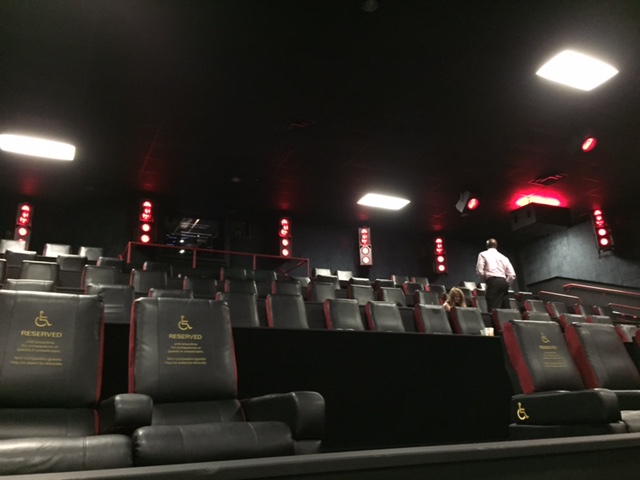
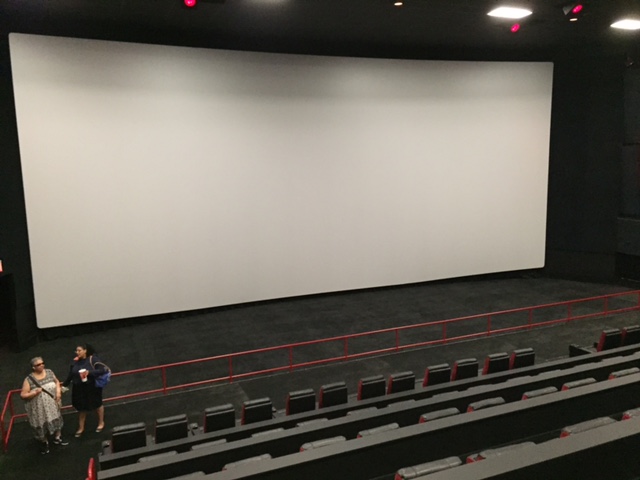
Posted by Jesse Skeen (Member # 586) on 10-06-2015, 02:18 AM:
That screen looks decent from the picture, but if there's no side masking for 1.85 then they're still doing it wrong.
Posted by Jesse Skeen (Member # 586) on 01-21-2016, 12:29 AM:
Well, efforts to save the old theater have pretty much failed as Monday was its last day of business and it's said that demolition will happen next Monday. Two TV stations covered the closing and one invited me to come out and appear. Links with video:
http://sacramento.cbslocal.com/2016/01/18/sacramento-century-dome-theater-shows-final-film-as-developer-gears-up-for-demolotion/
quote:
After almost 50 years the Century dome theater in Sacramento County is about to go dark.
The historic building showed its last film on Monday, and demolition crews are expected to get to work in a couple of weeks.
By the fall, the theater will be gone and instead there will be an expanded Howe ‘Bout Arden shopping center that will include a brand-new 14-screen theater. The first domes were demolished last summer, despite efforts to keep the mid-century modern architecture.
A petition failed to stop the developers, but organizers like Jesse Skeen aren’t giving up.
“I would implore anyone to go back to the drawing board and see what these theaters were like when they were brand new, not what they are now, and give us the modern equivalent of that,” he said.
“This would be a huge mistake to lose these domes,” said Martin Anaya with the Sacramento Film Festival. “This is an iconic piece of history. it’s a piece of Sacramento history and it’s something that needs to be preserved and protected.”
Many of the moviegoers tonight didn’t know it was the last night until they saw the signs and realized the only thing coming soon was a new theater.
Cathy Stricklin saw Star Wars in 1978 at teh theater, because it was one of the few theaters to show it in a 70mm format.
“It’s like you were in the movie you were experiencing that movie,” she said.
The new theater is slated to open in October.
http://fox40.com/2016/01/18/monday-marked-final-day-of-movies-at-century-domes/
quote:
The Century Theater domes on Ethan Way in Sacramento are now closed.
A portion of the theater complex was demolished in June. The remainder stayed open though Monday night, and will soon be torn down to make room for a new Century multiplex.
The Ethan Way domes date back to the 1960s.
A change.org petition to preserve and restore the domes gathered more than 700 signatures in recent months, but developers opted instead to build a new multiplex from scratch.
A sign on the lobby window reads:
"Attention Valued Patrons: We regret to inform you that this will be our last week of operations. Our last day of business will be on January 18th 2016. We would like to thank everyone for your patronage over the last few decades. We are excited to open our new state of the art theatre in late fall. This new complex will have fourteen screens, featuring leather recliners, wall to wall screens, state of the art sound and much more! Again we would like to thank you for all your patronage and we will see you in the fall."
The final movie to play at the domes Monday night was a 10:45 showing of "Joy."
I'm very happy that they including my naming the new theater "The Mistake". I had also said that at the final city planning commission meeting which approved the new theater despite those who showed up opposing it (not a single person came to support it.) I will check it out when it opens and retract that if by some miracle it actually turns out to be as good as these old theaters used to be, but I doubt that will actually be the case.
Posted by Brad Miller (Member # 2) on 01-21-2016, 10:02 AM:
Ashamed I had to grab this from the website video, as I'm sure the original broadcast would've had an awesome bug in the corner of the frame.
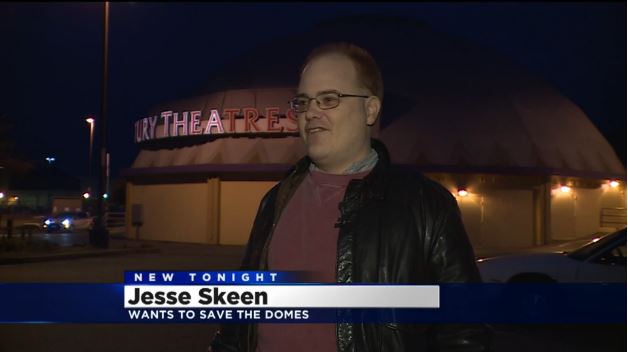
Posted by Terry Monohan (Member # 8285) on 01-21-2016, 05:12 PM:
Thanks Jesse for the information. It's so sad to see the Domes go. They all had a large type curved screen and with 70mm they were the best pace to watch a film. Old Ray Syufy cut some in two to make more money and this was the end, with sound leakage.
We hope they will keep the Century 21 in San Jose and build the new shop area around It. This won't be the case in Sacramento CA as a multi will be going in. Will the 2 big screens be curved in the new 14 multi, let's hope so.
Posted by Jesse Skeen (Member # 586) on 01-22-2016, 01:17 AM:
The plans for the new theater are horrifying- they are cramming 14 screens in a space barely big enough to fit the two original domes, and seat count will amount to about 120 per screen- most likely they'll all be top-masked as all their other new theaters have been. They will have one "XD" auditorium which will carry a premium price, but no guarantee of the screen being even as big as the two smaller un-split domes were. That was the main reason why I decided to shake things up- I'd welcome a new theater if it were a real improvement, but it's a step backwards. Just more reasons for me to stay home instead; gonna get a bigger 4K TV and Atmos sound system soon I hope!
One idea I had for the property after tearing down the old theater was to build a new theater that was a tribute to all of our city's fallen movie palaces- have a central lobby but have each auditorium designed to duplicate that of old theaters that were torn down. Say, one or two big domes built to modern standards, but also a replica of the Alhambra (which was torn down more than 40 years ago but many here STILL hold a grudge against that!) and others- it would be like a big block of classic theaters brought back to life. But no, we get a generic cracker-box.
Brad- actually the broadcast did have an awesome bug on it, but it's not on the online video (and of course online isn't in the right frame rate.) I loved KTXL's close-up on my eyes, but they ruined that on the air with a bug on the left side; there's a small bug overlayed at the top if you watch it online but I stole it and uploaded it to Youtube with no bug at all.
KCRA did a report yesterday that I wasn't part of- there's no text for me to quote here, link goes to a video and nothing else (and there's a ton of text and graphics over the picture) :
http://www.kcra.com/news/new-changes-coming-for-sacramentos-howe-bout-arden-shopping-center/37541308
Though they tried to keep it positive by focusing on the new stores coming to the property and talking mainly with people there to shop, they STILL got one person who said it was "sad" to lose the old theater and something should've been done to keep it.
Powered by Infopop Corporation
UBB.classicTM
6.3.1.2