This is topic End of proper wide screens = the end of moviegoing for me in forum Ground Level at Film-Tech Forum ARCHIVE.
To visit this topic, use this URL:
https://ft-forum.com/ft/cgi-bin/ubb/ultimatebb.cgi?ubb=get_topic;f=5;t=003008
Posted by Jesse Skeen (Member # 586) on 12-04-2016, 06:01 AM:
I hope this is the proper section to post this, apologies if it isn't. (Since it's mainly a decision made at Ground Level, I decided to post it here.) I know this has been discussed before but it can't be discussed enough in the current climate.
The trend of installing screens that were natively 1.85, with top-down masking for scope movies was bad enough, but now the trend has gotten even worse as many theaters are now showing 2.35 movies letterboxed with NO masking at all! This ruins the whole point of shooting movies in that format, as they are supposed to look BIGGER and WIDER than 1.85, and a letterboxed presentation makes the experience more like home video than a theater. (I personally tolerate letterboxing at home, but some people have installed 2.35 screens in their living rooms, showing more dedication than theater owners.)
I've spoken here before about Cinemark's new theater in Sacramento, built to replace the 1960s Century domes which in their prime had majestic wide screens. I had publicly pushed to ensure that this new theater would compare to the older one, but I visited it on its opening day and saw that ALL 14 of its screens are 1.85 with NO masking- and most of the movies they are currently showing are in 2.35! The opening of this theater has gotten a lot of fanfare, but those behind it should be ashamed and embarrassed, as should the media outlets who've given it free publicity but haven't called this out. I've seen my first and last movie at this theater.
I've also heard that both Cinemark and Regal now make it POLICY to not mask their screens, even on ones already equipped with masking! I saw this a year or so ago when seeing a free advance showing at Regal's Natomas Marketplace in Sacramento, where I was booth manager from 2000-2001 (I posted quite a bit on here why I ended up leaving that job.) It looked awful, like something was broken. If I'd had a flashlight, I would've gone behind the screen and set the masking properly. At the new Cinemark, I saw "Arrival" which had a lot of dark scenes. As the entire screen was lit up, that made it hard to "ignore" the black space at the top and bottom of the screen, again making it more like home video than a theater. Although I was pleasantly surprised by the size of the screen (it's actually comparable to the original domes that I'd hoped would be restored), letterboxing is a deal-breaker and I won't be going back. On top of that, it seems EVERY movie they were showing there was in 2.35, so why weren't the proper screens installed for them? I was able to talk to the projection manager there, who said "that's just the way new theaters are these days." If that's the case, I will simply stop going to theaters altogether and watch movies at home, where the presentation isn't perfect but at least it's more cost-effective and convenient for me. Cinemark promotes this as a "Next-Gen" theater, but I'll gladly take the last gen if that's the case! If there were a truly great theater in this area I would attend it on a weekly basis, but no theater meets that standard and this new one is proof that they aren't even TRYING. In fact by making this "policy", I'd say they're trying to make the moviegoing experience as mediocre as possible. It's no wonder why I got out of the business 15 years ago despite having a great love for it; the level of stupidity seems to know no bounds. The higher-ups seem determined to make "policies" that degrade the experience, but none that enhance it or even keep it up to minimum standards.
The movie theater is dead- long live home theater.
Posted by Louis Bornwasser (Member # 3063) on 12-04-2016, 10:55 AM:
The "smart ones" left the industry. The left overs became corporate management.
They now have control and will not listen to engineers and tech experts. This trend started about 20-25 years ago.
This is the only industry I know where you start as a respected professional and end as an errand boy with no input. (Death of a thousand cuts.)
Posted by Sam Graham (Member # 2889) on 12-04-2016, 02:42 PM:
quote: Jesse Skeen
I was able to talk to the projection manager there...
The what? Are you suggesting that's actually an active job title at a modern digital cinema? Brad could run that whole booth remotely from an app on his digital refrigerator.
Face it...probsbly less than one one-hundredth of paying patrons so much as notice, let alone care. The only mechanical movement involved in presentation anymore is those motorized recliners.
Posted by Jesse Skeen (Member # 586) on 12-04-2016, 03:17 PM:
Yes, they actually had a projection manager there- I was surprised. Likely because it was the first day of the place being open and they wanted to make sure everything was at least working.
And yes, it's very sad how little of the public cares. The fact that network TV has been an unwatchable mess for almost 20 years now says a lot, as do the large number of people who don't know how to properly set their TVs. But theaters should remain a place where things are always done right, and now they truly no longer are. You'd think at least with the home video window continually shrinking, theaters would want to step up their game if they want people to go there rather than wait just a short time to see the same movies at home.
Posted by Connor Wilson (Member # 6088) on 12-04-2016, 07:22 PM:
Jesse, I don't know the state of affairs in Sacramento, but for me there is still hope. A month ago, Alamo Drafthouse just opened their location in Brooklyn and you couldn't believe how much joy I felt when entering one of their screens for the first time. HUGE Common HEIGHT flat screen close to the walls and ceiling, and it definitely looked like they were capable for motorized masking. They had the Sony projectors (the good, newer ones) and the light output in scope was phenomenal for such a big screen. I asked a cleaning lady after a show if there were anamorphic lenses used, and she said "uh-huh." I'll take it with a grain of salt since I don't think she was an IT person who worked there. I was good friends with the IT manager of their Ashburn, VA location, but I have yet to meet the IT behind the Brooklyn theater. I believe there are people who still give a damn about them masking and presentaion. I know the Alamo folks do.
And I know I'm going in here with an unpopular opinion, but I don't mind common width screens. As long as they mask a scope movie properly, I have no quarrel, albeit the picture is smaller, but I think it's a reflection of the technology today. In digital cinema, Flat has more resolution than Scope. It's the other way around in the world of 35mm, but that's the state of affairs. The DCI specifications as we know then today are 11 years old. How's Whedon's Serenity, the first commercial feature to conform with the specs, is turning 11 this month. Personally, I would have projectors with a sensor closer to 4:3 than 16:9, and have the scope movies stretch to the full height of the chip, and corrected with an anamorphic lens, but that's for the next generation.
And I bet you DCI Scope would look worse on a common height screen than a common width screen. You're not only enlarging lost resolution, you're losing light too. Two screens of an indie theater I frequent are common height, and they are equipped with 2K DLP projectors. American Honey, a Flat film, looked fantastic on that kind of screen when projected and masked for Flat (the movie was in 1.37:1, so it wasn't masked all the way. phooey). Moonlight, a Scope film, took advantage of the common height screen, but the pixel grid was much more visible, being from a 2K projector. I still find it a quaint place to see a certain kind of movie I wouldn't have to trek out to the city to see.
Today I caught up with two of my uncles to see Doctor Strange at the AMC Palisades 21. It was recently renovated with power recliner seats and a digital IMAX. We saw it in Theater #8, standard, RealD 3D, Sony 4K, QSC 5.1, but a very interesting wide screen. I'm not sure what the ratio was, but it could be somewhere between 2.00:1 and 2.20:1. It's curved on the edges and no masking! The image between the black bars looked like a smiley face! It really showed me that from one chain to another, it's a different world to see movies. Why would theaters have maskless screens? Does digital fare well with it because it doesn't have an edge feather effect like unmasked film projection? Does it save money? Why the hell is it policy to leave it unmasked? If the home theater and movie theater are becoming one, why can't we buy a ticket to publicly binge-watch Modern Family?
But there is still hope. People like me are starting to go into the workforce and as a reaction to this rise of mediocrity we can put an end to it. The best movie theater in Loudoun County thrives on the technical knowledge of a 22-year-old. That makes me happy, as a 21-year-old.
Posted by Buck Wilson (Member # 5885) on 12-04-2016, 07:41 PM:
I think people know. Even if they can't say "Ugh I paid to watch a fuckin letterboxed movie?" I think there's a real sense of "cheapness" when everything in a modern theater comes together. Like there's less magic than there once was. Something's missing.
Posted by Mark Ogden (Member # 43) on 12-04-2016, 08:21 PM:
If you follow trends in cinematography at all, especially in art/alternative/foreign circles, then you know by now that masking is a concept that is becoming quaint, if not downright pointless. For example, there is a film playing around arthouses right now called I Am Not Madame Bovary. For most of its length the frame is circular, that is, all the action is viewed as it you were looking through a telescope (a still is below). Eventually, the frame becomes square, and then widescreen. How do you mask for that? For whatever artistic reason, many directors are playing around with variable aspect ratios within the same film. While a properly masked image is a very nice thing it is becoming obvious that it is no longer a real consideration among filmmakers that want to produce unusual effects, and to insist on it or make it a deal breaker may well rob you of the experience of a great movie presented in an otherwise top-notch venue. The terrifically entertaining Grand Budapest Hotel is one such example.

Posted by Jesse Skeen (Member # 586) on 12-04-2016, 08:42 PM:
For movies with changing aspect ratios, of course those have to be stated how to mask them for. I believe "Grand Budapest Hotel" came with instructions on that. There have been plenty of 35mm movies with changing ratios also, but meant to be projected with the masking set to one specific format.
I've seen a number of digital 2.35 movies on proper wide screens and they looked OK to me, though not as good as proper 35mm would have obviously. It was simply a mistake to make DCP's native ratio 1.85 in the first place with no anamorphic option, but if you're going to run a theater with that the screens should still be the proper ratio- otherwise what's the point of shooting in scope? If I were a filmmaker or theater owner I'd be pushing for those specs to change, possibly even continuing to run movies on 35mm whenever they were still available for that reason.
An unmasked screen simply looks sloppy and unprofessional- that might be tolerable at home since that's an instance where you often have to settle for doing the best with what you have, but it's entirely unacceptable to pay current theater prices and see that, regardless of how clean and shiny the rest of the theater is. No amount of time making your floor staff sweep the floors and clean stuff will change the fact that your screens are WRONG.
I've never been to an Alamo Drafthouse, I've heard they do things right but I'm not a fan of the whole dine-in concept. We do have a Studio Movie Grill nearby which I've heard has proper screens, but I've heard they keep the lights up partway through the movie so people can eat and be served. I'd rather eat elsewhere (for less money) before or after the movie.
Posted by Mike Spaeth (Member # 524) on 12-04-2016, 10:11 PM:
There you have it, from Jesse Skeen, the man who never met a change he didn't hate! I'm sure they'll miss your money at what appears to be the #2 theatre in the Sacramento DMA.
Posted by Michael Brown (Member # 890) on 12-05-2016, 02:55 PM:
What's happened is that over the last 20 years the general public have been trained that black bars on the top and bottom are normal for a movie.
20 years ago everyone at home were watching 4:3 pan and scan VHS tapes, or 4:3 tv broadcasts of movies on 4:3 television, then DVD came out and introduced everyone to letterboxing and people did whine and complain about letterboxing for several years until it was accepted. Fast forward to 2016 everone has 16:9 tv's but happily watch letterbox 'scope movies without probably even noticing the black bars.
People put fake black bars on stuff to make them look like movies - I'm seeing more and more TV commercials usualy for expensive cars and such that are framed at 2:35. Sometimes you are watching a TV show and they have a scene that is supposed to look like you are watching a movie - so what do they - letterbox it. That's why they get away with it.
Posted by Manny Knowles (Member # 1171) on 12-05-2016, 03:26 PM:
Scope AR hasn't been 2.35 in years. Or are y'all refusing to get with the program?
Posted by Michael Brown (Member # 890) on 12-05-2016, 07:18 PM:
ok 2.39 ![[Smile]](smile.gif)
Posted by Jesse Skeen (Member # 586) on 12-06-2016, 05:52 AM:
quote: Mike Spaeth
There you have it, from Jesse Skeen, the man who never met a change he didn't hate! I'm sure they'll miss your money at what appears to be the #2 theatre in the Sacramento DMA.
Wow, it's #2 after just 4 days being open? (Which theater here is #1?) And you're proud that the public accepts mediocrity? Congratulations.
Posted by Mike Spaeth (Member # 524) on 12-06-2016, 08:38 AM:
Elk Grove - Laguna 16 was the top theatre in the market last weekend.
Posted by Jonathan Goeldner (Member # 4854) on 12-06-2016, 10:13 AM:
oh and "La La Land' is gonna muck it all up with it's 2.55 wide screen imagery/framing ![[Wink]](wink.gif)
Posted by Brad Miller (Member # 2) on 12-06-2016, 11:01 AM:
The point to be made here is that the cinema industry is falling into that self-destructing trap of where a theater is successful without spending money on something (due to an outside influence not factored into the equation), so then another theater follows suit and so forth. Meanwhile the entire industry in their copycat nature starts spiraling downward in quality overall, and sooner or later it will find itself in a pit so deep they cannot pull themselves out of it.
The problem with masking is that not having it deteriorates the perceived image. Yes that is correct, colors are not as vivid, the perceived sharpness is not there and contrast is lower. This isn't a preference, it's just a fact of how our eyes work.
I blame IMAX and RealD for this trigger of overall destruction of presentation quality in the exhibition industry. Hear me out.
Back when IMAX started running Hollywood films (for their own survival) most theaters weren't building monster size screens, so people started getting excited over the sheer massive size of the IMAX screens (even though only HALF of the screen was being used).
IMAX has never done masking and just like how some (not all) of arthouse theaters got away with having terrible presentations, they were able to stay in business because they had exclusive content, so if the people in a town wanted to see the film, they had no other option than to put up with a terrible presentation...and the arthouse theater made money, thus these type of arthouse theater owners believed they did not HAVE to take their presentations seriously.
The same thing happened here in regards to IMAX. Back when this trend started, IMAX was the only "super big screen" game in town, so they got away without masking since people were so excited to see such a large image they bought tickets anyway and then the bean counters of the industry proclaimed "masking isn't necessary because IMAX doesn't use it, so we won't use it anymore either".
This was further backed up with the incorrect argument "digital has a sharp edge so masking isn't needed with digital" by people who never understood that masking did more for the image than simply to cover up the fuzzy edge of film projector apertures. (And that was for theaters that actually cut their plates properly, not the large amount that thought there should be a fuzzy edge to the image that butted up against the masking...but that's another discussion.)
Now theaters are back to building large screens again, yet they are taking the IMAX shortcut of not installing masking and they are foolishly creating a tall image. Humans don't see height like we see width, yet these theater designers are trying to copy the IMAX recipe by creating tall images based upon the 1.85 specification, even though 90% of movies are scope. This is where Jesse is absolutely correct. Cinema auditoriums should be built so scope maxes out the height of the screen wall. Want a taller picture? Then widen the auditorium! It's pretty simple. When theaters don't build common height screens, we get letterbox, and letterbox = home video. ("Letterbox" being even more obvious without masking.)
Keep in mind also when a customer sits in a seat they are happy with, that is directly related to the height of the screen and their distance from it. While yes I realize this upcharge bit with reserved tickets also works against presentations (since people can't pick their seat once they see what the real screen size is like upon entering the auditorium), the point to be made here is that if the movie starts and only part of the screen height is now being used, this is disappointing to the customer from every possible angle that this can be debated.
But RealD is also a huge contributing factor to the decline of quality at cinemas. They came in and did their deal with all of the big boy chains to put 3D into each auditorium, thus forcing silver screens to be installed everywhere. This post is already getting pretty long, so do I even need to explain the destruction of quality that happens to a cinema image with a silver screen vs. a white screen???
Other things happening in the industry is everyone installing significantly more expensive recliners over theater seats (of which carries a higher maintenance cost) at the cost of roughly half the original seating capacity. While I'm all for more comfortable chairs and spacing from the stranger next to me, this is also something that will help to eliminate cinemas, because that is substantially cutting their potential profits down.
Now we have people worried about "immersive lobbies"!!! To this I say: really? Are we so desperate to get customers now that THIS what we think will make customers come to the cinema?
So here we have everyone scrambling to figure out what to do. Meanwhile the answer is actually very simple. It all boils down to 2 major current facts that the decision-making people seem to be overlooking:
#1 People come to the cinema to see a particular movie. If that movie is available day and date, cinema will die. The studios want their money back as fast as they can get it, so they will continue to ease into this model with some small movie here and there that they know will bomb. This is because the studios are quite smart and know exactly what they are doing. Of course they want theaters to keep self-destructing on the above points. Then they will pick that crappy movie to day-and-date with knowing they can use the argument "see it didn't affect your profits, it's a different audience". Bullshit. It was a crappy movie! But the fact remains all it takes is for any of the reasonably large theater chains to play just one movie that is released day and date, then the fuse to the exhibition bomb will be lit.
#2 People come to the cinema to get a big screen experience that they cannot get at home. The problem is home video and home video projectors are getting better and better all the time. In fact there are lots of people now who haven't put tons of money into their home theaters that have a better presentation than the average multiplex! Translated this means if presentation is not taken as the #1 aspect of the movie going experience above every other aspect of the cinema (and this specifically means auditoriums being properly built with masking and large, native 2.40 screens) cinema will die.
EVERYTHING ELSE comes after these two points.
Posted by Bill Brandenstein (Member # 7758) on 12-06-2016, 02:34 PM:
Seeing what we have at our nearest Cinemark Theatres (Palmdale/Lancaster), no masking on 1.85 screens seems to be their el cheapo corporate policy. Since we have no decent theaters in our valley to the south, it's always choosing which annoyances to put up with for a given movie, and selecting the theater accordingly.
Mike, instead of taking a personal swipe at Jesse, why don't you add to the discussion a reason why you don't agree? I rather agree with him.
Posted by Mitchell Dvoskin (Member # 751) on 12-06-2016, 03:20 PM:
In addition to what Brad said, customers rarely complain about poor presentation. They just don't come back, or at minimum cut back their nights out at the movies.
While theatrical digital is capable of significantly better presentation over home in both picture and sound, the reality is that this is not the case in many locations. As predicted here, theatres that were doing film-done-wrong are now doing digital-done-wrong.
Posted by Mark Ogden (Member # 43) on 12-06-2016, 05:12 PM:
I would agree with you wholeheartedly, Brad, on your point #1. Point #2, not so much.
You and I, and the other folks on this forum, approach things differently than Mr. & Mrs. Average American Moviegoer. Since we are all more or less current or former film handlers who take pride in such matters, we expect, or even demand, a degree of technical excellence in film presentation that others do not. Just this last weekend I walked out in a showing of Allied at an AMC multiplex near here. They were trying to show the film in 2D through the RealD device in front of a Sony projector. That's bad enough, and I would have been willing to give it a chance, but what was worse was that the projector port glass was absolutely filthy and smeared, and resulted in an unsharp and low contrast image. I didn't even make it to the feature. But I am willing to wager that no-one else noticed or cared. I might point out that I was killing time by myself here, my girlfriend has mostly stopped going to the movies with me because she gets annoyed at my dragging her out of the show for presentation issues she considers minor, or doesn't notice at all. Such is it with most people. It could be argued, of course, that most people don't know from superior projection because they have never really seen it. But still.
This is why cinema will not die, at least not for reasons of presentation. People will sit through things that would make you and I tear our eyeballs out. My experience is that it takes a very serious issue to get people to up and leave a screening, a very dim picture, or one noticeably out of focus (and even then . . .). If 100 years of dicey projection hasn't killed cinema, lack of proper masking isn't going to do it. Sadly, not enough people care.
quote:
arthouse theaters got away with having terrible presentations, they were able to stay in business because they had exclusive content, so if the people in a town wanted to see the film, they had no other option than to put up with a terrible presentation...and the arthouse theater made money, thus these type of arthouse theater owners believed they did not HAVE to take their presentations seriously.
I don't know if Martin is in on this thread, or if he would agree with me, but unless you are a Landmark, or a Lammele, or an Angelica, then your arthouse is a vanishingly low-margin operation, so much so that many have gone to non-profit status in an effort to stay afloat. That having been said, I'm sure most arthouse operators want to take their presentation seriously, but lack the coin for anything more than the basics. I believe also that art/alternative moviegoers have somewhat different approach to things, a certain amount of funkiness is acceptable because it's more about supporting the theatre. There is an arthouse in upstate New York that occasionally snags a move-over from the local Regal if the picture fits their usual programming, and they usually do very well with it even though it may have already played a few weeks in town. Arthouse audiences can be like that.
But you have a point about exclusivity, I go to a lot of art/alternative theaters, and I very often encounter pillar-boxed flat (or even Academy) images on scope-sized screens. It can be off-putting, but rarely does it take me out of the picture. I'm just happy to see the film in a cinema, and happy that the operators are keeping the place going.
Posted by Martin McCaffery (Member # 37) on 12-06-2016, 05:25 PM:
Yup, I'm here (or, at least, one of the Martin's).
As the director of a non-profit, I do what I can to get the best presentation I can. We do have top and side masking, but since we are in a 1941 theatre, we have to letterbox or break the proscenium. Pre-digital, we had the best picture in town, because we had nothing but Carmike to compete with (but no top masking). Now, we're too dim but will have to live with it until we can afford to upgrade from the POC Solaria.
People will sit through amazing amounts of crap and abuse. But they will also be supportive of you if you treat them with respect and don't try to jerk them around.
I agree, they don't necessarily know what they want, technically speaking, but when they have a feeling something is wrong, they will quit coming to the theatre - even if that's not the theatre with something wrong.
Posted by Bobby Henderson (Member # 840) on 12-06-2016, 06:24 PM:
quote: Mark Ogden
This is why cinema will not die, at least not for reasons of presentation. People will sit through things that would make you and I tear our eyeballs out. My experience is that it takes a very serious issue to get people to up and leave a screening, a very dim picture, or one noticeably out of focus (and even then . . .). If 100 years of dicey projection hasn't killed cinema, lack of proper masking isn't going to do it. Sadly, not enough people care.
Ultimately theaters do not gain much benefit from customers who don't care about presentation quality. The problem is the attitude cuts both ways. They may not care if the movie is presented with a certain level of showmanship. But they also may not care about just watching the movie on Blu-ray, or DVD, or Netflix or a lower quality bootleg on a movie piracy streaming web site.
Most customers are simply going to watch the movie where ever it is available for the least amount of money. Commercial theaters don't stand any chance at all with something like a simultaneous day and date release model. Movie distributors keep pushing their luck by making release windows between theatrical and home release ever shorter.
I think the powers that be in both the movie industry (and the larger global media industry that owns all the movie distributors) are living in some kind of dream world. They're making a lot of decisions they believe will make them even more money and faster, while from my perspective it looks pretty suicidal in the long term.
Hollywood movies have not been generating nearly as much money on home video as they did 10 or 15 years ago. Retailers of physical movie & music discs as well as physical books have been decimated by online merchants. Video rental stores have seen an epidemic of closures. Home TV viewers appear to be more interested in TV series from premium networks like HBO or streaming services like Netflix. There's lots of other kinds of programming to watch on cable or online. It's pretty easy for some movie release to be forgotten in all of that. Commercial movie theaters are really the only venue where a movie release can stand out and get attention.
quote: Jesse Skeen
The movie theater is dead- long live home theater.
Like Brad said, IMAX is largely to blame for the current theater building trend of using common width screens and no masking. IMAX set the stage for it when it started showing "DMR" blow-ups of Hollywood movies on 15/70mm film. By the way, I was pretty put off by IMAX' "DMR" thing. Some theater chains had been building new theaters with at least one house featuring a really large 'scope ratio screen and big seating count. The problem was they needed 5/70mm prints for a properly bright and steady image but could only get 35mm film prints. Then IMAX comes along showing roughly 5/70mm quality while using 3 times as much film.
![[Roll Eyes]](rolleyes.gif)
When IMAX rolled out its 2K digital "Lie-MAX" product, on more modest sized yet masking free screens, they were practically begging theater chains to mimic the approach with their own home-brewed premium viewing concepts.
The other big culprit for common width screens: stadium seated auditoriums. The auditoriums have much taller ceilings. It would cost even more money to widen the auditorium for a 'scope screen that properly filled the end of the room. It's cheaper to just build a flat screen and go higher. IIRC when the AMC Grand 24 opened in Dallas in 1995 and helped launch the stadium seating building boom it had at least a few common width screens. In the late 1990's such screens usually at least had vertical masking.
Some theaters are still building auditoriums equipped with common height screens. Our newer Carmike location here in Lawton (the Patriot 13) has common height screens in all its standard priced houses; and the screens all have movable masking. Better yet, management there actually uses their automation to adjust the masking between flat and 'scope during the pre-show rather than just leave it wide open 100% of the time for 'scope (even though nearly all the movies they play are in 'scope ratio). The IMAX branded house has no masking and letter-boxes the 'scope movies.
The downside of common height screens is the low native resolution of the 'scope image being projected. The 'scope format is now the lowest quality format, all thanks to decisions made in setting d-cinema standards. Since 'scope movies are effectively letter-boxed TV style during the post production stage it only encourages a more TV like approach at the theater.
Posted by David Stambaugh (Member # 1102) on 12-06-2016, 10:57 PM:
Regal and Cinemark have abandoned the use of screen masking here. Apparently it was a really big nuisance for them. What a hassle it is to present a properly-masked image! Forget that!
Unfortunately 99.999% of moviegoers do not think "Hey, what happened to the screen masking?" They're much more likely to think "This looks just like my [letterboxed] HDTV screen only bigger and suspiciously out of color calibration."
RealD silver screens are an industry scourge. They need to go away. Now. Along with RealD. I avoid RealD, and 2D shows on silver screens, like the plague and so does everyone I know that still goes to movies. Everyone says the same thing: "It's dim, the screen is blotchy, and it's just a gimmick that adds nothing to the experience. Actually it's a distraction."
The industry's overall backwards wrongheaded logic toward proper theatrical presentation needs a serious course correction.
Posted by Leo Enticknap (Member # 534) on 12-06-2016, 11:19 PM:
quote: Brad Miller
#2 People come to the cinema to get a big screen experience that they cannot get at home. The problem is home video and home video projectors are getting better and better all the time. In fact there are lots of people now who haven't put tons of money into their home theaters that have a better presentation than the average multiplex!
The arthouse audience for sure, and the mainstream audience a little more than I think we give them credit for, are not just looking at technical presentation quality. They are also looking at the social experience of cinemagoing - being with 100 other people who'll have a similar emotional reaction to what they see on the screen as they see it, etc.
We're never going to win the arms race on techno-geekery alone. In the thread I started on "hi-def vinyl," Rex Oliver used the phrase "audiophools' to describe people who, to quote Flanders and Swann, "...never did care for music much, it's the high fidelity." 4K in the home is now within reach of a middle-class income. Just as in the 1950s when TV came along, the movie theater still has to upsell what it can offer that the living room will never be able to.
High quality technical presentation, in the hands of professional projectionists, will make a a big contribution to keeping the movie theatre alive, but that won't do the job alone. Plentiful parking, nicely decorated, welcoming buildings, a combination of mainstream blockbusters and slightly more off-the-wall choices all playing in the same building, for more arthouse oriented venues, a bar in the theater lobby ... you need to give your customers a reason to want to get out of the house.
Posted by David Stambaugh (Member # 1102) on 12-06-2016, 11:28 PM:
The last movie I saw in a theater was Star Trek Beyond. I was with someone else or I would have walked out on it. Why? 2D letterboxed presentation on a very blotchy hotspotting silver screen. It looked awful but I didn't want to be "that guy".
Now I try to find out in advance if my desired 2D show is on a white, or silver screen. Silver equals no go.
My modest home theater system outperforms most local theatrical presentations now, especially the sound.
Posted by Jesse Skeen (Member # 586) on 12-07-2016, 01:46 AM:
Now that you mention it, the 2D movie (Arrival) I saw on this screen didn't look evenly bright in the picture area, possibly due to its being silver. From where I was sitting it looked like the bulb might not have been properly focused, but having never operated digital equipment I can't be positive. Was this ever a problem with 3D on film in the past decades? I happen to LOVE 3D (I have a 3D display at home and have bought nearly every 3D Blu-Ray release just to show my support for it), but I hardly go to 3D movies at theaters though because of the upcharges (but I won't watch a 2D presentation of a 3D movie- I'll either pay extra or wait til I can see it at home.)
Letterboxed movies on IMAX screens are awkward, but I accepted that just because feature movies weren't really MADE to be shown on those screens. The films made specifically FOR IMAX theaters were in the fixed ratio of those screens. Non-IMAX screens on the other hand have been meant for showing different aspect ratios depending on the movie, and should be masked for them accordingly.
But that just shows there's people out there even more picky than I am. While the majority might not give a damn about picture quality at all (hence why they continue to throw their money away on bug-infested cable channels and have their TVs set to make everything look like a funhouse mirror), people who work at and run theaters should be BETTER THAN THAT, regardless. When I worked as a film projectionist, I could have cut corners and likely nobody would have noticed, but I still would have personally felt bad for having done so. I could not work for Cinemark or Regal in any capacity if they make it "policy" to not mask their screens- that just shows that they are LOOKING for ways to show that they don't care about presentation.
But the bottom line is that as theater presentations become more like home video, that just gives me less reason to even go anymore. Meanwhile an exceptional theater presentation that outdid what I could even GET at home at any price would have me going even if the movie itself didn't appeal to me.
Posted by Scott Jentsch (Member # 1681) on 12-07-2016, 01:45 PM:
quote: Brad Miller
The point to be made here is that the cinema industry is falling into that self-destructing trap of where a theater is successful without spending money on something (due to an outside influence not factored into the equation), so then another theater follows suit and so forth. Meanwhile the entire industry in their copycat nature starts spiraling downward in quality overall, and sooner or later it will find itself in a pit so deep they cannot pull themselves out of it.
The problem with masking is that not having it deteriorates the perceived image. Yes that is correct, colors are not as vivid, the perceived sharpness is not there and contrast is lower. This isn't a preference, it's just a fact of how our eyes work.
I blame IMAX and RealD for this trigger of overall destruction of presentation quality in the exhibition industry. Hear me out.
You make excellent points, Brad. While some might dismiss your comments as not being relevant to the general public ("they don't notice"), I think that there is merit to the arguments nonetheless. It's a death by a thousand cuts, and while each step taken to diminish the quality of a moviegoing experience is "only a flesh wound," they add up.
I hate silver screens because of what they do to the black levels. The ones around here are pretty good from a uniformity standpoint, but when everything black is grey, watching a movie set in space or a movie that is supposed to be dark is pretty disappointing. Unfortunately, there aren't many screens left that aren't silver (at least not around here).
The combination of constant-width screens and the lack of masking just screams that the theater doesn't care. It's actually worse than letterboxed movies on one's TV, because the bars aren't white/silver on the TV. That's something one would expect from a budget theater, not one that wants $10-15 for a ticket.
The fact that the multiplex companies are heading in this direction presents a dour outlook for the industry, but it also should present an opportunity for a savvy theater owner. A theater that got all the aspects of the moviegoing experience right should succeed over one that does not.
I believe that people are capable of appreciating the differences between good and bad presentations, but some aren't as perceptive as others. They need to have it explained to them so they can understand what they should be noticing through either subtle or not-so-subtle communication. People aren't mind-readers and we shouldn't look down on them for not appreciating some of the finer points of what makes a good presentation.
I encourage everyone here that has an opinion about the experiences at various theaters to post messages on the theater's Facebook page, Yelp, and yes on the theater Reader Comments pages on our site (www.bigscreen.com). Help get the word out about what is good/bad about a theater's presentation!
Posted by Mike Blakesley (Member # 26) on 12-07-2016, 02:47 PM:
quote: Scott Jentsch
I believe that people are capable of appreciating the differences between good and bad presentations, but some aren't as perceptive as others. They need to have it explained to them so they can understand what they should be noticing through either subtle or not-so-subtle communication
I agree - education is key. That's the biggest problem with masking... it does enhance the presentation but you can't advertise the fact because nobody knows what you're talking about. I don't think I've ever heard a comment about masking from anybody in my whole life except for here on Film-Tech. Anytime I've brought up the subject with other people, they go "huh?" And if I explain about the contrast issue, they say they can't see why that would make a difference.
Posted by James Wyrembelski (Member # 9037) on 12-07-2016, 03:38 PM:
I agree with the sentiment that people, even if they aren't quite sure what it is, can tell when something just isn't right.
All business, especially service businesses, should take note of the "little" things that really add up to convey level of quality. With the economy (at least in our area) on a huge upswing, competition should begin to really take hold and it is quality that really needs to shine. If not, the price should reflect the service involved. Paying top dollar to see a show should provide the customer with quality, top dollar viewing in all aspects, even if they really have no clue what is all involved such as masking. They may not know why the picture at a particular theater is better, but it just is!
Perhaps masking could be included in the advertisement for the theater? "Pristine digital projection, enhanced by screen masking!" The general public may not know what the hell that means, but it sounds fancy! Maybe have informational posters or sheets in the lobby explaining technical aspects of projection and why masking, etc. enhances the theater experience and its superiority to home viewing? I don't know what would work, but trying something sure beats out doing absolutely nothing to resolve the problem.
Posted by Jesse Skeen (Member # 586) on 12-07-2016, 09:37 PM:
Remembering all the complaints in the 80s and 90s about letterboxing on video (main reason why most movies on VHS were pan and scan, while laserdiscs were letterboxed as more educated people bought those) I'm surprised Joe Average doesn't at least ask these theaters to crop the movies to fit their screens (I don't know if projectors can be set to do that or not, though of course for me that would be even more of a deal-breaker.) I've noticed hi-def cable movie channels usually show cropped (or sometimes open-matte) versions of scope movies, I've even accidentally watched a couple on Netflix and could quickly tell they were cropped- not as badly as in the 4x3 days but still cropped nonetheless.
I've been working on a snail-mail letter to send to this new theater's management and everyone else I know who had anything to do with it, including the media outlets that gave it free publicity last week when it opened (though to be fair one TV news outlet here called me to come on TWICE before the older theater closed to voice my concerns about its replacement; I just wish they'd let me give a final evaluation of the new theater.) Will probably mail it out tomorrow, we'll see if I get any responses at all.
Posted by David Stambaugh (Member # 1102) on 12-07-2016, 10:33 PM:
I've given up on caring about common height vs common width. Just get the aspect ratio correct, with black masking. On a white screen. It looks so much better than without masking, and/or on a silver screen.
Posted by Bobby Henderson (Member # 840) on 12-08-2016, 10:11 AM:
quote: Jesse Skeen
Remembering all the complaints in the 80s and 90s about letterboxing on video (main reason why most movies on VHS were pan and scan, while laserdiscs were letterboxed as more educated people bought those) I'm surprised Joe Average doesn't at least ask these theaters to crop the movies to fit their screens (I don't know if projectors can be set to do that or not, though of course for me that would be even more of a deal-breaker.) I've noticed hi-def cable movie channels usually show cropped (or sometimes open-matte) versions of scope movies, I've even accidentally watched a couple on Netflix and could quickly tell they were cropped- not as badly as in the 4x3 days but still cropped nonetheless.
I still have a feeling the 'scope format is going to fall out of favor, if not stop being used by new movies completely. Right now it doesn't seem like such a thing is possible since nearly every new movie it seems is cropped down to 'scope aspect ratio. But I think the relentless trend of installing common width screens (sans masking) in new theater builds is setting the stage for the death of 'scope.
IMAX could once again be a culprit is driving this kind of change, just as it did for influencing the removal of masking and curtains from commercial theater screens. They've already had at least a couple or so "exclusive" features where standard theaters received a cropped, 'scope ratio version while the IMAX houses got the taller version that actually showed more imagery. The next Captain America and Avengers movies are going to use this approach. Supposedly some or most of the footage in these movies will be shot with IMAX' new digital cameras, modified Arri Alexa 65 cameras with vertical anamorphic lenses to stretch the image taller. They will be selling this taller image as a bonus in the theatrical market.
From the early 1980's thru mid 1990's most movie releases were flat. A lot of big event movies were released in flat format. Remember all those odd 70mm blow-up prints of movies in flat format? Of course this trend was heavily influenced by the VHS tape format and the then-booming home video industry.
The situation with home video is very different today. I'm not sure if movie studio executives have bothered to notice their biggest revenue source, physical movie disc sales, is in a state of rapid decline. Many thousands of video rental stores have closed, as have retail stores that specialize in selling videos, music, books and games. Even the Redbox kiosk business is now taking a beating lately. There has been overall sales growth in streaming VOD, but profit margins are far more slim there. And movies are not the top selling point with streaming services; TV series are the main point of interest there. Whether movie studios like it or not, the commercial theater market is going to be more vital to them in the future. They're going to be making less and less money on home video.
If the movie industry once again becomes more dependent on commercial theaters for revenue they might do more to once again tailor their content more for those theater screens. A lot of older theaters with common height, 'scope shaped screens have been demolished. There is industry pressure for theaters to incorporate recliners, in theater food service, bars, etc. That's all easier to incorporate into a brand new multiplex rather than retrofit into an old, existing theater.
In the end, the 'scope format is just becoming less and less relevant.
Posted by Mike Blakesley (Member # 26) on 12-08-2016, 12:01 PM:
quote: Bobby Henderson
If the movie industry once again becomes more dependent on commercial theaters for revenue
You mistyped there, it should have said "If the movie industry ever realizes how much they depend on commercial theaters for revenue, especially downstream"
Posted by Bobby Henderson (Member # 840) on 12-08-2016, 01:18 PM:
Right now the movie distributors and their parent companies seem to think they don't need movie theaters. They look upon theater chains with contempt and regard them as a major inconvenience standing in the way of the "real money" they think they can make doing what ever they want with movies on home video platforms.
The movie studios used to be very dependant on movie theaters. The metaphorical "pie" representing the home market is only so big, and to me it looks like the market is shrinking. Race to the bottom economics has taken hold in a big way. Movie studios and media companies are in sheer denial of this.
The thing that scares me for the future of movie theaters is the movie studios and media companies may only realize how much they really need commercial movie theaters as the core part of their business model until it's too late.
I've debated this with friends of mine, but I really the movie industry as we know will not survive if they cause the commercial movie theater industry to implode. The movie theater industry is not immune. It can be laid to waste just like other industries we've seen get torpedoed by technology, the Internet or other changes in society.
Posted by Eric Hooper (Member # 1730) on 12-08-2016, 07:55 PM:
Maybe we should start a list of theaters that are still “doing it right” by using masking PROPERLY in EVERY AUDITORIUM*. (*IMAX/LieMAX excluded)
Here in DFW I’ve personally observed the following theaters still “doing it right” and using masking properly in EVERY AUDITORIUM: ![[thumbsup]](graemlins/thumbsup.gif)
Harkins Southlake
AMC Grapevine Mills
AMC Starplex Lake Worth
AMC Irving Mall
Regal MacArthur Marketplace
Movie Tavern Ridgmar
Angelika Dallas
Alamo Drafthouse Dallas
Alamo Drafthouse Richardson
Studio Movie Grill Colleyville
Posted by Jesse Skeen (Member # 586) on 12-08-2016, 08:37 PM:
On-line comments I submitted to Cinemark, had to cut it quite short as there was a limit to comment length:
quote:
What in the world were you thinking, building this brand-new theater to replace an older iconic one famous for its huge screens, and installing native 1.85 screens without even any top or bottom masking? The whole point of 2.35 movies is to appear bigger and wider, and this theater defeats that purpose. I can already watch letterboxed movies at home- this will be the first and last movie I ever see here.
And their response:
quote:
Dear Valued Guest,
Thank you for bringing your concern to us. I understand your appreciation for the old Century Stadium Theatre which has held a long history here in Sacramento. We loved the old look of the Century Stadium but had to head towards the future and to stay innovative to offer the newest features available to all our guests. I’m really sorry to hear we were unable to do this for you. With our new Next Gen format we offer the ability to present our screens from wall to wall ceiling to floor however this does remove the need for masking but I do understand your concern here. I hope in the future we can provide a better experience.
Thank you,
Frank Johnson
General Manager
"This does remove the need for masking"?? Seriously, WTF???
Posted by Jim Cassedy (Member # 4115) on 12-08-2016, 09:28 PM:
I did some press screenings for Fox's "Jackie" a couple of weeks ago.
It's AR is 1:66.
(and its's about Jackie Kennedy- - not Jackie Mason )
Posted by David Stambaugh (Member # 1102) on 12-08-2016, 10:25 PM:
Well I'll give Cinemark points for at least more or less answering your question re masking.
The Cinemark 17 here recently replaced their horribly weathered outdoor signage. They're upgrading at least some auditoriums with "power recliner lounge seating" or some such thing. It appears that this involves ripping out the original stadium risers. ?
Posted by Bobby Henderson (Member # 840) on 12-08-2016, 11:00 PM:
Ripping out the old stadium risers is necessary for any conversion to recliners. Traditional theater seats are smaller both in width, but especially length. The converted theater will not only have fewer seats per row, but it will have fewer rows as well. Gotta have room for the foot rests to pop out. That's probably the biggest thing that sacrifices the number of seats per converted auditorium.
quote: Jesse Skeen
"This does remove the need for masking"?? Seriously, WTF???
I wonder if any of the jackasses running these theater chains have bothered to focus group any of this shit involving poor use of theater screens. I have my doubts. Given the choice between a 'scope image shown great big on a common height screen featuring curtains and masking I strongly doubt very many people would choose a screen following this new trend of no curtains, no masking and a 'scope image that only fills part of the screen. I think the executives just pushed that shit in there to try to copy what IMAX was doing, just so they could charge nearly as much money but not pay IMAX a bunch of the cut. It has nothing to do with giving customers what they would prefer to see.
Posted by Mike Blakesley (Member # 26) on 12-09-2016, 12:08 AM:
Standard everyday people will always pick comfort first. Why do you think they like watching movies at home? It might be that they think their "system" is just as good as a theater's, but even if they don't have that, they like being at home because they like their cushy recliner and their fridge o' snacks.
Even if their home "presentation" is subpar, if they're comfy they're happy.
Posted by Jason Whyte (Member # 1433) on 12-09-2016, 12:11 AM:
Why even have screens anymore? A few years from now we'll just be projecting onto walls because no one cares.
Posted by Jesse Skeen (Member # 586) on 12-09-2016, 02:22 AM:
The seats at this place are actually pretty cool, that's one of the few positives I'd give it- but improper screens are still a deal-breaker. If people DO care more about the seating than presentation, then that gives this theater even less of an edge as those who like the recliners can buy similar ones for their living rooms, but there's only so large a screen one can fit there. I actually did like the size of the "XD" screen and would have gone back had it been the proper ratio, maybe even if it had been top-masked but the masking always stayed put for scope features so it might not be so easy to tell at first.
As for listing theaters that still do it right, as bad as the nearby UA Market Square is, their screens are all common-height with side masking, as they should be. Since they started running digital pre-show, the masking does go to 1.85 in between shows which I don't really approve of, though if that crap is coming from the same projector then at least from an automation standpoint it makes sense as the lens has to zoom the same time the masking opens. The dimensions of the smaller auditoriums there actually would better fit common-width screens though, as the scope picture would have been the same size had they done that. Sad that newer theaters have made this place look good in comparison (they NEVER did film right, and their digital presentation is still somewhat flawed, mainly being too dark when I've been there.)
Posted by Jim Cassedy (Member # 4115) on 12-09-2016, 09:56 AM:
quote: Jason Whyte
Why even have screens anymore?
A few years from now we'll just be projecting onto walls
Last week I was head projectiontechguy for a virtual reality
conference/seminar.
Their vision for the future of entertainment is that we'll all
be wearing VR goggles.
Posted by Bobby Henderson (Member # 840) on 12-09-2016, 10:10 AM:
quote: Mike Blakesley
Standard everyday people will always pick comfort first. Why do you think they like watching movies at home?
Why? To save money.
It's a lot cheaper to watch at home. People are always looking to save money. So if a certain movie is playing at a theater, but can be seen at home on the TV screen or even on a phone via some piracy web site the viewer will gravitate to the least costly option.
For those occasions where viewers choose to pay more to see a movie at a commercial theater, those viewers assume a theater is supposed to follow certain professional standards of practice even if the viewers don't know what those standards may be. All they know is it costs a shit-ton more to go to the theater. The higher price automatically means the theater has to be observing some unspoken set of rules the viewers don't know. Since the customers don't know any better the movie studios and theater chain executives are just going to do whatever the hell they want.
I think customers are being taken for a ride with how d-cinema movies are authored to DCP and being presented in commercial movie theaters, namely the new builds with such cheap and unprofessional looking screens. When I walk into one of these "next gen format" rooms I feel like the construction crew just up and quit before they finished the project.
I can understand no curtains or masking on an immense flat or dome IMAX screen originally designed for 15/70mm film. There is no logic with aping that "style" on a smaller screen in an ordinary multiplex room, even in a fake large format premium house. The end result just looks bafflingly stupid.
Customers may only finally revolt via growing outrage over some of the shit Hollywood is green-lighting these days. I noticed on one of the movie trailer web sites they now have a teaser for a big screen version of Baywatch. Really? Baywatch? I guess they'll green light anything that has "brand identity" these days. Ugh.
quote: Jim Cassedy
Last week I was head projectiontechguy for a virtual reality conference/seminar. Their vision for the future of entertainment is that we'll all be wearing VR goggles.
Where would commercial theaters fit in with that scenario? I can put my phone in a GearVR headset anywhere. Don't need to be in a theater for that.
Posted by Mike Blakesley (Member # 26) on 12-09-2016, 10:59 AM:
quote: Bobby Henderson
For those occasions where viewers choose to pay more to see a movie at a commercial theater, those viewers assume a theater is supposed to follow certain professional standards of practice even if the viewers don't know what those standards may be.
I think you're over-estimating people. Sure they want things to look right and sound right, but beyond that they really don't know what to look for. The main thing they want is to see the movie they came to see and be as comfortable as possible.
In my theater we have our screen masked for scope, but we have a pillarbox presentation for flat movies because it's simply not possible to put movable masking over the ends of the screen due to the way it was built in 1930. (There is no space for the mechanism, so I've been told.) We get about 15,000 to 20,000 people a year in here. In the past 40 years, wanna guess how many people have said "It's too bad you don't have masking on that screen"? That's right, zero.
That's not to say I wouldn't put masking there (and a curtain) if I could afford it or it was possible. I would love to do that. But we'll probably need to update the seats, sound, popcorn machine or projector again before we can do either of those.
Posted by Terry Monohan (Member # 8285) on 12-09-2016, 11:47 AM:
In San Francisco CA and he rest of the Bay Area all the CineMark/Century Cinemas have stopped using black masking. I just won't go and I take my movie going to AMC that still projects things correct with auto masking. They sell black masking now to the home theatre crowd. I can't stand watching a scope movie with white screen at the top or a flat 1.85 movie with white screen sides. CineLux in the South Bay also has started not to use masking. These are not new big 1.85 screens but are very nice wide semi curved scope screens that look great for 2.35 but not so hot for 1.85. They still have the masking but don't use It. I think this has all got to do with the computer doing everything in each auditorium. Many times I'd walk into a local cinema and the the pre show would be on 1.85 flat and when the movie or true previews came on that were in wide screen scope the masking did not move and the image went off into the masking a few feet. I'd have to hunt down the person in charge in the lobby or selling popcorn and have him adjust the screen size on his hand computer to open the masking for the main feature. Many people in the auditorium just sat in their seats and they would watch a scope movie going into the masking I think If I did not complain. Many times they had to stop the movie and re adjust things for the screen to get wider. Many times they switch showings during different movie times of the day from a flat showing to scope film but forgot to program the screen correct. This is why many circuits have gone to just let the screen be the same size all the time so they don't get all the complaints. Gone are the days of showmanship, curtains, color lights on them and masking that moves to the correct screen size. This went out with the projectionist people in the booth. When the automation systems came in most of these things can be done by the computer, now they are taking away features the automation can do like masking.
Posted by Bill Brandenstein (Member # 7758) on 12-09-2016, 12:29 PM:
And ticket prices just keep going up, up, and up. Projectionist costs have gone down, down, and gone.
Posted by Mark Ogden (Member # 43) on 12-09-2016, 02:29 PM:
quote:
I think you're over-estimating people. Sure they want things to look right and sound right, but beyond that they really don't know what to look for. . . In the past 40 years, wanna guess how many people have said "It's too bad you don't have masking on that screen"? That's right, zero.
No, they don't complain, do they? And that speaks to the reality of movie-going that everyone here is struggling against: YOU care, and I care, and a handful of more presentation-savvy film-goers care, but Joshua and Caitlin Popcorn don't, and 229.7 million other North American movie-goers don't really either, but they are STILL buying tickets. As long as the presentation is reasonably bright and sharp with intelligible dialog and good multi-channel sound, everybody is good. You need a common height screen for a good presentation? At the big AMC near me, the auditoriums have screens that are neither common height or common width. They default to flat for the pre-show, and when the cue for 'scope hits, all four sides of the masking move in to frame for a 2:39 image. The place does huge business and generally has an excellent technical presentation. Curtains? Why? To close them for a few seconds between the pre-show and feature? That kind of thing impresses the old-timers who fart nails on CinemaTreasures when their local big single screen doesn't use them, but it's passe. It's worse actually, when the Ziegfeld ran Interstellar in 70mm, they opened and closed the curtain three times, and the audience at the show I was at started getting groaning at the pretentiousness of it all.
Common height screens and tight masking are all very well and good, but the lack of same IS NOT GOING TO KILL CINEMA. If it were otherwise, it would be dead already.
Posted by Mike Blakesley (Member # 26) on 12-09-2016, 03:21 PM:
quote: Terry Monohan
Many people in the auditorium just sat in their seats and they would watch a scope movie going into the masking I think If I did not complain.
I've told this before but it fits here: When we ran the movie "Driving Miss Daisy," the print we got was horribly scratched. One of, if not THE Worst I ever saw. There were no more prints available, so for each showing I would stand there after the show and I offered a pass to every single person that bought a ticket and said, sorry the film was in such bad shape. At least half of the people were surprised and said they hadn't noticed a problem. Of the ones who DID notice it, many of them said things like "I didn't think it was that bad....I saw a few scratches but not THAT many."
Posted by Monte L Fullmer (Member # 2797) on 12-09-2016, 03:39 PM:
quote: Bill Brandenstein
Projectionist costs have gone down, down, and gone.
What's a "Projectionist?" That's a dead title in this new era of operation.
They either quit to find other careers, or moved into the suit world to bounce pencils off the desk and count beans to look important.
Some did progress into the digital tech world, but have to travel as a tradeoff to keep their love for the industry intact.
Posted by Bobby Henderson (Member # 840) on 12-09-2016, 07:39 PM:
quote: Mike Blakesley
In the past 40 years, wanna guess how many people have said "It's too bad you don't have masking on that screen"? That's right, zero.
It's one thing if you have an old theater and are stuck with the screen dimensions and equipment on it due to geometric limitations of the building. Customers understand it's a historic, old theater.
There's no good excuse for installing a bare, incomplete screen in a brand new multiplex.
As for people complaining, why does a problem have to persist until someone complains about it? People in the movie theater industry absolutely know better about this stuff. Since they're pushing forth the bad standards of practice into new theaters anyway it's like they're insulting the customers for not knowing any better (even though it's not the customer's job to know any better).
This notion of maintaining a sub-standard practice or policy because the customers "don't care" can be a very risky gamble. A theater with poor showmanship may not generate many complaints to management. But how does management know for sure the customers haven't noticed the problem?
As I've said berore, in any modern multiplex it can be a GIANT pain in the ass for a customer to alert theater staff about a problem with the movie, be it a technical problem with the show or some jerk in the audience disrupting the movie. I really hate having to leave my seat when the show is underway, especially in a big stadium seated auditorium. After the movie is finished it can be a big pain getting a complaint to the right pair of ears. The vast majority of viewers are not going to screw with any of that. They won't say anything to anyone about the issue. But they won't have such a positive opinion about the theater anymore either. And there is a chance they won't return.
Customers who are perfectly happy paying to see flawed movie presentations aren't a blessing to movie theaters either. Customers who don't care about showmanship and presentation quality also might not care in the slightest if the theater goes out of business. These same customers might be just as happy watching the same movie on TV, on a computer screen or on a phone.
The only thing keeping movie theaters is business right now is that release window of exclusivity over home video. That's all. There's not enough people like us who preferred watching movies in big theaters over watching on TV. Once release windows become short enough all those customers who "don't care" will apply their "don't care" attitude to theaters crying for their help to survive and keep the theatrical movie-going experience alive. They'll save some money and push those theater doors shut for good.
Posted by Jesse Skeen (Member # 586) on 12-10-2016, 12:42 AM:
quote: Mike Blakesley
In my theater we have our screen masked for scope, but we have a pillarbox presentation for flat movies because it's simply not possible to put movable masking over the ends of the screen due to the way it was built in 1930.
If it was built in 1930, then the original screen would have been 1.33 Academy ratio. How did it end up being 2.35 after that?
quote: Mike Blakesley
In the past 40 years, wanna guess how many people have said "It's too bad you don't have masking on that screen"? That's right, zero.
How many people know the proper term? I didn't know it was called masking until I started working at a theater, but I knew enough that there were 2 aspect ratios for most movies and the unused parts of the screen were covered accordingly. I have seen a few Yelp reviews and Facebook comments for theaters where someone says "The picture didn't fill the screen." Of course many might be used to seeing it that way at home, but again theaters should be BETTER than that. When I watch a letterboxed movie at home I keep thinking "This was made for a wider screen than what I have." Watching a letterboxed movie in a theater says "This theater installed the wrong screen!"
Yes, people will still show up for the big movies regardless of how crappy the presentation is, but even at the theater where I projected film the RIGHT way I know that there are many smaller movies, especially weekday showings, where only a handful of people and sometimes ZERO people show up. Every time I ran a showing to zero people, I wondered if the higher-ups ever took the time to think about why that was? Likely they just figured the movie was lousy, but it also could've been that tickets were too expensive or pre-show ads were turning some people away, or maybe some technical problem that was beyond my control (like delayed upgrading to digital sound)? The smaller movies with unknown actors are ultimately the ones that show who your theater's REAL customers are, who will come no matter what you're showing. But likely people like me will just wait til we can buy them on Blu-Ray for less than the price of a ticket.
Posted by Randy Stankey (Member # 64) on 12-11-2016, 12:06 AM:
quote: Monte L Fullmer
What's a "Projectionist?" That's a dead title in this new era of operation.
They either quit to find other careers, or moved into the suit world to bounce pencils off the desk and count beans to look important.
Some did progress into the digital tech world, but have to travel as a tradeoff to keep their love for the industry intact.
I thought long and hard about whether to try and stay in the movie theater business or do something else. Ultimately, I decided to bail.
I had a few opportunities to take a job and get training in digital projection but I decided it just isn't worth it. Movie theaters are all but dead. Theaters will remain on life support for a while longer but the plug will eventually get pulled. In Ten years? Maybe twenty? I don't know.
I'm sure that I know much of what I need to know in order to get started as a digital technician, already. Retraining, for me, would probably be about learning the details. I have met so-called technicians who weren't really very knowledgeable. If it wasn't for the fact that they had access to equipment, proprietary software and the right pass codes which I didn't have (and, which were jealously guarded) I would have been able to do their jobs better than they could. If I applied myself, training would be likely just a formality.
I am fifty years old, now. I've probably got another fifteen or twenty years left before I have to decide about retirement. I just don't like what movie theaters have become and I shudder to imagine what they'll be like in fifteen or twenty years' time.
I had to decide which road to take... either stay in a dead and dying industry or to strike out fresh and do something else. I spent many long, sleepless nights thinking about this. I went through a long period of sadness, lamenting the loss of a career I truly enjoyed doing.
The crying is over, for me, now. I am doing something new, now. It's a bit of a stretch, for me, but it's something that is well within my transferable skill set. It's a business that will never go dead in my foreseeable future and, if I apply myself, I have the opportunity to get way far ahead of anything I could hope to achieve working for movie theaters.
Posted by Rick Raskin (Member # 1561) on 12-11-2016, 12:24 PM:
Randy: Congratulations on making the jump and best wishes for the future.
Posted by Randy Stankey (Member # 64) on 12-11-2016, 05:41 PM:
Thanks!
I'm working in an electronics factory. I've been there for almost a month and things are going pretty well.
Right now, I'm an AOI operator. (Automated Optical Inspection)
Completed circuit boards come out of the reflow oven then go into a machine that scans them with a digicam. As each panel of completed PCBs comes off the assembly line, I zap each one with a barcode scanner to view on a computer screen. The computer calls out a list of possible defects.
It is my job to decide whether those call-outs are true or false. If a panel is bad, it goes to the rework department for repair. If a panel is good, it gets sent on to final assembly and, ultimately, shipped out.
It's pretty monotonous work but I'm still in my training/probationary period. Once I pass probation I will have the opportunity to move up to operating the SMT line.
I don't want to say the name of the business in the clear because they are an ITAR registered facility but they also make Class-3 (Medical Life Support) devices for companies like Welch-Allyn.
Just the other night, I helped make control boards that go inside those portable oxygen concentrators you often see people walking around with, slung over their shoulders.
Like I said, I don't see much chance of this industry going under during my lifetime. Besides, it's kind of cool to be able to walk into a hospital or a doctor's office and see a defibrillator or a heart monitor and be able to say, "I made that!"
Posted by Bill Brandenstein (Member # 7758) on 12-12-2016, 07:48 PM:
Randy, let me second the congratulations on making a good transition.
And thank you for helping keep my mom alive. Quite seriously.
Posted by Martin Brooks (Member # 1269) on 12-13-2016, 01:28 AM:
Most people don't complain when a movie isn't presented properly either because they don't realize it or they don't care. I'm usually the guy who walks out and complains, cursing under my breath with audience members looking at me like I'm nuts (or maybe it's just my paranoia).
Whether the lack of showmanship and/or quality has any affect on a subconscious level as to whether people attend theaters or not is a good question that probably can't be answered. On the one hand, theater attendance has been pretty stable the last few years. On the other, theaters are reducing the seat counts to install lounge seating and I can't believe they'd be doing that if they could fill those seats.
If someone has never attended a roadshow presentation or seen a great 70mm mag 6-track print in a great theatre or attended a movie in a movie palace and has only seen movies in crappy mall theaters or theaters with small screens, they may not realize what great presentation can be like. But overall, as has been discussed in the past, I think people are seeing better presentation than in decades past. Maybe not better showmanship, but better technical presentation.
Personally, while I don't mind sitting in a lounge seat, most theaters that have converted now only have a few seats that have ideal positions, so I actually avoid most of those theaters.
As others have posted, I too have walked out when the Real D filter is left on the projector for a 2D movie. But I haven't seen that recently. I did venture into a local UA theater the other day and there was no center channel. It sounded like they were playing the center channel through the right channel. Guess the center channel speaker blew out or something. I walked out of that one and got my money back. I've seen tech problems in that theater before and IMO, they really have a lot of nerve because they charge just as much as Manhattan theaters do.
As I've posted before, the AMC Prime (Dolby Vision) screen at the Empire 25 in NYC does have a common height screen, although it's rare, if ever, that they play a 1.85:1 film. But there is no masking. Other than that, the presentation is generally fantastic, but I've only seen widescreen movies there.
And while I certainly understand the argument that a 2.39 film should look larger than a 1.85 film, the fact is that you're not seeing both at the same time, so if you do attend a common width theater, the fact that a 2.39 film will have less height won't be noticed by most people, especially if the screen is large enough. I mean you could just imagine that the reduced height is the full size of the screen.
While my own behavior is nothing more than anecdotal, I do see far fewer movies than I used to. Between the high ticket prices (which especially annoys me at crappy theaters), transportation costs, my fear that I'm going to be bored, and having enough entertainment at home, I just don't bother as much. There was a time when if I passed by a theater and something was about to start, I'd see almost anything and seeing 70mm films was a great pleasure. But there's fewer theaters in NYC than there used to be and most of what they're playing doesn't appeal to me anyway.
Posted by Mike Blakesley (Member # 26) on 12-13-2016, 11:27 AM:
quote: Jesse Skeen
If it was built in 1930, then the original screen would have been 1.33 Academy ratio. How did it end up being 2.35 after that?
It was 1.33 originally but was remodeled in to 2:1 when CinemaScope became a big deal in the '50s. The exit door was relocated to the side of the room and the screen went wall-to-wall.
Posted by Mitchell Dvoskin (Member # 751) on 12-13-2016, 12:06 PM:
quote: Martin Brooks
And while I certainly understand the argument that a 2.39 film should look larger than a 1.85 film, the fact is that you're not seeing both at the same time, so if you do attend a common width theater, the fact that a 2.39 film will have less height won't be noticed by most people, especially if the screen is large enough.
I can't comment on the presentation in that strange foreign land called New York, but here in northern NJ, most venues with common width screens run a 1.85 or 16:9 (1.78) preshow, and then if they have masking, cover the top/bottom for scope. It makes it very obvious when the commercials are bigger than the feature.
Posted by Scott Jentsch (Member # 1681) on 12-14-2016, 04:35 PM:
Maybe a well-done video that picks on the lack of masking at some theaters?
The 1.85:1 video could start with all-gray screen with colored pillarboxes to fill out the width of your 2.35:1 screen. It stars with some text that says "We appreciate you coming to this theater when you have other choices. You chose wisely, because when you see a widescreen movie here, you won't see the bottom and top of the screen like you do at other theaters."
As that text is being displayed, the screen gets darker, showing the gray "letterbox" bars at the top and bottom. Then some text that reads "At this theater, we care about giving you the best presentation, on our wide screen" which would then be shown full-width and full-height.
Make it fun and informational, and it might just be memorable as well.
Posted by Bill Brandenstein (Member # 7758) on 12-14-2016, 05:46 PM:
Well. If you want to really kick butt, you'd have curtains, begin with partial screen for that announcement, then open them full width when the scope images start. But that actually requires showmanship.
Kinda like Cinerama did in 1953.
Posted by Jesse Skeen (Member # 586) on 12-15-2016, 01:26 AM:
quote: Mitchell Dvoskin
I can't comment on the presentation in that strange foreign land called New York, but here in northern NJ, most venues with common width screens run a 1.85 or 16:9 (1.78) preshow, and then if they have masking, cover the top/bottom for scope. It makes it very obvious when the commercials are bigger than the feature.
And that's something that should NEVER be done. Having a pre-show at all is annoying and insulting, but if you HAVE to show one then the screen should be masked for the feature and the pre-show running on that. The masking should never move when people are in the theater to see it, unless you're alternating movies on that screen in different formats. When I ran double-features or other sharing of films on one screen, I hit the masking for the next movie as soon as the projector stopped running if I was there when the show ended. (One place I could set the automation to do that.) That way if someone walked right in for the next show, the masking was already where it should be.
Posted by Ken Lackner (Member # 1002) on 12-15-2016, 07:10 AM:
quote:
The masking should never move when people are in the theater to see it
What if it's side masking, so the audience sees the visible screen area become larger when transitioning from preshow to feature?
Posted by Brad Miller (Member # 2) on 12-15-2016, 11:07 AM:
Preshows are basically considered a necessary evil at this point. (Something has to bring in extra revenue to pay for the overpriced chairs with higher maintenance costs and half seating capacity.) Because the preshow requires having a visible screen to project onto, curtains are typically omitted in a theater's design as well.
That being said everyone has opinions, and here are mine. I feel the golden rule of presentation when curtains are nonexistant and preshow is considered a necessity:
PRESHOW - The preshow should be the LEAST "impressive" thing anyone will see.
*The image must NOT be bigger than the presentation the customers paid for.
*The sound must NOT be more "immersive" (I detest that overused word) than the presentation customers paid for.
*The lights should NEVER lower during the presentation, (which would indicate that the presentation the customers paid for is beginning).
TRAILERS - The trailers should be MORE impressive than the preshow, but LESS impressive than the feature.
*The image can be the same size as the preshow or feature size. (A better effect is achieved if the image remains preshow size, but obviously a flat preshow with flat trailers and a flat feature is what it is with most setups.)
*The sound should be MORE impressive than the preshow, but LESS impressive than the feature.
*The lights should dim slightly indicating part of the real show the customers paid for is beginning.
FEATURE - This must in every way be the most impressive section of the entire thing.
*The sound must be MORE impressive than the preshow AND the trailers.
*The image must be the biggest the customers have seen thus far.
*The lights should dim fully (to whatever that means per specifics of the auditorium).
Unfortunately we are battling pure anti-presentation stupidity these days.
The COMMERCIALS in the preshow are being recorded several db louder than the regular preshow content (such as trivia). So even if you adjust the typical preshow content to something acceptable, the commercials will be annoyingly loud. (In the land of bullshit, I hear this being referred to as "enhanced audio" instead of just calling it "louder audio".)
The TRAILERS are being given over-the-top sound mixes with extra compression and various mixing tricks to make them sound louder, plus they are being recorded significantly louder on the track as well.
The FEATURES are about the only thing that hasn't changed much over the years, but because the typical theater adjusts their master fader based upon what will not get them complaints on trailer volume, most features are not being played at a proper volume level.
The whole thing is backwards!!!
My recommendation (and general practice):
PRESHOW - Lights stay all the way up so people can easily find their seats. Sound is collapsed to mono as a rule. (An auto gain compensation is applied when possible within the sound processor, such as QSYS.) Volume is played at a traditional "living room tv" volume. In the event of a scope presentation, the preshow is fitted within the height of the feature's scope image.
TRAILERS - Lights dim to half. Sound is folded down from 5.1 to 3 across the stage (left, center, right only). Volume is played at 4 on the fader.
FEATURE - Lights dim to the lowest setting (always making sure to extinguish the overhead bulbs, which are distracting to patrons with glasses). Sound is full 5.1 (or better if the auditorium is capable). Volume is played at 7 on the fader. Yes 7. (If an auditorium isn't calibrated such that it can play a movie "comfortably loud" at 7 on the fader, then the trailers should be lowered appropriately as well.)
Also at the end of a movie, the next movie's format is analyzed and if it is a common width room, the masking is adjusted right then and there before any customer enters.
This is in my opinion as good as can be done given a typical auditorium of today. Unfortunately with masking-less 1.85 auditoriums there isn't much that can be done except to shrink the preshow down to scope height for scope presentations, but any way you slice it, customers feel ripped off when they see a huge screen and the image does not completely fill what is visible to them.
Posted by Randy Stankey (Member # 64) on 12-15-2016, 11:33 AM:
quote: Ken Lackner
What if it's side masking, so the audience sees the visible screen area become larger when transitioning from preshow to feature?
When I worked at my local Cinemark, I would program all flat trailers on scope movies then add in appropriate lengths of black leader & automation cues so that the screen started moving from flat to scope just as the DTS snipe hit the screen. (Common height / side masking, of course.)
You would often hear people in the audience gasp as the screen expanded. It looked really cool! ![[Cool]](cool.gif)
Posted by Mike Blakesley (Member # 26) on 12-15-2016, 12:21 PM:
We follow most of Brad's list above, except the trailers-sound-to-3-across part. We play the full 5.1 trailer soundtrack, but the volume is still set to 3.5 for the trailers. The lights stay at 100% for the preshow and 50% for the trailers.
As for the feature presentation volume.... *I* think it sounds great at 7, but we generally run it about 5.5 to 6, depending on the movie. I think it sounds 95% as good that way, and we get zero volume complaints but a lot of great comments on how good the movie sounded. Lots of kids coming out of Transformers-type movies with big grins and going "wow, that was LOUD!"
Posted by Mark Campbell (Member # 4411) on 12-15-2016, 01:02 PM:
I like Randy's method above. Back in the day in Seattle all SRO theaters would play flat trailers first end then expand the side masking to scope, show a couple more trailers and then start the feature. It was magical.
I was pleasantly surprised recently when viewing The Martian at a 2nd run AMC (ex-GCC) in the Seattle area. Pre-show was flat, lights went down a bit for previews which were also flat, then the house lights went down all the way for the features and the side masking expanded to scope.
Posted by Eric Hooper (Member # 1730) on 12-15-2016, 02:09 PM:
I just saw pictures of the "remodeled" Century 16 in Mountain View, CA on Yelp.
The new Cinemark Luxury Loungers seating looks real nice.
The new unmasked (what looks like 16X9) screens look horrible, with the letterboxing and pillarboxing.
![[puke]](graemlins/puke.gif)
To me, the new fancy seats don't mean anything if the picture I paid to come and see looks terrible...
However, this place seems to be a cash cow for Cinemark, and the customers buying tickets seem to be more in love with the seats than they do the actual movie picture.
As others have said in this thread, it seems customers have now just grown accustomed letterboxing and pillarboxing, just like their TV's at home. The majority are not smart enough to know something is wrong with the picture. It's as if they're being taken advantage of and being duped in my opinion. And like other's have also said, it's going to come back and bite the industry in the rear...
When they finally wake up and realize they've been duped, they're going to abandon movie theaters all together. They can get the same picture at home.
The smart customers have already started figuring this out... There's also an anger and backlash feeling to this also, as displayed by myself and others on this forum. It's as if our intelligence is being insulted and we are being duped. The general public is going to catch onto this eventually. And one or two entire theater chains doing this reflects badly on and is going to effect ALL theaters in the industry.
As other's have said, maybe it will be a good idea for the theaters who are "doing it right" to begin explaining this to their customers. It will educate their customers that they are receiving top knotch showmanship, and that the theater respects and values their business as a customer. It will also reflect poorly on the other theaters who are "doing it wrong", which hopefully will be a good thing because those theaters who are "doing it wrong" are about to take down the entire whole industry with them...
Posted by Mike Blakesley (Member # 26) on 12-15-2016, 02:44 PM:
As much as I like proper masking, I don't think the lack of it is going to take down the industry. If you were to gather a group of 10 moviegoers and explain to them what masking does, I'll bet at least 8 of them would tell you they never noticed a difference.
Me, I'm just glad that 90% of the movies we show are scope, since we have (and have always had) a pillarboxed flat image.
Posted by Rick Raskin (Member # 1561) on 12-15-2016, 04:12 PM:
For two years I worked an old house that had a common width screen from the pre-scope days. For scope features they would send an usher backstage to drop the top masking when I closed the curtain.
Other jobs I worked with common height screens would use masking for flat and when the curtains closed I would switch it to scope.
In both cases the audience was never supposed to see the masking move.
Than came those shadow box screens with no masking or curtains. I couldn't do much showmanship there.
All in all, I'm not really sure the patrons cared one way or the other; and that was 40 years ago.
So what's new?
Posted by Aron Toplitsky (Member # 6950) on 12-15-2016, 06:56 PM:
I consider myself more knowledgeable than the average person when it comes to the tech aspects of movie theaters and grew up watching scope films properly masked, but I didn’t really pay attention to, nor did the Common Height vs. Common Width screen issue bother me until it was pointed out on this site. I’m trying to see Rogue One at a Dolby Cinema AMC in Norwalk CA, which seems to have a fixed Common Height screen like the one Martin is talking about in NYC, but for some strange reason they are not playing it in there. What the hell??
Question for Martin or anyone else, I see Empire 25 in NYC is playing Rogue One in Dolby Cinema with 3D. I though Dolby Cinema was supposed to only show 2D?
I believe someone on here posted how they will not see a movie on a “silver screen” but how does one know that info? There is a local AMC theater in Torrance CA that really pisses me off when they play movies in certain auditoriums. The presentation has that dark, colorless soft focus look. I’ve complained to AMC and had a conversation with their management about those screens when Gone Girl was released, still nothing has been done. I sometimes peak my head into those screens and to my horror, Force Awakens and Hacksaw Ridge looked so DAMN terrible!! I mean come on, how can anyone accept an image so lousy? I just avoid those screens altogether. And yet there is a much older AMC two miles away that doesn’t seem to have this issue.
I’ve also read (I believe on this thread) the issue of scope films not looking as good on a properly masked screen when it’s digitally projected. Could The Arclight Dome in Hollywood fall into that category? I saw La La Land there this week and thought the image wasn’t great, considering they have laser projectors in there. And the slight letterboxing due to the 2.55:1 image was a bit distracting. The bars were hardly noticeable in the center of the screen and thickened at the edges, I guess since The Dome screen is curved? The quality of the image was more of an issue with me. I also thought that screen had the ability to extend more than 2.39:1
Thoughts anyone?
Posted by Mike Blakesley (Member # 26) on 12-15-2016, 08:21 PM:
quote: Aron Toplitsky
I believe someone on here posted how they will not see a movie on a “silver screen” but how does one know that info?
Just find out if they play "Real D" 3D movies there -- those require a silver screen. If they never play 3D or if they use Dolby, then a regular screen is probably there. I'm not sure about MasterImage 3D... does it require a silver screen?
Posted by Joe Redifer (Member # 3) on 12-15-2016, 11:52 PM:
This is a fun subject. Of course I agree with most of what Brad said in his first post.
The bottom line is that movie theaters ONLY exist because of their exclusive content. No multiplex could survive showing stuff that's already on home video. Maybe a single movie on a single screen for a single evening and labeling it as an "event" can show some profits, but 5 shows a day on every screen? Can't happen. The theater people know this and they know they don't really need to try in the areas of presentation because they have that exclusive content. They know they absolutely cannot compete. The content is their ONLY card they have to play. The only thing in their corner.
People are too stupid to appreciate good presentation. If they did, perhaps the theaters would have more cards to play. But in order for the audience to appreciate such things, they much first be educated about these things. First thing to know is that people are sheep and have an average IQ of about -22. That number decreases the larger the group of people get. They have been sold IMAX and LieMax. They will happily pay increased ticket prices for that and other super-immersive "experiences" like AMC Prime and Carmike Big D or whatever the hell. How the hell did this audience even get trained for this when theaters never advertise their facilities on TV or radio? I always wondered why they didn't do that. Anyway, maybe the good theaters need to advertise having masking, only simplify it and spice it up. The customer doesn't truly give a shit what it is if he or she thinks he's getting a premium experience of some kind. Advertise masking as "super high contrast" or some nonsense and say that the competition's screen is washed out. "Look at our competition they don't even use their entire screen! Here at Asshole Cinemas we always fill the screen and sometimes we'll even make it bigger for you after the trailers because we're the X-Tr3333me X-p3r1enc3! Fuk those other cinemas."
But Brad's really hits the nail on the head when he says:
quote: Brad Miller
where a theater is successful without spending money on something (due to an outside influence not factored into the equation), so then another theater follows suit and so forth.
We've seen this happen many times before:
-"The theater across town doesn't have union projectionists and they made some sweet greenbacks this year, maybe we should get non-union fucks who don't know shit as well."
-"The competition has their managers run the booth and they seem to be doing OK. Let's get rid of our dedicated and educated projection staff who make $12 an hour and have our managers who make $9 an hour run it. They won't mind the extra responsibility, we'll save money and be riding that gravy train to the bank!"
Etc etc etc.
So again... the bottom line is content is the only thing y'all have in your favor. You think it will last forever?
Posted by Bobby Henderson (Member # 840) on 12-16-2016, 11:22 AM:
Will movie theaters last forever? The business has been getting into some uncharted territory over the past few years.
Commercial movie theaters have already been selling to a limited customer base for over 30 years. Most people are satisfied enough to watch movies only at home. In the past, watching at home meant watching a badly downgraded version of the movie on a square TV set via a VHS tape deck. Today the technological edge commercial movie theaters had over home viewing is all but gone.
No one watches TV on square SD CRT boxes anymore. UHDTV has started replacing regular HDTV. Not only does movie viewing at home not have to suck anymore, but there's also several different choices how to watch. The home video industry (the movie industry's biggest source of revenue) is in turmoil, all thanks to race to the bottom economics and improving Internet speed/bandwidth. Brick and mortar video rental stores and movie/music retailers have been disappearing rapidly. We've gone from DVD to Blu-ray to UHD Blu-ray, but the last one may not even get a proper toe-hold in the market before fast Internet and streaming kills off physical media.
From my own personal experience, in the 1980's and 1990's I made much more of an effort to see movies in the theater. If I waited too long and missed the movie's theatrical release I'd have to wait up to a year before it appeared on video. That's a serious penalty to pay for farting around. Today there's hardly any wait at all.
Let's use Sully as an example. It arrived in theaters on September 9. Right now it's still playing at our old Carmike 8 theater in 2nd run. The "Digital HD" download version of Sully became available to buy on December 6, just under 3 months after its theatrical debut. The Blu-ray version goes on sale December 20. I wouldn't be surprised to see it hitting HBO before Spring of next year.
Today it's a whole lot more optional to see an anticipated movie during theatrical release. And even if you can't wait a couple or so months for the "Digital HD" download, there's any number of illegal movie piracy web sites allowing people to watch for pretty much nothing.
Posted by Joe Redifer (Member # 3) on 12-16-2016, 06:51 PM:
HBO is still a thing?
quote: Bobby Henderson
UHDTV has started replacing regular HDTV.
All it would take is for one manufacturer to advertise their televisions as "Higher resolution than the large majority of movie theaters. even IMAX" Honestly I'd love to see the commotion that would cause.
Posted by Scott Norwood (Member # 30) on 12-16-2016, 07:43 PM:
On the subject of TV: what are people watching on their 4K TV sets? As far as I know, there is no such thing as 4K broadcast. Does 4K exist for cable television? 4K Blu-Ray exists, but there is little to watch that has not been upconverted from HD or 2K. Is there anything other than (maybe) video games that takes advantage of the resolution?
Posted by Daniel Schulz (Member # 1881) on 12-16-2016, 10:07 PM:
quote: Scott Norwood
On the subject of TV: what are people watching on their 4K TV sets? As far as I know, there is no such thing as 4K broadcast. Does 4K exist for cable television? 4K Blu-Ray exists, but there is little to watch that has not been upconverted from HD or 2K. Is there anything other than (maybe) video games that takes advantage of the resolution?
Netflix and Amazon are both streaming UHD content, often with HDR as well. DirecTV also has UHD content. I think some cable providers may as well, but I'm not sure about that (I'm suspicious of the DirecTV and cable options, though, as their 1080P signals are typically inferior to broadcast).
We're still several years away from Over-The-Air broadcast UHD - the ATSC 3.0 spec is still being finalized, and deployment will take time. Plus, only about 15% of American households get their TV OTA, so there's not as much incentive there for broadcasters to invest in the upgrade.
Posted by Jesse Skeen (Member # 586) on 12-17-2016, 05:44 AM:
quote: Ken Lackner
What if it's side masking, so the audience sees the visible screen area become larger when transitioning from preshow to feature?
I still don't like that- the preshow is just something to put on the screen between showings, nothing more. When I go into a theater, I want to see the screen masked for the movie I'm going to be seeing, and if I don't even know about masking then I won't notice anything. With both film and digital, I've always seen trailers shown in the same ratio as the movie (even on these new masking-less screens, so some trailers have a beautiful smaller 1.85 image in the middle of the screen!) so why should the preshow get special treatment? The only mechanical thing that should happen in front of the screen is the CURTAINS opening (just one more reason to hate pre-shows!)
quote: Daniel Schulz
We're still several years away from Over-The-Air broadcast UHD - the ATSC 3.0 spec is still being finalized, and deployment will take time. Plus, only about 15% of American households get their TV OTA, so there's not as much incentive there for broadcasters to invest in the upgrade.
Ever heard of cord-cutting? Some people are finally realizing what I've known for 25 years- cable isn't worth having. Even then most of broadcast TV these days is an unwatchable mess, why would I want better picture quality when most shows are going to have a permanent logo on the screen, or infomercials on most stations in the late hours? (We've even got TWO sub-channels in this area that show nothing BUT infomercials 24/7- of course their picture is compressed to hell.) If I hadn't worked in the movie theater business I probably would've worked in TV during that time instead, and I'm REALLY glad I didn't do that! At least a fraction of theater managers still have some concept of showmanship, that word doesn't even exist in TV anymore!
Posted by Jack Ondracek (Member # 1466) on 12-17-2016, 08:22 AM:
Wow! 6 pages already... so far...
Well, I'm afraid the industry will lose you without much notice. Most likely, only the sympathetic ears here really care, and then there's probably only a percentage of them.
When I was new(er)to this business, there was a company that moved into every town they saw an opportunity, putting up ugly, cheap buildings, screens with (yep) no masking, no curtains, jumpy VIP35 consoles and crappy mono sound... even after Dolby came out. Where they bought operating theatres with union projectionists, getting rid of that expense was high on the list of imperatives.
Their presentation was downright terrible. That started in the early '70s and PEOPLE FLOCKED TO THEIR THEATRES! Why? Because they used their booking power to muscle out the smaller exhibitors that had, until then, been doing a better job of presentation.
Did you hear people scream?.. see editorials in the paper from local critics?.. picket lines in front of the theatres? Nope... just long lines to see the latest, first-run movie in that company's locations... which was in the end, their primary goal.
Letters to the company? Complaints to the managers? Long-term boycotts? Pages of angst on Film-Tech (after Brad invented the internet)? Sure, I would imagine, maybe a few. Did that result in any changes? Nope. Just hog all the product so people will have few options.
In the end, only the projectionists and, perhaps, a few staff and patrons really cared much, and that didn't represent enough of the bottom line to make the company change their marketing plan.
This kind of lousy service isn't exclusive to the movie business. Last month, I went through the drive-up line at a well-known taco franchise. Upon reaching home and digging into my intelligent choice of nutrition, I found they had left out the meat... from tacos, for cryin' out loud! I called the store, dragged the night manager out from his cigarette break and told him what his minimum wage ($15/hr, probably) staff had done to me. He told me to drive the 15 miles back and he'd put some meat in my (then cold and soggy) tacos.
A call to the company's customer service line and another to the local franchise managers resulted in........ nothing.
What an ultimate insult! To think a major, national chain of 4-wall taco stands would turn their back on someone who might spend $10 or so, maybe 2 or 3 times a year!
Do you think they care that I won't be back? Nope.
Do you think the theatre you're railing against cares, either?
And as for the public... if something like the lack of masking will send you from a 30-foot screen to some highly-compressed image on your 5" smart phone, then there's probably something else going on here.
Posted by Brad Miller (Member # 2) on 12-17-2016, 09:12 AM:
I'll bet you would be back to that taco stand if that was the only (intelligent) source of nutrition available! ![[Razz]](tongue.gif)
All the more reason why it will only take ONE day-and-date release, no matter how small and insignificant, to light the fuse to kill off movie theaters for good. But just you watch. Greed for the now will get in the way and it will happen. As I've stated before it won't happen on any sort of even half-ass movie. It will happen on some complete turd of a movie that nobody wants to play anyway, but then a slightly less-turdy movie will come along and then one slightly less-turdy than the one before and soon enough a decent sized movie it will happen on and that's the end of it...day-and-date will be a reality and movie theaters will officially die.
Posted by Mike Blakesley (Member # 26) on 12-17-2016, 09:29 AM:
That's what I've been thinking all along too... the other thing nobody is thinking about is, the very first day-and-date release won't make much of an impact on theatrical grosses, which will add fuel to the "See? It's not hurting theatrical at all!" argument, which will then lead to the next day-and-date which will have a little more impact, then a little more, and so on. By the time it has a lot of impact the die will be cast.
That's why I can't understand why NATO is so soft-talking on windows. Why don't they just come out and say "Studios, STOP SCREWING WITH THE WINDOWS because you will KILL YOUR BUSINESS AND OURS." Instead they keep yammering about "our studio partners" and "our friends in distribution."
Posted by Jack Ondracek (Member # 1466) on 12-17-2016, 09:47 AM:
quote:
I'll bet you would be back to that taco stand if that was the only (intelligent) source of nutrition available! [Razz]
All the more reason why it will only take ONE day-and-date release, no matter how small and insignificant, to light the fuse to kill off movie theaters for good. But just you watch. Greed for the now will get in the way and it will happen. As I've stated before it won't happen on any sort of even half-ass movie. It will happen on some complete turd of a movie that nobody wants to play anyway, but then a slightly less-turdy movie will come along and then one slightly less-turdy than the one before and soon enough a decent sized movie it will happen on and that's the end of it...day-and-date will be a reality and movie theaters will officially die.
No argument there, Brad (on both points).
It's just that the consumers have never been that discriminating... only a few diehard showmen that remind us all how things used to be.
Personally, I hate hate hate the preshows that have all-but taken over the time when we could find our seat in front of a closed curtain and (gasp) actually talk to the person next to us. But... I get around it by showing up, pretty much, at the published time. I get around most of the preshow and only have to tolerate one or two Geico commercials, maybe something to tell me how to whiten my teeth and one more, suggesting I show up early to watch the entire line-up of commercials.
Nobody around here runs curtains anymore. Only a couple of theatres run masking. However, most of them do a pretty good job with the rest of the presentation. Sound is good, seats are new, or recent, temperature is within my comfort range and the picture, so long as the projector isn't a Sony, is almost always without distractions.
I might note the masking, but it doesn't ruin my night. That's probably because the digital image is sharp to the edge and really doesn't need it.
I spend well over $40 to take each of my family members to a live show, and a whole lot more than $60 to haul them to a ball game, not to mention concessions, which are way over what I pay at a local theatre. Kept in perspective, the experience is still better than vegging at home all the time.
Posted by Brad Miller (Member # 2) on 12-17-2016, 03:46 PM:
I get your point Jack (and others) that most people don't know any better, but having done photography in the past, seeing the effects of a dirty lens (or port window) or even a light smudge on my own glasses...I just can't stand it. It kills the contrast and makes everything look dull!
Heck, I can't even deal with the optics found in most prescription glasses. It's like projecting through a Kollmorgen lens!
Masking actually does the same thing, and it's exaggerated with curved screens too due to the cross-reflections. However with dirty port glass and so forth that is easy to demonstrate to people. Few people are able to see two identical auditoriums side by side, one with masking and ond without, running the same content, lamp, power, projector, etc on a real life side by side to truly understand the negative effects NOT having masking really does to the image.
As you stated yourself, most people use the logic that masking's only real job is to create a sharp edge. While with film yes that was a prime reason for it, but the overall image improvement is a lot more than you would think it would be.
That being said, I hate going into an auditorium even if it IS masked and seeing medium to light colored curtains and 6-12 inches of black around the image. That is just not the right way to make the image look it's best. The ENTIRE FRONT of the auditorium must be black...and the image will just "pop" off the screen with more vivid colors, blacker blacks, whiter whites, better contrast as well as perceived sharpness. It's just how our eyes work.
The general rule I follow is to always have at least 15 feet of solid black on the side walls as measured from the screen surface, but more is encouraged. It doesn't distract from the design of the room at all doing it this way.
Here is an example (still under construction, but you get the idea).
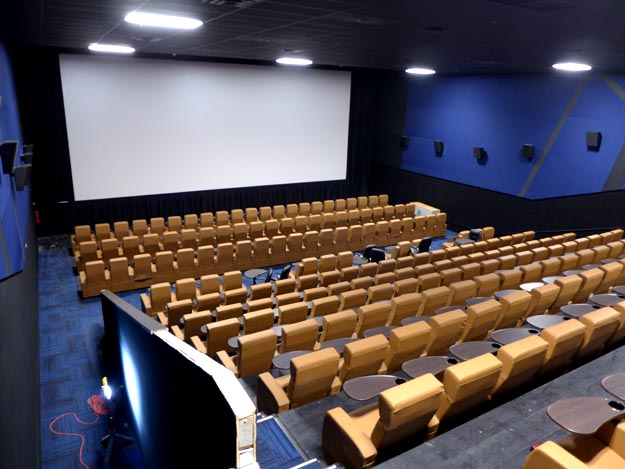
Posted by Rick Raskin (Member # 1561) on 12-17-2016, 04:29 PM:
If theaters become a thing of the past, what are all the tweens going to do on date night in Babylon?
Posted by James Wyrembelski (Member # 9037) on 12-17-2016, 06:01 PM:
YES!
The black around the area of the screen was something that totally bugged me before we took over our theater. The entire ceiling and most of the room was black (besides the wall curtains) except for...........the stage......a light white paint with a blue hue to it......ACK!
Posted by Ron Curran (Member # 3631) on 12-17-2016, 08:05 PM:
We are a small single screen sandwiched between two plexes. Our screen is common height with side masking and curtains. We do not show commercials – preshow consists of coming attraction images and community service ‘slides’ with soft music under. This lasts no more than 4 minutes before start time.
A maximum of 3 trailers opens the show – they are screened with masking to flat, audio at 38 (plenty) and house lights down, side lights dim.
The feature is shown with masking and image to the correct ratio, all lights down and sound (7.1 when available) at a level of 50 to 55 as appropriate, according to staff monitoring..
Patrons are ushered to their seats. Any mobile phone users are told to switch off NOW.
This is a CINEMA with a Scope screen. Directors who require a more intimate image have the masking brought in to 1.85.
What sort of third world automation are people using if it can’t handle proper cinema presentation, including individual touches such as masking changes within features (think Enchanted and The Horse Whisperer).
If people don’t notice or care, why do we regularly gross above the screen average?
Posted by Bobby Henderson (Member # 840) on 12-18-2016, 01:12 PM:
I can accept pre-shows and trailer packs since they're part of the business model for a theater to pay its bills. I just think they should be presenting such things in a better manner. I agree with Brad that the actual movie everyone paid to see should have the biggest and best quality image and best quality, most dynamic sound. A properly masked (and curtain equipped) common height screen is going to deliver better on that than the un-finished common width crap infecting so many new theaters.
Back when I liked movie trailers more, I thought it was great if they had a 5.1 surround mix. But too many of them are louder (and more obnoxious) than the feature's sound mix. So I would prefer it if they were dumped down to TV volume to throw a middle finger back at the sales-marketing assholes who order these mixing practices. Movie trailers tend to suck anymore since they all have the same boom-whoosh sounds, stylistic editing touches and used up tag lines like "get ready for the ride of your life." Why even bother?
quote: Joe Redifer
HBO is still a thing?
They do have that Game of Thrones series and some other original programming, such as Last Week Tonight with John Oliver, that make HBO one of the few channels on cable worth watching. If I didn't care about sports programming I would get rid of Dish Network and just get the HBO Now streaming service.
Now, channels like MTV, Discovery Channel, National Geographic or even big media companies like Viacom really do bring up the question "how are they still a thing?" If I could pick and choose my own specific pay TV channels to watch I'd end up with less than a dozen, and that's including a few HBO channels!
quote: Scott Norwood
On the subject of TV: what are people watching on their 4K TV sets?
Aside from UltraHD Blu-ray and Daniel's answers about Netflix, Amazon and DirecTV people can watch 4K content other sources on the Internet. Plus there are lots of consumer devices available now that capture 4K video (some smart phones, point and shoot cameras, DSLR cameras, GoPro or other action cameras).
quote: Jesse Skeen
Ever heard of cord-cutting? Some people are finally realizing what I've known for 25 years- cable isn't worth having.
It depends on the viewers and the kinds of programming they like to watch.
If you enjoy live sports programming you're stuck worse than ever with cable. So much of that programming has abandoned traditional broadcast networks and gone to cable networks. Premium cable networks like HBO, Shotime, Starz, etc. are showing more edgy and chance-taking content than what plays in movie theaters. The Spartacus series on Starz absolutely would have been tagged with a NC-17 rating if the same content was put into a conventional theatrical release. Even the season debut of The Walking Dead on AMC, a "basic cable" channel, took serious chances with its graphic violence. Casino was threatened with a NC-17 rating for trying to depict the same kind of graphic violence as shown in that episode of The Walking Dead.
One thing is certain: cable/satellite TV companies have been price gouging the hell out of customers lately. I think high price and relative lack of value for that high price is the key reason why so many people are cord cutting. Media company executives are very nervous about younger generations of viewers not even signing up for cable at all. Their own business model and programming paradigm is on the verge of collapse.
quote: Mike Blakesley
That's why I can't understand why NATO is so soft-talking on windows. Why don't they just come out and say "Studios, STOP SCREWING WITH THE WINDOWS because you will KILL YOUR BUSINESS AND OURS." Instead they keep yammering about "our studio partners" and "our friends in distribution."
The movie theater business is being subjected to the "death of a thousand cuts." I agree, the movie distributors will ease more day and date releases into the mix, acting like the policy has no effect. But you can gradually add tiny amounts of poison to somebody's food. He might not taste it, but eventually he's going to get sick and even die from the crap.
Distributors are trying to test the day and date thing with art house movies or other movies that would have gone "straight to DVD" anyway. But when they start going day and date with bigger, more legit movie releases the theaters will get hurt badly by it. Since customers by nature are pretty impatient they'll expect and demand the day and date thing to be the new normal once they get a good taste of it. Then movie theaters will be done. But the death of movie theaters will be the death of the movie business as we know it too.
quote: Rick Raskin
If theaters become a thing of the past, what are all the tweens going to do on date night in Babylon?
They'll sit in some college aged grown-up's house, watching stuff streamed from the Internet while drinking beer and smoking pot. Or they'll just go eat out at some better quality chain restaurant and then go home (and smoke some pot).
Posted by Daniel Schulz (Member # 1881) on 12-18-2016, 01:36 PM:
quote:
I get your point Jack (and others) that most people don't know any better, but having done photography in the past, seeing the effects of a dirty lens (or port window) or even a light smudge on my own glasses...I just can't stand it. It kills the contrast and makes everything look dull!
This reminds me of a story I heard recently from the Universal City IMAX screen, which still has 15/70 film projectors along with the new IMAX laser projectors. The port glass had not been cleaned in a *long* time, which was obvious when the new laser projectors went in and the crew was lighting them up for the first time with test patterns and wondering why they were performing so poorly. After cleaning the port glass the measurable resolution of the laser projectors was doubled.
As an aside, I like how they handled that installation - the film and laser projectors are on a rail system so they can now be swapped as needed. Rogue One is currently playing in 2D 15/70 film at that location.
Posted by Evans A Criswell (Member # 381) on 02-17-2017, 04:00 PM:
I haven't been on Film-Tech in a while and just read through this several-page discussion and am amazed that not having masking at all is becoming a thing. Some of you remember how I used to complain that Cobb built their multiplexes in the 80s and 90s (before Regal acquired them) with only a few large auditoriums and had 1.85:1 screens in all the others and showed scope movies with the sides chopped off, filling the 1.85:1 screen. Regal put top/bottom masking in its two Huntsville locations in 2003 so that the whole image was shown in every auditorium for both formats (common width in the small auditoriums and the original masked common height screens in the wider auditoriums). I hate to hear that we're now going backwards again. Of course, since most of the moviegoers are younger, after a decade or two of a negative change, nobody will remember the change and it "will always have been this way". Teenagers who go to theatres with no masking, 20 or 30 years from now, will never remember it. You don't tend to miss something that was never there, just as hardly anyone under 30 would remember TV shows without logos plastered in the corner because it's been part of TV since the early to mid 1990s. I have only been to 5 or 6 movies in the past 10 years and I've been wanting to start back going, but everything I read about the industry is discouraging in terms of what to expect if I start going to movies again.
Powered by Infopop Corporation
UBB.classicTM
6.3.1.2