This is topic A New Low in Presentation Standards in forum Ground Level at Film-Tech Forum ARCHIVE.
To visit this topic, use this URL:
https://ft-forum.com/ft/cgi-bin/ubb/ultimatebb.cgi?ubb=get_topic;f=5;t=003011
Posted by Daniel Schulz (Member # 1881) on 12-26-2016, 12:59 PM:
Just wanted to file this report, as it was so egregious.
Christmas evening I went to see Arrival at the newly renovated AMC Universal CityWalk. This theater has been heavily advertising its renovation on the radio, bragging about having powered leather recliners, Dolby Atmos and new laser projectors in every auditorium (ticket prices have been upgraded accordingly). First thing I noticed on entry was that the original problematic auditorium design was not altered (emergency exit is on an aisle to the left of the screen, so the screen is not centered in the auditorium). I'll let that go, as it's baked into the architecture of the building.
Second thing I notice is that the tab tensioners are visible at the bottom of the screen; the black fabric meant to hide them has pulled down, so there's not a clean masking edge at the bottom of the screen. I do take note of the Atmos speaker configuration; I've never seen Atmos in such a small auditorium, so that's pretty neat.
The screen is a 1.85 flat screen, and by now I no longer expect masking, so I know that my 'Scope movie is going to be projected letterboxed, so I'm braced for that.
Preshow starts, and I note that the image doesn't fill the screen. I shrug that off - often the preshow content is standard def, or 1080p, running on a secondary, non-DCI projector. It's annoying and unprofessional, but preshow, so whatevs.
But then, dear readers, then, the trailer pack starts and...the image still doesn't fill the screen. We are running flat content, off the expensive new Christie laser projectors, onto a flat screen, with empty screen area above, below and to both sides of the image.
Needless to say, when the feature starts I'm now witnessing a letterboxed image within the flat image area (the contrast ratio is good, but not so good that you can't see the letterbox bars), with that flat image area itself floating inside the flat screen. The 'Scope image doesn't even fill the screen from left to right! The effect is about as dramatic as if I'd just pointed a consumer 1080p projector at a blank wall in my apartment.
I know I'm preaching to the choir here, but man this does not bode well for the future of the exhibition industry. Thanks for listening.
p.s. if you're wondering I didn't bother complaining to anyone at the cinema, as I knew that was not something easily fixed onsite to save our show. I will be complaining after-the-fact in hopes that, while they won't install masking, they can at least fix the aesthetics of the bottom of the screen and get their Christie adjusted to fill the screen.
Posted by Tyler Purcell (Member # 9213) on 12-26-2016, 01:38 PM:
I saw two movies at AMC Burbank on Friday. I swore never to visit another AMC theater again in my entire life, but it was free. The first movie was 'Jackie', which was 1.67:1 aspect ratio. So the image didn't fill the full width of the screen. However it bled over top and bottom of the matte pretty substantially. The theater was never setup properly to run anything else but 1.85:1 or 2.40:1 content clearly. Very, very, very annoying. Worst off, they have installed some sort of special screen for those 3D projectors that totally alters the way a movie looks. It reflects light in a weird way that creates these little blobs of de-focused content. I had seen this before and it's why I hate AMC theaters.
Second showing was 'La La Land' which was in a much bigger theater. Some scenes there was important content on the curtain's, top bottom and left right. The same screen issue was present and was even worse because the screen was bigger. Had it not been free, I would have complained and got my money back.
The matte issue is such an easy fix, but the screens being all messed up, that's just uncalled for. They won't want things to look good in 2D, they only care about how they look in 3D. That's the problem folks and it's a problem at every AMC I've been to. Both in Boston where I spend a lot of time and here on the west coast as well.
Yet when you go to Arclight, those problems simply don't exist. Same ticket price, but AMC is a far worse presentation.
Posted by Daniel Schulz (Member # 1881) on 12-26-2016, 01:48 PM:
quote: Tyler Purcell
The first movie was 'Jackie', which was 1.67:1 aspect ratio. So the image didn't fill the full width of the screen. However it bled over top and bottom of the matte pretty substantially. The theater was never setup properly to run anything else but 1.85:1 or 2.40:1 content clearly.
I wonder how the Jackie DCP was formatted? 'Scope, but pillar boxed? Or Flat, but letterboxed?
Posted by Frank Bolkovac (Member # 6201) on 12-26-2016, 01:49 PM:
They just don't know, don't care, or just not interested.Future of the Cinema experience.
Posted by Adam Martin (Member # 641) on 12-26-2016, 02:00 PM:
Jackie is 1.66 inside of a flat container. La La Land is 2.55 inside of a scope container.
Posted by Paul Linfesty (Member # 214) on 12-27-2016, 12:13 AM:
And don't forget the NEWEST innovation of this theatre, perforated screens as this article points out: http://www.latimes.com/entertainment/movies/moviesnow/la-et-mn-universal-citywalk-amc-theater-renovation-20161212-story.html.
Ironically, when this was a Cineplex Odeon theatre back in the late 80's the theatre had common height screens with correct side masking.
Posted by Brad Miller (Member # 2) on 12-27-2016, 01:45 AM:
Forum policy...you must quote the article here to preserve the archives.
Posted by Paul Linfesty (Member # 214) on 12-27-2016, 02:22 AM:
Sorry about that...A little ‘Potter’ magic here too
The Wizarding World team redesigns the filmgoing experience at CityWalk cinemas.
BY LIBBY HILL
In April, Universal Studios Hollywood opened the Wizarding World of Harry Potter — an intricate re-creation of the universe created in J.K. Rowling’s series of “Harry Potter” novels, then interpreted for the Warner Bros. films — where fans have the opportunity to lose themselves in the world they love so much.
Content with what they’d built at Wizarding World, the minds at Universal Creative, the team that conceptualizes and deploys large-scale projects at Universal, set their sights on Universal CityWalk’s AMC Theatre, which, other than the installation of stadium-style seating in 2007, had gone untouched since it was built in 1993.
“We wanted a departure from the traditional movie experience,” said Gene Dobrzyn, senior vice president of Universal Creative.
That departure starts as soon as patrons enter the lobby and the newly designed box office area. The lobby is open format, eschewing the lurid reds and jewel tones favored by many theater chains in favor of cool blues and grays.
“The blue theme flows throughout,” said Dobrzyn. “We didn’t want to plaster it with Universal. We wanted to bring the Universal feel into it.”
Dobrzyn then points out the large sunburst chandeliers overlooking the lobby and globe vista on the second floor, echoes of Universal’s logo that lend themselves to the subconscious branding at work.
Gone are the outdoor box office windows, replaced with a serpentine queue system and centralized box office desk that allows patrons shelter from the rare adverse L.A. weather.
But for all the beauty of the redesigned lobby and lounge areas, the success or failure of the new look AMC hinges on what lies inside the 19 auditoriums — each of which is called the “black box.”
Black walls, black speakers, black seats — each of the theaters is designed to minimize any and all light interference that might distract from the filmgoing experience. Even the lights that assist patrons with stairs are a deep, unobtrusive blue.
The black seats do more than just absorb light. They also recline and expand into loveseats, creating an intentional feeling of luxury. “You would find these in a normal Hollywood screening style,” Dobrzyn said of the seats, which are 32 inches wide. “It used to be you would come to the movies and worry who you’d sit next to. Now there’s plenty of room.”
But as vital as it is to keep light and other distractions out of the black box, what Universal is putting into the black box is an even higher priority.
Each theater is equipped with Dolby ATMOS immersive surround sound and Christie RGB laser projection as well as a Christie Vive Audio system, allowing for audio fine-tuning on a theater-by-theater basis.
“The screens are all latest technology,” said Universal spokeswoman Audrey Eig. “They’re perforated, and we have about 40 speakers in each theater. We can point source audio out of anywhere in the theater, and as the image trails off-screen, the audio trails with it.”
The effect of the high-end projection and sound is palpable. Disney’s “Moana,” projected in 4K perfection, was eye-popping, rendering color and texture in scrupulous detail.
The Christie projectors are a departure from the old 35mm projectors, replacing bulky reels and film canisters with a sleek black box and laser projection, severing the link to physical film entirely.
Outside the auditoriums, the lobby and lounge area aim to be as comfortable and contemporary as the theaters themselves, places to relax and wait for friends.
“Getting to a movie early to get a good seat is a thing of the past,” said Dobrzyn, acknowledging the rise in reserved-seating theaters. “Now you can pick your own seat, get here any time you want. Now you can come and sit with your friends, you can talk, you can grab some food.”
Dobrzyn emphasized the importance of the free-flowing layout, using the “grab-and-go” -style concessions marketplace as an example.
“It’s all convenience style. It’s less standing in line. It’s ‘Go. Do your own thing,’ ” Dobrzyn said.
“While you’re standing in line, you can grab candy, popcorn. You don’t have to wait for somebody. You just grab a bag.”
For each choice meticulously made throughout the 18-month, four-phase process, Universal Creative always came back to the idea of creating a seamless, functional and state-of-the-art environment where film lovers could feel at home as they sat mere feet away from where some of their favorite movies were filmed.
“We have some of the most talented people in the industry creating these environments,” said Dobrzyn. “What keeps me doing it is the groundbreaking stuff that we do and seeing the guests at the end of the day come out with with a smile on their face.”
Now, the creators of Wizarding World of Harry Potter just have to wait and see whether Universal City-Walk’s AMC Theatre can make a little movie magic of its own. libby.hill@latimes.com
Posted by Buck Wilson (Member # 5885) on 12-27-2016, 07:50 AM:
I'm at a loss for words.
Posted by Bobby Henderson (Member # 840) on 12-27-2016, 09:58 AM:
Atmos and RGB Laser projection in every auditorium seems impressive. But I wonder if AMC got some kind of special deal from Dolby and Christie to make that happen at this high profile theater location. I certainly don't see AMC repeating that "Atmos & Laser in all auditoriums" treatment at many other theaters, if any. It certainly isn't happening if AMC is paying the normal price for all of that gear.
quote: Libby Hill, L.A. Times
The effect of the high-end projection and sound is palpable. Disney’s “Moana,” projected in 4K perfection, was eye-popping, rendering color and texture in scrupulous detail.
Obvious question: was Moana rendered in 4K resolution? Did the DCP contain native 4K content? These writers reporting on stuff like this or home theater should at least know better about making assumptions regarding some breed of projector or even a home HDTV set. Although some new laser projector may have 4K capability that doesn't mean the movies played on it will be 4K resolution. The vast majority of movies are not 4K.
quote: Libby Hill, L.A. Times
The Christie projectors are a departure from the old 35mm projectors, replacing bulky reels and film canisters with a sleek black box and laser projection, severing the link to physical film entirely.
She talks about that as if it's entirely a good thing. There's plenty of things in terms of quality that suck about "digital." There's also plenty of things that suck about new theaters, common width screens being one of the chief offenders. There's both good and bad regarding recliners. The increased comfort is good; although it's a pain in the ass to leave your seat if you need a bathroom break. Theaters pay a penalty of dramatically reduced seat counts and increased maintenance costs. People do love to break shit.
I'm not sold on reserved seating either. It can work in bad ways for both theaters and customers. I think reserved seating can hurt ticket sales. Since a customer has to buy in advance if he doesn't buy early enough he won't score a good seat. If he is buying late and sees no good seats left he may not bother. Theaters could end up stuck with more empty seats than they would with a first come first serve policy. When you're reserving a seat in advance you always get hit with that extra service charge. It's already expensive enough to go to the show without getting dinged with extra fees. Once someone has a seat reserved he can straggle into the show at any time, even well on into the movie and disrupting the show for others.
Posted by Louis Bornwasser (Member # 3063) on 12-27-2016, 10:13 AM:
Maybe I should patent "a perforated screen."
Posted by Harold Hallikainen (Member # 5405) on 12-27-2016, 10:36 AM:
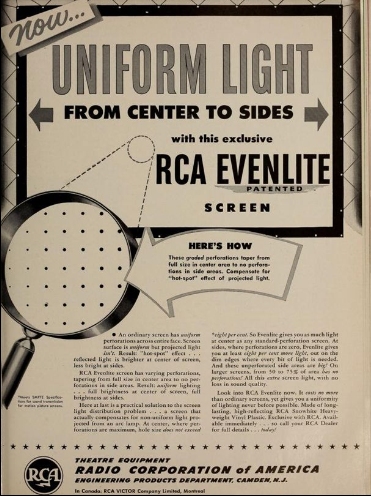
I was researching papers on luminance measurement for a SMPTE committee and ran across a paper from the 1950s about perforated screens. In this paper, they proposed varying the perforation area (I don't remember if they varied the hole size or the number of holes per unit area) to compensate for light fall off as you moved from the center of screen. More open area at the center of the screen reflected less light than at the sides.
Another SMPTE report on perforated screens shows a major portion of the high frequency sound being reflected by the screen instead of being transmitted through it. This is then reflected by the speaker back towards the screen (or worse, from the wall behind the screen) resulting in comb filtering of the audio due to the delayed signal combining with the original. But, it appears we are used to comb filtering by living in an environment with reflective surfaces, so it does not sound as bad as it looks on a spectrum plot. There also is overall attenuation of high frequencies by the perforated screen. This attenuation approximates the X-curve.
Harold
Posted by Bill Brandenstein (Member # 7758) on 12-28-2016, 10:50 PM:
Interesting that Daniel heard lots of radio advertising for Citiwalk's upgrade, but as much local radio as I listen to, only now just heard of this.
Wanna check out the details online? AMC's website is of no help. Neither is Fandango. The only amenity listed at either place is "power recliners." No mention of Atmos or laser, even though "Dolby Cinema at AMC" is a big deal at the other locations. Also unmentioned is Rogue One being in 70mm, although Fandango at least tells you that.
Is this transition still in progress? Wouldn't this be the first cineplex in the nation fitted with all Dolby Cinema? You'd think they'd shout that from the rooftops, or at least put it online. Ha! Maybe Dolby saw the miserable misalignments and pulled their trademark license...
Posted by Bobby Henderson (Member # 840) on 12-28-2016, 11:48 PM:
The lack of details from AMC's new web site design, not to mention it's really shitty Word Press style stock template, tempts me never to visit an AMC theater at all. The vauge-ness of it all implies that all AMC screens are just as good as any. As if they all have dual 4K laser projectors, Dolby Atmos surround sound and big recliners.
![[Roll Eyes]](rolleyes.gif)
To make matters worse, just get a gander on the new web site design's version of "Dolby Cinema @ AMC". Their list of "coming soon" Dolby Cinema screens contains theaters listed below in the "already has" list of Dolby Cinema screens. That's a real easy thing to update and they haven't even bothered with that. I guess it's just "give me your damned $22 for admission, shut up and like it!"
Posted by Daniel Schulz (Member # 1881) on 12-29-2016, 12:10 AM:
quote:
Interesting that Daniel heard lots of radio advertising for Citiwalk's upgrade, but as much local radio as I listen to, only now just heard of this.
Is this transition still in progress? Wouldn't this be the first cineplex in the nation fitted with all Dolby Cinema? You'd think they'd shout that from the rooftops, or at least put it online. Ha! Maybe Dolby saw the miserable misalignments and pulled their trademark license...
Although the auditoriums are now Dolby Atmos, they are not full-blown Dolby Cinema auditoriums (although the difference between the standard Christie laser projectors and the Dolby Cinema models is something I couldn't tell you).
Re: the website, I am given to understand that although AMC manages the site the property itself is much more the purview of Universal CityWalk, so that could explain the paucity of info on the AMC website. The Universal CityWalk site is a little more informative.
Posted by Mike Blakesley (Member # 26) on 12-29-2016, 01:59 PM:
Considering it's in the middle of a theme-park-type area, there's probably some sort of co-ownership or co-op thing going on there. They probably have a whole rule-book they have to follow that's in addition to what they'd have to do in a regular standalone setting.
I love the "black box" concept. Passing off "black everything" as an advantage when it's really just a cash saving tactic. I hate all-black auditoriums; they're depressing. I'm sure the thinking is "who cares what color it is when the lights go down?"
I also don't like reserved seats for the simple reason it's going to result in a lot of people showing up late for the showtime, in an attempt to miss the trailers and ads, resulting in a lot of stumbling and feet being stepped on, etc.
Posted by Mitchell Dvoskin (Member # 751) on 12-29-2016, 02:57 PM:
Went to see LA LA LAND at the AMC Rockaway Town Square Mall (NJ) Location.
Far too many trailers.
Poor contrast for the feature. Trailers looked ok.
Picture did not reach the bottom of the screen on the left/right sides (slightly curved screen).
Feature looked soft. Actually, it looked like it was in focus but lacked detail. Looked like watching a 1080p image on a huge screen, but obviously it was a theatrical DCP.
Sound (not Atmos) was good.
Posted by Brad Miller (Member # 2) on 12-29-2016, 03:25 PM:
"Black box" auditoriums do no good if the very area around the image is not masked (aka: floating screens or no masking).
The color of the walls once you get so many feet away from the image doesn't really matter much. It's the entire front end of the auditorium that must be solid black with masking to the image area to achieve higher quality.
Posted by Jesse Skeen (Member # 586) on 12-31-2016, 12:05 AM:
Sad that this would happen at a theater located AT the Universal Studios theme park- surely SOME people who work for the studio itself have been there and care about how their movies look?
I'm REALLY done with theaters at this point- I'm saving up for a video projection system, Atmos sound and maybe even some deluxe recliners or other fancy seating for my living room. As the theater experience gets worse and higher priced, the home experience gets better and more affordable.
Posted by Stephen Furley (Member # 1277) on 12-31-2016, 06:22 AM:
quote: Adam Martin
La La Land is 2.55 inside of a scope container
Why?
We are Screening La La Land in early March. Anything wider than 2.39 is a real pain to do. With digital side masking moves for anything between 1.33 and 1.85, but top has to come down for 2.39. It cannot come down any further. On Thursday we had Carmen Jones as part of the BFI 'Blackstar' season, which was 2.55 of course, and a few months ago we had a similar problem, but to a greater extent, with The Hateful Eight.
We had to shift the lens up, and for The Hateful Eight tilt the projector as well, the bring the picture up to the top masking, and then rig up some temporary bottom masking higher than normal using spring curtain wire stretched across the screen frame and supported at three points across its width on thin strips of wood hidden behind the cloth.
It looked good, but takes two people about half an hour to set up, has to be removed before the next show, and prevents us showing any trailers while it is in place.
Is La La Land really letterboxed to 2.55? If it is then we're going to have to do this again. We cannot show the picture letterboxed within a screen masked to 2.39 s we have some horizontal keystoning, which we are trying to do something about, and it would look terrible.
Café Society at 2.0:1 also caused us problems, in this case we had to tilt the projector down, not enough lens movement, to meet the normal bottom masking. At least in this case the top masking could be brought down far enough.
Don't we have enough different aspect ratios as it is without reviving odd ones which haven't been used for decades?
We're seeing increased use of other ratios for new films as well. About three 1t 1.66 in the last year or so, two at 1.33 or 1.375, and quite a lot of low-budget stuff shot on HD video at 1.78.
Posted by Leo Enticknap (Member # 534) on 12-31-2016, 12:05 PM:
quote: Stephen Furley
Don't we have enough different aspect ratios as it is without reviving odd ones which haven't been used for decades?
I projected for a seminar that Scorsese gave a few weeks ago, which immediately followed a screening of New York, New York. Someone asked him how he went about achieving a 1940s look in the 1970s, to which he replied that his first decision was to shoot in 1.37, which was vetoed by the producer on the grounds that almost no theaters would be able to play it properly, it would end up being shown in 1.85 in most places, and would only ever look even close to right on TV. In the end, he framed it with the intention of it being played in 1.66 (which was how I projected it), but with enough headroom that 1.85 would be just about acceptable.
Scorsese then commented that one of the few good things about digital cinema is that filmmakers can now pretty much choose any aspect ratio they like, without having to worry about the image being cropped in theatrical projection. He could also have added that it also enables DCP re-releases of titles produced in more unusual ratios to be presented in the correct shape (e.g. 1.66, 2.20 and 2.55), too.
The problem is, as you and others point out, that in a house with common width masking, this can only be done at the expense of image size if you want to go significantly wider or taller than 1.85; and at the extremes (1.19 Movietone or 2.79 UP-70), you're left with a tiny image.
I played that Carmen Jones DCP at AFI last month. The DCP transfer is really merciless to the shortcomings of very early CinemaScope: grainy as hell and even medium close-ups have the mumps really badly.
Posted by Brad Miller (Member # 2) on 12-31-2016, 12:08 PM:
I'm guessing nobody bothered to point out to Scorsese that while digital cinema may make it easy to achieve any aspect ratio, it doesn't easily achieve proper masking for it and that the movie will generally look bad everywhere (no masking or incorrect masking).
Really the same thing could have been done with film, and was on occasion. Case in point everyone remember the Wizard of Oz reissue where most prints were 1.33 within a 1.85 "container" (to use digital lingo)?
Posted by Leo Enticknap (Member # 534) on 12-31-2016, 12:10 PM:
I was stuck in the booth, or else I would have done.
He clearly knows more about what projection involves than many A-list filmmakers, but that response showed that his knowledge has limits.
Posted by Bobby Henderson (Member # 840) on 12-31-2016, 01:15 PM:
Far too many people have a romanticized image of digital technology. They believe it is infinitely precise, infinitely flexible and can do virtually anything. The truth is the technology can be very coarse and has its own numerical-based limitations.
For instance, look how terrible SD-resolution digital imagery looks when blown up (and cropped) to HD. I watched a lot of that in recent days with video retrospectives on the news about dead celebrities like Carrie Fisher and George Michael. 80's music videos can look pretty bad when you zoom away the black pillars to fill a HDTV screen. It would not have looked nearly so terrible if the elements they were blowing up were film, not SD video.
Film has its own limitations, but its "organic" nature makes the imagery more flexible.
I don't think the people who drafted current d-cinema standards were thinking clearly about all the best possible choices. They certainly were not considering the situation from a theater's perspective, or even what best to do within the limits of optical technology.
If it were up to me, d-cinema projectors would not have these rectangular shaped imaging chips in them. The 1.9:1 ratio chips seem to require much bigger and more expensive lenses than 35mm film projectors, like those giant Konica-Minolta lenses on the 2K Christie projectors at our old Carmike theater. Optics are circular. It's more efficient to fit a square inside a circle than a rectangle inside a circle. Lenses do not come with oval shaped light paths. It would have been better to use a roughly square imaging chip and project the image through a 2:1 ratio anamorphic lens. A square 4K resolution imaging chip would pack a hell of a lot more pixels than current chip designs yet not need such a huge, expensive lens. True anamorphic content would probably look far better than "scope" does in theaters now.
Unfortunately the standards folks said "no" to anamorphics. And then there is this problem of productions going on the cheap, doing everything in "2K," really 858p "scope." Add to that all the common-width movie screens. Take away the masking. Make it look just like the TV set at home. The ultra-wide aspect ratio imagery that was supposed to be BIGGER than anything else ends up looking smaller and less detailed.
Posted by Tyler Purcell (Member # 9213) on 12-31-2016, 03:41 PM:
I've actually made content that was shown in theaters and on our color grading monitors and scopes we would see all sorts of issues with noise. Yet when presented in a standard issue movie theater via DCP ALL of those issues were invisible. It was like someone applied a softening filter to everything. It was quite eye opening to the level of image manipulation modern digital cinema projectors achieve.
The standards for digital cinema projection were setup in the 90's and they were all based around a REC709 color space and 2k imagers. It's been 20 years since the first digital cinema projectors were installed for Toy Story and nothing has changed. We're still distributing films using the same REC709 color space in 2k. It really doesn't matter that SOME theaters have 4k projectors, it's nearly impossible to find that content. In fact, I'm still to this day shocked they don't advertise actual 4k releases because they look so much better.
If cinema's as we know them today stick around, what will happen is that studio's will force theater owners to adopt HDR laser projection systems in order to get a certain title, maybe Avatar 2 or something like that. So theaters will have spend gob of money upgrading so they can get that movie first run. That will set off the first "standards" change since digital cinema started. but as of today, those poor theaters that invested in Laser HDR are being screwed thanks in part to the reluctance of the format catching on. There is NO reason why every movie can't be slightly modified for HDR playback. They spend millions converting movies from 2D to 3D, the HRD conversion is a few hours worth of work, yet they don't do it. Theaters I think will loose their shirts with the HDR Laser upgrades, it's vastly more expensive then standard 2k digital cinema projectors. So if they're forced to make that kind of an upgrade, I fret many simply won't get those titles, what ever they may be.
If I were a studio head, I would ban 2k from even existing! All of the digital cinema cameras shoot close to 4k (The alexa XT being 3.2k). So there is no excuse for filmmakers NOT using a 4k workflow. Even on the little feature I just finished at home, we could have easily finished in 4k, but the studio didn't even want a 4k version. They wanted 1920x1080, they wouldn't even accept our 1.85:1 2k finish! So our movie now has black bars at the top and bottom and won't ever be played back in real 2k. Ohh and this is SONY's specs ladies and gentlemen. You know, the company that pushes for high-resolution technology? Their flagship camera the F65 shoots 8k, yet ALL of the movies shot with it, have been released in 2k. WHAT?!?!?!
Meanwhile in Japan and even China, cinema's have been 4k for decades and ALL of their content is 4k. They adopted digital cinema MUCH later then we did, but when they did the roll out, 4k was already the standard. So they pushed out the film projectors fast and ramped up 4k digital cinema. The Japanese and Chinese studio's all pushed for 4k acquisition at all cost, even if the cameras looked like crap color wise, it was always about resolution for them. Heck, I've heard that there is a real 8k projection solution in Japan that's been adopted by theaters who no longer want to pay for IMAX licensing. They're actually shooting and distributing in 8k and honestly, from what I've been reading, its not been a problem. So if they can do 8k... why the heck are we doing 2k? The main excuse is the hard drives are too costly... really? That's such a lame excuse, it doesn't even compute.
Finally.. 4 perf 35mm camera negative resolves around 5k. So if you shoot anamorphic 35mm, you're dealing with an image that's pretty close to 4k. Once you make an IP, IN and release print, that resolution drops substantially. Final 35mm release prints are around 800 horizontal lines worth of resolution. So they're pretty darn close to 2 DCP, yet they're 4th generation! A 5k digital scan of 35mm negative, digital color correction and a 4k laser out, resolves MUCH higher resolution then the classic photochemical finish. Then there are larger formats like 5/70 which look fantastic when high-resolution images are scanned onto it. A great example would be the 5/70 print of 'Interstellar' and 'Batman v Superman', both finished in 4k. So if the old 50's workflow is no less quality then our "modern" digital workflow, then why the F are we mucking around with it?!!?! Goes to show, it's all about pencil pushers in the long run.
Posted by Bobby Henderson (Member # 840) on 12-31-2016, 07:06 PM:
4K, 5K, 6K and 8K d-cinema cameras on set make no difference.
The reason why HDTV quality 2K remains very much the de facto standard iin movie distribution to theaters and home video is it's a lot cheaper to handle in post production. Executives figure 2K is good enough. It takes at least 4 times the amount of rendering time to produce CGI effects in 4K. Other post production costs ramp up with 4K versus 2K.
The last time I checked there are no digital projectors with native resolution going above 4K. So shooting formats like 6K and 8K will always get down-rezzed to at least 4K in post production, if not 2K.
Posted by Daniel Schulz (Member # 1881) on 12-31-2016, 07:38 PM:
quote: Tyler Purcell
The standards for digital cinema projection were setup in the 90's and they were all based around a REC709 color space and 2k imagers. It's been 20 years since the first digital cinema projectors were installed for Toy Story and nothing has changed. We're still distributing films using the same REC709 color space in 2k. It really doesn't matter that SOME theaters have 4k projectors, it's nearly impossible to find that content. In fact, I'm still to this day shocked they don't advertise actual 4k releases because they look so much better.
DCI color space is P3, with substantially more of the visible color spectrum covered than Rec 709.
As to resolution - although I would definitely be all on board with moving all of D-Cinema to 4K, I don't see 2K digital projection as a giant stumbling block. I see quality differences in motion picture imaging that are much more related to the choice of camera used in image acquisition, talent of the DP, and talent in color grading, irrespective of whether the final product is 2K or 4K; I'd rather see good 2K than mediocre 4K, at the typical screen size and viewing distance for cinema. And I'd much rather see HDR 2K than SDR 4K.
As noted above, the real limiting factor with 4K DCPs isn't the principal photography, it's rendering time and cost for the VFX. I think Moore's Law, coupled with the evolution of home video via UHD Blu-ray and the streaming 4K services, will push motion picture production into 4K pipelines.
Posted by Bill Brandenstein (Member # 7758) on 12-31-2016, 08:02 PM:
Tyler, Interstellar 5/70 was purely photochemical on any shots permitting it.
And I agree that it's pencil pushers to blame. That, and the movie-going public is ignorant of what they're seeing and hearing.
Now, if you will, let me redirect this excellent discussion back on-topic. I went. To Universal AMC. With my family. It was great.
So we celebrated New Year's Eve by going to Rogue One in Imax 15/70 and Sing in 2D. You can see my detailed presentation comments for each title on the review threads: Sing, and Rogue One.
I'm not dismissing the concerns voiced above and on Yelp; expensive cocktails in a plastic cup that can't leave the bar area, $10 popcorn buckets, confusing queues, and shoddy projector installations are real issues here. But please remember that the Santa Clarita community is a city of 200K serviced exclusively by 2 lackluster Edwards' cineplexes. They're not awful; but don't go expecting the presentation to thrill you.
This did. Imax on film rocks, but you knew that. More importantly, I stuck my head into about 8 other screens and saw brillant, colorful laser images on all of them, including the largest ones, and immersive sound speakers all over the place, including subwoofers in the middle of the side walls. So while I don't think this necessarily qualifies as Dolby Cinema, it is SO VERY MUCH BETTER than average, even your best and brightest DLP, what is the point of quibbling when the Dolby Cinema houses are so few and far between?
Let me address Daniels's very reasonable complaint. It appears that screens 1 and 14 (the massive, balcony-equipped ones at the front left and right of the complex) have incorrect lenses. The screens are very large, the throw is modest, and the picture indeed doesn't quite fill the edges. That's just stupid. The ads are shown full-screen, then masking drops and the Rogue One scope image uses the bottom portion, meaning that the bottom corners "smile." But at least the masking is there and adjusts.
As for all the others, the alignment and edge-to-edge brightness was fine, with the exception of screen 13 where we viewed "Sing." As I noted on the "Sing" review thread, it was a dual-head projector with a portion that was slightly out-of-focus, and the very bottom left edge was half brightness because the projector wasn't entirely high enough to clear the port window.
So installation was sloppy. This is still so far ahead of what I typically see at the movies that it's hard for me to get too worked up about it.
However, to be fair Daniel, I'd love to know where you consistently enjoy going for movies. Arclight? Do you really think Arclight's images look as good as AMC Universal's lasers?
Sherman Oaks, Burbank, and Universal City are all 25-30 miles from home, and today was a rare day to pry my family out of our home valley to see this show. In fact, it's been (regrettably) a whole year since the last time.
Posted by Bobby Henderson (Member # 840) on 12-31-2016, 08:33 PM:
quote: Daniel Schulz
As noted above, the real limiting factor with 4K DCPs isn't the principal photography, it's rendering time and cost for the VFX. I think Moore's Law, coupled with the evolution of home video via UHD Blu-ray and the streaming 4K services, will push motion picture production into 4K pipelines.
Native 4K (and higher) resolution content faces serious uphill battles.
The Ultra HD Blu-ray format is walking on proverbial thin ice. The format itself, despite technical superiority to regular Blu-ray, is up to this point a sad joke. Very few titles on UHD BD are true 4K. Most are fake 4K, blow-ups from 2K sources.
The Ultra HD Blu-ray format, like all physical optical disc retail products (software, music, movies), depends largely on brick and mortar retail channels for sales. All of the specialty music/movies stores are dying. Video rental stores are nearly extinct. Retailers like Walmart and Target are their last hope. Online merchants like Amazon sell lots of music and movie discs (sales tax free of course), but Amazon has a big and growing business in streaming movies and music. The movie studios themselves have been reducing their movie disc releases to mere bare bones products. If the movie does have ample extras the studios divide up extras between Walmart, Best Buy and Amazon specific products. And then the studios give preferential treatment to their own "HD Digital" download products, offering them up for sale 2 to 4 weeks earlier than when the Blu-ray version hits retail shelves.
4K streaming might take off, but only when really fast Internet connections become widely available. Currently only a small minority of Americans can stream true 4K content without it dumping to 1080p or 720p. Of those who can stream 4K content, how many will bother paying extra to do so? If I recall correctly Netflix has an upper tier subscription costing a few bucks extra per month to unlock 4K.
And then there's the studio bean counters. Moore's Law is definitely working in terms of advancements in GPU technology. nVidia stock has been one hell of a great investment in recent years. Their GPUs are being used in pioneering artificial intelligence. Still, the bean counters see that "4K takes 4 times the amount of rendering time" equation. It doesn't matter if the render time is being brought down to faster and faster times. 2K will still always remain 4 times faster and more profitable.
Even those 4K UHDTV sets have pushed 2K sets aside in electronics stores, they're probably going to be stuck playing 4K content from consumer GoPro cameras, smart phones and computer displays.
Posted by Tyler Purcell (Member # 9213) on 12-31-2016, 10:17 PM:
Most people still color in Rec709 because it meets all deliverable criteria. Thus, they don't need to do any conversion of color space which may upset the over-all look of the image. Studio's don't require P3 deliverable, they take 12 bit 444 REC709 2k files and make DCP's out of them for projection.
In terms of 4k being a limitation for rendering, that's hogwash. I work for a few VFX houses, supporting their server infrastructure and client workstations when I'm not out making movies. They do everything in 4k and the difference in render time is negligible because they only render final approved outputs in 4k, everything else is 1080p. So the time it takes to render out 250 special effects shots in 4k vs 2k is what, maybe 3 extra days tagged onto post? Disney/Pixar have been rendering their all CG movies in 4k for over a decade. Yes they have one of the best render farms on the planet, but you never hear them complain about 2k vs 4k rendering.
On those same lines, most movies don't have big VFX shots, so they have no excuse.
I render 2k and 4k out of DaVinci on a daily basis, 2k will render at slightly above real-time and 4k will render slightly below real-time. We're not talking about minutes per frame, this isn't the 90's. So if DaVinci has no problem conforming 4k on my nearly 10 year old workstation, then movies without heavy visual effects shots, have no excuse.
Posted by Bobby Henderson (Member # 840) on 12-31-2016, 11:17 PM:
quote: Tyler Purcell
In terms of 4k being a limitation for rendering, that's hogwash. I work for a few VFX houses, supporting their server infrastructure and client workstations when I'm not out making movies. They do everything in 4k and the difference in render time is negligible because they only render final approved outputs in 4k, everything else is 1080p. So the time it takes to render out 250 special effects shots in 4k vs 2k is what, maybe 3 extra days tagged onto post? Disney/Pixar have been rendering their all CG movies in 4k for over a decade. Yes they have one of the best render farms on the planet, but you never hear them complain about 2k vs 4k rendering.
I smell bullshit in that story. If 4K was really so fucking easy to render then why even bother with 2K, especially when 4K TV sets are totally taking over electronics store shelf space?
I don't make movies, but I've only been doing computer graphics work for my living for the past 25 years. I'm keenly aware of the capabilities and limitations for computer systems. And I'm also keenly aware of bean counters using those same facts of life regarding digital technology to their own benefit.
Nearly all movies are still having their final render done in mere 2K. I will not buy it for a second that all CGI is being output in 4K only to be dumped down to plain HDTV quality. The math of it easily spells out the render routines being dumbed down to 2K way ahead of post production crews getting their mitts on the assets. There is absolutely no logic at all for any movie to have all of its post production work done at 4K and then only get dumbed down to 2K for final theatrical release. The idea of that is only absolutely stupid.
Posted by Tyler Purcell (Member # 9213) on 01-01-2017, 01:52 AM:
Well it's all true and it's my business, I'm on the creative side of things and 4k is not a big deal at all. I work with Red Code, Pro Res XQ, Cinema DNG and Intraframe MPEG on a weekly basis, all of them in 4k workflows. Now my clients only need 1080p versions, but due to the ability to zoom up images and the higher color space of using the original files, I generally finish at the full resolution. Then I will down-res to match whatever the clients delivery requirements are.
This is the same workflow EVERYONE in the studio system uses. They don't convert the camera raw to 2k... no, they edit the show in a low-res proxy format. They take the project import it into DaVinci or equivalent software for finishing. They link to the original camera media which is in most cases 4k or above. They do all the finishing in that resolution. They give the effects houses colored camera original (and size) files to work with and the effects houses give them back exactly the same format they give to them in the first place. Once the whole show is complied and all the effects shots are replaced, they will export to the settings the studio requires.
This is how things are normally done. Yes I've been part of post production on many shows that shot on Alexa in 3.2k and they finished in 2k because in doing so, they fill-in the missing color information from the bayer pattern. Alexa shows are almost entirely finished in 2k as a result of this small issue. However, Red shows are always finished in 4k because the camera can't shoot less then 4k without cropping the imager. Same goes for the Sony F65 and even the new Alexa 65. Almost every digital movie made is shot with one of those 4 cameras; Alexa XT (3.2k), Alexa 65 (6k), Sony F65 (4k) or Red Dragon (6k).
Posted by Bobby Henderson (Member # 840) on 01-01-2017, 04:07 AM:
You're still talking about shooting live action imagery with video cameras, not the 3D/CGI rendering stuff and compositing chores which require an immense amount more of compute horsepower than merely shooting the live action "plates." All that post production stuff is really where the money choices between 2K and 4K take place. Way too many "deciders" go the 2K route thinking that's good enough.
Posted by Stephen Furley (Member # 1277) on 01-01-2017, 06:06 AM:
quote: Leo Enticknap
I played that Carmen Jones DCP at AFI last month. The DCP transfer is really merciless to the shortcomings of very early CinemaScope: grainy as hell and even medium close-ups have the mumps really badly.
Leo, it was certainly grainy, but I was surprised at how good the colour looked.
Interesting that you should mention the mumps. The BFI could not supply a trailer, and the several copies on Youtube were all terrible, so I went to HMV and bought the Blu-Ray. This had a somewhat better copy of the trailer, only SD, but the best that I could find. I keep a caption on the server to show before such 'bad' trailers, as we sometimes have to use for old films. The HD video of the film itself looked much better, in fact not a great deal different to the DCP unless you looked closely. Both showed signs of 'mumps', presumably they would both have been derived from the same digital transfer from film elements. However, the trailer looked much worse. Did they digitally distort the new trailer somewhat to reduce the 'mumps' effect? It would be interesting to overlay the same still frame from the trailer and the new trailer of the film.
The sound was a bit disappointing, but reasonable for its age; at least unlike an original Cinemascope print probably would have it didn't have 12 KHz tone.
Posted by Daniel Schulz (Member # 1881) on 01-01-2017, 11:16 AM:
quote: Bill Brandenstein
Let me address Daniels's very reasonable complaint. It appears that screens 1 and 14 (the massive, balcony-equipped ones at the front left and right of the complex) have incorrect lenses. The screens are very large, the throw is modest, and the picture indeed doesn't quite fill the edges. That's just stupid. The ads are shown full-screen, then masking drops and the Rogue One scope image uses the bottom portion, meaning that the bottom corners "smile." But at least the masking is there and adjusts.
I was in one of the small auditoriums, and there was no masking at all. The screen was of modest size, as was the throw distance. I really want to like this theater, as I agree with you that their spending the money to put in Atmos on every screen and dual laser projectors suggests an intention to do right by the audience - which is why my experience with the image not filling the screen was so frustrating.
quote: Bill Brandenstein
However, to be fair Daniel, I'd love to know where you consistently enjoy going for movies. Arclight? Do you really think Arclight's images look as good as AMC Universal's lasers?
I used to like Arclight Hollywood, but it has gone *way* downhill over the years. I've been dividing my time pretty equally between the TCL Chinese IMAX, the Dolby Cinema screens at AMC Burbank or AMC Century City, the Village in Westwood (probably my favorite venue, as it is a huge non-stadium house with a huge, properly masked 'Scope screen and Dolby Atmos), and Arclight Hollywood for run-of-the-mill releases.
Posted by Bill Brandenstein (Member # 7758) on 01-01-2017, 03:56 PM:
Fair answer, Daniel. Helpful, even! And had "Sing" been in scope I might've had a different opinion (since screen 13 was small, and I don't know if the edges are true moveable masking or not).
Ever do Arclight Sherman Oaks? I've been to all of the venues you mentioned, all in pre-Atmos days, but not that one.
Posted by Bobby Henderson (Member # 840) on 01-01-2017, 05:32 PM:
I imagine Dolby Atmos ceiling surround speakers would be much more effective in a normal slope seating auditorium like the Village theater because of the lower ceiling.
Posted by Daniel Schulz (Member # 1881) on 01-01-2017, 08:00 PM:
quote: Bill Brandenstein
Ever do Arclight Sherman Oaks? I've been to all of the venues you mentioned, all in pre-Atmos days, but not that one.
I don't mind Arclight Sherman Oaks, other than being annoyed that it was a retrofit to faux-Arclight of an existing Pacific; the Arclight Hollywood, built from scratch (apart from the Dome of course) is superior.
Honorable mention also for the Pacific in Winnetka - I don't go there much now that I no longer work in the West Valley (I used to stop at that Pacific on the way home from work sometimes), but the two big houses in Winnetka have killer Meyer sound systems, huge screens and good projection.
My closest theater is the Laemmle North Hollywood, which is OK mostly because it's pretty new.
Posted by Leo Enticknap (Member # 534) on 01-01-2017, 10:05 PM:
quote: Brad Miller
Really the same thing could have been done with film, and was on occasion. Case in point everyone remember the Wizard of Oz reissue where most prints were 1.33 within a 1.85 "container" (to use digital lingo)?
Point taken, though with film, presenting a non-standard (as in, not 1.85 or 'scope) aspect ratio involved either the theater spending serious money (investing in a lens and plate for the desired ratio) or the distributor (creating pillarboxed prints, as you note, and which happened quite a bit in the '90s, e.g. with The Blair Witch Project and the Dogma 95 movies).
With a DCP, you don't need to spend that up-front money to avoid cropping the picture, but just because you can get the aspect ratio right in the DCP doesn't mean that the theater it goes to can mask the screen properly, or avoid presenting an unacceptably small image. If you want to be able to do the full range of ratios from 1.19 to 2.79 with an acceptable picture size, you need a native screen ratio of around 2.20 and adjustable masking on all four sides, which only a tiny handful of theaters are in a position to invest in.
quote: Stephen Furley
I keep a caption on the server to show before such 'bad' trailers, as we sometimes have to use for old films.
An excellent idea, which I fully intend to rip off - thanks Stephen! We do sometimes have to make DCP trailers for more obscure titles from less than ideal sources (including, very occasionally, ripped from YouTube), and so a snipe like that would be a good idea.
Posted by Jim Cassedy (Member # 4115) on 01-03-2017, 01:10 PM:
quote: Harold Hallikainen
I was researching papers on luminance measurement for a SMPTE
committee and ran across a paper from the 1950s about perforated
screens. In this paper, they proposed varying the perforation area
Apparently, RCA marketed such a screen in the early 1950's.
This ad-scan is from 1951:
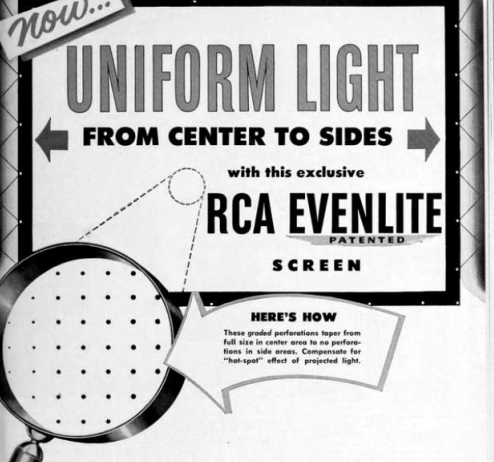
Close-up shows the 'graded perforations'
Posted by Mike Blakesley (Member # 26) on 01-03-2017, 01:12 PM:
How are screen perfs made, anyway? Seems like it would be a fascinating process to watch a screen get made.
Posted by Jim Cassedy (Member # 4115) on 01-03-2017, 05:36 PM:
I think they start off with a big box of little holes.
Then they spread them out on a flat surface and weave them together.
(But seriously, it would be a good topic for the "How It's Made" TV show.)
Posted by Mike Blakesley (Member # 26) on 01-03-2017, 06:10 PM:
I always thought they laid out thumbtacks on a floor and...never mind, getting ridiculous. I agree it would be a good TV topic.
Posted by Leo Enticknap (Member # 534) on 01-03-2017, 06:57 PM:
I'm guessing that it's done in essentially the same way that film is perforated: a cutting block (like the one in a Neumade or CIR splicer) is driven through the surface under pressure. Presumably the screen surface has to be held taught in some way as this is done, to avoid hanging chads.
Posted by Tony Bandiera Jr (Member # 2365) on 01-03-2017, 07:51 PM:
quote: Mike Blakesley
How are screen perfs made, anyway? Seems like it would be a fascinating process to watch a screen get made.
Well, I can tell you from some past experience that most screen makers guard that information carefully. I got to tour Stewart Filmscreens some years ago, and they would not show me the perforation or manufacture of the seamless screen materials. "Proprietary process" was the quoted reason.
Posted by Mike Schulz (Member # 4297) on 01-03-2017, 08:39 PM:
quote: Leo Enticknap
to avoid hanging chads.
The year of 2000 called. They want their chads back.
Posted by Steve Guttag (Member # 268) on 01-04-2017, 06:18 AM:
Well for Stewart, there is no mystery there. On their standard Cine-perf, it is clearly manually applied via some sort of rolling pin. Just look at one. The perfs are not uniform in application (they weave about). The good in that are no moiré patterns. The bad, sometimes they collide into each other and appear to have a seam.
The bigger deal on Stewart is that their gains are spot on and the image off of one really looks better. Their Ultramatte 130 is a non-hotspotty looking screen with a bit of "snap." Their Snomatte 100 screens are what a screen should look like. I just wish they were not 4-5 TIMES as much money as a standard movie screen. They are better, just not that much better (unless you are evaluating image quality on it or are betting your career on the look).
Posted by Martin Brooks (Member # 1269) on 01-23-2017, 12:57 AM:
quote: Adam Martin
La La Land is 2.55 inside of a scope container.
I saw this a few days ago at the Loew's Lincoln Square in NYC on their "Loew's" screen, which is their largest auditorium, with a balcony and Dolby Atmos sound.
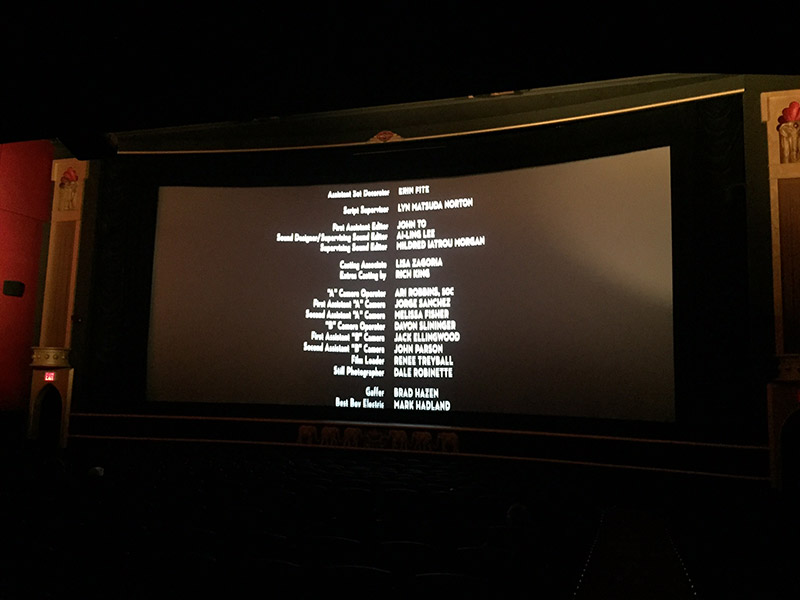
Maybe it's because of the curved screen, but it did not look to me like it was projected at 2.55. It looked like standard 2.4:1 to me. When the "LaLa Land" title appeared there was very little space on the left and right sides outside of the title. Did anyone see this in a theatre where they were sure it was projected at 2.55? Do you remember if there was much space outside the title?
I'm wondering if they enlarged the image to common height and lost some of the width.
Posted by Martin Brooks (Member # 1269) on 01-23-2017, 06:23 PM:
Someone on this site who wants to remain anonymous sent me a photo of the title frame of La La Land playing at their theater and as it turns out, I did see it at 2.55:1. It just didn't seem that way due to the curved screen. Interesting how that affected my perception.
Posted by Aron Toplitsky (Member # 6950) on 05-13-2017, 02:06 AM:
Wow didn't know Lincoln Square converted their Loew's auditorium to Atmos. I've seen many films in that auditorium when I lived in NY. Towards the end around ten years ago it just didn't sound good anymore. How is the Atmos in that room?
Just wondering if there is any update on AMC Universal and their crappy projection? The theater looks really nice and I'm loving laser projection/Atmos in every theater, but don't want to drive 25 miles north to experience a lousy image.
Posted by Mark Ogden (Member # 43) on 05-13-2017, 09:01 AM:
For what it's worth, I've seen two movies at the AMC Universal theaters in the last few months, Life about a month and a half ago, and Fate of the Furious two weeks ago. Both were fine visually, bright and sharp. I tend to believe that the report that began this thread was an embarrassing but one-off problem and not a regular occurrence at the theater.
But I'll tell you one thing I noticed about the sound at both these shows: the ridiculous low frequency amplification. Both these shows had the subs cranked up to Sensurround levels, and while some get off on that kind of thing, the acoustic rattle in both houses was noticeable, annoying and uncalled for. I'm all for good sub-bass performance but if you can't do it cleanly without rattling and vibrating every fixture in the room, then you are just calling attention to your fanboi sound system and you aren't fooling anyone, IMHO.
Posted by Aron Toplitsky (Member # 6950) on 05-13-2017, 07:28 PM:
Mark,
I'm one of those that gets off on cranked up bass, but when it rattles objects in the theater, I agree it's a HUGE turn off and very distracting! I've noticed the same issue at AMC's Century City 15 Dolby Cinema room in Los Angeles. I've complained to both Dolby and AMC and of course never heard back from either one.
Posted by William Kucharski (Member # 7246) on 05-16-2017, 10:49 PM:
quote: Aron Toplitsky
I'm one of those that gets off on cranked up bass, but when it rattles objects in the theater, I agree it's a HUGE turn off and very distracting! I've noticed the same issue at AMC's Century City 15 Dolby Cinema room in Los Angeles. I've complained to both Dolby and AMC and of course never heard back from either one.
Given I've complained ad nauseum to both local and corporate AMC as well as Dolby about my local Dolby Theater (AMC Flatiron Crossing 14) that features both lower corners glowing a nice red from the unshrouded stair lighting and a lower half of the screen out of register from the top half (stacked projectors) I don't think any of them care about any type of quality issue.
Posted by John T. Hendrickson, Jr (Member # 849) on 05-26-2017, 06:09 PM:
You really have to wonder if anyone gives a rat's pitootie about presentation anymore
Posted by Bobby Henderson (Member # 840) on 05-26-2017, 09:45 PM:
The exit light problem is just stupid. You could solve that problem with some cardboard, tape and a step ladder in a just a few minutes. Fashion a hood just large enough to block the light from hitting the screen, but not obscuring the view of the exit signs from the people in the seats. Glow problem solved.
Posted by Frank Cox (Member # 6258) on 05-26-2017, 10:03 PM:
That's exactly what I did with the exit sign that's near my screen. I used a little piece of 3/8 plywood that I wrapped with screen masking material.
Posted by Frank Angel (Member # 248) on 05-30-2017, 02:51 AM:
As Bobby said, it's just stupid for this to be a problem. First off, I have never seen any regulation setting a specific lumen value for exit lights (if anyone has, let us know what it is). All you need for an exit light to fulfill it's requirement is no matter where you stand in the theatre, you need to be able to read EXIT. I will bet that 9 time out of 10, that can be accomplished with 50% less of the brightness most exit lights actually spew out. I imagine exhibitors just put them up and however bright they are, that's how bright they leave them; no one futzes around with them once they are up.
Thing is, they can EASILY be dimmed down by just adding a small household dimmer in the fixture itself or they can just as easily be dimmed down with few pieces of either neutral density gel or a light blue or aqqua gel from Rosco. If it's red LED, the blue-ish theatrical gel will tame that bright red down substantially -- job done.
Now walk round the theatre...can you still read EXIT? If yes, you are good to go and probably have significantly reduced the spill on the screen. Still see a red haze? Add those fins on the screen side -- use black poster card and it will look uber-professional, just like it came that way.
There is no reason for this to even be an issue...at least not for an exhibitor who gave a damn.
And of course, you can always design a theatre so that exit doors aren't in the FRONT of the theatre NEXT TO THE EFFIN SCREEN! That works too.
Posted by Jack Ondracek (Member # 1466) on 05-30-2017, 11:03 AM:
Frank, I ran into this problem when we had our indoor house. Matter of fact, our Fire Marshall did have a lumen standard for theatre exit lights... he just didn't have anything to measure it with.
His solution was to forbid us to do anything to modify the exit lights we had in the building... such as adding a gel filter or disconnecting some of the LEDs. Still, we found a pot in the sign's power supply that seemed to have a rather dramatic effect on the output... no modification necessary. ![[Big Grin]](biggrin.gif)
The unfortunate part of this is that some theatres have found ways to bring exit light levels down to the point that you can hardly see them in a dark room, much less one with lights or (maybe) smoke. That just supports the fire department's view on these things...
Posted by Harold Hallikainen (Member # 5405) on 05-30-2017, 11:39 AM:
It would be interesting to see a standard on exit light brightness. I imagine the goal is to have the exit light visible if the lights suddenly go out, as in a power failure. In a typical application of an exit sign, the room may have been brightly lit, then the lights went out. Your eyes were "light adapted," and the exit sign may have to be relatively bright for it to be visible. Maybe a bit complex, but it'd be interesting to have an exit sign with an ambient light sensor and a delay that mimics the eye's adaptation to darkness so it remains visible but gets dimmer over time as the eye becomes more sensitive in darkness.
Harold
Posted by Frank Cox (Member # 6258) on 05-30-2017, 01:18 PM:
While battery-backed exit signs are available I don't think they're in use in very many places. At least I haven't seen too many in the wild around here. So if the power goes out the exit signs are off too.
Posted by Carsten Kurz (Member # 5396) on 05-30-2017, 02:40 PM:
We do have nation wide standards for exit sign brightness and emergency lights in germany. However, they do not deal with cinema explicitly. I know some vendors of exit signs that have two brightness modes, one 'dim', one brighter for 'emergency' mode. So if your system allows it, you can have a dimmer emergency sign during presentations, and it will only light up brighter when alarm is on. Not many cinemas have them, though.
- Carsten
Posted by Manny Montes (Member # 5639) on 05-31-2017, 04:28 AM:
A better option i've found (while more expensive) is the tritium powered signs, no need for electrical, they meet fire code (at least in every city i've worked in) and they're dimmer than the electrical ones (especially the newer much brighter LED versions)
Posted by Harold Hallikainen (Member # 5405) on 05-31-2017, 05:09 PM:
Tritium appears to be required to be handled carefully. A quick search found this" http://www.everglow.us/?photoluminescent=20&signs=replace-tritium-exit-signs&gclid=CjwKEAjw07nJBRDG_tvshefHhWQSJABRcE-ZoEx3k5VqLFZ7072wrBJURbokY7OUfX-Qp5lGVBbTvhoCwBfw_wcB . They sell "photoluminescent" signs that are supposedly approved. I think the are "charged" by ambient light, then emit light when it's dark. I wonder if there is ever enough ambient light in an auditorium.
Harold
Posted by David Buckley (Member # 2600) on 05-31-2017, 06:55 PM:
quote: Frank Cox
So if the power goes out the exit signs are off too.
I find that... "astounding". Here in NZ and in other places I've lived, where exit signs are legally required then they have to continue to operate when the power fails for a minimum of three hours, same as legally required emergency lighting.
There's a popular type of exit sign available here, that has either a white background with green lettering, or black background with green lettering. The white version is great in most applications where there is "ordinary" lighting, but is horrible in cinemas and theatres. For which venues they make the black version, which emits just a soft glow, which is much less obnoxious in dark spaces.
Posted by Manny Montes (Member # 5639) on 06-01-2017, 02:54 AM:
That is true that it is required to be handled delicately, however the company we buy from, if you are replacing a sign they will pay for you to ship it back to them for disposal since it is considered "nuclear waste", it's included in their replacement sign price.
Posted by Bobby Henderson (Member # 840) on 06-01-2017, 11:57 AM:
I'm used to seeing tritium used in glow in the dark gun sights. I bought a Sig Sauer P226 over 10 years ago and the tritium night sights still glow just about as well when I first bought the pistol.
Posted by Randy Stankey (Member # 64) on 06-01-2017, 11:38 PM:
quote: Harold Hallikainen
I think the are "charged" by ambient light, then emit light when it's dark. I wonder if there is ever enough ambient light in an auditorium.
The signs are filled with tritium gas and phosphorus.
Tritium decays radioactively and the released beta particles excite the phosphorus to make it glow, continuously.
No sunlight is necessary to make them glow. They will glow for about ten years before they need to be replaced.
The half-life of tritium is approximately 10 to 12 years.
Since tritium decays into beta particles, it is relatively harmless as far as radioactivity is concerned. Beta particles will not penetrate more than a fraction of a millimeter through human skin. The tritium inside glowing signs, etc., is encased in glass and metal. It is totally safe as long as the sign enclosure remains intact.
The only real negatives that I see are because if tritium leaks out it can become an environmental contaminant. Radiation isn't much of a hazard and, although it is toxic, it isn't a great concern unless it is ingested or inhaled. Even then, if one seeks medical treatment, there isn't much danger.
Just use them as directed and don't break open the enclosure and there will be virtually no danger at all.
Many theaters that I have worked in used tritium luminescent signs. They have all worked just fine. No issues with replacing batteries or backup power supplies. But for the expense and the issues of disposal, I would use them virtually anywhere.
Posted by Frank Angel (Member # 248) on 06-06-2017, 04:48 AM:
Are you able to turn them on or off, or do they just glow for 10 years and then die? Are there already available in formats that would be useful in a theatre environment...isle lighting, decorative rope lighting for concessions and the like? Who is selling the stuff?
Powered by Infopop Corporation
UBB.classicTM
6.3.1.2