This is topic Fox Film Chief Stacey Snider Says Current Theatrical Windows Are ‘Anachronistic’ in forum Ground Level at Film-Tech Forum ARCHIVE.
To visit this topic, use this URL:
https://ft-forum.com/ft/cgi-bin/ubb/ultimatebb.cgi?ubb=get_topic;f=5;t=003023
Posted by Scott Jentsch (Member # 1681) on 02-15-2017, 02:05 PM:
Here comes another shot across the bow of movie theaters and release windows. Especially bad news for anyone running a sub-run theater:
Fox Film Chief Stacey Snider Says Current Theatrical Windows Are ‘Anachronistic’
web page
quote:
Twentieth Century Fox Chairman Stacey Snider wants everyone to see the upcoming X-Men film “Logan” in a theater. She doesn’t, however, believe we need to wait quite so long to watch it (for a second or third time) at home.
During a Tuesday afternoon keynote conversation at the Code Media conference at the Ritz-Carlton Laguna Niguel in Dana Point, California, Snider acknowledged that the current theatrical window is a little too long, although she underlined her studio’s reliance on the big screen.
“We’re more dependent on our exhibitors than almost any other company,” she said. “We don’t have the same cable assets, we’re not going to be bought by AT&T this week. That theatrical experience really is important.”
However, given how theatrical releases earn their revenue, Snider said there’s an unavoidable logic in shortening the theatrical window.
“Most of the big films, even the blockbusters, have done 90 percent of their business in the first three to four weeks,” she said. “Who is it helping [by] not to offer premium video on demand earlier? Who is it hurting?
“It’s not about smashing the window, maybe it’s about tightening it,” Snider explained. “For a business not to be able to sell what it makes for a period of time is anachronistic.”
ox, which recently launched a FoxNext division focused on virtual and augmented reality, is at the forefront of all major studios in embracing technology. Snider said hybrid films, which combine “a little live action with a lot of technology,” provide an avenue to take advantage of its technical prowess.
“If we stockpile and pursue with passion stories that lend themselves to that technology, we can keep almost an assembly line process going,” she said. “That will still be artistic but will take advantage of the marvels technology has created.”
Snider also said Fox plans to leverage its technology to create experiences, like the augmented reality “Planet of the Apes” project it debuted at this year’s Consumer Electronics Shows, to keep fans close to their favorite characters during the long period of time between feature films.
“People spent time just immersing themselves in these movies,” she said. “It’s important to offer them this 365-day access to the characters they love. Thus was born the idea of not saying goodbye to our fans during that long stretch of time when we’re developing sequels.”
That includes Ryan Reynolds’ potty-mouthed mercenary Deadpool, who headlined Fox’s biggest film of 2016.
“He’s going to pop up in places where you don’t expect him,” she said.
Snider acknowledged Disney’s current box office supremacy, but pointed at profane Marvel flick “Deadpool” as an example of something Fox could experiment with that the Mouse House could not.
“They can’t do an R-rated superhero movie,” Snider said. “It would destroy the castle.”
Examples of the release window for some of their current releases:
Why Him?: 95 days (3 wks in Top10)
Trolls: 95 days (6 wks in Top10)
Miss Peregrine's Home for Peculiar Children: 74 days (6 wks in Top10)
Deadpool: 88 days (8 wks in Top10)
Morgan: 102 days
Posted by Adam Martin (Member # 641) on 02-15-2017, 02:34 PM:
Jane, you ignorant slut.
Posted by Mike Blakesley (Member # 26) on 02-15-2017, 08:20 PM:
More stupidness from the suits. I don't see why they can't realize the difference between 3-4 months and 3-4 weeks.
Posted by Frank Angel (Member # 248) on 02-15-2017, 09:42 PM:
As stupid as this is, this is what makes the most sense to them -- sell it when it's hot so they don't have to re-market it again after the public with its 30 sec attention span has moved on to other things. And the younger the studio executives are, the more they will get multiple, spontaneous orgasms at the thought of selling a picture to every platform at the same time -- to them this is porn. It's not an aberrant, off-in-left-field idea....it is going to be with us far into the future, or until there is a massive sunspot that shuts down the internet. They are only going to get more and more aggressive about it, even if they can't see that it's self-cannibalism.
Posted by Bobby Henderson (Member # 840) on 02-16-2017, 12:37 PM:
These suits are just going to keep pushing and pushing until they get their wish and make simultaneous day and date realize the norm. My guess is once they've squeezed the theatrical release windows down to a short enough time it will be like opening the lid on a Pandora's box. When that lid cracks up enough it will blow wide open and then there will be no way to shut it.
Such will be the case with the movie industry. Instead of increasing cash flow they'll end up killing their cash flow instead. I think the release windows are already excessively short. If they shorten the window to only a couple or so weeks it will be very easy for anyone to just wait and watch the movie at home. People like getting out of the house, but they'll take "free" or "cheap" over paying $20, $40 or more on a single trip to the movie theater if all they have to do is wait a couple or so weeks. For me it's already no big deal at all to wait 3 or 4 months to see a movie.
Posted by Mike Schulz (Member # 4297) on 02-16-2017, 04:04 PM:
quote: Bobby Henderson
For me it's already no big deal at all to wait 3 or 4 months to see a movie.
This is what I think will bite them in the arse if they keep shortening the release windows. 3 or 4 months is just enough time to convince people that they need to watch a movie at the cinema (especially the tent pole films like Star Wars, etc.) but there are still a lot of people who don't feel the need to see a movie right away and are willing to wait a few months.
If the DVD/Bluray/Streaming release happens only 4 weeks after the theatrical release, there will be a significant amount of casual movie-goers who will never see the need to spend money at the cinema if they only need to wait such a short amount of time to see it on Netflix. Heck, I consider myself a pretty big movie nerd as I tend to watch as many films as I can on the big screen as opposed to waiting for the Bluray but if that wait time is whittled down to one month, even I will likely cut my movie-going in half or more.
They are going to shoot themselves in the foot if they do this and the exhibitors are going to get slaughtered, too.
Posted by Justin Hamaker (Member # 2165) on 02-16-2017, 06:43 PM:
quote:
Who is it helping [by] not to offer premium video on demand earlier? Who is it hurting?
Who it's helping is movie theatres. The shorter the window gets, the more likely a consumer is to skip the theatre. Especially for movies that don't demand to be seen on the big screen. Waiting 3 months - or longer - to make a movie available on VOD, cable, and other streaming platforms does not diminish demand for the movie.
The better question is "who is it hurting" by waiting, and I don't believe it is hurting anyone. The studio is still going to sell DVDs, digital downloads, and pay-per-view.
As has been said countless times, if you marginalize theatres out of existence, there will be no bringing them back. Maybe the theatres in the big cities will survive no matter what, but anything which undercuts movie theatres makes it more difficult for theatres in small towns to survive.
Posted by Bobby Henderson (Member # 840) on 02-17-2017, 10:22 AM:
Here's another thing these suits in Hollywood keep forgetting: the image/sound quality of watching movies at home has never been better. There is no longer any wide gulf of image/sound quality between the movie theater and the living room at home. In the past there was real pressure to see a movie in a commercial theater because that was where it was, by far, going to look and sound better. There was a tremendous difference between watching Die Hard in 70mm 6-track Dolby Stereo versus watching it panned and scanned on VHS HiFi. Plus, you had to wait a long freaking time for that crappy VHS version of the movie.
Today a movie in d-cinema looks very similar to watching a movie on Blu-ray disc at home. The DCP may sport less video compression and deeper color bit depth. But the picture on my 65" HDTV screen at home is in perfect focus while the theater's projected image is not.
Add to this the fact Hollywood movie studios stubbornly continue to produce damned near everything in 2K. There is little difference in resolution between a 2048 pixel wide image and a 1920 pixel wide image. Some productions actually post produce in 1920x1080 and then blow the up to the image to 2048 by whatever.
"4K" UHDTV sets have been replacing 1080p resolution TV sets on electronics store shelves. Pretty soon it will be difficult to buy a new TV that isn't "4K." Yet the overwhelming majority of titles being released on the new Ultra-HD Blu-ray format are artificial blow-ups from 2K.
I no longer feel like I'm missing anything by waiting for a movie to appear on home video. At worst I might miss out on a great Atmos mix, but most movies with Atmos sound like regular 5.1 or 7.1 and are Atmos in name only. Very few theaters are equipped to handle that sound format either. Recliners are getting popular in movie theaters. The couch in my living room facing my TV set is pretty comfortable.
In the end, the only big difference between the movie theater and watching at home is price. It costs a hell of a lot less to watch at home. Waiting 3 or 4 months is no hardship at all. It's nothing like the wait times we had in the past (several months or even well over a year was common in the 1990's). Waiting only a couple or so weeks would be a breeze for just about anybody, even young people who still sense time dragging more than it flies.
quote: Justin Hamaker
The better question is "who is it hurting" by waiting, and I don't believe it is hurting anyone. The studio is still going to sell DVDs, digital downloads, and pay-per-view.
Perhaps. But the studios will not make up the losses of income that will happen if most or all commercial movie theaters disappear. People at home are not going to up the amount of Hollywood movie watching they do at home. There is already a huge glut of content on the TV screen. Companies like Netflix and Amazon are pouring billions of dollars into their own TV series and movies to a lesser extent.
quote: Justin Hamaker
As has been said countless times, if you marginalize theatres out of existence, there will be no bringing them back. Maybe the theatres in the big cities will survive no matter what, but anything which undercuts movie theatres makes it more difficult for theatres in small towns to survive.
If studio heads shrink release windows down to a sort of "event horizon" point of no return it will be nothing short of a complete disaster for the movie theater business. The big chains like Regal, Cinemark, etc. will fold and they'll close down big city premiere-class theaters right along with the common suburban multiplex sites.
Perhaps some independent theaters might try to survive in artsy pockets within big cities, but such theaters would have a short life span. The same problem now afflicting theaters that can still show film will hit theaters with digital gear: no new parts, no service and no "pro" level d-cinema content to play. If a massive number of commercial movie theaters close it's a sure bet many theater equipment and service suppliers are going to go out of business too or shut down their cinema product lines if they're diversified enough. Most of the stuff they sell to movie theaters can't be sold on the consumer electronics end.
If this disaster comes to pass it will take a heavy toll on movie studios. Those idiots think they're immune to the problems suffered by movie theaters. But the movie theaters are what make the movie industry a movie industry. Without theaters studios like Paramount, Warner Bros. and 20th Century Fox would be nothing more than production companies making TV shows. Under that kind of perception there is no way they would be able to continue making 2 hour movies with $200 million production budgets. Those days would be long gone.
Posted by Timothy Eiler (Member # 383) on 02-17-2017, 11:33 AM:
quote: Justin Hamaker
Maybe the theatres in the big cities will survive no matter what, but anything which undercuts movie theatres makes it more difficult for theatres in small towns to survive.
That small town where theatres cant survive seem to be getting larger
Posted by Frank Angel (Member # 248) on 02-17-2017, 12:03 PM:
quote: Bobby Henderson
the movie theaters are what make the movie industry a movie industry.
Another quote to put up on the projection booth wall.
Posted by Scott Jentsch (Member # 1681) on 02-18-2017, 05:56 PM:
quote: Bobby Henderson
Today a movie in d-cinema looks very similar to watching a movie on Blu-ray disc at home. The DCP may sport less video compression and deeper color bit depth. But the picture on my 65" HDTV screen at home is in perfect focus while the theater's projected image is not.
Don't forget the black level and contrast, both of which are much better in both my LED TV and LCOS front projection setup. I don't even have the newest technology (enhanced local dimming, 4K, HDR, etc.) which would make the difference even greater.
The lack of contrast and decent black levels is my greatest gripe with the theaters in the area, followed closely by wimpy bass.
I've been predicting it for years, and I'm actually surprised by how long it's taking to come to fruition. Studios will do a day-and-date release of a big movie at some point, and if a majority of theaters do not compare favorably, the die will be cast. A failure to capitalize on the time between now and then is a squandered opportunity and the industry will have only itself to blame (even though plenty of blame will be thrown in other directions).
Posted by Bobby Henderson (Member # 840) on 02-18-2017, 05:56 PM:
That really is it in a nut shell. The movie theaters are the "front end" of the entire movie business. That's the main thing connecting customers to that business. If you take movie theaters out of the equation you'll just have TV shows.
You could apply this to other industries or brands to see the lunacy in it a little more clearly. Starbucks is really popular. Hell, we even have a couple of them here in Lawton! They proudly charge a lot for their coffee drinks. Imagine some bean counter saying, "hey we need to shut down these pricey retail locations with all that property and staff and crap! We'll put everything into getting more coffee powder shit on grocery store shelves! We'll be rich!" Of course that would put Starbucks brand on the level of Folgers, Sanka and other grocery brands of mass produced coffee. Howard Schultz might pull a gun out of his desk drawer and shoot said bean counter.
Posted by Michael Riley (Member # 5693) on 02-19-2017, 12:07 AM:
Do any of these idiots realize what a boon this would be to piracy? As it stands right now, you can search Google for any recent movie release and quickly find multiple sources to stream them online, but the saving grace is that we're still at the point where you can't find quality pirates of new releases until long after they are out once the home release becomes available, if you want to watch a pirate of Lego Batman or John Wick 2, you'd have to settle for a poor quality Russian cam possibly with subtitles. With day and date digital, people will pass around and stream 4K HD rips of everything on the day of release, if not earlier. It would kill their business.
Posted by Justin West (Member # 920) on 02-19-2017, 12:51 PM:
I'm sure the studios have that piracy concern all under control, Michael...NOT! Like theatres who have remained 35mm relegated to play only those features available on film, so too would most digital theatres play only those features NOT released simultaneously "in theatres" and on VOD, DVD, etc.
Just think of the OSCAR nominations coming in for what will essentially be direct-to-video releases, in a world with no windows! Then again, maybe we will see some minor-studios or new independents with theatrical-only releases to both fill the void and surprise us with their quality and appeal?! Not to forget AMC/Regal's Open Road Films venture
Posted by Louis Bornwasser (Member # 3063) on 02-19-2017, 01:27 PM:
If they keep up with animated and remakes and animated remakes, they might as well just release them on the internet direct.
They will try and try until they kill the golden goose.
Posted by David Buckley (Member # 2600) on 02-19-2017, 03:17 PM:
Mike Schulz bang on the money:
quote: Mike Schulz
if they keep shortening the release windows. 3 or 4 months is just enough time to convince people that they need to watch a movie at the cinema (especially the tent pole films like Star Wars, etc.) but there are still a lot of people who don't feel the need to see a movie right away and are willing to wait a few months.
Stacey's right in that the the vast, vast majority of screen business is done in the first week or two, but that is only because The Gap gets people to watch product at the movie houses. Take away The Gap, and they, well, just wont pay the premium and they'll watch at home. And as Bobby continually points out, home systems have never been so good.
The real problem is that if The Suits break the golden egg, there really is no going back. The public will never go back to cinemas, and that's the end of the money stream that makes the movies. Netflix gets the win.
Posted by Justin Hamaker (Member # 2165) on 02-19-2017, 04:03 PM:
quote: Bobby Henderson
If studio heads shrink release windows down to a sort of "event horizon" point of no return it will be nothing short of a complete disaster for the movie theater business. The big chains like Regal, Cinemark, etc. will fold and they'll close down big city premiere-class theaters right along with the common suburban multiplex sites.
I agree the small art house theatres might be able to survive based on the loyalty of the art house crowd. However, I think the main first run theatres to survive will be flag ship locations in large population centers. With a larger population to pull from, these theatres are better able to absorb incremental losses to their business, especially as they become more of a destination as more small town theatres close.
Posted by Bobby Henderson (Member # 840) on 02-19-2017, 05:34 PM:
The big question is how many movie theaters need to stay in business to keep all the movie theater equipment suppliers in business? All of the companies that make projectors, cinema processors, speakers, theater seats, sconce lights, poster cases, etc. must build those products at some level of scale. They can't build that kind of stuff in one-off, two-off tiny quantities. There has to be enough theaters in business to keep those companies making stuff for that market.
A company like Dolby might still be able to continue making commercial level cinema processors if America's commercial movie theater market implodes. But they would be relying on almost all of their business going into the export market. Exporting is its own wildcard considering we could be lapsing into a freaking trade war with big countries like China. Dolby might see a bunch of doors slam shut on their business.
What kind of consequences could fall onto the theater business in other countries if America's theater business collapses? Many of those markets rely quite a bit on big budget American movies. If that supply of big budget content dries up it could be bad for thousands of theater screens in international markets even if they maintain various release windows.
As the suits in Hollywood keep shrinking the window between theatrical and home video release I just get more and more bearish on the future of America's entire movie industry. These bean counting executives either really don't seem to be aware of the kind of risk they're taking or they just don't care about it, living in complete denial. They're not seeing how this chess game could play out a dozen moves into the future. They have no idea how the contagion could spread if American movie theaters become a thing of the past.
Posted by Louis Bornwasser (Member # 3063) on 02-20-2017, 08:38 AM:
If America get a cold; Europe sneezes. This has been the case for at least 65 years. Add to that the fact that ownership of chains and studios is centering on Japan/China and that these folks are driven ONLY by bottom line.
I long for the days of bean counters; they would at least appreciate having beans in the future. We are beyond that now. Hence, the major reason I retired. I just lost the faith in responsible leadership.
Posted by Bobby Henderson (Member # 840) on 02-20-2017, 10:54 AM:
The movie industry had sort of an "oh shit" moment of panic when they finally realized once companies who made film related products, such as Kodak, went out of business that manufacturing capability would be gone forever. So they made some cursory effort to keep Kodak on life support and are now scrounging to keep at least some film projectors operational.
The situation is far more complicated and difficult with d-cinema product lines. Take the product lines for d-cinema projector lamps for instance. How many different models of d-cinema projector lamps are currently being produced? I imagine there is a fairly wide variety. But every lamp model needs a good base of installed projectors to be worth producing at all. Lamps are expensive enough as it is with many d-cinema systems currently in service. If that installation base dropped to a mere fraction the cost of those lamps would certainly get far more scary expensive.
The Hollywood studio suits are clearly taking movie theaters for granted. They think the theaters are always going to be there no matter how badly they erode the theaters' business model.
Lots of big, disruptive changes have taken place over the past 10 years. We've seen book stores and video rental stores vanish in many places. Big brands like Blockbuster Video and Waldenbooks are now gone. Physical media (books, CDs, DVDs, Blu-ray, etc.) could all become a thing of the past. Millions of Americans have ditched traditional land line phone service. Many are "cutting the cord," getting rid of traditional cable TV. How many people still send "snail mail" via the mailbox on their house or drop it in a USPS blue neighborhood mailbox? The Postal Service is having an ever more difficult time justifying its existence. Why spend a bunch of money on stamps when you send the same messages online instantly? Some of these big changes, like the demise of certain retailers, has been brought about by people looking for bargains (mainly online).
Movie theaters are not immune at all to these same disruptive changes. Movie theaters have been around for all of our lives. But the same goes for other businesses that now seem to be gasping their last dying breaths. Sears has been in business over 100 years and pioneered much of the modern business model of brick and mortar retail. Our Sears store in Lawton's Central Mall is going to close in March. I think the entire company will be lucky if it survives to see 2018.
If America's movie theater business fails I worry about how the fallout from that could spread to other kinds of brick and mortar businesses. Whether it's an obsolete 70's style mall or a newer "town center" plaza many shopping centers have a big movie theater as an anchor to attract customers after work, after dark and on the weekends. If theaters disappear it could lead to a major drop in foot traffic at these shopping centers. When people go shopping they often like to eat out and see a movie as part of that experience of getting out of the house. Without the entertainment option that just makes it easier to stay at home and order something from Amazon.
Posted by Mitchell Dvoskin (Member # 751) on 02-20-2017, 02:18 PM:
> Movie theaters have been around for all of our lives. But the same goes for other businesses that now seem to be gasping their last dying breaths.
100 years ago in February of 1917, almost every town and city in this country had at least one, if not more, blacksmith shops that fulfilled a community need. In my lifetime, I can not ever remember seeing an operating blacksmith shop. Mass production allowed for the ordering, either by a retailer or mail order, replacement parts for whatever you needed.
The movie production and exhibition business has been sacrificing it's future for short term profitably since the 1970's, when it all but abandoned the weekly family market for more adult (R Rated) entertainment. Like now, there were a lot of factors that went into that short sighted decision, such as home video and cable tv, but the long term results is that we now have almost 2 generations of people who were not brought up going to the movies on a regular basis. If movie theatres were to disappear, I don't think that the majority of people under 35 would even notice.
The problem that the exhibition industry faces now is that for many, there is no reason to go out to a theatre to see a movie. Those that care about presentation can do it better at home than many theatres, and those who don't tend to care only about the cost. The only thing theatres have going is the exclusive window. When that is gone, there are going to be a whole lot of locations going with them.
That said, some theatres will survive, and some of those will even run movies now and again. Unless, of course, the exhibition industry finds some way to remain relevant.
Finally, as stated above, there is an entire infrastructure required to produce the equipment and replacement parts needed for theatrical exhibition. Once that infrastructure is no longer economically viable, it is "The End - Made in Hollywood USA".
Posted by Justin Hamaker (Member # 2165) on 02-20-2017, 03:43 PM:
The strongest consumer argument for maintaining a strong exhibition industry will always be the ability to get out of the house and watch a movie without the distractions of home. Having the ability to pause, skip, rewind, and delay only makes it easier to be distracted while watching a movie. So even if the "big screen" argument is less important, there is still the case to be be made for simply getting out of the house.
Posted by Louis Bornwasser (Member # 3063) on 02-20-2017, 04:44 PM:
Exactly. Sadly the inmates are running the asylum.
Posted by Pravin Ratnam (Member # 1417) on 02-20-2017, 07:49 PM:
I have been a loyal movie theater goer for decades ever since I was a little kid watching all kinds of movies and not just kids movies back in the day. I gotta say. The thrill is gone. When I watch a movie on Amazon Prime or netflix, sometimes, it is tough for me to even remember if this movie had a theatrical release or not. So this issue which was a bigger deal to me in the past is not resonating to me as much these days.
The media talent is diluted with some good writers and filmmakers lured to TV where there are just way too many TV shows being made. I can't even recognize half the titles you see on channels like FX, USA, etc.
As far as indie movies, I don't even bother watching them in the theater anymore as I get better quality on my TV than in some indie house with bad equipment.
As far as documentaries, I never understood why the distribution on cable tv is so bad. There is no reason to have a theatrical release for docs anymore other than the whole Oscar qualifying requirement.
The theater may be a place where we go to see the type of movie which requires a big screen to enjoy it to the max. I watched The Revenent on my 75 inch SONY and the scene where Leonardo falls off the cliff with the horse just didn't have the same impact as it did in the theater.
And yes, I agree with Bobby why the movie industry is slow to move to 4K or higher resolutions.
Posted by Frank Cox (Member # 6258) on 02-20-2017, 09:32 PM:
There doesn't seem to be the sort of excitement around a movie now that there used to be. I remember when I played stuff like Toy Story (the first one) there was a real buzz and excitement around it; these days there doesn't seem to be as much excitement in the lobby as there used to be for that sort of thing. People are getting more and more jaded, I guess.
Posted by Bobby Henderson (Member # 840) on 02-20-2017, 11:13 PM:
quote: Pravin Ratnam
I have been a loyal movie theater goer for decades ever since I was a little kid watching all kinds of movies and not just kids movies back in the day. I gotta say. The thrill is gone. When I watch a movie on Amazon Prime or netflix, sometimes, it is tough for me to even remember if this movie had a theatrical release or not. So this issue which was a bigger deal to me in the past is not resonating to me as much these days.
One big difference is Netflix and Amazon are not sinking upwards of $100 million or $200 million into the production budget of a single 2-hour movie. A bunch of their original movies are fairly low budget fare that would likely go direct to DVD anyway. They are collectively spending a lot of money on productions, but they're spreading most of that across a whole bunch of TV series projects.
quote: Frank Cox
There doesn't seem to be the sort of excitement around a movie now that there used to be. I remember when I played stuff like Toy Story (the first one) there was a real buzz and excitement around it; these days there doesn't seem to be as much excitement in the lobby as there used to be for that sort of thing. People are getting more and more jaded, I guess.
I think it's the Save the Cat curse among other things. Major movie studio executives are now having to answer to bosses in parent media holding corporations. Those guys aren't interested in taking any chances. They want to sell the same ideas over and over again. To make matters worse, they want these regurgitated and repackaged ideas to translate better to international audiences. That effectively means more explosions, less suspension of disbelief and far less witty banter. Humor and other kinds of amusing exchanges between characters can be lost in translation to audiences in China, Russia, etc.
Traditional 2-hour movies are growing more bland and predictable. The situation is bad enough that a movie that takes a few chances but is still overall a mediocre movie can be a sort of big sensation until people realize the movie isn't quite so great and they get sick of it. I figure this is why my movie buying habits over the past few years have dropped off to near zero.
quote: Mitchell Dvoskin
The movie production and exhibition business has been sacrificing it's future for short term profitably since the 1970's, when it all but abandoned the weekly family market for more adult (R Rated) entertainment.
Prior to the late 1970's I don't think there was any more in the way of real family oriented movies than in the decades following the 70's. Full length animated movies and other movies specifically geared for children were not all that common. Movies made before the mid 1960's may have had to follow rules of the Hays Code, but most of those "clean" movies were still very much geared for adult audiences.
Posted by James Wyrembelski (Member # 9037) on 02-20-2017, 11:13 PM:
I honestly do not understand how people even keep track of all the entertainment available to them. We still have cable and even a land line. I bet the land line gets more use from me than cable. I want to "cut the cord" on cable, but I can't convince my other half to do so...I think it's more of a comfort thing than anything....that "its always been there" so it would be weird without it.
Its rare I even watch any shows on TV...there's too many, and I honestly don't have the time between everything I do in the day to sit down and watch a series or sift through the same re-runs that have been going on for years in the same time slots. Netflix? Forget it...I got rid of it after saving things and finding them removed from streaming after a week or two. I watch the news online and that's about it. We go to the movies quite regularly and its about the only way I can keep track of whats out there and keep my sanity. Its also our excuse to get out of the house, especially in the winter months. In my opinion, there's just simply too much content anymore and I don't have the time for it...How does everyone else? I know I'm in the minority on this one.
Posted by Aaron Garman (Member # 1653) on 02-20-2017, 11:29 PM:
My home cinema has evolved to the point where it actually is better than any local cinema in the area save for sheer screen size. I have a sharper picture, more accurate color, typically better contrast due to proper masking at home, and sound that all the local theaters have forgot they are capable of producing.
It's not that our local cinemas can't be good, it's as if they refuse to be good. They settle for mediocrity. Sure, recliners, alcohol, and expanded food options are nice. But why pay for all of that and then get an absolutely abhorrent presentation that is letterboxed and lacks any sort engrossing sound?
I love the communal aspect of cinema so I will always prefer to see it in a cinema but operators are barely holding on to me because the value just is not there any longer.
AJG
Posted by Frank Cox (Member # 6258) on 02-21-2017, 12:56 AM:
quote: James Wyrembelski
We still have cable
My cable tv is "free" since I'm the local quality control guy for the cable tv/internet company (among other things). I have something like 300 channels -- everything from Praise TV to Hustler -- and watch exactly none of it. I haven't watched television in years since there's always something more interesting to do. There is a good digital music selection through the cable box, though, so I play the "Seventies Channel" all day in my living room to keep my bird (and myself) entertained. But the channel setting on the box never changes otherwise, unless they call me to "check the picture on channel 198" or something like that.
I also take orders for service connections and most of the people who sign up these days are interested only in Internet service and don't want the TV service even when it's offered with a limited time discount. There's less and less interest in cable tv and I don't have to wonder why since the price of that can get up to an amazing amount, especially if you want any of the specialty channels or sports.
Posted by Jack Ondracek (Member # 1466) on 02-21-2017, 12:00 PM:
quote: Bobby Henderson
Lamps are expensive enough as it is with many d-cinema systems currently in service. If that installation base dropped to a mere fraction the cost of those lamps would certainly get far more scary expensive.
A few days ago, I had a tech suggest that, as the industry moves toward laser, lower demand might increase the cost of xenon lamps and quality might decrease. That was interesting to me because, while I could see converting one of my machines, I had no plans to (ever) convert the others... couldn't see the cost penciling out.
Posted by Tyler Purcell (Member # 9213) on 02-23-2017, 12:58 AM:
Yea well, the multiplex cinema is going to die anyway. The days of people needing that sort of entertainment are behind us.
- The first nail in the coffin was the cheapening of decent home entertainment, mainly DVD.
- The second nail in the coffin was the increase in ticket prices, thanks directly to the "upgrade" to digital cinema. Now the cinema is identical to the home theater.
- The third nail in the coffin was the gimmicks and remakes/reboots that cause people to be turned off about going to the cinema at all.
- The fourth nail in the coffin was upgrading home video to HD and now UHD quality.
- The fifth nail in the coffin is the availability of content online for instant access.
- The sixth and final nail in the coffin will be day and date release.
The only way to "save" the industry is to charge an exorbitant amount of money for day and date releases and most of that money goes towards keeping the cinemas alive. If they don't do it that way, if the money goes directly to the studio, then you might as well lower the coffin into the ground and forget the multiplex even exists.
I for one hope the multiplex goes away. I hope AMC goes out of business an the Wanda group gets the F out of this country. I hope the studio's loose their shirts and realize they've been greedy assholes. I hope the people who make movies, realize they've been part of the problem too. Everyone is living high off the horse and it's just crazy. Union truck drivers are paid to sleep in the cabs of their trucks and make $60/hr doing it? Top directors are being paid between half and one million dollars to make a movie? Are you crazy sir? The industry needs to collapse like the music industry did and it needs to be re-birthed.
As I've said in many threads, in a world without multiplexes, revival cinema rules. Single movie houses that play multiple movies a day that barely survive, are kind of the future. Sold out showings, going to those who really like the cinema experience. Special experience screenings as well, maybe 3D maybe 4D, maybe 7D, IDK... but they are going to stick around. In that climate, the cinema will return to what it's suppose to be, a special experience, not a lame garbage one where you're just another cow being pushed into and out of a building.
Posted by Bobby Henderson (Member # 840) on 02-23-2017, 01:35 PM:
quote: Tyler Purcell
Yea well, the multiplex cinema is going to die anyway. The days of people needing that sort of entertainment are behind us.
And yet, here we are in an online forum dedicated specifically to commercial movie theaters and theatrical movie releases. Why are we still here?
quote: Tyler Purcell
The only way to "save" the industry is to charge an exorbitant amount of money for day and date releases and most of that money goes towards keeping the cinemas alive.
Why pay $30, $50 or whatever to watch a movie at home on your TV screen when all you have to do is wait 3 or 4 months to pay a couple or so dollars for the rental?
I strongly doubt day and date release will the create the sort of cash flow boom that all the executives and bean counters have been fantasizing about for years. Chances are slim to none the ploy will convince more people to a new movie immediately. Only so many people are willing to pay first run prices to see a movie. The people who prefer watching movies at home and paying the far cheaper price to do so aren't going to change their habits, even if they have the option to watch the movie on their TV screen earlier for a higher price.
The only thing the day and date release concept will do is cannibalize the theatrical customer base. Theaters can afford to lose only so many customers before getting into financial trouble. How much that customer base is shifted to the home living room depends on the pricing. I don't think the studios can charge the sorts of pricing you see for PPV events like a UFC event. It only costs around $20 or so to buy a copy of a movie when it is first released on Blu-ray. Movies aren't going to draw a big group of people to a house party like a live UFC event. But odds are strong viewers won't be watching these premium priced day and date movie releases alone in their living rooms.
quote: Tyler Purcell
I for one hope the multiplex goes away. I hope AMC goes out of business an the Wanda group gets the F out of this country. I hope the studio's loose their shirts and realize they've been greedy assholes. I hope the people who make movies, realize they've been part of the problem too. Everyone is living high off the horse and it's just crazy. Union truck drivers are paid to sleep in the cabs of their trucks and make $60/hr doing it? Top directors are being paid between half and one million dollars to make a movie? Are you crazy sir? The industry needs to collapse like the music industry did and it needs to be re-birthed.
Big question: has the music industry been "re-birthed?" That industry is far smaller than it used to be, thanks to a variety of reasons, all of which were destructive but not fatal for that industry.
If movie theaters disappear it will start a domino effect. The traditional movie industry will fail next. Then traditional cable TV will take a major hit. Peripheral losses will be felt big in the consumer electronics industry (movies sell TV sets and speaker systems). Even the music industry and fashion industry would suffer because they use movies to give their product exposure.
I think hoping for the failure of the movie industry is very foolish. If that industry collapses there will be no "re-birth." It will just be dead. We'll all just be watching fucking TV. That's all.
By the way if Wanda gets the fuck out of our country it very well might take our movie industry with it. And that's not the fault of "union truck drivers getting paid $60 per hour to sleep in their cabs." It's the fault of executives getting paid far greater sums of money to undermine and then sell out what has been an American dominated industry. The Chinese aren't just acquiring movie theater chains around the world. They're financing many "American" movies, buying production companies and building studios. They are positioning themselves for the take-over, ultimately moving the center of the movie industry from Hollywood to Hong Kong or Shanghai.
quote: Tyler Purcell
As I've said in many threads, in a world without multiplexes, revival cinema rules. Single movie houses that play multiple movies a day that barely survive, are kind of the future.
Single screen palaces are a long dead thing of the past. If people really cared about those kinds of theaters sites like the Ziegfeld in New York or the Northpark I-II in Dallas would still be open. Bargain cinemas, revival houses, independent drive-ins, etc. are all very dependent on a complex ecosystem. They all need content from the movie studios. They all needs service, parts and supplies from other businesses who specifically exist to serve commercial movie theaters. If multiplex theaters disappear they'll take that ecosystem of content distribution, service, parts and supplies with them. If any ecosystem does manage to survive if American multiplex theaters fail that ecosystem might be based in China!
Posted by Paul Mayer (Member # 355) on 02-23-2017, 05:57 PM:
From The Atlantic:
quote:
Why Netflix Will Release Martin Scorsese's Next Film
A $100 million gangster epic starring Robert De Niro, Al Pacino, and Joe Pesci has become too risky a proposition for major studios.
DAVID SIMS FEB 22, 2017
Martin Scorsese’s next project, The Irishman, is as close as you can get to a box-office guarantee for the famed director. It’s a gangster film based on a best-selling book about a mob hitman who claimed to have a part in the legendary disappearance of the union boss Jimmy Hoffa. Robert De Niro is attached to play the hitman, Al Pacino will star as Hoffa, and Scorsese favorites Joe Pesci and Harvey Keitel are also on board. After Scorsese branched into more esoteric territory this year with Silence, a meditative exploration of faith and Catholicism, The Irishman sounds like a highly bankable project—the kind studios love. And yet, the film is going to Netflix, which will bankroll its $100 million budget and distribute it around the world on the company’s streaming service.
Netflix’s ascension in the world of film distribution has largely been on the margins. Its insistence on releasing movies online the same day they come out in theaters has thus far stopped its projects from being shown in most major cinema chains. The fact that a Scorsese movie—and one this expensive, with a cast this stacked—is opting to go to Netflix rather than one of the major studios is an indication of something seismic. Until now, big directors have avoided the company, afraid it would doom their films to only be seen in people’s homes. But with Scorsese aboard, that could begin to change.
Anne Thompson of Indiewire, who broke the news of the Netflix deal, noted that The Irishman had long been planned as a Paramount Pictures production. Paramount distributed Scorsese’s last four movies, three of which were huge hits: Shutter Island ($294 million worldwide), Hugo ($185 million worldwide), and The Wolf of Wall Street ($392 million worldwide). Though all had big budgets, Scorsese’s brand recognition is peerless. His name, and the A-list movie stars who work with him, are usually enough to attract audiences, even if the film is a baroque, profane, sexually explicit 3-hour comedy about a sociopathic Wall Street broker.
Yet, Scorsese’s most recent effort, Silence, was a bomb. It cost some $40 million to produce and has grossed only $7 million, receiving just one Oscar nomination (Best Cinematography) after its late-December release failed to draw audiences. Paramount arguably botched its roll-out, though the studio was hampered by the crowded slate of awards films (including Arrival and Fences) and by being unsure until late in the season that Silence would even be ready for awards contention. The film itself is an undoubtedly punishing watch and probably would have benefited from opening ahead of the usual glut of prestige Christmas films.
Though Silence’s failure was very specific, it seems to have scared Paramount off. According to Thompson, an industry source put it this way: “Paramount is not in the position to take risks. This way, he can make the project he wants.” There’s no better indicator of how much the film industry is changing than the fact that a Scorsese gangster film starring De Niro, Pacino, and Pesci seems risky, and Netflix is the safe haven to make the big-budget picture of your dreams. Some of Paramount’s upcoming projects might seem, on paper, riskier, such as a sequel to Daddy’s Home featuring Mel Gibson; certainly, the chances at awards contention are miniscule. But that is the calculation executives made.
In the world of streaming media, Amazon has so far proven itself far more attractive to big-name directors, because it gives films a proper theatrical release and waits for months before moving them onto its online Prime service for viewers at home. That approach is how Amazon acquired Manchester by the Sea at last year’s Sundance film festival and got it a Best Picture nomination, and turned Love & Friendship into one of the surprise indie successes of the year. Netflix, on the other hand, only puts its films in a handful of theaters to qualify them for awards eligibility. It mostly expects viewers to watch movies at home (an approach that has, so far, gotten the company ignored by Oscar voters and beaten to big acquisitions at Sundance and other festivals).
Making The Irishman is on a whole other scale than the small indie films Netflix has worked on so far. Though Thompson reported that the deal will include a “limited Oscar-qualifying release” in theaters, this is an expensive film that will be made for television screens first and foremost. There is a chance that the appeal of Scorsese would be enough to break the embargo big theater chains have imposed on Netflix’s releases, but it’s unclear if that’s something Netflix even wants. After all, the primary purpose of these investments is to draw subscribers, not to make money in cinemas.
Scorsese is not the only big-budget director working with the company. This year, Netflix will release Bright, a $90 million sci-fi cop drama starring Will Smith and Joel Edgerton, set in a world where humans and Orcs co-exist. Directed by David Ayer (Suicide Squad), it also sounds like the kind of film best served on a big screen. The same goes for Bong Joon-ho’s Okja; the Korean director’s follow-up to the acclaimed Snowpiercer is a “multi-lingual monster movie” that features Tilda Swinton, Steven Yeun, and Jake Gyllenhaal.
Still, it makes sense that these filmmakers would be drawn to Netflix. Ayer’s experience on Suicide Squad was one that saw Warner Bros. tinkering with different cuts up to the last minute. Bong fought with The Weinstein Company over the length of Snowpiercer, as the famously intrusive producer Harvey Weinstein tried to make it shorter and more accessible to a wider audience. Scorsese has wrestled with such intrusion for most of his career; Netflix is essentially offering him a blank check, and is the rare studio that couldn’t care less about running time. The appeal is obvious, and if other artists follow suit and migrate to streaming companies, the impact on theatergoing culture could be profound.
Posted by Bobby Henderson (Member # 840) on 02-23-2017, 09:22 PM:
In some ways it makes sense for Martin Scorsese and Netflix to make a deal like this. Scorsese can make The Irishman the way he wants to make it, with as much running time and graphic violence as he likes. The MPAA threatened past Scorsese movies like Casino with NC-17 ratings, forcing edits to gain an R-rating. Netflix has made NC-17 and "unrated" movies available to viewers. Obviously Netflix sees a $100 million Scorsese movie as a marketing tool to give its service more prestige. Most of Netflix' 2-hour original movies have been "direct to DVD" quality.
Some of the details raise some questions. Al Pacino as Jimmy Hoffa? They don't look alike at all and Hoffa was 62 when he vanished. Pacino will be 77 in April. Robert De Niro, Harvey Keitel and Joe Pesci are all in their 70's too. I know all these actors are big names. But why not try out some younger actors more age appropriate to the story (and maybe ones not named Leonardo Di Caprio).
The other Netflix movie deals sound more iffy. I think Amazon is taking the smarter approach by using the traditional theatrical release model and then having the movies play on its Prime service. The movies will seem more like legit movies rather than glorified TV shows.
quote: David Sims, The Atlantic
The fact that a Scorsese movie—and one this expensive, with a cast this stacked—is opting to go to Netflix rather than one of the major studios is an indication of something seismic. Until now, big directors have avoided the company, afraid it would doom their films to only be seen in people’s homes. But with Scorsese aboard, that could begin to change.
That's a big over-statement. Big name Hollywood movie directors have already been dabbling in TV production for years. Even Scorsese has been doing it with shows like Boardwalk Empire and Vinyl on HBO. David Fincher has been involved with House of Cards on Netflix. Other big name directors have helmed episodes of various TV shows. Not many have directed a regular 2 hour movie made only for a streaming service like Netflix though.
Posted by Mike Blakesley (Member # 26) on 02-23-2017, 11:15 PM:
A new movie on Netflix doesn't "seem like a movie," no matter how much they might try to make it so. It seems like a TV show. It SEEMS like a direct-to-video movie because that's what it is.
As for "The Irishman" being "a boxoffice sure thing"... are they kidding? An R-rated gangster movie starring Al Pacino, Robert DeNiro and Joe Pesci? I love all those guys but they're not exactly Chris Pratt or Tom Hanks these days. And even those two guys have had occasional trouble getting audiences in lately. And Scorsese isn't exactly guaranteed boxoffice gold either.
The studios are going to do it regardless of what anyone says. They're going to charge $50 for a new movie, then when it doesn't draw the numbers they want, they'll drop it to $25 and then $20, and they'll give some percentage of that to "the theaters" (and how they're going to come up with THAT percentage is any lawyer's wet dream). While that's happening, pirates will figure out ways around whatever "encryption" they employ, and piracy will stay the same or maybe increase.
Meanwhile the theatrical crowd won't drop like a rock, it'll drop slowly and steadily, and by the time the studios realize what they've done it'll be too late. That is, IF they ever realize it, which is doubtful.
quote: Bobby Henderson
Big question: has the music industry been "re-birthed?" That industry is far smaller than it used to be, thanks to a variety of reasons, all of which were destructive but not fatal for that industry.
Depends on what you mean by fatal. The retail end of the music industry is all but dead, and the manufacturing end of it is declining. The concert industry is where the money is these days, with "merch" being the big cash cow.
Posted by Frank B. McLaughlin (Member # 6683) on 02-24-2017, 04:04 PM:
The Federal Communications Commission has opened discussions concerning ATSC 3.0 (4K Ultra High Definition television) looking at deployment around 2019. Over the air test are now being conducted in Portland. Now just where do you suppose this 4K content will come from?
PS: Quoth one extremely high placed exec in a mega circuit: "We don't order 4k dcps as you can't tell the difference from the 2k."
We shall see. And, oh yes, Japans"s NHK is doing their 2020 Olympics in 10k.
Posted by Bobby Henderson (Member # 840) on 02-25-2017, 08:03 PM:
10K? Assuming it's 5 times regular HD I guess that would be 9600 X 5400. Or 10240 X 5400 if they wanted to go 5 times the 2K DCI standard. While there are cameras that can shoot 8K resolution I've never heard of any that do 10K.
Regarding the ATSC 3.0 UHD standard, how is that even going to work? How many UHF or VHF channels have to be combined together to cover the bandwidth of one 4K broadcast channel? I know they're going to use the latest compression standards, like HEVC. But how many bits can fit into a 6Mhz channel assignment?
Meanwhile, residential Internet service speeds are getting faster and mobile phone service is getting faster as well -fast enough to handle 4K material without to much problem in a lot of places. So I guess this 4K thing has the potential to become very important to broadcasters.
In the end, you gotta have native 4K content for any of this stuff to truly be 4K. Most Hollywood movies are still doing this 2K nonsense.
Posted by Tyler Purcell (Member # 9213) on 02-26-2017, 12:05 AM:
quote: Bobby Henderson
And yet, here we are in an online forum dedicated specifically to commercial movie theaters and theatrical movie releases. Why are we still here?
My comment was looking into the future, not the present or the past. As a filmmaker working in hollywood and someone who knows the distribution companies pretty well, I see a push towards the small screen like no other in the history of cinema. This is way worse then anything else we've had to encounter before.
So just because what I predict hasn't happened yet, doesn't mean it won't start happening this year.
quote: Bobby Henderson
Why pay $30, $50 or whatever to watch a movie at home on your TV screen when all you have to do is wait 3 or 4 months to pay a couple or so dollars for the rental?
I know we've had this discussion a few times, but I know PLENTY of people who would gladly pay $50 to watch a first run movie at home, if it means they don't need to leave the house.
Furthermore, my point in mentioning this yet again, is to punctuate exactly what you said. The studio's would loose their shirts if they used the standard release model for day and date releases. So they have to come up with an entirely new model that so far, nobody has done. The $50/screening model I think works very well because it's an "option" rather then there being NO options today.
quote: Bobby Henderson
Big question: has the music industry been "re-birthed?" That industry is far smaller than it used to be, thanks to a variety of reasons, all of which were destructive but not fatal for that industry.
Very much so. In fact, the music industry is budding with new and amazing artists who 20 years ago, would get zero recognition. Thanks to the complete death of the industry and the technology boom, recording facilities charge less money, artists charge less money to record on albums and there is a plethora content. In fact, vinyl sales and record player sales are breaking records (no pun intended).
Think of it a different way. 20 years ago, the top guys were making a lot of money and everyone else was left by the wayside. Today, ANYONE can make money, maybe not enough to live in a multi-million dollar house, but if you've got a good sound and work hard, you can make a living.
This mentality is exactly what the film industry needs to embrace and it would work for them. Instead of putting all their money into huge union shows that are only there to pay for those businessmen and workers lavish lifestyle, why not make more, smaller movies? We have talked about this a lot of times and the model works very soundly. The industry has to completely collapse to make that model work though. The fat men need to leave and the rebirth needs to be by people who care, which there are plenty who do.
quote: Bobby Henderson
By the way if Wanda gets the fuck out of our country it very well might take our movie industry with it.
Good Riddance?!?!
Besides, the Chinese don't want old film archives and old buildings in Hollywood, they simply want to make money. So the history of the industry is safe in a lot of ways, it belongs to Hollywood and it will stay here no matter what China does. They already have a budding industry and offer huge tax advantages for shooting there, but nobody really does and that's not going to change.
quote: Bobby Henderson
Single screen palaces are a long dead thing of the past. If people really cared about those kinds of theaters sites like the Ziegfeld in New York or the Northpark I-II in Dallas would still be open.
I wholeheartedly disagree, there is a HUGE resurgence of "art houses" across the country.
Yes, we lost a few theaters, but generally it's only due to the land being worth more money then a movie theater can produce... ANY theater for that matter, megaplex or otherwise.
I personally can't wait for the big theaters to start closing. It's going to be the beginning of a new era and I hope to see it in my lifetime!
Posted by Mike Blakesley (Member # 26) on 02-26-2017, 12:27 PM:
quote: Tyler Purcell
I know PLENTY of people who would gladly pay $50 to watch a first run movie at home, if it means they don't need to leave the house.
This reminds me of when I had an employee who told me, "We are going to be super busy tonight.....EVERYBODY is coming!" I said, "What do you mean by 'everybody?'" She said, "Well, everybody I talked to." I said, "How many is that?" She said, "Well.....three people." And we had a lousy crowd that night.
So the lesson is, "plenty" of people in one person's world may not be a model the whole industry could survive on. Even if I didn't own a movie theater I can guarantee you I would NEVER pay $50 to watch a movie in my house when I know it'll be out on video for $3 rentals in a few weeks. But I don't want to "cocoon" in my house all the time, and going out on the town for an evening is something I expect so spend some bucks on.
In short, unless you have a killer setup and a nice crowd of friends in attendance, watching a movie at home isn't worth 50 bucks. Especially when you consider repeat business. OK, so you pay $50 to watch "Rocky 9" this week....are you going to pay $50 again to watch "Spiderman XIII" next week, and "Revenge of the Jedi's Grandchildren" the week after that, and so on?
That's why that model will probably tank. If they want to make it work, they'd have to lower the price.
Posted by Bobby Henderson (Member # 840) on 02-26-2017, 01:29 PM:
quote: Tyler Purcell
My comment was looking into the future, not the present or the past. As a filmmaker working in hollywood and someone who knows the distribution companies pretty well, I see a push towards the small screen like no other in the history of cinema. This is way worse then anything else we've had to encounter before.
Just like the suits are trying to totally ruin the movie theater industry the same short-sighted bean counters are threatening to ruin what some are calling the modern golden age of television. I can't believe some of the TV series concepts that are being green-lit. Just how in the hell is a Marley and Me TV series supposed to work? It's hard work just trying to stay caught up on TV series that are actually good. That situation makes it that much easier to skim past all the damned derivate ideas for TV series or movies.
quote: Tyler Purcell
I know we've had this discussion a few times, but I know PLENTY of people who would gladly pay $50 to watch a first run movie at home, if it means they don't need to leave the house.
I think you're living in an isolated market completely not typical for the rest of the nation. If you're a rich guy who has his own private screening room that looks just like a movie theater then maybe paying $50 to watch a movie one time might seem like a good deal. The vast majority of Americans have a conventional living room and TV set. There is absolutely nothing magical about paying $50 to watch a 2 hour movie on something like that, even if you make a decent paycheck.
Most Americans are very price conscious about their entertainment. If a cheaper option is available they will take it even if that means waiting a relatively short amount of time for the huge price discount.
So, while there might be a few takers for the $50 premium screening model, I predict so few people would buy that product that movie distribution people would become quickly dissatisfied with the results. They would feel the need to make changes to the pricing model to get more customers and bigger cash flow. Once the price was low enough to attract middle class customers it would create a big enough drop in movie theater ticket sales to cause disaster.
quote: Tyler Purcell
In fact, the music industry is budding with new and amazing artists who 20 years ago, would get zero recognition. Thanks to the complete death of the industry and the technology boom, recording facilities charge less money, artists charge less money to record on albums and there is a plethora content. In fact, vinyl sales and record player sales are breaking records (no pun intended).
Breaking records based specifically on what statistic exactly? Vinyl is going through a resurgence for audiophiles and hipsters only. That's all. Vinyl unit sales are nothing like what they were back in the 1970's when it was a real mainstream music distribution format. Overall music sales (CDs, downloads, etc.) are in the freaking toilet compared to unit sales 25 years ago. It's awful.
These budding new artists you mention are not getting any real recognition. All of the avenues for new artists to get real recognition are dying. Music radio became a cesspool of bland, corporate controlled content where everything sounds the same as it has for years and years. They don't allow any big breaths of stylistic fresh air to hit the airwaves. The suits put their iron fisted hold on music style after 1990, the last time the music industry had a healthy house cleaning of music style. The industry has been bland and in a state of decline ever since. Music videos are still being made, but you can only watch them online (at YouTube or Vimeo) since networks like MTV and VH1 rarely ever show music videos anymore. Retail stores that specialized in selling music on CD, cassette, vinyl, etc. have being dying off rapidly thanks to sales tax free online merchants. I think it was a lot easier to browse retail music store shelves for new stuff than look at a damned web page.
The only way for new artists to get recognition and make any money at all is by playing at live music venues. But there's only so many of those around, and quite a few of them have been closing. Gotta clear that space for more upper income gentrification via luxury condos and coffee shops.
Honestly the only good thing that has happened for the industry in recent years is technology. One can build a professional quality home recording studio and deliver pro quality content for a small fraction of what an analog-based pro recording studio cost. The days of needing a monster mixing board and huge tape machines that cost as much as a Corvette are long gone. Unfortunately not many budding artists have access to producers who know what the hell they're doing to help this new talent hone their stuff into something that will actually sell rather than sound like amateur hour.
quote: Tyler Purcell
Good Riddance?!?!
Besides, the Chinese don't want old film archives and old buildings in Hollywood, they simply want to make money. So the history of the industry is safe in a lot of ways, it belongs to Hollywood and it will stay here no matter what China does. They already have a budding industry and offer huge tax advantages for shooting there, but nobody really does and that's not going to change.
You said "Good Riddance" (regarding theaters) not me.
Movie studios have come and gone over the decades. Absolutely nothing in Hollywood is immune from going out of business.
Over the past 20 years Hollywood itself has become increasingly irrelevant when it comes to movie and TV production. So many movies and TV shows are being produced outside of Hollywood, either inside the US in places like New Mexico, Texas and Georgia or outside the US in Vancouver, Toronto, New Zealand, Australia, Mexico, etc.
So it really wouldn't be all that difficult for America's movie industry to dry up and the market shift elsewhere in the world. As for all those archives that would supposedly keep the movie business centered in Hollywood, who is going to pay for the upkeep on those archives? Who is going to pay for the storage space? None of that stuff is free. Whether the assets are stored on film or on digital both are very problematic.
quote: Tyler Purcell
I wholeheartedly disagree, there is a HUGE resurgence of "art houses" across the country.
Specifically where is this resurgence taking place? What NEW art house theaters are being built? We have a thread in this forum that closely tracks theater openings and closings. There aren't any new single screen theaters or twins being built anywhere. Anything that could qualify as being an "art house" theater that is new is either an Alamo Drafthouse or ArcLight Cinema. Both of those are still multiplex concept theaters.
quote:
I personally can't wait for the big theaters to start closing. It's going to be the beginning of a new era and I hope to see it in my lifetime!
Beginning of a "new era?" That's a really optimistic spin on what would amount to all movies being reduced to mere TV shows. You think that's a good thing, but I'm absolutely sure it would be a disaster and not just for the movie industry either. The consequences would spread farther than that.
Posted by Tyler Purcell (Member # 9213) on 02-26-2017, 04:09 PM:
Few things to note...
One... the vast majority of people in this country have families and most of them are more then one child. The average in the US is 2.5 kids. If you add up the movie tickets for you, your mate and two children... you're looking at around $50 bux. Plus, you've gotta deal with leaving home, maybe even potentially getting a babysitter, etc. So the idea of paying $50 bux to see a first run movie, 4 months before it comes out on video, is extremely attractive to families.
Two... When I moved to California in 2002, ticket prices were $7.75. Today they're $16.00 for 2D and $20 for 3D no matter where you go. Does anyone balk at those prices? No, the theaters are still packed on any given release weekend, you can barely get seats for the big releases. So if you and some buddies pitch in together, it will cost WAY less then a group of you trying to get tickets in the same isle together, dealing with getting food, parking, meeting up, etc. It's so much easier to simply meet at someones house and watch the movie. We all do this when movies are on video, so what's the difference? None in my opinion...
Three... I don't know any rich people. Most of my friends are like me, we are super busy and can barely find the time to watch a movie. I can usually find two hours, but I can't find three or more, which is about how much it takes to deal with going to a cinema. Time is money and people will pay an exorbitant amount of money , to save time, if it was possible.
Four... Remember, the vast majority of people don't need to use this service. If only 15% of them did, that's a lot of money.
So now that subject is over... on to something else
In terms of the musicians today not getting recognition... Prior to the shake up in the industry, the only way to even get music was from a CD store. So you would have to somehow magically know the artist by listening to radio all day long. Today, artists have social media accounts and they push ads onto would be customers. We can download any music at any time from various sources. We get to fully control what we like and what we listen to through programmed internet radio. The day's of the disk jockey deciding what YOU hear, those days are long gone. Heck who even listens to the radio anymore? I only listen to NPR honestly. So today, musicians have far more exposure then they've ever had. Sure, the money isn't there anymore, but ANYONE can be a recognized artist.
Where I agree the only way to make REAL money is to play at venues, there are smaller more intimate venues all over the place that make music more entertaining. The days of the big sell-out concerts are long gone (thank god)
In terms of the discussion of movies and TV being made in other places. I think it's great honestly. It brings diversity to the big screen. There is still PLENTY of work here in Hollywood, it may not be the highest paying work, but there are more talented people in the industry then ever before. So the jobs are harder to get, unless you're willing to travel and of course have your own equipment.
The only "future" for the studio's is moving into the small screen. Lower budget productions that are well produced and can compete for space on your television screen. A lot of them are already doing it, so it's just a matter of time before that becomes the biggest revenue center.
When I mean "NEW" cinema's, I mostly refer to re-births. Cinema's that were once one thing and are now something else. Here in So Cal in the last few years we've had THREE huge awakenings. The Sunset 5 theater, which use to be a dive bomb, is now re-opened as a nice art house. Quentin's theater the New Beverly has been completely awesome, even though it's a few years old now. The Silent Movie theater is now an art house that shows a wide variety of new and older content, now called "cinefamily". The Laemmle Royal theater is a brand new all-digital theater for art films, they did a good job re-outfitting it.
New York has the Draft House and I've been told another theater is currently being converted into an art house. Sure, they're not single screens, but this new business of running older and new content simultaneously is working and I think it's the future of cinema as we know it, for better or worse. The big movie palaces like the Chinese, El Cap and Cinerama Dome, they will stick around for first run movies because those are the only things that make money. I just think the standard ol' multiplexes will go by the wayside, especially in the sub's.
Posted by Bobby Henderson (Member # 840) on 02-26-2017, 08:57 PM:
quote: Tyler Purcell
One... the vast majority of people in this country have families and most of them are more then one child. The average in the US is 2.5 kids.
Actually the birth rate in the US is 1.88 children per woman (2012 Census figure). Our nation's birth rate has been dipping into regressive territory for many years. Net population growth has been coming from immigration and the higher birth rates of immigrants. Since the great recession even their birth rates have plummeted badly. High inflation in cost of health care and education are driving birth rates lower. Others factors threaten to drive birth rates even lower.
Young adults choosing not to have kids are among the fastest growing demographic groups in this nation. Another rapidly growing demographic is our elderly population, like retiring baby boomers. Hollywood does very little to cater to that demographic. They gear movies more toward teenagers and young adults. There will be fewer of those customers in the future, maybe far fewer.
quote: Tyler Purcell
If you add up the movie tickets for you, your mate and two children... you're looking at around $50 bux. Plus, you've gotta deal with leaving home, maybe even potentially getting a babysitter, etc. So the idea of paying $50 bux to see a first run movie, 4 months before it comes out on video, is extremely attractive to families.
Families with kids far more often watch movies at home, and stick with family oriented fare. For middle class families it costs a shit-ton of money to raise children and they're always looking for ways to save money. If they're going to watch a movie on TV they're not going to pay $50 to do it. They're going to wait until it costs $3.
Parents will, when they have the money to do so, pay a babysitter so they can have a date night out. It's called "getting out of the house." Movie theaters are one popular aspect of a date night. It's not much of a date night if you're stuck at home on the damned couch. If movie theaters are no longer around those couples will figure out something else to do. And they'll tell Hollywood to stick its $50 TV show rental up its ass.
quote: Tyler Purcell
When I moved to California in 2002, ticket prices were $7.75. Today they're $16.00 for 2D and $20 for 3D no matter where you go. Does anyone balk at those prices? No, the theaters are still packed on any given release weekend, you can barely get seats for the big releases.
Again, you're not living in a typical area of the country. Metro Los Angeles has a very high cost of living. One has to be paid considerably above the US median cost of living not to practically be in poverty there. So maybe people in L.A. won't balk at a $16 ticket price. I personally know lots of people who won't even pay $10 to see a first run movie. High ticket price inflation is indeed having an impact on theater ticket sales. 3D is experiencing a rapid decline in theaters primarily over price.
This past weekend I watched Get Out at a Friday night screening at a large theater in Oklahoma City's popular Bricktown district. I don't think more than 1/3 of the seats were filled. That's despite the movie's rare 100% Rotten Tomatoes score. Tickets for the huge Cine Capri house were only $11 each. The crowd in this theater trended very young and single.
quote: Tyler Purcell
In terms of the musicians today not getting recognition... Prior to the shake up in the industry, the only way to even get music was from a CD store. So you would have to somehow magically know the artist by listening to radio all day long. Today, artists have social media accounts and they push ads onto would be customers. We can download any music at any time from various sources. We get to fully control what we like and what we listen to through programmed internet radio. The day's of the disk jockey deciding what YOU hear, those days are long gone. Heck who even listens to the radio anymore? I only listen to NPR honestly. So today, musicians have far more exposure then they've ever had. Sure, the money isn't there anymore, but ANYONE can be a recognized artist.
Nevertheless, unit sales of music are historically very low. Even established stars with major label contracts have a difficult time moving lots of CDs, digital downloads, etc. While there are more ways to listen, streaming services like Pandora, Amazon Music, etc. have their own difficult barriers for new talent to gain entry. The truth is music fans have to do considerable work to find innovative new music.
quote: Tyler Purcell
Where I agree the only way to make REAL money is to play at venues, there are smaller more intimate venues all over the place that make music more entertaining. The days of the big sell-out concerts are long gone (thank god)
Today we have organized ticket scalping operations that will siphon away all the tickets for a big name act show and then sell the tickets to fans for a much higher price. Big cities like Los Angeles have lots of intimate venues. When you get into the middle of the country the number of venues drop off precipitously. And not all of them, particularly casino concert stages, are welcoming to new talent.
quote: Tyler Purcell
When I mean "NEW" cinema's, I mostly refer to re-births. Cinema's that were once one thing and are now something else. Here in So Cal in the last few years we've had THREE huge awakenings. The Sunset 5 theater, which use to be a dive bomb, is now re-opened as a nice art house. Quentin's theater the New Beverly has been completely awesome, even though it's a few years old now. The Silent Movie theater is now an art house that shows a wide variety of new and older content, now called "cinefamily". The Laemmle Royal theater is a brand new all-digital theater for art films, they did a good job re-outfitting it.
Los Angeles and New York City are not the rest of the country. I would support an art house movie theater in my town, but I would be one of the few people doing so. I can recall watching movies like The Usual Suspects, Hoop Dreams and Dead Man Walking practically by myself in the movie theater. Unfortunately most people want the usual big studio movies, even when it's a whole lot of derivative crap.
You want the regular multiplex theater to die. Killing that means killing the entire movie theater business. The math is very simple. There is just not nearly enough art house movie theaters in huge cities to keep the infrastructure of the movie theater business alive. It is mandatory for there to be a large enough install base of theaters to justify making projectors, lamps, sound equipment and any other supply item that could go into a theater. They're not going to stay in business just to stock the freaking New Beverly and a few draft houses.
Posted by Eric Hooper (Member # 1730) on 02-27-2017, 11:55 AM:
The millennials know how to, and are accustomed to, watching movies streaming on their devices for free. No one is going to pay $50 to watch a movie on any of their devices. They will find it for free on line somewhere if they don't want to wait the 3 months for it to be $3.99 on Amazon, or available on Netflix.
Note my use of the word "device"....
Posted by Tyler Purcell (Member # 9213) on 02-27-2017, 12:10 PM:
Remember, Los Angeles and New York, are the two biggest demographics for media consumption in the entire country. Trends generally are set in those two places first and then move to the rest of the country. So again, if the studio's can get 15% of their viewers from this new home-viewing model, they are raking in the dough. It's a complete win-win from their perspective because theaters are expensive. The model will work great in places like Los Angeles and New York where time is money and people HAVE money.
I maybe unusual, but I've had a decent home theater for 25 years, started back in the, laserdisc, Sony XBR, Dolby Pro Logic days. Today I have a DLP projected, 7 foot wide screen that's all THX certified and DTS/Dolby Digital decoding. It's a "decent" home theater for an apartment. Most of my friends have home theaters similar to mine, some more lavish. Point being, people who consume media, have decent viewing devices. So yes, even though I'm a struggling artist, I would have zero issues paying $50 to see a first run movie on my home theater. Think of it this way, if I called my friends and said, hey for $10 bux do you wanna see the new Star Wars movie without having to go to the cinema? They'd be at my house in 10 minutes and they'd gladly pay. Sure, it doesn't work for ALL movies, and your point earlier about kids movies is valid... but I don't see it mattering. The El Capitan theater is SOLD OUT for weeks when a new Disney movie comes out and it's ALL kids. As a teacher of High School, I can attest to kids wanting to see the newest content immediately. Parents will pay for this service because they can keep an eye on their kids as they watch it. Is this good for society? NO, but does it matter? No... the studio's want money and they will want to make this service a reality. Kids and parents will use this system, it will be very popular.
When I say cineplexes will go out of business, I'm not really referring to "all" of them, I'm referring to the vast majority of them. Big chains like AMC and such, where they've got so much invested, they simply can't stay above water. This will allow smaller theaters, who already have equipment, to be the providers of entertainment. We need to turn movie theaters back into special places, for a special experience, rather then the sterile cattle pushers they are today. It's a "night on the town" rather then a "lets go see that movie". That's the paradigm that needs to change. Charge $30 bux a seat, it won't matter, it's a "special" experience that can't be seen at home.
Right now, cinema's are no better then what can be seen at home, so why bother for them to even exist? They serve no purpose but for people who need to consume content immediately after its release. So we need to change that model somehow and normal cineplexes aren't going to do that. Bigger more whacky gimmicks are also not going to cut it. People don't care really, especially the older generation, who don't really go to the cinema anyway. So something needs to be done and I personally believe a complete death and rebirth, is the only way to do it.
Infrastructure is not a concern, it already exists. If theaters go out of business, there will even be more great used equipment for sale, so I don't see it as being a problem. Even if film projection made a small come back, support channels would open up because it would be a necessity. Remember, it's supply and demand, so if there is a demand, the supply will tick up once more. So I don't see any of this being an issue unless you're talking about NEW product, but again... there are other venues outside of multiplex theaters that use cinema projectors, so it's not like manufacturers will stop developing and making them.
Posted by Gordon McLeod (Member # 33) on 02-27-2017, 12:53 PM:
China has far from a budding industry but along with India have a massive production infrastructure
Posted by Mike Blakesley (Member # 26) on 02-27-2017, 04:50 PM:
Tyler - you don't seem to understand economies of scale. If there are only a few multiplexes left, it won't make sense for companies to keep building machinery for them. It won't be worth it -- or if they do build stuff, it'll be so expensive as to be non-affordable. The used equipment market will only last for one generation of hardware -- after that it'll have to be all new stuff, especially if performance upgrades keep happening, which they will.
quote: Tyler Purcell
Think of it this way, if I called my friends and said, hey for $10 bux do you wanna see the new Star Wars movie without having to go to the cinema? They'd be at my house in 10 minutes and they'd gladly pay.
Hmm, so let's see...sounds like you're going to turn your home theater into a commercial enterprise. Let's set aside for the moment the fact that it's probably illegal to charge people to watch a video in your house. You're going to set a showtime, provide snacks, clean up after everyone, etc. And you're going to do this weekly? Or are you going to rotate among your friends, with each of you starting his own little mini-movie-theater?
How many friends are you going to cram into your home theater...15? At your area's prevailing ticket price of $16, that's $176 in ticket sales that the studio would lose out on...they lose $88 if you figure half of the money goes to the exhibitor. If you pay $50 "bux" for the movie, and the studio is paying 15 or 20% of that money to "the theaters" to make up for their lost sales...that means the studio would collect, at most, $42.50 out of your 50 bux. That means they LOST over $40 just on your house alone what they would have made with a theatrical release.
Multiply that by all the thousands of other houses around the country doing the same thing, and you can see why that model will never produce the kind of revenue they're hoping for. Especially when you consider that not everyone has 15 friends willing to pay $10 to see a movie on opening day in their house, like you do. Lots of people are just a couple, or they're a family with 2 or 3 kids on a budget and they would just as soon wait a month to get the $4 rental rather than pay 50 "bux" to see a movie on day one.
Of course some day they'll probably deploy the eyeball-scanning technology that'll allow them to charge you for everyone in your house, and remember they are all about raising revenue, so very likely you'll eventually be paying $10 to $15 per person....just like you would have at the movie theater! And you still have to make your own popcorn!
If the studios forge ahead with their silly plans, they'll kiss half of their revenue goodbye just like the music industry did; they'll destroy the very concept of the blockbuster movie, and they'll cost thousands of ancillary jobs, not just in the theaters, but in the candy suppliers, warehouses, shipping companies, seating and concession equipment etc. manufacturers, etc. etc. etc. Like Bobby said, it'll be a domino effect.
The worst thought is, it's going to be a slow, agonizing domino effect. It's already happening due to the shrinking windows. Makes me wish I was closer to retirement.
Posted by Bobby Henderson (Member # 840) on 02-27-2017, 09:33 PM:
quote: Tyler Purcell
Remember, Los Angeles and New York, are the two biggest demographics for media consumption in the entire country. Trends generally are set in those two places first and then move to the rest of the country.
While metro NY and LA both have giant populations when both are combined they comprise only about 12% of the nation's entire population of nearly 330 million. So they're not reflective of the nation's average demographic or economics. There are other highly populated zones in the nation which influence popular culture. Thanks to technology it's no longer mandatory for someone to be located in NY or LA to get anywhere in arts and entertainment. But! The suits running the mere handful of global holding companies that own movies, music, TV, news, etc. aren't really interested in new trends. They're only interested in re-selling stuff based on old trends.
quote: Tyler Purcell
When I say cineplexes will go out of business, I'm not really referring to "all" of them, I'm referring to the vast majority of them. Big chains like AMC and such, where they've got so much invested, they simply can't stay above water. This will allow smaller theaters, who already have equipment, to be the providers of entertainment.
It's not easy for independent operators to get the capital needed to open a new movie theater, especially one that will be up to date in terms of equipment and amenities. Companies like Wanda have gone on a buying binge gobbling up all sorts of small chains like Showplex and Starplex and then moving up to bigger ones like Carmike. All of those chains were vulnerable for takeover or just plain going out of business. In this environment some big resurgence of indie art house theaters is very unlikely. Even if a lot of indie guys gained a bunch of momentum they wouldn't do it with art house and revival fare.
quote: Tyler Purcell
Infrastructure is not a concern, it already exists. If theaters go out of business, there will even be more great used equipment for sale, so I don't see it as being a problem.
You must not be all that familiar with the always on-going need for replacement parts for both film-based and digital-based theater projection equipment.
The film-based stuff is damned near finished for good, even with tens of thousands of theater screens still in operation. Nearly all the film projection equipment in the field is used. No one is making new components for that stuff. Currently operational 35mm and 70mm setups are having to cannibalize parts from other systems. Some of these existing systems are only one part failure away from being turned into a giant door stop. There's only so much usable parts and equipment to go around since a great deal of projection systems went to the land fills. Studios aren't lending out their film prints anymore. New movies may get a run of a few prints, but those prints will go to a very select number of theaters, not just any theater.
In some respects the digital-based gear is in an even worse situation. The parts are far more costly and have a considerably shorter life span. Lamps have to be changed like clock work. You can't risk letting one explode inside a projector and take out a very expensive light engine and Lord knows what else. There's lot of other mission critical parts in these systems, like boards loaded with lots of computer chips. All of those parts are made in large production runs, not a couple or so at a time. If companies that make lamps stop making them for theater projectors every d-cinema theater will go dark permanently. And that's regardless if the theater is an ordinary multiplex or a beloved art house in a huge city.
quote:
Of course some day they'll probably deploy the eyeball-scanning technology that'll allow them to charge you for everyone in your house, and remember they are all about raising revenue, so very likely you'll eventually be paying $10 to $15 per person....just like you would have at the movie theater! And you still have to make your own popcorn!
If the movie studios tried deploying some kind of eye scanning system to see how many people were in a living room and charge a rental fee according to that I guarantee the system would be met with very fierce backlash. Customers would be angry over the pricing setup and angry for what they would perceive as an invasion of privacy. I still remember how pissed home theater fans were over the DiVX format that screwed with the new DVD format. This would be far worse.
Posted by Mitchell Dvoskin (Member # 751) on 02-28-2017, 10:19 AM:
And of course, this would be a bootleggers dream. They would not have to crack the encryption to make a high quality copy, they could just aim a digital camera at a flat screen tv and capture the analog sound, remix the separate channels back into Dolby Stereo/Digital and away you go.
Back in the early 2000's when I was working in NYC, bootleg DVDs were available from public street vendors day and date with the theatrical release. While some were crappy shot off the screen copies, others looked as good as the subsequent official release, complete with Dolby Stereo sound.
All $50 day and date will do is cannibalize the theatrical and subsequent DVD/Bluray market.
Posted by Tyler Purcell (Member # 9213) on 03-01-2017, 12:18 AM:
Ba Ba Ba But...
It's coming guys. Everything I've mentioned is on the horizon.
People will FLOCK to the $50/viewing model. No if's and's or but's about it. Right now the studio's share the profits with the theaters, with the $50/viewing model, no DCP, no sharing with theaters, nothing. They keep all the money. So for them, it's a complete win-win. They're greedy bastards and they could give two shits about theaters.
Again, this model only pertains to people who are literally going to the movies to see something and decide to watch from home. Since again, most households contain more then 2 people and most tickets are $14 - $20 for first run, the added cost is negligible. I don't understand how people don't see that... it's FAR more money to step out of your house then it is to watch something at home.
Again, ticket prices are $14/person average. So you only need 3 friends to come over to be cheaper then going to the cinema. 4 people (including you) times $14 is $56. I don't see how that math is so confusing to people. It's no different then buying a bunch of pizza's and splitting the bill.
The whole eye ball scanning technology thing is never going to happen. This system will be an app you download and install on your device and thats it. They aren't going to try and stop piracy, it won't make any difference. By the time the pirated copies are out, the people who wanted to see it, will have already seen it. The problem is theaters dictate the time and place to see it, where if it's available at home, it won't be dictated. So those "I must watch XYZ friday night" people, will simply order take out and watch at home.
In terms of equipment... guys guys guys, theater projectors are used for other things besides cineplexes. Plus, it's already developed. Laser projectors are dropping in price and becoming more available. Wait two years, they'll be a lot better and they don't need frequent lamp replacements. Plus, there will be PLENTY of theaters, they'll just be "speciality" houses... not common every day cattle call cineplexes. So yes the infrastructure won't be going anywhere.
Also, projectors? They're mechanical. You got a problem with a part? Make a new one. Boston Light and Sound did it for the Hateful Eight rollout, so what's the big deal? You can ALWAYS fix a film projector, they will be working for another 100 years + at this rate. It's part of the reason why I see film as the solution to the problem, but that's another topic for another thread.
What I want is the cinema to be a special place where you see a SHOW, not a stupid movie you're going to forget about in 5 minutes. Thats the only way to differentiate it from television and that's what will save the cinema. Agree with me or not, but this future I depict above is here and we will see the end of the cineplex in a few short years.
Remember 150,000 people lost employment over 5 years during the switch from film to digital. What's another 150,000 when the cineplexes go away? The studio's don't care, they only want cash and they want it now.
Posted by Manny Montes (Member # 5639) on 03-01-2017, 01:45 AM:
This is such a sadly romantic viewpoint when in actuality the opposite is going to happen. People are not going to flock to a $50 day/date release on home video because there have been tests and as the studios have seen, it really doesn't work. Yes I get that with a family it would be more expensive sometimes to go out (or to go out with my friends) but the difference is that you don't account for the fact that most people are social beings and not cave dwellers who want to never leave their house. We go out for the experience, for the shared thrills, scares, laughs, etc. I think you'll see a decrease in movie-going and a lot of small mom and pop places won't be able to weather the decrease and close but eventually we as an industry will find equilibrium and balance out.
Also the big 3 aren't going anywhere, you say they have "too much invested" but fail to account for the fact that they also have a great supply chain and can balance their losses out over 300+ locations instead of the single twin theatre that is going month to month. The chains (besides AMC) are not aggressively expanding and actually have been making very good financial decisions regarding their theaters and have seen increased profitability by adding in expanded menus, seatside service, liquor, beer, wine and reclining seats.
While I'd love to agree with you that art houses are going to make a revival, we simply haven't seen it on any large enough scale. As a side note, as much as alamo tries to be an arthouse they really are mainly first run multiplexes with a more independent feel, but they do not run arthouse in any majority of their auditoriums. Film is dead (except for as an archival medium), digital is here to stay, laser is upcoming, day and date is a studio wet dream but so far has not yet shown any promise in any of the testing they've done.
Posted by Mike Blakesley (Member # 26) on 03-01-2017, 12:42 PM:
quote: Tyler Purcell
with the $50/viewing model, no DCP, no sharing with theaters, nothing. They keep all the money.
The studios have proposed that they will give 15 to 20% to theaters to make up for lost sales and to get theater chains to sign on to the program. Whether that will actually happen remains to be seen. And given the studios' expert wishy-washy calculating methods, combined with the video industry's reluctance to release real numbers, there's no way of knowing how that idea will play out.
quote: Tyler Purcell
most households contain more then 2 people and most tickets are $14 - $20 for first run, the added cost is negligible. I don't understand how people don't see that... it's FAR more money to step out of your house then it is to watch something at home.
Of course it's more expensive to go out. It's more expensive to do ANYTHING outside your house. What I don't get is the big problem people have with that. Sure you're spending more money, but you're not just getting the movie....you're GETTING AN EXPERIENCE for that money. You're "renting" all the equipment and people the theater uses to provide you that experience. If you're at home spending $50, for that you are getting the movie. That's all. You have to pay for everything else, including your TV, your snacks, your video service, and even the couch your butt is sitting on. None of that is free. Of course you might say "I already have all that stuff." Doesn't matter, you still had to pay for it at some point and when you wear it out, you'll pay for it again. Everything has a cost.
quote: Tyler Purcell
Again, ticket prices are $14/person average.
Wrong again. Maybe that's in your world. In my little world, ticket prices are $7.75 for adults, $5.25 for kids. Some small theaters near here charge even less. In Billings, it's $10 or $11 for adults depending on what day you see a movie. The national average is around $8.50. All of which makes spending $50 for a first run movie even less attractive to those outside "big cities."
quote: Tyler Purcell
The whole eye ball scanning technology thing is never going to happen.
If it becomes feasible for the studios to charge by the person for watching their precious content, you bet it will happen.
quote: Tyler Purcell
They aren't going to try and stop piracy, it won't make any difference.
That's probably the silliest thing in your whole post. The only REASON for this whole $50 thing is to curb piracy. They spend millions of dollars trying to stop piracy.
I stand by my original math in my post above. Again, you have to look at the big picture and think of the whole, not just your little part.
Posted by Bobby Henderson (Member # 840) on 03-01-2017, 03:42 PM:
quote: Tyler Purcell
People will FLOCK to the $50/viewing model. No if's and's or but's about it.
Tyler, is the smog in Southern California altering your perception of reality? $50 is too damned much money to watch a movie one time on a TV screen. Maybe $50 is cheap for some people living in L.A. I just read an article about a Twitter employee in the SF Bay Area complaining that he can barely support his family living in a tiny 2 bedroom apartment on his $160,000 per year salary. That kind of crap is not remotely "normal" for the rest of the United States. I could live pretty comfortably in the Dallas, Houston and Austin areas on a $160K salary. My ends would be meeting like a motherfucker here in Lawton on that salary.
The simple fact is you're putting far too much value in watching a movie at home on a TV screen. You're also putting way too much value in seeing the movie early, during its theatrical run. Maybe a small army of douchebags in SoCal might be into blowing $50 on a PPV movie. You won't get many takers elsewhere.
Another fact is you're completely ignoring the value people put into getting out of the house. I can grill steaks at home for me and my girlfriend at a mere fraction of what it costs to eat out at a good steak house. But we're still eating at home. Doing that 100% of the time gets very boring. The same thing goes for watching movies. If you only watch movies at home the experience is no different that watching other TV shows. It's all the same and ultimately not worth much money.
quote: Tyler Purcell
In terms of equipment... guys guys guys, theater projectors are used for other things besides cineplexes. Plus, it's already developed. Laser projectors are dropping in price and becoming more available. Wait two years, they'll be a lot better and they don't need frequent lamp replacements. Plus, there will be PLENTY of theaters, they'll just be "speciality" houses... not common every day cattle call cineplexes. So yes the infrastructure won't be going anywhere.
Laser projectors remain horrendously expensive. It's very unlikely they'll drop to price points comparable to conventional Xenon lamp based d-cinema projectors. There's not a big enough install base of "speciality" houses to give manufacturers the economy of scale they need to make projectors and replacement parts at cost levels that aren't laughably ridiculous. Add to that the fact a few different companies are making these projection systems, lamps, etc. The situation wouldn't be quite as bad if every movie theater used the same exact types of equipment. But they're not doing that.
quote: Tyler Purcell
Also, projectors? They're mechanical. You got a problem with a part? Make a new one. Boston Light and Sound did it for the Hateful Eight rollout, so what's the big deal? You can ALWAYS fix a film projector, they will be working for another 100 years + at this rate.
Bullshit. First: only a limited number of parts in a film projector can be re-created in a machine shop. Boston Light and Sound got many of the projectors used in the Hateful Eight release up and running by cannibalizing other existing machines. Second: studios are all but finished with distributing film prints to theaters. These revival houses you're talking about can only get existing prints on loan from collectors, and even collectors aren't keen to letting just anyone run an irreplaceable print.
quote: Tyler Purcell
What I want is the cinema to be a special place where you see a SHOW, not a stupid movie you're going to forget about in 5 minutes. Thats the only way to differentiate it from television and that's what will save the cinema.
Many customers will only pay to see a movie in a theater when it is a big event release. Nevertheless, movie theaters stay in business via customers who are willing to see the stupid movies you forget about in 5 minutes in a movie theater. Commercial theaters will go broke if customers only show up in early Summer or during the holidays.
quote: Mike Blakesley
If it becomes feasible for the studios to charge by the person for watching their precious content, you bet it will happen.
I'll laugh if the studios try using web cams, eye scanners or some other tech to "see" how many people are in a room watching a movie. The public backlash would be entertaining to watch.
Here's another problem with the studios' PPV fantasy: all of the movie studios would have to unite together and agree on a single premium PPV home movie viewing system. They would have to pose a totally united front to theater operators. That's not likely. Worse yet, the parent media companies rarely agree on anything either. Past format wars in theaters and on home video prove this. If movie distributors can't agree on a single standardized delivery system then they would have no chance dealing with the retaliatory actions from big movie theater chains. AMC, Regal and Cinemark are all very big in the United States. AMC's owner, Wanda, has considerably farther reach internationally. These chains have been consistent at boycotting specific movie releases that tried releasing onto home viewing formats simultaneously.
Posted by Tyler Purcell (Member # 9213) on 03-01-2017, 09:31 PM:
OHH Doggy! Got some replies off that one eh? LOL
Few things... yes I do live in a different planet then most of the country. Most of the population of this nation lives in the big cities... Los Angeles, New York, Austin, San Francisco, Chicago, etc... So when I use Los Angeles as an example of things like prices and what people do with their spare time, it's at least HALF the population I'm talking about. These are people with money because you can't live in these places without money. I've also traveled the country and seen movies in many places, I have yet to go anywhere the tickets for new movies are less then $12 in the last few years.
In terms of getting out of the house... Umm, ever heard of sports? People gather at houses to see 3 - 5hrs of sporting, sometimes every other day? I don't see any difference between that and once a month pay per viewing of a new movie. Football and NASCAR alone, bring home a greater audience viewership then movies do. I know it's a different business model, but if you're talking simply about people wanting to leave the house, that's a great example of people simply wanting content at home.
Besides, Netflix is making barrels of money through home distribution and they have less then 100 million subscribers paying peanuts. So the business model of watching NEW, first run content at home, is VERY much alive. There is no argument to be made about this. Most people are lazy and would rather watch something at home then go out.
Now this whole thing about laser projection... So far there is only ONE home theater projector on the market, it's 4k and laser for $8k. However, everyone is going that way and it won't be long until the market is flooded. I'd say CES 2018 will bring Sony and Panasonic to the table for similar prices and of course 4k image quality. Theater grade laser projectors are dropping in price as well. If you want, I can copy and paste some numbers from google, but I think you guys already know the skinny.
In terms of film projectors... my earlier statement about remanufacturing wear parts for projectors is completely correct. I don't know why you think it's so difficult. Only reason people don't do it right now, is simply due to the cost and availability of used components. Once the used market is dried up, it will be time to make new parts and just like other "old" things, there will be a new and budding market of people making critical replacement parts. Today it doesn't exist, but it will in my lifetime because film projection ain't dying.
This leads me to my final point... film is making a slow comeback. It will never be what it once was, but neither will the cinema. So as megaplexes die off, which will happen... there will be a push to attract people back to the cinema and like they're testing now, things like 70mm prints which are very special, will slowly make their way back into the main stream. In 2017 there are already 4 70mm feature films slated (king kong, Vox Lux, Dunkirk and Murder on the Orient Express) I assume PT Anderson will strike 70mm prints of his new movie when it's done and I also assume Warner Brothers will do another digital to film release this year like King Kong. These are baby steps guys and the popularity of film will increase as people get tired of paying $14 for the same quality they can see at home. Film will never come back to the level it was even a few years ago as it was dying, those days are gone. I think 35mm over-all is going to be a dead format for projection very fast. I do think large format will stick around and that's the future of the cinema anyway.
Posted by Mike Blakesley (Member # 26) on 03-01-2017, 10:14 PM:
Film isn't coming back in the scale you suggest. Why would it? Almost nobody cares what "format" they see a movie in. Maybe 5% of people do, if that. The rest don't care, as long as they see the image on the screen. There are a few film "purists" but certainly not enough to keep a manufacturing infrastructure in place. There are a ton of people around the country who are interested in old steam tractors, but have you tried to buy parts for one of those lately?
If "large format" is the theater of the future, it'll still be digital. Anything else just doesn't make economic sense.
The whole "population" argument. Sure, half the population lives in the large cities. (Maybe more than half, I dunno.) Do you really think the movie studios would like to lose up to HALF of their potential market? You are living in some sort of a bubble if you think they don't care about that.
The prices you are citing aren't realistic for at least half the country. I gave you one example of movie ticket prices being much lower than $12, maybe you didn't see it, but that was Billings, MT which is the biggest city in the state and thus most likely has the highest ticket prices in the state. I just checked the Carmike website and weekend price for a regular movie is $10.75. Less for kids. As I pointed out, the average ticket price in this country is under $9.
Sports is another item altogether. A group of people gathering to watch sports is NOTHING like watching a movie. With a movie you're involved in the story, you want everybody around you to shut the F up. In sports it's more like a party. Nobody listens to the words from the screen, it's just background noise. It's a completely different environment -- and it has 10,000 commercial breaks and you aren't likely to miss any major plays if you take a bathroom break, blah blah. And live sports....forget it. It's not even a valid comparison to movies. It costs way more and is far less "available." It's apples and oranges.
Netflix is making barrels of money, yes, but that's just because they have a lot of subscribers. Have you ever heard of a "blockbuster Netflix movie?" No, because they don't exist. Netflix makes TV shows. They are a small blip on the cultural radar compared to a huge movie. (I'm not talking about TV "series" here, but movies.) There is a reason why the Movies section always comes first in entertainment magazines; movies are a bigger thing than TV shows, but Netflix movies are just made-for-TV diversions that get lost in the streaming pile. Or maybe I should say "steaming" pile, it's more accurate.
Posted by Manny Montes (Member # 5639) on 03-02-2017, 01:56 AM:
Not sure where you're getting a $12 ticket average, in 2016 the average ticket price was $8.61
Also as for places that you "can't" find tickets below $12. Lived in Miami for 10 years, ticket prices were $10.75 when I left last year, here in south carolina even in Charleston or Columbia they're around $10-$10.50 for evening shows.
Yes NY or CA is more expensive but everything is more expensive there and the average income is also higher.
And yeah netflix is booming, i've got a netflix account but as you probably are aware, it's mostly TV shows, old movies or direct to TV movies on there. I love watching it but I usually turn it on when I have nothing to do. As someone above said, I could cook at home every day of the week, hell I wasted 2 years in culinary school and probably would enjoy cooking for myself that much. But humans are social beings and getting out of our homes is something that will always happen whether it is sporting events, movies, etc.
Posted by Bobby Henderson (Member # 840) on 03-02-2017, 09:54 AM:
quote: Tyler Purcell
Few things... yes I do live in a different planet then most of the country. Most of the population of this nation lives in the big cities... Los Angeles, New York, Austin, San Francisco, Chicago, etc... So when I use Los Angeles as an example of things like prices and what people do with their spare time, it's at least HALF the population I'm talking about. These are people with money because you can't live in these places without money. I've also traveled the country and seen movies in many places, I have yet to go anywhere the tickets for new movies are less then $12 in the last few years.
Big cities in the United States are not all alike. It costs a shit ton of money to live in any Californian city. The cost of living in big cities of Texas isn't dirt cheap, but it is a bargain compared to anywhere in California. That kind of explains why cities in Texas are among the fastest growing areas of the nation (far ahead of anywhere in California by the way).
Current median household income in the United States is $51,759. That's multiple earners under one roof. Median personal income of all workers over age 15 is $30,240. That's poverty wages for SoCal.
quote: Tyler Purcell
In terms of getting out of the house... Umm, ever heard of sports? People gather at houses to see 3 - 5hrs of sporting, sometimes every other day? I don't see any difference between that and once a month pay per viewing of a new movie. Football and NASCAR alone, bring home a greater audience viewership then movies do. I know it's a different business model, but if you're talking simply about people wanting to leave the house, that's a great example of people simply wanting content at home.
First of all, I don't know anybody who has house parties every other day to invite people over to watch a sporting event on TV. Even when people are watching sports on TV hardly any of the content is pay per view. It's either FREE to watch on over the air broadcast channels, or on a cable TV channel. Some niche sporting events on TV are pay per view, but again the prices are usually cheap. Major UFC events and high profile boxing matches are the only events that can command a high PPV price tag. And those events get only so many takers.
Next thing: have you ever heard of sports bars? I wonder.
Quite a few people will get out of the house to watch an event like the Super Bowl, taking it in at a sports bar restaurant hybrid like Buffalo Wild Wings if they're not going to a house party to watch the game. The event is an opportunity for people to socialize.
quote: Tyler Purcell
Besides, Netflix is making barrels of money through home distribution and they have less then 100 million subscribers paying peanuts. So the business model of watching NEW, first run content at home, is VERY much alive.
Netflix shows very little in the way of first run movies. The bulk of its "first run" content is the TV series productions it funds directly, such as House of Cards. The service carries a bunch of other TV shows too. There's so many TV series in their content line up that it's a pain in the ass to find a good movie to watch on Netflix.
Netflix is making money (not as much as you think by the way) in subscriber fees. The service spent its first several years of life losing money, only turning things around in 2013 due to an adequate proliferation of broadband Internet access. Their stock has shot up from $8.26 per share in the Fall of 2012 to a record high of $142 per share now. Some investors are now talking about shorting the stock. Netflix' content costs are continuing to rise, now to nearly $7 billion per year. Add in R&D and marketing costs ($1.3B and $1.0B). They're bringing in a little over $2 billion in revenue per quarter. In the end that equals a narrow profit margin. As content costs grow Netflix will be forced to raise prices, just like what happened with the cable TV companies.
quote: Tyler Purcell
There is no argument to be made about this. Most people are lazy and would rather watch something at home then go out.
We'll have to agree to disagree on this one. Maybe some nerd who lives home alone can do that. Wives and girlfriends will put up with the staying at home all the time shit for only so long.
quote: Tyler Purcell
Now this whole thing about laser projection... So far there is only ONE home theater projector on the market, it's 4k and laser for $8k. However, everyone is going that way and it won't be long until the market is flooded.
The consumer market for projectors of any kind is very limited. Flat panel TV screens have grown gigantic and relatively cheap. Most consumer electronics video projectors are actually getting sold for board rooms in offices and meeting spaces in hotels and conference halls. Those customers don't really care about buying top of the line stuff either. They're more geared on buying cheap cheap cheap.
The professional theatrical market is a different animal. Commercial laser projectors are not making a big dent in the current install base of Xenon projectors. Most commercial movie theaters are just going to keep using the projectors they have until they break and can no longer be repaired. IMAX with Laser and Dolby Cinema screens make up a very tiny percentage of the overall install base of d-cinema projectors. There's very little install activity taking place with laser projectors outside of those two premium theater concepts.
Even if Laser could take over the movie theater industry, the whole product has a limited life span. Just like a regular Xenon-based d-cinema projector, laser projectors are loaded with all sorts of proprietary computer chips, IC boards and other parts. Any of those can fail at any time. If you don't have an adequate install base of movie theater screens keeping the projector company in business your laser projector won't get any new replacement parts when something breaks.
quote: Tyler Purcell
In terms of film projectors... my earlier statement about remanufacturing wear parts for projectors is completely correct. I don't know why you think it's so difficult.
Do you think you can make a new reflector or other specialized parts in a projector's lamp house in a machine shop? There's lot of parts in a film projector that depend on a supply chain from a lot of different kinds of specialized manufacturing lines. Today, nearly all of the supply chain for film projector parts is DEAD. Those manufacturing lines are not going to start up again because there isn't nearly enough screens equipped with film projectors to make the effort profitable at all.
quote: Tyler Purcell
It will never be what it once was, but neither will the cinema. So as megaplexes die off, which will happen... there will be a push to attract people back to the cinema and like they're testing now, things like 70mm prints which are very special, will slowly make their way back into the main stream.
The problem with that is nearly all Hollywood movies are 2K rendered TV shows. There's no point in laser recording that crap to a 70mm film print. If you shoot a movie on 65mm film, use a 100% analog post production process and output to 70mm film that's one thing. But hardly anyone is doing that. Christopher Nolan is the only one making such movies with any mainstream hit potential. Quentin Tarantino's movies have a limited fan base for obvious reasons. Paul Thomas Anderson's movies are very much an acquired taste. I've liked some of his work but found others, like The Master (filmed on 65mm but oddly framed at 1.85:1) dreadfully boring.
Posted by Tyler Purcell (Member # 9213) on 03-02-2017, 01:21 PM:
Well just wait and see! Everything I've talked about is happening, it's coming very fast and when it hits, don't be shocked.
Few side notes...
Projector lamp housings have nothing to do with the projector mechanics, which is what I'm talking about. There are so many used lamp housings on the market, I can't imagine components of them being irreplaceable anytime in my lifetime. My comments were on "wear" items like the intermittent and gate components.
With lower-cost home theater laser projectors hitting the market, industrial projectors pricing will drop soon after. Right now you can get a 4k theater laser projector for 100k. IMAX charges 1.5 million for their solution. So yea, the pricing is dropping super fast and like all technology, once it's available to the public, there is no reason for the public to leave their houses. I agree that most people have TV's, but OLED is far superior to any projection system and it's about a year away from being main stream.
In terms of "film" making a comeback. Guys, this is my business, I have a foundation dedicated to promoting film and re-building infrastructure. Right now I'm working on a few things that will turn the industry on it's head. It's happening and its coming very fast. Before you know it, those hateful eight projectors will be back up and running on a more regular schedule. Sure, its only 90 - 100 screen's, but it's a start and it's just the beginning.
Again, people who live in the middle of nowhere, they don't care about these things. However, in the big cities, people see 70mm and they know what that means, they know its special. I've been to dozens of sold-out 70mm screenings where the digital theater next door is practically empty. Warner Brothers see's the validity of releasing big movies in 70mm because honestly, it's cheap. It probably costs them half a million to strike an interpositive and make a dozen prints from it. They'll make around 2 - 4 million off those prints though. People like me come out of the woodwork to see something special and Hateful Eight broke all the records on 70mm print viewing and it was an unwatchable turd. Just imagine if the THREE big 70mm movies to come out this year, entirely shot on 70mm, are more "general audience" and do really well on film?
I know you guys hate film, I know you never want to see it again, but people never thought Kodak would have the best year they've had in decades in 2016. Brining back an all new super 8 camera? What? Heck the prices of used film cameras are going up! People are realizing, holy shit we can use this stuff to make art with. The film movement is happening guys and you should support it because it's what will keep you working. Digital ain't gonna keep you working, film will! So I don't know why ya'll so negative about film's resurgence.
Posted by Bobby Henderson (Member # 840) on 03-02-2017, 03:01 PM:
quote: Tyler Purcell
Projector lamp housings have nothing to do with the projector mechanics, which is what I'm talking about. There are so many used lamp housings on the market, I can't imagine components of them being irreplaceable anytime in my lifetime.
The reality is many thousands of film projectors, consoles and platter systems have gone to the dump. There are many different makes and models of film projectors, all with only a limited supply of usable parts. No one is making new parts for these machines. As film print availability continues to dry up more of the still-working projectors will be headed for the land fill.
quote: Tyler Purcell
My comments were on "wear" items like the intermittent and gate components.
Those components still have to be manufactured at extremely precise quality levels. If anything is off the slightest bit the penalty is a damaged film print.
quote: Tyler Purcell
With lower-cost home theater laser projectors hitting the market, industrial projectors pricing will drop soon after. Right now you can get a 4k theater laser projector for 100k. IMAX charges 1.5 million for their solution. So yea, the pricing is dropping super fast and like all technology, once it's available to the public, there is no reason for the public to leave their houses.
Professional level digital projection systems and those sold in the consumer space are two completely different product lines. The only thing they have in common is throwing light at a screen. The parts inside and power requirements are very different and far different in cost.
quote: Tyler Purcell
In terms of "film" making a comeback. Guys, this is my business, I have a foundation dedicated to promoting film and re-building infrastructure.
Your business is not on the theatrical end obviously. And you're in a forum where a bunch of the people here make their living in movie theaters, working "in the trenches" serving the movie-going customers. People on the production and distribution side of the movie business have far far less contact and interaction with movie-going customers. The consequence of that is being woefully out of touch with what kind of product customers actually want and what they're willing to pay for it.
quote: Tyler Purcell
Before you know it, those hateful eight projectors will be back up and running on a more regular schedule. Sure, its only 90 - 100 screen's, but it's a start and it's just the beginning.
I would love for 70mm to make a come back. Unfortunately the best case scenario for those 70mm film projectors is movie productions using the latest 6K and 8K d-cinema cameras at their full resolution capabilities, rendering finished product at those resolution levels and outputting it to 70mm film prints to get past the 4K limit of d-cinema projectors. Now there's about as much chance of that actually happening as me hitting a $400 million Powerball jackpot. The bean counters just love finishing a movie in 2K, even if the original footage was recorded with a 6K Arri Alexa65.
Not enough of the general public even cares about this stuff. Most can't even shoot video from their phones correctly, doing the vertical video thing instead. When so much of the public can't even grasp the simple concept of aspect ratio how are they going to understand resolution? It's going to take a lot more than just people living in L.A. to support a film-based infrastructure.
quote: Tyler Purcell
I know you guys hate film, I know you never want to see it again, but people never thought Kodak would have the best year they've had in decades in 2016.
Best year in decades based on what? They filed chapter 11 five years ago. The company is still loaded with debt and being forced to sell off pieces of itself. It's putting more focus into commercial printing and packaging while trying to keep its film business alive. I think that Super 8 camera will amount to nothing more than a passing curiosity. The general public is addicted to shooting vertical video with their damned phones.
Most people in this forum actually love film and are fully aware of certain advantages it has over d-cinema. Nevertheless, the infrastructure of photographing movies, post producing them, distributing them and showing them to the public has ditched film in favor of digital. The genie is out of the bottle.
Day and date release is another genie>bottle equation. Get rid of the multiplexes as you say and you'll see the movie industry blend into the TV industry. In many respects it has already turned into TV on the production and post production end. The same camera systems and production pipe lines are used. The only difference is the distribution model.
Posted by Mike Blakesley (Member # 26) on 03-02-2017, 03:41 PM:
quote:
I know you guys hate film, I know you never want to see it again,
This shows that you don't know to whom you're speaking. Almost everybody here loves film. But most of us are not in the "film" business, we're in the "theater" business and today's mainstream theater business is digital-based, not film-based. My theater went digital not because I hate film, but because I knew if I wanted to actually be able to book movies, I had to have the equipment to show them on. We kept our film projector operational for three years after we installed the digital equipment; in those three years it got used zero times, so we took it out.
Your discipline is obviously in the specialty market - which is fine, that'll always be there. But if you think film is going to make a comeback outside of a niche market, you're dreaming.
Full houses for a 70mm screening in L.A. are not a big thing...first of all, there are so many people in L.A. that you could stir up a full house for just about anything. I'm sure the reason that the "digital house next door" was empty was that the 70mm screening was promoted more as something special... and/or "film fans" were courted with advertising. I guarantee you if the same thing was tried out here in the hinterlands (translation: 95% of the country) the results would be different. Most people are looking for the most convenient showtimes, and their second criteria is the biggest screen they can find. Beyond that, they don't care how the picture gets there.
Posted by Tyler Purcell (Member # 9213) on 03-02-2017, 04:06 PM:
But don't you see, the movie industry is already TV, there is no difference!
The moment SAG and AFTRA joined, that was the end of the industry.
Digital technology is television
Film technology is "cinema"
So we're using 100 year old distribution methods for something that's no different then what we see on TV.
There are 7 billion people in the world ok? Lets say 3 billion of them consume media on a regular basis, as in go out of their way to pay for consumption. If only 500 million of those people paid $10 a month... you're looking at 60 billion dollars a year. That's 10 billion more then the entire film industry made in 2016.
The mere idea of having movie theaters and overhead for those theaters, is just flat out stupid when the content you make looks the same anywhere you present it, at home or at the cinema. As someone who works in production, there is very little difference today between how a TV show is shot and how a feature is shot. It's all the same equipment, it's even the same schedule, it's just the budgets per minute of finished content are lower. Studio's can't keep up with television thanks to Netflix, Amazon, HBO and Cinemax making great programming that blows the doors off most theatrical products. The studio's are learning, that business is the future and they are joining that bandwagon and you will see more features being distributed via those channels only, with limited theatrical release for "awards" purposes.
The solution is to get more people hooked on paying a monthly fee and it's happening fast. The problem is that Netflix, Amazon and the rest, aren't banding together, they're all charging individually and that doesn't work. There needs to be one payment for everything, even if it's more money... say $30 a month, people will pay for it if they get everything. Then you add commercials before the shows, then you add special hardware purchases of which a small percentage goes to the distributor... the whole thing adds up to a 180 billion dollar business, if 500 million people subscribe for $30/month. That's the future guys... because right now, nobody is making that much money a year.
The distributors have to band together and make this model a reality and it will happen once they realize how powerful it would be, how they'd have complete control over the distribution network. People won't own anything, they will simply stream what they want, so the whole notion of day and date is negated. If you want something, you click the button and watch it.
Theatrical will be a side show and nothing more, which is all it is today anyway. Shitty digital 2k projection that's flat and uninspiring to watch. Theaters over run by horrible human beings who talk constantly, use their phones and are pigs. I have to sit in the handicapped seat by myself to watch movies today, people are so disgusting. Every time I go, I'm sitting next to someone with a huge soda, hot dog covered in crap and they're eating like a pig the entire movie. The floors are sticky, if I have to go to the bathroom, I'm disrupting an entire row of people. All of this is a huge turn off, nobody wants to go to the cinema anymore because they don't want to deal with any of this. It's one thing to pay $7.75 which is what I use to pay 15 years ago... it's another to pay $20 which is how much 3D movies cost here in LA today and that price is going up.
So don't give me this nonsense about the theater somehow being a great place. When you work somewhere, of course it's a great place, but you aren't the problem, your customers are. You can't change customers, they'll be assholes no matter how many times you tell them. Remember, half the population lives in the cities, so half the population deals with these problems and attendance is at an all-time low, even though profits are up, thanks to the studio's charging more for speciality content.
Sorry for the rant...
Posted by James Wyrembelski (Member # 9037) on 03-02-2017, 06:16 PM:
quote:
There needs to be one payment for everything, even if it's more money... say $30 a month, people will pay for it if they get everything. Then you add commercials before the shows,
So, basically cable....
Posted by Tyler Purcell (Member # 9213) on 03-02-2017, 06:44 PM:
Yep, basically cable... but without the massive infrastructure/overhead.
Posted by Mike Blakesley (Member # 26) on 03-02-2017, 07:15 PM:
quote: Tyler Purcell
The mere idea of having movie theaters and overhead for those theaters, is just flat out stupid when the content you make looks the same anywhere you present it, at home or at the cinema.
You just don't get it....the difference between home and cinema is not just the presentation, it's in the WATCHING.
quote:
Theatrical will be a side show and nothing more, which is all it is today anyway. Shitty blah blah blah blah...
All of this is a huge turn off, nobody wants to go to the cinema anymore because they don't want to deal with any of this.
So don't give me this nonsense about the theater somehow being a great place. When you work somewhere, of course it's a great place, but you aren't the problem, your customers are. You can't change customers, they'll be assholes no matter how many times you tell them.
There you go again, not looking at the big picture. Just because the theater(s) you go to are shitty and dirty, doesn't mean all of them are. And just because YOU don't want to go to the cinema anymore doesn't mean lots of other people don't.
You CAN change customers. The people who come to my theatre know they have to behave themselves or we'll ask them to leave. So problems here are at an absolute minimum. It's just a matter of educating people, making rules and then enforcing them.
Attendance is NOT at an all time low, either. It's been fluctuating around the 1.3 billion tickets mark during the last 10 years in this country. Better movies = higher ticket sales. Last year was about the same as 2015, but significantly higher than 2014. 1.3 billion means that on average, every person in this country goes to the movies about 4 times a year.
When you consider that there are multitudes more options for people to entertain themselves now than there were even 10 years ago, it's amazing that theatrical attendance has held up as well as it has. Look at the comparison to video sales now to what they were a few years ago, to theatrical ticket sales. Video is way down, while theatrical has held its own.
If the theater you attend sucks, go find a different, better theater. And avoid the opening weekend -- then you'll minimize all the problems you cited and you'll have the experience you deserve.
There's no doubt that Netflix and its ilk are thriving, but your pie-in-the-sky of all the content providers "banding together" is an impossible dream. First, they'd never all be able to agree on enough details to make that happen, and second, there's a little thing called anti-trust laws that would keep it from happening anyway. This is why there isn't just one big TV network, even though TV has been around for over 100 years.
Posted by Buck Wilson (Member # 5885) on 03-02-2017, 10:30 PM:
Tyler, I hope you're right about film and am curious what the big thing you are working on is.
You're wrong, though I'm thinking you were being factious, about everyone here hating film. It's quite the opposite. I could understand it may look that way at times because many of us are critical of aspects of the medium, but that's only because we want it to be as PERFECT as can be. I mean, the site has film right in the name. The front page of the forum didn't even HAVE a digital cinema subforum in the beginning. I'm willing to bet most here would love to work with film again. I sure would.
I could see a lot of what you're saying happening. But I also believe the studios would be shooting themselves in the foot, and they'd be better off properly investing in what they already have.
Posted by Manny Montes (Member # 5639) on 03-03-2017, 02:55 AM:
quote: Tyler Purcell
In terms of "film" making a comeback. Guys, this is my business, I have a foundation dedicated to promoting film and re-building infrastructure. Right now I'm working on a few things that will turn the industry on it's head. It's happening and its coming very fast. Before you know it, those hateful eight projectors will be back up and running on a more regular schedule. Sure, its only 90 - 100 screen's, but it's a start and it's just the beginning.
So in one section you're telling us that our issue is that we are in the exhibition side so we obviously don't think our theaters are going to close but you're on the side of promoting film and can't see that film is dead for any mainstream purpose. When I first started posting here I was running a 5 screen art-house, I used to have a romantic view of film, we were a community gem, people surely would come out to see movies on film, good movies that had an actual plot. Guess what? AMC renovated up the street and we sunk. Digital is king now, people don't care about HOW movies are presented, they want 2 hours out of the house watching a popcorn flick. Sure you have a few people who are willing to go out of their way to see film or 70mm productions but these are always sold out because the locations are limited as are the runs. For example if you wanted to see hateful8 in miami there were only 2 locations showing it, so of course they were packed compared to the 25 other theaters showing it digitally in the DMA
Posted by Tyler Purcell (Member # 9213) on 03-03-2017, 03:08 AM:
You guys are funny...
I live in Hollywood man, we've got the best of everything. When I go to other states and visit, the theaters are way worse then here. Arclight cinema's Hollywood is probably the best theater in the whole country. Yet, it doesn't matter if the pig next to you is munching on his hot dog and spilling soda all over your feet now does it?
In terms of ticket sales... The MPAA says the ticket sales have been gradually declining since the early 2000's. From a peak of 1.5 billion to around 1.3 billion in 2016. That may not sound like a big decline, but 2016 was nearly identical to the ticket sales of 1996. So the industry is pretty stagnant and is not "growing" like the profits are. My comment about being at an all-time low (was more of a joke), references population growth data. There are more people living in this country then ever before, yet ticket sales have been nearly stagnant? So it's super important to take population into account and when you do the research, you'll see how low we really are.
In terms of one provider... they're doing it now. I can only get Spectrum where I live. If I want any content on my television, there is one choice. So it would be the same way, there would be a single payment system that people can use. A shell company that handles the processing of data. The audience pays X amount per month and the money is distributed to the makers of that content based on the viewership. It's no different then watching a movie at the cinema. There are AMC theaters all over the country, so you're basically paying AMC, who then pays the distributor and so forth. So imagine AMC being the company you're paying for the online service, only they'd have A LOT more content. At first it would only be movies, but then I'm sure over time everyone else would join the bandwagon. So it may sound anti-trust ish.... but I think it would be OK because the money would be sent directly to the distributors.
Obviously it's a pipe dream, the likelihood one company does this... is, well.. slim. I talk about it because we're discussing this very topic. I for one would pay $50/month to not have any content at home, if all I had to do was click and watch anything I wanted at any time. I think a lot of people would do the same thing and based on the profits the film industry makes right now, the numbers I'm talking about are significantly higher. It's just, someone needs to bite the bullet and make it a reality. Wish I was a millionaire cuz I'd do it.
Buck, yes I'm being facetious.. I know you guys love film, but when people come on here and say film is dead, it's not good and it makes me upset. I spend every waking moment working with film and my life revolves around the medium to a level that most people would die for. So it's FAR from dead and sure on a projectionists website, you guys are thinking mainly of theatrical... but from a filmmakers perspective, I can't do anything without good projectionists. So when projectionists say "film is dead" to me that's saying, they don't want to deal with it anymore. The proper response would be, we love film and can't wait for a revival. If you think negatively about it, then nothing will happen. It takes people who love something, to come together and make it a reality.
Mike... :sigh: I get your point about the "experience" I do, I really do. I saw Jaws during the re-release few years ago in the cinema and it was a great experience. I've seen the movie dozens of times prior but never in the cinema. That was one of the rare occasions where going to a modern all-digital cinema made sense, it was an experience. Going to your local megaplex at 2:00 on a tuesday, isn't going to give you any more experience then watching at home. The only way to really get an experience is to deal with the friday night crowds and honestly, that's why people flock to the movies on friday night, they too want that experience and I get that. So you've gotta deal with all the mess and rude people, who by the way live everywhere. Why can't people take friggen showers?
Posted by Mitchell Dvoskin (Member # 751) on 03-03-2017, 10:01 AM:
One of the problems you face with any streaming option is that for most of the country, both broadband and content providers are not up to the challenge of reliably providing enough bandwidth and inter-provider connectivity.
Posted by Bobby Henderson (Member # 840) on 03-03-2017, 10:12 AM:
quote:
But don't you see, the movie industry is already TV, there is no difference!
If the product is just a 2 hour TV show, why should I pay $50 per viewing to watch it? Hell, why should I even pay $5 to watch it? Why should anyone pay anything extra at all above what they're paying for a cable TV subscription or even just freaking Netflix?
Once commercial movie theaters are gone (fulfilling your wish) all we'll have is just TV shows. There's really not all that much value in TV shows, particularly 2 hour made for TV movies. All those epic movies that people love will no longer get made. No studio is going to blow $200 million on a 2 hour made for TV movie.
quote: Tyler Purcell
There are 7 billion people in the world ok? Lets say 3 billion of them consume media on a regular basis, as in go out of their way to pay for consumption. If only 500 million of those people paid $10 a month... you're looking at 60 billion dollars a year. That's 10 billion more then the entire film industry made in 2016.
You're over-estimating the world-wide value and appeal of Euro-American movies and ignoring a shit-ton of geopolitical realities with that comment.
quote: Tyler Purcell
The solution is to get more people hooked on paying a monthly fee and it's happening fast. The problem is that Netflix, Amazon and the rest, aren't banding together, they're all charging individually and that doesn't work. There needs to be one payment for everything, even if it's more money... say $30 a month, people will pay for it if they get everything.
That's not going to happen. The DOJ would never approve a merger of all streaming services offering Hollywood movies. The stock valuations of the companies involved are priced sky high, making such a merger very risky financially. The people running those different companies all have giant sized egos.
You're also forgetting why millions of people have been "cord cutting," putting up rabbit ears and getting Netflix. It's all about saving money. Streaming services like Netflix, Hulu, Amazon Prime, Pandora, Spotify, etc. are "all you can eat" services that provide entertainment content to consumers very cheap. People are gravitating to those services to save money.
quote: Tyler Purcell
In terms of one provider... they're doing it now. I can only get Spectrum where I live. If I want any content on my television, there is one choice. So it would be the same way, there would be a single payment system that people can use.
Cable TV is far different from any Internet-based content consumption service. It's regulated far differently and those regulations are why you have localized monopolies for traditional cable TV service pretty much everywhere. Cable TV companies have to spend a lot of money installing wire all over a city or town. So they end up being treated more like a utility. But it's a utility many customers are abandoning due to giant price hikes over the past several years.
quote: Tyler Purcell
Theatrical will be a side show and nothing more, which is all it is today anyway. Shitty digital 2k projection that's flat and uninspiring to watch. Theaters over run by horrible human beings who talk constantly, use their phones and are pigs. I have to sit in the handicapped seat by myself to watch movies today, people are so disgusting. Every time I go, I'm sitting next to someone with a huge soda, hot dog covered in crap and they're eating like a pig the entire movie. The floors are sticky, if I have to go to the bathroom, I'm disrupting an entire row of people. All of this is a huge turn off, nobody wants to go to the cinema anymore because they don't want to deal with any of this.
If nobody wanted to go to theaters anymore the theaters would already be out of business. Basically, your comment above sounds like you're projecting a very snobby attitude at movie theaters and the customers who visit them.
Also, are you disabled? If not, what kind of douchebag are you to take up a handicapped seat in a movie theater?
quote: Tyler Purcell
So don't give me this nonsense about the theater somehow being a great place. When you work somewhere, of course it's a great place, but you aren't the problem, your customers are. You can't change customers, they'll be assholes no matter how many times you tell them.
Customers are the ones paying to keep you employed. Sure, people can be thoughtless pigs, but if you're running a business you gotta do what you can within reason to keep them happy so they keep spending money at your business.
quote: Tyler Purcell
You guys are funny...
Meanwhile, you just sound like a jerk with that kind of dismissive lead-in.
quote: Tyler Purcell
I live in Hollywood man, we've got the best of everything. When I go to other states and visit, the theaters are way worse then here.
Way worse in what ways? Specifics please. On the previous page all you did was bitch about movie theaters in your own area. So I'd like to hear just how insanely worse theaters in the interior of this country can be versus the ones in SoCal.
Posted by Mike Blakesley (Member # 26) on 03-03-2017, 02:36 PM:
quote: Tyler Purcell
Going to your local megaplex at 2:00 on a tuesday, isn't going to give you any more experience then watching at home.
Hmm, so the screen that's at least 20x as big as any TV screen makes no difference, getting out of your house makes no difference, and a 10,000 watt sound system makes no difference? Either you have the world's most amazing home setup, or those Hollywood multiplexes must be REALLY shitty.
Posted by Justin Hamaker (Member # 2165) on 03-03-2017, 03:57 PM:
Tyler, the point you're missing is that some people go to the movies to see a movie on the big screen. Period. They may have access to a variety of streaming platforms and and 50" (or larger) 4K displays in their home, but they still go to the movie theatre to watch a movie on the big screen.
Part of the purpose for this is escapism. If you're at home, you still have to deal with being at home. This means the various distractions at home such as chores, email, and anything else you can easily escape from by getting out of the house. Plus most people don't have a near totally dark viewing room with a screen masked off. In fact, many people probably have a set up where they may have to deal with glare from the sun - either directly on the TV or in their field of view. Most people also don't have a full on surround system like you have in the movie theatre.
The reality is people will pay $12 a ticket to go to a movie theatre because there is a perception of added value over watching at home. But while a family of 4 might be willing to pay $75 to go out to a movie (once your factor tickets and snacks), they usually would not be willing to pay that same amount of money to watch the movie at home. Again, it's the perception of value. Given the number of people who will complain about a 25-50¢ increase in ticket prices, I can assure you the average person is not going to shell out $50 for watch a day and date pay per view. They would rather wait a few months to pay $2 for a RedBox rental, or maybe a shorter amount of time to stream on Amazon for $5-$6.
The one point where I agree with you is the mediocre movies being released into theatres. This is probably the biggest area where theatres have lost business over the last 20 years. These movies often don't create the urgency to watch them now on any platform, let alone one where they have to pay the equivalent of $10 or more per person.
Posted by Tyler Purcell (Member # 9213) on 03-03-2017, 11:11 PM:
Just so you guys understand, I was the kid with the double Super 8 projectors setup with a screen in his bedroom, projecting prints of silent and sound movies for a stuffed animal audience at 9 years old. I'd usher in the stuffed animals, I'd put little popcorn down for each of them and I'd dim the lights, and start the projector. I was a master of the reel change, even though my super 8 prints didn't have markers. My entire childhood revolved around movies and the cinema. I remember as a 13 year old, my dad got me into the projection booth to see the 70mm print of Terminator 2. I already knew all about the projector and threading pattern thanks to books from the library. My dad had me point out the different components of the projector and I remember being pretty embarrassed.
Our local theater went out of business when I was very young, so where I remember seeing movies there, I never got the opportunity to work at a theater as a consequence since all the theaters around me were too far away. I worked at Blockbuster video which was the closest link I could have to the movie industry in a small rural town. I built a really decent home theater with the money I got from working and I've had great home theaters since. As a teenager my dad tried to help me get into being a projectionist, but even his connections didn't help. I was turned away because nobody believed my passion would lead to a long-term career. My dreams of being a projectionist and eventually technician, were squashed by a few older people who didn't want a kid taking their job.
I wound up becoming a filmmaker and now have a 501c3 foundation dedicated to keeping film alive. I teach teenagers and college kids how to shoot on not just 16mm, but 35mm and how to project on both formats. They learn the in's and out's of the entire workflow from start to finish, something that back in my teen's, nobody would teach me. I'm at least lucky to have connections that allow me to get hands on with projection equipment as an adult.
I only wrote this story because I'm pretty passionate about this stuff and as a filmmaker, I'm depressed to see the direction the industry is taking. However, to me (as I've said before) there is no difference between a digital signal being presented in a theater and a digital signal being shown at home. Today there really is no reason to visit the theater. As many have said, wait for home video if you wish to see new releases. The uniqueness of the cinema has disappeared now that film is gone. The only reason people still go, are the reasons ya'll pointed out above and frankly, I don't see those reasonings being able to sustain the industry through the next recession. The cost is just too great in my opinion and the studio's don't care.
So the discussion of "what's next" when it comes to first run theatrical studio content, is a critical conversation to have. Many of the big filmmakers have stopped making theatrical bound features because for the same money they can produce 10 - 12 episodes of a show and get a few years worth of paid work out of it, vs spending 5 years of their own time, begging to make a feature that goes theatrical. Netflix, Amazon, HBO, Cinemax, AMC and BBC, these guys have taken a bunch of the top filmmakers and produced stellar content with them. In a lot of ways, the content they make is better then A LOT of theatrical bound stuff. They are the future of content for better or worse, not 2hr movies that cost $200 million. So the mere thought we NEED even $100 million dollar 2hr movies, is incorrect, we don't.
My point about the cineplexes folding and the industry moving to SOME SORT OF ON DEMAND SYSTEM, is good, it's not bad. Let digital media be presented on digital displays. In fact digital theater projectors are nowhere near the quality of OLED. So in a few years with UHD content at home and people upgrading to OLED, they will actually have a better viewing device at home thanks to the industry pushing out .h265 Rec 2020 UHD media to consumers. :slaps palm on forehead: They're killing it for themselves, now there is no magic at the theaters anymore.
I would like to address a few comments made above.
One.. Bobby, yes I'm projecting a snobby attitude because what does the cinema offer me? If you paid $17.50 for a 70mm screening of a movie and everyone around you was on their phones in a sold-out house and the guy next to you smelled like a pig, barely fit in the seat and was eating a disgusting hot dog, how would you deal with it? Go ask for a refund? Whenever I go to the movies, I have the same problem. Doesn't matter what theater, doesn't matter what time of day, there is always someone annoying in the theater doing something stupid.
I'm the most respectful person you will ever meet. I don't steal handicapped seats, I make sure nobody is going to sit there and if someone does come, I will gladly give it to them. Plus at the theater I frequent, they're all assigned seating and there are literally a dozen handicapped seats. I'm the guy who will hold their piss and sit there in pain, so I don't disrupt anyone. I turn my phone off before I get into the building and I eat my popcorn before the movie starts, so I don't make any noise during the show. Model citizen I know, but I don't expect much from anyone else, I just expect a certain level of courtesy which has evidently disappeared.
I get your point about running a business, so you don't care. It's not your fault people are pigs, that people are jerks, that people are no fun to be around. It's a society problem and there is nothing you can do about it. At the same time, I use to go to the cinema 6 times a month easily, maybe more and in 2016 I went 8 times the whole year. My friends? Nobody goes anymore because they, like me, don't get the benefit. We are clearly not alone and eventually it will take a toll on the industry. I understand the content they distribute is also the problem. I already have 6 movies I would like to see in the theaters in 2017 because they interest me.
In terms of my comment related to theaters in other places. At least the Arclight has decent projection, decent sound systems, decent seats, decent food, decent parking, I mean it's the best theater in So Cal hands down. When I go other places, even the Burbank AMC, the projectors aren't aligned to the screen properly. The sound systems always have ONE blown speaker or amp, the seats aren't comfortable, the food is disgusting and the parking is impossible. I went to AMC Burbank in 2016 to see La La Land and Jackie through the academy screening program, so it was free. Even as a freebee, the screen in one theater you could see the black wall behind the screen. In the other theater, the projector was projecting on top of the screen matte quite a bit, like a few feet on all directions. The center channel was distorted on the voices and the image over all looked faint, like the lamp was about to die. This by the way, is the premiere AMC theater in the US. This is the ONLY THEATER that doesn't take gold tickets.
Now I've seen movies in Fort Lauderdale, Orlando, West Palm Beach, New York City, West Virginia, Colorado, Los Vegas, Boston, Maine, New Hampshire, Vermont, Connecticut, Rhode Island and up and down the coast of California from San Diego to San Fransisco. That's a long list I know and some places I only saw one movie, and all of them were cineplexes... but I haven't been impressed by anything. Every theater has it's pro's and con's, but the Arclight Hollywood has none of the con's. So even though it's not some beautiful palace, it's still a great place to watch movies. Especially the center upstairs and downstairs theater, the short and wide ones, those are excellent. The cinerama dome really is only good for film because the digital projectors don't have the proper masking (or lens) on them, so the smile box screen is always over-projected onto the ceiling and floor, which looks bad.
Mike... It's called field of view. I have a 7 foot wide screen and I sit 10 feet away from it. So in my brain, it's just as big as a screen in the movie theater. Now most people don't have this, but my digital cinema projector cost me $915 and I set it up on a few crates of laserdisc's, so this is not difficult for an average person to make happen. I've even projected on my other wall which is 13 feet across and sat around 12 feet away, it was like going to an IMAX theater, only not as crisp. I have an excellent stereo that will easily out perform a theater system for the small room I have it in. All in all my home theater cost me around $5k, but it's going on 13 years old (I did just upgrade my projector though). Today you'd spend around $4k to get the same thing and honestly, I understand most people won't spend that kind of money. Ohh and don't get me wrong, if I had a big enough place, I'd have two 35mm and 16mm projectors. ![[Smile]](smile.gif)
Sorry for the long winded post guys, I kinda wrote this over a few hours working on something else.
Posted by Bobby Henderson (Member # 840) on 03-04-2017, 01:27 AM:
quote: Justin Hamaker
The one point where I agree with you is the mediocre movies being released into theatres. This is probably the biggest area where theatres have lost business over the last 20 years. These movies often don't create the urgency to watch them now on any platform, let alone one where they have to pay the equivalent of $10 or more per person.
The ever shrinking amount of time of the theatrical release window is one big factor that created that lack of urgency to see most movies on the big screen. 20 years ago if someone was curious about seeing a certain movie they needed to get to a theater to satisfy that curiosity. Otherwise they were going to be waiting about a year for it to be available to rent on VHS. Pretty big penalty for missing the movie on the big screen. The penalty isn't quite as bad today. We can thank the movie distributors for that.
quote: Tyler Purcell
I'm depressed to see the direction the industry is taking. However, to me (as I've said before) there is no difference between a digital signal being presented in a theater and a digital signal being shown at home. Today there really is no reason to visit the theater. As many have said, wait for home video if you wish to see new releases. The uniqueness of the cinema has disappeared now that film is gone.
The way you put sounds like you're placing the blame for this situation all on the movie theaters. They're not the ones who pushed for d-cinema. The movie distributors did that, as well as pushed bad standards of it (like the shitty version of 'scope we're stuck with across the board). The motivation has always been saving money and increasing cash flow. But the theaters paid for d-cinema, just like they did with widespread installs of digital surround sound and stadium seating. Now they're expected to install huge recliners, dine-in options and various premium concepts featuring giant screens, next-gen surround sound and even high priced laser projection.
Meanwhile the only thing the movie distributors can do is continue to erode the time window between theatrical release and home video release, making it that much easier for people to wait for the video and save a lot of money.
This premium day and date release model is only another cash flow improvement stunt. The movie studios have turned the retail home video sales and rental market into a disaster with their bean counting schemes. The studios deliberately undermined physical media platforms (DVD, Blu-ray) to go around brick and mortar retail partners -all in the scheme to sell direct to consumers. But guess what? Not very many people are into buying digital downloads of movies. It's not any different than watching on Netflix. So why not go with the cheaper option completely on just watch the show on a streaming service for next to nothing? The whole thing is race to the bottom economics. The bean counters will keep persisting in this nonsense until all they have is a badly struggling pay TV industry.
quote: Tyler Purcell
One.. Bobby, yes I'm projecting a snobby attitude because what does the cinema offer me? If you paid $17.50 for a 70mm screening of a movie and everyone around you was on their phones in a sold-out house and the guy next to you smelled like a pig, barely fit in the seat and was eating a disgusting hot dog, how would you deal with it? Go ask for a refund? Whenever I go to the movies, I have the same problem. Doesn't matter what theater, doesn't matter what time of day, there is always someone annoying in the theater doing something stupid.
But you said Hollywood is better than all these other icky places where we live. You have the best of everything there. Doesn't that include the customers too?
I got spoiled visiting some really good theaters living in New York City -lots of shows in 70mm (and with no up-charge on the ticket price either). I've been to other great theaters elsewhere in the country over the years. One thing is certain: the average crappy multiplex theater today is quite a bit better than the average multiplex in the early 1990's.
Posted by Justin Hamaker (Member # 2165) on 03-04-2017, 04:20 AM:
Two more points Tyler
First, the growth of high quality cinematic series on HBO, Showtime, and streaming platforms is a welcome addition to the entertainment market. I think it's a boon for everyone to see the bar being raised. Plus, many of these stories don't lend themselves to a two our feature film. That being said, there are still plenty of high quality films being made. Usually stories which are relatively narrow in scope and don't lend themselves to a 8-12 part series.
Secondly, you have to be aware that your own standards for an acceptable viewing environment are completely different than the average consumer. Joe Blow isn't going to notice most of the things which turn you off. As long as the movie is in focus, the volume is not too quite or not too loud, and the lamp isn't flickering, the average person is far more worried about the content on the screen than the presentation.
Posted by Mitchell Dvoskin (Member # 751) on 03-04-2017, 11:53 AM:
quote: Tyler Purcell
Now most people don't have this, but my digital cinema projector cost me $915 and I set it up on a few crates of laserdisc's, so this is not difficult for an average person to make happen.
I hope you are not actually projecting those LaserDiscs (or DVD or VHS). NTSC sucks projected much bigger than 50" diagonal.
Comparing NTSC standard definition to a digital theatrical presentation is laughable. If your home projector is not capable of projecting 1080p at the minimum, and you are not feeding it 1080p from either streaming or Bluray, and do not have a minimum of Digital 5.1 sound, then you should not be talking about your home system vs theatrical presentation. Theatrical presentation will still win in absolute terms, but a good modern home system will certainly be pleasing to the eyes and ears.
Posted by Tyler Purcell (Member # 9213) on 03-04-2017, 02:22 PM:
Hey Mitchell,
No, no, the laserdisc's are basically there for looks today... the player works, but I hardly use it. Most of my sources are 1080p or 4k. The projector is capable of accepting 4k signals, but it's a 1080p DLP imager. It's just a toy for now as I wait for the laser 4k projectors to come out and drop in price. I'll invest in a laser/HDR/UHD projector in 2019 because that's kind of where the technology will stop in my eyes.
All of my sources are DTS or Dolby Digital, audio is super important to me. I have a B&W surround kit that's very good. It's lower end stuff, but I've worked really hard at making it sound the way it should. It's unfortunate the remixes of movies on BluRay isn't very good, there is some loss from theatrical to home theater in the mix for sure.
Over-all however, I'm pretty happy with my kit and so is everyone else who is privileged enough to see it working. I live in an apartment, so I can only really use it when my neighbor is away, which is unfortunate, but them's the breaks!
This is from one of the screenings I did of Interstellar where we used the 13 foot wide wall.
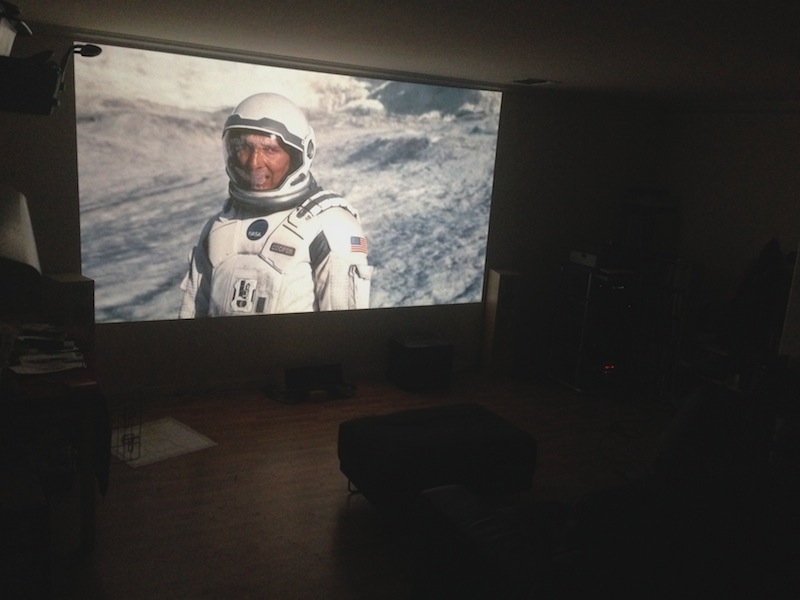
Posted by Mike Blakesley (Member # 26) on 03-04-2017, 03:21 PM:
I get your drift about field of view, but no matter how much it "looks the same size," it's still about perception. A good theatrical presentation is just impressively bigger, that's all...and it's not just the size of the picture, it's the size of the room the picture is in.
To me the biggest difference between home and theatrical is the size of the sound. In a bigger room, with a good system, the sound is bigger. There's just no other way to describe it. And at my theater we have a wood floor so you really feel it as well as hear it. It's not just about power, it's also about space.
And we don't need to worry about annoying the neighbors either.
We had a young mom at the show not too long ago...she'd recently had a baby and hadn't been to a movie in about a year, and afterward she came out with this big smile, and said "Wow, I forgot how much better movies are in the theater."
Posted by Tyler Purcell (Member # 9213) on 03-05-2017, 12:46 PM:
Yes I agree that good movie theaters (which are hard to come by) do have decent screens that look great and no matter where you sit, the field of view will be larger then the vast majority of home theaters. It's just, that's not the case for most movie theaters, especially if you sit middle or towards the back.
I think the vast majority of people, don't have home theaters. They have a "television" and that's about it. So their only connection to cinema at home is cable/satellite, DVD and streaming. Most people don't even have decent televisions. So sure, I can imagine people watching a movie at the cinema and being amazed at how good it is. For people who actually consume a lot of content... and invest heavily in that content like I do, we're a different breed and as I've said earlier, we don't have the time to see all the movies we want to see at the theater. We also have the money to pay for a service to watch them at home. So I get both side of the coin... the people who love the cinema for the fact they can see something they don't get at home and the people who simply can't afford the time it takes to see something at the theater and will pay to have it at home. Is this a small population? Yes... I was thinking 15% of frequent movie goers would invest. It only takes a few people to start a trend and I think it would catch on like wildfire. Not in rural areas, but in cities where to be frank, it's a pain to even leave the house, let alone get in the car, take the train or walk.
The problem is, nobody takes convenience and time into the equation. Move to Manhattan or even downtown LA, then ask me if you wanna go to the movies. ![[Razz]](tongue.gif)
Posted by Frank B. McLaughlin (Member # 6683) on 03-05-2017, 02:54 PM:
The independent exhibitor in metro areas is almost extinct. The circuits will zone you out (this is slowly disappearing), the studios will overcharge you, and should you make a booking mistake and it is turkey time your plain stuck. You find exhibitors who really care in places like Montana not Los Angeles. The circuits are driving customers to the living room.
Posted by Justin Hamaker (Member # 2165) on 03-05-2017, 06:33 PM:
quote: Tyler Purcell
For people who actually consume a lot of content... and invest heavily in that content like I do, we're a different breed
Again, this is just a small segment of the population.
A 2014 study by the MPAA found that only about 11% of the population were frequent moviegoers - people who go at least once a month, while 48% were occasional - meaning less than once a month. Another 9% were infrequent, meaning they go about once a year. 32% of the population are not moviegoers at all.
According to the study, the 11% of frequent movie goers accounted for 51% of all tickets sold.
Another interesting finding was that frequent and occasional moviegoers were more likely to be tech savvy than the rest of the population. These people were more likely than the rest of the population to have a computer, disc player, smart-phone, tablet, video game system, and/or video-streaming device. Since this was in 2014, the technologies are likely different, but I would suspect the same pattern probably holds.
Posted by Lyle Romer (Member # 1266) on 03-05-2017, 07:57 PM:
quote: Tyler Purcell
Mike... It's called field of view. I have a 7 foot wide screen and I sit 10 feet away from it. So in my brain, it's just as big as a screen in the movie theater.
It does not work that way. Your brain can still figure out the actual size of the screen. Unless the room was pitch black (which is pretty much impossible due to the light from the screen), there are references that tell you how big the screen is.
I can go 2 feet away from my 65" TV and although it will fill my entire field of view, it doesn't look huge like sitting half way back in a theatre with a 60 foot wide screen.
The perception of screen size is a combination of field of view and the actual physical size.
Posted by Mike Blakesley (Member # 26) on 03-05-2017, 08:45 PM:
Thanks Lyle, that's what I was trying to get across but you did it better than me.
quote: Tyler Purcell
I was thinking 15% of frequent movie goers would invest.
Well...if Justin's figures are correct, and 11% of the population are frequent moviegoers, that's about 36 million people in the U.S. 15% of that number is about 5 and a half million. If all those people paid $50 for a first run movie, that'd raise 275 million. But it would never happen -- because not everybody wants to see any particular movie. On a good day, you'd probably get one-third of the potential customers, at the very most. So, 1/3 of 5.5 million is under 2 million people. If that many people paid fifty bucks each, you're raising somewhere between 90 and 100 million. If 20% of that is going to the theaters, it's down to between 70 and 80 million. The actual figures would probably be less.
Hell, even a medium sized blockbuster can sell that much in tickets in two days. Disney will probably do $400 million in ticket sales on "Beauty and the Beast" and they will pocket at least $250 million from that gross. And then they have the streaming/Netflix market a few months later to pad their take, and then physical sales after that.
The fact that Disney is the only studio (so far) not talking about this $50 madness shows that they alone have bothered to do the math.
Posted by Tyler Purcell (Member # 9213) on 03-05-2017, 11:37 PM:
Hey Justin, interesting statistics. Are those on the MPAA site?
Posted by Rex Oliver (Member # 7593) on 03-06-2017, 12:39 AM:
Watching movies at home or the theater-when I go to the theater-its nice to have SOMEONE ELSE show the movie to you.A few times I watched at the theater I was the only one in the auditorium-I go to the Late shows.Felt special that night-no one else watching but me! One time while watching alone-the sound went out-was during the movie "Sniper" Told the concessionist and she spread the word to the projectionist(still playing from film)He corrected the problem and came down and gave me a free pass for another moive!Used it the next day.
Powered by Infopop Corporation
UBB.classicTM
6.3.1.2