This is topic Regal proposes FLOP pricing in forum Ground Level at Film-Tech Forum ARCHIVE.
To visit this topic, use this URL:
https://ft-forum.com/ft/cgi-bin/ubb/ultimatebb.cgi?ubb=get_topic;f=5;t=003068
Posted by Rusty Gordon (Member # 2210) on 10-25-2017, 01:13 PM:
Here in Nashville Regal added recliners and jacked prices up to $18 from $11 virtually overnight. These reclinervision houses are pricing themselves out of habitual moviegoing. No longer will kids be able to afford to see "whatever" and attendance is in decline of their own making. Now they're starting to see the error of their ways. Not every movie is worth $18. Kids want to sit with their friends at the movies and reserved seating is an obstacle to that as well. While these chains bankrupt themselves with 45 seat recliner houses, independents will have an opportunity to serve the masses and keep habitual moviegoing alive.
Regal Cinemas Plan May Let You Pay Less for Flops, More for Hits
Posted by Stephan Shelley (Member # 8587) on 10-25-2017, 02:03 PM:
Here in the San Francisco Bay Area where there is a lot of competition, multiplexes that have converted to luxury seating while dropping there seating capacity in half have doubled there grosses do to increased prices. However in more rural areas the opposite. The folks there do not like the increase in price.
Posted by Harold Hallikainen (Member # 5405) on 10-25-2017, 02:04 PM:
The demand pricing is interesting. They could do something like airlines where you can book early and get a low price, book later and get a higher prices as the tickets sell out, and finally sell standby seats at the end in case people do not show up (but don't overbook and haul people out of the theater). Another simple approach to demand pricing would be to just start with a high price the first week, then drop it each week thereafter.
Harold
Posted by Buck Wilson (Member # 5885) on 10-25-2017, 02:24 PM:
Regal is too pretentious for their own good. They've raised the ticket price at my dumpy 10 plex 20 cents or more every 6 months in the 5 years since they bought us.
Posted by Martin McCaffery (Member # 37) on 10-25-2017, 02:25 PM:
All of this assumes sellouts. Based on grosses I see at the multiplexes here a really big film may sell out one or two shows (out of, let's say the 24 a day one multi had for the latest Madea movie), but the rest of the run is pretty sparse.
I know I don't represent the viewing public, but how many movies are there that people would pay a premium to see in the first week?
Posted by Marcel Birgelen (Member # 6801) on 10-25-2017, 02:57 PM:
quote: Harold Hallikainen
The demand pricing is interesting. They could do something like airlines where you can book early and get a low price, book later and get a higher prices as the tickets sell out, and finally sell standby seats at the end in case people do not show up (but don't overbook and haul people out of the theater). Another simple approach to demand pricing would be to just start with a high price the first week, then drop it each week thereafter.
Personally, I would hate this approach...
You know why? Flying in a pressurized tin can with wings, while getting myself groped and having to watch other people's luggage spinning around in front of me for an hour, never knowing if they didn't sell YOUR seat to somebody else who paid a few dimes more... it is a necessity to get from A to B in a reasonably acceptable time frame, it's not something I'd consider the fun part of any given journey.
Going out to see a movie is something I'd still consider something I'd do for fun. So, pretty please. Let's not try to import the bad aspects of your average flying experience. ![[Wink]](wink.gif)
Posted by Harold Hallikainen (Member # 5405) on 10-25-2017, 03:09 PM:
I agree that airlines are not a great model! Demand pricing is an economist's dream, though. We see it in lots of stuff.
Harold
Posted by Brad Miller (Member # 2) on 10-25-2017, 03:30 PM:
Rusty - the site rules require you post the text of any article you link to. Please edit your post to include this. You can use the "quote" button on the edit screen to paste it in.
Posted by Dennis Benjamin (Member # 1137) on 10-25-2017, 10:31 PM:
Our company is installing luxury powered recliners in our locations and not raising our ticket prices. So....
Posted by Rusty Gordon (Member # 2210) on 10-25-2017, 10:39 PM:
Brad, the system said the time limit to edit the message was exceeded. Here is the text of the article.
Regal Cinemas Plan May Let You Pay Less for Flops, More for Hits
More stories by Anousha SakouiOctober 25, 2017, 6:02 AM CDT
Regal Entertainment Group is testing demand-based pricing for films, potentially leading to higher prices for top hits and low prices for flops, a big change for an industry that typically uses a one-size-fits-all approach.
Working with app maker Atom Tickets LLC, which has lobbied theaters to try dynamic pricing, Regal plans to test the concept in early 2018 and see if it boosts revenue and fills more seats at non-peak times.
“Changes to the historical pricing structure have often been discussed but rarely tested in our industry, and we’re excited to learn even more about how pricing changes impact customer behavior,” Amy Miles, chief executive officer of the Knoxville, Tennessee-based exhibitor, said Tuesday on a call with analysts.
Shares of cinema chains have been pummeled by falling attendance and threats to the traditional Hollywood movie model, with more people staying home to watch streaming services like Netflix Inc. Studios, also hurting, have been pushing to make new movies available in homes sooner -- cutting the window of exclusivity that theaters enjoy.
Regal, the second-largest chain in the U.S., reported Tuesday that revenue dropped 12 percent from a year earlier to $716 million, attributing the decline to an underwhelming movie slate. Regal shares have slumped 21 percent this year. AMC Entertainment Holdings Inc., No. 1, has tumbled 58 percent.
Industry executives are debating whether dynamic pricing will increase attendance. Some object to a system that would involve charging higher prices for hit movies and lower prices for unpopular movies. Miles said Regal would conduct the tests in enough markets to be statistically significant and said the experience of Atom Tickets, which sells movie passes through its app, will be helpful.
“If we can get consumers to go one more time a year, that is transformative to the whole business,” said Matthew Bakal, co-founder and executive chairman of Atom. The company has already worked with Regal on services such as pre-ordering concessions.
Miles said Regal won’t consider sharing revenue with MoviePass, a controversial service that offers consumers once-a-day admission to theaters for less than $10 a month. MoviePass pays full price for tickets to theaters and therefore loses money on every subscription. The company said it plans to make up the difference through advertising revenue and by gaining a share of theater concession sales.
Posted by Jesse Skeen (Member # 586) on 10-26-2017, 12:23 AM:
Why do people keep paying to see Madea movies? ![[Confused]](confused.gif)
Posted by Mike Blakesley (Member # 26) on 10-26-2017, 12:44 AM:
I felt the same way about Eddie Murphy movies....he really went down the tubes. Three or four classics followed by almost 100% crap since.
Posted by Jack Ondracek (Member # 1466) on 10-26-2017, 12:47 AM:
I'd like to know how a theatre can square variable pricing schemes with the terms of its master license.
Considering the part where terms are based on the highest established price for a given time and category, about the only way I can think of would be if you declared your ticket prices for a show before you ran it. I'm not sure you could change your prices mid-week, after you realized you had a dog on your hands.
... unless that rule changed while I wasn't looking.
Posted by Scott Norwood (Member # 30) on 10-26-2017, 01:58 AM:
Wouldn't customers just take advantage of "dynamic pricing"? As in, if one theatre did this and another theatre across town had "normal" pricing, wouldn't customers just go to whichever theatre had lower prices for the movie that they wanted to see? In other words, one would go to te dynamic-pricing theatre to see Gigli and to the normally priced theatre to see Star Wars. Or would that make too much sense?
Posted by Kenneth Wuepper (Member # 1174) on 10-26-2017, 08:29 AM:
The problem is this: once the customer sees all of the other factors as unimportant, like quality and comfort or presentation, the only thing left is price. Someone willing to look at a movie on their phone would certainly see price as the only factor in going to a movie theater.
Posted by Martin McCaffery (Member # 37) on 10-26-2017, 09:17 AM:
quote:
Why do people keep paying to see Madea movies? [Confused]
Because they appeal to an audience that Hollywood ignores.
Posted by Bobby Henderson (Member # 840) on 10-26-2017, 10:51 AM:
I think this flexible pricing thing will open up a big can worms. If all Regal wants is to raise prices higher, like charge even more money for big event releases on top of the normal ticket price, then this experiment could backfire. Even if they're trying out the model in only a few theaters the policy could still generate a shit-ton of negative publicity and have customers everywhere weary of visiting any Regal location out of fear of being price gouged.
The only way I can imagine flexible pricing could work is if the ticket prices dropped to lower than normal levels, even down to bargain levels, during week nights or weeks into the run. That could potentially put more butts into the seats. However, once a theater opens that door customers will use their power to wait against the theater. It's nothing to wait for a week or two to see a new movie release, especially if you don't care about seeing it on the biggest theater screen in the complex -just like it's nothing to wait 2 or 3 months to watch the same movie on the big "4K" HDTV screen at home.
I'm willing to pay a little extra for a movie ticket if the theater is actually delivering something above the standard experience. Laser projection with Dolby Atmos sound might be worth a premium. A 70mm film presentation is definitely worth a premium. A luxury viewing experience with huge seats, no one under 21 allowed (especially crying infants), no phone use allowed and mixed drink service is worth a premium.
It's not worth a premium to see the same old super hero movie in the same old vanilla auditorium with 2K projection and low volume 5.1 sound just to be able to say you watched the big movie during opening weekend. Screw that. That would make me want to wait for the video release out of spite.
Oh, and charging a lower price for a "bad" movie? I'm not optimistic that will work well. People already waffle enough as it is when deciding whether to see a movie in the theater or not. What criteria is used to judge whether a movie is bad or not popular? It's all subjective.
quote: Martin McCaffery
I know I don't represent the viewing public, but how many movies are there that people would pay a premium to see in the first week?
Not very many. We already have a lot of theaters charging premiums of some kind just to enter the auditorium regardless if the movie is a high-demand, new release. Recliners cost extra in many places. IMAX Digital, Dolby Cinema, etc. have their extra surcharges.
quote: Marcel Birgelen
Going out to see a movie is something I'd still consider something I'd do for fun. So, pretty please. Let's not try to import the bad aspects of your average flying experience.
The airline industry and movie theater industry are two very different things. The airline industry is very consolidated and has its customers over the barrel, pants down around the ankles and the bottle of lube is empty. Movie theaters are not in such a customer rapey position.
quote: Jesse Skeen
Why do people keep paying to see Madea movies?
Martin nailed it with his answer. Those crappy Madea movies are among the few wide releases tailored for African American audiences. And it's fairly insulting since the Madea movies trade in so many groan-inducing stereotypes. Lots of black customers show up to see those movies anyway just to support an African American movie-maker that has achieved success. Some other more talented black filmmakers, like Steve McQueen, are wisely not letting themselves get pigeon-holed into making only "black" movies.
quote: Scott Norwood
Wouldn't customers just take advantage of "dynamic pricing"? As in, if one theatre did this and another theatre across town had "normal" pricing, wouldn't customers just go to whichever theatre had lower prices for the movie that they wanted to see?
It depends on the driving distance between various movie theaters and how clear the movie theaters advertise their prices. So many theaters now incorporate sales tax into the overall price. You don't see round figures. And that makes it easier for the theater to sneak in price increases. Customers looking for a bargain have to work to find it.
I think a big chunk of the movie going public is just getting out of the house on the weekend, going out to eat and checking out a movie. They're not putting much thought into bargain hunting when they want to go out and get entertained. However, at some point they'll feel the pain of price gouging and get angry by it.
This past Friday my girlfriend and I spent the evening at a younger couple's house. We ate and watched a movie there. They ended up buying a digital copy of The Dark Tower since the ladies wanted to watch that. I've never bought a digital download of a movie. But this couple has bought over 100 movies that way. Both husband and wife were in the Army and had a lot of DVDs and Blu-rays stolen when moving from one duty station to another. That turned them off to buying physical media.
My point with that story is that there is a generational shift in attitudes about seeing movies in the theater. I think Millennials are largely indifferent about it. And I think a growing number of Generation-X people are falling into that camp too. If Regal wants to make even that much more expensive to see a movie in a theater there will be even more people just watching at home.
Posted by John T. Hendrickson, Jr (Member # 849) on 10-26-2017, 01:04 PM:
Jack Ondracek said:
"I'd like to know how a theatre can square variable pricing schemes with the terms of its master license."
Yep. Me too. Are the studios really going to let theatres make these decisions without retaining control?
Posted by Martin McCaffery (Member # 37) on 10-26-2017, 01:57 PM:
I suspect Regal is in a better negotiating position vis-a-vis the master contract than most of us are.
Posted by Rusty Gordon (Member # 2210) on 10-26-2017, 04:57 PM:
Here are reasons I frequent the movies less than ever.
1) Value. Tickets and concessions have always been quite expensive. Now I have to pay for premiums I don't want. Surcharges for *this* sound or *that* seat. Seats that are luxe but no choice but to pay $5-6 more to see a film since the seats have been upgraded. (I wish I could attend Dennis' sites.) Here prices have jumped by 1/3 overnight after the seats have been upgraded. If they maintain these electric recliners like they took care of the old seats, half of them will be broken by New Years'. I don't need table services of Dine-In theatre with some "acclaimed executive chef". I can go to eat at a restaurant before the movie. Don't want food? You're still paying an up charge to pay that chef.
2) Digital projection has brought an onslaught of non-film related advertisements bombarding patrons. I just want to see my film. I'll tolerate film previews.
3) AMC charges >$7.00 for an empty cup which gives me the privilege of standing in line at a Freestyle machine to pour myself an inferior tasting beverage.
4) Purchase a ticket online and pay a 'convenience' fee. Want to avoid it, *buy * a premium membership. Don't want either? Stand in line to buy a ticket at the concession stand. Some new theatres have no box office! Not a member? Stand in a longer line because some lines are "just for members"!
5) Films. Most films in the multiplexes are dreck. If I want to see an 'art' film or one with a smart story or cast or has some acclaim, I have to drive out of my way to that theatre. Every theatre devotes multiple screens, each with a generous slate of showtimes to "Boo 2: A Madea Halloween" but if I want to see "Jane the Movie" m a y b e it will be at one site on one screen for one or two showtimes.
Posted by Allan Young (Member # 6332) on 10-30-2017, 07:14 AM:
Posted by Leo Enticknap (Member # 534) on 10-30-2017, 10:41 AM:
I see no reason why a form of airline-style dynamic pricing couldn't work. Airline customers fall into two categories: the one described by Marcel (medium and long-haul passengers who have no choice but to travel by plane), and short-haul passengers who have a choice between air and ground transportation.
The latter is a more appropriate comparison with movie theater customers: there has to be a reason why you'd want to see a movie at the theater rather than on a consumer platform. Preserving the 90-day window is one way to provide that reason, and luxury auditoria with high-quality presentation is another. Cut-price tickets for less popular movies could be a third. It could potentially appeal to people who value the theater-going experience, but can't or won't blow $20 on a ticket. If $10 gets them in to see a Michael Moore documentary, or The Amity Bulls--t 16, or a foreign movie that is trying to cross over into the mainstream, or even a popular blockbuster but at 10am on a Monday morning, I can't see that there is much to lose by trying it.
Posted by Mike Blakesley (Member # 26) on 10-30-2017, 02:52 PM:
"Flop pricing" would be OK, if they would discount the flops from what they're priced at now. The problem is, they'll make the "hit" movies premium-priced and leave the flops at the existing price points.
That's how to piss people off right there. As if this industry needed another way.
Posted by Harold Hallikainen (Member # 5405) on 10-30-2017, 06:57 PM:
Do you think overall revenue on flops could increase by decreasing the price? Would at least twice as many people show up if the price were half? It would be interesting to try to determine the optimum price (most revenue) at a particular theater considering the movie itself, the market, the time of day, how long the movie has been out, etc.
Harold
Posted by Mike Blakesley (Member # 26) on 10-30-2017, 07:05 PM:
I don't think it would make much difference. We had a Monday "Discount Night" for quite a while, and at some point I started noticing people were surprised when they got a discount. So after a few weeks, I quietly stopped the discount. Nobody complained at all.
I think people go to the movies when they want to go and see what they want to see. I know "Boo 2" is going to suck so I wouldn't pay to see it, regardless of the ticket price.
Posted by Harold Hallikainen (Member # 5405) on 10-30-2017, 07:16 PM:
That's interesting that it did not make much difference. It does seem that to a certain extent, demand pricing is used in theaters in the use of lower priced matinee tickets. Some theaters also offer a discount on what they've found to be a slow night. Use of variable pricing to do "load leveling" allows you to not have facilities for a large peak. Instead of a huge auditorium for opening night of a hit movie, you can use a smaller room with a higher price. Those willing to wait a few days get a lower price. As mentioned, the matinee discount is a form of this. Time of use electricity billing is another. Shifting or flattening the peak electricity demand reduces the need for more power plants and transmission facilities. Here in the Denver area there are toll express lanes. The toll varies with time of day. For example, one express lane is $0.85 before 6am and after 10pm. 7:15am to 8:30am, it goes up to $5.10. It's free for high occupancy vehicles.
So, is there room for deman-based pricing in cinema beyond matinee and discount night?
Harold
Posted by Frank Cox (Member # 6258) on 10-30-2017, 07:57 PM:
I used to have a discount night -- everyone paid the child admission price on Thursdays, i.e. the last night of the movie.
When I saw that people were surprised to get a discount (as Mike said) I stopped doing that since all it was doing was costing me money.
Nobody has ever complained about it. I do get the very odd (once per year or so) person asking if there is a discount night. Nobody complains when I say there isn't one.
I don't think the price is a major factor in going to the show, as long as it isn't completely extortionate. If I charged $1 more for tickets people would still come -- if I charged $100 they wouldn't, of course. So there is a happy medium in there somewhere.
Posted by Bobby Henderson (Member # 840) on 10-30-2017, 10:01 PM:
quote: Mike Blakesley
"Flop pricing" would be OK, if they would discount the flops from what they're priced at now. The problem is, they'll make the "hit" movies premium-priced and leave the flops at the existing price points. That's how to piss people off right there. As if this industry needed another way.
Since the bean counters have cooked up this idea chances are pretty high they'll do exactly like you said: make tickets for the "hit" movies even more expensive and leave the "flops" at regular price.
The theater might be able to sneak in this nonsense since ticket pricing is no longer clear anymore. No round figures; all odd numbers via sales tax inclusion. It's easy to remember ticket prices like $7, $7.50 or $10 and notice when the price jumps 25¢ or 50¢. It's not as easy to remember $10.87. A hike to $11.23 won't be as noticeable. Combine that pricing environment with the existing situation of certain theater screens already costing more to enter and it might be relatively easy for the theater chain to sneak in this variable pricing. They might start out with small pricing differences between different movies and then gradually turn up the heat on those prices over time.
I can remember theaters during my childhood very clearly advertising their prices, such as sticking "$2 per carload" on a drive-in theater's street sign. In my college days theaters in Manhattan had clearly legible signs at the box office showing pricing. The TV stations ran news stories about Cineplex Odeon breaking the $7 barrier on Manhattan ticket prices in the late 80's. Customers were pretty angry about it. But life went on.
I wonder how this "hit" and "flop" pricing is going to play into the already existing premiums for big screens, next-gen sound, recliners, etc. How are the prices going to compound on themselves? Are we going to see an evening ticket price for Lie-MAX jump from $18 to upwards of $30? At some point any customer is going to reach a pain threshold on this stuff.
quote: Mike Blakesley
We had a Monday "Discount Night" for quite a while, and at some point I started noticing people were surprised when they got a discount. So after a few weeks, I quietly stopped the discount. Nobody complained at all.
AMC ran a $5 ticket Tuesday special for Stubs Premiere members this month. I took advantage of it a couple times. The crowds weren't all that big. I did get very annoyed by some of the customers during a screening of American Made. Some people acted like pigs, putting their feet all over the seats in front of them. One lady played with a freaking iPad clear into the first act of the movie. An older couple had their phones making noise constantly (and the lady took a call).
Our older former Carmike 8-plex was turned into a bargain theater. But AMC started placing some first run movies at that theater and charging $3 or $4 less than the standard ticket price at the nearby Patriot 13. This has to be an experiment on AMC's part, particularly since they're playing some of the same movies at both theaters. I'm not sure if very many people have noticed the price differences between locations. We watched the Planet of the Apes sequel at the old Carmike 8 (for $6 per ticket, IIRC) and not all that many people were in what used to be a THX house.
My guess is theaters will have to be very clear and obvious on discount pricing if they're wanting to encourage customers to come see a low demand "flop" movie. Concessions will still cost the same I'm sure. I can imagine a lot of people thinking about the price and then saying, "meh, I'll wait to see it on Netflix."
Posted by Marcel Birgelen (Member # 6801) on 10-31-2017, 05:31 AM:
Kinepolis, a local chain which only recently also bought itself into the Canadian market tried the concept of discounted tickets for less popular movies a few years back, but their pricing policy has since been reversed.
I guess the measure only resulted in them making even less money on exactly those movies. I also highly doubt a movie's popularity can be increased by making tickets cheaper than those of popular movies.
I think it mostly speaks for itself, it's simply not the way people go to see a movie:
John A: Hey, let's go and see Big Epic Movie tonight at the Royal Movie Shack.
Jane B: Yes, I waited for that one for ages! Lets go!
Johnny B: Yeah, but Sequelitis Crapola Part XXVI is running at the Royal Movie Shack too and it's only half the price!
John & Jane A: No way? HALF THE PRICE?
Johnny B: Yeah, no kidding. I mean, it's a crap movie, but at that price, unbeatable!
John & Jane A: Yeah! Great! Let's do that.
And this is obviously how people book an airline ticket:
Jane A: Let's do an extended weekend to Hipsterville!
John B: Great idea, let me check the ticket prices...
Allright, I got a return on Compound Flyers for $60 return per person. Leg room: Zilch Plus, no meals, only hand luggage allowed.
And I got this one, Golden Eagle Air Carriages for $1200 return per person. Including on-board spa and swimming pool, gilded faucets and an unlimited champagne and caviar buffet.
Jane A: Imagine how much caviar you could eat in 50 minutes effective flight time.
John A: And look, it also got complementary massages and a sauna.
Jane A: No way!
Jane A & John A: For just $1200 a ticket? That's a bargain... deal!
quote: Frank Cox
I don't think the price is a major factor in going to the show, as long as it isn't completely extortionate. If I charged $1 more for tickets people would still come -- if I charged $100 they wouldn't, of course. So there is a happy medium in there somewhere.
I think there is some kind of compounded effect though. The casual visitor will probably not really mind the extra dollar, but the regular visitor is more likely to notice.
If the price hike is not in-line with what would otherwise be seen as an inflation correction, this could be perceived as something negative and possibly motivate those regulars to either limit their amount of visits or have a look at possible competition.
I think it's also therefore that some chains have started to increase their ticket prices by odd amounts. Just add a few cents every few months and the increase will be more gradual and people are less likely to really notice and complain about it.
Posted by Rusty Gordon (Member # 2210) on 10-31-2017, 12:11 PM:
What if there were theatres that played movies after the first-run theatres but charged a lower price? You could call them "second-run" theatres. Lousy movies would get there quickly while hit movies would take a while longer. Independent mom and pop theatre owners could buy older, less luxe sites with fewer screens and do well... hummmm.
Posted by Bobby Henderson (Member # 840) on 10-31-2017, 12:45 PM:
quote: Rusty Gordon
What if there were theatres that played movies after the first-run theatres but charged a lower price? You could call them "second-run" theatres. Lousy movies would get there quickly while hit movies would take a while longer. Independent mom and pop theatre owners could buy older, less luxe sites with fewer screens and do well... hummmm.
I guess the face-value idea is that "flops" would be denoted to second-run status immediately, yet playing second-run in the same building as first run movies. I'm still 100% cynical about the ploy. I suspect the "flops" will stay at regular pricing and that cost will establish the new second-run pricing level. Company board members will give themselves high-fives for coming up with such an incredible idea. Investors will happily love it because fuck those customers.
quote: Marcel Birgelen
I think there is some kind of compounded effect though. The casual visitor will probably not really mind the extra dollar, but the regular visitor is more likely to notice.
The compound effect goes on from there. Concessions cost a bunch; it's easy to pay as much at the snack counter as it is for tickets. If a couple is visiting the theater to see a new movie chances are good they'll be paying another premium to see the show on the big, premium screen and/or a screen with recliners or other features that involve a premium. Many multiplex sites gear their best showtimes for such screens, applying the odd times like 8:30pm and 11:00pm to standard priced screens playing the movie.
Lots of people visiting movie theaters also do other things in the same evening. Just eating at a mainstream restaurant like Olive Garden and watching a first run movie will easily cost a couple more than $100. Shit, if the couple gets a good steak or anything slightly fancy the cost shoots upwards of $150 or more.
Posted by Mike Blakesley (Member # 26) on 10-31-2017, 03:31 PM:
quote: Marcel Birgelen
I think there is some kind of compounded effect though. The casual visitor will probably not really mind the extra dollar, but the regular visitor is more likely to notice.
Whenever we play a family movie, I notice the Dads doing the math in their heads as soon as I quote them the total for two adults and 3 kids.....you can just see the wheels turning and the thought "I could have spent less than this in 3 months and owned the video." I almost wish they WOULD gripe about our ticket price so I could explain what they're getting for their money vs. the stay-home option.
quote: Bobby Henderson
I guess the face-value idea is that "flops" would be denoted to second-run status immediately, yet playing second-run in the same building as first run movies. I'm still 100% cynical about the ploy.
The other thing that would happen is, the second-run house would immediately get the reputation of "Oh, they never get the GOOD movies" and it would probably hit the skids pretty fast as that notion grew.
Posted by Martin Brooks (Member # 1269) on 11-01-2017, 01:31 PM:
Instead of flop pricing, why don't they simply charge more on Friday and Saturday nights when the theaters are full and charge less when they're empty, which is almost any other time.
As I've posted before, during the first two quarters of 2017, AMC averaged sales of only 91 tickets per day per screen. That's why they're willing to put in lounge seating which decreases the number of seats up to 2/3rds (although I think that's still a big mistake for hit movies as it lowers the potential revenue whenever a show sells out.)
Flop pricing can work, but only if it's promoted properly. And they shouldn't call it that because who wants to see a "flop" and the studios would probably freak out. But if up on the film listing display, if they indicate "bargain pricing" for the flop films and it was consistent and it's also publicized on all the ticket buying websites, it might put some additional butts in seats. Although I can also imagine people complaining, "that film SUCKS, why is it full price?"
But countering that, in spite of all the complaints that movies are too expensive (the national average is only $8.65 although it's obviously much higher in big cities), I wonder what percentage of people reserve their tickets in advance and pay the extra "convenience" fees. If that's a high percentage of buyers, it would then seem that there isn't the price sensitivity that we think there is.
Posted by Marcel Birgelen (Member # 6801) on 11-01-2017, 04:25 PM:
quote: Mike Blakesley
Whenever we play a family movie, I notice the Dads doing the math in their heads as soon as I quote them the total for two adults and 3 kids.....you can just see the wheels turning and the thought "I could have spent less than this in 3 months and owned the video." I almost wish they WOULD gripe about our ticket price so I could explain what they're getting for their money vs. the stay-home option.
Somebody should really make a somewhat witty infomercial about the "cinema experience" in DCP format.
On this forum, you're amongst people who probably have seen more than a thousand films in a proper cinema, but most people tend to remember those movies they've seen in a cinema for a long time. You pay for the experience. Going to a concert is also more expensive than listening to a recording of the same concert on your iPhone.
quote: Bobby Henderson
The compound effect goes on from there. Concessions cost a bunch; it's easy to pay as much at the snack counter as it is for tickets.
Better margins on those concessions than on those pesky tickets, especially for those newish movies everybody wants to see. You know, the movie is just the marketing trick to lure you in.
But yes, a night out at the movies comes at a price. It's still quite a lot cheaper than going to a concert, live performance or major sporting event though. Then again, the relative high price should only motivate exhibitors to provide the best bang for the buck.
quote: Martin Brooks
Instead of flop pricing, why don't they simply charge more on Friday and Saturday nights when the theaters are full and charge less when they're empty, which is almost any other time.
This kind of pricing scheme is pretty common in e.g. Germany, where many theaters charge extra for the busy days in the week. I think the argument against such pricing scheme could be that people feel cheated they need to pay more for exactly the same thing. Yet, it's standard in the hospitality and entertainment industry at large. People have been paying hefty premiums for hotel rooms, theme parks and all kind of other things during busy periods.
Posted by Bobby Henderson (Member # 840) on 11-01-2017, 10:12 PM:
quote: Marcel Birgelen
On this forum, you're amongst people who probably have seen more than a thousand films in a proper cinema, but most people tend to remember those movies they've seen in a cinema for a long time. You pay for the experience. Going to a concert is also more expensive than listening to a recording of the same concert on your iPhone.
When you attend a concert you're seeing the band playing the music live, in person, in the same building as you.
quote: Marcel Birgelen
It's still quite a lot cheaper than going to a concert, live performance or major sporting event though. Then again, the relative high price should only motivate exhibitors to provide the best bang for the buck.
Very few people can afford to attend live concerts of popular bands on any sort of frequent basis at all. Hell, lots of has-been bands charge a lot of their shows. One of our local casinos opened an event center that can seat a couple thousand for concerts. Their ticket prices are often ridiculous. I'm not paying $50 per ticket to watch a band that hasn't had a hit in 20-30 years (or longer) and is down to only 1 or 2 original members. It's now common for bands who are popular to price the face value of their tickets well past $100 each. Then the volume ticket buying companies suck up all those tickets and charge double, triple or much more than the face value.
Sporting events are just as ridiculous as live concerts, if not considerably worse. OKC Thunder tickets are pricey. I've only been to a couple of games the entire time the Thunder has been in OKC. I watched the former New Orleans Hornets play once in OKC too during the aftermath of Hurricane Katrina. I have yet to watch the Dallas Cowboys play live in Cowboys Stadium. People joke that it's cheaper to take a vacation trip to Cancun than pay for parking and nosebleed seat tickets at a Cowboys game.
Attending a movie theater is not remotely on par with watching a live concert or a professional major league sporting event. The activity is just something people casually do to get out of the house during the weekend or even a weeknight. The experience of watching a movie with a bunch of other people carries more drawbacks these days than benefits, thanks to inconsiderate audience behavior. On a technical level the movie-watching experience is barely any better than watching at home. I have a huge TV in my living room and it shows letter-boxed 'scope movies just about as good as the letter-boxed 'scope movies on the commercial theater screens.
You guys may think dropping $100 or more between two people for dinner and a movie is cheap. The cost adds up fast. If I do the dinner & movie thing every weekend with my girlfriend the cost equals a damned car payment. And if the movie watching couple has 3 kids in tow, then hell yes the dad is going to be calculating costs in his head like crazy. 5 tickets and drinks/snacks for 5 people is going to cost a shit load of money.
The United States has 326 million people (2017 US Census estimate). Only a small minority of that population visits movie theaters on a frequent basis. There's lots of people, including many families, who never go to the movie theater.
Posted by Mike Blakesley (Member # 26) on 11-01-2017, 10:57 PM:
The reason it costs a lot to see popular bands (or "once popular") is that it's what the market will bear. And, concerts cost more and more to put on, what with the showmanship that's becoming a given in the average big concert today. That's why a $10 T-shirt costs $40 at a concert -- they make their money on overpriced merch. Merch is the concession stand of the concert business.
I'm on our local fair board here, and even country artists who were popular in the 70s and 80s are getting $50,000 or more for a show. A really popular current band/artist can get $1 million or more for ONE SHOW.
You're definitely right that a majority of people don't go to theaters anymore. I don't think it's because they hate the experience, or because it's too expensive -- it's because the alternative is so much easier, and it's "good enough." Those other factors -- expense, hassles -- just help to justify the "good enough" factor.
Posted by Allan Young (Member # 6332) on 11-02-2017, 07:33 AM:
quote: Mike Blakesley
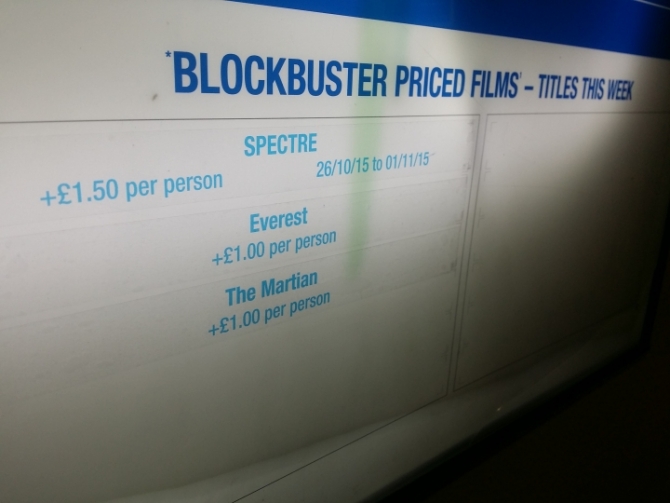
"Flop pricing" would be OK, if they would discount the flops from what they're priced at now. The problem is, they'll make the "hit" movies premium-priced and leave the flops at the existing price points.
...which is exactly how it was implemented by a couple of chains in the UK a few years back. The "Blockbuster Tax".
Posted by Martin McCaffery (Member # 37) on 11-02-2017, 07:42 AM:
Yup, what they are really headed to is a "Tentpole Tax".
Posted by Bobby Henderson (Member # 840) on 11-03-2017, 12:26 AM:
quote: Mike Blakesley
The reason it costs a lot to see popular bands (or "once popular") is that it's what the market will bear. And, concerts cost more and more to put on, what with the showmanship that's becoming a given in the average big concert today.
The concert business is catering more and more to the richest "one-percenters" and corporate clientele. That's where 100% of their supposed financial growth is taking place. They don't give two shits about the average middle class customer and they absolutely are not pricing their product where the average middle class customer can afford to go see a big name concert any more than a couple times a year at best.
Many smaller (and more affordable) concert venues are disappearing, thanks in part to the unrealistic terms the talent and their representation want which makes the venue end up losing money. Then the property owners find an opportunity, close the joint and build condos, a Starbucks or something else in its place. Shit, the legendary CBGB's club in New York closed a decade ago over this kind of crap.
Seeing a well known band live in concert is now, without question, a luxury item. It's an activity that's not affordable at all to do frequently. Comparing casual movie-going to that is kind of crazy. Movie-going is supposed to be affordable, but it's actually fairly expensive. I'm personally only going to consider watching movies in theaters "cheap" entertainment if I'm pulling down $100 or more an hour for pay.
quote: Mike Blakesley
You're definitely right that a majority of people don't go to theaters anymore. I don't think it's because they hate the experience, or because it's too expensive -- it's because the alternative is so much easier, and it's "good enough." Those other factors -- expense, hassles -- just help to justify the "good enough" factor.
Cost is indeed the main thing. There's no question about it, especially when a family is going to see a movie together. Hell, parenthood itself is being turned into an unaffordable luxury item. We have runaway cost inflation in health care, which you need a whole lot of if you're going to bring a new child into the world. Day care is ridiculously expensive. Unless Daddy has a great paying job both parents will have to work to make ends meet. These days young couples who should be having kids are so covered up with student loan debt and other burdens many of them can't even afford to have kids at all. It should come as no surprise things like those Kodi boxes are so popular with young people.
Posted by Mike Blakesley (Member # 26) on 11-03-2017, 11:43 AM:
quote: Bobby Henderson
Cost is indeed the main thing. There's no question about it, especially when a family is going to see a movie together.
Yes it costs a lot, even here, to take a family to the movies. But how often do most families go? There isn't a "family" type movie opening every week. Even if a family was trying to hit all the major PG-rated Disney and Dreamworks etc. animated films, it's still only five or six films a year at most.
All the factors add up, but if you were to take the early video window and the fact that every kid has 1001 other options to focus their eyeballs on all the time, I think most families would find the cash to go to the movies every couple of months.
I think I can base this theory on the fact that when I was growing up, my dad had just bought into a business and my mom was staying at home with the three of us. Our family was on very tight budgets during that time, but my folks still took us all to every Disney or other family movie that came to town. They found the money somehow.
Posted by Pravin Ratnam (Member # 1417) on 11-08-2017, 07:04 AM:
There is already an unoffical blockbuster tax at a smaller level. Most blockbusters have widespread Liemax openings (not to mention Regal's RPX or any other chain's own properietary large screen format). The prices for those usually have a decent surcharge.
And AMC used to have those twilight shows that they phased out. A lot of chains used to have more variable pricing to get more people into day time slots. I guess this an evolution of that?
Posted by Bobby Henderson (Member # 840) on 11-08-2017, 04:02 PM:
In the case of AMC they're pushing their Stubs Premiere thing these days. They revived their $5 Tuesday tickets special for Stubs Premiere members.
I remember AMC's twilight pricing specials from newspaper ads back in the 1990's. In the theater directory ads the twilight shows would be specially marked. I don't know when AMC got rid of those specials. I'm used to seeing theaters running late morning and afternoon matinee pricing and higher evening prices.
I'm not 100% certain, but I seem to remember theaters in Manhattan not having any matinee prices. It was the same (higher) price all day and night.
Posted by Martin Brooks (Member # 1269) on 11-20-2017, 10:53 PM:
quote: Bobby Henderson
I'm not 100% certain, but I seem to remember theaters in Manhattan not having any matinee prices. It was the same (higher) price all day and night.
That was true back then and largely true today. Some theaters do have lower pricing for 10am shows. The AMC Empire 25 is charging $8.19 for a 10am show (for everyone). The 1pm shows are $16.29 for adults and $13.29 for children and seniors.
Strangely, an AMC in Queens is charging far more: $9.29 for the 10am show and $18.59 for adults, $15.59 for children and $17.09 for seniors. Usually the boroughs are a bit less expensive than Manhattan. They must be doing decently: tomorrow's (Tuesday) shows are largely sold out, although the seat counts are low: 7 theaters with lounge seating with seat counts from 58 to 170.
Powered by Infopop Corporation
UBB.classicTM
6.3.1.2