This is topic First US Theatre With LED Screen in forum Ground Level at Film-Tech Forum ARCHIVE.
To visit this topic, use this URL:
https://ft-forum.com/ft/cgi-bin/ubb/ultimatebb.cgi?ubb=get_topic;f=5;t=003102
Posted by Martin McCaffery (Member # 37) on 04-21-2018, 09:58 AM:
Got half a million and change sitting around?
quote:
The first LED cinema screen in the U.S. was unveiled Friday at Pacific Theatres Winnetka in Chatsworth, a suburb of Los Angeles, where Warner Bros.’ Ready Player One will be the first movie offered on this exhibition system, starting Saturday. The Samsung LED Cinema Screen marks a radical shift from the theater projection systems that have been used since the birth of cinema. Instead, the LED screen is more akin to a giant television screen, and its use would render the projection booth a thing of the past.
At its unveiling Friday, Samsung shared new details about content creation for the screen — and what it might mean for both studios and filmmakers.
Why switch to LED screens? Samsung vp Stephen Choi argues that “there hasn’t been anything new to draw audiences into the theaters,” and they need “a new experience, to provide the ‘wow’ factor.”
So far, the images that the screen produces have impressed many in Hollywood, including Jerome Dewhurst, senior color scientist at postproduction facility Roundabout Entertainment. He contends that the LED screen’s “pure black is much deeper" than other systems.
It remains to be seen whether the non-expert eye of the average moviegoers will see a noticeable difference, and whether audiences would then be willing to pay a premium for it. At launch, Pacific Theatres Winnetka is not charging a premium for the LED auditorium. But, in time, theaters may choose to charge a premium ticket price to watch movies on a LED screen.
In order to prep movies for exhibition on the new LED screen in theaters, Samsung hopes to outfit post-production facilities so that filmmakers can view their work on an LED display. The first color grading (digital intermediate) postproduction suite to offer a Samsung LED Screen in North America has now opened at Roundabout’s Santa Monica facility. It offers a 17-ft. screen that can play 2K resolution, standard or high dynamic range, 7.1 surround sound, and offers a Blackmagic DaVinci Resolve color grading system. Samsung hopes to add its screens in more post houses.
According to Samsung, its Cinema Screen can play a standard DCI-compliant Digital Cinema Package (the digital equivalent of the film print) if the images are standard dynamic range. But for a high dynamic range (HDR) grade it would require a separate version, meaning that the studios would need to make another deliverable. Studios are already creating multiple versions of their films, including digital 2D, digital 3D at different light levels, Imax, Dolby Cinema, and local languages. The more deliverables, the more time and expense films must spend in postproduction.
The reason for the new HDR version — meaning that the images have a wider range between the whitest whites and blackest blacks — is that the LED screen is brighter than what is typically projected in theaters, which is 14 foot-lamberts (a measure of luminance in cinema). In comparison, the LED screen has a peak brightness level around 300 nits (a measurement of brightness), which Samsung estimates could display roughly 88 foot-lamberts.
The new Samsung LED Cinema Screen in Chatsworth is 34 feet wide and 18 feet high with all of the features of the smaller screen at Roundabout, but it can additionally support 4K resolution.
When introduced to the press on Friday, the theater presented trailers of Black Panther and A Wrinkle in Time, in standard dynamic range; various Amazon trailers including Life Itself, in HDR; and some ARRI-provided demo material shot with its new Alexa LF large format camera, also in HDR.
Ready Player One was screened in its entirety in standard dynamic range and Samsung confirmed that it therefore didn’t create a new version of the film.
But on the HDR front, this screen does underscore a concern voiced by many cinematographers last week at NAB, that in the digital realm, their images can be manipulated and changed all too easily in postproduction. In fact, Ready Player One cinematographer and two-time Oscar winner Janusz Kaminski lamented that cinematographers are losing control of the images they shoot.
The cinematographers’ participation in color grading can vary, as some DPs have guaranteed involvement in their contracts while others do not.
Roundabout’s Dewhurst emphasized that he encourages the DP’s involvement. “It’s Roundabout’s view that an HDR theater requires a dedicated grading session, not an automated system, to create the deliverable,” he added, recommending that the LED HDR grade could be the master version, used as the starting point for other versions of a movie.
Samsung installed its first two LED screens in South Korea.
READ MORE
L.A. Theater Debuts First LED Video Wall in U.S.
He also revealed that Roundabout has already started to invite members of the American Society of Cinematographers to see the screen and discuss the creative work.
Samsung has additionally been showing their LED screen to filmmakers and Hollywood studio execs. The screen might be of particular interest to James Cameron, Ang Lee and other filmmakers exploring the use of higher frame rates. Ready Player One was screened on the Samsung system at 24 frames per second, the standard in cinema. But the tech manufacturer contends that it’s working to get the system up to a high frame rate of 60 frames per second.
The question of how to handle the sound has been a topic of discussion for the past year, since Samsung first announced its LED Cinema Screen plans. This is because in traditional cinema, there are speakers directly behind the screen, which is not doable with LED panels.
For this theater auditorium, Samsung-owned Harman International developed a JBL Professional cinema sound audio system that can accommodate up to 7.1 Surround Sound. Harman’s cinema solutions manager Dan Saenz explained that the new configuration places the front speaker directly above the screen and incorporates some filtering technology, designed to make it appear as though the sound was coming from the screen; and it places an additional speaker in front that bounces high frequency sounds off the screen and into the audience, also aimed at creating the sonic experience of a traditional theater.
Still, the biggest hurdle to a rollout could come down to the cost. Samsung said the cost of a screen could run anywhere from $500,000-$800,000, a hefty price for a theater owner. Pete Lude, chief technology officer of engineering firm Mission Rock Digital estimates that in comparison, top of the line laser projectors generally cost between $150,000 to $300,000.
Samsung argued that there are other benefits that could help offset some of the cost, citing as an example that the LED Cinema Screen’s life span is estimated to be a 17 years. “And we’re looking at financial companies to see if there are options available,” said Samsung’s Choi.
The company also pointed out that unlike projection systems, a LED screen could be used with ambient light in the room, potentially making it an attractive option for dine-in theaters, gaming or other such users.
While Pacific Theatres Winnetka is the first U.S. theater installation, the Samsung LED Cinema Screens are available in several international venues, including two in South Korea, and one each in Zurich, Bangkok and Shanghai. Samsung expects to have at least 10 installed worldwide by the summer, and roughly 30 by the end of the year.
While currently focused on 34-foot screens, Samsung is also working on a 46-foot 4K LED screen, which it aims to introduce in late 2018.
The Samsung LED screen will be on display next week at theater owners convention CinemaCon. And Sony will show its Crystal LED cinema screen during the confab.
[URL=https://www.hollywoodreporter.com/behind-screen/how-new-led-cinema-screen-could-change-filmmaking-moviegoing-1104745?utm_source=Sailthru&utm_medium=email&utm_campaign=THR's%20Today%20in%20Entertainment_now_2018-04-21%2010:22:14_rrahman&utm_term= hollywoodreporter_tie]Hollywood Reporter[/URL]
Posted by Frank Cox (Member # 6258) on 04-21-2018, 11:56 AM:
So that really is watching TV in public.
Posted by Carsten Kurz (Member # 5396) on 04-21-2018, 02:12 PM:
First time I hear a backed up price quote for the Samsung screen.
- Carsten
Posted by Mike Blakesley (Member # 26) on 04-21-2018, 02:35 PM:
This is the first time I've ever seen an article that gives actual estimated prices for these things.
quote:
Samsung said the cost of a screen could run anywhere from $500,000-$800,000, a hefty price for a theater owner. Pete Lude, chief technology officer of engineering firm Mission Rock Digital estimates that in comparison, top of the line laser projectors generally cost between $150,000 to $300,000.
Better sharpen those pencils, guys....numbers like that aren't going to get you mass adoption.
Our projector is just about 8 years old and I'm beginning to wonder what our next machine will be like. I was hoping it might be a laser machine but I'm not so sure.
Posted by Sam Graham (Member # 2889) on 04-21-2018, 03:07 PM:
I just don’t see this idea as practical.
How serviceable is it if it breaks down? Does everyone really want to relive AMC’s old HITS sound days? I mean, Sony seems to have a solution with their OLED sets and their Acoustic Surface technology, but can something like that work on a cinematic level?
I can see the technology evolving down the road, but it’s just not here yet.
Posted by Frank Angel (Member # 248) on 04-21-2018, 03:43 PM:
Sure these things can be used in lighted rooms, just like TV. I guess that's the objective...? Get everyone to pay a premium to watch a big screen TV. So even if a movie plays in theatres before farming it out to video, it's still going to be a made-for-a-TV-screen movie...hehe.
And about that oh-so all-important black level....black level can only EVER be as good as the ambient light in the room. Turn on those lights so people can see what they are eating and there goes whatever advance in blacks that screen can provide. (Anyone ever figure out why people feel the need to strap on a feed bag just to be able to enjoy a movie? -- but I digress) You can't get black-blacks unless the entire room is black and everyone sits in total darkness and you then you have to figure out how to make a screen that doesn't reflect all those super nits back into the room...oh wait, then you've just got a damn black wall, instead of just a big TV. ![[thumbsup]](graemlins/thumbsup.gif)
Henry Kloss's Advent VideoBeam projection system very effectively used a system that placed his acoustic suspension at the projector and bounced the audio at the VideoBeam's hard, solid, parabolic curved screen surface. It reflected back to the audience creating a very real illusion that the sound was indeed coming directly from the screen itself. I doubt that would have worked if the screen didn't have that parabolic curve to it, but it might be a starting point for that kind of idea.
Here's a question tho, if you placed enough speakers all around the perimeter of the screen, wouldn't ATMOS processing be able to create the illusion that sound is coming directly from any part of the screen? Isn't that what it does for the rest of the room, i.e. create the illusion that the audio is coming from phantom locations anywhere it wants to place them? Why would the middle of the screen be any more difficult an illusion for it to create?
One of the Yamaha receivers we use in a small screening room has a "height" setting that is able to create an illusion that speakers which are placed on the floor on either side of the screen are at the height of the screen. Depending where you sit, this can be very convincing...or not so much.
Thing is, Yamaha for years has always been masters of audio manipulation -- since the 80s they pioneered a system where they have gone into famous halls like La Scala or Carnegie Hall, etc, done something with laser sweeping technology and are able (remains to be seen how well able) to make sound played with that processing setting, sound as it would if performed in that hall. No question it is audio smoke and mirrors, and who knows unless they fly you out to La Scala and let you play your CD there how close they get to it. Point being, seems with a little R&D, processing should be able to come close to positioning sounds where they are needed without having to have speakers there.
At one time in history Disney techs thought they needed to place speaker all across the front of the theatre (9 channels & speakers, I seem to recall) in the place the musician in the orchestra would have been sitting in order to recreate the orchestra correctly. We have come a long way since that quaint idea and understand that three or even two channel/speakers can create that illusion quite accurately. The only reason why we have not gone further in R&D to figure out how to create point-source location from the screen without there needing to actually have a speaker at that location is because our R&D figured it out with holes in the screen and we stopped there. You can bet that necessity will be a powerful motivation to figure out how do it without the holes.
Posted by Lyle Romer (Member # 1266) on 04-21-2018, 04:05 PM:
quote: Frank Angel
wouldn't ATMOS processing be able to create the illusion that sound is coming directly from any part of the screen
I don't know if you'd need anything quite so advanced. Wouldn't it work to put matched sets of speakers for each channel above and below the screen? Wouldn't that make a phantom sound as if it was coming from the center or does that only work for left and right making phantom centers?
If it would work, if you are spending over a half a million on the screen, a few extra speakers shouldn't break the bank!
Posted by Marcel Birgelen (Member # 6801) on 04-21-2018, 04:45 PM:
quote: Sam Graham
How serviceable is it if it breaks down? Does everyone really want to relive AMC’s old HITS sound days? I mean, Sony seems to have a solution with their OLED sets and their Acoustic Surface technology, but can something like that work on a cinematic level?
I have one of those Acoustic Surface OLED screens and it works pretty well. It sounds better than most of those flimsy speakers they put around the edges or with speakers behind the screen. For bass, they still need a separate speaker though.
The only reason it works well with those OLED screens is because they're so extremely thin and densely packed together. I can't imagine anything like this to work with something like a giant LED wall, without causing a massive amount of resonance.
quote: Mike Blakesley
Our projector is just about 8 years old and I'm beginning to wonder what our next machine will be like. I was hoping it might be a laser machine but I'm not so sure.
The Laser-Phosphor machines will probably get in reach of the average low-to-mid-end xenon machine within now and a year or two.
Now, with Laser-Phosphor you have the advantage of not having to change your bulb every so often, but it's still unclear what kind of hours you realistically can expect from such a laser light engine.
I would love to see some good reviews of this LED wall technology. I'm especially interested in how a 2K wall would look like, while sitting in the front part of the auditorium. While large LED walls can look amazing from afar, they can get extremely ugly close-up, because of the usually massive screen door effect.
Projection allows you to somewhat "blur" the screen-door effect away by adjusting the focus, LED walls don't have that "luxury".
Posted by Jarod Reddig (Member # 6363) on 04-21-2018, 05:57 PM:
I know an installer that is putting the first residential one in a penthouse in California.
Im an old school guy: I want projection and perf screens.
Posted by Scott Norwood (Member # 30) on 04-21-2018, 07:18 PM:
quote: Lyle Romer
Wouldn't it work to put matched sets of speakers for each channel above and below the screen? Wouldn't that make a phantom sound as if it was coming from the center or does that only work for left and right making phantom centers?
I would guess that this would only work from one particular position in the auditorium. The left/right thing works fine in almost exactly one seat and sounds awful anywhere else in the cinema.
Posted by Bobby Henderson (Member # 840) on 04-22-2018, 01:45 AM:
I'm not surprised to see the price of this Samsung LED display running at least $500,000 to $800,000. I wonder if that's just for the 2K price. Cost per RGB LED cluster (or pixel) is the biggest barrier for any mass adoption of these boards.
quote: Sam Graham
How serviceable is it if it breaks down? Does everyone really want to relive AMC’s old HITS sound days? I mean, Sony seems to have a solution with their OLED sets and their Acoustic Surface technology, but can something like that work on a cinematic level?
Service is going to be another thing on top of the huge up front price. These LED displays are literally a bunch of individual modular driver boards all joined together like bricks in a wall. If one board goes bad you just replace that individual board rather than the entire display. It's not hard to do at all. Still, a theater operator is not going to like having to replace LED tiles in his screen frequently. The cost of doing so will add up after awhile. So the build quality of these boards has to be very good. There's a bunch of stuff out there that is just imported crap and can't hold a candle to the American made boards companies like Daktronics.
As a LED screen ages the brightness level of those LEDs drop. New replacement boards won't match perfectly with the LEDs as they age. Any decent modern product line of jumbotron signs should have adjustment software where new boards can be tweaked to match the appearance of older existing boards in the sign. Without such a feature the whole display will eventually take on an uneven "quilted" look. The tiles have to collectively look uniform in color and contrast. I don't know how far Samsung is over-doing the color capability of its board design. The LED signs we sell from Daktronics have a physical capability of 281 trillion colors, even though you're never going to show more than 24-bit or 32-bit color content on these displays. The sheer overkill on shading of each color channel is to allow for adjustment of new replacement tiles.
quote: Sam Graham
I can see the technology evolving down the road, but it’s just not here yet.
As I've said in other posts about this stuff I think they have to come up with a different kind of LED board design that lets sound pass through it. The conventional driver board design used on signs and billboards isn't appropriate for this application.
Regarding black levels, brightness and contrast, full color LED displays can be pretty awesome on all those fronts. A projected image, even one from a laser source, will never equal the extremes of color and contrast that can be shown by one of these LED displays. A black piece of detail on a LED screen is going to look pretty freaking black when it's next to other details that can be painfully bright.
When the first full color LED signs were commercially sold they really kind of stank in terms of outputting color and contrast evenly from light to dark. Shadow detail could be crushed all to hell and highlights blown out. The displays were great for showing off garish color primaries, but not as good for subtle tones. Lots of advances have been made over the past 20 years and more keep coming.
Posted by Frank B. McLaughlin (Member # 6683) on 04-22-2018, 07:43 AM:
Two items:
1) An article in the April 20th Variety states: The Samsung LED cinema screen supports 2K or 4K resolution and can also play 3D content.
2) Has anyone discovered Samsung's projected life span of this product.
PS: Would love to see 3D at 80 fl.!!
Posted by Steve Guttag (Member # 268) on 04-22-2018, 08:06 AM:
They are starting at 4K resolution, yes they can play 2K but none are native 2K.
As for Dynamic Range, no it is no longer ambient light dependent because the screen is no longer a reflector, it is just a transmission device. You can effectively make them ignore the Exit signs and more.
I believe the sound aspect will be overcome with time (they definitely are not there yet nor would I advise anyone to develop significant workarounds for it. Sound isn't something that should be "good enough" when it comes to getting the sound to come from the image.
I stand by my prediction that within 10 years, people will no longer be putting in projectors. Direct View is the end-game of cinema presentation. It has all of the benefits and few of the downsides of presentation. The current hurdles are sound and cost. Sound will be overcome as they already can "print" LED screens. Imagine, if you will, a flexible direct view screen that you could hang flat, curved or whatever, all without geometric distortions or Morie'. It works in high or low ambient light.
With current technology, it is already a serviceable item (it is comprised of smaller blocks that can be individually replaced. They already have screen protectors for the blocks so if a kid throws a drink at it the screen, it can be cleaned off (better than a vinyl screen, which becomes ruined).
Since this technology can be ported to the home, the potential market is BILLIONS of systems out there with Cinema being used as the advertisement for the home. That is what will drive costs down.
The two biggest players are Samsung and Sony, at the moment, two of the industry's entities that have very good home presence. This is GOING to happen. And I don't think it is a bad thing, so long as the sound issue is addressed (and I really think it will, without BS psychoacoustics).
And Mike, if you aren't running 4KW or higher on your xenon projector, don't bother with Laser, there is just so very little benefit there and ZERO cost improvement. At 4KW, that is a different story, there can be LONG-TERM cost benefits (not at the onset). I haven't seen LP lasers come down in price enough to warrant their being used below 4KW.
Christie's new CP4325-RGB laser looks very promising, we'll see if the others have a similarly priced RGB (it is under $100K and can compete with a 4.0KW 1.2" xenon machine on light while delivering 3X contrast.
Posted by Lyle Romer (Member # 1266) on 04-22-2018, 06:54 PM:
quote: Steve Guttag
I stand by my prediction that within 10 years, people will no longer be putting in projectors. Direct View is the end-game of cinema presentation. It has all of the benefits and few of the downsides of presentation. The current hurdles are sound and cost. Sound will be overcome as they already can "print" LED screens. Imagine, if you will, a flexible direct view screen that you could hang flat, curved or whatever, all without geometric distortions or Morie'. It works in high or low ambient light.
A few years ago, I remember somebody almost jokingly discussing this with John Pytlak (R.I.P.) in a thread about Kodak and OLED. Amazing how quickly technology has progressed that, as you say, it is very likely going to happen in the shortish term future.
Posted by Mike Blakesley (Member # 26) on 04-22-2018, 08:12 PM:
quote: Steve Guttag
And Mike, if you aren't running 4KW or higher on your xenon projector, don't bother with Laser, there is just so very little benefit there and ZERO cost improvement.
We are running 4kw. I guess the biggest benefit I could see from Laser would be not having to replace bulbs, but what's the lifetime of a laser system?
Posted by Leo Enticknap (Member # 534) on 04-22-2018, 09:49 PM:
For the Barco DP4K-30L that was installed at the Egyptian while I worked there, we were told 30,000 hours running at 100% power, with no dropoff in lumen output. Likely longer if the laser diodes were not being run on "maxed out" power. That's roughly 10-12 years in a typical multiplex pattern of usage (running for 12 hours or so a day), and obviously a lot longer if you're playing shows for fewer hours a day/week.
Posted by Marcel Birgelen (Member # 6801) on 04-23-2018, 01:01 AM:
quote: Steve Guttag
They are starting at 4K resolution, yes they can play 2K but none are native 2K.
Well, according to the article, there are also 2K versions: It offers a 17-ft. screen that can play 2K resolution, standard or high dynamic range, 7.1 surround sound, and offers a Blackmagic DaVinci Resolve color grading system. Samsung hopes to add its screens in more post houses.
Yes, 17 ft. isn't really a large screen and maybe the configuration is only available for production facilities, but that also somehow feels backwards.
quote: Mike Blakesley
We are running 4kw. I guess the biggest benefit I could see from Laser would be not having to replace bulbs, but what's the lifetime of a laser system?
The claims I've been told vary between 20k and 50k hours @100%. The problem obviously is, nobody is willing to give you a hard warranty on such an extended period.
Also, nobody is telling you exactly what those numbers represent. Are those averages? If so, what is the expected standard deviation?
The oldest systems in place I know off, are about two years of age now, they're not showing any noticeable degradation on the light output yet.
Posted by Jack Ondracek (Member # 1466) on 04-23-2018, 09:12 AM:
quote: Leo Enticknap
For the Barco DP4K-30L that was installed at the Egyptian while I worked there, we were told 30,000 hours running at 100% power, with no dropoff in lumen output. Likely longer if the laser diodes were not being run on "maxed out" power. That's roughly 10-12 years in a typical multiplex pattern of usage (running for 12 hours or so a day), and obviously a lot longer if you're playing shows for fewer hours a day/week.
They're heading in the right direction, but I don't think we're quite yet ready to push the "commit to buy" button.
Our DP2K-32B is rated at 33,000 lumens with a 6,500 watt bulb, running full-out. We get about half-life out of any bulb we've put in the machine before the drop-off is beyond its CLO function to keep up and our foot is planted firmly to the floor. That means we're getting roughly 250 hours +/- before we need a fresh bulb to keep up. At average prices, given we're a drive-in with a 3.5 to 4.5-hour night, that puts us at an ongoing cost of about $3,300/year for bulbs.
According to spec, the DP4K-32L comes out of the gate at "up to 28,000 lumens" and loses "less than 20% (during a life of) 30,000 hours". So... by the time this machine hits max-hours (about 60 years at my place, or well beyond the point that I'm interested in much of anything), we're down to 24,000 lumens.
This assumes the machine runs that long at full power. The tech companies I've talked to believe these numbers are only good if you keep the machine at %50 output or less, which most certainly puts its performance beneath that of what we now have. The Barco spec sheet is silent on this point.
By ignoring the urge to run our bulbs to warranty, and instead, changing them at about half-life, our -32B gives us performance I consider to be "on the lower half of pretty darned good". I'd like to push that evaluation up a bit, but I don't think we're quite there yet...
Our -23B machines easily get to warranty. I don't see laser penciling out on that size unit... ever. I'd like to see myself running that model until they quit making xenon bulbs or the traces come off the circuit boards... but you never know about this stuff.
A LED screen for a drive-in? Oh... hahahaha... good one! Just let me pull my wallet out and... ummmmm.. nope. OTOH, we wouldn't have to worry about the sound... already got that figured out.
The notion that LED will be the "great disruptor" and will, eventually, replace conventional projectors and screens may well happen... but probably so will the Jetsons' flying cars, and you and I won't live long enough to see that. Remember, it wasn't that long ago that a huge percentage of the exhibitors in our country were squawking about upgrading their readers with a $700 LED replacement... and it took the studios' participation (and some crowd funding) to get much of the digital conversion accomplished. A year or two before the big chains fully converted, at least one of them was still putting 35mm installations in their new builds.
Posted by Terry Monohan (Member # 8285) on 04-23-2018, 09:24 AM:
Now let's see If they can come out with a way larger screen like 85 feet and have It curved. We do camera/ projection work each year for a bodybuilding show up near Seattle WA and each year the big LED screen looks better and brighter almost too bright, they have to turn down the image on the LED screen. I think the company they rent the LED screen from does rock shows outside also. Now movie theatres will have them also. I still like old 35mm/70mm film on a white curved screen. No pixels up close.
Posted by Marcel Birgelen (Member # 6801) on 04-23-2018, 01:32 PM:
quote: Jack Ondracek
A LED screen for a drive-in? Oh... hahahaha... good one! Just let me pull my wallet out and... ummmmm.. nope. OTOH, we wouldn't have to worry about the sound... already got that figured out.
Obviously, the price isn't yet in the right ballpark, but I'd say that a LED screen could be a big advantage for any drive in. It would allow you to start screenings far earlier, since you don't need a near-complete dark anymore to get some contrast.
Posted by Mike Blakesley (Member # 26) on 04-23-2018, 01:53 PM:
I'm curious why a 35-foot screen is $500,000 to $800,000, yet you can buy an LED seven-foot screen TV (complete with a tuner and crappy speakers) for under $3000.
I mean, I know "economies of scale" aren't as good when you're only talking a few thousand screens in the world vs. millions, but come ON.
Posted by Bobby Henderson (Member # 840) on 04-23-2018, 02:14 PM:
quote: Terry Monohan
Now let's see If they can come out with a way larger screen like 85 feet and have It curved.
How about something like this?
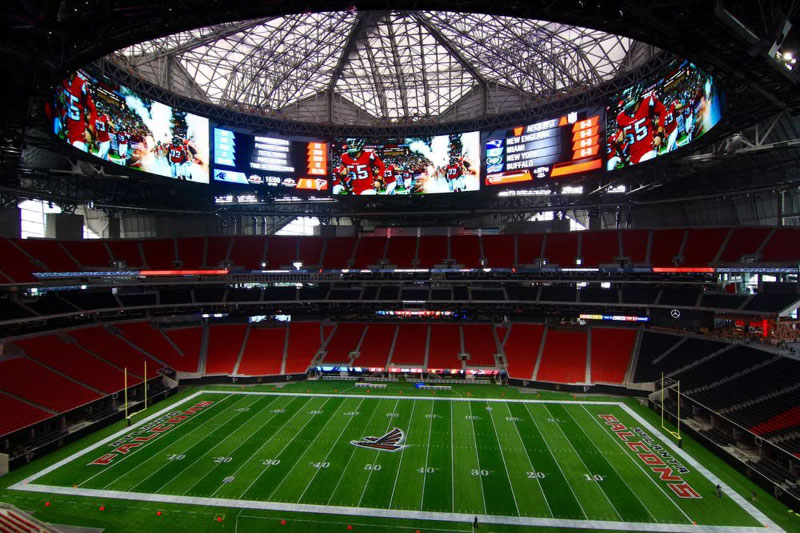
That's the Mercedes Benz Stadium 360° halo board. It's 58 feet tall, 1075 feet in circumference, roughly 62,350 square feet in size. Resolution of the board is 21512 X 1152 pixels.
LED-based displays have been customized to follow curves or fit unusual shapes for many years now. The Colorado Rockies baseball stadium has a new 8369 square foot LED display with the top edge of the screen following the jagged mountain shape of the team logo. The LA Dodgers had a hexagonal-shaped LED display tailored to the shape of their old outfield scoreboard. The NASDAQ sign in Times Square not only follows the cylindrical curve of the building's SE corner, but it also has holes in it for building windows. Las Vegas has many customized LED sign installations following curves, unusual shapes or even filling large letters.
Cost is the main limitation with LED displays. It's physically possible to build a giant sized dome screen theater with a LED-based screen. Pixel pitches can scale down as tight as 1.2mm between pixel centers. But who could shoulder the outrageous cost of such a thing?
quote: Mike Blakesley
I'm curious why a 35-foot screen is $500,000 to $800,000, yet you can buy an LED seven-foot screen TV (complete with a tuner and crappy speakers) for under $3000.
The reason is because you're making an apples to oranges comparison. There are lots of physical differences between a large LED-based sign and a small consumer product TV screen. These LED signs have individually manufactured, high intensity LEDs assembled into the driver board tiles. Each pixel will have at least 3 or 4 individual LEDs. The faces of each board have louvers separating the rows of individual LEDs. The insides of these tile boards all have their own electrical and computer-based components, connecting cables, etc. TV sets are not made like that at all.
Posted by Marcel Birgelen (Member # 6801) on 04-23-2018, 03:02 PM:
Yet if volumes of LED screens go up and they are able to lose a lot of the material, which is now still being used, the cost of them could come down considerably.
If out-door LED screen modules could be produced on something like a wafer for example, like a multi-layer pancake like consumer LCD and even OLED screens, then they could become much more economical.
There is a huge potential market out there for them, starting at almost every advertising billboard on the planet. We could benefit from such an economy of scale.
Posted by Scott Norwood (Member # 30) on 04-23-2018, 05:20 PM:
quote: Marcel Birgelen
Obviously, the price isn't yet in the right ballpark, but I'd say that a LED screen could be a big advantage for any drive in. It would allow you to start screenings far earlier, since you don't need a near-complete dark anymore to get some contrast.
This.
If it works in daylight (or even twilight), that could be a huge boon for drive-ins. Does it?
Posted by Mike Blakesley (Member # 26) on 04-23-2018, 05:52 PM:
quote: Bobby Henderson
There are lots of physical differences between a large LED-based sign and a small consumer product TV screen. These LED signs have individually manufactured, high intensity LEDs assembled into the driver board tiles. Each pixel will have at least 3 or 4 individual LEDs. The faces of each board have louvers separating the rows of individual LEDs. The insides of these tile boards all have their own electrical and computer-based components, connecting cables, etc. TV sets are not made like that at all.
Ok, thanks for that explanation. But TV set pictures are outstanding...why can't they just make a big theater screen using the same process as a TV set, only bigger? If a cinema screen is going to be compared to a big TV, why not just make it that way?
Posted by Frank Angel (Member # 248) on 04-23-2018, 05:59 PM:
Digital has already made a huge impact on DI image quality in terms of brightness. The ability do start an hour earlier at dusk or even a bit before rather than waiting until full darkness would certainly be another big improvement for DIs -- possibly allowing them to run the A feature twice. Again it would only work if the price would come down to some reasonable level that would work for the DI business model...actually ANY cinema's Business model -- basically one monumental price drop.
Back to the issue of location sound when you can't have speakers behind the screen -- I still don't quite understand why ATMOS wouldn't be ideal for solving this issue. Why would it not be possible for the processor to place sounds right AT the screen in whatever location the sound designer wants it? Isn't the very essence of object-based reproduction that sounds can be located anywhere in the room given enough amps/speakers? Why does that ability vanish when it gets the screen location?
Posted by Carsten Kurz (Member # 5396) on 04-23-2018, 06:37 PM:
That is not really the intention and working of Atmos. Look around in an ATMOS auditorium. Notice how MANY speakers you see?
- Carsten
Posted by Marcel Birgelen (Member # 6801) on 04-23-2018, 07:11 PM:
quote: Mike Blakesley
Ok, thanks for that explanation. But TV set pictures are outstanding...why can't they just make a big theater screen using the same process as a TV set, only bigger? If a cinema screen is going to be compared to a big TV, why not just make it that way?
Your average LCD screen isn't really sufficiently bright for outside application. You might remember that when you try to look at your phone when the sun is hitting it.
So, LCD technology is out for this purpose, no matter how you scale it.
Then, the only alternative is OLED. OLED is already pretty expensive and when you go big, there is no real advantage over OLEDs compared to "traditional LEDs".
The problem here is that current LED walls are still not really a mass-manufactured product like normal "consumer screens". Also there, you'll notice that only the common resolutions are real cheap. If you're looking for an LCD based screen with an odd resolution or configuration, it will become extremely expensive quite easily.
Like I mentioned in my previous post: If they can figure out to make LED wall modules like they produce current screens, much like microchips are being made and they figure out a way to reduce the amount of material required for such a module, the price could drop dramatically. I don't see any reason why we couldn't create an IC-like surface populated with multi-color LED arrays. It will just take a while to get it right and to get it ready for mass-production.
There is a huge potential market out there, so I think it will be only a matter of time once mass-manufacturing of standard "LED wall" modules start to get hold.
Posted by Frank Angel (Member # 248) on 04-23-2018, 08:20 PM:
[QUOTE] That is not really the intention and working of Atmos. Look around in an ATMOS auditorium. Notice how MANY speakers you see?/QUOTE] Carsten, I get that, so what if you surrounded the perimeter of the screen, above, below and on both sides with speakers, wouldn't applying the object-based processing principal be used to locate sound points pretty much anywhere across the screen surface? I mean, it can locate sounds above and blow the screen with just the standard L,C,R and some height speakers...if there were more of a concentration of speakers around the perimiter around the screen, seems intuitive that a processor could create the same kind of phantom location across the screen as it creates phantom sounds at locations in the middle of the theatre where there are no speakers. After all, with only three speakers behind the screen in a 5.1 or 7.1 system, we are presumably creating the illusion that voices are moving across the screen in places where there are no speakers. Having speaker systems above, below and on either side of the screen..maybe dozens of speakers surrounding this Jumbotron LED screen frame seems like enough location points to be able to create the illusion that voices are coming from the middle of the screener anyplace else the processor wants to place them.
Posted by Lyle Romer (Member # 1266) on 04-23-2018, 09:02 PM:
quote: Mike Blakesley
why can't they just make a big theater screen using the same process as a TV set, only bigger?
Probably has a lot to do with production yield. LG was happy to exceed 85% yield on their OLEDs. Throwing out 15% when producing theatre sized screens will drive costs up a lot.
Also, manufacturing technology will have to be developed to seamlessly join strips of OLED display together. It wouldn't be cost effective to try and develop equipment that can produce 15+ foot sizes in the narrowest dimension. No way the tooling to produce consumer sized screens can produce those sizes.
You'd also need some kind of cleanable/changeable protective coating. This is a challenge if the screen is also perforated for sound (pretty much removes changeable from the equation because you'd have to get the perfs to line up again). You can't have some idiot throwing food or drink at the screen able to ruin a $100,000+ screen
Then, compared to the LED display, if you get a bad pixel or segment, the whole thing will need to be replaced vs a single module.
When it becomes cheaper to use OLED for giant displays and billboards than LED, that's when it will make sense for theatre screens. If a company like Daktronics is making huge OLED displays for other applications, it will be a no brainer to make them available for theatres.
I think it will take a specialty company like that to develop things like joining OLED panels into a single display.
Posted by Bobby Henderson (Member # 840) on 04-23-2018, 10:56 PM:
quote: Marcel Birgelen
Yet if volumes of LED screens go up and they are able to lose a lot of the material, which is now still being used, the cost of them could come down considerably.
The cost of conventional LED signs (typically made for outdoor use) has come down quite a bit over the past 20 years. But the cost per pixel makes something like a HD-quality jumbotron for a stadium still cost a fortune. A 48' X 14' digital billboard with a modest 35mm pixel pitch would have cost over $500,000 at the end of the 1990's. Now you can get a good quality board the same size but with a tighter 20mm pitch (and a whole lot more pixels) for $100K to $150K, depending on how much the company selling it marks it up. Mind you, that's the LED board only. That billboard structure is going cost a good chunk of money too.
Losing material isn't much of an option using current technology, especially if we're talking about a display that would be used outdoors like a drive-in theater screen. These LED signs contain a lot of steel, aluminum and plastic. A high resolution display is going to draw a lot of power. The outdoor signs have to be weather proofed, yet feature different methods of ventilation.
Pushing the economy of scale downward using traditional LED sign materials and technology is going to be difficult. The market for these types of LED displays is shrinking in many cities and towns. Some communities are drafting highly restrictive sign ordinances, many of which are completely banning the use of LED signs. Edmond, Oklahoma (a higher income suburb of Oklahoma City) changed its ordinance to ban any new LED signs. The so-called "retail apocalypse" is another thing that may drive down sales of all types of signs in general.
Indoor movie screens are really going to need a new kind of exposed LED technology that hasn't been created yet. The LED tiles need to be at least somewhat flexible and somehow allow sound to pass through the boards. That would require new methods to physically join the tiles, power them and send digital data to them.
quote: Scott Norwood
If it works in daylight (or even twilight), that could be a huge boon for drive-ins. Does it?
Current LED sign technology can work great in daylight if a good quality product is installed. Contrast will take a hit if the sun is blasting the sign face directly, but you'll still see the imagery just fine. One solution is building the drive-in screen facing an angle where it's not getting hit directly with late afternoon sunlight. Any decent outdoor LED sign will either have a solar cell or use a timer to control dimming. If a good quality LED sign is set at daylight brightness at night time the display will be painfully bright.
quote: Mike Blakesley
Ok, thanks for that explanation. But TV set pictures are outstanding...why can't they just make a big theater screen using the same process as a TV set, only bigger? If a cinema screen is going to be compared to a big TV, why not just make it that way?
Because the materials and manufacturing processes are entirely different. It's impossible to manufacture a one-piece TV monitor the size of a movie theater screen. The thing would have to be built out of a series of tiles. Such a thing would not be seamless, which would make it a deal-breaker for movie screen use. When you scale the amount of materials and components used in a single TV monitor up to the size of a movie theater screen the cost increases in geometric fashion. What kind of controller would be used to chain all these TV tiles together? I've seen plenty of tiled video walls before, but nothing on a the scale of a movie theater screen.
Some major advances had to be made just to get OLED technology to scale from the tiny size of a phone up to a good sized TV set. OLED is a totally different thing from the exposed LED technology used in signs. The manufacturing process of a small OLED display is a little similar to computer chip fabrication. There is no cost effective way to scale OLED up to the massive size of movie theater screens or billboards. Exposed LED signs are made with lots of individual parts. Some of the product assembly process is automated; some of it has to be done by hand. I think of it like daisy-chaining a whole bunch of computer motherboard-like components together into one big product.
quote: Marcel Birgelen
The problem here is that current LED walls are still not really a mass-manufactured product like normal "consumer screens". Also there, you'll notice that only the common resolutions are real cheap. If you're looking for an LCD based screen with an odd resolution or configuration, it will become extremely expensive quite easily.
When it comes to LED signs they're manufactured based on the customer order. Companies like Daktronics will have a lot of the basic components in stock, but it takes time after the display is ordered for it to be assembled and tested. And, yes, the prices of these displays do go up as resolution is increased. A coarse 34mm display won't have nearly as many pixels as a 20mm display. Tighten the pitch between pixel centers to 10mm or 6mm and the price will really shoot upward.
Posted by Steve Guttag (Member # 268) on 04-24-2018, 08:23 AM:
They are rated at decrease in output over a period of time. Some are down to 80% at 30,000 hours while others are down a full 50% at 30,000 hours.
So you have to over-buy a bit on the lasers to ensure you get the light you need at the anticipated end of the projector's life. Changing xenons is cheap and the light output is "like new" with each lamp change.
Note, color wise laser-phosphor is marginal and depending on the system, they use a few tricks to get it DCI compliant. That said, nobody is watching movies in real-life with color meters and for film 99% of theatres were at the wrong color and we all survived.
Temperature and Humidity are also big factors in laser life. If you plan on getting a laser system, plan on making sure it has a good HVAC system and can maintain humidity too (don't want any condensation inside). Also plan on starting the laser at no more than 75% of its power (for any format) so you have headroom as the laser(s) decay. The more headroom you have, geometrically the more life span you have bought.
Posted by Tony Bandiera Jr (Member # 2365) on 04-24-2018, 10:43 AM:
quote: Mike Blakesley
We are running 4kw. I guess the biggest benefit I could see from Laser would be not having to replace bulbs, but what's the lifetime of a laser system?
The honest answer is, who knows for even a reasonable guess?
Until the technology has been in use for xx years, we will never know what the lifespan actually is... (think Sony LcOS).
DLP has proven to be fairly robust, despite it being a "moving mirror" "mechanical" technology..I honestly thought that we'd see a LOT more stuck pixels and outright failures over time.
Or, think of CFL bulbs..they claimed such high lifespans, but the reality is the driver circuits suck and they overdrive the actual lamp to the point that failures are too often (sometimes dangerous) and the lifespan is nowhere near what was claimed.
The true lifespan of a laser projection system will depend heavily on design (not overdriving anything, adequate cooling, etc.), quality control and tolerances, and resisting the temptation to use marginal spec components (Dolby, you need to heed this with your blasted power supplies).
In short, ask us again in ten years and we'll have the answer. ![[Big Grin]](biggrin.gif)
Posted by Louis Bornwasser (Member # 3063) on 05-02-2018, 08:22 PM:
LED screens at the drive in: 2 words: water and lightning. Reminds me of water-filled speakers. Now I have to worry about frozen speakers.
Posted by Bobby Henderson (Member # 840) on 05-02-2018, 10:31 PM:
A LED-based drive-in movie theater screen would have to be made just like an outdoor LED-based digital billboard or digital sign. Those are weather-proofed. A direct strike from lightning could cause damage but such a thing is actually rare. Since the displays are modular the parts that were damaged are repaired or replaced, not the entire display. If lighting was that big a deal our company wouldn't be able to sell any LED signs, billboards or even gas price displays to anyone.
Powered by Infopop Corporation
UBB.classicTM
6.3.1.2