This is topic Why aren't classics shown on the biggest screens? in forum Ground Level at Film-Tech Forum ARCHIVE.
To visit this topic, use this URL:
https://ft-forum.com/ft/cgi-bin/ubb/ultimatebb.cgi?ubb=get_topic;f=5;t=003211
Posted by Geoff Jones (Member # 3668) on 08-15-2019, 12:51 PM:
If a theater is showing a classic movie, why don't they show it on a really large screen, to offer something the viewer can't get at home?
For example, Alamo Drafthouse Westminster is showing Mad Max: Fury Road tonight at 7:00 in a smallish theater with 115 seats. They have sold 32 tickets so far.
Once Upon a Time in Hollywood is on their premium "Big Show" screen at the same time and has sold 15 tickets so far.
I've seen similar numbers repeatedly at multiple chains. Classics sell more tickets than current blockbusters showing at the same time, yet they are usually on smaller screens.
I would pay to see MM:FR on the big screen, but it isn't worth it to me on the smaller one. I can put in the Blu-Ray and watch it on a decent-sized screen at home. How many other customers are making that same decision?
Forget about screen size for a moment - tonight's MM:FR seating chart shows that the most generally desirable seats are already taken. If it were in the larger auditorium, that would not be the case. How many customers have looked at that and decided not to attend?
This just seems like a missed opportunity... money on the table.
Posted by Scott Norwood (Member # 30) on 08-15-2019, 12:57 PM:
I agree with you, but it's probably a booking restriction. Generally, a major first-run title is not allowed to share a screen with another title, even for a midnight show. Some cinemas seem to have found ways around this (or just ignored the restriction and done it anyway) for midnight shows, but that would be my guess for the reason.
Posted by Mitchell Dvoskin (Member # 751) on 08-15-2019, 01:33 PM:
Mad Max: Fury Road (2015) a "classic"?
I suspect the real reason is that in most locations, with a few exceptions in major cities, a "classic" film will not draw more than 75 to 100 paying customers.
Everyone says that they would like to see their favorite classics on the big screen again, but when it comes to putting their cold hard cash down at the boxoffice, it seem that most are nowhere to be found.
Posted by Geoff Jones (Member # 3668) on 08-15-2019, 01:57 PM:
Scott, are there any examples of theaters being penalized for breaking this "rule?" It's hard to imagine Sony getting their panties in a bunch over one showing three weeks after OUaTiH opened. (And anyone who wants to see OUaTiH on the big screen has dozens of other opportunities.)
Incidentally, Harkins Northfield in Denver is showing four different titles on its premium screen over the next several days, with two or three titles there each day. (Angry Birds 2, 47 Meters Down, Good Boys, and Apocalypse Now.) I wonder if they are breaking the rules or if they have a special arrangement with the (4!) different studios distributing those films... Either way, it's nice to see them making the extra effort to provide these opportunities for their customers.
quote: Mitchell Dvoskin
Mad Max: Fury Road (2015) a "classic"?
Everyone has different tastes. I define a classic as any film people are willing to revisit in the theater. Have you got a better definition?
quote: Mitchell Dvoskin
I suspect the real reason is that in most locations, with a few exceptions in major cities, a "classic" film will not draw more than 75 to 100 paying customers.
Everyone says that they would like to see their favorite classics on the big screen again, but when it comes to putting their cold hard cash down at the boxoffice, it seem that most are nowhere to be found.
I don't understand this reply at all. I've provided data showing that more people are willing to put down their cold hard cash to see an older film than a current release in the metro Denver area tonight, and I have seen this in other areas as well.
And besides, the whole point of my post was to suggest a reason why more people aren't attending: Because theaters aren't showing them on big screens!
What is the relevance of 75 to 100 paying customers? I've seen reports on these forums about multiplexes that aren't drawing 75 to 100 paying customers for an entire day on some days. Should they just close those days? Or maybe try something different?
Posted by Mark Gulbrandsen (Member # 72) on 08-15-2019, 02:06 PM:
Definately booking restrictions. The exhibitor has signed a contract to play it in X sized auditorium for X number of weeks.
Mark
Posted by Mitchell Dvoskin (Member # 751) on 08-15-2019, 04:32 PM:
> I define a classic as any film people are willing to revisit in the theater. Have you got a better definition?
My definition would be any film that remains popular over many decades. I do not doubt that many recent vintage films would draw a theatrical audience, but to me that does not make it a classic. Just my opinion, nothing more.
I can't speak to the Denver market, but here in suburban New Jersey, those venues that regularly run classic films rarely draw more than 100 paying customers.
Posted by Geoff Jones (Member # 3668) on 08-15-2019, 06:04 PM:
quote: Mitchell Dvoskin
I can't speak to the Denver market, but here in suburban New Jersey, those venues that regularly run classic films rarely draw more than 100 paying customers.
Again, the reference to "100 paying customers" makes no sense to me.
There aren't theaters in West Milford, NJ with reserved seating, so I can't tell how many tickets they are selling, but the AMC in Rockaway, NJ twenty-two miles south has sold a whopping 27 tickets to Hobbs & Shaw for the 7pm showing that just started in their Dolby Cinema auditorium. By my math, a classic film screening in that auditorium tonight would need to sell 28 tickets, not 100, in order to make more money.
But my point was not that more theaters should show classics (although they should!), my point was that theaters showing classics should put them on their largest screens.
quote: Mark Gulbrandsen
Definately booking restrictions. The exhibitor has signed a contract to play it in X sized auditorium for X number of weeks.
I keep hearing this, but I also keep running into examples where it doesn't appear to be true. When looking at the AMC Rockaway, I noticed they are playing multiple titles in their Dolby Cinema Auditorium. (Dora (Par) and Hobbs (Uni) this week, then Blinded By The Light (WB) and Once Upon a Time in Hollywood (Sony) starting tomorrow.) Maybe I'm naive, but I find it hard to believe they negotiated arrangements between all four studios to juggle showtimes in that auditorium. Wouldn't the paperwork and legal review make that cost-prohibitive?
There may actually be booking restrictions in the fine print of their contracts, but based on what I keep seeing, it doesn't seem like the studios care.
Posted by Martin McCaffery (Member # 37) on 08-15-2019, 06:26 PM:
When you are AMC you have a little more weight to throw around than if you are an art theatre in the middle of nowhere. Alamo is somewhere in the middle of those. Nonetheless, the number of people who make their decisions based on screen size is so small it is probably beyond measuring. The difference between 25 and 18 people to a chain like AMC is not worth a phone call to a distributor. Likewise dropping one screening the 4th week into a run to show a one off is not going to get Sony to stop booking with AMC.
Very little in the film distribution business makes "sense." You just have to deal with it.
Posted by Helmut Maripuu (Member # 2281) on 08-15-2019, 06:32 PM:
In Sweden we can visit the Film Institute which has about 1800 films in its archive. All 70 mm films shown in Sweden are available in cold stores
old films are digitally restored and developed as digital and ordinary 35/70 mm film.
Just filling out the form, usually the movie will come up in the program.
https://www.filminstitutet.se/sv/om-oss/filmhuset/biografsalonger/
https://www.filminstitutet.se/sv/om-oss/filmhuset/biografsalonger/
Posted by Geoff Jones (Member # 3668) on 08-16-2019, 09:10 AM:
quote: Martin McCaffery
Nonetheless, the number of people who make their decisions based on screen size is so small it is probably beyond measuring.
I don't buy this. Theaters spend millions to design, build, and promote "Premium Large Format" auditoriums. (RPX, Cine1, CineCapri, Dolby Cinema, Imax, LieMax, UltraScreen, EPIC, SDX, GDX, SuperScreen DLX, BigD(!), ETX, Prime, UltraAVX, XD, etc.) I can't believe they spend all that money for a customer segment so small it is probably beyond measuring.
quote: Martin McCaffery
Very little in the film distribution business makes "sense."
This, I buy. ![[Smile]](smile.gif)
quote: Martin McCaffery
You just have to deal with it.
I don't know about this. I took my kids to Harkins Tuesday Night Classics occasionally and noticed that there were more people in attendance at the classics than at whatever was in their PFL auditorium. I reached out to them on social media and email to ask that they move those showings to the big screen. They've started doing that for some showings, and based on my casual observation, attendance at those showings has increased. Customers are having a better experience and the theater is making more money.
#AndyDufresne
quote: Helmut Maripuu
Just filling out the form, usually the movie will come up in the program.
![[thumbsup]](graemlins/thumbsup.gif)
Posted by Mike Spaeth (Member # 524) on 08-16-2019, 01:09 PM:
Studios don't dictate house placement, Mark. The last film that was done with was Star Wars: The Last Jedi. This phenomenon can be chalked up to several things: lazy managers, lazy film buyers, or sometimes, in the case of Fathom Events, the equipment necessary to run the show is only present on a couple of screens in the building. The studios care only about a "full schedule" and if you do proper "three-dimensional" programming to maximize your building's output, it doesn't matter what auditorium a particular show runs in.
Posted by Marcel Birgelen (Member # 6801) on 08-16-2019, 01:14 PM:
I do mind the auditorium something is played in. Especially a classic movie revival has no business being screened at screen 47 in a multiplex, then I rather watch it at home, thank you.
It doesn't need to play in the biggest auditorium either, but it does need to be a decent sized room, preferably something that still looks like a proper cinema.
Also, going to the movies and sitting in an empty theater might be fun now and then, especially if you're not working in the industry and can have that perk essentially as often as you want, but there is actually something special when seeing a movie as part as a larger audience.
I can still remember sell out or near sell outs for reruns of classics and semi-classics (where-ever you draw the line) like Brazil, The Big Lebowski, Fear and Loathing in Las Vegas, Saving Private Ryan, Titanic, The Shawshank Redemption, The Wall, The Right Stuff, 2001, Ben-Hur and a lot more. Those are really fun to watch, especially because you are there with other people that come there either for the experience or specially for that movie.
But even for such events, you need to build an audience, you can't just randomly schedule a classic movie in your otherwise first-run schedule and think a whole bunch of people will show up. It needs time, so people actually start to watch your programming and decide to free up their busy schedule to come to you.
The problem is, it requires some dedication, a human touch, somebody curating a program, know how to advertise it and build a bit of cult status around it, so you get a regular following. Then this sort of thing can actually make money. But this is not something you can expect from a mega-chain like AMC. Too much effort for the potential gain...
And yes, there are often booking restrictions, not so much fitting in this one show into the existing schedule, but getting an acceptable deal (as in the rental costs and permission) from the studio/distributor to actually be allowed to screen that particular movie isn't always easy... (And then there's that other thing: Getting a DCP that works or... imagine, even an actual film print...) Been there, done that. And since Fox is now Disney, stuff hasn't really gotten better in that regard.
Posted by Martin McCaffery (Member # 37) on 08-16-2019, 03:44 PM:
quote: Geoff Jones
I can't believe they spend all that money for a customer segment so small it is probably beyond measuring.
They are building them to showcase the movies that are made for them, and for which they can charge a premium. Your original example, Mad Max Fury Road, was certainly made to be seen on a gargantuan screen, and I suspect everyone in your area who wanted to saw it that way the first time around. But I don't see any reason Casablanca (to pick a classic) needs to show in an ultra wide, dolby atmos, 4k super theatre. As noted above, big chains are not in the business of hand crafting and curating their programming. Pick the empty theatre and put it in is probably the full extent of their curation.
Posted by Jesse Skeen (Member # 586) on 08-17-2019, 12:12 AM:
I'd go so far to say that theaters shouldn't even HAVE those smaller screens. Some of them are downright embarrassing. You might as well tell the patrons that they have crappy taste in movies to see something that they put on those screens. I have to laugh when the studios advertise something as "See it on the big screen!"
Posted by Lyle Romer (Member # 1266) on 08-17-2019, 01:50 PM:
quote:
I'd go so far to say that theaters shouldn't even HAVE those smaller screens. Some of them are downright embarrassing. You might as well tell the patrons that they have crappy taste in movies to see something that they put on those screens. I have to laugh when the studios advertise something as "See it on the big screen!"
100% agree. Once they reach a minimum screen size (40 ft maybe), capacity reduction should be accomplished by making the auditorium shorter. I know the sound will suffer at some point due to the length to width ratio. When you get to the point where it can't be dealt with, that is your smallest auditorium.
People can argue viewing distance and sight lines until they are blue in the face but there is a difference in experience when the same percentage of your field of vision is filled by a 20 foot wide screen vs. a 60 foot wide screen.
Other visual cues let us determine the size of the image. To offset that ability requires VR goggles so that all you can see is the image.
Posted by Frank Angel (Member # 248) on 08-17-2019, 03:03 PM:
quote:
Definitely booking restrictions. The exhibitor has signed a contract to play it in X sized auditorium for X number of weeks.
I get that Mark, a studio may require their title to play every day for X number of weeks (usually that X is WAY longer than the customers wanting to see it, leaving the exhibitor to play it to near empty rooms, with not enough sales to pay for the electricity, but that's another story), but I have never seen a master contract that said the studio had exclusive rights to the exhibitor's screen 24 hours a day. If that is what they are going for, then they should just build their own damn theatres and be done with it.
And that would be a piece of cake today, given as how there is no such thing as anti-trust any more...you know, the Justice Department asleep or drunk at the wheel. Disney+Fox+LucasFilm? Come on.
If a studio's title pays normal scheduled hours, say 1pm to 11pm on Friday and then it plays a normal schedule again on Saturday, i.e., 1pm to 11pm, how does the exhibitor playing a midnight show of MAX MAX on Friday midnight violate any contract to play the studio's film 7 days a week? Screening the classic at midnight doesn't impinge on the 7 day requirement, not that I would consider anything to worry about contractually.
Plus, I have seen quite a number of screen splits at the Regal Sheepshead Bay in Brooklyn where they will run animated titles specifically targeted for kids only in the daytime and play an adult feature for evening shows in that same theatre. Then again, the answer may be that they are Regal and without them whatever studio would balk at such a split might find itself without that screen at all. Yah, no question it depends what exhibitor is wanting to do the odd unconventional thing on whether or not the studios allow the rules to be bent or broken. The studios may have the ball and will take it and go home if the game isn't played by its rules, but in the case of the big chains, THEY have the ball park and THEY can shut that down and go home as well. The small independent exhibitor doesn't have that luxury...too many other ballparks in town.
Posted by William Kucharski (Member # 7246) on 08-17-2019, 03:29 PM:
The thing is, no one who wants to see the classic in a theater on a big screen isn't going to not go because it's on a smaller screen; the fact that it's in a theatre at all is enough.
It's very difficult to find a theater screening Fathom releases like the TCM showings on a truly large screen, the closest I have come in Colorado is the AMC Westminster 24.
It's truly a shame when the TCM release being shown is one truly worthy of presentation of a large screen, like the recent run of Hello, Dolly! or when they run The Sound of Music or It's a Mad, Mad, Mad, Mad World.
That's why I've been so utterly grateful when the Cinerama Dome has occasionally run the latter, or when the Egyptian has run The Sound of Music off 70 mm.
In both cases, the showing was worth flying to Los Angeles to see. (Or San Francisco, when I got to see Dunkirk in 15/70, completely worth it.)
Posted by Geoff Jones (Member # 3668) on 08-17-2019, 05:30 PM:
quote:
The thing is, no one who wants to see the classic in a theater on a big screen isn't going to not go because it's on a smaller screen;
I guess I am "No One." I make this decision frequently. I skipped MM:FR. I own it on Blu-Ray and can watch it on a 125" 2.4:1 screen at home. Over the next several weeks, Drafthouse Westminster is showing Creepshow, Stand By Me, and Pulp Fiction. I'd love to revisit those films (and introduce my teen to them) in the theater, but it isn't worth it to me to see them on a screen that isn't (perceptively) much bigger than what I have at home. Hell, I wanted to revisit It: Chapter One before Chapter Two comes out, and several theaters showed it recently, but on their smaller screens, so yup, I opted to watch it at home.
It's actually a pretty silly statement. The same people who are likely to want to see classics in theaters are the exact same people who are likely to have big home theaters. Cinemas need to give them a reason to bother. Putting classics off in the corner isn't enough.
Signed,
A Man Has No Name
Posted by William Kucharski (Member # 7246) on 08-17-2019, 08:37 PM:
That's the thing; even the smaller screens as at the Century Boulder are over twenty feet as opposed to 125".
For me the bigger issue about a venue like the aforementioned Century are the light grey blacks; it is always a downer when you have better contrast at home.
On the other hand, seeing The Sound of Music a couple decades ago at the Regal Continental on their big (now RPX) screen was completely worth it despite it being a beat-up 35mm print.
Posted by Brent Barnhart (Member # 10321) on 08-17-2019, 11:45 PM:
I believe it was an “old rule” that once a movie was booked in Aud. X it was intended to remain in that Auditorium for the duration of that booking. However, it appeared as though the studios understood and either looked the other way or adapted. After all, Everyone was moving product and by right they should. Premium houses however are separate from the “regular” houses. For example, recently the mouse fought with the globe over having their product in the PF rooms.
A fight like that doesn’t leave room (at least in peak season) for a Mad Max, but I can agree with the argument that a large room in said “regular” rooms would be helpful.
I do, however contrary to OPs data agree that retro titles do not draw. Unless it’s free. Would putting it in a larger room do it? Maybe, maybe not. But it would certainly reward those who came for it
Posted by Frank Angel (Member # 248) on 08-18-2019, 04:28 PM:
quote: Marcel Birgelen
you need to build an audience, you can't just randomly schedule a classic movie in your otherwise first-run schedule and think a whole bunch of people will show up. It needs time, so people actually start to watch your programming and decide to free up their busy schedule to come to you.
Exactly. This is what a good arthouse does and why it is such a different animal than a first run cinema. When we started, we could barely pay to turn the lights. Our very first opening show was YENTL -- 4 trk mag no less. We are located adjacent to a fairly large Jewish neighborhood and I thought we would get a good turn-out as the opening film in a series "The Great Romantic Musicals." We had so few tickets sales that the joke was, we were going to send the ushers to go and stand next to each patron as their personal valet usher. By the time we closed our operation a decade later, we were nicely in the black, with about 500 loyal patrons who love our programming. Of course, this was before streaming video services and before titles on DVD were released only months away from the theatrical release. I am not sure we would have done as well or even survived in the age of Netflix. Arthouse...it's a hard row to hoe.
quote: Mitchell Dvoskin
Everyone says that they would like to see their favorite classics on the big screen again, but when it comes to putting their cold hard cash down at the boxoffice, it seem that most are nowhere to be found.
So true. Reminds me of an argument I heard between the owner of a single screen in Brooklyn who had turned to playing porn as a way to survive. He was surrounded by a dozen or so protesters who wanted to stop him from playing "smut." The theatre never even put titles on the marquee, just "ADULT CINEMA" is all it said. That wasn't good enuf for them. They insisted he stop running the porno altogether. Why couldn't he run G and PG titles. His answer was, "Because I did run G and PG titles and you people never showed up; where where you when I was about to go bankrupt?" So the cry of "Why can't you run classics?" could easily be met with, "You buy your tickets up front and I'll show whatever you want." Actually we did a little of that with our subscription system. Buy the subscription booklet with vouchers and that gives you a discount and it gives us operating cashflow.
Posted by Geoff Jones (Member # 3668) on 09-09-2019, 01:02 PM:
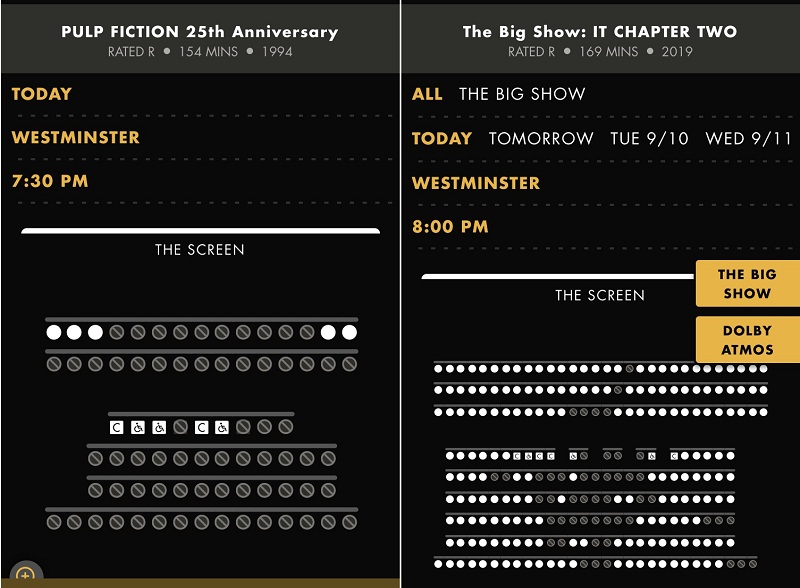
Here is a visual representation of the point I'm trying to make.
A local theater showed Pulp Fiction last night on a small screen (constant width, I think) while IT played on their big 60' screen.
These seating charts were captured less than an hour before each show started. (I'll save you some time counting: PF = 68 tickets, IT = 50 tickets.)
1. How many people looked at the chart for Pulp Fiction and decided the screen was too small to be worth the time or money? (I know of 2.)
2. How many people looked at the chart in the days leading up to the screening and decided not to attend because the seats they prefer were already taken?
3. How many people attended that screening and said "That was fun, but it wasn't really that much better than seeing it at home" and how many of them will skip the next classics showing?
4. How much more money could the theater make if it ran classics in the big screen?
___________________________________(NOT TO SCALE)___________________________________
Note: This is not a one-off - it's typical. Classics almost always sell more seats than the current release in the big screen.
Note2: "Classics" for the purpose of this discussion = any title not in current release that people would like to revisit.
Sorry to keep ranting about this, but it seems like such a missed opportunity. There's clearly a market demand that is not being met.
Posted by Martin McCaffery (Member # 37) on 09-09-2019, 02:04 PM:
How many looked at it and said "Good God, 'It Chapter Two' is 169 mins!" ? ;>
I imagine if this sort of thing was programmed at the local level by someone with the authority to make decisions, your argument would be valid. To Corporate Headquarters, it's just a rounding error.
Posted by Bobby Henderson (Member # 840) on 09-10-2019, 11:25 AM:
quote: Jesse Skeen
I'd go so far to say that theaters shouldn't even HAVE those smaller screens. Some of them are downright embarrassing. You might as well tell the patrons that they have crappy taste in movies to see something that they put on those screens.
I'm pretty sure when theater chains design the auditoriums in typical modern multiplex theaters they're basing most of their choices on anticipated attendance levels for that specific theater location and adjust the primary and secondary auditoriums for it. They balance those expected attendance numbers with the cost of utilities (heating, air) and other operational costs per seat.
To use an exaggerated example, no theater is going to build a secondary house with 700-1000 seats and a giant sized screen if movies are being moved to that room after 3 or 4 weeks of play time.
I don't like tiny auditoriums, but my biggest complaint about modest sized rooms with low seating capacities is the screens are often very small in relation to the size of the room. I wouldn't mind seeing a movie in a room with less than 100 seats if the screen was big enough to fill much of my field of vision. Some boutique "ultra luxury" theaters actually do that. Typical multiplex theaters usually do not. The secondary screens in typical multiplex theaters often have the audio turned down to something akin to TV speakers volume. I don't like that either.
The model of modern theatrical releases is very different from what it was 30-40 years ago when single screen houses with lots of seats (and 70mm projection capability) were still common. The typical theatrical release today blows its wad in just a couple or so weeks. Very few movies today have any staying power at all. Distributors set it up that way. The wait time for a movie to reach home video is very short. Meanwhile there are lots of theaters and lots of theater screens. It's very easy to see a new movie during its opening weekend, even if it is an extreme demand blockbuster. It's rare for any theater in any city to have people waiting in line for hours to see a specific movie.
Today theater chains prefer to have a specific, high demand movie play on 3 or more screens with staggered show times rather than play the movie in one huge house with fewer available show times.
The premium priced theater screen is really the only exception to this trend. Those kinds of theaters cater to a certain kind of audience. Not everyone is willing to pay $18 or more to see some new sequel in "IMAX." Some cash conscious movie-goers prefer to pay less to see the movie in a smaller house and with lower, less dynamic volume levels.
New movies also tend to be "platformed" in their release timing. Often we don't see more than one "big" movie get released during a specific week. No two would-be blockbusters are going to go head to head with each other. That gives theater chains even more incentive to build just one big, premium house, a few mid-size rooms and some tiny auditoriums when the movie has gone into terminal, clearance shelf mode.
quote: Geoff Jones
Note: This is not a one-off - it's typical. Classics almost always sell more seats than the current release in the big screen.
I don't think that statement is scientific at all. At best it could only apply to specific niche theaters in giant city markets.
Last week I was on vacatation in Colorado Springs visiting family. During that time I took in a Tuesday afternoon matinee show of The Matrix. The movie was playing on a recently installed Dolby Cinema screen at the AMC location in Chapel Hills Mall. This was my first time visiting this theater since they remodeled the big house for Dolby Cinema (it was formerly a Carmike Big-D house). They had the sound cranked up really well, which I found a little surprising. Usually if I see a movie at a theater in Colorado Springs the sound tends to be turned down lower than usual (and really low in non-premium houses).
Anyway, I had been monitoring reserved seat activity for this movie. I chose a Tuesday matinee for the early show pricing combined with Stubs Premiere discount: $10. Despite the relatively cheap ticket price hardly anyone was in the theater. My parents and brother weren't interested in watching a 20 year old movie they could just as easily watch on Blu-ray. So I ended up going to the show by myself. I could have easily booked great seats at any time during the previous weekend. Meanwhile, It: Chapter Two was selling much better than The Matrix. The prime 7:00pm Fri-Sat shows had all the good seats going fast. The matinee shows weren't doing bad either.
The Matrix was originally released at the end of March, 1999. Yet this 20th anniversary engagement was booked in the last week of August. That was likely the only time Warner Bros could get The Matrix booked onto any Dolby Cinema screens. Late August is usually a very slow time at theaters, just like early January or late April. Those periods tend to be a time when studios release crap product they need to clear off the shelf. It's easier during this time for a classic movie like The Matrix to get access to premium big screen houses. During other times theaters are only sticking new, higher profile releases into the premium houses.
Posted by Geoff Jones (Member # 3668) on 09-10-2019, 01:12 PM:
quote: Geoff Jones
Note: This is not a one-off - it's typical. Classics almost always sell more seats than the current release in the big screen.
quote: Bobby Henderson
I don't think that statement is scientific at all. At best it could only apply to specific niche theaters in giant city markets.
You're right - I should have clarified. My comment is based on observation of Harkins Northfield's Tuesday Night Classics for the last couple of years and classics at the Alamo Drafthouse Westminster ever since it opened this summer. In both cases, old films almost always sell more tickets than the current release playing at the same time. I occasionally look at other markets and tend to see the same thing, but that's definitely anecdotal.*
I raised this issue with Harkins and they have started playing some of their classics on their big screen. From what I've observed, it's been successful for them.
It looks like The Matrix played in 138 Dolby Cinema auditoriums from 8/30 through 9/5. Bravo to AMC for that. I hope the Chapel Hills location doesn't have red aisle lights shining on the screen like the AMC Dolby Cinema in Broomfield. :/
Of course a re-release isn't going to sell as many tickets at a Tuesday Matinee as a big new release is going to sell on opening night. But I wonder if The Matrix sold more tickets than whatever was playing in the next biggest screen at the same time. I wonder if that was true for most showings of The Matrix that week.
I'm not advocating that theaters bump big new releases from their premium auditoriums on opening night. Some thought is obviously needed to book them at appropriate times, and it looks like AMC did a good job finding a slot for The Matrix.
I'm only saying that if you're going to book them, put them in your largest house and give people something they can't get at home. You'll make more money if you do.
*Here's an anecdote for you - Merchant Walk theater in Marrietta, GA at 7pm tomorrow:
The Two Towers - 11 tickets sold
It: Chapter 2 - 6 tickets sold
Posted by Bobby Henderson (Member # 840) on 09-10-2019, 02:00 PM:
quote:
It looks like The Matrix played in 138 Dolby Cinema auditoriums from 8/30 through 9/5. Bravo to AMC for that. I hope the Chapel Hills location doesn't have red aisle lights shining on the screen like the AMC Dolby Cinema in Broomfield. :/
This is the first Dolby Cinema @ AMC auditorium I've visited that doesn't have the old AMC Prime-style Red LED lighting (including red lights in the speakers). Everything has gone blue, more like the Dolby Cinema screens in Europe. But there's no stealth fighter panels on the walls and ceiling. The surround speakers appear to be a different make and model as well. Previous AMC Prime/Dolby Cinema houses used (I think) Christie Vive surrounds. These might be QSC, but I don't know for certain.
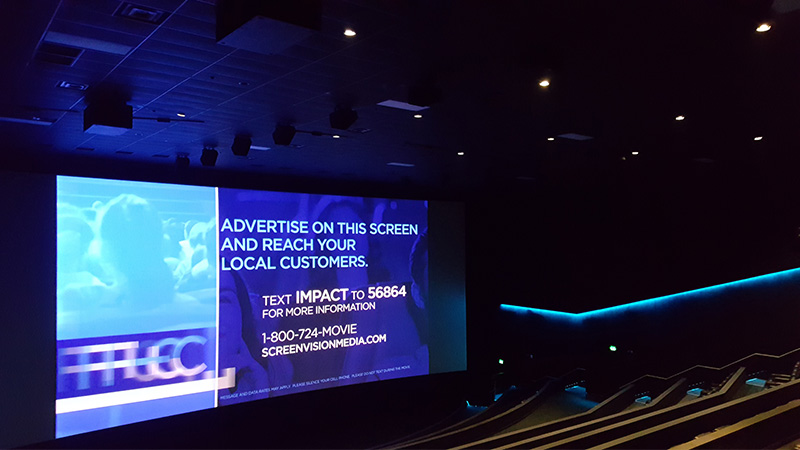
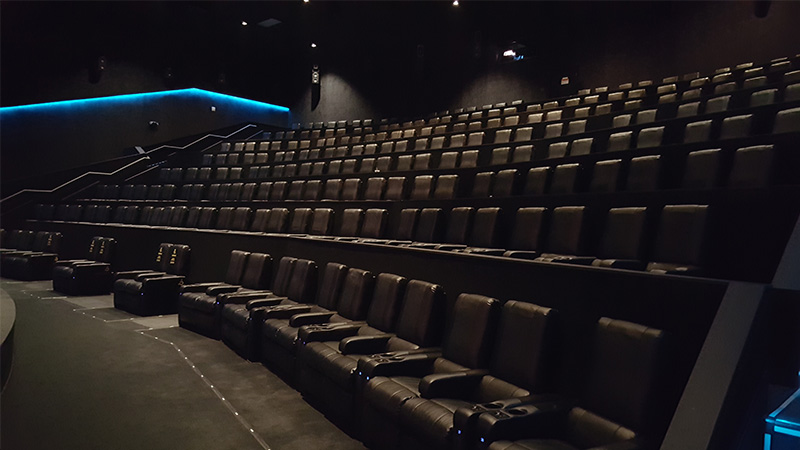
The image of the seating area is a bit misleading. A couple or so rows of seats were out of the camera shot to the left. Still, the switch to recliners ate a lot of seats in this auditorium. On the bright side the screen is pretty big in relation to the seating area. And it's scope shaped. Most Dolby Cinema @ AMC screens I've visited have had the usual common width shaped screen with 'scope movies letter-boxed on them.
quote: Geoff Jones
Of course a re-release isn't going to sell as many tickets at a Tuesday Matinee as a big new release is going to sell on opening night. But I wonder if The Matrix sold more tickets than whatever was playing in the next biggest screen at the same time. I wonder if that was true for most showings of The Matrix that week.
From what I could see just checking the theater's seating chart in the AMC Theaters app it looked like It: Chapter Two was selling more tickets for the weekend evening shows. I would have gone to an evening/weekend show that first weekend I was in Colorado Springs if others in my family wanted to see the show. Since I wound up going alone I picked a Tuesday matinee instead to save a few bucks.
Posted by Geoff Jones (Member # 3668) on 09-10-2019, 02:57 PM:
I’m confused. I thought The Matrix played from August 30 through September 5 and IT opened on September 6.
Posted by Bobby Henderson (Member # 840) on 09-10-2019, 05:21 PM:
That's right. I watched The Matrix on Sept 3. My relatives weren't interested in checking it out during Labor Day weekend, so I waited to see the movie during the week before It: Chapter Two took over the Dolby Cinema screen Thursday evening, Sept 5.
Posted by Scott Norwood (Member # 30) on 09-11-2019, 01:48 PM:
I suppose that the real answer here is that big, mainstream multiplex cinemas really aren't very good at doing specialized programming.
Repertory programming isn't easy and the people who are doing it right have a deep knowledge of the films that they are showing and the audiences who come to see them. Maybe it's just too much to ask AMC/Regal/Cinemark/etc. to do this.
Posted by Randy Stankey (Member # 64) on 09-11-2019, 09:57 PM:
I think it's a culture thing.
When I worked at Mercyhurst, we would regularly sell out movies like "The Sound of Music", "Lawrence of Arabia" or "The Good, the Bad and the Ugly but only have half to two-thirds on other movies. (800 seat house.)
At the local Cinemark, they would run the exact, same movies... "SoM", "LoW" but get, maybe 10 or 20 people during a whole day's schedule. Mercyhurst would get 40 times the business in one showing that Tinseltown got in an entire day.
People who go to googolplex theaters just don't think about watching classics. People who go to the college theater just don't think about watching main stream movies.
The bean counters at the big chain theaters just don't think that they have the time to build an audience with the classics. They want the sure thing so that they can make the quick buck.
College theaters and small art houses build their business on being in touch with the audience on a more personal level and they make their money showing more culturally significant movies. That's their "sure thing" and they wouldn't want to mess that up by trying to show the latest blockbusters that anybody can go see at the local Cinema Googolplex.
Each has their own niche and they stick to it.
That means that the Googolplexes just don't even consider showing classics in anything but the smaller houses.
It's just entrenched thinking.
Powered by Infopop Corporation
UBB.classicTM
6.3.1.2