This is topic The Annual Popcorn Rip Off Article in forum Ground Level at Film-Tech Forum ARCHIVE.
To visit this topic, use this URL:
https://ft-forum.com/ft/cgi-bin/ubb/ultimatebb.cgi?ubb=get_topic;f=5;t=003218
Posted by Martin McCaffery (Member # 37) on 09-08-2019, 02:14 PM:
The Hustle
This time with charts.
quote:
Why is movie theater popcorn so outrageously expensive?
Yes, $7 popcorn is a ripoff. But it’s also the lifeblood of most movie theaters’ business model.
BY ZACHARY CROCKETT
SEPTEMBER 8, 2019
n March of 2012, Justin Thompson, a 20-year-old security technician from Livonia, Michigan, decided to go to the movies.
Inside, he encountered an atrocity we’re all familiar with: the movie theater concessions stand, with its $8 popcorn, $6 sodas, $5 candy bars.
Left with no alternative, Thompson indignantly bought a treat at an 800% markup. Then, he went home and sued AMC for charging “grossly excessive prices” on its snacks.
“He was taken for a ride,” Thompson’s lawyer, Kerry Korgan, told The Hustle. “I’m sorry, but you can go and get a bag of popcorn at any convenience store for next to nothing.”
The lawsuit was later dismissed, but it raised a question we’ve all asked: Why the hell are movie theater concessions so expensive?
We set out to find an answer — and it took us right to the heart of a declining industry’s business model.
The movie concessions “racket”
Before we dive into the why, let’s take a quick look at just how much you’re overpaying for snacks at the movie theater.
We dug through concessions data from AMC, Cinemark, and a number of other theater chains to compile rough averages of how much certain items cost. Then, we compared these prices to the typical street price you might pay at a convenience store.
It should be said that movie food and beverage prices vary widely by geographic region, theater size, and a number of other factors. In the course of our research, we saw popcorn prices as low as $0.99 and as high as $13.75. The figures you see here are rough, non-definitive industry averages — but they still paint a bleak picture.
Zachary Crockett / The Hustle
Moviegoers pay the highest premium for popcorn.
At most major movie theaters, you’re looking at around $8 for a medium-sized bag of buttered popcorn — nearly the price of the average movie ticket ($9).
At 11 cups, the average medium-sized movie popcorn goes for $0.73/cup. By contrast, a 175-cup bag of genuine movie theater popcorn can be had on Amazon for $48.23, or about $0.27/cup.
A movie theater ICEE ($6.49) runs 4.4x more than a 7-Eleven Slurpee (which is the same thing), and a soda ($5.99) is 3x the cost of a store-bought Coke. One box of movie M&M’s ($4.79) could buy you nearly 3 boxes at your local Walmart.
For a simple date night (let’s say a popcorn to share, two sodas, and some Red Vines), you’re looking at $24.79 — more than the price of two average tickets ($18). For a family of 4, the cost of snacks might run up to $50 or more.
When we examine the markup (profit minus cost) on these products, the figures are even uglier.
Zachary Crockett / The Hustle
Richard McKenzie, a professor at the University of California, Irvine, determined that it costs the average theater around $0.90 to produce a bag of popcorn. At $7.99, that’s a 788% markup.
Including the cup and a free refill, that $5.99 soft drink costs a theater $0.91 (a 558% markup); candy, which can be purchased wholesale for ~$1.16, isn’t far behind.
It’s easy to write this all off as simple price-gouging. After all, movie theaters have a captive audience — and once you’re inside, they have a monopoly on every secondary good you choose to purchase.
But the pricing of these concessions isn’t as simple as it seems.
Theaters don’t make much on tickets
Allen Michaan was just 19 when he built his first movie theater in the 1970s. In his 40-year career, he’s operated more than 20 cinemas, including the historic Grand Lake Theatre in Oakland, California.
As he tells it, pricey popcorn isn’t some diabolical price-gouging scheme — it’s the lifeblood of a theater’s business model.
“After the distributor takes its cut, we barely make money on ticket sales,” he says. “We have to make up for that somehow.”
When a theater wants to show a film, it must agree to pay the distributor a percentage of all ticket sales. This percentage is higher during the first few weeks of a film and decreases over time, but generally averages out to ~70%.
So, if a theater sells a movie ticket for $9, its cut is only $2.70 — and that’s without accounting for other expenses.
Theater owners could price tickets higher, but it wouldn’t do them much good since 70% of any increase goes straight to the studios. Instead, they think of movies as a loss leader: their primary goal is to get as many people through their doors as possible, even if it means breaking even (or losing money) on the price of admission.
In fact, the price of a movie ticket hasn’t gone up much in the last 90 years. In 1929, a ticket was $0.35; today, it’s $9. Adjusted for inflation, that’s a fairly reasonable price increase of 108%.
Zachary Crockett / The Hustle
The same can’t be said for movie popcorn: Over the same period, its price has gone up a whopping 1,188% — more than 10x the increase of a movie ticket.
Movie theaters’ margins are made not on their primary product (movie tickets), but on secondary products at the snack stand, where customers guzzle ICEEs and shove buttery kernels down their gullets.
“If we didn’t charge as much for concessions as we did, the tickets to the movies would cost $20,” the CEO of Regal Cinemas, the nation’s second-largest theater chain, told the Los Angeles Times in 2008.
To survive, Regal and other cinemas adhere to an old industry adage: “Find a good place to sell popcorn and build a movie theater there.”
The popcorn business
Unlike tickets, concession sales are not shared: theaters keep 100% of the revenue they generate. And this revenue generates much higher profits.
The Hustle looked through annual reports (2015-2018) from two leading movie chains (AMC and Cinemark) and found that concessions account for ~30% of total gross revenue, yet make up 45-50% of gross profits.
In 2018, Cinemark sold $1.8B in tickets at a cost of $1B (distributor fees). By contrast, concessions brought in $1.1B at a cost of just $181m — an 84% profit margin.
This strategy of selling a primary good at cost (or at a loss) and making the bulk of profit on a complementary good (like popcorn) is a form of the widely employed razor and blades business model. Microsoft, for instance, will sell its Xbox consoles at a steep loss to get people to buy them, then make healthy returns on games and accessories.
Photo: Andrew Stawicki/Toronto Star via Getty Images
“Theaters are able to keep a positive profit because of concession sales,” says Ricard Gil, a business professor at Queen’s University in Canada.
Gil, along with a colleague from Stanford, analyzed 5 years’ worth of revenue data from a major movie chain and found a different motivation for expensive popcorn: Theaters use it as a way to price discriminate, or charge customers varying prices for the same experience (in this case, seeing a movie).
“There is a wide dispersion in willingness to pay for a movie experience,” says Gil. “How much a customer values her movie experience is positively correlated with her valuation of concession consumption.”
Some moviegoers value the experience of seeing a movie at $9 and buy only the ticket; others might value it at $23.50 (the price of a ticket, plus popcorn and an ICEE). Snacks enable a theater to segment its customer base into “high-value” and “low-value” groups.
Popcorn is no savior
Even with $8 popcorn and 84% profit margins, most movie theater owners aren’t living the high life.
“I’m not getting rich off what you pay for popcorn and soda,” says Paul Turner, who runs Darkside Cinema in Corvallis, Oregon. “I drive a 26-year-old van.”
Profits from popcorn, he says, are used to pay off the high overhead costs of running a theater: staff, rent, AC, utilities, and the constant upgrades (Surround Sound, IMAX, 3D) that consumers demand.
Popcorn also can’t salvage the bones of a declining industry.
Less than 10% of the US population goes to the movies, compared to 65% in 1930. And those who do go are attending less: In 2018, the average moviegoer paid for only 3.5 tickets, down from 4.9 tickets in 2002.
As a result, the National Association of Theater Owners says the number of cinemas in the US has fallen from 7,477 to 5,869 (-22%) in the past 20 years.
Zachary Crockett / The Hustle
Consumers have cited the high cost of tickets and concessions as a main deterrent to seeing a movie. In turn, theaters have made efforts to lower these prices, ranging from refillable popcorn buckets to annual subscription models.
But at the end of the day, some customers, like Gil (the economist who examined outrageous snack prices), are still willing to pay for the experience — even if it comes with 788% markups.
“I have young kids, so going to the movies is almost a utopia,” he says, “And when I go, I certainly buy popcorn.”
Posted by Justin Hamaker (Member # 2165) on 09-08-2019, 05:02 PM:
I give the author credit for at least attempting to answer the question honestly. Although the snark and bias comes across stronger than the actual explanation.
Posted by Scott Norwood (Member # 30) on 09-08-2019, 07:50 PM:
Agreed with Justin.
What I don't get about these "investigative" articles, though, is why they always pick on movie theatres. Why don't we ever get articles about "why is food expensive at {restaurants, sporting events, anywhere else outside of the home}"? I'm willing to bet that the markup on food at many of these other places is actually higher than at most cinemas.
Posted by Frank Angel (Member # 248) on 09-09-2019, 12:06 AM:
The guy really thought he had a legitimate lawsuit against AMC because he thought the popcorn price was too high? Does he not understand the concept of capitalism? I don't like what my landlord is charging me for rent, but never would it have crossed my mind that I would have a gouging lawsuit against him. Also, no one is forcing anyone to strap on a feedbag in order to enjoy a movie.
Posted by Rick Raskin (Member # 1561) on 09-09-2019, 05:49 AM:
I think this reply to the original article hits the mark:
"learned this years ago in school. People should be pissed at the movie makers, or the theaters should protest the strong arm moves put on them. sporting events or concerts have over priced food as well." --- Steve Varga
Posted by Mark Lane (Member # 10848) on 09-09-2019, 03:01 PM:
The prices the major chain theaters charge encourages people to sneak in their own food. The last time I was at Cinamark they wanted $4.00 for a .10¢ bottle of water.
We charge a dollar for that same size bottle of water. Our largest popcorn is $4.00 and a large soda is only $2.50. We sell king size candy bars for as low as .33¢ each and there is room for a fair profit in those prices. Three full size candy bars for a dollar with a bit of a profit in there at that price. We we can do that, the major chain should be able to do it also.
Our soda comes from a local company and not Pepsi or Coke, cheaper and better tasting.
As a result, many of our showing have 100% or more of customers purchasing something from the concession stand. It is more work for the same amount of profit but it is a business model that so far has been working for us.
Nearly everyday we hear how much the experience would cost at other theaters.
We feel the concessions is part of the theater experience. If we can increase the experience we will increase the ticket sales. We believe the concessions sales and ticket sales work hand in hand.
I understand the big chain business model, and I know they have more overhead than we do, but I generally don't subscribe to it.
Posted by Ed Gordon (Member # 10866) on 09-09-2019, 04:14 PM:
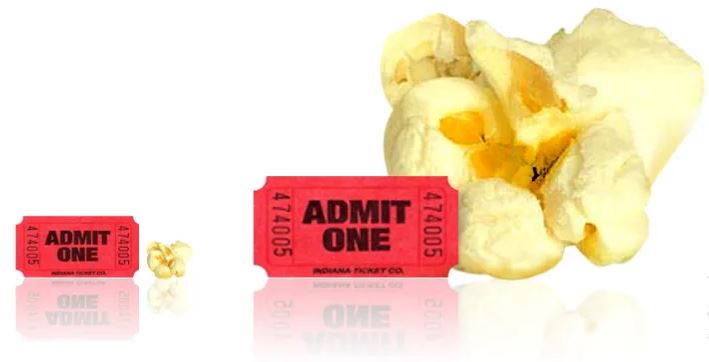
quote:
Here you see a movie ticket and kernel popcorn, as scaled to their price increase over the past 80 years. On your left, 1929. On your right, 2009. Needless to say, things have changed.
In 1929, The Great Depression popularized popcorn as a movie time treat since it was cheap, easy, tasty and somewhat filling. Back then, a bag cost you 5 cents. Now, a (small) bag costs you $4.75. Sure, our new bag is probably a bit bigger, but it's vastly more expensive.
In fact, when adjusted for inflation, popcorn prices* have seen an ironic 666% price increase, while movie ticket prices have increased a more moderate 66%. The above picture tells the story to scale, but just in case you're a bigger fan of numbers:
1929
Movie - $4.32 ($0.35 pre-inflation)
Popcorn - $0.62 ($0.05 pre-inflation)
2009
Movie - $7.20
Popcorn - $4.75
What gives? As many of you know, Hollywood takes a majority of ticket proceeds (we're talking upwards of 70% or more) during the first few weeks a film is released. Not so coincidentally, those first few weeks are also usually a film's best-attended screenings. So theaters fall back to popcorn, soda and candy to make money because Hollywood doesn't see a cut of these sales.
But is this 666% popcorn price increase evil? Obviously, numbers don't lie. Has the increased price of popcorn helped keep ticket prices in check? Possibly, though there's no real way of knowing.
Still, one thing's for sure: Those stadium seats and surround sound systems won't pay for themselves...right?
From a 10 year old article.
I go to a theater to see a movie, not eat, so none of this impacts me (except perhaps the tickets are cheaper if the concessions are subsidizing the price of tickets) Regardless, it makes movie theaters look bad, and lets the movie producers off the hook. Then again, it fits with the theory that the producers want to push the audience to streaming first run movies at $30 a showing...
Posted by James Westbrook (Member # 3690) on 09-12-2019, 03:07 AM:
I will admit I glanced at the article. I wonder if the author is aghast about concession prices at sporting events? If not, why is he letting them have a pass?
Maybe it's because movies have more attendance than sporting events...there, I answered my own question.
Posted by Mike Spaeth (Member # 524) on 09-12-2019, 02:31 PM:
quote: Mark Lane
We sell king size candy bars for as low as .33¢ each
You sell candy bars for a third of a penny?
Posted by Randy Stankey (Member # 64) on 09-12-2019, 09:26 PM:
Why do people pick on movie theaters when so many of the products people buy are patent rip-offs?
Why do people buy bottled water at $1.99 for a 20 ounce bottle? That works out to $12.73 per gallon! More expensive than gasoline!
Why do people pay $3.69 for a 1.6 ounce bottle of "MiO Liquid Water Enhancer" when they could buy an equivalent amount of Kool Aid for 75¢ ?
https://www.makeitmio.com/en/original
MiO is EXACTLY the same thing as Kool Aid. The only difference is that it's liquid, sold in tiny plastic bottles instead of powder, sold in paper pouches.
One packet of Kool Aid plus one cupful of sugar which you probably have in your kitchen cupboard makes eight servings.
This will cost 25¢ at the grocery store.
With Mio, you're supposed to buy a 1.6 oz. bottle for $3.69 and you're supposed to squirt it into a container of bottled water which you have to buy separately.
You're paying five times the price of Kool Aid for the flavored syrup and you're paying four times the price of gasoline for the water.
Those kinds of markups are at least as bad as people claim movie theater popcorn to be!
BTW: Kool Aid and Mio are made by the same company, Kraft Foods. They are screwing you, coming or going, no matter which product you buy!
Movie theaters are in the Minor Leagues compared to things like this!
Posted by Frank Angel (Member # 248) on 09-24-2019, 07:22 PM:
Why do people buy bottled water at $1.99 for a 20 ounce bottle? That works out to $12.73 per gallon! More expensive than gasoline!
People will pay for convenience...and tend toward being lazy if there is choice between easy and difficult, or at lease less easy. And when they are rich, they can opt for convenience and pay for it. The flavored water is already made and packaged -- no mixing or measuring -- basic instant gratification. People like that. And then there's the other thing -- people are also quite stupid.
Posted by Frank Cox (Member # 6258) on 09-24-2019, 07:28 PM:
Quite a few years ago the Pepsi salesman was here one day and said, "You should be selling bottled water."
I said I wasn't too interested because who in the world would buy bottled water?
He told me that he would give me a free case to try it, so I said I would take that.
Ever since I've been selling bottled water. It's my number one selling drink.
And I'm still amazed that people actually buy that.
Posted by Frank Angel (Member # 248) on 09-24-2019, 08:25 PM:
We have a bottled water service in our office. It is from a brand that I will not mention. We are also in NYC which gets its water from reservoirs up state in the Catskill Mountain region. The water is the best as any mountain or spring bottled water. One day just for an experiment I took an empty 5 gallon bottle and filled it up with tap water. I put a sign on it that said, This is NOT XYZ bottled water, but mountain water from the Catskills that we are trying and considering switching to.
Let us know how you like it." Everyone said it was even BETTER than XYZ water. It convinced them to purchase five bottles from XYZ and simply refill them with NYC tap water. Lots-o-money saved.
Posted by James Wyrembelski (Member # 9037) on 09-24-2019, 09:11 PM:
Even in our small town...people will gladly hand over 2.50 for a bottle of water. I get it through our fountain service provider just out of convenience. You also can't get 20oz cases in stores. I could probably just get the cheap 16 oz ones, but I hate how wimpy the bottles are. They FEEL cheap. The 20oz comes in a nice sturdy bottle and I can charge more.
But those bottles sure don't cost me 20 cents. If I sold it for 1 dollar I'd lose money.
Posted by Randy Stankey (Member # 64) on 09-24-2019, 11:52 PM:
Penn and Teller did an episode in their series, "Bullshit," about bottled water.
They went to an upscale restaurant in New York and sold the customers bottles of designer spring water. The trick was that every bottle was filled from a garden hose in the alley behind the restaurant.
They put fake labels on the bottles with names such as "Eau de Robinet" and "Piss de Chat." (Names which translate from French as "Faucet Water" and "Cat Piss".)
"Piss de Chat" even had yellow food coloring in it and the waiter even upsold it to customers as having "essential minerals."
In almost every case, the customers preferred the designer bottles to tap water even though they were the exact same thing.
If I need to carry drinking water some place I might, occasionally, buy a bottle of water but, more often, I'll wash out an empty soda bottle and fill it with water from the kitchen sink. My girlfriend has a Nalgene bottle that she refills and keeps in the fridge.
We do it because buying bottled water is a waste of resources and because paying $12.00 per gallon for water is stupid!
The point I was getting at, above, was how people will stupidly pay exorbitant prices for ordinary things like water without blinking an eye but will cry foul when they have to pay for popcorn which has a fraction of the markup.
Stupidity on top of stupidity!
Posted by Jarod Reddig (Member # 6363) on 09-25-2019, 06:11 PM:
Honestly even though these articles piss me off I think they can do a lot of good, and Im glad this guy tried to get his facts right. It will help the average Joe understand a cinemas business model. And as we all know the average person knows very little about how a cinema is ran or operated.
Posted by Mike Blakesley (Member # 26) on 09-25-2019, 09:06 PM:
Yes but these articles always focus way too much on the cost of the popcorn ingredients vs selling price, and not enough on what it really costs to run a theatre.
Posted by Bobby Henderson (Member # 840) on 09-25-2019, 09:32 PM:
I wonder if Zachary Crockett (the guy who wrote the article) even gets out of the house. Most people already know why popcorn and other stuff at the movie theater is more expensive than buying the same shit at the grocery store. Has this guy ever compared what a six pack of beer costs at a grocery store versus what the same six beers cost at a night club or even a regular bar? Who is going to file lawsuits over any of that?
No one is forcing anyone to buy popcorn at the theater. It's an optional purchase just like anything else at the snack counter. Hell, watching a movie in a commercial theater is optional. Lots of Americans don't go to commercial theaters at all because of the ticket prices. I've told friends of mine who only watch movies at home that movie studios would no longer make any big budget movies if there are no commercial theaters in which to showcase them.
Regarding bottled water, I don't buy that stuff either. Long before Penn & Teller's episode of Bullshit, other programs have covered the myths about bottled water. The big one is bottled water is supposedly more clean. The stuff is mostly tap water! There's even labels on the bottles stating that some of the contents may come from "municipal water supply." Even if the stuff is 100% "spring water" it's not any more clean. I remember seeing one documentary about New York City's water supply system (Modern Marvels, I think) and its tap water would often beat most bottled water in taste tests.
Then there's the whole pollution thing. A lot more than plastic water bottles contribute to it. Still, it seems like a pretty damned needless contribution to the amount of plastics going into landfills or our waterways and oceans. The broken down, micro particles are getting eaten by fish and birds. The stuff is working its way back up the food chain right on to our dinner plates.
Posted by James Wyrembelski (Member # 9037) on 09-25-2019, 10:00 PM:
quote: Mike Blakesley
focus way too much on the cost of the popcorn ingredients vs selling price, and not enough on what it really costs to run a theatre.
That's where things can really sting too. Many people compare the cost of things at the snack counter vs grocery stores/gas stations. And some (not all) truly think you're ripping them off and rolling in it. I wish.
It reminds me of the times just right before the financial crisis and the "great recession". I worked at the local restaurant and not only were we dealing with a slowing sales but all the extra stuff that started coming out of it. Fuel surcharges, rising food prices, and all this nickel and dime stuff was coming out of the woodwork.
Of course, the only thing that could be done was to raise prices enough without scaring off everyone en masse. It was really hard as a long time employee to listen to countless claims of us ripping everyone off. Not to mention getting to see what it was doing to the owner who, at that point, was just trying to keep the place open. It was always nice to hear "guess that means you just get less of a tip" after prices went up and how they could make the same thing at home for a fraction of the price.
Yes....yes you can... ![[Roll Eyes]](rolleyes.gif)
Posted by Martin Brooks (Member # 1269) on 09-25-2019, 11:29 PM:
Yes, movie concessions are extraordinarily expensive and personally, I almost never purchase them because I can't stand being ripped off. But that's also true at arenas, convention centers, sports stadiums, amusement parks and almost anywhere where one is part of a "captive audience". And it happens because of the dogma of "maximizing revenue" pushed by finance types. What they don't take into consideration is the bad feelings it leaves which kills repeat business.
But having said that, the high margins on concessions is keeping movie theaters in business. Looking at AMC, the largest movie chain, their gross margin on concessions was 84% and constituted 32% of revenue in the first two quarters of this year (their gross margin on films was 48%).
But overall, AMC lost $487 million in 2017, made $110 million in 2018 and so far in 2019 has lost $81 million.
So if we want theaters to survive, they have to do the concession ripoff. If you don't like it, don't buy. I don't. I've never understood why people can't get through 3 hours without eating crap. But obviously, there are many people who have the money and don't care.
The question is if they charged half the price, would they sell twice as much? If they charged a quarter of the price, would they sell four times as much? Probably not.
Posted by Bobby Henderson (Member # 840) on 09-26-2019, 11:31 AM:
One weird theory I have on concessions pricing: if the stuff was priced considerably lower (but still very profitable) there would be a hell of a lot more of it to clean off the floors in the auditoriums between shows.
Posted by Randy Stankey (Member # 64) on 09-26-2019, 11:39 AM:
quote: Bobby Henderson
...there would be a hell of a lot more of it to clean off the floors in the auditoriums between shows.
Are you going by the old saying, "Men value things that come at a cost."
If popcorn was cheap then people wouldn't care as much?
Posted by Frank Cox (Member # 6258) on 09-26-2019, 12:47 PM:
The first year after opening my theatre I did what became the annual free show for Santa Claus Day. And thinking I was going to be a really nice guy I gave away free popcorn. Free movie and free popcorn for everyone!
After the show I had to get my snow shovel to clean up all of the popcorn on the floor. I've never seen that much popcorn wasted before.
So there's never been a free movie with free popcorn here again.
Posted by Harold Hallikainen (Member # 5405) on 09-26-2019, 01:20 PM:
There's a theater around here (Denver area - I think it's a Landmark theater) that has free popcorn and drinks. Ticket prices seem about normal. I wonder how that's working. I have not seen it at other theaters, including Landmark theaters, in the area.
As I mentioned previously, the high price of popcorn is not for the popcorn, but for paying someone to clean up the mess.
Harold
Posted by Mitchell Dvoskin (Member # 751) on 09-26-2019, 02:59 PM:
I posted the essence of this on another thread here before.
AMC has a concession problem, and it is not really the cost. It is the paid Stubs member priority line. Having a fast lane for paying members is not necessarily a problem, but having only one server who never has time to server the non-member customers has to be costing them money.
Me and my girlfriend went to see the Downton Abby preview at their Rockaway Square NJ location. I already knew that it was a waste of time to attempt to buy snacks/soda at AMC due to what I stated above, but my girlfriend actually wanted something. After 20 minutes of waiting in a not being served line, she too gave up along with about half the line.
I was standing across the lobby from the concession stand chuckling. If the brain trust at AMC thinks this will make anyone want to signup for a paid Stubs level, they are wrong. What this does is make people skip the concessions altogether, and when possible, skip AMC altogether.
There is no excuse for bad customer service, and this policy is bad customer service.
Posted by Jarod Reddig (Member # 6363) on 09-26-2019, 04:39 PM:
Ya I agree Mike but better then them just saying the popcorns high just to screw the public while raking in the ticket sales. At least this makes some of the public understand that movie theaters have to pay back to the studios for ticket prices. Almost everybody I talk to has NO IDEA that theaters must do this.
Posted by Bobby Henderson (Member # 840) on 09-26-2019, 10:49 PM:
quote: Randy Stankey
Are you going by the old saying, "Men value things that come at a cost."
Not quite like that. Cheaper popcorn prices would just make the stuff more affordable and accessible to more people. A certain portion of any theater audience are filthy pigs who don't care about spilling popcorn, candy and soft drinks. They'll upend the remains of a popcorn bag onto the floor. The numbers will vary by location. But it's a good bet that if movie theater popcorn was significantly cheaper it would result in even more people spilling the stuff all over the theater.
quote: Mitchell Dvoskin
I was standing across the lobby from the concession stand chuckling. If the brain trust at AMC thinks this will make anyone want to signup for a paid Stubs level, they are wrong. What this does is make people skip the concessions altogether, and when possible, skip AMC altogether.
For me, signing up for a $15 per year AMC Stubs Premiere membership was 100% about avoiding high service charges when ordering tickets online. We're talking $5-$6 for convenience fees just for a couple of movie tickets. Ordering online is a pretty necessary thing when buying tickets in any reserved seat auditorium. That is unless someone doesn't mind getting really terrible seats when buying tickets in person at the box office shortly before the show begins. It doesn't take long at all for a Stubs Premiere membership to pay for itself. The snack counter line cutting thing is a small bonus, but it's not the big selling point for AMC Stubs at all.
I will agree it's a bunch of bullshit AMC doesn't properly staff up its ticket/snacks counter to handle the two different lines of customers. Playing games with staffing and payroll seems to be a common problem for all big theater chains.
Posted by Jarod Reddig (Member # 6363) on 09-27-2019, 06:36 PM:
Ya my local AMC Classic 8 never has more then one register open at the concession stand. It has 2 registers at the counter tho and another at the entrance for tickets only. Me and my buddies always joke about them not even having a AMC member line.
When Im out of town I do everything I can to avoid an AMC unless it has a Dolby Cinema and Im in the area. Then I will go. I love nachos at the movies and I HATE how they just simply use Tostitos chips, salsa, and cheese. I have that at home. Before it was AMC it was Starplex and before that was Dickinson and they both used Ricos warmed chips and cheese which i always enjoyed. Ive since ordered some to make at home and enjoy them in my theater all time.
Posted by Bobby Henderson (Member # 840) on 09-27-2019, 10:39 PM:
I'm certainly no advocate for watching movies at AMC's theaters, but here in Lawton, Oklahoma our AMC location (formerly the Carmike Cinemas Patriot 13 theater) is actually the good theater in town. I'd rather bludgeon my testicles with a hammer than pay to watch a movie at the tiny little 12-plex inside 70's era Central Mall. I can't even remember who owns that theater now ("Showplex Cinemas" I think). Edit: sorry, it's New Vision Theatres. Dickinson was the original operator when the theater opened nearly 20 years ago. Then Hollywood Theaters had it for some time. Then another company had it (Starplex?) before AMC bought the place. But AMC had to "divest" it when they bought out Carmike Cinemas. When that merger completed my late friend's old Carmike 8 theater was closed for good (it had been operating as a bargain/2nd run house before the AMC buy-out).
Still, the staffing thing is bullshit. The (now) AMC Patriot 13 theater gets pretty busy, particularly on the weekends. It seems like AMC picked up on some of the penny pinching shit Carmike's higher ups did incessantly with staffing and carried that policy over. 300 people are in the lobby for the 1:00pm slate of shows? Let's staff two counter people for that. And that's with the two separate lines for "special" Stubs members and the other line for the rest of the, um, cattle.
Posted by Mike Blakesley (Member # 26) on 09-27-2019, 11:31 PM:
Understaffing is so dumb. If I think we’re going to be at all busy I’ll schedule 2 people. And other employees are always a phone call away if we get unexpectedly slammed.
Posted by Marcel Birgelen (Member # 6801) on 09-28-2019, 07:43 AM:
I do understand the dynamics behind the movie theater business, I do understand why concessions are so overpriced, while most people don't really understand it and think it's the theater ripping them off.
Yet, what I don't understand is that some places keep on selling the lowest quality junk to their patrons. Why not use real coconut oil instead of some cheaper surrogate to pop your popcorn? Or why not pop it fresh instead of buying it pre-popped in big bags? It's really not so much more expensive to do it right and I'm gladly paying the premium if the product I get is good. Almost nothing is so sad as having to pay through the nose for some stale, chewy, slightly reheated popcorn. Next time I'll pass...
Posted by Dave Bird (Member # 490) on 09-28-2019, 08:33 AM:
I'm fascinated by the idea of "processing the line", particularly in businesses I've never been involved in. I kind of believe the concept that some of the best ideas come from people new to the industry because they don't know "how we do things", they aren't limited by it. Two counter staff on busy nights sounds ridiculous if they are the ones fetching all the orders. I'm from the grocery biz and so we had the luxury of always having 20-30 people in the building. If one department got swamped or even if you needed packers up front on Christmas Eve, you could damn well get everyone up there. At the drive-in, our main tricks are opening the gate early so that 2 attendants can sell the place out and everyone is parked a half hour prior to the show. Inside, we still use only one cashier, but we are a cafeteria line setup and when busy, you bet we have 4-6 in there constantly producing product. You can't convince people to come in early, but even if 1,000 people are on the lot, our line is gone by showtime. When we add people, it's in prep/popcorn/kitchen. Curious to try another till in there to see if we get more sales or if it just overwhelms us. Either way, we don't understaff, it was a different biz, but the best lesson we learned was not to operate "cheap". Sometimes that means we can't offer as much, but we don't do it cheap.
Posted by Bobby Henderson (Member # 840) on 09-28-2019, 11:35 AM:
Under-staffing a theater literally kills business. If there is a long line of customers at the snack counter and too few staffers are handling the orders you'll have customers bailing out of the line or not even entering it in the first place. There's the equation of a movie fixing to start yet it's a 20 minute wait in line to get those high priced drinks and snacks. It's easier to just skip the snack counter and watch the movie free of empty calories.
Some movie theater chains got a little sneaky, configuring theater lobbies to prevent customers from avoiding the snack counter. Here in Lawton, a few years ago Carmike built our Patriot 13 theater with no separate box office. At this theater (and plenty of other new theaters) customers have to buy their tickets at the snack counter.
As we know, AMC absorbed Carmike Cinemas. They continued the staffing games Carmike's upper management made famous. But they undermined that one route only path to the auditoriums. The Stubs concept brought about two different member and non-member lines, which makes the ticket/snack counter wait time for non-members all that much more irritating. Then they installed some ticket ordering kiosks in the lobby. Hooray for technology, but I think that ploy to get more modern was more about cutting staff even more. The problem is it allows customers to completely bypass the ticket/snack counter. Hell, when I order a movie ticket online I don't even have to stop at the snack counter or one of those kiosks. I can show the ticket-tearing guy the QR code on my phone and I go right into the auditorium without buying anything at the snack counter.
Extra staffing pays for itself. But these executives far removed from actual theater locations don't see that. They're only looking at trend lines of total payroll numbers and constantly pressuring the shit out of theater managers to get those numbers down low as possible. The suits don't understand the extra money they're going to make by getting customers through the snack counter line faster. The concept is no different than a good restaurant trying to be Johnny on the spot with good and fast customer service. You cycle more customers through your finite number of tables. They have a more positive experience. They spend more money there (including buying more highly profitable beer/mixed-drinks) and tip the servers better. If a restaurant gets cheap with its staffing then the quality of customer service will drop. And that can be potentially devastating to a restaurant. Customers are very fickle.
Posted by Jack Ondracek (Member # 1466) on 09-28-2019, 03:34 PM:
I think part of this is deciding who you want your target patronage to be. Having run our drive-in for 33 years now, I'm convinced you can't run any kind of business model well and please everyone. So... who do you want to serve and who are you willing to see drive past your place?
When we bought our business, it had $5 carload admissions and pretty bad food, even compared to a McDonalds or Burger King. We kept it that way for the first 6 or 7 years, while we figured out what we'd taken on and learned about the community we were to serve for the better part of our working lives.
Behavior-wise, the customers were, ummm.... challenging. Many of them would go out and buy beer, then give us their last $5. Our fields were a big, drunken party. They'd vandalize our bathrooms and spend next to nothing in the snack bar. On weekends, it took upwards of 3 hours to pick up the trash. Many of them had no respect for the place at all.
The place was usually full, but we weren't having any fun, and the studios were reluctant to book anything but sub-run out here. The people we really wanted kind of avoided the place, because some of our regulars scared the kids.
We eventually turned our ears on and heard our community say they wanted first-run movies, a safe environment for families and decent food. Nowhere in that input did we hear anything about admission or concessions price or waiting times.
So... We went near market-rate per-capita pricing, first-run films and cooked-to-order concessions. The $5 crowd grumbled but eventually bought in or went somewhere else. In 5 years, we pretty much turned the crowd around to the business model that remains today.
Water? yah... we have $3 bottles, and we sell a lot of them. I have them in a +/- 1 degree cooler that keeps them at 34 degrees... very nice during the summer. We also have 50 cent cups and a fountain you can use for free, if the price of a bottle puts you off.
We use coconut oil and Flavacol in generous quantities in a 41 year-old Cretors machine (or its younger sibling). On weekends, running them are full-time positions.
We have burgers, chicken, pizzas, fries, corn dogs, Icees, cotton candy and Dippin' Dots. All of it is upwardly non-competitive, yet our lines are customarily out the doors.
People put up with the lines because they know what they'll get when their turn comes up. It's not cheap but it's good stuff. We have room for 4 register lines and, on busy nights, ALL of them are staffed with a cashier, and an assigned runner. The popcorn machines have people assigned to them and there's a person to get the food from the window to the counter, where it's delivered to the customer. We get few complaints about time because the customers see everyone hustling... unlike the stereotypical post office with 4 registers and one union cashier who goes as fast as a sloth because there's no motivation to do better.
As for why people grumble about pricing in the first place... I think a lot of it is because they don't really understand the business. That part is our fault because we put everything together to present an experience that we don't WANT the customer to think too much about. It's much more about how they enjoyed the overall experience than what it took to make it happen. That lack of detailed knowledge makes it impossible for them to reasonably evaluate what a fair price might be, so it seems a certain amount of misinformed snark is inevitable.
BTW... I don't charge a "food permit fee" or restrict my customers from bringing their own stuff in here. Frankly, I couldn't handle the business if they all switched to my food, and I see permit enforcement as a bit of a downer to the experience. Folks who have large families and maybe can't afford the whole cost of admission and concessions will bring some of their own stuff in. They're making a compromise, and I suppose I am to.
One thing though. We have them here for 4 to 6 hours, depending on when they arrive, so eventually, we see a lot of them in our snack bar anyway.
I think we've done a pretty good job. The community has been very supportive over the years, we are (slowly) able to improve things year by year, and one of my kids hung around to pass the business to, eventually.
It's been a pretty good life for a stereotypical old price-gouger.
Posted by Steve Guttag (Member # 268) on 09-28-2019, 04:14 PM:
Bobby,
Back in my exhibition days...I can tell our our home office was constantly monitoring both the per-capita as well as staffing. EVERY manager's numbers were under constant scrutiny to ensure they had the right balance. Every theatre was assign target numbers and a range (different theatres would need different numbers based on several factors, including location, types of movies, screen count...etc.). Managers that lowered the payroll too much would affect their PC and would be as penalized as the manager that over-staffed yet had a higher PC. It was a constant challenge to tweak those numbers to find the best balance that was the most profitable for the business.
Posted by Bobby Henderson (Member # 840) on 09-28-2019, 07:47 PM:
I get the feeling that in my particular market the higher-ups are prioritizing minimal staff over customer service.
quote: Jack Ondracek
We have burgers, chicken, pizzas, fries, corn dogs, Icees, cotton candy and Dippin' Dots. All of it is upwardly non-competitive, yet our lines are customarily out the doors.
People put up with the lines because they know what they'll get when their turn comes up. It's not cheap but it's good stuff.
I think one advantage you have is your drive-in theater is a locally owned independent, and it's a drive-in. Combine that with the wide array of food choices. The customers probably don't have much of a problem waiting a little extra to support a retro-style theater that's also a local business.
But if you're at a major chain theater just wanting a bag of popcorn and a fountain drink cup (to fill at a Freestyle machine) or are waiting only to buy tickets then a long wait in line is probably not going to be tolerated nearly as well.
The restaurant industry knows how critical wait times can affect business. I think some of the big steak/BBQ chains go a little too far with gaming table top turn-over times. So many customers have no idea what goes in to cooking their steaks. The slabs of beef are shipped to the restaurants, often pre-grilled just to get the grill marks on them. In reality when they're cooked they're heated up in a commercial-grade microwave. It's like heating up leftovers. But you're paying a good chunk of money for that steak anyway.
There's a little steak house in the small town of Temple, OK called The Rocking H. They make a good steak and it doesn't come out of a microwave. Lots of people from Lawton are willing to make the half hour drive down there to eat. Prices are pretty reasonable too.
Posted by Dave Bird (Member # 490) on 09-29-2019, 11:33 AM:
I think we share a similar attitude Jack, I like to say "we're raising prices to serve you better" as my go-to joke, but it's true, we've learned to focus on what we can do well, cook to order (in a different service model) and got rid of the cheapskates.
I felt it was a shame when I visited the nearby city drive-in that just closed that a number of the things we were doing to simplify things for ourselves may very well have saved the place. Likewise, the owner echoed a few things you say, they raised carload night pricing and then eliminated it altogether. Struggling to operate two businesses at once, they eliminated Monday nights. Not a single complaint, and no loss in numbers, they just came on one of the other six nights.
We had a couple challenging nights this season where so much of our staff were having "once in a lifetime" stuff combined with midweek Lion King crowds we just decided to cheat our way through a Tuesday and Wednesday with myself plus a box office person to serve 250-300 people per evening. Announced no grill or fried food for those evenings, had my helper come in a couple hours early, made and bagged a ton of hot dogs and popcorn, opened early. Smooth sailing, had 3 or 4 people ask about fried food, per cap concessions were HIGHER than usual. It went so well in fact that I really would consider doing a night or two a week putting hot dogs on special and going without the grill. Not to cut staff, but to allow me to have a younger "assistant manager" get some experience running the place while our manager gets a couple nights off. I want a system where we're constantly training people capable of running the place.
We're also finishing our second season of closing the hot fryer and grill either at showtime on quiet nights, an hour into the first film on double features, or through first intermission for triple feature holiday showings. We realized that we just sold very little hot food at intermission and rather than having the kids stand around the entire first movie, we can basically clean the place top to bottom, serve the intermission crowd, then tidy and go home. It's fun to play around with something that nobody tells you how you have to do it!
Posted by Jarod Reddig (Member # 6363) on 09-29-2019, 03:21 PM:
There is nothing that gets my blood boiling more then under-staffing. It happens a lot in my local town EVERYWHERE. I live in a college town so usually the staff anywhere has kids working and kids call in sick all the time. Huge turnover rates too. NO one gets fully trained on anything. Almost every time I go to my local cinema it has a new person taking my money at the register. Hate it.
Posted by Martin Brooks (Member # 1269) on 09-29-2019, 07:23 PM:
Understaffing is insane, especially when paying minimum wage and charging movie theater prices for snacks. A popcorn and a soda can bring in $$7 to 11 in revenue (and $6 to $9 in earnings) and you would let that customer walk away because you didn't want to hire another person for $7.40 to $15 an hour who could serve that person and 20 others?
I can understand keeping the staff to a minimum during the week when the theater is pretty much empty, but not on a weekend when it's busy. Personally, I don't do lines and I will use the line as an excuse not to fill up on crap anyway. But sometimes, if I have already skipped a meal that day and/or I'm very thirsty, I'll cave, but only if there is a minimal or no line.
This reminds me of the idiots you see on those restaurant/bar reality shows who know less than nothing about running such a business.
quote: Bobby Henderson
I remember seeing one documentary about New York City's water supply system (Modern Marvels, I think) and its tap water would often beat most bottled water in taste tests.
If you get the water from the fire hydrant, yes. But the pipes in many (most?) old NYC buildings are horrible, some have lead and I notice there's weird discoloration in the toilet, so I don't trust my tap water as drinking water, although I'll cook with it. But at the fire hydrant when it's running cold on a hot day? It almost tastes sweet! But even if bottled water is better (and the major brands do taste pretty good), I don't trust the plastic.
Posted by Bobby Henderson (Member # 840) on 09-29-2019, 11:17 PM:
I don't remember the tap water being that bad in NYC. But then I don't know what all has happened in the following 30-ish years. Nevertheless, water sold in plastic bottles at the grocery store often is no better than tap water. These companies are mostly selling an illusion of safety.
quote: Jarod Reddig
There is nothing that gets my blood boiling more then under-staffing. It happens a lot in my local town EVERYWHERE. I live in a college town so usually the staff anywhere has kids working and kids call in sick all the time. Huge turnover rates too. NO one gets fully trained on anything. Almost every time I go to my local cinema it has a new person taking my money at the register. Hate it.
Understaffing is a double-edged sword. And it cuts wrong both ways. You get high turnover on crap-quality employees who find any excuse not to show up for a shift. But then, because hours and shifts are constantly being trimmed, and paychecks right along with it, you lose GOOD employees because it's impossible for the good ones to earn any decent money at all. They work at the theater for a short stint and then immediately quit when something better comes along. In the end customer service suffers on both counts.
It's supposed to be a "business 101" class kind of thing to know employees are the company's most valuable resource. That sure as hell doesn't seem to be what happens in practice. In real world practice if you're not the business owner then often you're considered to be some kind of loser piece of welfare receiving shit. Not all companies operate like this (especially small, family-owned outfits). Too often big companies consider employees as a vague, yet very expendable resource.
Posted by Dave Bird (Member # 490) on 09-30-2019, 09:09 AM:
Employees are your most valuable resource, I've always believed my most important job in managing was to look after them first, make things as smooth for them as I can and there's just no size of crowd that can overwhelm us. That said, we simply had to cut down on what we offered when the gov't raised student minimum from $11 to $14 overnight. We decided to close the grill after the show starts most nights since we weren't selling much of that at intermission anyway, open the box a bit earlier so we had more time to deal with parking without an extra staffer. The attrition of a couple long-time students moving on let us re-jig it so most nights we'll have one less, but one MORE on Friday and Saturday nights. Raised prices a bit. A little more efficient quieter nights and extra help otherwise. And I'm adamant that the kids who are working for us, even if the roster is down one or two, that they all are able to achieve what they always have, getting enough hours to pay for a big chunk of their schooling at least spitting distance from debt-free. We work hard, they tell us often this was the best job they ever had. We just won't do it anymore if it ever has to be otherwise.
Posted by Randy Stankey (Member # 64) on 09-30-2019, 09:30 AM:
quote: Bobby Henderson
I remember seeing one documentary about New York City's water supply system (Modern Marvels, I think) and its tap water would often beat most bottled water in taste tests.
quote:
If you get the water from the fire hydrant, yes. But the pipes in many (most?) old NYC buildings are horrible, some have lead and I notice there's weird discoloration in the toilet, so I don't trust my tap water as drinking water, although I'll cook with it. But at the fire hydrant when it's running cold on a hot day? It almost tastes sweet!
quote: Bobby Henderson
I don't remember the tap water being that bad in NYC. But then I don't know what all has happened in the following 30-ish years.
I can tell you exactly what happened... Fluoride.
No, I'm not an anti-fluoridation nut. It's about the chemistry that goes on inside the pipes.
When water flows through pipes for an extended period of time, a layer of scale builds up on the interior walls. That scale serves as a passivation layer, protecting the metal underneath.
Fluorine has a very high affinity for calcium. When fluorine is introduced into the water supply it begins to dissolve the calcium lining the insides of the pipes, releasing it and any other substances that were contained in that scale back into the water.
In the past, any lead and contaminants would have been drawn out of the water, into the scale in the pipes. Now, with fluoride, that scale is being dissolved back into the water.
This is what happened in Detroit. When they changed the water supply from Lake Erie to the Detroit River, they had to change the mix of disinfectants like chlorine, bromine and fluorine, plus a few anti-corrosion substances but they got the mix wrong. That bad mix allowed the scale on the insides of the pipes that had built up over a period of 100 years to dissolve and release poison back into the water.
You're right. The main water lines are probably clean. They get maintained and replaced every so often. It's the lines that branch off the mains, inside buildings, that don't get maintained.
That's why water from the hydrants tastes good and the water from your faucet tastes bad.
Posted by Jack Ondracek (Member # 1466) on 09-30-2019, 07:21 PM:
At the risk of putting my foot in this...
I'm not sure that the "employee is our most valuable resource" is any more valid a slogan than "the customer is always right". That said, the customer is always the customer and your employees are certainly valuable. In the end however, the unvarnished goal is to generate a sustainable program that ensures the ongoing success of the business, without which there are no customers OR employees.
We pay close attention to the customers, and are always looking for ways to reasonably meet their needs within the limits of what we're trying to accomplish with the business. Those parameters are our right to choose as the owners of the business, for which we are ultimately responsible.
Our employees are certainly integral and necessary, but most come to us with no experience. We are their first job. As such, it's a bit symbiotic. We are paying, maybe too much at first, for their time, while teaching them, at our expense, to become productive members of our team and giving them a place to learn skills they'll use to take their next step. They'll learn teamwork, elementary accounting, food service, sanitation and customer service, while building their own self-confidence. While they're with us, they are part of our family and we have their backs.
We look at it this way because we have no illusion about whether there's a career path in theatre concessions or parking lot management for them. There isn't much money to be made as a trainee, who comes to you with little else but desire and a mostly-blank slate. At best, they might be with us for 3 or 4 years, until they finish school and (over here) community college. They'll eventually move on and we both know it. So... we make it a bit of an introduction to life, we position it that way and we make it clear to our staff that their major benefit in being with us is what they'll take with them when they leave. If they do their part, that starts with what we hope will be one of the best references they'll ever get.
We treat them like adults, because we're expecting adult performance from them. This is the first place many of them have experienced respect for the effort they choose to put into their jobs, and for the most part, we have to shoo them out the door at night.
All in all, it's worked out to be a pretty good system.
Posted by Justin Hamaker (Member # 2165) on 09-30-2019, 08:33 PM:
Going back a bit, I think part of the appeal of bottled water is the fact than many municipal water systems provide poor tasting water. It may be completely healthy to drink, but the combination of minerals and chlorine, as well as anything else added, result in the water having an unpalatable taste.
Of course there is also the convenience issue. If I'm thirsty and don't have a drink with me, I would prefer to have the option of buying bottled water rather than only having sodas to choose from.
Posted by Randy Stankey (Member # 64) on 09-30-2019, 08:56 PM:
I understand but I think it's more to the point that the city might supply perfectly clean, drinkable water but, by the time it goes through miles and miles of pipeline and through, God knows how many, crusty, old pipes along the way, it could have picked up almost anything.
With water chemistry affecting scale formation or dissolution and the unknown state of pipes inside houses and other buildings, once pure water will end up containing lead and all sorts of other contaminants.
Detroit's (Flint, Michigan) water was probably perfectly fine when it left the waterworks but it wasn't when it got to people's homes.
Posted by Mike Blakesley (Member # 26) on 10-01-2019, 12:11 AM:
We go on vacation in Florida about once a year and every time we get home one of my most pleasurable experiences is getting a drink of our Montana tap water. Not only does it taste good, but it's nice and cool, even in the summer. Florida water usually tastes fine, but it's always kind of luke-warmish, understandably.
Posted by Randy Stankey (Member # 64) on 10-01-2019, 12:58 AM:
When I visited Orlando everything tasted like swampwater.
Posted by Marcel Birgelen (Member # 6801) on 10-01-2019, 01:53 AM:
It's an ongoing conspiracy theory that Walt Disney makes the tap water in Walt Disney World taste bad to sell more bottled water. ![[Smile]](smile.gif)
Powered by Infopop Corporation
UBB.classicTM
6.3.1.2