This is topic 3 Phase Power to Homes in forum Film-Yak at Film-Tech Forum ARCHIVE.
To visit this topic, use this URL:
https://ft-forum.com/ft/cgi-bin/ubb/ultimatebb.cgi?ubb=get_topic;f=8;t=000665
Posted by Paul Cassidy (Member # 951) on 02-02-2002, 05:56 AM:
Has anyone been able to find a inexpensive way of providing 3 phase power to their home ,or do you need some kind of generator? as my Ernemann IXs only have 3phase drive motors and Recitifiers and I want to run them at home while they are waiting for their home to be built.------------------
A KIWI eats,roots & Leaves.
Posted by Chris Erwin (Member # 176) on 02-02-2002, 07:21 AM:
Paul,A rotary phase converter cost about $1,500, I think. This gizmo takes the single phase and creates the 3 phase power. It's pretty much a generator as you said. It's used in areas where 3 phase was needed but not available such as country drive-ins, small towns, or remote radio transmitter sites.
Hope you get to run 'em soon. 
--Chris
Posted by Pete Naples (Member # 761) on 02-02-2002, 07:26 AM:
Rotary phase convertors are somewhat noisy beasts in my experience! How about an electronic invertor from someone such as Fenner?? We regularly use these, with 3 phase motors on projectors, and wherever possible we install booths single phase for increased safety. Those units are really useful, you run them on single phase, 3 phase comes out the other end, and you can adjust frequency, ramp up time, ramp down time etc, etc.
Posted by Paul Cassidy (Member # 951) on 02-02-2002, 07:35 AM:
Thanks for that as I have heard it quite expensive to get a 3phase connection to a home ,We run on 240 volts in NZ and for 3 phase get charged for the total amount of Amperage available to the Business or Dwelling even if you use only a small amount. 
------------------
A KIWI eats,roots & Leaves.
Posted by Greg Mueller (Member # 17) on 02-02-2002, 10:54 AM:
You can build a phase "adder" pretty cheap. The basic design is just a regular 3 phase motor (also refered to as a rotary converter). The more amps you need the bigger the motor you need. And, if you want it to be self starting you have to add other stuff to it. But, the basic phase adder is pretty easy to make. Contact me off line if you want to talk about it.------------------
Greg Mueller
Amateur Astronomer, Machinist, Filmnut
http://www.muellersatomics.com/
Posted by Paul G. Thompson (Member # 655) on 02-02-2002, 05:18 PM:
About 10 years ago, I bought a 35,000 Watt 3-Phase open delta generator. It is driven with a 4-cylender Diesel Engine, (gasoline start-Diesel run) which is the same type that was use in the IH TD-9 bulldozer. I got the entire setup for 800 bucks, including 220 gallons of Diesel fuel, and a 250 gallon fuel tank. Along with that came a 3-phase Cutler-Hammer manual transfer switch, and about 100 feet of tri-plex service wire. It comes mighty handy sometimes. However, I had to re-build my electric furnace so I could run it on 3-phase power as well as single phase.
If you can run into a deal like this, grab it! With 35,000 watts of nice clean power, it'll drive your big projection booth and just about anything else you might have handy.
The only drawback is the damn thing is not portable. It weighs about 4000 to 5000 lbs.
Posted by Mark Gulbrandsen (Member # 72) on 02-02-2002, 05:38 PM:
I sucessfully ran my VIC 10's off of a roto-Phase, rotary phase convertor for quite some time. http://www.oceanmachinery.com/rotophase.htm
I bought the smallest one made at the time. It wasn't too expensive either, around 300.00 or so. Later on I ran all my shop tools, Verticle Mill, Lathe, and Surface grinder off of a larger rotary convertor that I aquired used. I think it would run up to 12 H.P. of motors. No problem here running all the shop tools at once! It was only a little bit noisier than a regular 3 phase motor and with it mounted on shock mounts the noise was not annoying at all.
Rotary convertors generate the third phase very ewll, and at about 95% efficiency as it has special windings to offset the loss that would normally be involved. Converting an electric motor to act as a rotary convertor can work but expect a bit of power loss in doing so.
Mark @ GTS
Posted by Greg Mueller (Member # 17) on 02-02-2002, 05:50 PM:
Mark
I still run all my CNC mills off phase adders but I have one per machine. Even with the expensive ones you wind up with a high leg, but that's ok. You just have to figure out which way your machinery likes to be hooked up. ------------------
Greg Mueller
Amateur Astronomer, Machinist, Filmnut
http://www.muellersatomics.com/
Posted by Mark Gulbrandsen (Member # 72) on 02-02-2002, 07:03 PM:
I originally tried a Molyphase static convertor first. The bad thing is that they will not run a two speed 3 phase motor. Both my Mill and Lathe had these. The rotary can run almost anything. I don't remember having a very high leg at all. usually within 5 to 7% of what the other legs were. Thats certainly acceptable IMO.
Mark @ GTS
Posted by Greg Mueller (Member # 17) on 02-02-2002, 07:46 PM:
Yah while the regular legs would be at about 223v the high leg would be maybe 241 or 2. Once the machine starts up it pulls down the high leg and all is well. I have the three for the CNC mills and then one that runs the lathe and manual mill------------------
Greg Mueller
Amateur Astronomer, Machinist, Filmnut
http://www.muellersatomics.com/
Posted by Gordon McLeod (Member # 33) on 02-02-2002, 08:14 PM:
We used a unit made by LENZ in germany on all the 50Hz ernaman 9's that were imported to canada (60Hz) to provide a 3 pahse (from single phase) drive for the 3 phase motors
Posted by Josh Jones (Member # 447) on 02-02-2002, 10:42 PM:
The rotory converter greg speaks about is just a 3 phase motor connected to a single phase motor. the 1phase unit drives the 3phase unit by way of a coupler, or belt drive. The 3 phase motor has a capacitor across one of it's legs, and to start it, hit the cap with a 50 volt pulse and it will start induction. you have to drive the "generator" 4-5% faster than it's nameplate RPM to achieve syncronous speed. it depends on the type of motors you use, as not all types will work in this configuation. plus, you will need a very large motor to get a large amount of power. The only real drawback of this device is it is very large, and if it is overloaded it will stop generating. This does however make it burn out proof.
Josh
Posted by Dave Macaulay (Member # 813) on 02-02-2002, 10:49 PM:
Use a frequency drive. You can cobble together a rotary converter but it will take up a fair bit of room, be inefficient, and make some noise.
3ph power is almost universally unavailable in residential neighborhoods in the USA and Canada. I've never understood exactly why, but that's the way it is.
Posted by Paul G. Thompson (Member # 655) on 02-03-2002, 03:18 AM:
Common availability of three phase power in the residential neighborhoods of the USA and Canada will probably never happen. (not in our lifetime, anyway.) When I was a kid, the only thing electrical power was used for in the home was for lights and a radio. Home heating in those days was by an old coal-fired furnace or an oil burner space heater. Bath water was heated on the stove, and dumped into the bathtub.
The kitchen stoves were usually natural gas fired. We didn't have air conditioners in those days, either.
I don't know of any household appliances today that are designed to operate on three phase power. Most appliances rated at 240 volts (such as the heavy appliances like electric furnaces, air conditioners, etc.) would not be very efficient with 208 volts.
Although my electric furnace configures itself automatically to run on 3 phase power when I throw the transfer switch to bring the generator on line, it takes the furnace a little longer to do the job with 208-volt three phase power than it does running on 240-volt single phase power, since the elements are designed to operate at 240 volts.
Naturally, all the 120-volt appliances will run just fine.
Posted by Mark Gulbrandsen (Member # 72) on 02-03-2002, 06:06 AM:
Josh,
Thats why off the shelf rotary convertors have special windings. No fuss, no muss.
Mark @ GTS
Posted by Greg Mueller (Member # 17) on 02-03-2002, 10:39 AM:
Actually Josh it can be done with even less, using only a 3 phase induction motor------------------
Greg Mueller
Amateur Astronomer, Machinist, Filmnut
http://www.muellersatomics.com/
Posted by Josh Jones (Member # 447) on 02-03-2002, 02:52 PM:
well, then, I'm all ears Josh
Posted by Josh Jones (Member # 447) on 02-03-2002, 02:56 PM:
Mark, that would cost lost of money, and I am saving for other things.
I did try the induction generator with 2 RCA 9050 motors, and was able to get 150 watts out of it before induction collapsed.See for yourself
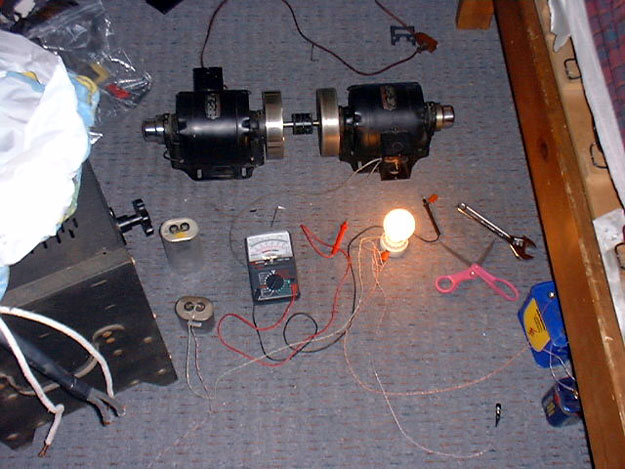
Josh
Posted by Paul G. Thompson (Member # 655) on 02-03-2002, 03:07 PM:
Josh, didn't we see some 3-phase induction motors in the "Sledge Hammer Specials" Department at Macs? I have a 3-phase induction motor you can have to goof around with if you want it.
Posted by Mark Gulbrandsen (Member # 72) on 02-03-2002, 04:54 PM:
Paul,
Does his parents realize he's attempting to burn down their house?
Mark @ GTS
Posted by Paul G. Thompson (Member # 655) on 02-03-2002, 06:19 PM:
LOL!! Maybe I should get Josh a BIG fire extinguisher for his birthday in a few months. 
Actually, Josh is very careful around electrical devices.
Posted by Greg Mueller (Member # 17) on 02-03-2002, 06:41 PM:
Back when the telephone company was called GTE in Everett, WA. every thursday they had a small silent type auction and would get rid of their current surplus junk. One time I bought a pallet of about half a dozen used 3 phase motors for about $50. The reason I wanted it was that there was one of them that was still brand new in the box. The smallest one was 7-1/2 horse. Not many people want old big 3 phase motors. Mostly cause the general public can't use them. I used them all (except one that was toast)over the years on the air compressor and such. You might look around for that type of situation where you are.------------------
Greg Mueller
Amateur Astronomer, Machinist, Filmnut
http://www.muellersatomics.com/
Posted by Paul G. Thompson (Member # 655) on 02-03-2002, 06:55 PM:
Greg, I am also interested in just exactly how a 3-phase induction motor can be converted into a generator. I never really looked into it, but I am under the presumption that railroad locomotives use dynamic braking by converting the traction motors into generators, and the output is completely dumped across huge ballast resistors, thereby making the motor (which is now acting like a generator) look into almost a dead short circuit. I think most locomotives use AC traction motors these days, as EMD uesd that technology in their locomotives in 1992. I would presume GE followed suit in their locomotives.
Maybe you, Mark, or Will might be able to basically explain it to me.
This is all I really know about it, thanks to a website I stumbled upon.
DYNAMIC BRAKING OPERATION
Dynamic braking is applied to the locomotive only. A dynamic brake interlock keeps the air brakes on the locomotive from being applied when automatic air braking and dynamic braking are being used.
APPLYING DYNAMIC BRAKING
Dynamic braking is applied in the following manner:
1. Move the Throttle handle to IDLE.
CAUTION: To prevent equipment damage when
changing from power to dynamic braking or from
dynamic braking to power, pause 10 seconds with
Throttle handle at IDLE and Dynamic Braking handle
OFF.
2. Move the Dynamic Brake handle to SET-UP position. Then move the handle into the BRAKING sector, as required.
3. After the slack is bunched, advance the Braking handle until the desired braking effort is obtained. Observe and correct braking effort during the initial period of dynamic brake application.
The amount of braking effort obtainable varies with the position of the Dynamic braking handle for various speeds. Maximum braking effort is obtained in the 8th Notch at speeds of about 49 mph.
NOTE: Wheelslip warning may occur while in dynamic braking. This indicates wheels are sliding. Sand is applied automatically to the wheels of sliding unit. Reduce the Braking handle position until the warning stops.
USE OF AIR BRAKES DURING DYNAMIC BRAKING
When necessary, the automatic air brake may be used in conjunction with the dynamic brake. Automatic air brakes will apply on the train but not on the locomotive. If the Automatic Air Brake handle is moved to the EMERGENCY position, the dynamic brake is removed and brakes on the locomotive, as well as those on the train, go into Emergency application.
CAUTION The independent air brake must not be
used during dynamic braking, to avoid flat spots on the
locomotive wheels caused by sliding.
RELEASE OF DYNAMIC BRAKING
Release dynamic braking by moving the Dynamic Braking handle to the OFF position.
Here is one that the engineer really screwed up big time......
......................................................................
Railroad Accident Report
Derailment of Union Pacific Railroad Unit
Freight Tran 6205 West Near Kelso, California
January 12, 1997
NTSB Number RAR-98/01
NTIS Number PB98-916301
Synopsis: On January 12, 1997, about 11:52 a.m. Pacific standard time, the Union Pacific Railroad unit freight train 6205 west derailed 68 cars on the Union Pacific Railroad Los Angeles Subdivision, milepost 238.7, near Kelso, California. The train consisted of 3 locomotive units and 75 loaded covered hopper cars. While descending Cima Hill, the engineer inadvertently activated the multiple-unit engine shutdown switch, which shut down all the locomotive unit diesel engines and eliminated the train's dynamic braking capability. The train rapidly accelerated beyond the 20-mph authorized speed limit despite the engineer's efforts to increase the train's air braking, which the engineer placed in emergency 1 minute and 13 seconds after dynamic braking loss. The train's consist weight was listed at an average of 13 tons per car less than the train actually weighed. The train eventually reached a speed of 72 mph and derailed 68 of its 75 cars while exiting a siding near Kelso, California. No fatalities, injuries, fires, or hazardous materials releases resulted from the accident. The total damage cost was $4,079,152.
The National Transportation Safety Board determines that the probable cause of the derailment was (1) a prolonged pattern of inattention and lack of action by Union Pacific Railroad management to protect effectively or relocate the multiple-unit engine shutdown switch in SD60M locomotives after the switch had repeatedly been recognized as subject to inadvertent activation; and (2) failure of Union Pacific Railroad management to adequately address critical safety issues such as dynamic braking system operational reliance and protection, and authorized maximum train speeds in the event of dynamic braking failure. Contributing to the severity of the accident was the failure of Union Pacific Railroad management to ensure accurate car weight assessment and training for operating personnel on retainer-setting procedures and effects.
The major safety issues discussed in this report are the placement of safety-critical locomotive cab controls, adequate train-speed safety margins for steep-grade railroads, and the criticality of dynamic braking systems. The report also discusses accurate car weight reporting, the power brake rulemaking process, and the use of air brake retainers.
As a result of this accident investigation, the National Transportation Safety Board makes recommendations to the Federal Railroad Administration, the Association of American Railroads, and the Union Pacific Railroad.
......................................................................
I wonder if the engineer was in the unemployment line after this one...
Posted by Greg Mueller (Member # 17) on 02-03-2002, 06:59 PM:
Check this out http://www.gwm4-3phase.com/rotary.htm
It's even fancier than the ones I've seen guys use (they didn't have the caps) but this is it pretty much
Thanks to Phil for the link------------------
Greg Mueller
Amateur Astronomer, Machinist, Filmnut
http://www.muellersatomics.com/
Posted by Paul G. Thompson (Member # 655) on 02-03-2002, 07:03 PM:
Thanks for the link, Greg
Posted by Gordon McLeod (Member # 33) on 02-03-2002, 08:21 PM:
The Prevost machines here in Toronto were all 3 phase motors running on single phase using a set of capacitors to fake the 3 phase
The trick is having sufficient capacatance on start up to overcome torque demands yet to maintain a stable 3rd phase for the run cycle
Remember a 3 phase motor will continue to run on 2 phases if it is already spinning when a phase is dropped out
Posted by Paul Cassidy (Member # 951) on 02-03-2002, 10:20 PM:
http://www.howstuffworks.com/power4.htm
It seems we have 3phase in our street as I have checked with an electrician (we have overhead lines)and the main transformer is close to our house (we don't have seperate ones on poles as in the pictures)all we need to do is check the Tariffs with the Power Co. run a New power Line to the house a new Meter use single phase to the house and 3phase to the Workshop/Home theatre, still not the cheapest option so I will check out the above options and let you guys know.
Posted by Phil Hill (Member # 371) on 02-04-2002, 06:00 PM:
That's sooo true Gordon. It's very common to get a "good" voltage reading on a leg of 3-PH power even though the circuit is open and not connected to the "source". It is always necessary to isolate the measured circuit to insure there is no back-feeding.
>>> Phil
Posted by Phil Hill (Member # 371) on 02-04-2002, 08:26 PM:
Com'on Mark! Give Josh a break! I think he's soooo cool and talented to try different things. His interest and his youthful expermentation reminds me of me a few (OK several) years ago! (OH, did I mention I caught my folk's house on fire TWO times!) Anyway Josh, DO NOT stop your quest for knowledge! It will be rewarded in the long run!
>>> Phil
Posted by Steve Guttag (Member # 268) on 02-04-2002, 08:40 PM:
The experiment I can deal with (did similar ones in my yoot). What I am trying to figure out are the scissors! The adjustable wrench I might be able to understand but the scissors? Please don't tell me they are the wire strippers/cutters in this experiment! Or even worse, the points are were used to tighten the coupling on the motors! 
Steve
------------------
"Old projectionists never die, they just changeover!"
Posted by Josh Jones (Member # 447) on 02-04-2002, 09:18 PM:
Hey if you dont have(or cant find) the tools you need, you improvise
I did use the scissor as a wire stripper to wire the caps. see the rectifier off to the right? that one came from south dakota and died the next day(must have been a secondary short).Josh
Posted by Stan Gunn (Member # 554) on 02-05-2002, 10:41 PM:
The most simple way to run a 3 phase moter on single phase for lower power moters is the capacitor method,
I think a cap around 20mf, But it must be a moter start type of cap.
No pilot motors or extra work, I have 16mm BAUERS and CINEMECS that have been running this way for years.
------------------
ALL PARTS FOR VICTOR AND KALART VICTOR 16MM PROJECTORS.SERVICE TO 35 AND 16MM PROJECTION EQUIPMENT.
35MM sprockets made to order.
Posted by Gordon McLeod (Member # 33) on 02-06-2002, 10:13 AM:
Actually you should use a motor run type capacitor not a start type as they are designed to be switched off line after intermitent use
The value of the cap is dependent on the amount of starting torque required and the motor. In some cases it may require switch some of the caps out of the circuit after it starts otherwise the motor will run very hot
Posted by Stan Gunn (Member # 554) on 02-06-2002, 11:48 PM:
You are Right Gordon,
I tend to use run caps for all applications, 
------------------
KALEE FOREVER.
ALL PARTS FOR VICTOR AND KALART VICTOR 16MM PROJECTORS.SERVICE TO 35 AND 16MM PROJECTION EQUIPMENT.
35MM sprockets made to order.