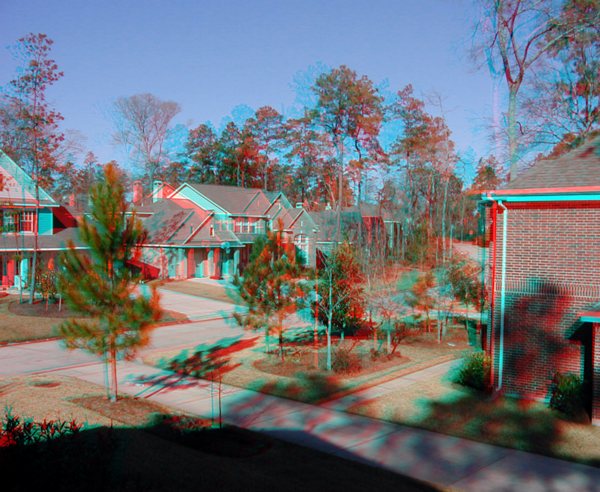
This is a picture looking out the window of my uncle's house.
After doing some photo restoration on some scanned family photos, I decided to go after these images to see what I could do. I fixed the worst problems with fading and tears, converted them to anaglyphs (red/blue images), enlarged the files and put them on my website.
If you have a pair of the red/blue glasses kicking around, put them on and let your eyes adjust to them for a couple of minutes, then head to my website www.electricrailroad.com and click on the 3-D link.
The most recent ones I've corrected are in the Vermont subpage. There are some more recent shots I've taken as well. The Goldcoast Railroad Museum subpage has full color anaglyphs.
It helps to have a big monitor to view these. Some of the images are quite large to make the perspective match more accurately.
This is a picture looking out the window of my uncle's house.
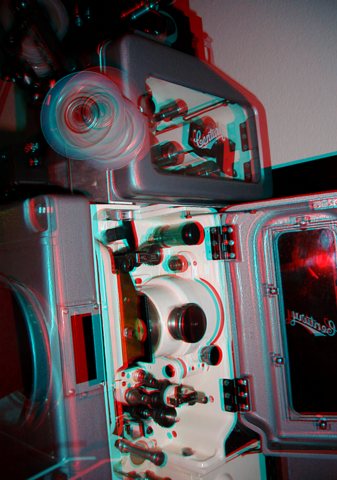
This is an unauthorized 3D pic of "someone's" Century JJ. 
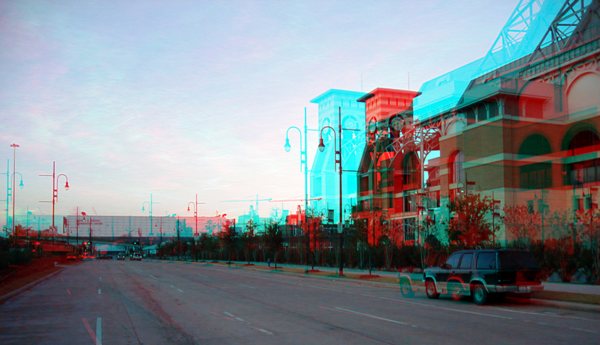
The street by Enron Field in Houston TexASS.
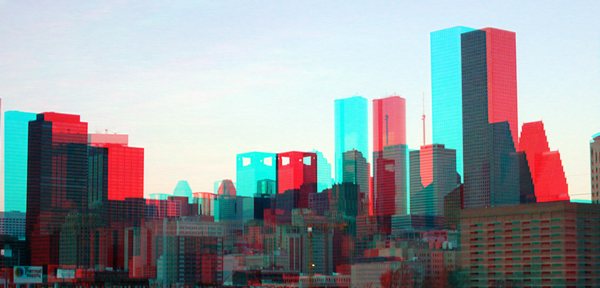
Downtown Houston.
These are only a few 3D pics that I have taken. I think I perhaps compressed them a bit too much here. Oh well. Forum member Jeff Skallan has a ton of pics as well that are awesome. Jeff, if you want to post a few here on the forum, e-mail them to me and I'll put them on the FTP so that you can link to them from here like I have.
Jpegs will create ghosting if the compression is too great. My original tiffs have very little ghosting but as soon as I convert them to jpegs it starts to show up. 
If you use Photoshop, I think 6 is at the lower edge of safe, but I've got to test that out on a few glyphs.

We showed a reel of G.W. "Billy" Bitzer's early 3D experitments a couple weeks ago, so we had some glasses laying around the booth. Joe, do you use a stereo camera set-up of some sort, or do you do your processing in a computer? Question for both of you guys: How, in a computer (I assume you're using photoshop or something similar), do you turn a pair of images into an analglyph?
Just take two pictures of the same damn thing, only move the camera a couple inches left or right between the two shots. If you are taking a picture of something far away, move the camera more. Get your two images into Photoshop. Determine which one is the left and which one is the right. Next take the left image and go into "channels". Select the Blue channel and fill it with 100% black (so that the Blue channel no longer exists). Do the same with the Green channel. Click "RGB" and your image will be all like red and stuff, dude. Now take your right image and do the same damn thing, except just black out the Red channel only. Click RGB again and go back to "layers". Now drag one image on top of the other. Select the blending mode to "lighten" and drag the images around so and adjust as necessary. Flatten your image and save as a HIGHLY compressed JPEG to ensure many artifacts and ghosting. You are done! Easy as pie!
)I'm also thinking about linking to a 3D image page I designed not long ago for a site called "PixelCraze". 3D is cool!
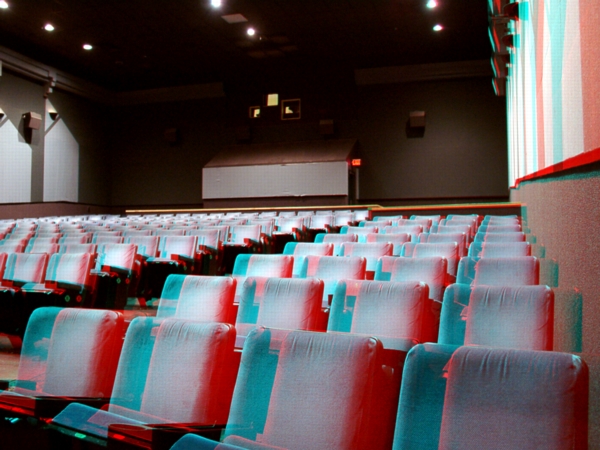
These are before and after anaglyph photos of our the new stadium seating installation. These photos are designed to have the red filter on your 3D glasses at the left, while blue is for your right eye.
Before:
After:
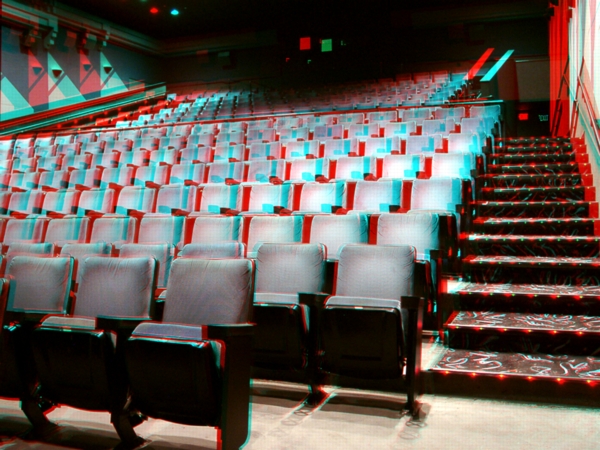
I created these using a 2 second exposure and converted them to 3D with Photoshop 5.0
This is a page I designed for a friend's website. It features 3D pics from both myself and Jeff. I think the pics on this page are pretty damn good. So put on your analglyph red and blue glasses and click here!
While looking through the bargain section I came across another amazing book worth mentioning. "TESLA Master of Lightning" by Margret Cheney & Robert Uth ($14.95). Nothing to do with anaglyphs or 3D, but is such a grand view of how one man sculpted literally everything we depend on in our industrialized "modern" world.
Nikola Tesla (1856- 1943) was the inventor of so many things, it's hard mentioning them all. He created the AC power system we've used for well over a hundred years now, X-Rays, radio transmission, remote controlled devices, florescent lighting, wireless transmission of energy, neon lighting as well as endless other astonishing things. Tesla held over 700 patents in his day. This book features 250 photos that showcase quite possibly the most ingenious man to ever live. It's amazing that I was never taught any of this in school! Check it out.
http://www.pbs.org/tesla/
— Program Air Times —
WUFT 12/12 10:00 pm
WHYY 12/17 1:30 pm
WCET 12/14 10:00 pm
WGBX 12/14 8:00 pm
KUAT 12/12 9:00 pm
WNET 12/21 10:00 pm
KERA 12/13 9:00 pm
WFYI 12/13 3:00 am
WEDU 12/26 10:00 pm
So ya think these guys are so efficient they know exactly when their show will air 9 months early, or is the webmaster super lazy? Check out WFYI's awesome air time too. 
People still argue about the effectiveness of his boundry layer turbines, which in a way shows that he still stands head and shoulders above the intellect of today's average man. However, some of what gets attributed to him was not exactly what he had envisioned. I seem to remember he wanted two frequencies of AC power, one for industrial use and one for lighting. The low frequency power from Niagara was one of his legacies.
Back to 3-D:
The 3-D book is disappointing to me in one way, that the images were not enhanced or corrected to take away the age spots and fading. Showing a few uncorrected for historical interest would have been fine, but IMO the presentation of the images should have been a lot less like copy shots stuck in a book. Still, these 3-D images provide an entirely different perspective to current news. When such a major a historical event as the U.S. civil war can be seen in such detail and immediacy one gets a broader view of recent world events. Seeing the parades in New York and the battlefield scenes during that war puts the WTC collapse in perspective. Compared to the death and destruction of the war between the states, that terrorist act was a minor mosquito bite.
Personally, I'd love to see a 3-D slide presentation of the (cleaned up) stereographs, interspersed with maps and timelines and properly narrated. I'd be willing to bet it would be a history lesson that few students would forget.