 )
) This problem doesn't happen too often, but it is distracting when it does happen. I would have much preferred "Aliens" to be shot in Panavision like the first "Alien" movie was filmed. But James Cameron doesn't like anamorphic and Super35 was not quite up to snuff then so the 35mm release went out 1.85:1. The reverse sometimes happens as well. "Lethal Weapon" was a 1.85:1 film, yet all three of its sequels were in 'scope. But the result in the long term is that "Lethal Weapon" doesn't quite fit visually with the other films in that series.
Another cinematography discrepancy I find distracting is how "2001: A Space Odyssey" was filmed in 65mm/70mm, whereas its somewhat forgettable sequel "2010" was shot in 35mm 'scope. Why wasn't that filmed in 70mm as well? I recall the "2010" ads really blasting that 70mm logo out there far more than the original "2001" did. To make matters worse, the director of "2010" (Peter Hyams) listed himself as the Director of Photography as well. I don't know. Judging from the visual quality of his films, I think he needs to hire a real DP. I would be against him getting those "ASC" letters put after his name from all the hazy, color-drained images nearly all of his films contain. The opening scenes of "The Musketeer" were embarrasingly bad --and it had one of the cheeziest opening title sequences in recent times. Enough of my Peter Hyams needs a real DP rant.
Anyway, I think a film sequel should be shot in the same manner as its original. There are few exceptions that make any kind of sense. The only one that comes to mind perhaps might be "The Hustler" being a black and white film and its more modern day sequel "The Color Money" being a color film.

The reason that Leathal Weapon is flat is because Richard Donner took over Directing the film after the original director, (not sure who it was) was caned during production and some scenes had already been shot. So rather than reshoot them he decided to continue on.
As far as super 35 goes. It was in full use for all arial shots in Top Gun do to the fact that anamorphic lenses were being damaged due to all the stress from the jets. Cameron likes to use Super 35 because the camera is not as heavy and is less bulky than with anamorphic lenses.
Now here is the big kicker it it probably has been mentioned here before. SPIDERMAN IS FREAKING FLAT!!!!!!!
I think it's many decisions all relating down to budget, experience and the producer and/or studio requests.
I am also disappointed with the fact that alot of movies are being shot Flat and not treated with Anamorphic. Movies like " Collateral Damage, Spiderman etc etc " should be scope while stupid crap like " Crossroads " should ( and is ) in flat.
Director preference can change though, and not always for the better. Spielberg used to shoot exclusively in scope, but now he does everything flat. He had already made that general change in style by the time he shot the third Indiana Jones movie, but he apparently adhered to Bobby's rule about sequels, and shot it scope. I believe that was the last scope movie he did.
Sam Raimi uses flat lenses like many other directors. Sometimes it is budget, as you can use cheaper film that normally doesnt come out well on anamorphics. This film is normally manufactured by fuji, as apposed to kodak. As with Raimi, he preferes the flat so that he never has to worry about if the image came out right or not. It is a purely paranoia thing, like superstition.
As to why Blade 2 in flat, that was because a new director was attached to the projects. Guillermo Del Toro uses flat capture as apposed to Steven Norrington who likes the scope.
As to Indiana 3 in scope when spielberg has begun a religeon based on flatness, that was actually George Lucas's call. George films in scope, and as producer of the film, he gets final say.
In fact, the producer always gets the final say, but usually leaves it up to the director, unless you are God of Skywalker Ranchero.
The reason that cameron chooses super 35 is because he can shoot it for a scope presentation while shooting flat, getting much more color saturation with flat lenses. He also gets to present the home video version 4:3 without pan and scan. If you get the home video 4:3 versions of most of his films, they do not pan or scan, but actually show the BOTTOM half of the frame, as they did not exist in the theaters. What a wacko.
SPAM SPAM SPAM SPAM SPAM SPAM SPAM SPAM
WONDERFUL SPAM
My favorite director is Alex Proyas, who also changed his choice from flat to scope when he shot Dark City.
As to why some of the dumbest films get the scope treatment? A lot of times with these films you get new directors who love scope and insist on it, and get a DP qualified to shoot it that way.
Spielberg says that the flat presentation is how most poeple see, WHAT A DORK!! I have 215 degree peripheral vision, and flat presentation makes me feel cheated. I MUST LIVE IN SCOPE.
Dave
In general, using a larger image area (i.e. 35mm Anamorphic) helps reduce grain and improve sharpness in the final image. Anamorphic camera lenses generally are at a disadvantage to spherical lenses for speed, size/weight, and aberrations, but using Super-35 for "scope" releases requires optical printing to "squeeze" and recenter the image.
------------------
John P. Pytlak, Senior Technical Specialist
Worldwide Technical Services, Entertainment Imaging
Research Labs, Building 69, Room 7525A
Rochester, New York, 14650-1922 USA
Tel: +1 585 477 5325 Cell: +1 585 781 4036 Fax: +1 585 722 7243
E-Mail: john.pytlak@kodak.com
Web site: http://www.kodak.com/go/motion
Here is an interesting ASC article on Cameron's Super 35 usage and why it works so well for him.
I certainly agree that scope generally looks better than 1:85 blown up to current "ultrascreen" proportions. Personally, I would love to see John Pytlak's 1.5 anamorphic process replace the wasted image area of the current 1.85 standard. Here is a link to the article John P. wrote on the proposed new system. (I hope you don't mind, John. I know linking, especially to Kodak sites, is your specialty. )
 about cropping, so for crying out loud shoot the movie for the big screen and forget about home video!!!
Oh, uh, Steven, if you're reading this, I luv you man.
Spielberg's last 'Scope movie was Hook. His next movies were Jurassic Park and Schindler's List. Personally, I'm not sure if his switch to flat wasn't due, in part, to his desire to be taken more seriously by the Academy. He made a lot of interesting choices with Schindler's List which could be analyzed as consessions to the snob artistic community. So, the guy whom everyone considered to be the king of "Hollywood slick movie" directing makes his movie in 1.85 and in Black and White. He hires a Polish D.P. He makes his first R-rated movie and, as if that wasn't enough to convince the Academy that he was serious, he takes on the subject of the Holocaust. Just try not to give an Oscar to this director already!
There's still the perception in Hollywood that 'Scope movies are popcorn movies and serious movies must be flat.
Of course, Spielberg had reasonable explanations for all those artistic choices and I'm not saying those explanations weren't sincere. I'm only saying that it was interesting that so many things he used to do were abandoned in 1993 and that Spielberg desperately wanted an Oscar. After Hook was pretty-much considered a disaster, he defiantly showed Hollywood what he was made of in 1993 by making two movies, one of which was the biggest money-maker of the year and the other which was the Best Picture. There was even an ad in one of the trade papers announcing that Jurassic Park was completed ahead of schedule and under budget. Take that!
As for Cameron, his preference for Super 35 isn't just about the eventual video versions of his movies. Joe beat me to the punch but that ASC article is great. If you are interested in Super 35 it's a must-read. Also, check out more of what Cameron has to say about Super 35 in this interview...
http://www.theasc.com/magazine/dec97/titanic/chs/pg2.htm
...and the Super 35 discussion starts at the bottom of the page. He calls it a "God-given format" and explains how he doesn't like the shallow depth of field and other limitations of anamorphic.
It's interesting that when a movie series switches formats from one movie to the next it pretty-much always has something to do with a switch of directors and/or producers. It's an instant method of telling the audience "this is not the movie you saw last time." And, since sequels can usually never live up to the original, it's a courteous message we should listen to.
List of the Best Picture winners going back to 1990, and their projected format. I can't remember every picture and/or I have not seen everything on the list, but here's what I remember without doing a lot of research. And I am not taking into account whether they were shot anamorphically or in Super 35 (that's a different debate):
Gladiator (scope)
American Beauty (scope)
Shakespeare In Love (scope)
Titanic (scope)
The English Patient (flat)
Braveheart (scope?)
Forrest Gump (scope)
Schindler's List (flat)
Unforgiven (scope)
Silence of the Lambs (flat)
Dances With Wolves (scope)
This year's Best Picture nominees are:
A Beautiful Mind (flat)
Gosford Park (scope)
In The Bedroom (scope)
Lord of the Rings (scope)
Moulin Rouge (scope)
This year's nominees for Cinematography are:
Amelie (scope)
Black Hawk Down (scope)
Lord of the Rings (scope)
The Man Who Wasn't There (flat)
Moulin Rouge (scope)
So [since 1990 anyway] projecting flat does not seem to be any assurance at all that a movie will be better-received by the Academy. In fact the list seems to say the opposite.
Now I admit that some movies are better-suited to 1.85 flat. Schindler's List is a perfect example. It would have been totally inappropriate to the material to shoot in scope.
So even though you may be correct about Spielberg's reasoning, the facts seem to suggest he is wrong. In fact the data suggests the opposite. Spielberg's boxoffice disappointments were mediocre or worse movies period, and their lousy reception by the public and the Academy seemed to have little to do with the format they were shot in.
quote:
Dave, I am a bit confused about what you were saying about Cameron's 4:3 video transfers. How can they show the bottom half of the frame and be 4:3? Super 35 produces a wide aspect ratio, so how does he transfer to video without pan and scan? I am just curious.
Actually, super 35 does not inherently produce a wide aspect ratio. It uses the silent aperture, which creates a 1.33:1 aspect ratio. The only reason it produces a wide ratio is because it is customary to crop out a 2.39:1 rectangle from the 1.33:1 image. Sometimes, a common topline approach is used (the Jim Carrey movie "The Cable Guy") and in other cases the two images have a common center. Actually, super35 could be used to produce movies of any aspect ratio. I believe "Spaceballs" was done in super35 and was 1.85:1. This is a rarity, though. There is no reason that, say, a TV show couldn't be filmed in super35. That would produce a 4:3 image using every bit of area between the perforations.
See Super35 illustration and explanation here.
Back in 1997 and 1998, I could spot a scope movie made in super 35 because they looked grainy. Pushing Tin was a good example of a very grainy super 35 movie. In recent years, the quality of movies made in super35 has improved, but I still prefer Panavision-style shooting for scope movies.
------------------
Evans A Criswell
Huntsville-Decatur Movie Theatre Information Site
David A: Hook rang up $119M. Adjust that for ticket price inflation and it would be around $160M in today's dollars. Flop? No. Major hit? Yes.
To clarify the 007 reference: The first 3 Bond movies (Dr. No, From Russia with Love, Goldfinger) are all flat. Starting with Thunderball every Bond has been scope.
On James Bond films, most have been in 'scope. But in addition to "Dr. NO", "Goldfinger" and "From Russia With Love" being either 1.66:1 or 1.85:1, Roger Moore's first couple Bond efforts ("Live and Let Die" and "The Man With the Golden Gun") were also shot flat. All of the Bond movies after that have been in 'scope.
About home video framing of Super35, it varies a great deal. While the full 4-perf 35mm camera aperture is open for Super35, that full image is not typically what makes it into a "full frame" VHS release. Commonly, the picture has one safe action crop for 1.85:1, taking away some of the top and bottom of the image. Then the 1.33:1 TV frame can be extracted out of the center of that. So you are still losing a bit off the top, bottom and sides. Sure, some shots in a transfer can use that full 35mm frame. But with most scenes the composition will be far too loose. I've seen a number of Super35 transfers to home video that featured shots just as heavily panned and scanned as any anamorphically filmed release. I certainly saw such things with an on-the-fly comparision between "Fight Club" on DVD and a full frame broadcast on HBO. Finally, your visual effects shots are usually rendered/produced in the aspect ratio of the release format, so if it is a Super35 release, pretty much all the effects shots will be in 2.35:1 and heavily panned and scanned.
I think Super35 can only have a chance to exceed anamorphic 35mm in quality when optically enlarged to 70mm. I see it having no quality advantage over anamorphic otherwise. Super35 is a format designed more for convenience rather than quality.
At any rate, I hope Steven Spielberg will shoot the next "Indiana Jones" sequel in 'scope on 35mm like all the others in the saga rather than shooting it flat so it goes to home video easier. I also hope he can convince producer George Lucas not to pull a DLP gag with it either.
And yes, I do think George Lucas has really broke the continuity of "Star Wars" by insisting on videotaping "Episode II" and "Episode III" rather than shooting them on film. It breaks continuity even further since these next two installments will be video-ed using spherical lenses rather than anamorphic elements. I do realize Panavision and Sony tried hard to come up with an anamorphic lens pack that would work with the HD cameras. They just couldn't make it happen. I suppose some software engineers at CineLook could come up with a filter to imitate the depth of field and distorsion effects seen in actualy anamorphic photography, but since so many people think "digital is perfect" why bother?
Finally, I think sequels need to be able to stand on their own as good movies and not rehash the original. But doing this is a matter of development, script work, quality of direction and acting. Changing film formats alone just to be different is not a good move. I have a bad feeling "Blade II" is going to be a hollow and derivative movie instead of bringing exciting new things to the series. I hope I am wrong about it. The fact that it was shot flat makes it look more like a straight-to-video/dvd item than it would have had it been "scoped".
As for the anamorphic cinematography "artifacts" in the newer Star Wars movies... they have most certainly added some to the CGI special effects you can readily see in the latest trailer (which opens Friday at a theatre near you... very near you, perhaps... like, maybe next door).
Rocky 1976 flat
Annie Hall 1977 flat
The Deer Hunter 1978 SCOPE
Kramer vs. Kramer 1979 Flat
Ordinary People 1980 flat ?
Chariots of Fire 1981 flat ?
Gandhi 1982 scope
Terms of Endearment 1983 flat
Amadeus 1984 scope
Out of Africa 1985 flat
Platoon 1986 flat
The Last Emperor 1987 scope
Rainman 1988 flat
Driving Miss Daisy 1989 flat
Here they are:
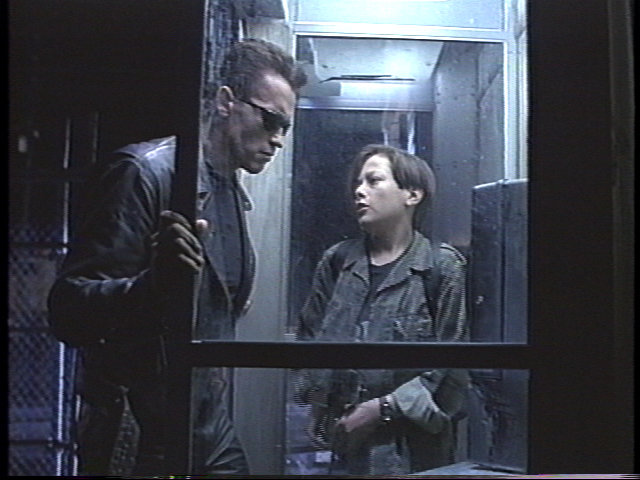
Here is a direct capture from the VHS version.
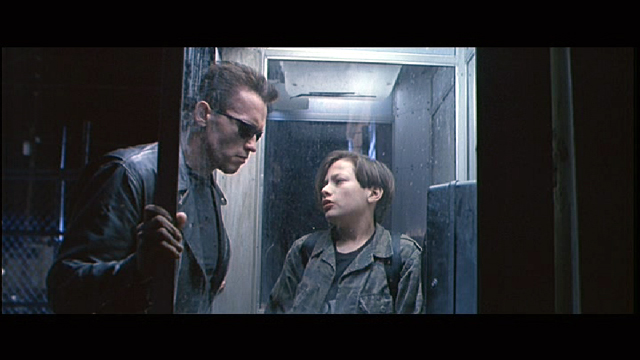
Here is a direct capture from same exact frame of the DVD.
Draw your own conclusions about how Super 35 is transferred to home video.
------------------
John P. Pytlak, Senior Technical Specialist
Worldwide Technical Services, Entertainment Imaging
Research Labs, Building 69, Room 7525A
Rochester, New York, 14650-1922 USA
Tel: +1 585 477 5325 Cell: +1 585 781 4036 Fax: +1 585 722 7243
E-Mail: john.pytlak@kodak.com
Web site: http://www.kodak.com/go/motion
quote:
Evans, I was under the impression that those shooting Super 35, like Cameron, were shooting 3-perf pulldown Super 35. (Look here for nice diagrams of the different 35 and Super 35 formats) Once I read your post, what Dave was saying makes sense to me. Since Super 35 3 perf is a possiblity, I don't really understand why you wouldn't use it, unless you are making a big consideration for the home video market, which Cameron undoubtedly is. Thanks for the clarification.
quote:
In general, 3-perf pulldown cameras are most often used for film being shot for television, rather than feature films.
I'd never heard of 3-perf super35 until the post I quoted above.
As for John's comment, why would anyone want to use 3-perf for TV? Using 4-perf yields the TV aspect ratio. Wouldn't using 3-perf require cropping of the sides of the image to get the image to fit the TV (unless you're talking about HDTV), wasting image area on the negative? 3-perf would work for HDTV, though.
------------------
Evans A Criswell
Huntsville-Decatur Movie Theatre Information Site
------------------
John P. Pytlak, Senior Technical Specialist
Worldwide Technical Services, Entertainment Imaging
Research Labs, Building 69, Room 7525A
Rochester, New York, 14650-1922 USA
Tel: +1 585 477 5325 Cell: +1 585 781 4036 Fax: +1 585 722 7243
E-Mail: john.pytlak@kodak.com
Web site: http://www.kodak.com/go/motion
quote:
I'm sure Sam Raimi could have gone with scope for Spiderman if he wanted. I think he just doesn't like it. All of his movies, as far as I know, have been 1.85.
Raimi directed "For Love Of The Game" (1999), which was scope.
This is why I am against having the masking change at any time when the customers can see it- when they walk in, it should be set to how it's going to be for the entire movie. I left my job at the last theatre I worked at because they forced me to have the masking set to Flat in between all shows, reason being most screens were top/bottom masking for scope and they wanted the slide show to get "the biggest screen possible". They had 2 screens with side masking but they had those go to flat in between shows too; didn't make much sense but neither did a lot of other stuff there.
Before I worked at a theater I knew what the masking was but not exactly how it worked (did someone have to come down and move it by hand?) I found the answer during a double feature when the masking moved out for the second movie.
The decision for scope versus flat is an artistic one. Yes, economic and practical factors show up, too, but it's a fundamentally artistic choice.
It is never inherently wrong to choose a particular format.
I think it's also a little disturbing how people are pigeonholing directors and producers on aspect ratio. It may be a religion for some, but that doesn't make it a religion for all.
--jhawk
p.s.: Minority Report is Scope.
Because of the larger image area, "Scope" IS usually better than "Flat" for image quality. A larger image area on the camera negative reduces the manification of the grain and improves sharpness. A larger image area on the print allows more efficient use of the light, and less concentration of radiant energy on the film frame.
I do agree that the aspect ratio chosen for a film should be an artistic decision, rather than an economic one. But the limitations of video display sometimes push producers toward pictures that are less wide in hopes of maximizing the video market. 
There are better ways of achieving a 1.85:1 aspect ratio than simply cropping the image area:
http://www.kodak.com/US/en/motion/newsletters/reel/february97/pytlak.shtml
------------------
John P. Pytlak, Senior Technical Specialist
Worldwide Technical Services, Entertainment Imaging
Research Labs, Building 69, Room 7525A
Rochester, New York, 14650-1922 USA
Tel: +1 585 477 5325 Cell: +1 585 781 4036 Fax: +1 585 722 7243
E-Mail: john.pytlak@kodak.com
Web site: http://www.kodak.com/go/motion
On the technical end, I do prefer anamorphic 35mm photography over Super35. Much of the time it looks better --even after the film has been transferred to DVD.
Not sure if that was meant for me or the other Dave, but see JPytlak's comment. There are 2 valid reasons for shooting flat: 1) artistic; 2) cost. Going way back in this thread, I think someone speculated that Spielberg shot many of his movies flat because he felt it might help him win awards, and it works better for home video transfers. Those are two very crummy reasons for shooting flat (my opinion of course) but we are just speculating and nobody knows the real reasons why Spielberg does what he does. If he *is* doing it for artistic reasons, more power to him, but sometimes I think he makes the wrong choice. And as someone else said, his new movie about to come out which I am suffering a memory block on the name of right now is scope. Yay.
What would the artistic reason be for shooting something like "Collateral Damage" flat? And cost couldn't be much of a factor in a big-budget movie like that either. But they did it flat anyway. Same question applies to "Count of Monte Cristo". Or Spielberg's "AI" (cost is clearly not an issue on *any* Spielberg movie). Home video is the only reason that makes sense to me. And that's a lousy reason.
Screen masking: Nobody around here changes the masking between shows. And of course nobody has curtains. So when you enter the auditorium, you know instantly what format the movie will be in.
Super-35: I went to see "Lord of the Rings" again today, with a group who all wanted to see it again. I paid attention to image quality, and luckily the focus was excellent. It was quite grainy throughout. It probably would have been less grainy if shot scope, yes? Not saying it looked lousy, only that it could have looked better. Maybe the complexity of all the effects shots made scope impractical.
Changing format in a series: I appreciate the point, but I'll bet you could survey 1000 moviegoers who saw an original in scope some years ago, and a sequel in flat, and not one of them (unless they are film-techers or something) would mention that, even if you ask a leading question.
Dave can be DStam. And then there's JPyt, BMill, SGut, MGul and even BMaar.
New rule: You are not allowed to be cool unless you do this!
I desperately want to be cool, so if a senior film-techer such as you JRed says I'm DStam, I'm right on it. I could also be "ChattersTooMuch", which is kind of long but it would have the virtue of instant recognition among other film-techers.
DFav
and it's all lowercase, guys. capital letters are *so* last week.
you can be 'amar' and not just 'amart'. do you have a family member with a first name that starts with a 'k'. --can't seem to do a question mark here since it is uncool to press the shift button-- they could be 'kmart'. that would be cool.
Peter Jackson had done Super 35 work before Lord of the Rings and the visual effects company he wanted to use was also experienced in that format. This seems to have been his major reason for chosing Super 35 instead of anamorphic 'Scope.
Also... Spielberg's collaborations with Janusz Kaminski thus far have all been "flat" and, according to what I've been able to look up, Minority Report will be too.
While John is certainly correct on the technical point that scope gives you more light and requires less magnification (so is therefore less grainy), I think we can all agree that flat can look good. It's not as if it is a deprecated format, nor do you hear people going around saying, "No! We won't use flat! It's too dark." Both scope and flat can be projected and filmed well.
I continue to believe that the choice of scope versus flat is really artistic. What aspect ratio you want your viewer to be in. In-your-face action versus "see-the-big-picture", etc. I think if you go back and read interviews and articles in In Camera where the question of "why flat?" or "why scope?" is asked, you'll see answers in the artistic plane.
Dave Stambaugh, I did mean you when I said, "Dave, you seem..."
On usernames, it is the case that over here I'm generally referred to by my username, with a lowercase initial. Comes of being a Unix geek, I suppose.
I'll certainly weigh in and agree that while keeping the aspect ratio across sequels is a nice thing, most of the audience won't notice, and it's really not a big deal to change if you "have to" for some reason.
On Minority Report: Greg, when I said it was scope yesterday, that's based on the "Team Fox Exhibitor Materials Update" for the week of March 8th, which lists for Minority Report:
Release Date: June 21, 2002
Rating: Not Yet Rated
Running Time: N/A
Format: Scope /Dolby SR, SRD, DTS
Attached: TBD (FOX)
Loose: Sin Eater (FOX), Road to Perdition (DW), TBD (PAR), TBD (UNI), TBD (SONY)
Trailer Version: A
Running Time: 1:22
Format: Flat & Scope - Dolby SR, SRD, SDDS, and DTS
Status: Now available and should be on screen
(So Dave, you are correct that it is not safe to presume an aspect ratio based on a trailer, though sometimes a trailer will give you a hint if it is letterboxed. So basically saying the trailer is in scope doesn't give any information.)
--jhawk
(who does prefer the lowercase "jh", thanks for asking)
Judging from what I saw, the film is definitely not a 'scope picture. At least, it was not filmed using anamorphic lenses. All the work is spherical lens based (easily determined by a few lens flare artifacts showing round elements instead of anamorphic abberations). Also, the composition in the trailer leads me to believe the film will presented in flat 1.85:1 ratio. The headroom and movement along the vertical axis of the frame doesn't look like 'scope work to me. So I would be surprised if this is shown in Super35 --although Super35 would be possibility.
David Stambaugh kind of hit on another funny point. Movie trailers are very often NOT shown in the framing format of their release. Many flat movies have 'scope cropped trailers. And there have been lots of 'scope films whose trailers have been cropped on the sides (minor pan and scan). I have even seen 'scope movie trailers where the film frame is letterboxed inside a 1.85:1 frame. I could have sworn I saw such a trailer for "Lord of the Rings".
The original pilot was shot in 4:3 but the rest was shot as I remember with a super 35 3 perf pull down, to get the 16:9 aspect they wanted.
The unfortunate problem is that they ordered all of the effects shots in the 16:9 aspect, so the effects shots never filled the entire 4:3 screen. Thier admittance to this was that they never realized it would air 4:3.
They had to do a blow up and cut the sides off to avoid the problems that had happened when the first pilot aired and the following few episodes. Oops.
Of course now you can see it in its original aspect on sci fi channel.
I do not know if they are using the same on that piece of crap show Enterprise, but I would not doubt it.
Also someone asked earlier why would it be less expensive to shoot flat on a cheap stock? Cheap stocks do not have the great depth of field or deep emulsion that a good kodak stock would have. The true cheap stocks, commonly used by independants trying to save money, react better to spherical lenses, as the light source travels to the film negative easier rather than using anamorphics.
Good or great film stocks from Kodak have great light reactivity making anamorphics easier to deal with. Kodak has several film stocks that allow anamorphics to use very low light while still getting a decent picture.
And heres to jred. Thanks for clarifying the super35 and james cameron issue. Nothing better than a visual aid.
Dave
quote:
The trailer I saw for "Minority Report" yesterday (with LotR) was scope, though it may not mean anything.
Yeah might not mean anything. I had a scope Jurassic Park 3 trailer in my hands before. (not 1.85:1 with sides masked out, it was the full 2.35:1 image).
I think i open up a thread about it.
Resident evil will never be accused of being a flawless action movie. But it had a great sound mix and decent cinematography that could have pulled me in. NOOOOOO, lets go for the claustrophobic flat. Boring. Bring me Scope or bring me Death!!!