
The less venues there are using carbons, the less will be the demand, and the more difficult they will be to obtain. How long can the remaining users keep going? Is this really the end? It would be a shame if there were not a few places still using arcs.
I agree, though, that we should hope that at least a few theatres continue to burn carbon for film projection. In the New England area, the Wellfleet Drive-In, the Cape Cinema, and the Avon Cinema all still burn carbon; there are others that I don't remember offhand, either. I've run the Cape Cinema booth for a few days and very much enjoyed it, although I wouldn't want to deal with carbons for 8-10 hours a day, every day, either....
Pendle Stairway Cinema, Ilfracombe. Ross projectors, BTH Type C arcs, 2000’ reels.
Tyneside Cinema (The News Theatre), Newcastle upon Tyne. Philips projectors & Peerless Magnarcs, changeovers.
Futurist Theatre, Scarborough (stage & films), changeovers.
New Royal Cinema, Faversham (ex Odeon & Classic). Original BTH equipment, 2000’ reels.
Only very recently changed to xenons is the Plaza, Oxted with the AEI 2kw lanterns from the Regal, Cranleigh, and the Rex, Wareham.
Edit: Tyneside Cinema.
BTW, a pedantic anoraky point - it's now almost 50 years since xenons were introduced. The first short-arc xenons were demonstrated by Zeiss Ikon at the Photokina trade show in Berlin in 1954.
Re: Tyneside, after checking a video I have edited my last post. Or is it the same place that had a 2nd screen added with the Westars ?
Perhaps you could kindly let us all know. Thanks.
quote:
When I was given a tour of the Tyneside projection boxes around Christmas last year, they had DP75s in one screen and Westars in the other. All four projectors were still running on carbons, and the picture looks great.
Where is this place? I will be in that part of the country at the end of September, maybe I can get to see a film while I am there
There are exceptions, but, in general, I think most British cinemas do a pretty good job, in many cases it is the audiences that are the problem, but even there we seem to be better than some places. I have only been to one American cinema, and that was good, nothing like the horror stories we sometimes read about in these forums, and rec.arts.movies.tech.
quote:
BTW, a pedantic anoraky point - it's now almost 50 years since xenons were introduced. The first short-arc xenons were demonstrated by Zeiss Ikon at the Photokina trade show in Berlin in 1954.
I knew it was in the '50s, but I hadn't realised that it was quite that long ago. The first time I saw a xenon was twenty years later, and that was on 16mm. By the early '80s, most places seem to have converted, in many cases being tripled at the same time.
Were these three electrode lamps, like the early BTH ones?
Do you remember those strage, very small, pulsed lamps which Philips used in shutterless projectors at one time? I never saw one, but I have seen pictures of them.
Let me know when you're going to be up there and I'll get hold of a listings brochure give the manager a call to see if it would be possible to arrange a box tour.
Scott, if you grew up in the carbon arc booths like I did, you would feel like you are "missing something" when they are gone. They all had their own personalities.
Seems like in those days the projectors and lamps would know who is tending to their needs. If you pissed them off, they would do some extremely nasty things to you for no apparent reason.
quote:
Carbons are useful for more than just film projection: there are many places that have carbon-arc Super Trouper (and other models of) spotlights.
Those use eentsy carbons, so their availability lifespand curve may be slightly different.
Bob Furmanek & his crew are burning carbons behind the Kinotons at the Loew's Jersey.
I'm trying to resuscitate a booth now which has carbon arc lamps, & am trying to sort out a few problems related to carbons in present day. For instance, what do you do with 6 boxes filled with a billion carbon ends in the year 2002?
quote:
The only UK cinemas I heard of recently that are still on carbons:
Pendle Stairway Cinema, Ilfracombe. Ross projectors, BTH Type C arcs, 2000’ reels.Tyneside Cinema (The News Theatre), Newcastle upon Tyne. Philips projectors & Peerless Magnarcs, changeovers.
Futurist Theatre, Scarborough (stage & films), changeovers.
New Royal Cinema, Faversham (ex Odeon & Classic). Original BTH equipment, 2000’ reels.
Only very recently changed to xenons is the Plaza, Oxted with the AEI 2kw lanterns from the Regal, Cranleigh, and the Rex, Wareham.
I heard that the Plaza had converted, I have never been there, have walked past it a few times.
Visited the New Royal few years ago, with the CTA. Read an article about the Futurist some time ago, there was talk of both of these converting, I assumed they had done so by now. I had not heard of the other two.
I think the Astra, Duxford (part of the Imperial War Museum) still has carbons, but it is not a normal cinema, and I don't think it often shows anything.
Pinewood studios was still using carbons a few years ago, Peerless Magnarcs on Philips/Kinoton machines, but I don't know if they still are.
quote:
Carbons are useful for more than just film projection: there are many places that have carbon-arc Super Trouper (and other models of) spotlights. Also, advertising searchlights use huge carbons to produce their super-bright light.
I know of only a very few places that still have carbon spots, and I have never even seen a working searchlight. These use different carbons, and having seen the price of searchlight ones, I think their future must be in doubt
quote:
There were only two times I ran a carbon arc booth in the last 18 years. The last one was almost a year ago. Althought I was "out of tune" with the carbon arc lamp for the 17 year gap, it still was fun.
Scott, if you grew up in the carbon arc booths like I did, you would feel like you are "missing something" when they are gone. They all had their own personalities.Seems like in those days the projectors and lamps would know who is tending to their needs. If you pissed them off, they would do some extremely nasty things to you for no apparent reason.
You are right about "missing something", If I see a film with carbon, having previously seen it with xenon, it's like seeing a different film, it somehow seems 'alive. It's a bit like some peolple feel about steam engines. I first ran a carbon arc when I was six, they were everywhere then. At about ten I stopped going to the cinema. When I returned in the '70s, everything had changed, including the arcs. Last year I taught a four year old to run one of my 609 16mm machines; sadly, she may be the last, and is almost certainly the youngest person to learn to run arcs. She loves them, and was quite upset when I wouldn't let her open the lamphouse to look at the arc directly!
quote:
Bob Furmanek & his crew are burning carbons behind the Kinotons at the Loew's Jersey.
They were when I was there, and they still had a few boxes left, but I don't know how long they will last, or whether they will be able to get any more decent ones, and I wouldn't like to think about what ones that size cost now.
quote:
I'm trying to resuscitate a booth now which has carbon arc lamps, & am trying to sort out a few problems related to carbons in present day. For instance, what do you do with 6 boxes filled with a billion carbon ends in the year 2002?
I've often wondered, why did cinemas never seem to throw out carbon stubs, even when they were too short to use for anything? You often find boxes or buckets full of them in old places, even years after they stopped using the things.
quote:
Get rid of them, you will never regret it.
No, I will always regret the last few places giving them up, but I think the end is near. I doubt that anywhere will be using them five years from now, and I think it could well be less than that.
With even very traditional places like the Plaza and the Byrd giving them up, there seems no hope for the last few.
I only ever heard of two conversions from xenon to carbon, and one of those closed a few years later.
When you get to my age you get set in your ways.
Does anyone know what the last completely new cinema to be equipped with carbon arcs was?
"Bright lite carbons" or something to that effect. I have a shoebox full of carbons and a few more boxes which should keep my home booth supplied for 40 years. By the time I convert to xenon, film probably wont exist anymore, and I will be nothing more than a fancy computer programmer
Josh
Unfortunately, when I was burning the 11mm black stick, most of our stubs were too short to run a full reel. What a waste. We never chanced a contest like that with those carbons. It was too risky for the carbon to get out of trim and endanger the water-cooled silver jaws.
I have, on occassion, ran the 13.6 black stick, and we could couple those together.
Josh, I have burned just about any brand of carbon rods made. The very best was Nationals by Union Carbide. The rest were pure crap. They didn't give a good light, they sputtered excessively, left too much fly ash, and were not consistant in maintaining proper trim and arc stability.
quote:
When carbon trims were down to about four inches, we inserted them in "carbon savers", either the ones we rolled from Maxwell House Coffee tins, or the commercial ones made from steel bar stock
Gerard, what's the design for rolling carbon savers from coffee can stock? Umm, do they make coffee cans any more? Would aluminum soft drink can stock work? Does the arc just vaporize the carbon saver? We'll be doing some carbon economizing with carbons in that booth on calibration & non-ticketholder nights.
quote:
Get rid of them, you will never regret it.
I can remember only two makes of carbons in my early days, being MORGANITE, or SHIP.
At my cinema from 1978 I used MARBLE 7mm & 8mm carbons in Peerless Magnarc’s. I had no problem with these carbons and they burnt very satisfactory. I changed to xenons in 1982.
Jack Roe Cinema Supplies, who still supply MARBLE carbons, also use to supply excellent copper carbon misers, which joined carbons very firmly.
The Jet arc used a small furnace to physically fuse to carbons togather
We used almost ever make of carbon when I started National (union carbide), Marble(double Eagle), Ibagawa (sunny), Lorraine, Ringsdorf (Diamond), and some Morganite carbon as well
At one point some chineese carbons ended up here
In the theaters were I worked relief and the regular guy had his lamps in order, you could run a reel and never have to trim up those Nationals. This was true with the Peerless Magnarcs and the Ashcrafts.
Havn't had my hands on a carbon for many years, but boy was it fun to run them!
The commercial savers I have used did not join two carbons, but had a
spring-steel strip to hold the trim in the hollow end. The otherend was solid, turned down to a smaller diameter ( the way some large drill bits have turned-down shanks to fit a standard size .25" drill chuck.) Some had a central plunger pin for knocking out the remaining stub to insert another. The shank was clamped into the lamphouse jaws.
The Lady Street Cinema, Annan was Carbon until I twinned it a couple of years back, again Westrex and Magnarc.
There are two cinemas in the borders, Gretna and Lockerbie that AFAIK are carbon lit. Both run film occasionally, I think they are used for bingo most nights.
quote:
Union Carbide made a 13.6mm poditive blackstick carbon in a joinable 11" length or a non joinable 22"
Gordon, this sounds exactly like the positives that the Loews were running when I was there in April, but they were far more than 11". Was there a 22", or something close to it, joinable version? Biggest carbons I've ever seen, at least for film projection, I've seen bigger ones used for other purposes.
The picture at the bottom of the page shows a very early model of Eidophor, maybe not digital, but it was an electronic projector, and it did use a carbon arc! Later models, which I remember seeing in use, used xenon lamps, there is a picture of one of these, as well as a lot of other interesting stuff on the cinephoto site.
I rather like the original Eidophor, it looks like some sort of sinister military device used in atomic weapons production, or something.
Something else I can't help wondering, that arc wouldn't burn for very long, did they only use these things for short periods, or were they possibly the only video projectors ever used with changeovers?
The "carbon savers" that I was obliged to use in my carbon arc booth days were tubular, fabricated of soft-drawn copper, with a loose seam that could be tightened with a pair of gas pliers to effect electrical continuity. These worked quite well except when a miscalculation caused them to burn through. Those were the days! 
In layman's terms, it is referred to as "insufficient attention to insignificant minor details".....in other words, "Screw-up's by the Gross" 
...........................................................
Si Tienes Prisa, Paseme Por Enrisa.
quote:
To the best of my recollection the 13.6 joinable ws only available in the 11 length since 2 joined would be the same as a 22" standard which was about the maximum length that would fit in the lamphouse between the dowser and the arc jaws of the burner
I don't understand this. I would have thought that the ideal length for a joinable carbon would be the length of a normal, non-joinable one (22"), minus the length of a stub, therefore, something like 18", so that when you join them you get 22". Why were the joinable ones only half the normal length? I can't see why you would want to join two new 11" carbons, why not just buy 22" ones?
quote:
They must have a old stock as I understood the joinable was discontinued some time ago
As I understand it from Bob and Bernie, there are old stock that was left in the theatre when it was tripled, and xenon converted, in the mid '70s.
Do you know when the joinable carbons were introduced?
quote:
suppose from the name it must have had four atoms of carbon to one of chlorine (or vice-versa?)
Of course its use was prohibited as it was toxic, and was replaced
by tri-chloro-ethylene (?), which I suppose had a 3 to one molecule?
The carbon tetrachloride molecule has one carbon with 4 Chlorines surrounding it in a cute tetrahedron. Like you say, it used to be like 409 spray cleaner, everywhere & for everything, then it was linked to liver spots in the 70s I think & that was that.
Kodak's got a list of solvents which they've reviewed for cleaning film on their site http://www.kodak.com/US/en/motion/hse/solvent.jhtml
trichloroethane's out now, too. The nice thing about trichlor is shown on the list as its "medium" evaporation rate, meaning you could do a little work with it before it was gone.
You'll also notice that, with only one exception, none of these solvents have water in them. The reason for that water is absorbed into film emulsion, & above 50% RH, it's destructive. The exception in the list is isopropanol, & I guess it's listed because it evaporates so quickly.
Probably the most useful for general availability & general cleaning, & especially in film paths, is naptha, which is so available in big old cans in the paint section of Lowe's or Home Depot near the methanol & paint strippers. Also, naptha is cigarette lighter fluid, available in those little squirt cans at Wal-Mart, etc. But you'll notice it has a low evaporation rate, so if you're in the field cleaning up some film you'll need to go slow so that it evaporates as you proceed. Also bear in mind that if you're cleaning film with these solvents, the lubricant goes with the cleaning, they'll need to be lubricated again, so it's to work with the Johnson's Paste Wax on the edges!
Naptha is great for cleaning gates, sprockets, bands, etc.
When you're looking for a solvent for a job, a great mnemonic for whether you want something soluble in water or not for the job is "like dissolves like". Alcohol doesn't dissolve grease, that's why you use gasoline, naptha, etc. It has to do with polar & nonpolar molecules, which is where it all gets even more exciting, but oops, I see everyone is asleep now.
I believe that the Empire Theatre, Halstead were running the Morganite long feeders with a Tower. They also have a 2nd tower on No 2 spare projector.
_________________________________________________________
Pete wrote,
quote:
There are two cinemas in the borders, Gretna and Lockerbie that AFAIK are carbon lit. Both run film occasionally, I think they are used for bingo most nights.
I know the Prize Cinema well, visited Gretna Green many times. In fact I got married there, and did the mock anvil wedding afterwards for tradition and benefit of the tourists! For those who don’t know, Gretna Green, Scotland was famous for young runaway marriages until they were outlawed, I think around the early part of the century, maybe a little later.
This was my 2nd marriage, tragically my first lovely wife died of cancer leaving three children.
quote:
"This was my 2nd marriage, tragically my first lovely wife died of cancer leaving three children."
I'm very sorry to hear that. My mother and aunt died of cancer, a long time ago. It's not a pleasnt way to go.
Sorry, there was no intention of inflicting my past sadness onto others. Perhaps it was wrong of me to mention it, in particular off topic! It was purely connected to my story of Gretna.
BTW. I have just remembered that the long feeding carbon lamphouses were the Morgan Auto-Arcs. I don’t know if any were exported outside the UK. Many, like the Peerless were converted to xenon.
Autoarcs made for one of the worst Xenon covnersions! I've no experience of them as Carbon lamps but as Xenon they were truly dreadful. On most of them it's not possible to adjust the mirror without opening the door, which is not clever! The only decent Xenon autoarc I've ever come across had been converted by mounting the guts of a Kinoton lamphouse inside it, not the usual Thorn E53 conversion. I had the misfortune to run an E53 converted Autoarc on the back of a Westar at the Robins, Dunfermline. The thing was so inneficient that we had to run 2kw on a screen about 8' wide, it ran red hot, bulb life was a joke and worst of all was the dowser that refused to stay open. I had to be very ingenious with elastic bands! Lateron, after the rectifier caught fire, it was relocated to someplace more suitable, a skip behind the building, and was replaced with a Orcon 1000B, which if working well is a cracking little lamphouse.
Bernard, cancer is a terribly cruel disease. I've lost quite a few friends, relations and colleagues to it. No matter how long ago it was, the memories are always with you.
I can't remember where we went now, it was a three or four day trip over Easter. The Lonsdale sounds familiar, I seem to remember it was in two parts, the older one running towers, and the newer one cakestands. Very kind manager, or was he the owner, who gave us each a small package as we left, contained chocolates, I seem to remember.
There was somewhere that had a kalee, one of the newer, normally gold ones, 18 or 20 maybe, but the odd thing was that this one was a strange blueish-green colour. There was another place which had the projector head (Vic 5?) bolted to the wall, instead of being on a pedistal. Thn there was a place which had not shown film for some years, but the machines were still in place, and useable, these had Monarc carbon arcs on them. I seem to remember that this place was a last-minute add-on to our programme.
We stayed at a rather nice hotel in Workington, can't remember the name now.
I seem to remember that one of the organisers of this trip was a young man, who had some involvment with the BBC in that area.
Seem to remember that we also went to a Stan Laurel museum in Ulverston.
Our leader/guide came from a place with a strange name, but I can't remember it now, it's quite well known, and I will probably lay awake all night, trying to think of it.
I can't remember the date now, but it was the weekend when London telephone numbers made the second of three changes in the last 12 years or do, from 071 and 081, to 0171 and 0181. Somebody may remember when this was.
The blue Kalee must be Bowness, as Kendals is gold. I think Jim Schulz repainted the ones he rebuilt a blue colour. The place with the mech bolted on the wall is Zepherylis Stereophonic Cinema in Ambleside. It's a Westar. There is a Vic 8 in the the other screen there. I've no idea where the place with Monarcs is, not come across that.
quote:
Yup the Lonsdale is two buildings, one with 3 screens and towers and the other is two screens with platters. The owner, Alan Towers, is a top bloke, I think it belonged to his father before him. It was ABC originally. Jimmy the chief has worked there since the end of WWII, and is still working, now in his 70's.
I was in carlisle last year, on one of Hertfordshire Railtours' trips, London, York, just outside Leeds station, Aire valley line, to Settle Junction, then a short berak in Carlisle, before returning to London via Hexam, curve South of Newcasle and East Coast Main Line to King's Cross.
While I was in Carlisle I had a look to see if the cinema was still there, but I couldn't find it. It was pouring with rain at the time, so I didn't spend too long looking, where is it in relation to the station, I will have another look next time I'm there.
quote:
The blue Kalee must be Bowness, as Kendals is gold. I think Jim Schulz repainted the ones he rebuilt a blue colour. The place with the mech bolted on the wall is Zepherylis Stereophonic Cinema in Ambleside. It's a Westar. There is a Vic 8 in the the other screen there. I've no idea where the place with Monarcs is, not come across that.
I can't remember where the blue Kalee was, I still think of anything that is normally gold, 18, 20, 21 etc., as 'new', and black 8, 11, 12 etc. as 'old' despite the fact that even the newest ones are now 44 years old, just one year less than me.
Yes, it was Zepherylis, I remember the name now, I seem to remember that the Vic 8 was in a very small box, and we couldn't all squeeze in at once.
I can't remember where the old carbon arcs were, it wasn't a cinema, more like a multi-purpose village hall type of place, without fixed seating. It was several years since they had shown any film, they said they might do so again in the future, but if they did, they would probably convert to xenon.
I am no longer a member of the CTA, but do intend to re-join. When I do I will have a look in their archives, ther should be a copy of the tour notes there.
Cumbria seemed to have lots of small independent cinemas at the time, I don't know how many are still there.
The CTA is mainly concerned with the architecure of the buildings, unlike the PPT, whose interest is in the equipment, therefore, not all of the places we visited would still have been functioning as cinemas at the time, indeed on many visits, the majority of venues are now bingo halls, churches etc.
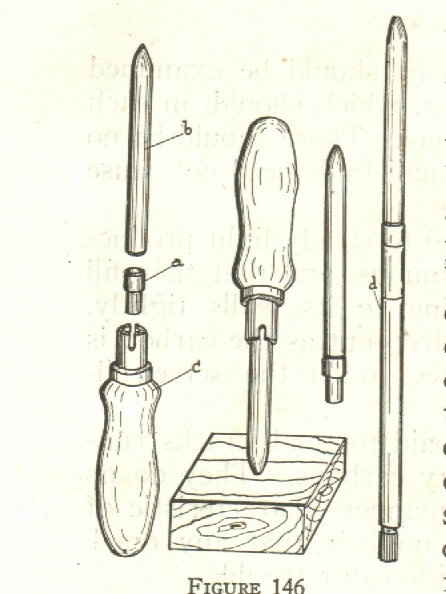
One type is illustrated on Fig. 146. The pro-cess of using them is as follows: A cap is slipped on the rear (unburned) end of the stub. The other end of the cap then is shoved into the recess in upper end of handle
c. The end of the stub is then rested on the wooden block, which must be of soft wood to prevent breaking the crater edges, and the upper end of the handle is struck a sharp blow with the palm of the hand. This not only shoves the cap tightly on the carbon end, but clamps it there immovably and in good electrical contact. The handle then is pulled off and the cap inserted in a recess in the end of rod d, and a knurled nut at its bottom is turned clockwise, which clamps the cap tightly into the rod. The rod in turn is inserted into the carbon jaws of the arc lamp. Such devices save as much as 25 per cent of the carbon.
Another way to provide for maximum use of carbons is to use specially processed carbons having a hole drilled into one end, and a pin milled at the other to fit into the hole. When a carbon is burned down several inches, a new carbon can be attached to it by this male-and-female means, the stub forming the tip of the new carbon; and over the joint is placed a copper sleeve, which is com-parable to the regular copper coating and burns away
quote:
I was in carlisle last year, on one of Hertfordshire Railtours' trips, London, York, just outside Leeds station, Aire valley line, to Settle Junction, then a short berak in Carlisle, before returning to London via Hexham, curve South of Newcasle and East Coast Main Line to King's Cross.
[rant]
Yikes! Did you do that, err, voluntarily? My weekly trips from York to Newcastle are bad enough: the trains are always late, old, dirty, freezing in winter/boiling in summer, full of teenage yobs screaming into mobile 'phones (even in the carriage where you're not supposed to use them), impossible to get any work done in and generally an ordeal. The only reaon I use them at all is because parking is virtually impossible anywhere near our Newcastle office. And then there's the cost - £26 return. I estimate that making the trip by car would cost me £10-12 (taking into account everything - petrol, maintenance costs, insurance, tax and depreciation). If you bear in mind that all motoring costs are taxed to hell and that rail travel is VAT-exempt, then the true cost of making that trip by car is probably around £2-3, i.e. around 10% of doing it by rail.
The prospect of going right round the country in one of those semi-mobile cowsheds is about as attractive to me as being strapped in a chair and made to watch all 67 Nightmare on Elm Street films in succession (or however many there are). And the further you go the more of a ripoff they are: I'm off to visit a friend in Truro next weekend. It would have cost me £120 by train from York and taken nine hours. My Ryanair ticket from Stansted to Newquay cost me £38 return. Even after the costs of getting to and from each airport I anticipate having enough change for a very nice meal, not to mention the enormous time saving.
Rather than let morons like Livingstone persecute taxpaying motorists even more, what the government needs to do is close down all the railways and tarmac them over. That would solve traffic congestion.
[/rant]
------------------
John P. Pytlak, Senior Technical Specialist
Worldwide Technical Services, Entertainment Imaging
Research Labs, Building 69, Room 7525A
Rochester, New York, 14650-1922 USA
Tel: +1 585 477 5325 Cell: +1 585 781 4036 Fax: +1 585 722 7243
e-mail: john.pytlak@kodak.com
Web site: http://www.kodak.com/go/motion
Alhambra, Penrith. Graves Cumberland Ltd
Alhambra, Keswick. Graves Cumberland Ltd
Gaeity, Whitehaven. Graves Cumberland Ltd
Plaza, Workington. Graves Cumberlans Ltd
Zepherelys (sp) Ambleside
Theatre by the Lake, Keswick
Bowness
Cockermouth Arts Centre
Lonsdale, Carlisle
??? Theatre, Whitehaven
Brewery Arts Centre, Kendal
And probably more I've forgotten.
how can yo miss the Lonsdale?! It's about a 30 second walk from Carlisle Railway Station!
quote:
how can yo miss the Lonsdale?! It's about a 30 second walk from Carlisle Railway Station!
Probably by walking in the wrong direction; also, it was raining so hard I could hardly see ten metres in front of me. I remember getting to some sort of market, with canopies over it. I stood under there for a few minutes, but there was no sign of the rain stopping, so I went back to the station.
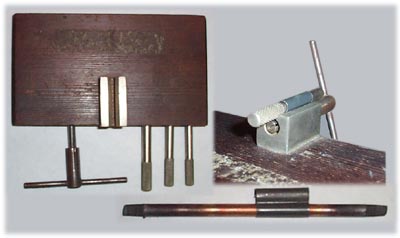
This jig could make carbon savers for 6mm, 7mm, or 8mm "Suprex"carbons used in Magnarcs, Enarcs, and the like. Take a small rectangle of thin sheet copper or a scrap of metal from a coffee can, bend it widthwise around a die of the desired size, insert the ends of the bent sheet into the slotted tool, slip the tool into the jig, twist the handle until the metal cinches tightly around the die and remove...voila, homemade carbon saver.
Incidentally, the extremely talented man who gave me the jig also, around the same time, graciously lent me his original of the National Projector Carbon Bulletins for me to photocopy. It is from that photocopy where a surprisingly oft-referenced treasure trove of information on this site originated from. (Sorry if I sounded like I was tooting my horn...)
Using 13.5mm joinables in an Ashcraft Super Cinex he would open the door while running; loosen the clamp; grab the free end of the still-lit carbon with a pair of Bakelite fuse pulling pliers; slide on a new stick tap it with the handle of the nut driver; crank back the clamp arm and tighten it again... All in about 15 seconds.
Doing this, he could keep the lamp lit continuously as long as the negative stick would hold out!
His explanation was that the only part of the carbon rod that's electrically live is the part between the silver jaws and the flame of the arc. It's possible to touch the rest of the rod without getting bitten. Using the Bakelite pliers was mostly to protect the hand from any heat and to help you keep the left end of the rod steady while you moved the arm back to the starting position.
It's something I would never consider trying myself but it's enough to make you give that slack-jawed, wide-eyed look that Keanu Reeves is so famous for... "Whoah!!" 
Is there anyone that is still running carbons today, wishes to continue doing so, and thinks they will still be able to in five years time? I doubt it.
quote:
Yup the Lonsdale is two buildings, one with 3 screens and towers and the other is two screens with platters. The owner, Alan Towers, is a top bloke, I think it belonged to his father before him. It was ABC originally. Jimmy the chief has worked there since the end of WWII, and is still working, now in his 70's
Wonderful that this Independent is still operating, with a Warner multiplex also in Carlisle. It must be tough competition though.
Carlisle, Cumbria.
Lonsdale City Cinemas, Warwick Road CA1 1DN. Seats: 1:374 2:220 3:54 and at Mary Street CA1 1QR. Seats: 4:119 5:112
Warner Village, Botchergate. 08702 406020 7 screens / 1,500 seats.
There was a cinema that the owner decided to close, as his chief projectionist was finally forced to retire being over 80 years of age. Must be something good in nitrate film and carbon fumes.
ACA918P Marble Double Eagle Carbons 9 x 18 Pos Box of 50
ACA818P Marble Double Eagle Carbons 8 x 18 Pos Box of 50
ACA914P Marble Double Eagle Carbons 9 x 14 Pos Box of 50
ACA814P Marble Double Eagle Carbons 8 x 14 Pos Box of 50
ACA714P Marble Double Eagle Carbons 7 x 14 Pos Box of 50
ACA812P Marble Double Eagle Carbons 8 x 12 Pos Box of 50
ACA712P Marble Double Eagle Carbons 7 x 12 Pos Box of 50
ACA812N Marble Double Eagle Carbons 8 x 12 Neg Box of 50
ACA712N Marble Double Eagle Carbons 7 x 12 Neg Box of 50
ACA79N Marble Double Eagle Carbons 7 x 9 Neg Box of 50
ACA69N Marble Double Eagle Carbons 6 x 9 Neg Box of 50
If you've got something like Super Core-lites, or at the other extreme, Bell & Howell 609s, it looks like you're out of luck.
I did manage to find quite a large stock of old ones for 609s in a couple of places, and I don't use them very often, so I should be ok for a few years at least.
The other problem is that they are quite expensive now, compared to xenons.
quote:
Incidentally, the extremely talented man who gave me the jig also, around the same time, graciously lent me his original of the National Projector Carbon Bulletins for me to photocopy. It is from that photocopy where a surprisingly oft-referenced treasure trove of information on this site originated from. (Sorry if I sounded like I was tooting my horn...)
Jon, Many thanks for providing the carbon bulletins. As you say, much useful information. Unfortunatly, pages 4 and 5 seem to be missing from number 2. Were these missing from your original set? If so, does anyone else have a copy of these pages that they could scan, to complete the set.
quote:
Yikes! Did you do that, err, voluntarily? My weekly trips from York to Newcastle are bad enough: the trains are always late, old, dirty, freezing in winter/boiling in summer, full of teenage yobs screaming into mobile 'phones (even in the carriage where you're not supposed to use them), impossible to get any work done in and generally an ordeal. The only reaon I use them at all is because parking is virtually impossible anywhere near our Newcastle office. And then there's the cost - £26 return. I estimate that making the trip by car would cost me £10-12 (taking into account everything - petrol, maintenance costs, insurance, tax and depreciation). If you bear in mind that all motoring costs are taxed to hell and that rail travel is VAT-exempt, then the true cost of making that trip by car is probably around £2-3, i.e. around 10% of doing it by rail.
I will answer here the points which you made, I hope Brad doesn't mind, but if you want to take the discussion further, then I suggest that we take it to a more appropriate forum, either private e-mail, or the uk.transport or uk.railway newsgroups.
I used to travel a lot by train, mainly local journeys, now I seldom do so, partly due to the cost. My journey to work is from Coulsdon to Croydon. This costs me 70p each way by bus, or 65p if I buy tickets in advance, in books of six. By train it would cost me exactly three times as much. I had a car for a few years, 1978-82, because mother insisted I had to have one, to drive her to various places. I absolutely hated driving, I think I did less than 2000 miles in all the time I had the car, including one journey of 300 miles, the only time I ever drove outside London. Car finally expired at about the same time as mother, so I stopped driving, and will never do so again. For short journeys, up to about 5km, I walk, unless I'm carrying something very heavy, or the weather is very bad. Longer than that, I go by bus. If there isn't a bus, I generally don't go.
There's nothing inherently wrong with old trains, see next paragraph.
quote:
The prospect of going right round the country in one of those semi-mobile cowsheds is about as attractive to me as being strapped in a chair and made to watch all 67 Nightmare on Elm Street films in succession (or however many there are). And the further you go the more of a ripoff they are: I'm off to visit a friend in Truro next weekend. It would have cost me £120 by train from York and taken nine hours. My Ryanair ticket from Stansted to Newquay cost me £38 return. Even after the costs of getting to and from each airport I anticipate having enough change for a very nice meal, not to mention the enormous time saving.
These railtours use refurbished BR Mk. 1 loco-hauled coaching stock. This was built between 1951 and 1963; that which is still in use would date from towards the end of this period, so it's about 40 years old, but is more comfortable than most of the later-built stock.
I agree with you that rail fares are, in most cases, too high. If you want to travel during peak hours, and/or turn up an go, they can be extremely expensive, even more so if you use Virgin trains, I have only used them twice since they won the franchise, and will not do so again.
My only recent experience of flying was in April, when I flew from London Gatwick to Newark International, mainly to see the Loew's Jersey Theater. (There, a film connection, to justify it being in this forum My last previous flight was in 1974, out to Leningrad, and back from Moscow. I think it is an absolutely ghastly way to travel, but since I can't afford to go over on the QE2, I ddnt have much choice. I did see the QE2 sailing out of New York harbour while I was there, looks a much better way to travel.
I had to check in two hours before take-off, go through several different security checks before I could get on the plane, had nothing to look at out of the window, could eat only when the meal was brought round, was far more restricted as to what I could take with me than I would be on a train, had to wait ages to reclaim my luggage at the other end, and the airports were miles away from my starting point and destination. At least I could get up to use the toilet if I needed to, in a car, bus, or many coaches, I couldn't. Most trains now do have toilets, and I can take a walk to stretch my legs, or go to the Buffet any time I like. On the plane, as soon as we hit any slightly turbulant air, they insist you sit down and put belts on. On older trains, you can even open the window to get some air.
The railtours have much lower fares, unless you choose to take the first class dining option. The trip which I described, to Carlisle and back, would typically cost less than an off-peak return to York. Many of these tours have various optional extras, e.g. I have got off at Appleby for a coach trip to places like Hawes, or Barnard Castle, which are very difficult to reach by other means, and re-joined the train at Darlington on the way back. Hawes is a strange place, they make Wensleydale cheese there, and everywhere you look you see Wallace and Grommet!
I choose not to drive, and I therefore have to accept the restrictions which this places on my freedom of mobility, there are many places that I would like to go, but it is just too difficult to get there; but what about the many people who for reasons of health, disability, age etc. cannot drive. How are they supposed to travel. In many places in this country public transport is terrible. The worst example I have seen was in a Devon bus timetable; there were places which were served by only one bus route, and that particular bus ran once a month! I'm not sure what you do if you run to catch the bus, and just miss it. Maybe the bus stops should have tents, instead of shelters! There were several routes which ran only once a week. In the unlikely event that you were to see one of these buses, I'm sure it would be empty, or very nearly so, such a service cannot be considered a serious option as a means of transport.
quote:
Rather than let morons like Livingstone persecute taxpaying motorists even more, what the government needs to do is close down all the railways and tarmac them over. That would solve traffic congestion.
What that would actually do is to stop the people who currently travel by train from doing so; They would either not travel at all, or they would travel by other means, mainly by road. In the case of lightly-used lines, this would make little difference, at least to the state of the roads, what difference it would make to the passengers would depend on the alternatives available. In the case of more heavily used lines, it would make the congestion worse. In some cases converting the ex railways into roads would not be possible, where it was, it would be expensive, in most cases, additional land would have to be purchased, bridges ann tunnels re-built to provide necessary clearances etc. Even where ths was done, the capacity of the new road would be less than the former railway which it replaced. How is that going to solve the congeston problem?
There were railways in this country which should never have been built, most of them have closed, in some cases as long ago as the early part of the 20th century. There are other lines which should have closed, and most have done so. There are few lines still open, which should now close. There are some lines which were closed, and should not have been. Many of these are the subject of pointless re-instatement proposals, which will never come to anything. Large amounts of time, money and effort are wasted on campaigns, studies, environmental assessments etc. for quite impossible re-opening schemes. I do not support schemes to re-open railways, with a very few exceptions, but nor do I beleive that more mass closures are the answer.
Oh  !
!Sharp eyes, Stephen! Unfortunately I must have had a brain fart when I made the copy, because my copy is missing the same pages (these two pages would have been one duplexed sheet). The projectionist who lent me the original passed away six years ago; his widow either donated it to an archive, gave it to another collector, or--egads--threw it out. Maybe a copy will show up on eBay someday...