I am hunting around for a second hand projector at present and want to get one with a cinemascope lens.
So far I have found ads for the following from one chap in Canberra;
The following has a ENN lamp (less bright)
1. Bell & Howe 1680 $125 Green model
The following have ELC globes (brighter)
2. Bell & Howe 1692 $175 (Charcoal)
3. Bell & Howe 1695 $195 Green Specialist comes with new gear & still frame
4. Hokushin Sc10 $125
5. Eiki SL1 $185 ([practically new, comes with cinemascope bracket)
6. Eiki RT1 $90
None of the above come with cinemascope lens - that will cost an extra $125 although he may have some for $80.
In addition there was an ELMO C16 for sale for $140 in the Trading Post here in Melbourne.
Which of the above would you recommend I buy and why? Essentially I am looking for a reliable 16mm projector that I want to show old films in scope on at home eg What's Up Doc and Grease. Any there any dangers or pitfalls associated with any of the above models?
Your 16mm thoughts please
Cheers Peter
This is more of a question for Ken Layton or Scott Norwood, more up their alley
Josh
Yes I too have heard evil things about the Bell & Howe machines. I did read somewhere though that Eiki was no longer going to provide support for its machines.
I plan on using my projector for home outdoor use with an outdoor screen. The idea is to show old favourites like Whats Up Doc and Grease on hot balmy summer nights. I think it would be fun to screen movies at home, particularly if I can get the presentation ok.
The only downside of 16mm that I have seen so far is that the sound is mono but I will probably get around that by building a stereo synthethiser. They are available as kits here in Australia.
I might add I have also seen the following projector B&H on Ebay Australia but I will probably avoid that B&H as well.
http://cgi.ebay.com.au/ws/eBayISAPI.dll?ViewItem&item=1375399964
cheers Peter
Where will you get the prints once you get set up with a very good 16mm projector and a scope lens? I have heard 16mm prints are hard to find unless you can find someone who collects them. When 16mm was used a lot before video became popular, Honolulu had a film rental store where anyone can rent full lenght feature films. The Hawaii public library also had a 16mm film collection but almost all of the titles were single reel educational films. When I was still in grade school, I had a neighbor who did exactly what you are planning. He had set up a nice little booth at one end of his spacious yard and a good size 'flat' screen at the other end. All the movies he presented were flat pictures because 16mm scope prints were not yet available for home exhbition. Some of the films I remember seeing was "THE JUNGLE BOOK" with Sabu , "THE EMPEROR JONES" with Paul Robson and "THE SALT OF THE EARTH". The sound was played back through a very ancient speaker and because stereo sound was not too common even in theatres, the sound was not bad. I sure wish I lived near you because I love to watch movies in an open air setting during the summer like I did when Mr. Minnor put on his picture show for all of his neighbors many years ago.
-Claude
Are those prices in US dollars or Australian dollars? They seem very high for US currency. You should be able to get a great portable machine for about $100.
I have some good news - I have made my decision! The following is what I have settled on.
I'm sending a cheque off tomorrow for the following
- 1 x Eiki SL1 (about 1983-83) projector, practically new, ELC globe (24v 250 watts) including scope bracket
- 1 x cinemascope anomorphic lens $80
- postage $32
After reviewing everyone's feedback I decided to give the Bell & Howes a miss. I didn't think it worth the risk. The Eiki SL1 was more expensive but did come with the scope bracket, was somewhat newer and had the 250 watt globe. The RT1 and Hokishan had 200 watt globes. Like all projectionists I just want more grunt!
Hopefully this time next week my new projector will have arrived and I can start to have some fun.
Claude, we have a number of distributors in Australia that supply films on 16mm, namely Roadshow Non-theatrical, 16mm Australia, Ronin Films etc. I don't anticipate that finding films to rent will be a problem. Some distributors like 16mm Australia can be a bit pricey however. Someone said to me that I could rent 16mm films from Roadshow Non-theatrical for as little as $25. I'm also told that newer films are now provided letterboxed so I won't need my anormorphic lens for these. Yes, it will be fun to project films for my family and friends. I might even show some French films for memebers of my the French class I attend.
Scott, the SL1 was manufactured about 1983-84 so of the projectors I listed , it is one of the newer ones. Having the brighter bulb and scope bracket is also helpful and worth the extra money in my opinion. By the way the prices are all in Australian dollars so halve them to get the $US equivalent.
Thanks everyone for your help. Now I just have to work out a way to fit a 2000w bulb to my new projector (more light, more light...) 
It will be interesting to see how, picture quality-wise, the 16mm projected image stacks up against digital.
cheers Peter
ps I have looked at some photos of the SL1 but can't work out where I plug in my computer yet.
-Claude
Cheque was sent today so all I have to do is sit back and wait for the courier to arrive.
I find it interesting though that super-8 has better sound quality than 16mm yet 16mm has the superior visual quality. As I understand it 16mm had an optical audio mono track and super-8 magnetic stereo. Odd that a poorer quality visual medium would have superior sound.
Naturally having now sorted out which projector to buy I need something to show on it. I've been advised to get an old reel of 16mm and play around with the projector a bit before mashing up one of Roadshow's prints. Seems like a good idea. Perhaps readers could list some of the common mistakes that newbies make with 16mm and how not to mash up your film on your first attempt. I'm sure, notwithstanding the experience of everyone on this forum, that you have some horror stories about things you did to prints when first starting out.
Also at some stage I would not mind getting a used print of 'Grease' on 16mm. I have hunted around on the internet but no-one seems to be selling any. What coudl I expect to pay for a used print of that film?
Interestingly one print I did come across of Grease was in super-8
format
http://netfora.com/films.html
It is for sale for 25 pounds which seems quite good value. My father-in law owns a super-8 projector which I could show it on. I have a couple of questions about super-8.
1. For home use does super-8 give good visual quality? What size image can you project with a reasonable picture? How would it stack up against dvd or video?
2. The super-8 print for sale is wide screen but not scope. I don't quite understand what is meant by widescreen. I understand scope to mean using an anomorphic lens to stretch the picture wider. Would a widescreen print be letterboxed or have the ends of the picture cut off?
cheers Peter
If i was going to buy a good 16mm machine, I would look for an Eastman 25 or possibly the television version, the 285. Those machine are the catalac of 16mm machines, or at least the were. Plus they use geneva movements.
Josh
------------------
"Film is made of silver, video is made of rust"
'nuf said
Regarding Super 8, you can blow it up a whole lot easier in a short throw situation than 16mm. Just TRY and find a short focal length lens for a 16mm projector of the kind of quality available in Super 8mm machines at any kind of comparable price. Also, there are many models of Super 8mm machines in which you can put an arc lamp in. I've done it to Eumig S926, Elmo ST-600, ST-1200, and GS-1200 models, but certainly this can be accomodated into other models depending on their design. If you really want to do it right, get yourself a Beaulieu 708EL Pro and drill out the back of the lamp cover, then get you an external xenon lamphouse and go to town! So long as you have a whole lot of forced air for cooling and a heat shield, you'll be just fine. I've put a 2000 watt lamphouse behind my Beaulieu before!
While I'm thinking about it, have you ever compared the actual image size of a 16mm frame to a Super 8mm frame? Remember that the 16mm perforations are quite large, as is the mono optical soundtrack. The difference is really not all that much. Plus you can buy brand new prints from Derann films in the UK (as well as other vendors) for around $300 US. Why be stuck paying top dollar for old used library and airline prints of 16mm movies, mostly in 1.33 aspect ratio and all of them in optical mono when you can get brand new prints of recent full length feature films?
Also, Super 8 prints can be re-recorded for much higher fidelity than the labs provide. If you use FilmGuard on them, there will not be any dropouts in the tracks and as such you will be able to encode with dbx noise reduction for damn near cd quality (better than 35mm optical tracks).
Now if you're REALLY serious about wanting some incredible sound from Super 8mm, you can simply record the timecode signal onto the magnetic track 2. Then of course record a mono mix-down of the audio on track 1. This way you can output the signal into a dts player for full 6 channel digital sound WITH A BACKUP AUDIO SIGNAL! 
quote:
Naturally having now sorted out which projector to buy I need something to show on it. I've been advised to get an old reel of 16mm and play around with the projector a bit before mashing up one of Roadshow's prints.
I would invest in a good 2nd hand 16mm Tape Film Splicer, acetate cement splicing is a thing of the past, and won't join polyester stock anyway. A bench type Rewinder is a must, and a couple of new spare spools.
Most 16mm prints found damaged on receipt is because they are rarely checked properly before despatch, if at all! Be a professional projectionist, and always carefully examine all splices. Damaged perforations can be difficult to detect on 16mm, best method IMO is to lightly grip the perforation side between finger and thumb, by which nature you will not harm the picture area. I would also clean each reel gently with a large Selvyt, changing to a clean part of the cloth say 3 or 4 times during a 1600’ spool. Practice makes perfect, and you will have the satisfaction and guarantee of a trouble free show every time. You also do not want to be held responsible for someone else’s carelessness, report all serious faults.
That’s some of the procedures I did for my 16mm home cinema many years ago. The kitchen became the projection box showing through an optical glass porthole into the living room with a throw of 25’ onto a solid 12’ masked screen with three adjustable ratios, for academy, wide, & scope. The projector was an RCA Hollywood which I converted to 24 volt 250 watt QI lighting, and long running 5000’ reels. I even had an aperture plate made for 1.85 machined within a set of gate runners. Picture and sound was magnificent at that time, so don’t be put off just having mono! I was most fortunate to get my films free with trade contacts. Always two features we held most shows on Friday nights, great great fun! I think it is safe to reveal now that I run “The Battle Of Britain” 5 days before the world premiere at the Dominion Theatre.
I’m sure you will get as much enjoyment with your projector. But be careful Peter, you could finish up like me and run a full-time cinema for 25 years.
Your reply raises a couple of questions in my mind. I know these questions are relatively simple but I ask you to bear with me as I am a beginner.
1. What is filmguard? I have seen so many posts about this stuff but do not know what it is. Obviously it must protect film in some way but I don't know whether you paste it onto the film or its some kind of sticky tape that you attach to the film. Is it worth getting for home use?
2. Brad, you talk about rerecording the soundtrack in a hi fidelity format on super-8 using the two magnetic tracks available. If one was to purchase a second hand super-8 print of a film (eg What's up Doc) where would you get the high quality soundtrack to record onto the super-8 film? DVD? More importantly lets say that you had a film, a quality soundtrack source and the appropriate recording equipment - how would you get the soundtrack in sync with the images. Having a soundtrack out of sync with your picture is awful - almost as bad as dubbing.
3. Finally why does 16mm film have optical mono sound and not magnetic stereo like super-8? Would it be possible to buy a jar of some sort of magnetic resin and 'paste' a magnetic stereo soundtrack onto a 16mm film and the rerecord the soundtrack in digital on that?
Thanking you
Peter
Thanks for the tips. yes indeed I do want to be professional in the way I handle films and would prefer to send film back to the distributor exactly as I received them. I shall have to hunt around at some local swap meets and see if I can pick up the equipment you mentioned.
Frankly if money was not an issue I'd be sorely tempted to become a projectionist. Its considerably less stressful than being an accountant (unless of course your projector starts to mash up that nice shiny new print you just got from the distributor).
For me there's always been a certain kind of magic associated with outdoor projection. Some of the nicest memories I have as a child are of being taken to the drive-in by my parents. Truly, when one projects the flickering image onto a surface in the outdoors it magically takes one to a different world but hey, I think I'm preaching to the converted methinks. I think there would also be a certain satisfaction on seeing the joy on children's faces as you project a film.
I think if there is one thing I'm glad about in being born in the late twentieth century, its that I got to see movies, something most of my ancestors never got to see. Hopefully my descendants will continue to enjoy this marvellous invention as I have.
cheers Peter
2. DVD, videotape, Laserdisc, just whatever has a good clean copy of the soundtrack can be your master source. Set up the projector to shine a picture of the same size as your tv set and put the two images side by side. Once you have played with things for a little bit you will know precisely when to hit the buttons. Then don't worry about lip sync, just sit back and verify that the two pictures have their camera change cut simultaneously. That makes it real easy to see if the projector is getting even one frame off. You would be amazed at how easy it is to maintain sync for 20 minute spurts. (Video transfers sometimes chop off frames at the end of a reel or the print will be missing frames at the ends of the reels for some odd reason, but it is easily covered up in redubbing.)
3. Yes there is magnetic sound capability for 16mm. I don't know of anyone with striping machines, and it would be not cost effective to do so. Plus you would end up with films you could never re-sell.
quote:
Now if you're REALLY serious about wanting some incredible sound from Super 8mm, you can simply record the timecode signal onto the magnetic track 2. Then of course record a mono mix-down of the audio on track 1. This way you can output the signal into a dts player for full 6 channel digital sound WITH A BACKUP AUDIO SIGNAL!
Pardon me for asking Brad but do you know anyone who has actually done the above? I hunted around the Internet but could not find any mention of anyone actually having done it.
Also have you heard the results of such an overdub? If so what was your impression of the sound quality. It seems to me that one could do such an overdub on a popular film like 'Grease' and then invite one's friends around for a film night but not tell that you've fiddled with the sound. They'll be expecting some tinny sound, maybe stereo but if one has carefully hidden speakers and subwoofers around the room they'll literally be blown away by the sound quality if it is as good as you say.
You weren't kidding us were you?
cheers Peter
I've seen 16mm DTS prints (we got one at a festival, but couldn't run it); the optical track contains timecode and is very distinctive. It's a great concept for special-venue use, but not useful for general releases, unless the DTS unit is shipped around with the print and disks.
Peter, yes I have re-recorded many tracks for myself and others. The result is impressive. I have never gone the way of the dts, but after speaking with Karen several months back, she agreed there was no reason why it would not work. That is all that is done with 16mm dts prints anyway. The timecode "noise" is just recorded on the optical track.
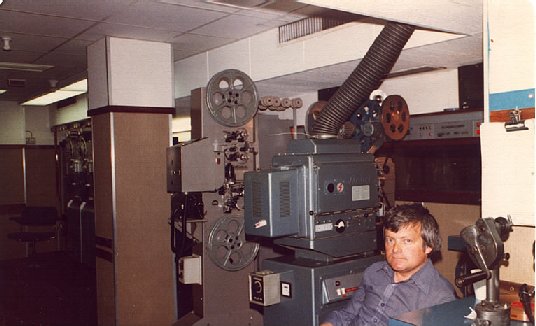
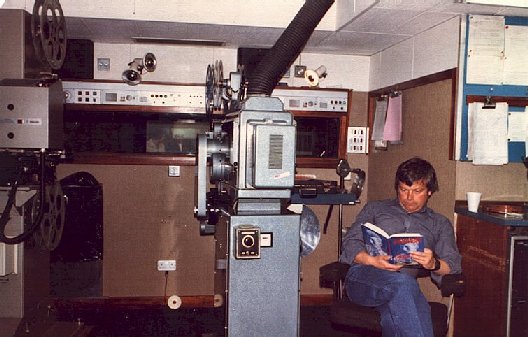
One of the very best 16mm double band projectors that I worked on was the BAUER, with an intermittent movement! Partly seen nearest in the picture with a vertical xenon lamphouse. Playback only, it could be interlocked with other follower heads for rock ‘n roll dubbing. Projectionist Ken Wells. ITN News (cica 1980). On the other side of the room there were two other theatres equipped the same.