 ]
]
quote:While I'm thinking about it, have you ever compared the actual image size of a 16mm frame to a Super 8mm frame? Remember that the 16mm perforations are quite large, as is the mono optical soundtrack. The difference is really not all that much. Plus you can buy brand new prints from Derann films in the UK (as well as other vendors) for around $300 US. Why be stuck paying top dollar for old used library and airline prints of 16mm movies, mostly in 1.33 aspect ratio and all of them in optical mono when you can get brand new prints of recent full length feature films?
I found this to be an interesting line of thinking and worthy of some further discussion in a separate discussion. Perhaps even John Pytlak might wish to chime in with his thoughts on the image quality of the two mediums. The emphasis here is not much so on the theoretical image quality (eg pixels/inch) but on user's practical perceptions of the difference's between the two mediums when used in reality. Is the difference that noticeable?
Do readers agree with Brad's comments? Is the difference in picture quality only marginal? Brad's comments were of course framed (no pun intended) in the context of home use.
I suppose the acid test is whether if, as a projectionist, someone displayed an image on a wall in a home situation but you couldn't see or hear the projector - could you tell whether it was super-8 or super 16?
If Brad's arguments do hold up then it is arguable that super-8 with magnetic stereo sound (and the possibility of recording 6 channel digital stereo on the tape) is a better option for home users than 16mm. I'm sure on the other hand that there will be plenty of detractors who will prefer 16mm.
One other point regarding super-8 film - is it still possible to buy super-8 sound film? I read at the following url that Kodak had discontinued manufacturing it?
cheers Peter
I know little to nothing about either format.
------------------
Adam Fraser
www.pinestheatre.com
By the way, a 400 foot reel of Super 8mm film = a 2000 foot reel of 35mm film. You will note some features are listed as 4x600, meaning 4 30 minute capacity reels.
www.derann.co.uk
As for 16mm...NOTHING beats a ISCO Vario-Kiptaron 20-60mm (not to be confused with the low-end Vario-Kiptaron that sells for a 1/3rd of the price 35-65mm). The good Vario-Kiptaron will rival just about anything made today and make 16mm look as good or better than 35mm (Depending on the actual print of each).
http://www.iscooptic.de/english/dbl/kiptaronb.php
Steve
------------------
"Old projectionists never die, they just changeover!"
------------------
Adam Fraser www.pinestheatre.com
I am sorry I was not able to join in on this discussion until today because I was very busy during the weekend. I hope Brad does not mind if I make a sales pitch on this thread to anyone who is interested in buying super 8 sound films because I have several complete features I do not need anymore. One of the film is "GREASE" but it is not the scope version. It is full screen. I also have the complete "SATURDAY NIGHT FEAVER", "THE WARRIORS" and "MURDER ON THE ORIENT EXPRESS" - all Paramount features. I also have some MGM "TOM & JERRY" original theatrical shorts that has been spliced on long reels. If you or anyone is interested, please send me an EMAIL.
I bought all of these films when I worked with high school yearbook staff members taking pictures for the kids when I was the school's contract photographer and I used to host parties at my studio after hours for many of my teenage friends. We would spend hours watching all of the above mentioned films and have a lot of fun.
I still have my Elmo projector but I dont know if it works anymore because I have not used it in years. This projector can play movies on these these very large reels that can hold about an hour of film played back at 24fps. The size of the reels is about 12 1/2 inch in diameter. If anyone is interested, this projector is also available.
-Claude
RELATIVE IMAGE AREAS
(RELATIVE PROJECTED IMAGE AREA) GAUGE AND FORMAT
------ --------------------
(334.9) 65 mm Negative and 70 mm Positive
(220.2) Technirama Negative AR 2.35:1
(194.9) VistaVision Negative AR 1.85:1
(124.2) 35 mm Full Aperture Negative
(121.2) 35 mm CinemaScope AR 2.35:1
(100.0) 35 mm Academy Standard AR 1.37:1
(95.1) 35 mm TV Transmitted Area
(83.0) 35 mm Wide-Screen AR 1.66:1
(74.3) 35 mm Wide-Screen AR 1.85:1
(60.2) Techniscope Negative AR 2.35:1
(21.8) 16 mm Standard
(20.5) 16 mm TV Transmitted Area
(15.4) 9.5 mm
(6.6) Super-8
(4.4) 8 mm

For print formats, larger projectable image area is most important because it allows more light on the screen without causing excessive heating of the print by the radiant energy of projection. For 35mm prints, a 7000 watt xenon lamp is about the practical maximum. For 70mm, you can go much higher.
http://www.kodak.com/US/en/motion/newsletters/pytlak/fall97.shtml
http://www.kodak.com/US/en/motion/newsletters/pytlak/winter97.shtml
http://www.kodak.com/US/en/motion/newsletters/pytlak/dec98.shtml
http://www.kodak.com/US/en/motion/newsletters/pytlak/march99.shtml
http://www.kodak.com/US/en/motion/newsletters/pytlak/feb97.shtml
------------------
John P. Pytlak, Senior Technical Specialist
Worldwide Technical Services, Entertainment Imaging
Research Labs, Building 69, Room 7525A
Rochester, New York, 14650-1922 USA
Tel: +1 585 477 5325 Cell: +1 585 781 4036 Fax: +1 585 722 7243
e-mail: john.pytlak@kodak.com
Web site: http://www.kodak.com/go/motion
My Eiki Sl-1 arrived today and naturally I took it it out of its box and took it for a spin. Unfortunately no intruction manual came with the projector but it did not take long to work out which way the reels ran and which way way the film ran through the projector.
I was really impressed with the special effects that came with the projector. After a couple of minutes I was watching the screen and suddently the film just sorted of melted on the screen as I have seen in some movies. [ Just kidding ]
No seriously - I had an old black and white film on the subject of making files that Buddy had provided me with. The film ran perfectly and the sound was ok. It wasn't Dolby surround but it was only a training film.
Here's some comments I noted. For indoor use I noted that at a throw of about 5 metres I could get a picture of about a metre or slightly less maximum. This is a little annoying because I think that for indoor use a picture width of about 2 metres would be good. However with the scope lens on, the width expands out signficantly and gives more of the cinematic feel. In just plain jane mode (no scope lens) I had expected that one could blow the picture up much larger.
I then took my projector outside and projected an image onto the back wall of my house from a similar distance (my house is painted white). It was quite amazing the way that a projector could take an otherwise unassuming wall and animate it with a 3 metre wide image. I have yet to dig out my projector screen and try the projector with that but I assume that the image should improve further.
Even though I have only been able to project a black and white image so far I have been impressed with my new toy. The Eiki is well built, easy to use, has a simple film feeding system, stores compactly and gives a good clear picture with good light. The only downside is the limitation in terms of not being able to project a large image over a short distance however this can be compensated somewhat by the use of a scope lens with a scope print. I'd recommend the unit to anyone.
It will be interesting now to have a look at a super-8 projector and compare the results. I might get a chance this weekend to do that at my in-laws place.
Also today my Roadshow 16mm catalogue arrived. A glance down the listing brought a smile as I noted that 'La Cage Aux Folles' was on the listing. I hope it isn't dubbed. It was pleasing to also see 'Grease' there. No sign, however of 'What's up Doc?'. Anybody know who distributes that film in Australia?
A quick (but tricky) technical question for John Pytlak as well. In a darkened room with a good 16mm projector (250 watt bulb) running a scope lens, how small/large an image should be projected to guarantee a 16 footlamberts result?
cheers Peter
I just quickly checked my projector and yes it has a 50mm lens. I shall keep an eye out for a shorter lens.
cheers Peter
Too many variables to answer:
How efficient is the illumination system of the projector?
What is the gain of the screen?
Most tungsten lamp 16mm projectors should be able to handle a screen up to about 2 metres wide with good illumination.
But it is best to actually measure the screen luminance:
http://www.kodak.com/US/en/motion/newsletters/pytlak/spring98.shtml
http://www.kodak.com/US/en/motion/newsletters/pytlak/march2000.shtml
http://www.kodak.com/US/en/motion/newsletters/pytlak/june2000.shtml
------------------
John P. Pytlak, Senior Technical Specialist
Worldwide Technical Services, Entertainment Imaging
Research Labs, Building 69, Room 7525A
Rochester, New York, 14650-1922 USA
Tel: +1 585 477 5325 Cell: +1 585 781 4036 Fax: +1 585 722 7243
e-mail: john.pytlak@kodak.com
Web site: http://www.kodak.com/go/motion
Their light output was to the naked eye virtually identical, though as you'd expect, the colour temperature was radically different. I did once have to run a show with these two machines that included a changeover, and a customer remarked that it was a pity that the colour seemed to have faded so much during the last half of the film!
For what it's worth, I suspect that the reason why 50mm primes are shipped as standard is that 16mm portables were intended to be used in classrooms, training and conference situations rather than in homes. In this kind of environment you would typically want a throw of 5 to 10 metres rather than the 2 to 3 you have in a living room.
Peter,
I hope you will able to get a very good quality 25mm lens to double your picture width. With my 25’ throw I upgraded my standard 50mm lens for academy & scope. And purchased a good quality 37.5mm size lens for 1.85 wide.
My first projector was a Bell & Howell 631, had a variable aperture plate, which worked satisfactory on a masked screen. The RCA was much better though with the 1.85 aperture plate machined and fixed into a set of gate runners, I was able to file out the plate to fit precisely. Also a vast improvement with the RCA compared to the B & H was the extremely smooth optical framing adjustment by the claw movement.
Here is a picture of the best type of Tape Film Splicer to look out for, made in Italy by CIR would be ideal for you. The special myler splicing tape you will need is 15mm in width. I didn’t bother doing a photo of my Rewinder as it is duel 16/35 which is geared ideal for 16mm 5000’ long play reels. You should be able to pick up a decent cheap small 16mm Rewinder just for 1600/2000 reels. Do check that the spool security clips are complete and sound though before you buy.
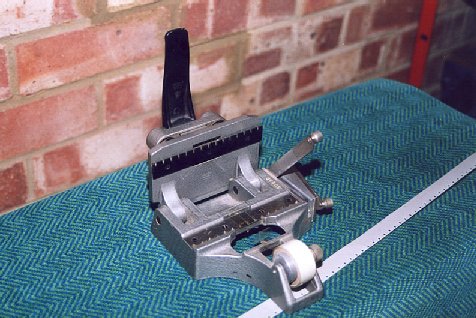
Very hard to get but very useful if you can get one is a variant of the 16mm CIR joiner in Bernard's picture which has a set of retractable pins on both edges of the film path, so you can tape over both sides without having to turn the film around horizontally.
Obviously, a xenon or metal-arc (Marc 300) lamp would be more efficient and a higher color temperature.
------------------
John P. Pytlak, Senior Technical Specialist
Worldwide Technical Services, Entertainment Imaging
Research Labs, Building 69, Room 7525A
Rochester, New York, 14650-1922 USA
Tel: +1 585 477 5325 Cell: +1 585 781 4036 Fax: +1 585 722 7243
e-mail: john.pytlak@kodak.com
Web site: http://www.kodak.com/go/motion
In terms of splicing at least oen distributor I have spoken to has indicated that they prefer that home users don't do any splicing. They would prefer that the film was returned and they will fix it. However for any films I buy a splicer would be handy.
Thanks John and others for the technical help. One day when everything is set up I'll see if I can find someone with a light meter to come around to my place and measure the light output of my projector and how changing the size of the screen affects teh luminosity.
cheers Peter
For a given projector and lens, screen luminance is directly related to the image AREA. If you double the AREA, you halve the screen luminance. If you double the width (quadruple the AREA), you need four times more light from the projector.
------------------
John P. Pytlak, Senior Technical Specialist
Worldwide Technical Services, Entertainment Imaging
Research Labs, Building 69, Room 7525A
Rochester, New York, 14650-1922 USA
Tel: +1 585 477 5325 Cell: +1 585 781 4036 Fax: +1 585 722 7243
e-mail: john.pytlak@kodak.com
Web site: http://www.kodak.com/go/motion
Can someone please explain to me a little about lenses. I have a 50mm lens - doe the 50mm refer to the width of the lens or the focal length? Also why will a 25mm lens give me twice the size picture?
cheers Peter
It is to do with focal length! A shorter focal length, will give the larger size picture. And the longer focal length, the smaller picture! to explain in easiest terms. A 25mm lens needs to be good quality as your picture is twice the size of your standard supplied 50mm lens.
A student film society I ran many years ago did exactly what you do (this being 35mm): on each projector we used one prime lens plus a Schneider zoom converter for 1.38, 1.66 and 1.85, and the prime plus an anamorph for 'scope. We had 2.6k lamps on a screen that I would guess was 25ft across in 'scope, so all we needed to do was to wind up the amps a bit to compensate for the zoom. Even then the lamp was well within limits and I honestly don't think it made a visible difference to the optical quality of the projection.