
Here are some excerpts from a Weekly Variety article from July 28, 1982:
The gist of the article was about how 70mm print runs could be larger if exhibitors had enough 70mm equipment.
"....The 11 early summer 70m films were released in a total of 282 prints in the large format, virtually blanketing the nation's population of about 320-350 (including Canada) active 70m screens..."
"Striking fact is that the low print runs on seveal of the 70m pictures indicate that many more wide-gauge prints could have been made if only there were more prime theatres with the equipment available...."
"Paramount Pictures led the distribs with the widest print run, working with 68 copies of Star Trek II: The Wrath of Khan in 70m. Impressive statistic is that some 20% of Trek's $60million plus gross has been earned at only 4% of its theatres, those booking the 70m version....."
"Par's less succesful summer release, "Grease 2" had only eight prints out of its total 1250 in 70mm and they generated about 3% of the gross..."
Other notes from the article about 70mm releases:
ET released in 31 sites in 70mm.
MGM-UA had 37 prints of Poltergeist, 25 of Rocky III
WB had 10 prints for Blade Runner, 5 prints for Firefox, 3 for The Road Warrier
Disney's Tron released in 41 prints with 2 added later. "Tron is....actually the lensed in 70mm, using the Super Panavision 65 camera and lenses..."
"Looking ahead, Fox will reissue "Star Wars" on Aug 13 with four 70mm prints, rejuvenated from extant ones, working in New York and Los Angeles......Christmas reissue of ....Empire Strikes Back is projected to use about 40 prints (in 70mm.)
"For...Revenge of the Jedi," Lucasfilm planning through Fox next summer 100+ prints in 70mm..."
"Paramount currently has 12 prints of its Raiders of the Lost Ark reissue in 70mm.....MGM/UA releases about 20-30 units of Pink Floyd's - The Wall followed by two wide prints of "Yes, Giorgio" in September. Columbia's "The Tempest" is also starting off with two 70mm prints on Aug 13...."

------------------
John P. Pytlak, Senior Technical Specialist
Worldwide Technical Services, Entertainment Imaging
Research Labs, Building 69, Room 7525A
Rochester, New York, 14650-1922 USA
Tel: +1 585 477 5325 Cell: +1 585 781 4036 Fax: +1 585 722 7243
e-mail: john.pytlak@kodak.com
Web site: http://www.kodak.com/go/motion
------------------
Cheers, Thomas
www.in70mm.com
www.dp70.com
www.70mm.dk
quote:
"....The 11 early summer 70m films were released in a total of 282 prints in the large format, virtually blanketing the nation's population of about 320-350 (including Canada) active 70m screens...""Striking fact is that the low print runs on several of the 70m pictures indicate that many more wide-gauge prints could have been made if only there were more prime theatres with the equipment available...."
The 1980s (particularly the early-to-mid '80s) were really good times for moviegoers interested in 70mm presentations, even if most of the films were "only" blow-ups. The number of 70mm equipped theaters in North America nearly doubled from 1982 to 1984 which often resulted in an increase in the number of 70mm prints released for those titles given 70mm treatment.
1984: Over 600 prints for just over 15 releases
1985: Over 400 prints for around 25 releases
1986: Over 400 prints for over 15 releases
quote:
ET released in 31 sites in 70mm.
MGM-UA had 37 prints of Poltergeist, 25 of Rocky III
WB had 10 prints for Blade Runner, 5 prints for Firefox, 3 for The Road Warrior
Disney's Tron released in 41 prints with 2 added later.
Those were pretty good print numbers, which allowed most of those films to be seen in 70mm in markets outside L.A. and New York.
But as "large" as those 1982 numbers were, they were nothing compared to some other 70mm releases, such as:
Over (or near) 100:
THE EMPIRE STRIKES BACK (1980)
STAR TREK III: THE SEARCH FOR SPOCK (1984)
COCOON (1985)
SILVERADO (1985)
YOUNG SHERLOCK HOLMES (1985)
TOP GUN (1986)
STAR TREK IV: THE VOYAGE HOME (1986)
HOFFA (1992)
Over (or near) 150:
BRAINSTORM (1983)
RETURN OF THE JEDI (1983)
ALIENS (1986)
DICK TRACY (1990)
FAR AND AWAY (1992)
Over 200 70mm prints:
INDIANA JONES AND THE TEMPLE OF DOOM (1984)
2010 (1984)
INDIANA JONES AND THE LAST CRUSADE (1989)
Other huge 70mm print runs included ALIEN (1979) and RAIDERS OF THE LOST ARK (1981).
RE: BLADE RUNNER. There's some interesting 70mm-related information included in the book FUTURE NOIR: THE MAKING OF BLADE RUNNER by Paul M. Sammon (Harper/1996), including an implication by the film's producer that no U.S. cities ever actually screened the film in 70mm!
quote:
There's some interesting 70mm-related information included in the book FUTURE NOIR: THE MAKING OF BLADE RUNNER by Paul M. Sammon (Harper/1996), including an implication by the film's producer that no U.S. cities ever actually screened the film in 70mm.
The implication is wrong. I will vouch that I saw a 70mm print at Mann's Hollywood Theatre. I could see the reels through the portals. I could tell it was 70mm by the image quality as well as the small round changeover cues. (I saw three other 70mm films that day, including E.T. at the Dome (with screen masking open all the way, even though it was an OAR 1.85 print), The Thing at the Pacific, and Firefox at the Vogue).
Seeing FOUR different 70mm films in one day!!!
Only in Los Angeles.
Only in 1982.
Those were the days.
------------------
John P. Pytlak, Senior Technical Specialist
Worldwide Technical Services, Entertainment Imaging
Research Labs, Building 69, Room 7525A
Rochester, New York, 14650-1922 USA
Tel: +1 585 477 5325 Cell: +1 585 781 4036 Fax: +1 585 722 7243
e-mail: john.pytlak@kodak.com
Web site: http://www.kodak.com/go/motion
other SF 70mm doubles: Logan's Run -opened as a first run at the Alexandria (later added Wind and the Lion to the bill, then 2001: a Space Odyssey)
Star Trek I and II at the Regency III
In L.A., other double features in 70mm were shown:
West Side Story/ Around the World in 80 Days
Fiddler on the Roof/ Man of La Mancha
Camelot/ Oliver!
There were quite a few others as well, mostly packaged from films several years after their original roadshow releases.
Also, there was an engagement of Star Trek I and 2001 in San Diego.
Has today's Digital Cinema presentation had the same effect for some of the lesser releases that had digital "prints" in the last three years? 
------------------
John P. Pytlak, Senior Technical Specialist
Worldwide Technical Services, Entertainment Imaging
Research Labs, Building 69, Room 7525A
Rochester, New York, 14650-1922 USA
Tel: +1 585 477 5325 Cell: +1 585 781 4036 Fax: +1 585 722 7243
e-mail: john.pytlak@kodak.com
Web site: http://www.kodak.com/go/motion
Only in Los Angeles.
Only in 1982.
John you should really visit Bradford one day.
A few years back we ran Star Trek 1 through 5 on one day. The first was in 35mm the others in 70mm.
And what we do on Widescreen Weekends can make the strongest tech go weak at the knees.
Of course, I was commenting on the grand days when a big city could have several first-run 70mm engagements running at the same time.
------------------
John P. Pytlak, Senior Technical Specialist
Worldwide Technical Services, Entertainment Imaging
Research Labs, Building 69, Room 7525A
Rochester, New York, 14650-1922 USA
Tel: +1 585 477 5325 Cell: +1 585 781 4036 Fax: +1 585 722 7243
e-mail: john.pytlak@kodak.com
Web site: http://www.kodak.com/go/motion
How is the color quality of the 70mm prints you have been running at your large format film festival in the UK? I have a couple of feet of 70mm film from "THE JAZZ SINGER" and about a couple of frames from "OUTLAND", "YES GEORGIO" and "SOUTH PACIFIC" and the color on all of them is majenta. It was rather unfortunate that no effort was made to have film printing machings at the labs capable of producing IB prints in 70mm like they did with 35mm. As I had mentioned on another thread, the short strip of IB 35mm film I have from the "THE TEN COMMANDMENTS" in VistaVision is gorgeous.
-Claude
------------------
A KIWI eats,roots & Leaves.
quote:
Of course, I was commenting on the grand days when a big city could have several first-run 70mm engagements running at the same time.
In addition to the four films I did see in 70mm in Hollywood that day, I actually had quite a few others I could have chosen to see:
Annie (Chinese I)
Star Trek II (Chinese II)
Rocky III (Chinese III)
Poltergeist (Paramount)
In fact, I did see both The Road Warrior and Rocky III in Hollywood the last weekend in May, and Star Trek II, Poltergeist and Annie a couple of weeks later. The only 70mm film I missed that summer was Grease 2. In the month of June of 1982, only one 70mm equipped theatre in Hollywood ran only 35mm, the Egyptian with Author! Author!(Fox)
As a matter of fact, of all major studio releases in June that year, only two Fox releases, including Megaforce, were in 35mm only. Other 70mm films I got to see that summer included Napoleon (Dome), Tron (Chinese I), Tempest (Plaza in Westwood) and Pink Floyd - the Wall (Village Westwood).
With 6 70mm presentations of old films in Hollywood in September (5 actually originating in 65, one in horizontal 35- closer than normal blow-up) it's ALMOST like old times!
"BATMAN" was indeed in 70mm. I remember this film very much because of the problem that they had with the print when a projectionist 'ruined' a couple of minutes of film at the Waikiki #3 where the picture was playing it only Honolulu engagement in 70mm. They did continue to play the film minus the few minutes but someone who saw the movie a couple of times at another theatre in 35mm noticed the missing footage and made such a big fuss, the Honolulu Advertiser reported it on the front page and not on the entertainment section of our morning newspaper where the story actually belonged. When the news was out, Consolidated (Pacific) promptly replaced the 70mm print with a 35mm and contacted Warners Brothers with a request for a replacement reel for the 70mm print. Warner Brothers hesitated but they did send another reel containing the missing footage. I have not yet seen the movie but if they were not able to get a replacement reel for the 70mm print, I would have been forced to see this film in 35mm and would not have been a 'happy camper'.
-Claude
Any 70mm prints made on Kodak print film AFTER the early 1980's should still be looking very good, even if stored at room temperature. Even the acid environment from possible mag-stripe related vinegar syndrome should have less of a detrimental effect on the improved dyes:
http://www.kodak.com/country/US/en/motion/about/chrono4.shtml
http://www.kodak.com/US/en/motion/about/chrono3.shtml
"Outland", "Jazz Singer" and "Yes, Georgio" just predate the improved Kodak technology by a year or two.
FWIW, I have photographs of my daughter printed on a non-Kodak paper in the late 1970's that have virtually no cyan dye left, and many Kodak prints of the same age and stored identically that are almost unchanged.
For prints with the older print film dye technology, storing them cool, dry and vented (or sealed with Molecular Sieves) will help slow the fading. As always, proper washing during processing (low residual thiosulfate and correct emulsion pH) is a significant factor in long term dye stability.
------------------
John P. Pytlak, Senior Technical Specialist
Worldwide Technical Services, Entertainment Imaging
Research Labs, Building 69, Room 7525A
Rochester, New York, 14650-1922 USA
Tel: +1 585 477 5325 Cell: +1 585 781 4036 Fax: +1 585 722 7243
e-mail: john.pytlak@kodak.com
Web site: http://www.kodak.com/go/motion
Then in the 80's
Mann's Chinese Theatres #1 DP70 (2 machines) CP200 (full boat)
#2 DP70 (2 machines) CP200 (full boat)
#3 DP70 (2 machines) CP200 (full boat)
Mann's Hollywood Theatre Simplex 35/70 prototype (1 machine) CP100
Mann's Vogue Theatre DP75 (1 machine) CP100
Mann's Fox Theatre DP75 (1 machine) CP100
Pacific's Cinerama Dome JJ2 (2 machines) CP200 (full boat)
Pacific's Hollywood Pacific #1 JJ (2 machines) CP200
#3 JJ (1 machine) CP200
Pantages Theatre DP70 (4 machines) CP100
Paramount Theatre DP70 (2 machines) CP200
UA Egyptian Theatre #1 DP70 (2 machines) CP200 (D150 screen)
Now in 2002
Mann's Grauman's Chinese #1 DP70 (2 machines)
(do not know if any of the other booths are 70mm equiped in this plex)
Pacific's El Capitan JJ3 (1 machine) DLP also
Pacific's Cinerama Dome FP75 (2 machines)
(do not know if any of the other booths are 70mm equiped in this plex)
Pantages DP70 (4 machines)
Egyptian Theatre main house DP70 (2 machines)no longer D150 equipped
AMC's Hollywood Galaxy Vic 8 (3 machines) 3 houses equipped
Yes, Batman was in 70mm. I saw the prints at Mann's Village and Bruin
and Chinese theatres.
SoCal's Laguna Hills Mall 3
Edwards El Toro 5 (this might have been a circa-1985 Christie??)
Edwards University
Edwards Town Center (2 of 4 screens with 70mm)
Edwards South Coast Plaza
Mann Rancho Niguel (not positive on that name)
There were probably others I'm forgetting. The booth for the El Toro 5's 70mm house had a large window the public could look through, right in front of the platters & projector. You could see everything. I was fascinated by the sight of a 70mm print running! (Who wouldn't be??!!  ) The hand-lettered masking tape strip on the tail said "STAR TREK IV - SCOPE - IN GLORIOUS 70MM 6-TRACK DOLBY". The only other 70mm print they ever showed there was "Cocoon"...
Batman was photographed 1.85. A lot of the blowups to 70mm that were 1.85 did not fill the entire 70mm frame. So you had black area going down the frames. Theaters were told not to pull in there masking for these presentations.
Why not?
Also, I'm curious about the 6-track sound formats. Am I right in thinking that the first film to have 3 front channels and 2 surrounds is APOCALYPSE NOW? If so, was that the point at which this configuration became more common than 5 front channels and 1 surround, or did this happen later? Also, is there any way of easily finding out which movies were in which format (maybe a website or something)?
quote:
Then in the 80'sMann's Chinese Theatres #1 DP70 (2 machines) CP200 (full boat)
#2 DP70 (2 machines) CP200 (full boat)
#3 DP70 (2 machines) CP200 (full boat)
Mann's Hollywood Theatre Simplex 35/70 prototype (1 machine) CP100
Mann's Vogue Theatre DP75 (1 machine) CP100
Mann's Fox Theatre DP75 (1 machine) CP100
In the early 80's, at least, the Hollywood, Vogue and Fox were all using changeovers with two projectors each, even for 70mm shows. Actually, I never saw any platter projection at any of these theatres, although I think the last time I was in one of Mann's smaller houses in Hollywood was 1984 (the Vogue).
The last time I was at the Chinese I (Harry Potter) i could only see one projector in the new upstairs booth.
If the Vogue had a DP 75, I wonder what happened to the original 70mm projectors they installed in 1959 for the LA debut of The Big Fisherman and also used for Born Free? Wasnt the DP 75 only introduced in the late 60's?
-Claude
The first movie to use split surrounds the way digital sound films are mixed today was on the 70mm prints of "SUPERMAN" released in 1978. It was used again the following year in 1979 with "APOCALYPSE NOW" in the 70mm version.
-Claude
quote:
There's some interesting 70mm-related information included in the book FUTURE NOIR: THE MAKING OF BLADE RUNNER by Paul M. Sammon (Harper/1996), including an implication by the film's producer that no U.S. cities ever actually screened the film in 70mm!
Paul Linfesty wrote in response to the above quote:
quote:
The implication is wrong.
I agree. This example in the Blade Runner book illustrates just how unreliable memory can be. I mentioned it to see what type of discussion could be generated.
I found Future Noir: The Making Of Blade Runner to be an outstanding book and a must-read for any Blade Runner fan. However, like any massive research project, the final product is not free of errors. Based on the nature of how information is compiled, however, the errors can't (or shouldn't) always be attributed to the author.
One humorous subjective goof in the book (again attributed to someone's memory) that I can't resist not mentioning is an item explaining how the release date of Blade Runner was selected (June 25, 1982). Alan Ladd, it is explained, selected that date based on the good luck he felt that same date brought him with the openings of Star Wars and Alien while he was at 20th Century Fox prior to forming The Ladd Co. Well, he remembered the "25" part correctly. Alien and Star Wars were both released on the 25th of *May* in their respective years of original release!
As to whether any 70mm prints of Blade Runner actually made it to some theaters, well, we've seen a couple recollections in this thread suggesting they did. As far as newspaper advertisements go, I have notations from searches or photocopied ads with 70mm engagement notations for the following cities:
Los Angeles:
Westwood (Bruin)
Hollywood (Hollywood)
Pasadena (Hastings)
Seattle (theater ?)
San Francisco (Coronet)
Chicago (Esquire)
New York (theater ?)
VARIETY mentioned ten prints being released for Blade Runner. I listed above locations of seven (assuming the ads were correct). Gordon mentioned Toronto a few posts back; that would make eight (assuming he was referring to an original engagement and not a move-over or special screening).
A 70 also seems to have played in London, but I don't know if that print was among the ten mentioned in VARIETY.
------------------
Cheers, Thomas
www.in70mm.com
www.dp70.com
www.70mm.dk
Edwards El Toro 5, El Toro (Now closed)
Edwards Town Center 4, Costa Mesa. Screens 1 & 4 were 70mm. (Open, current 70mm capability unknown).
Edwards South Coast Plaza, Costa Mesa. (status unknown)
Edwards Big Newport, Newport Beach, had 3 screens with 70mm. (Open)
AMC Mainplace (16?), Santa Ana. (Status unknown)
I wonder what happened to the original 70mm projectors they
installed in 1959 for the LA debut of "The Big Fisherman" &
also "Born Free"?
_____________________________________________________________
If the Vogue theatre had 70mm projectors in 1959. Then why
did it take till 1980 for the Vogue to show it's next 70mm
film. ("The Island"). The Vogue theatre was part of Fox West
Coast theatres, then National General Theatres then Mann Theatres.
At the time the only type of 70mm projectors were DP70's in that chain. The Simplex 35/70 machines in the Hollywood Theatre was a prototype. That machine ate so much film. Maybe the chain put in
70mm projectors only for that engagement. And took them out soon after. Yes, in the early 80's the Hollywood houses had change-over projection. But by the mid 80's, they changed over to platter format.
When I looked in the booth at the Vogue last in Oct. 2000, I still found parts for the DP75. Mann theatre took out all the DP75's and CP100's and sold them. For a short time Mann ran the Vogue as a move-over and replaced the DP75 with a old Simplex XL machine. So that
management could run the theatre. During the last years of the
Hollywood, Vogue and Fox theatres. The one projectionist ran all
three houses. (It's about 6 1/2 blocks between the Hollywood & the
Fox. The Vogue was in the middle). The National and the Village theatres had DP75's but later put in DP70's. The Bruin theatre got 70mm equipped in 1978 with "Capricorn One".
If that's the case, they must of put the equipment in. And never
booked or ran that many 70mm's. But the DP75's were put in the early 80's. The last time I was back stage they still have all five big
Altec speakers in place. But the theatre is a very sad place to see or run a movie, Thanks Mann theatres. The big roadshow houses had DP70's, except the Warner Cinerama House (aka:Hollywood Pacific). The Fox got remodeled in the mid 60's, it was known as the Iris theatre. The Hollywood got remodeled in 1977, for the "Star Wars" move-over from the Chinese. In Hollywood, I ran mostly in the Pacific houses. But I did do a shift in some of the Mann houses.
According to the Landmark theatre page, the Fine Arts has 70mm equipment. Would you happen to know if this is accurate, and if so, when the equipment would have gone in? The reason I'm asking is that last year I had gone through every LA Times on a weekly basis from 1965-1972 looking over movie ads (I saw the Fox remodel ad, was this when they added 70mm?) and saw that CHARGE OF THE LIGHT BRIGADE was roadshowed at the Fine Arts. Would you know if this was a 70mm release? I also came across a roadshow of an AIP production of JULIUS CAESAR with Charltone Heston at the Pacific Beverly Hills around 70-71. Do you know if this was also 70?
AIRPORT at the Hollywood Pacific was advertised in 70mm 8-TRACK stereo. Do you know if this was accurate (any surround switching cues, perhaps?) The Egyptian also claimed 8-track for a "D-150" presentation of 2001.
BTW, I always thought the Vogue was a 35mm house until THE ISLAND played there in 1980 (I saw THE DEEP in 4-track mag there in 1977). Therefore, I was surprised to come across the BORN FREE ad in the 60's. And then Michael Coate of Widescreen review came across the ads for the transformation of the Vogue into a roadshow house for the Panavision 70 L.A. debut of the BIG FISHERMAN.
The Fine Arts (aka:Regina) theatre to what I know has always been
35mm house. When National General, Mann and Laemmle theatres had the house it had a very nice pair of Black Simplex XL's. I will try to check for you about the 70mm equipment.In 1993 Cecchi Gori company remodeled the Fine Arts theatre and AMC managed the theatre for a few
years. Before turning it over to Landmank theatres. When Mann & Laemmle had the house the surrounds were in the ceiling. We had a different system
, before the last sound system we had at the Hollywood Pacific. With
"Airport" and "2001" those must have been newspaper typos. Those theatres had Ampex systems in the booths. But the D-150 screen at the
Egyptian, was unreal. One day I opened the curtains and hit the wrong
screen masking. This format opened SO wide, it looked like the curtains were never going to stop. I think the old D-150 screen was about 80 or 90 feet wide. Back at the Pacific during its last years,
we had a CP200 in #1 & #3 and a CP-50 w/SR in #2. The Hollywood Pacific was a very fun theatre to run during that time. One day I
went back stage, You could see behind the new screen. The curve of the old Cinerama screen on the front of the stage. The Vogue theatre
had a very nice wall to wall screen with a waterfall curtain. Out of
the Hollywood, Fox and Vogue the best move-over 70mm was at the Vogue.
I never knew the Vogue had a make-over in the late 50's.
Superman 1978 (SS)
Apocalypse Now 1979 (SS)
Jazz Singer, The 1980 (SS)
Superman II 1980 (SS)
Pink Floyd The Wall 1982 (SS)
Supergirl 1984 (SS)
Black Cauldron, The 1985 (SS)
Return To Oz 1985 (SS)
Top Gun 1986 (SS)
Terminator 2: Judgment Day 1989
Hook 1991 (SS)
Star Trek VI 1991 (SS)
Shining Through 1992 (SS)
quote:
As a matter of fact, of all major studio releases in June that year, only two Fox releases, including Megaforce, were in 35mm only.
And if Megaforce hadn't turned out to be such a dog it too would have been released in 70mm. There was some press during its post-production and prior to release that it was scheduled to be released with 70mm prints.
Paul Linfesty wrote:
quote:
I saw three other 70mm films that day, including E.T. at the Dome (with screen masking open all the way, even though it was an OAR 1.85 print)
From the "Projectionist's Notes" for E.T. regarding the open masking preference:
Dear Projectionist,
A special audio and visual concept went into the design of E.T. The Extra-Terrestrial. I need your help to present this film with the maximum dramatic impact and highest quality sound and picture quality that your theater can offer.
The film is unusual in that it is a 1.85 flat visual presentation with a stereo (normally 2.35 widescreen) soundtrack. This means that special stereo sounds and music will emanate from the left and right loudspeakers behind the screen. Most likely these speakers will lie outside of the edges of the 1.85 projected image. Therefore it is of the utmost importance that the screen masking not be moved into the edges of the projected image because they will cover the outside speakers and absorb and muffle the sound.
The film frames themselves are printed with a 1.85:1 hard matte and should present the proper aspect ratio on the screen. Assuming the aperture plates in your projectors have the proper dimensions and are kept clean, the lack of screen masking tight on either side of the projected image should not be objectionable to the audience. I would rather have the presentation of full sound with an image with slightly gray edges on the right and left of the screen rather than an image with a uniform black border and a muffled track. Please examine the parameters in your own set-up and arrange the optimum method of presentation for your theater. I've included some notes from Dolby Labs about 1.85 flat presentation with stereo sound that give the details. It might also be helpful to show these notes to your operations manager.
I am relying on your cooperation and expertise in helping to make E.T. and entertaining and enjoyable experience for your audience.
Sincerely,
Steven Spielberg
There, aren't you glad I don't ever throw anything away?!
Loew's Village VI
Loew's 19th St. East 6
Sutton
Cinema 1 and 2
City Cinemas First & 62nd
UA 64th & 2nd (Gemeni)
Beekman
UA East 85th
Loew's Orpheum 7
Clearview Park & 86th St.
City Cinemas 86th St. East
Chelsea Cinema 9
Loews Astor Plaza
Ziegfeld
Paris
Loews 84th St. 6
However, out of that entire list, the only decent places to see 70mm would have been the Astor Plaza, the Ziegfeld and perhaps the Orpheum (the Orpheum was great when it was still a twin.)
"Deceased" theatres which had 70mm on at least one screen were:
Gramercy (which the Museum of Modern Art is going to use as its new temporary theatre until the museum reopens in several years)
Paramount / Columbus Circle
Loews Fine Arts
Baronet / Coronet
National Twin
Embassy I
Angelica 57
86th St. East Twin
Regency
34th St. Showplace
Embassy I, II, III
Guild 50th St.
Criterion 7
Encore Worldwide
Loews NY Twin
Murray Hill
Pacfic's Cinerama Dome "Where Movie Going is an Event"
These, New York Roadshow houses were the best.
Loew's Capital
Loew's State (not the one in the basement at the Virgin store)
UA Rivoli (before the twinning)
Moss's Criterion (before UA, damaged the house)
Bill, I agree about the Vogue theatre. It had a huge wide screen and was perfect for CinemaScope films. The exit doors are below the screen (although I think originally they were at the sides before the 59 remodel). I saw a screening there of ther AFI fest a few years ago and was pretty much horrified at what was done to the place. The red brick walls exposed, everything painted butcher red, etc. The Vogue, like the Fine Arts and Bruin, still have the round ceiling mount speakers visible (at least the grilles are still there). When I saw THE DEEP at the Vogue, they weren't using these overheads, though. They were using these very cheap looking scholroom type PA speakers on the sides (and maybe two on the back wall). The same exact looking speakers were also seen at the Fox (where I saw Close Encounters, SE in 70), the Hollywood (where I first saw Blue Lagoon (4-track MAG), Blade Runner (70mm), Deal of the Century (DOLBY SVA), Bruin (where I first saw Days of Heaven, and before they remodeled the theatre, removing the distinctive flourescent-glowing sconces), and the Mann Westwood I). I know eventually all these speakers were replaced with modern JBL's.
Those overhead round speakers seemed to be popular in the 60's. I've seen them at the National, Newport, Plitt Century Plaza 2 (where I heard them only once, for STAR WARS, before being replaced by side mounts, first, 6 big boxes, later, with the Klipch's). Also, the Northpoint in SF and the Ziegfeld in NYC (still up there when I was there this summer). Also, last but not least, the Loew's Cinema Valley Plaza here in Bakersfield, which used 8 of them. A beautiful late 60's theatre with 70mm (Norelco's) 1230 seats, TWO presentation curtains. Unfortunately, it only ended up with one roadshow, an 8 week run for Thoroughly Modern Millie (I think a 35mm release).
Bill, If the 8-track stereo ad of 2001 and Airport were typos, then they must have been deliberate. Both featured very large print and used the 8-track designation in ALL print AND directory ads, both large and small for the entire runs (Airport played many months. The reason I'm asking about all this 8-track stuff that in going back on microfilm in newspapers and the web, I have been coming up with quite a few references for 8-track stereo.
1) a 1969 article in the LA Times discusses the new D-150 system goinig into the Egyptian and Camelot, Palm Springs (still running, still featuring DP70's, now an overly equipped arthouse). According to this article, D-150 features 8-channel stereo. This has to be more than just a misprint, as it goes on to list channel assignment as 5 stage speakers and seperate surrounds for left, rear and right walls. The paragraph further states that recently, Todd-AO films have been using this configuration as well.
2) An 1963 AMPEX ad highlighting the opening of the Cinerama Dome and mentioning their system featuring the new 8-channel sound.
3) The mentioned Airport ads (all of them for the Pacific).
4) The 2001 ad at the Egyptian (and postings elsewhere that claimed this film was "8-Track"
5) An article on the Cinerama.top cities website refers to Scent of Mystery as being in 8-track sound and featuring 360 degree sound that pans around the room.
6) An article about the re-premiere of Playtime in which a perdson associated with the film said it originally had a narrower width than normal for 70mm because it had 8 tracks on the film instead of 6.
There's just two many references for me to think its all just typos.
I thought at the time the theatre was just being sloppy! I'm glad to know they were just following instructions! (wouldnt be the first time. When I saw 2001 in 1977 there, the top masking was in the lowered position for 35mm, so a significant amount of image fell into black. And it was VERY noticable!)
I'm wondering if they used specially cut apeture plates at the Dome for ET. While the masking was open, there was no keystoning effect on the edges. And instead of black (even taking into account the Dome's contrast problems, at least at that time) all I remember seeing was very light blank screen, as though nothing was projected on it, even black.
Were these instructions generic, to be used for both 35mm and 70mm? There were certainly plenty of films by this point in time that were 35mm flat (and 70mm OAR, for that matter)that had stereo tracks.
After thinking about it, I do remember part of the old sound system.
In the main house at the Pacific, had on it something about 8 channels. I will look to see if I have any pictures of the old
sound system and booth. That house had 5 Altecs backstage and 6 surrounds in the auditorium. Most of that system got moved over to the Pantages. When we re-equipped that booth.
Some of the EK 35mm prints that the Dome got were special. They were printed lighter.
quote:
Martin , You are missing these 70MM Roadshow houses.These, New York Roadshow houses were the best.
Loew's Capital
Loew's State (not the one in the basement at the Virgin store)
UA Rivoli (before the twinning)
Moss's Criterion (before UA, damaged the house)
I did list the Criterion, but I didn't go back far enough to list the others. The Loew's Capital became the Loew's Cinerama and I saw "How The West Was Won" there. There was one bit of sound mixing work in that film that has always stayed with me: there's a scene in front of a window. There's music coming from behind the window, probably in a bar or something similar. It sounded uncanny. I saw the movie a second time when my Junior High School class got tickets to the film. I was not a very outspoken student at that time, but when we got back, I gave a presentation on how Cinerama worked to an incredulous class.
I saw "West Side Story" at the Rivoli and it was one of the best moviegoing experiences of my life. I later purchased the soundtrack album and would place my friends heads between the loudspeakers to try to re-create the effect, but of course, I could not duplicate the 6-channel sound with my hi-fi.
I also saw "Lawrence of Arabia" in the original roadshow presentation, but I can no longer remember if it played at the Loew's State or the Criterion. Also a great experience.
Other NYC houses probably equipped for 70mm:
National
Astor (?)
Warner / Warner Cinerama / Warner Twin
Trans-Lux West (saw Woodstock there in 70mm 6-track discrete)
Radio City Music Hall
"Lawrence of Arabia" roadshowed at the Criterion.
Yes, the National, Warner and Radio City had 70MM projection.
Radio City got theirs in the late '69. I think with
"Airport".
The Rialto theatre had it for a short time, before they razed the
theatre. The DP70 projector came from the National.
Apologies to Thomas and Bill.
The National opened in December 1972 with the premiere of THE POSEIDON ADVENTURE. The pre-opening ad highlighting the theatre said the movie was to be "presented in the granduer, scope and excitement of 70mm and 6-track stereophonic sound." They also ran THE TOWERING INFERNO in 70.
BTW, which building in Times Square contained the National theatre? I was just there this summer and couldn't figure out where exactly it was. TOYS 'R US, maybe?
The Criterion theatre (1657 seats) is where the Toy-R-Us store is now.
The old Loew's State (3339 seats) is where the Virgin MegaStore is.
The old Loew's Capital (5486 seats) was across the street from the Winter Garden theatre. (Paramount Plaza)
The Rivoli theatre (2092 seats) was where Caroline's Comedy Club is on Broadway.
The Roxy theatre (5886 seats) was on the southwest corner of 50th & 7th Ave. (TGIF- restaurant in the hotel build for the Michelangelo.
The Paramount Time Square theatre (3664 seats) was in the Paramount
building, which is now the WWF store.
Radio City theatre (5949 seats)
Was the Astor where the Astor Plaza is now? I read years ago that the new Astor Plaza took several years to open due to the fact that it was underground, and it took a while to find soundproofing that worked to block out (or minimize) the sounds of the subway.
When I was in Manhattan this May, I did get to visit the Ziegfeld for the DLP presentation of Star Wars II. And I also took the Music Hall tour, where I observed the projection room with its battery of projectors.
Yes, The old Astor Theatre and Hotel once stood there. I think the Astor Theatre was going to be a Walter Reade Theatre at one time.
But because of the delay Loew's took over the theatre. Yes, to the sound problem. The Loew's Paramount theatre at 61st & Broadway had
the same problem with subway movement. The Loew's Paramount was in the basement of the Gulf+Western building in Columbus Circle. When
Paramount Pictures was in the building, this was used as a screening
room. When the theatre was built, they found they had a subway movement problem. Charlie Bluhdorn the Head of Gulf+Western had the
theatre ripped out and redone. They had a rubber cocoon between the
main walls of the building and the inner theatre walls. This theatre
closed a few years back. Now Trump owns the building and has turned
the building into a Hotel. (This theatre was 70mm equipped)
Another theatre that has the same problem is the Angelika Film Center
at Houston & Mercer. The theatre is in the basement and has a subway
movement problem. It's like watching a movie in the San Fernando Valley, California during Earthquake season. If you come back to NYC, take a trip over to Jersey City. To see the Loew's Jersey City theatre (3200 seats). The theatre is equipped to run Dolby Stereo and Perspecta Sound and has a original Vitaphone system. The theatre is being restored by The Friends of the Loew's Jersey City. www.loewsjersey.org
quote:
According to my records (no accuracy guaranteed) the following films were the only US releases to use the 70mm Dolby Split Surround format. Corrections welcomed.Superman 1978 (SS)
Apocalypse Now 1979 (SS)
Jazz Singer, The 1980 (SS)
Superman II 1980 (SS)
Pink Floyd The Wall 1982 (SS)
Supergirl 1984 (SS)
Black Cauldron, The 1985 (SS)
Return To Oz 1985 (SS)
Top Gun 1986 (SS)
Terminator 2: Judgment Day 1989
Hook 1991 (SS)
Star Trek VI 1991 (SS)
Shining Through 1992 (SS)
Martin,
I'm very surprised no one has commented on your post given the number of 70mm enthusiasts who read film-tech. I'm also surprised one member in particular -- who shall remain nameless(!) -- hasn't chimed in as I imagine this person would dispute some of your info. I'm even more surprised it has taken myself this long to reply given my interest in the topic!
Here's what I can contribute to the discussion.
I'm unaware of any U.S. 70mm screenings of Supergirl. I believe a 70 was shown at its London engagement.
I believe the following are missing from list:
Indiana Jones And The Last Crusade (1989)
Days Of Thunder (1990)
Dick Tracy (1990)
The Hunt For Red October (1990)
Alien 3 (1992)
Baraka (1992)
I would imagine any title simultaneously released with 35mm-digital sound prints may have had their 70mm prints in the split surround format. This would include:
The Doors (1991)
Cliffhanger (1993)
Geronimo: An American Legend (1993)
Gettysburg (1993)
In The Line Of Fire (1993)
Last Action Hero (1993)
Miracle On 34th Street (1994)
My Fair Lady (1994 re-issue)
True Lies (1994)
Hamlet (1996)
Disney had magnetically striped 70mm prints prepared for special screenings of The Lion King and Pocahontas. Unsure of specific channel configuration.
Some *possible* split surround releases:
Dragonslayer (1981)
Tron (1982)
Krull (1983)
Indiana Jones And The Temple Of Doom (1984)
Explorers (1985)
Flatliners (1990)
The Rocketeer (1991)
Ask if you want sources on my info.
quote:
Was "Batman" ever released in 70mm , as it was advertised in Auckland as 70mm but when I went to see it , it was masked Wide Screen and not in scope , this was a 7omm theatre "Regent" but it did not look 70mm to me , not in flat
Yes, it was. The film was shot in 35mm 1.66:1 and projected in theatres either in 35 mm 1.66, 35mm 1.85 or 70mm 1.85 blow-up.
I saw it in 70mm at the Palace in Liege (Belgium) that has no screen masking and, strangely enough, the Warner logo and Batman opening credits scene filled the whole width of the screen in 70mm. But when the film actually "begins", the image is only 1.85 with vertical black strips at the left and right of the image. And I visited the booth: the platter was definitely loaded with a 70mm print...
I am pretty sure that Temple of Doom was NOT a split surround film.
Steve
------------------
"Old projectionists never die, they just changeover!"
quote:
According to my records (no accuracy guaranteed) the following films were the only US releases to use the 70mm Dolby Split Surround format. Corrections welcomed.
Superman 1978 (SS)
Apocalypse Now 1979 (SS)
Jazz Singer, The 1980 (SS)
Superman II 1980 (SS)
Pink Floyd The Wall 1982 (SS)
Supergirl 1984 (SS)
Black Cauldron, The 1985 (SS)
Return To Oz 1985 (SS)
Top Gun 1986 (SS)
Terminator 2: Judgment Day 1989
Hook 1991 (SS)
Star Trek VI 1991 (SS)
Shining Through 1992 (SS)
I clearly remember noticing stereo surround effects in "Indiana Jones and the Last Crusade" and "The Abyss", both in 1989.
Last Crusade: beginning of film, Harrison Ford escaping a ship by night and raging sea, with cloudbursts falling on the ship in stereo surround.
The Abyss: Ed Harris swimming in deep sea, with small extra-terrestrial pods turning around him in stereo surround.
quote:
Did you ever note how those older 70mm titles still live in our memories today, decades later, even though not every picture was a top-10 hit? Having 70mm prints made a picture an "event", and separated them from the "crowd" of a routine 35mm release.
The two most amazing movie presentations I remember were 70mm roadshows.
For INDIANA JONES AND THE LAST CRUSADE at the Empire (London, UK), they played the Indiana Jones theme while the festoon curtain lift and multicolored concealed lighting changed. Then the overwhelming laser show played with its own music and thunderstorm effects, plus fiber-optics lights in the ceiling vault above the screen. Finally, the second curtain horizontally parted, revealing the THX Cimmaron trailer (the first version of it, best one). All film long, sound was so powerful, yet absolutely crisp clear and distortion-free.
LAWRENCE ARABIA 1989 at the Odeon Marble Arch (London, UK). Best 70mm screen in London for me (alas split into a trash-plex since then). The film music as Non-Sync plus the typical 1960's "look and feel" due to auditorium architecture and decoration, plus the grand curtain opening all together contribute to a huge impact...
BTW, "Tucker" is rarely mentioned but I had the opportunity to see it in 70mm at the Kinepolis Brussels when it was released in Belgium.
quote:
Lawrence of Arabia's restoration got the 5.1 treatment with the dreaded hard center dialogue. Lawrence of Arabia ushered in the SR 70mm releases.
Are you talking about LOA's 1989 release? This is the first time I saw this listed as a 5.1 release. And would the mag version even be considered 5.1 (unless it was a mid-90's print of 2001?)
(Steve, weren't you the one who criticized in another thread the use of the 5.1 term as a non film term used by the home vidiot crowd?)
Also, 1986's STAR TREK IV: THE VOYAGE HOME was the first 70mm film with SR encoded prints, which showed at L.A.'s Cinerama Dome and Village theatres.
quote:
Most 70mm films after TOP GUN were split surround. Even films like HOFFA were split surround. Lawrence of Arabia's restoration got the 5.1 treatment with the dreaded hard center dialogue. Lawrence of Arabia ushered in the SR 70mm releases.I am pretty sure that Temple of Doom was NOT a split surround film.
Steve,
Lawrence in split surround, in 1989? My source for it being a single surround remix was one of the restoration producers.
My source for Temple Of Doom being a split surround mix was one of the re-recording mixers on the film. Until being told this a couple years ago I was under the impression it was a single surround mix. (Naturally, it is possible the mixer is remembering incorrectly.)
I realize you have handled many of these titles in question and have a wealth of knowledge and experience on the topic, but I will respectfully disagree with you regarding most post-Top Gun 70mm releases being in the split surround format. In looking over my list of 70mm releases I would estimate the number of single surround titles after 1986 outnumbered the split surround ones by at least a ten to one margin. Of course, my sources may be incorrect so I welcome any additional input you may have.
Back in the 1980's, there were all those cool horizontal logos that could spread across the entire stack of theater listings. I don't see that anymore. I was really disappointed to see the 70mm banners missing in the ads for the new 70mm DTS version of "Lawrence of Arabia." I would have liked something kind of like this:
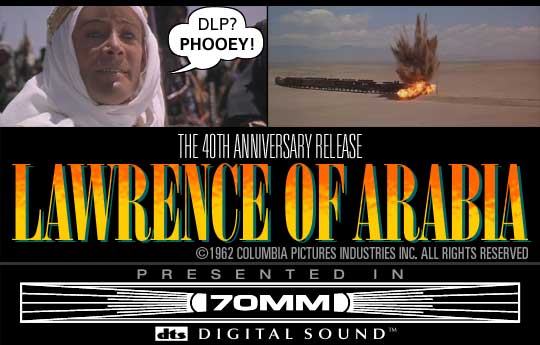
It really seems like there is more pomp and circumstance going into DVD releases. There's actual specific hype about the audio and video quality with Tuesday's "Episode II" DVD release. Some similar stuff is going on with the extended cut of "Lord of the Rings" and its DTS-ES 6.1 track. Maybe Hollywood is getting more bang for their buck in advertising such technical stuff for DVD.
-Claude
I would have set the copyright notice even smaller if I could, but the type would have become illegible.
I think that 70mm logo is pretty much the favorite 70mm logo of most folks (well, at least its my favortite), and unofficially considered the official logo for 70mm. Paramount first used it on "Star Trek II: The Wrath of Khan". I don't know if Paramount is actually the company that developed and trademarked that 70mm logo. I just call it the "Paramount 70mm logo" for shorthand. If someone knows the real trademark holder of that 70mm logo, please tell me.
Other studios developed different logos. Fox had their own logos, but they did use the Paramount style 70mm to promote "Die Hard." Many newspapers around the country had ads featuring whatever 70mm logo art was laying around and stuck it on any show. The NY and LA ads at least had some kind of a system going in relation to specific distributors.
When getting down to really picky points I should have used a different 70mm logo, mainly the one Columbia-TriStar used on its 70mm ads in the late 1980s and early 1990s. Columbia-TriStar's "official" 70mm logo has a lot of similarities to the Paramount 70mm logo. The "70mm" element is set in Antique Olive Nord and Frankensteined into the "Paramount" design. I like the "Paramount 70mm" logo more, so I used that instead. Artistic license I suppose. What do the film distributors care anyway? Most see 70mm as a dead format anyway.
I would add a GIF image showing the Columbia 70mm design. But for some odd reason, the insert image item is no longer available in the response box.
quote:
I would add a GIF image showing the Columbia 70mm design. But for some odd reason, the insert image item is no longer available in the response box.
I think that the 'insert image item' got removed in an attempt to unhack part of the ubb. You can still upload pictures by clicking on the upload button to the left.
quote:
I'm unaware of any U.S. 70mm screenings of Supergirl. I believe a 70 was shown at its London engagement.I believe the following are missing from list:
Indiana Jones And The Last Crusade (1989)
Days Of Thunder (1990)
Dick Tracy (1990)
The Hunt For Red October (1990)
Alien 3 (1992)
Baraka (1992)
My lists come from a variety of sources, including newspaper ads, Variety articles and listings, other journal articles and the lists that Dolby used to publish. Although Dolby's lists were frequently inaccurate, they tended to err by stating that something was in a better format than it was actually released in, not the other way around.
Out of the above list, I only saw Indiana Jones and the Last Crusade and the Hunt for Red October in 70mm and I don't remember them being in split surround, but I could easily be incorrect.
I believe I saw Dick Tracy in CDS 70mm digital, so it's possible it did have split surround, at least in digital format.

Not quite as good looking as the Paramount one.
The projector was a Vic 8. The screen was HUGE and the image was razor sharp. ET ran there, too.
The FOX Theatre in Atlanta also runs 70.
The biggest thrill for me was watching a print of OKLAHOMA! running thru the big V8 at 30 frames per at the Columbia.
As to post Top Gun split surround mixes...I will disagree with you on that one...most were either split surround and used the stereo effect or were at least split surround safe. I was amazed at the little fanfare that was given to it though. Sometimes, one had to listen to the slate on the leaders of the film. For instance, HOFFA had no indication it was split surround...the TAP report didn't even mention it. The slate on the film clearly stated "Hoffa, 6-track split surround reel..." We dialed up 43 and all played well.
Note, a non split surround film will have no HF response in the surrounds if played back on format 43.
As to TEMPLE OF DOOM...that is only from personal recolection. Whereas SS 70mm prints were rare before Top Gun, it was hard to to convince the powers that be that we should equip our 70mm theatres for split surround (Acc rack with kits B and C/64). If Temple of Doom was a split surround film, it would have been used (by me if no one else) to convince my employer that we should upgrade. TOP GUN had advance notice of it's split surround track and that it was the favored format.
So...find me the slate that proclaims that TOD was indeed split surround...until then I'll say it isn't.
Steve
------------------
"Old projectionists never die, they just changeover!"
quote:
I have no idea how well the split surrounds were used though.
Maybe you were being too distracted by that "dreaded" center dialog you complained about on this film's restoration earlier? Haven't you been able to enjoy any movie since most directional dialog died out many years ago?
quote:Martin,
My lists come from a variety of sources, including newspaper ads, Variety articles and listings, other journal articles and the lists that Dolby used to publish. Although Dolby's lists were frequently inaccurate, they tended to err by stating that something was in a better format than it was actually released in, not the other way around.
quote:The prints of Indy III that played at the Chinese in Hollywood and the National in Westwood were definitely in the split surround format. There was one scene in particular in the movie where I could easily detect the separate left-right surround effects. Whereas in most of these (supposed) split surround presentations I often found it difficult to hear any distinct differences in the surround content (though this may be in part due to simply being absorbed into the movie and not being truly conscious of the sound). Also, a source at TAP informed me that only the few SR-encoded 70mm prints of Indy III were split surround. Not sure why it would need to be released like that, but that's what I was told.
Out of the above list, I only saw Indiana Jones and the Last Crusade and the Hunt for Red October in 70mm and I don't remember them being in split surround, but I could easily be incorrect.
quote:I happened to save a copy of the "projectionist's notes" enclosure from the Dick Tracy prints, and it noted that the 70mm-mag prints had a "format 43" soundtrack (a processor setting for 70mm Dolby A-encoded soundtracks with split surround) and that theaters with that capability should play it back as such.
I believe I saw Dick Tracy in CDS 70mm digital, so it's possible it did have split surround, at least in digital format.
quote:Steve,
I have ZERO doubt that the Lawrence was a split surround SR mix for the restoration. I have no idea how well the split surrounds were used though. The requirement was for 6 SR cards. My source was none other than Robert Harris himself and personal knowledge of the set up.
quote:Can you elaborate on what exactly that means?
As to post Top Gun split surround mixes...[CLIP] most were at least split surround safe
quote:I was in agreement with you that it was likely not a split surround release. I stated that the info came from one of the mixers who was (possibly incorrectly) recalling how the film was mixed. Note that I listed it in my previous post as a "possible split surround" release. I listed those few titles as possibles to see if that might prompt anyone here to dig into their notes or memories of dealing with them when they were released.
So...find me the slate that proclaims that [Temple Of Doom] was indeed split surround...until then I'll say it isn't.
Can 70mm split surround be processed by equipment other than Dolby? I've read ALL pages of theatre reviews on the Film-Tech "Pictures" section and I was struck to see that the majority of booths equipped with a CP200 didn't have the Accessory Unit. Isn't it required for processing 70mm split surround sound? Please correct me if I'm wrong.
On formats 43 and 46, what is the highest usable low frequency for the sub-bass channels? I've heard of 200 Hz years ago, by the times of the CP200, and sub-bass sound could also be directed to full-range speakers #2 and #4 in cinemas having 5 full-range speakers behind the screen (with not so good result, of course)...