This is topic Lamphouses in forum Film-Yak at Film-Tech Forum ARCHIVE.
To visit this topic, use this URL:
https://ft-forum.com/ft/cgi-bin/ubb/ultimatebb.cgi?ubb=get_topic;f=8;t=001220
Posted by Sam Hunter (Member # 1119) on 09-04-2002, 10:57 PM:
What is the smallest wattage xenon lamphouse availiable for use on 110 single phase and where might someone find one?
------------------
Samual Hunter Sr.
KC5ZSL
Posted by Brad Miller (Member # 2) on 09-04-2002, 10:59 PM:
1000 watt. You can find some old ORC integrated units that work well.
Posted by Bernard Tonks (Member # 809) on 09-05-2002, 03:42 AM:
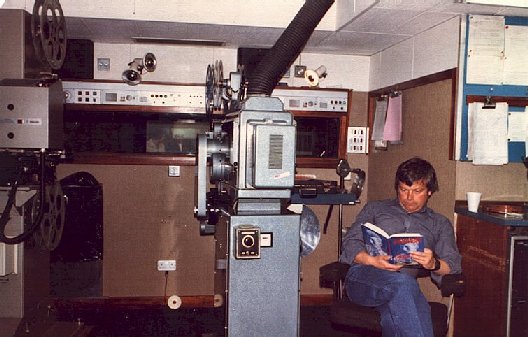
I have seen 500 watt xenon lamphouses made by Philips (Kinoton) for 16 & 35mm, really only suitable for rabbit hutch cinemas, preview and dubbing theatres. The 35mm Kinoton FP20 on the left.
Posted by Brad Miller (Member # 2) on 09-05-2002, 03:51 AM:
I just realized I misread your post. I thought you were asking for the largest lamphouse that can run off of 110V. I too have seen 500 watt units, but never anything less than that.
Posted by Sam Hunter (Member # 1119) on 09-05-2002, 08:39 AM:
I looked at the info in the manuals section on the 750W-1KW ORC's and they look like a decent unit for home exhibition. They look well made.
What kinda reliability issues do the ORC's have and can you still get replacement parts for them?
------------------
Samual Hunter Sr.
KC5ZSL
Posted by Richard Fowler (Member # 893) on 09-05-2002, 09:06 AM:
If the reflector is dull you can get them resurfaced by Ultraflat. The control circuits are fairly easy for repair by a electronics tech.
Ignitor is simple also and can be substituted with some other brand if it is not available from Strong. I have seen other people remove the rectifier and control circuits and mount them in a separate box to increase reliability.
Richard Fowler
TVP-theatre & Video Products Inc. www.tvpmiami.com
Posted by Scott Norwood (Member # 30) on 09-05-2002, 09:11 AM:
Cinemeccanica makes (made?) 500w lamphouses. Check the picture gallery under "GCC screening room." The picture there was watchable, but on the dim side. Not "film done right," but not quite "film done very wrong," either. The lamphouses themelves were decent, but just too small for that size screen.There are 350-watt xenon bulbs made for 16mm projectors, but I doubt that anyone makes an external lamphouse for that size.
Posted by John Pytlak (Member # 331) on 09-05-2002, 10:56 AM:
In one of our Kodak screening rooms, we still have a set of ORC Model 1600-16 lamphouses on three matched EASTMAN Model 30 16mm projectors. These are the ones with the separate power supply, and each have a "snout" condenser lens assembly to focus the light at the aperture with minimal modification of the original (tugnsten lamp) projector cabinet. They also have remotely controlled rotary solonoid dowsers. I installed them in the early 1970's, and they are still kickin'.The ORC Model 1000 lamphouses had the built-in 1000-watt power supply, and operated on 115 volt, 15 ampere service. The X-1000 lamp had an operating range of 15 to 35 amperes. The entire lamphouse is only 9x13x18 inches in size, and weighs 80 pounds.
The best advice with these lamps is to ventilate them well. Their compact size can lead to heat deterioration of the internal components, especially in the Model 1000. When buying a used one, open it up to check for any seriously deteriorated plastic components, circuitry, or insulation. Likewise, the reflector coatings can be heat-damaged if the lamps were poorly vented.
But they are great little lamps for smaller screens, and will last for decades if kept cool and comfortable.
------------------
John P. Pytlak, Senior Technical Specialist
Worldwide Technical Services, Entertainment Imaging
Research Labs, Building 69, Room 7525A
Rochester, New York, 14650-1922 USA
Tel: +1 585 477 5325 Cell: +1 585 781 4036 Fax: +1 585 722 7243
e-mail: john.pytlak@kodak.com
Web site: http://www.kodak.com/go/motion
Posted by Steve Guttag (Member # 268) on 09-05-2002, 12:32 PM:
To answer the question...500 watts is the smallest I know of and I believe Kinoton still makes it (for use with their projectors)As to the largest lamphouse to run on 110VAC...That would go to Strong, probably...The Super Lume-x with a 110VAC compact switcher...can handle up to 2000 watts.
Steve
------------------
"Old projectionists never die, they just changeover!"
Posted by Mike Spencer (Member # 1364) on 09-05-2002, 02:06 PM:
Hello.. Sam I am using Orc 1600 watt Lamphouses with the seperate power supply's someone else mentioned here.. These can be configured three ways 110, 220. and 440 single Phase... I ran 220 off an unused hot tub circuit breaker.. and am using 220.. as it costs less.. but they work fine off 110.. These seem to work ok with 1000 watt lamps.. when turned on a low setting.. as the current is controled by a reostat at the power supply.....I am currently using 1600 watt Cristie lamps...... Hope this Helps... Mike
Posted by Sam Hunter (Member # 1119) on 09-05-2002, 02:12 PM:
Pretty good info for free.
All you guys need to be payed more.
I guess now I just wait and see what I can find.
Thanks!------------------
Samual Hunter Sr.
KC5ZSL
Posted by Paul G. Thompson (Member # 655) on 09-05-2002, 02:23 PM:
The smallest I know of is 500 watts.The ORC-1000 integrated lamp John was referring to has to be adequately ventilated. If not, you can expect a high rate of failure of the control boards in addition to what he has already cited.
Posted by John Pytlak (Member # 331) on 09-05-2002, 02:36 PM:
For a small screen, I would recommend going with at least the 1000 watt lamp. With a two-blade shutter, and normal optical efficiency, you should be able to light up to a 9 x 22 foot matte white screen. For smaller screens, you can always slightly defocus the lamp (getting better uniformity) and/or run at the low end of the recommended current range. Or consider using the extra light to allow a three-blade shutter, virtually eliminating shutter flicker at 24fps, and allowing you to slow the projector for silent films. Even with a three-blade shutter, a 1000 watt lamp should still be able to light a 6 x 14.5 foot matte white screen to 16 footlamberts.------------------
John P. Pytlak, Senior Technical Specialist
Worldwide Technical Services, Entertainment Imaging
Research Labs, Building 69, Room 7525A
Rochester, New York, 14650-1922 USA
Tel: +1 585 477 5325 Cell: +1 585 781 4036 Fax: +1 585 722 7243
e-mail: john.pytlak@kodak.com
Web site: http://www.kodak.com/go/motion
Posted by Gordon McLeod (Member # 33) on 09-07-2002, 11:15 AM:
THe M1000 uses a 700 watt lamp the M1600 uses a 1K lamp
There have been several 16mm machines with 350 watt xenon lamps and also the verticle chrisite and cinemcanica is a 450 watt
Posted by John Pytlak (Member # 331) on 09-07-2002, 11:49 AM:
Thanks, Gordon. I forgot that ORC's X-1000 lamp was really 700 watts, and the X-1600 was only 1000 watts. I recall that ORC felt justified in that the lamphouse efficiency made them "equivalent" to 1000 and 1600 watts, respectively.------------------
John P. Pytlak, Senior Technical Specialist
Worldwide Technical Services, Entertainment Imaging
Research Labs, Building 69, Room 7525A
Rochester, New York, 14650-1922 USA
Tel: +1 585 477 5325 Cell: +1 585 781 4036 Fax: +1 585 722 7243
e-mail: john.pytlak@kodak.com
Web site: http://www.kodak.com/go/motion
Posted by Steve Kraus (Member # 476) on 09-07-2002, 12:18 PM:
Ah, that explains why they called it "1000" because it sure cannot be driven at those current levels without tripping.The ORC 1000 uses a regulator circuit that controls the phase/timing of the AC--just like a common light dimmer--being passed to the transformer, which one presumes is designed to handle the funky waveform. There is a small circuit card with electronics and a second one with either a pair of SCR's or a single TRIAC mounted on small heatsink(s). An adjustment pot at the back of the unit is used to set current. I often contemplated removing the electronics and having the pot work the TRIAC or SCR's directly just like a light dimmer, given that most rectifiers are unregulated and work just fine.
The 1600 (separate supply) is also regulated but the regulation is done on the DC output. There is a large bank of transistors with current dividing resistors mounted on a large heatsink as you can imagine. Unlike when you rapidly switch current between fully on and fully off in a switching type supply, when you regulate DC directly Ohm's law still applies and the voltage drop across them times the current equals Watts of heat to dissipate.
IIRC, these transistors are germanium and obtaining replacements is a problem. You may well find these units where all the transistors have blown but it keeps chugging away "wide open" with no problem at all.
Posted by Sam Hunter (Member # 1119) on 09-08-2002, 05:25 PM:
Very good info. I will be looking for an ORC but in no hurry.
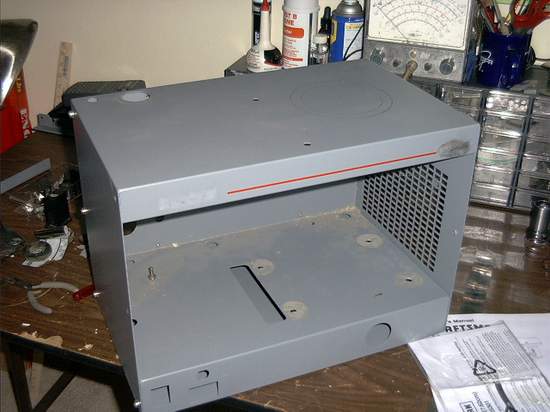
Since I have a short throw and 6 X 6 screen I think I will try and make a lamphouse. I have ordered a PAR64 FFP 1000Watt halogen tight beam spotlight bulb from topbulb and will fit it inside this old dehydrater case that I am going to fashion into a fake xenon looking lamphouse. Color temp looks like the same as an ELC so maybe it will look good.
------------------
Samual Hunter Sr.
KC5ZSL
Posted by Sam Hunter (Member # 1119) on 09-08-2002, 05:38 PM:
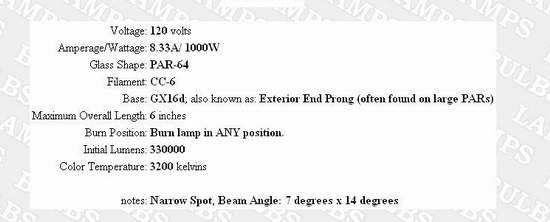
Here is the specs on the bulb I want to use.
Do you think this will make a good light source?
------------------
Samual Hunter Sr.
KC5ZSL
Posted by Gordon McLeod (Member # 33) on 09-08-2002, 05:51 PM:
The problem with using a Par type lamp is the reflector doesn't cause convergence after the apperture. Remember that the Lamphouse is part of the optical system and the lens performance is linked to the light sourceYou will at least have to put a condensor lens in the front to focus it down to the apperture spot and converge beyond it
You would be better with a ellipsoidal reflector from a stage light
Also the Par is a non symetrical beam angle
Posted by Brad Miller (Member # 2) on 09-08-2002, 06:34 PM:
The color temperature of that bulb is wrong too.
Posted by Steve Kraus (Member # 476) on 09-08-2002, 07:06 PM:
I should mention that I have a little baby Christie with a vertical bulb and a separate power supply with a high/medium/low control. I don't remember the wattage but I thought it was 450. It may have been intended for 16mm but it works well on 35mm for a small screen.
Posted by Richard Fowler (Member # 893) on 09-08-2002, 08:21 PM:
We have one of those baby Christie in our shop which was originally part of a Translux / Norelco ( Kinoton ) 16mm projection system.
Richard Fowler
TVP-theatre & Video Products Inc. www.tvpmiami.com
Posted by Sam Hunter (Member # 1119) on 09-08-2002, 09:55 PM:
Looks like this subject is already covered in another topic that Mathew started.
What is a baby christie? Thats a Xenon right?
According to the specs the color temp on an FFP is 3200K as compared to an ELC which has 3400K.
Whats the possibilty of scooping up a mirror from an junked out xenon or something of that source and using it with a bulb?
Just for grins and giggles I found the working distance (1.238")on a ELC bulb from the osram site and measured my eiki and found it to be exact. I passed up a slide projector on ebay the other day that had a xenon bulb system. I think it went for 60 dollars.------------------
Samual Hunter Sr.
KC5ZSL
Posted by John Pytlak (Member # 331) on 09-09-2002, 07:32 AM:
In simple terms, the optical system used with most arc lamps is an eliptical reflector, with one focus at the arc plasma, and the other near the aperture, illuminating the film evenly. If you are trying to light a small screen "on the cheap", your best choice might be one of the tungsten halogen lamps with integral reflectors used in slide projectors, although I don't know if the optimal lamp-to-film distance would be too short to allow the shutter blade.
Possible lamps are:
EXR 82 V/35 h/300 W
FHS 82 V/70 h/300 W
EXY 82 V/200 h/250 W
Of course, any unfiltered tungsten-halogen lamp will have a much lower color temperature (about 3200K) than the 5400K aim specified by standard SMPTE 196M for motion pictures.
I've also heard of some people using a slide projector and relay optics as a light source for a 35mm film projector. That $60 xenon slide projector could have worked well.
------------------
John P. Pytlak, Senior Technical Specialist
Worldwide Technical Services, Entertainment Imaging
Research Labs, Building 69, Room 7525A
Rochester, New York, 14650-1922 USA
Tel: +1 585 477 5325 Cell: +1 585 781 4036 Fax: +1 585 722 7243
e-mail: john.pytlak@kodak.com
Web site: http://www.kodak.com/go/motion
Posted by Sam Hunter (Member # 1119) on 09-09-2002, 12:35 PM:
In my quest for fire  I have cancelled the order for the PAR 64 bulb and instead found a nice clean new Leko stage light.
Surely I can make this thing work. The bulb color temp is too cool so I will have to retrofit it somehow.
Anybody got a nice small xenon for sale?------------------
Samual Hunter Sr.
KC5ZSL
Posted by Sam Hunter (Member # 1119) on 09-30-2002, 03:13 PM:
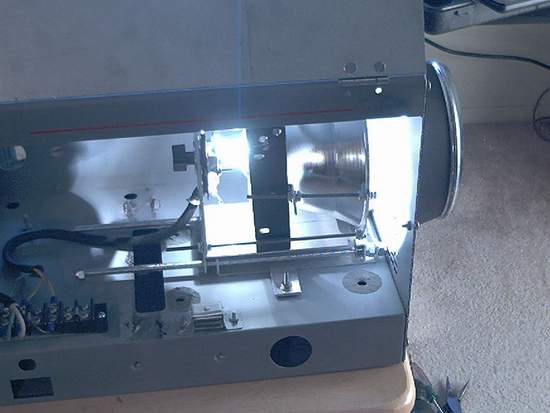
Here is my project so far.
I am using a EKD 120 V 650 Watt bulb as a light source with a 6" Ellipsoidal reflector. I have designed a setup that you can adjust the mirror and bulb. It all looks good but a couple of things worry me.
1: Where the light beam converges gets pretty damn hot, enough to blue a 1/8" metal ruler. Will my projector handle this much heat?
2: I am not sure the 6" lens will focus to the head for which I wish I could find a 10" reflector which would also help item 1.
Here are some pics.
Let me know what you think as I do not want to melt down my Brenkert.
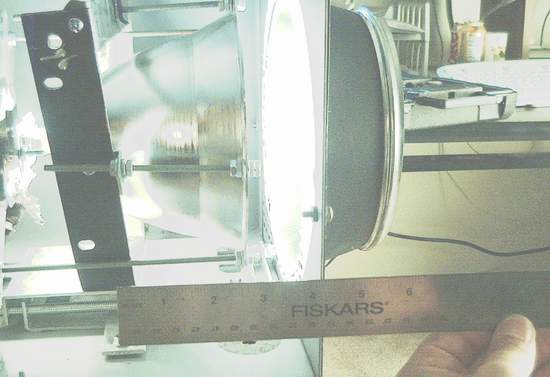
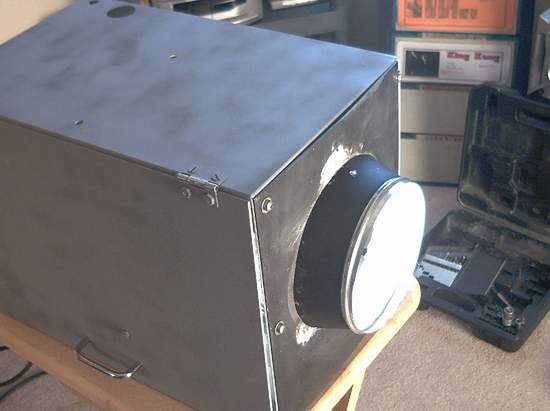
Thanks.
------------------
Samual Hunter Sr.
KC5ZSL
Posted by Sam Hunter (Member # 1119) on 10-19-2002, 12:18 AM:
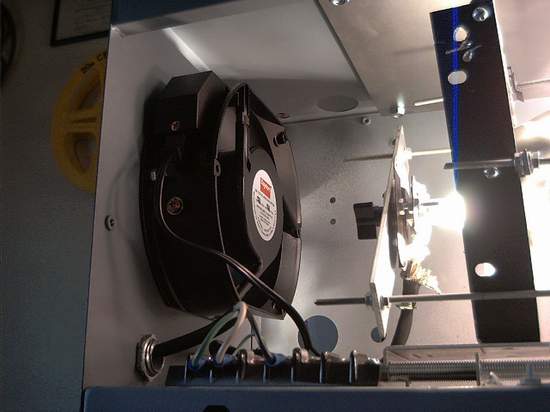
The finished product, Has ellipisodial lens, heat filter, condenser lens and 650 watt quartz halogen lamp as well as heatsink and cooling fan.
Let me know what you think.
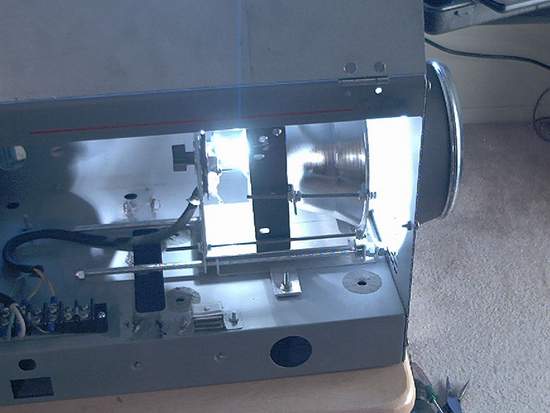
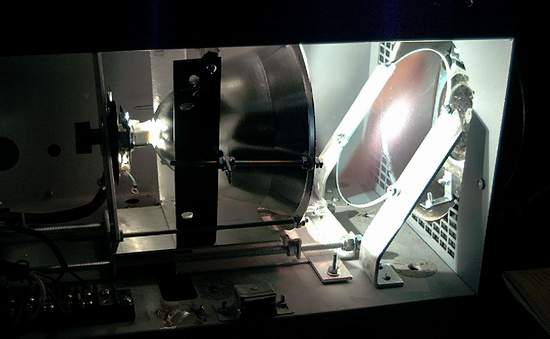
Posted by Brad Miller (Member # 2) on 10-19-2002, 01:38 AM:
Pretty cool there Sam! One question. The exhaust???
Posted by Sean McKinnon (Member # 612) on 10-19-2002, 05:54 AM:
Pretty cool does it work well? How much did it cost to build?
Posted by Pete Naples (Member # 761) on 10-19-2002, 06:44 AM:
I second the question about exhaust, shouldn't be too tricky to add though.That looks like a well though out and built piece of kit Sam, good luck with it! I wish I had the time to do stuff like that, there's a huge sense of achievement to be had in getting something like this off the paper and into reality.
Posted by Sam Hunter (Member # 1119) on 10-19-2002, 09:03 AM:
Thanks guys,
The cost? I am afraid to add it up but the mirror was the most expensive item as I picked it up for about 100 bucks, the fan cost about 45 bucks, the reflector about 20 bucks, paint about 12 bucks, misc HW about 20 bucks, condenser lens came from a Leko that I bought a pair of for 50 bucks and the bulb about 20 bucks. Damn I spent alot 
After all this I found a nice 1500 watt christie for 350 that I am going to pick up and use it when I move into my new home in a couple of years.
The exhaust will go thruogh the front into the projector helping to cool the gate area. If that doesn't work then I can always make an opening in the top. That fan in the picture is a 350 CFM Dayton and is a little on the noisy side but boy it moves some air.
The snood on mine is about twice as big as it should be as I thought the openings on the back of a Brenkert was 6 inches, so I may have to do a redesign in that area.