This is topic OHHH, Canada! in forum Film-Yak at Film-Tech Forum ARCHIVE.
To visit this topic, use this URL:
https://ft-forum.com/ft/cgi-bin/ubb/ultimatebb.cgi?ubb=get_topic;f=8;t=002634
Posted by Tim Reed (Member # 137) on 10-25-2003, 11:02 PM:
Well, I was in Ontario this week, hauling freight. Very nice, I must say. That's the first time I've ever been in the country, and everyone I came into contact with was very pleasant. (Better than at a lot of US shippers, where the dock workers act like you're an interruption to their day!) I was in Kitchener and Pickering (Gord, I thought about you when I was going through Toronto! And Daryl, in Hamilton.)
While in the province, I noticed a few things that I just have to ask our Canadian FT'ers about...
1) What does QEW stand for?
2) What's with the crown on the route signs? Is it the Queen of Canada or something?
3) Who is Tim Horton, and why would I want to eat at his place?
4) What's with the "Eh?" Why does everybody say it?
5) How come the AMC theatres up there aren't called CMC? I noticed the AAA motor club is CAA.
6) Cool! An actual highway roadsign for a nudist colony on Route 6!
7) Wow! Is that a real shipwreck on the east side of the QEW at St. Catherines?
8) Saw a manufacturer around Grimsby that said "MAXX" on the building. The typeface is the exact same style as used with IMAX. Is this a sister company? Anyone?
9) Fix the currency. Having to offer an exchange rate for USD at every store and McDonald's must be a terrible aggravation, to say nothing of the additional workload.
10) Don't think I didn't notice the maple leaf in the McDonald's "M" up there... hey, you all didn't invent McDonald's, WE did!
11) Give up the km/h and all the metric stuff. Everything else up there you all got from here, anyway, so why not use the measurement system, too?
![[Razz]](tongue.gif)
Seriously, I enjoyed my stay there and look forward to returning soon (Although I could do without going through customs in and out.)
Posted by Randy Stankey (Member # 64) on 10-25-2003, 11:41 PM:
QEW = "Queen Elizabeth Way"
Canada used to be a Brittish colony.
Posted by Michael Schaffer (Member # 1204) on 10-26-2003, 12:34 AM:
Tim, you maight have overlooked the fact that the rest of the civilized world uses the metric system. It would be far better for the exportability of US products if they adopted it too. I was told the conversion was started in the 70s, but then reversed in the 80s.
4) is probably just a little cultural difference. In the US, everybody says "uuuh, uuuuh, I am not sure" all the time.
Posted by Rick Long (Member # 213) on 10-26-2003, 01:21 AM:
(1) QEW stands for Queen Elizabeth Way, in honour of Her Majesty.
(2) The crown stands to indicate that this in one of "Her Majesties, Highways" (In practice, it means that this road is maintained by funds from the Federal (rather than Provincial) government.)
(3)Try it, you'll not go back to Krispy Kream".
(4) We DO NOT all say that. eh?
(5) AMC - who knows? CAA - Canadian Auto Club.
(6) Sorry, its clothed for the season.
(7) No, it was towed there in hopes of opening it for a sea-food restraurant, but it never materialized.
(8) Not a clue.
(9) The way the US dollar is dropping you will probably match us soon.
(10) MCDONALD? You SURE he was a yank?
(11) I grew up with Imperial measures. We converted to metric in the late 60's. It is SO much better than Imperial. From selecting wrench sizes to ordering lumber, Metric has got it hands down.
Posted by Ron Lacheur (Member # 1126) on 10-26-2003, 01:30 AM:
When you can't find a cop, just go to a Tim Hortons, there's at least one in there guarding the place. ![[Wink]](wink.gif)
Posted by Bobby Henderson (Member # 840) on 10-26-2003, 01:45 AM:
I've been to Canada a couple times. One of the things I noticed is how it seems more "clean" than the United States. In America it is cool to be a filthy pig, which is the only reason I can figure on why asshole teengers dump out their popcorn on the floor of the movie theater. They probably would't pull that crap in their own home --or maybe they would, after all they're filthy pigs!
For question #6, I thought it was too cold in Canada to have a nudist colony. It was cold enough living in Syracuse, and that was on the south side of Lake Ontario.
About question #8 (the Maxx and IMAX font), the typeface used for the IMAX logo is a variant of the typeface Microgramma. That's a pretty commonly used font. I see it used on a lot of police car graphics. Swiss designers Alessandro Butti and Aldo Novarese created the font for the Nebiolo type foundry in 1952. In the 1960's the two reworked Microgramma into an even more popular variant: Eurostile. That's the font Dolby Labs used as the basis for its original logo.
Posted by Erick Akers (Member # 875) on 10-26-2003, 06:10 AM:
Ahh,Tim Hortons...
Thats not fair, That Does It!!!
Now I need my Doughnut Fixx!!!
The late Dave Tomas of Windys made an excelent choice when he purchased Tim Hortons!!!
I've been known to travel quite a distance for guilty pleasuers such as Tim Hortons and Chrystals, they absolutely kick the crap out of White Castles.
Tim, try a poutine the next time you visit. ![[thumbsup]](graemlins/thumbsup.gif)
Dont you just love Customs?
I usually enter by way of Portal, ND. Overall a really nice Canadian Customs office.
Ours Really Sucks!!! must have been a 1940's Texaco Station. ![[Frown]](frown.gif)
Posted by Stephen Furley (Member # 1277) on 10-26-2003, 06:44 AM:
Michael wrote:
quote:
Tim, you maight have overlooked the fact that the rest of the civilized world uses the metric system. It would be far better for the exportability of US products if they adopted it too. I was told the conversion was started in the 70s, but then reversed in the 80s.
I have to agree with this. The SI is not perfect, but it's a lot better than the alternatives. We went metric about thirty years ago, and I would never want to go back. There are just a few things which are still in imperial units, and some of them are rather odd. Distances on roads are still in miles, and speed limits are in MPH; I think speedometers are now dual calibrated. On the railways it's miles and chains ![[Eek!]](eek.gif) (80 chains to a mile
(80 chains to a mile ![[Confused]](confused.gif) ) on the main network, but the newer light rail systems, and I think the London Underground, use km. Beer from a cask is sold in pints, but bottles and cans are metric. Milk in bottles, either glass ones delivered by the milkman, or plastic ones bought from a shop is in pints, but in cardboard cartons it's in litres, why?
) on the main network, but the newer light rail systems, and I think the London Underground, use km. Beer from a cask is sold in pints, but bottles and cans are metric. Milk in bottles, either glass ones delivered by the milkman, or plastic ones bought from a shop is in pints, but in cardboard cartons it's in litres, why?
I understand that the US came very close to adopting the metric system long ago, around civil war time I think, but the proposal was narrowly defeated at that time.
What's wrong with the SI? Not a lot. A unit of mass really shouldn't be called a kilogram, or kilo anything else for that matter, but the old cgs system was just as bad, using the cm as the basic unit of length. The litre, which seems to be a redundant unit, as originally defined, was not quite equal to 1000 cm3. The SI units were originally defined in terms of physical standards, such as the standard metre bar, with all the problems that involves, such as ony existing in one place at any one time, and liability to change or damage, but these have now been replaced by absolute, constant standards. The main Imperial units were re-defined some time ago in terms of their SI equalivants. If you measure something in yards, and trace back through the standards used to make that measurement, you no longer end up at the Imperial stand yard, as a metal bar somewhere, but at a number which is some exact part of a metre. If you measure something in yards you are really measuring it it metres, or rather some fraction thereof. Why not use the real thing directly?
So what's wrong with the old system? Well, for a start, it's not really a system, just a lot of odd, unrelated units, ok if you want to go and buy a pound of carrots, not so good when you need to start making calculations. Then there's the problem of different units with the same name. US gallons or Imperial ones? Avoirdupois ounces, or apothecaries ones? What about troy ounces, are they the same as apothecaries or not? And no, I couldn't remember how to spell avoirdupois, I had to look it up. Let's stop this nonsense, there's too much opportunity for confusion and error.
I recently bought a book of photographic formulae, some of the measurements were in drams, minims (sp?) I don't even know what they are, and other obscure units. This was a newish book, some of the formulae were old, but some quite recent; do people really still use these units? Thankfully metric quantities were also given.
A couple more examples. Small drills, up to half inch, used to come in three series; 1/16 inch to 1/2 inch x 1/64 inch steps, No. 80 to 1, and A to Z. The number and letter sizes provided intermediate sizes between the 1/64 inch steps. No. 80 was the smallest, Z was the largest and A was slightly larger than a No. 1. E was exactly equal to 1/4 inch, but all the others were odd sizes. You are going to finish a hole with a 7/32 inch hand reamer; what size drill should you use? A drawing calls for a W drill, but you don't have a letter set, what is the nearest fractional or metric size to it? Is it close enough? You break your 27/64 inch drill, but you have a full set of letter sizes, what is the nearest letter size, and is it within tolerance for the job, considering the tolerance on the size of hole which a drill of some stated size will make anyway. The situation improved somewhat when the number and letter series were both replaced by a new series in decimal fractions of an inch, but it's all much simpler in metric.
Then there are paper sizes. Most technical documentation I get now comes as PDF files on CD or from the Internet. Mosst of it is formatted for Letter size paper. I can't get that here, must documents will print on A4, but there are a few that won't, I had to bring a couple of reams of letter size paper back with me last time I came over. Want something bigger than Letter, well there's Legal. How big is it? Goodness knows. How does it relate to Letter? Probably not at all. We used to have similar, but not the same, odd sizes, which were phased out in the early '70s. Now consider the ISO sizes. Its all based on a sheet size of 840x1188mm, known as A0. That may not sound very sensible, but wait a minute. An A0 sheet has an area of one square metre (nice round number) and the sides are in the ratio of 1 to sqrt(2). So what? Cut the sheet in half, and what have you got, two sheets A1 size. Cut one of those in half to get an A2 sheet, etc. etc. A4 is 210mmx297mm, about 8 1/4x11 3/4 inches, quite close to letter size. A5 is often used for handbills, A6 for postcards, A8 for compliment slips etc. The great thing is that all thest sizes are the same shape. Need to enlarge or reduce a document? No problem. Need to produce an A4 size booklet? Print it on A3 paper and fold it in half. Need some A6 paper? Take a pack of A4 and cut it in half each way. Isn't life simple? Need an intermediate size, say half way between A5 and A4? No problem, it's called B5. There's a whole series of 'B' sizes, but they're not used that much. Need an envelope to put an unfolded A4 sheet in? It will need to be slightly larger than A4. Guess what it's called; C4.
Of course, you may sometimes want a different shape. Some books are a squareish shape, 2/3 A4, and cheque books are 1/3 A4. All these are standard sizes, and a printer or paper merchant would have no problem if you specified any of them. Apart From the A, B and C sizes, there are two others; RA and SRA. These are untrimmed sizes, normally found from RA2 and SRA2 upwards. The RA series allows for a few mm of trimming to produce an A size finished job, the RA series has a slightly larger trim for work where the print has to bleed at the edge of the sheet. That's it; a vast range of sizes from one standard sheet and a few simple rules for dividing it. If you need to go larger then 2A is twice the size of A0, etc. When you get used to it it's all incredibly simple to work with.
I think the main reason we resisted converting for so long was simply NIH (not invented here). I'm old enough to remember when we used the old imperial units almost exclusively, and I'd never want to go back.
There is obviously some cost involved in the conversion, but when just about all of the rest of the world does it a different way, and that way is better, there's a pretty good case for converting.
By the way, what gauges of film do you run in America? Those of you still running carbon arcs, what diameter are your carbons? Strange that the lengths are in inches though. I also saw some carbonated drinks in 2 litre bottles while I was over there last time.
Posted by Gordon McLeod (Member # 33) on 10-26-2003, 09:26 AM:
Tim Hortons has become the defacto canadian standard for donought cofee shops
The metric system rules
Posted by Jon Miller (Member # 163) on 10-26-2003, 09:43 AM:
quote:
Those of you still running carbon arcs, what diameter are your carbons?
It's interesting that, at least for National carbons, negative carbon thicknesses are expressed in inches above the 9mm size (the next step up is 5/16"), while positives are all in millimeters up and down the line. Don't see the logic here...
Posted by Charles Everett (Member # 889) on 10-26-2003, 12:41 PM:
Tim Hortons is named for co-founder Tim Horton, a defenceman with the Toronto Maple Leafs when the NHL had only the "Original Six" teams.
Pretty soon Tim Hortons doughnuts won't be totally fresh. The company admitted this week it plans to pre-bake doughnuts in Ontario, freeze 'em and ship 'em to local stores to be finished. Co-founder Ron Joyce spoke out against the move and some customers have gone elsehwere for their doughnuts, according to the Halifax Herald.
CAA stands for Canadian Automobile Association and is their equivalent to AAA.
Fix the currency? Take the exchange rate into consideration and prices are about the same as the US (except for petrol). You can always use Visa/MasterCard/American Express if need be.
The maple leaf in the Mickey D's logo in the Great White North? GM Canada has a maple leaf in its logo, too.
Canada traces its roots to England and France. Besides, many Americans now want to buy prescription medicine in Canada because it costs less up there.
Send this man back to SCTV, eh!
Posted by Gerard S. Cohen (Member # 994) on 10-26-2003, 01:13 PM:
Stephen,
Letter size is 8 1/2 X 11 inches, and legal size 8 1/2 X 14 inches, written as 8.5" X 11" and 8.5" X 14." I still have trouble with daguerrotype sizes:
full plate =
half plate =
quarter plate = ?
sixth plate =
eighth plate =
ninth plate =
Not to mention book printers' sizes,
elephant folio =
folio =
quarto =
16mo =
etc.
Nor to mention type sizes, from "diamond" upwards...
Posted by Ron Lacheur (Member # 1126) on 10-26-2003, 02:19 PM:
Charles if that's the case, I wouldn't be surprised if " Timmy's " business dropped like a rock. Corporate Greed strikes again.
Posted by Stephen Furley (Member # 1277) on 10-26-2003, 02:21 PM:
Gerard, I knew what letter size was, but not legal, I just knew that it was bigger than letter. Letter works out at a ratio of about 1.29:1, while leagal is about 1.65:1. If you fold a sheet of letter it becomes about 1.55:1, quite different to the original sheet.
Years ago, our 'office' paper sizes, for typing, duplicating etc. were quarto, which was 8x10 and foolscap, which was 8x13; both were replaced by A4 from about 1970. However, there were several 'foolscap' sizes, for different types of papers, and, at one time we could buy three different quartos, 'normal' 8x10, 'American quarto' which is what you now call letter, and 'metric quarto', which was 8.25x10. The latter two sizes were not very common. The ISO series sizes really were a great improvement. We don't have the three ring binders which you use, our most common type for A4 papers has only two rings, at 8cm spaninh, and it's horrible, the pages move about too much, and get torn. There was an older standard at 7cm spacing, which was even worse. We can also get four ring binders, with all holes at 8cm spacing, and these are much better. I use them for almost everything now.
I know full plate is 6.5x8.5, but, if I remember correctly, half plate is not half of that, but 4.75x6.5; is that correct? Quarter plate really is a quarter of full plate, 4.25x3.25, isn't it; the size of the medium sized Speed Graphic. I believe you are more consistant than us, in always putting the smaller dimension first, we tend to refer to 5x4, 10x8 and 20x16, but 10x12 and 11x14. Photographic sizes are one of the few things where we still use inches, it's easier to say 5x4 than 10.2x12.7, which is how the boxes are marked now.
There are three plate/film sizes, which will all fit the same camera back, but each needs a different holder, these are half plate, 5x7" and 13x18cm. No wonder manufacturers don't want to make them, and shops don't want to stock them when what is already a very small market is split between three different sizes. A 5x4 camera will also take 9x12cm film, but again, different holders are required. 9x12 is not very common here, put I bought a large quantity of slightly outdated Fuji Astia very cheaply in this size, and managed to find three holders to fit. It's quite a nice format, a slightly wider ratio than 5x4.
I think the old sizes are still used for posters, but I haven't got a clue what size a 'twelve sheet', or whatever poster is.
I remember once having to cut a 5/8" left hand B.S.P (british standard pipe) thread for a connection to a propane cylinder, on a normal metric lathe. It is a pain to do, you have to set up a weird gear train, and once you start you can't disengage from the lead screw, or it won't pick up again correctly for the next pass, even with a screw cutting dial on the machine, you have to pull the tool back, stop and reverse the spindle to get back for the next pass. Give me an all-metric system any day.
I have just had an interesting thought. There has been a lot of talk of Concorde in the past few days. At the time it was designed Britain was still making engineering drawings in imperial units, whereas France was, of course, using metric. I wonder how they managed? Trying to use both systems sounds like a bad idea. I suspect that the whole project was done in metric, partly because I think it would have been easier to persuade the British to work in metric than the French to work in imperial, metric units had already been in use in Britain for many years for certain specialised purposes, partly because the 'new, modern' metric system, which most of the rest of the world had been using for a long time of course, fitted in with the modern image of the plane, and partly because although the French and British were, in theory, equal partners in the project, in reality it was very much French led.
However it was done, it was a fine bit of engineering.
Posted by Chris Markiewicz (Member # 1415) on 10-26-2003, 03:38 PM:
I went to theatre school in Banff in 1980-81; liked it a lot. That's where I first learned projection (changeover).
McDonalds Hawaii has a little outrigger canoe as part of their logo.
Posted by Dino Panagiotopoulos (Member # 1579) on 10-26-2003, 06:40 PM:
Tim,
Generally when it comes to restaurants like Mcdonalds and such they like to slap on the Maple Leaf because I guess that would be the logo of the Canadian division of the company. I get the joke though
As for Timmy Ho's, my family must be the only people in this country that isnt addicted to that coffee.......they must be putting something in there for people to consume so much of it. Maybe Im just crazy?
Posted by Matthew Bailey (Member # 601) on 10-26-2003, 08:23 PM:
Hmmm McDonald-are you referring to BSR McDonald? BSR being the name of a turntable/record changer manufacturer.-you'de somtimetimes see on those 1970's stereo record changers the words "PRECISION CRAFTED IN GREAT BRITAIN BY BSR"
Posted by Rick Long (Member # 213) on 10-26-2003, 11:03 PM:
I remember those, Matthew. I never found one that I could use a magnetic cartridge on without excessive rumble though.
Posted by Michael Schaffer (Member # 1204) on 10-27-2003, 12:55 AM:
Here is what Canada looks like. Canada is on the right, behind all the water.

Posted by Bob Maar (Member # 763) on 10-28-2003, 07:11 AM:
Nothing beats a http://www.whitecastle.com
Only a homemade Canadian Butter Tart comes close.
Posted by Dave Bird (Member # 490) on 10-28-2003, 07:34 AM:
Tim, surprised nobody mentioned that you only get 3 downs to make 10 YARDS here! (The field is 110 yards by 65, 20 yard end zones with the posts on the goal line, and 12 players per side). Our textbooks in public school were still imperial despite the country being metric, so I much prefer imperial. I recall that tests in metric were a challenge when our books were not..... ![[Roll Eyes]](rolleyes.gif)
Posted by Gordon McLeod (Member # 33) on 10-28-2003, 09:28 AM:
Actually Tim you are in Big Big trouble you didn't smuggle back Bob Marrs supply of contraband butter tarts ![[Big Grin]](biggrin.gif)
Posted by Tim Reed (Member # 137) on 10-31-2003, 12:11 PM:
Guys! Hee-hee-hee! ![[Smile]](smile.gif) Great responses, thanks. I'm glad no one (except Michael Shaffer) took me seriously on the "us vs them" lines. (In reality, it took me all of 60 seconds to get used to looking at the km/h side of my speedometer. I actually thought it was pretty cool.)
Great responses, thanks. I'm glad no one (except Michael Shaffer) took me seriously on the "us vs them" lines. (In reality, it took me all of 60 seconds to get used to looking at the km/h side of my speedometer. I actually thought it was pretty cool.)
Okay, that settles it. I will be sure to stop at Tim Horton's next time. My brother (who's also a trucker) told me that I'd purely LOVE the coffee... and I'm not a coffee drinker!
Posted by William Hooper (Member # 71) on 11-03-2003, 02:17 AM:
quote:
Distances on roads are still in miles, and speed limits are in MPH; I think speedometers are now dual calibrated.
Smiths (maker of spedometers & electrical components)has made those dual mph/kph spedometers & they've been in domestic & exported dashboards since the 70s British Leyland days.
Posted by Stephen Furley (Member # 1277) on 11-03-2003, 04:23 AM:
There's a film connection there as well. Kelvin, Baird and Bottomley, I think that's what they were called, were part of, or had some connection with, Smiths Industries, and they made the Peerless Magnarc, under licence, in Glasgow. Most of the Peerless arcs in this country were made there.
My car, when I had one, was in miles only; it was a 1967 model. I wasn't sure when they started fitting dual calibrated ones.
Posted by Chris Markiewicz (Member # 1415) on 11-03-2003, 02:12 PM:
A friend of mine in Alberta in 1981 had a '65 Ford station wagon; the speedometer drive had a little adapter on it that geared the reading up from mph to kph. Quite something to be driving down the highway at the same speed as all the other traffic with the speedo pegged at 120!
Posted by Daryl C. W. O'Shea (Member # 1303) on 09-26-2004, 03:19 AM:
quote:
Quite something to be driving down the highway at the same speed as all the other traffic with the speedo pegged at 120!
How times change. If you're only going 120, and there's not a lot of traffic, people will be passing you left and right.
quote: Tim Reed
8) Saw a manufacturer around Grimsby that said "MAXX" on the building. The typeface is the exact same style as used with IMAX. Is this a sister company? Anyone?
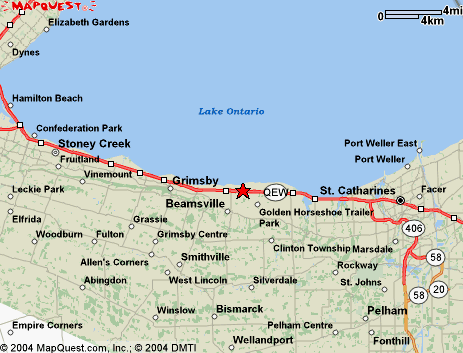
It's actually 'MAAX', and you're right, you could probably throw rocks at the Grimsby sign from the place.
I've driven by this place numerous times this summer, and have taken pictures during the day, but I can't remember when I did that so I've got thousands of pictures to look through.
In any case, I drove by again this morning.

According to Canada 411 they are:
MAAX Spas
905-563-8511
4670 South Service Road RR 1,
Beamsville, ON
L0R 1B1
Posted by Leo Enticknap (Member # 534) on 09-26-2004, 06:33 AM:
quote: Stephen Furley
My car, when I had one, was in miles only; it was a 1967 model. I wasn't sure when they started fitting dual calibrated ones.
My second car was a 1991 Fiat: in a piece of inspired Italian engineering (not!), the speedo was an LCD digital one which you could change between mph and km/h at the touch of a button. The trouble was that it had an annoying habit of changing of its own accord, and on at least two occasions I almost had a heart attack when I looked at the speedo and it seemed to tell me that I was exceeding the speed limit by enough to get me a jail sentence.
Units of measurement seem to have become a hot political issue in recent years: probably because metrication is closely associated with the European Union in most of our minds; and that institution is not very popular here, to put it mildly. The situation even gave rise to a local celebrity dubbed the 'metric martyr' (link to BBC Online obituary of man who received criminal conviction for selling fruit in imperial measures), who in 2002 refused to obey a European Union directive requiring fruit and vegetables to be sold in pounds and ounces, and was taken to court as a result.
Posted by Steve Kraus (Member # 476) on 09-26-2004, 10:54 AM:
Is that last sentence backwards? Surely the EU forbids pounds and ounces and insists on metric.
Posted by Mark Gulbrandsen (Member # 72) on 09-26-2004, 11:21 AM:
Hortons doughnuts are about the best doughnuts there are. Krispy Cream is awful by comparison.... mass produced crap would better describe Keispy Cream product.
The speeds prople drive at along the QEW are unbelievable...almost makes the autobahn look like a kids play ground .
Mark
Posted by Tim Reed (Member # 137) on 09-26-2004, 12:55 PM:
Daryl.. hey, you remembered this thread from almost a year ago? Cool. Thanks, that's the place. I've since seen some of the MAAX trucks driving around down here, with a big picture on the side of a hot chick in a jacuzzi.
Weird how the names and typefaces are nearly identical. Makes me wonder...
I remember seeing a plumber driving a pickup truck in KY years ago, and it was "Century Plumbing"... with an exact duplicate of the Century Projector Company logo on the door!!
Hey, Mark, I purely LOVE Krispy Kremes! I've yet to stop by Tim Horton's, though, haven't been back up that way.
Posted by Leo Enticknap (Member # 534) on 09-26-2004, 01:08 PM:
quote: Steve Kraus
Is that last sentence backwards? Surely the EU forbids pounds and ounces and insists on metric.
Yes, sorry, my mistake.
Posted by Trevor Bailey (Member # 75) on 09-26-2004, 02:04 PM:
Tim,
Horton's is starting to appear in Maine...I tried one of their berry filled muffins...pretty good. Much better than any of the DD muffins. Krispy Kream has started to appear in RI and while their donuts are different, I tried them once and that was enough. I still like the local "one off" donut shops...my favorite is Frosty's in Brunswick, ME. Tony's in Portland is also pretty tasty. I don't drink coffee so I can't comment on that.
Posted by Randy Stankey (Member # 64) on 09-26-2004, 02:36 PM:
We'll be getting a Tim Horton's in Erie pretty soon. It'll be right down the street from the Krispy Kreme that opened a little over 2 years ago. Let the "Donut Wars" begin!
I like Krispy Kremes but only when HOT. If they cool off, they are just another donut. If Horton's are as good as you say, I can't wait to try!
Posted by Ron Lacheur (Member # 1126) on 09-26-2004, 06:15 PM:
Tim Horton's doughnuts have changed probably since the last time you were up here Mark.
They are now 70% baked in a central location, frozen and baked again at the destination. This is to still call them " freshly baked ". Their donuts are crap now.
Posted by Paul Mayer (Member # 355) on 09-26-2004, 06:39 PM:
quote: Trevor
I still like the local "one off" donut shops...
Me too. I always try to support local "Ma & Pa" kind of places when it comes to food. The Corporate Way of things these days has just turned me completely off to any big chains of anything anymore, but especially restaurants.
Is Horton's mostly a truck-stop kind of thing? Or can you find them anywhere in Canada? Even if they've gone down in quality since centralizing their cooking, I'd still like to try that coffee. Damn, it's been seven years since I was last in the Great White North!
Posted by Adam Martin (Member # 641) on 09-26-2004, 08:01 PM:
quote: www.timhortons.com
Tim Hortons has more than 2,350 stores across Canada and a steadily growing base of 228 locations in key markets within the United States
And somehow affiliated with Wendy's.
Posted by Ron Lacheur (Member # 1126) on 09-26-2004, 09:52 PM:
Tim Hortons is everywhere. Almost like McDicks.
Posted by Wayne Keyser (Member # 2420) on 09-26-2004, 10:14 PM:
A Comment and a Question:
You don't bake donuts, you fry them. And fresh, hot Krispy Kremes are my idea of heaven - the dough practically vanishes at first bite, leaving nothing between your tongue and all that glaze/icing/filling (with the right menu choice, all three). I'm fat, and I know my fattening stuff, darn it!
Question: What's "Canadian Club" Whiskey called up there? "American Club"?
Posted by Steve Kraus (Member # 476) on 09-26-2004, 10:23 PM:
Yes.
Just as in France they call deep fried potato strips "Our Fries."
Posted by Daryl C. W. O'Shea (Member # 1303) on 09-26-2004, 11:55 PM:
If they called CC "American Club" nobody would buy it, considering most American alcohol is either weak or just bad. Crown Royal and Canadian Club are the rye's of my choice, and I've yet to go somewhere in North America or Europe that I couldn't get at least one of them if I wanted to.
Tim, I've got a great long term memory, lousy short term memory.
It's not uncommon for a population of 20,000 to have 5 or more Tim Horton's stores. The majority of their business is coffee sales. Although donuts are certainly significant, their volume pales considerably to the amount of take-out coffee they sell every morning (people will line up for over half an hour to buy it). I don't drink coffee though, and I eat very few donuts (probably less than 5 a year). Donuts just aren't my thing, although I don't suspect I'm harming myself due to lack of donut intake. I suspect they put crack in their coffee.
quote: Mark Gulbrandsen
The speeds prople drive at along the QEW are unbelievable...almost makes the autobahn look like a kids play ground.
The QE (yes, occasionally I/we abbreviate a three letter abbreviation to a two letter one) is nothing compared to the 400 North bound, especially the 400 at night, or around 4 to 6pm when people are getting off work. Speeds of 140 to 180 km/h (87 to 112 mph) or higher really aren't that uncommon. At least half of the people are doing 140 km/h at any given time. Although you'll find this on any of the 400 series highways, and the QEW late at night. Except around long weekends, then only the stupid people go exceedingly fast and get nailed by the OPP, sometimes four times in a single weekend.
I've always thought Americans drive slow. Except for the Michiganites who come to Ontario and try to keep up, unfailingly cut everyone off, often rear ending people or causing other accidents. I fear Michigan plates.
Posted by William Hooper (Member # 71) on 09-27-2004, 03:34 AM:
quote: Michael Schaffer
Here is what Canada looks like. Canada is on the right, behind all the water.
Primitive Canada has a huge grease cup sticking out of it. How much is it costing the country to have some cushy-job sucker climb up there every couple of months just to give it a half a turn? It's the 21st century; install a grease feeder !
Posted by Phil Hill (Member # 371) on 09-27-2004, 03:42 AM:
Ya know William, after reading all your posts here on FT over the last many moons, I cannot decide if you're on dope or just have really bizarre sense of humor. I think it's the latter as I too have much of the same thoughts and usually agree with you. ![[beer]](graemlins/beer.gif)
>>> Phil
Powered by Infopop Corporation
UBB.classicTM
6.3.1.2