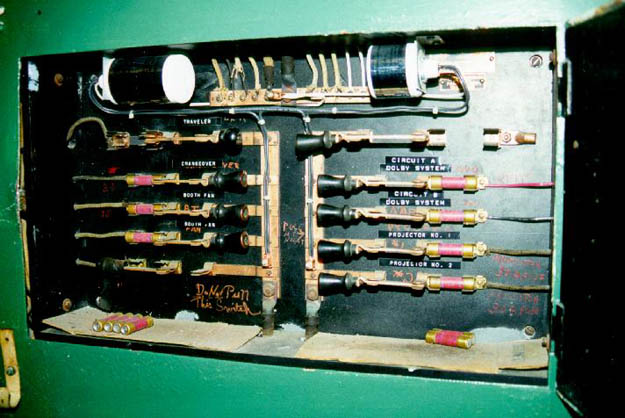
This is topic Share your worst electrical nightmare! in forum Film-Yak at Film-Tech Forum ARCHIVE.


To visit this topic, use this URL:
https://ft-forum.com/ft/cgi-bin/ubb/ultimatebb.cgi?ubb=get_topic;f=8;t=003443

Posted by Tony Bandiera Jr (Member # 2365) on 08-05-2004, 07:22 PM:
 
Want to see how many of you can share some of your worst electrical mishaps/shocks/amazing stories. And also what is the highest voltage you've come into contact with? (Lamp igniters don't count.) Here's my list to start with:

Mishaps:

Exploding panels in old booths;
Rectifier which defined "fire" (total flameout, but it held to the end of the show!);
Projector motor (Christie) doing a slow burn (Held for about 3 days b-4 it let go);
Misc. tools damaged by "dead" circuits (ALWAYS ASSUME IT'S HOT!);
Lindsay-Fairbanks dimmer exploded;
Circuit breakers exploded, etc.

Shocks:

480v, 277v lighting (hurts a LOT);
DC hit from a rectifier (open circuit voltage);
The worst by far: 115v, 400 cycle aircraft power (I was thrown over 50 feet and had burns on my hand and right foot!)

Highest voltage with direct contact:

12,000 volts. Underground distribution voltage before being stepped down to 120/240 for homes. This was when I knew a motocrosser's dad on a PG&E line crew. Put on all the protective gear and touched a live pad switch lug. Even with the gloves, etc. on I could still feel the current! Freaky!

Here's a link to some cool electrical arcs/explosions:

http://205.243.100.155/frames/longarc.htm

Keep in mind after watching the videos in that link that at one time I was actually going to work for So Cal Edison! I changed my mind, not because of the electricity, but I'm afraid of heights! [Eek!]

 -
 
Posted by Bobby Henderson (Member # 840) on 08-05-2004, 10:17 PM:
 
I've accidentally brushed against electrical fences powered by cattle fence chargers. That'll make you feel like you've been hit in the back with a 2x4.

Our sign company was installing the main pylon sign for a Chick-Fil-A on Cache Road. Some of the people at the construction site wanted to lend a hand. This large flexible face sign was being lifted into the air. There were overhead power lines not too far away. Nothing was attached to the sign to ground it. One construction guy approached the sign as it was twisting on the crane cable. He wanted to steady it. He was told, "I wouldn't touch that if I were you." But he did. And he got whalloped pretty good by a static charge. Our install crew got a pretty good laugh out of that one.

Our neon plant has a tube bombarding setup which uses more voltage than what is required for an electric chair. I stay the hell away from that thing.
 
Posted by Tim Reed (Member # 137) on 08-06-2004, 02:01 AM:
 
quote:
Mishaps: Exploding panels... Misc. tools damaged by "dead" circuits

Shocks: 480v, 277v lighting (hurts a LOT);
DC hit from a rectifier... 115v, 400 cycle aircraft power

Highest voltage with direct contact: 12,000 volts.

Doesn't sound like booth work has been your strong suit. The idea is to avoid getting bitten!
[Big Grin] [Razz] [Wink]
 
Posted by Michael Schaffer (Member # 1204) on 08-06-2004, 06:09 AM:
 
How much voltage do you actually need for an electric chair?
 
Posted by Bobby Henderson (Member # 840) on 08-06-2004, 06:18 AM:
 
They normally run at 20,000 to 30,000 volts. We bombard neon with more than that.

Voltage ratings alone can seem misleading regarding the amount of power conducted. For instance, the third rail in the New York City subway system runs at 600 volts. But I don't know the level of amps in that rail. Obviously it is more than a standard 20 amp household circuit would provide.
 
Posted by John Pytlak (Member # 331) on 08-06-2004, 07:27 AM:
 
It's the CURRENT that kills, not the voltage. But higher voltages allow more current to flow through the resistance of the skin:

http://www.osha.gov/SLTC/etools/construction/electrical_incidents/eleccurrent.html

quote:
Three primary factors affect the severity of the shock a person receives when he or she is a part of an electrical circuit:
Amount of current flowing through the body (measured in amperes).
Path of the current through the body.
Length of time the body is in the circuit.
Other factors that may affect the severity of the shock are:
The voltage of the current.
The presence of moisture in the environment.
The phase of the heart cycle when the shock occurs.
The general health of the person prior to the shock.
Effects can range from a barely perceptible tingle to severe burns and immediate cardiac arrest. Although it is not known the exact injuries that result from any given amperage, the following table demonstrates this general relationship for a 60-cycle, hand-to-foot shock of one second's duration:

Current level
(in milliamperes) Probable effect on human body
1 mA Perception level. Slight tingling sensation. Still dangerous under certain conditions.
5 mA Slight shock felt; not painful but disturbing. Average individual can let go. However, strong involuntary reactions to shocks in this range may lead to injuries.
6-30 mA Painful shock, muscular control is lost. This is called the freezing current or "let-go" range.
50-150 mA Extreme pain, respiratory arrest, severe muscular contractions. Individual cannot let go. Death is possible.
1000-4300 mA Ventricular fibrillation (the rhythmic pumping action of the heart ceases.) Muscular contraction and nerve damage occur. Death is most likely.
10,000 mA Cardiac arrest, severe burns and probable death.

http://web.princeton.edu/sites/ehs/hazardcommguide/8.htm

quote:
The severity and effects of an electrical shock depend on a number of factors, such as the pathway through the body, the amount of current, the length of time of the exposure, and whether the skin is wet or dry. Water is a great conductor of electricity, allowing current to flow more easily in wet conditions and through wet skin. The effect of the shock may range from a slight tingle to severe burns to cardiac arrest. The chart below shows the general relationship between the degree of injury and amount of current for a 60-cycle hand-to-foot path of one second's duration of shock. While reading this chart, keep in mind that most electrical circuits can provide, under normal conditions, up to 20,000 milliamperes of current flow


Current Reaction
1 Milliampere Perception level
5 Milliamperes Slight shock felt; not painful but disturbing
6-30 Milliamperes Painful shock; "let-go" range
50-150 Milliamperes Extreme pain, respiratory arrest, severe muscular contraction
1000-4,300 Milliamperes Ventricular fibrillation
10,000+ Milliamperes Cardiac arrest, severe burns and probable death

http://www.findarticles.com/p/articles/mi_m0BPG/is_3_17/ai_84263250

quote:
ABSTRACT: Since clinical signs of underlying injury, especially skin appearance, may fail to indicate the severity of the actual injury from electrical current exposure, you must maintain a high index of suspicion for life-threatening injury. The major cause of death in patients with electrical injuries is cardiac dysrhythmia. In the emergency department, use cardiac monitoring for all patients with electrical injuries and, regardless of external signs of exposure, obtain an ECG. Emergent cardiac catheterization should be performed for a patient who has clinical signs of a myocardial infarction. Laboratory tests for patients with electrical burns should include creatine kinase levels, complete blood cell count, electrolyte levels, renal function tests, and urinalysis. Technetium 99m scans have been found to be very sensitive in identifying injured muscle. The goals of surgical management are to remove devitalized tissue, prevent infectious complications, and preserve as much tissue as possible. (J Crit Illnes s. 2002;17(3):94-100)


Posted by Phil Hill (Member # 371) on 08-06-2004, 07:34 AM:
 
Electric chairs operate at about 2000 volts at around 7 or so amps for several seconds to a half a minute. Then the voltage is lowered to around 240 volts for a similar time period. The cycle is repeated a few times to insure the desired result or until the "subject" catches fire. AC is used of course since it's much more lethal than DC current.

Even the largest of neon signs operate at a current-limited maximum voltage of 15,000 and 60ma and is usually not lethal. The bombarding process to remove the impurities in the glass and electrodes is done at a much higher voltage and current and is deadly. It *IS* scary!

>>> Phil
 
Posted by Randy Stankey (Member # 64) on 08-06-2004, 11:05 AM:
 
quote: Bobby Henderson

For instance, the third rail in the New York City subway system runs at 600 volts. But I don't know the level of amps in that rail.

Bobby,

I don't know how much current goes through the third rail, either. But there is one thing I can tell you for sure...

There's enough to push a train! [Big Grin]

Two of my worst electrical nightmares in the booth come from some idiot trying to replace diodes and getting them all mixed up. In both cases, the person literally put the new diodes in a pile and picked them randomly as they were installed. No attention was paid to whether they were "forward" or "reverse" diodes. In both cases, it led to a total meltdown of the recitfier.

In the CFS rectifier, the capacitors overheated and blew their guts all over the inside of the lamphouse and all of the wires fried themselves. Virtually the only things left intact were the heat sink/frame of the rectifier and the transformer. I had to strip out almost every other part and replace it with new. This includes the terminal blocks and the contactor. It was obvious that this rectifier had been abused this way before. Those CFS rectifiers may have their faults but they can take a lot of abuse before they shit the bed. This one had too much abuse and just died. There were several loose connections and overheated parts that were running on their last legs. When the brainstrust who put in the diodes turned the projector on after "fixing" it, the thing just went into "cascade failure" mode and melted down one piece at a time. I spent about 10 hours on a Saturday fixing that one.

After that, my boss gave me a portable Strong rectifier to keep on hand in case of a similar problem in another theater. The idea was simple: Just gut the old rectifier out of the lamphouse and connect the new one in its place, temporarily, until the replacement can be ordered.

It wasn't long after until some idiot did the same thing in a different theater. This time, on a Christie lamphouse. I don't know HOW the guy did it but he caught the thing on fire. I got the phone call from a frantic booth manager who didn't know what to do. I just told him to shut the machine down and shut off all the breakers to that machine. If the fire isn't too bad, it SHOULD burn itself out in a minute or two. I said, "If the fire doesn't go out in a minute or if it starts to spread outside the projector pull the fire alarm, evacuate the building and let the fire department take it from there.

Fortunately, it didn't get that far. The fire went out almost immediately after the machine was shut down. The whole main terminal board was fried beyond recognition but the rest of the rectifier was in good shape. I installed the portable rectifier and put in the order for replacement parts. (Why do these things always happen on a Saturday night?! [Confused] )

So a short time after that I got another call from the same theater who told me that the replacement rectifier had blown up! No! It wasn't the classic failure that the Strongs do by going up in smoke, etc. Somebody had fiddled with the thing like I specifically told them NOT to do. I told them, "Don't even TOUCH it!" Appearelty some goof ball touched it and shorted something out because the report that I got was that there was a loud popping noise and a big spark of electricity which "threw him against the wall."

I can guarantee that kid was tinkering when he was specifically told not to! I set things up in a specific way so as to avoid such problems but when I got there to fix it... AGAIN... things were in a different place than where I had left them.

What burns my ass is not that people make mistakes and mess things up but they continue to do these things even AFTER they have been specifically told HOW or how NOT to do things!

I still maintain that both of these incidents border on willful neglect and destruction of the equipment!
 
Posted by Michael Schaffer (Member # 1204) on 08-06-2004, 12:26 PM:
 
I wouldn't say they "border". They are already deep in that territory. Apart from the destruction of hardware, people can get hurt seriously. Then they will go and sue the company or try to somehow profit from their "work accident".
 
Posted by Tony Bandiera Jr (Member # 2365) on 08-06-2004, 12:32 PM:
 
quote:
Doesn't sound like booth work has been your strong suit. The idea is to avoid getting bitten!


Tim: Quite the contrary. (Had an English muffin this morning.) That was pretty much the full list of over 30 years working with electricity and 20-some in the booth. Most of the exploding panels, etc. didn't result in a shock. Just me getting super pissed off. The aircraft incident was a combination of bad cable, wet hands and failed contactor in a mobile generator. (One leg of the three-phase didn't open.)

A lot of panel incidents are the result of breaker/fuse failures or loose connections. I learned early on not to stand directly in front of any breaker or disconnect ("Bulldog") switch, especially when possibly closing into a fault. A good point to remember even when just working in a booth. Also, never look at the breaker/switch when operating it. An arc can cause permanent eye damage!

Always be careful around electricity!

Edited for spelling.
 
Posted by Stephen Furley (Member # 1277) on 08-06-2004, 12:50 PM:
 
I don't know about the New York Subway trains, but on the former British Railways Southern Regiion lines, which use 750 Volts D.C., I know that some trains draw about 6000 Amps. The more modern ones, tend to draw more power than the older ones, and there's a major upgrading project underway at the moment, because in some areas the supply cannot cope with the new trains being introduced. There are some lines in Liverpool, and North London, which use the same system, but most of our electrified lines use 25kV 50 Hz single phase A.C. on overhead lines.

We used to have various other systems, 600-660 V D.C. third and fourth rails, still used on the London Underground, 1500V D.C, still used by a light rail system in Newcastle, 1200V D.C. side contact protected third rail, 6.25kV 50Hz. single phase A.C., and a couple of small systems with 6.something kV low frequency A.C. All of these are now extinct on the main line network. There's very little new electrification being done now, but almost everything in recent years has been 25 kV.

What Voltage are the N.J. Transit electrified lines between Newark and Trenton?

I was interested to see that the New York Subway had a few rotary converters still running until about five years ago. All of ours were taken out many decades ago, though some of the old substation buildings are still in use. I don't think we even have any mercury arc rectifiers in use now. We used to have both steel tanks, and glass bulbs, like giant versions of the ones that cinemas used to use. Some of these were about 1.5 metres high, usually with six anodes; very impressive things to see working.

Until recently, the London Underground still had it's own steam turbine powered power station, dual, oil and gas, fired since the early '70s. It must have been one of the last railways in the World to generate its own power. I managed to get a visit to the place a few months before it closed.
 
Posted by Bobby Henderson (Member # 840) on 08-06-2004, 02:41 PM:
 
I only know the 600v tidbit about the New York City subway trains because of the warning signs I saw posted in the trains and on subway platforms from my 5 years of riding.

I'm going to have to double check some of those scary pieces of trivia regarding the electricity in our neon plant, like the amount of volts, wattage, amps used by the bombardment system.

We have a couple color LED message centers in our shop right now, waiting to be installed on a couple bank signs. I wouldn't figure those things using a lot of power. But it turns out each double sided message center requires 38 amps. Jeez.
 
Posted by Tim Reed (Member # 137) on 08-06-2004, 03:10 PM:
 
quote: Tony Bandiera Jr
Tim: Quite the contrary. That was pretty much the full list of over 30 years working with electricity and 20-some in the booth.
Yeah, I know, I's just teasin' ya. [Wink] Sounds like we've got similar backgrounds. [Smile]
 
Posted by Matthew Bailey (Member # 601) on 08-06-2004, 07:15 PM:
 
I had several 120 volt hits during my childhood years& aldo probably during those years a 20 kilovolt hit fom a TV vacuum tube rectifier.
 
Posted by Michael Schaffer (Member # 1204) on 08-06-2004, 09:46 PM:
 
That explains the picture.
 
Posted by Tony Bandiera Jr (Member # 2365) on 08-07-2004, 01:04 AM:
 
Stephen: "Mythbusters" recently did a piece about pissing on the third rail. Do you have any pics of those old mercury arc rectifiers? They would be a sight to see indeed.

Bobby: Jeez indeed. How big are those LED signs? ANd is that 38 amps at 120v or 240v?

Tim: Tease. [Big Grin] Do share some of your electric exploits with the masses.

quote: Matthew Bailey
I had several 120 volt hits during my childhood years& aldo probably during those years a 20 kilovolt hit fom a TV vacuum tube rectifier.
Sticking pins in the sockets, eh? [Big Grin] And TV's are the worst for shocks. That's why I never work on 'em.
 
Posted by Chris Hipp (Member # 1788) on 08-07-2004, 01:11 AM:
 
I got a little shock from a Switching suitcase power supply tonight. The power input (quick disconnect) shorted out and when I touched the casing it shocked me.
 
Posted by Jason Black (Member # 684) on 08-07-2004, 01:24 AM:
 
Micheal,

Like YOU have room to talk about someone's picture????

Pullleeezzzze.

[Roll Eyes] [Big Grin]
 
Posted by Josh Jones (Member # 447) on 08-07-2004, 02:31 AM:
 
15KV @ 120ma

thats my record. Neon sign transformer feeding a home made salt water capacitor.....OUCH

Josh
 
Posted by Tony Bandiera Jr (Member # 2365) on 08-07-2004, 03:05 AM:
 
quote: Josh Jones
15KV @ 120ma

thats my record. Neon sign transformer feeding a home made salt water capacitor.....OUCH

And what evil experiment was young Josh attempting here?
 
Posted by Michael Schaffer (Member # 1204) on 08-07-2004, 03:32 AM:
 
quote: Jason Black
Micheal,

Like YOU have room to talk about someone's picture????

Pullleeezzzze.

Jason, I am targeting you too. I just have to find a suitable picture of Cher for the Separated at Birth? thread.
 
Posted by Brad Miller (Member # 2) on 08-07-2004, 03:47 AM:
 
My worst electrical nightmare was back when I was working at UA. We had a bunch of power fluctuations and some really bad storms that evening and lost power to sections of the building. I was in the electrical room trying to see if we had any breakers that needed resetting when one of the main panels started to smoke. So I pulled off the cover with fire extinguisher ready and the thing burst into flames in my face, followed immediately by another panel being blown off of the box. It was then that I heard Phil Hill screaming like a little girl in the background as John Pytlak walked calmly into the room and handed me a piece of paper with a link written on it. The rest is sketchy. I don't remember dreams all that well, but I guess that's about my worst "nightmare". [Razz]

In all seriousness, I've only gotten zapped by 220V AC before. No big deal.
 
Posted by Phil Hill (Member # 371) on 08-07-2004, 04:06 AM:
 
quote: Brad Miller
I don't remember dreams all that well, but I guess that's about my worst "nightmare".
Thank God for John's and my sake it wasn't a wet dream! [beer]

>>> Phil
 
Posted by Stephen Furley (Member # 1277) on 08-07-2004, 06:31 AM:
 
Ignoring high voltages from things that can't source much current, I've had 415V a.c. (from mains) and 100V (dynamo on showman's engine) and 200V d.c. (supply to old lift motor) once each, and 240V a.c. (from mains), probably about ten times during my life, I used to do worryng things with the mains as a child. None of them very pleasant, but none did any permanent damage.

Can xenon ignitors do real harm? I don't know how much current they can supply. Xenons still worry me, I've never used anything bigger than 2.5k, but I don't like handling them.
 
Posted by Jeff Stricker (Member # 224) on 08-07-2004, 06:44 AM:
 
I received a 440V shock in machinery lab when my lab partner accidently energized the circuit I was hooking up. Seems he had difficulty with English (not his native language) and confused my instruction to leave power knife switch OFF. That knocked me on my kiester and gave the professor a scare, too. Following that, I instructed my lab partner to keep his hands in his pockets and I would operate all the equipment.

I worked with an enginer for many years who had a similar accident in college. His right arm and leg were about 75% paralized.
 
Posted by Dennis Benjamin (Member # 1137) on 08-07-2004, 06:53 AM:
 
I got 1200 volts that knocked me across a room before....

But the worst thing was:

I was working at the Springhill 4 Theatre in Springhill, FL. A customer came out of an auditorium and said that the picture 'went out' during the movie. I ran upstairs to see what was going on. The Xenon wasn't on. When I tried to re-ignite the bulb - the rectifer made a hellacious noise. I stood there for a moment, scared to try again, but I did anyways. The rectifer blew up, shot flames everywhere - and caught my damn pants on fire. What a night! However, when I went downstairs - the customers had heard everything, saw my pants, and took thier rainchecks and went home - without a single complaint.

True Story....
 
Posted by James B. Openshaw (Member # 1310) on 08-07-2004, 08:44 AM:
 
2 of my worst electrical nightmares happened during my pre-projection days as an usher at the AMC Seven Hills 10 when I lived in Aurora, CO (Around age 16). Both of these experiences happened while theatre cleaning.

The cleaning lights for the auditorium were turned on and off by one of those switches with those thin slots where you need a key or something thin to switch off the lights. Since the theatre was too cheap to give all ushers a light switch key, we had to improvise. So I decided to remove my nametag and use the sharp pin to switch the lights down. As a result, I sure did feel a shock and my nametag pin was melted.

The other accident included using the electrical leaf blowers that we used to clean auditoriums after heavy crowds. One of the electrical outlets on the walls was slightly deformed and go figure I decided to use that outlet. The first time I plugged in the blower everything ran fine until about halfway finished the cord was snagged and I ended up pulling the plug of the outlet. When I went back to plug it in, there was a flash of light accompanied by sparks and concluded with black marks on my hand. This also resulted in all other wall outlets shutting off and we ended up using the traditional dustpan and broom to finish up.
 
Posted by Tony Bandiera Jr (Member # 2365) on 08-07-2004, 01:57 PM:
 
quote: Dennis Benjamin
The rectifer blew up, shot flames everywhere - and caught my damn pants on fire. What a night! However, when I went downstairs - the customers had heard everything, saw my pants, and took thier rainchecks and went home - without a single complaint.

True Story....

So that would rule out the "Liar, liar pants on fire" rebuttal by any of the customers....since I've never met any liars whose pants were on fire [Big Grin]

I hope for everyone's sake you were wearing underwear...even if after that it wasn't clean! [Eek!]
 
Posted by Stephen Furley (Member # 1277) on 08-07-2004, 02:29 PM:
 
Sadly, I never took any pictures of rectifiers, either cinema or railway ones. There are plenty of pictures on line however.

http://www.tigercom.dsl.pipex.com/gallery.htm
http://homepage.ntlworld.com/electricstuff/mercarticle.html
http://www.starfury.demon.co.uk/uground/belsize.html
http://www.electricstuff.co.uk/mercarc.html
http://www.subbrit.org.uk/sb-sites/sites/b/belsize_park_deep_shelter/index4.shtml

In some cases you need to scroll down to near the end to find the best pictures. These are small industrial units, similar to those found in some of the larger cinemas. Railway ones could be much larger, but the really big ones were always steel tanks.

This is a not very good picture of the works of a large 12 anode steel tank one, removed from its tank, at 'The Depot', the reserve collection store for the London Transport museum.

 -

This beast is about 2 metres high, and 2.5 metres in diameter, when mounted in its tank.

Similar ones were used on the IND system in New York. The IRT and BMT both used rotary converters. There are some very good pictures of these in a recently-published book, available at the New York transit museum. The book is printed in China, and the quality of the reproduction is supurb, as is much else that's coming out of China these days.
 
Posted by Phil Hill (Member # 371) on 08-07-2004, 02:38 PM:
 
While I like the looks of an operating Mercury vapor rectifier such as an 866, those big glass bulb mercury arc rectifiers scare the pants off of me! I keep my distance from those! Yikes!

>>> Phil
 
Posted by Tony Bandiera Jr (Member # 2365) on 08-08-2004, 12:03 AM:
 
quote:
While I like the looks of an operating Mercury vapor rectifier such as an 866, those big glass bulb mercury arc rectifiers scare the pants off of me! I keep my distance from those! Yikes!

Thank gods for that, since we don't want to see you with your pants off!! [Smile]

Been told by an old-time operator that some of those mercury rects made some pretty evil noises too.

Stephen: Thanks for the links, they are great!!
 
Posted by Josh Jones (Member # 447) on 08-08-2004, 01:37 AM:
 
About the best you will see out of a xenon igniter is around 70-100 KV at a few milliamps. Keep in mind, however, that it is not DC coming out of there, it is actually an RF pulse.

RF burns really hurt and take a loooooooong time to heal.

Josh
 
Posted by Tony Bandiera Jr (Member # 2365) on 08-08-2004, 01:56 AM:
 
Josh: What was the deal with the neon xfmer and salt water cap? Jacob's Ladder?

RF burns are indeed really nasty. Anything with a higher frequency than normal AC mains (50 hz or 60 hz) tends to have greater net energy. More penetrating power (Burns are deeper), etc.
It was explained to me that's why my aircraft shock threw me so far, it was 400 Hz. (Standard AC for most aircraft.)
 
Posted by Phil Hill (Member # 371) on 08-08-2004, 02:28 PM:
 
Actually a Jacob's Ladder uses NO capacitor.... it relies on the hot yellowish flame of a Low Freq AC arc's heat currents to pull the arc up the ladder. A cap would make that arc very noisy and a bright bluish-white that would basically just sit there at the shortest gap.

More than likely that bad boy is for a Tesla Coil or LOUD spark noise generator?

Also, I've never seen a neon sign xmfr with a current rating more than 30 mils. I suspect JJ is putting 2 in parallel? Nasty boy! I'm referring to the transformers, not Josh... But! Hey, we can talk... [evil]

What are you using for your salt water caps? I use Miller Lite beer bottles. I would use Corona bottles, but we ALL know, corona is a bad thing for HV...it robs much-needed energy for a coil. [Roll Eyes]

C'mon Josh! Tell US! You bait us and then hang us out like last night's underwear!

quote: JJ
...will see out of a xenon igniter is around 70-100 KV at a few milliamps.
True, but keep in mind that the cap B4 the gap stores a hell of a lot of energy. In many designs without bleeders and while the voltage is not high enough to jump the gap, the cap will store the HV a LONG time and will give you a nasty bite.

>>> Phil

[ 08-08-2004, 06:45 PM: Message edited by: Phil Hill ]
 
Posted by Bob Healey (Member # 1003) on 08-08-2004, 07:53 PM:
 
My worst electrical disaster:
At college, I was providing lights for a Sunday afternoon jazz concert using the school's equipment. They contracted with an off campus 3rd party to provide the sound reinforcement. I didn't have to arrive for setup until 11am for a 1pm start (the lights were pre hung/focused, everything just needed to be powered on and tested.). At breakfast, around 9am, one of the people who worked with the campus sound crew saw me and told me I needed to get down to the auditorium ASAP as I had no power. He also suggested I grab the 3 phase extensions from storage.

In the auditorium, the lighting dimmers were setup to be powered off a camlock drop and the sound system was designed to use a 30A 3phase twist outlet. The outside audio company decided that they had to use the cams for themselves and that I could deal. The school electrician was onsite as our ground and neutral camlock connecters were not compatible and he had to splice ground and neutral into the box directly.

The dimmer rack was designed to be run off of camlocks or a pair of 30A 3phases lines in parallel, so I asked the electricial to hook a second twist outlet into the box to go with the one normally reserved for sound. He goes and wires it in on the box end, and I connect the extensions to the dimmers. He energizes the two breakers on the wall box. I energize first one input, then the other on the dimmers. There is a loud pop and most of the building blacks out.

It turns out that the electrician crossed the black and the blue phases when he hooked up the second outlet. The input breakers on the dimmer rack tripped, the breakers on the wall panel back stage tripped, the breakers in the panel feeding the auditorium tripped, and the breaker in the mains panel that fed that section of the building tripped. The audio guys were ready to kill me over the shock to their equipment. The electrician also discovered a breaker panel that he didn't know about when things didn't come back on after he reset the breaker in the mains panel. Didn't blow the mains, but came close.

Got everything sorted out by noon with a 1pm performance. I have reduced power, so I used less lights than normal, resulting in the corners of the stage (with no performers) not being illuminated. Expecting something to overload during the show, I had set a pair of follow spots to illuminate as much of the stage as possible, then closed their shutters.

During the show, the conductor moved over to one corners and a soloist moved to another. I went and attempted to bring up extra lights which resulted in the dimmers tripping their input breakers. I left to sprint backstage through the auditorium, and my assistant, in his haste to get the shutters open on the followspots, forgot they were on and accidently turned them off.

The dimmers at full load want about 58A of current/phase, I had 60A/phase, normally 100A/phase. Shortly after that abused the rack died, and I found out the campus electricians had also done such wonderful things to the rack as swapping a hot phase and neutral or a hot phase and ground in other temporary hookups in non-standard venues. The audio company has me pegged as a total incompetent for not keeping the lights on during the show, even though they took my power supply (only drew 5A total on all phases), and pretty much left the electricial to improvise whatever power he could for me.

Oh, and the act was the US Army Jazz band.
 
Posted by Tony Bandiera Jr (Member # 2365) on 08-08-2004, 11:44 PM:
 
Bob: I can relate to your situation. I worked for an A/V company up North and camlocks and dimmers caused us the most drama. The closest call came at the end of a show when one of the crew guys decided to "help" by disconnecting the feeder to our main distro box (200amp 3-phase). He had already disconnected the ground and had twisted the neutral cam when I saw what he was doing and screamed at him. I spent the next ten minutes ripping this idiot a new asshole and told him and everyone else on the crew to keep thier f..king paws off of the feeder.

Why was I so upset? Because our entire house P.A. and stage monitor rig as well as the dimmer pack (64 channels) WAS STILL POWERED UP!! [Eek!]

Tip for those dealing with camlock power hookups:

CONNECT = GROUND, NEUTRAL, BLACK, RED, BLUE (Or Whatever colors hot legs are)

DISCONNECT = BLUE, RED, BLACK, NEUTRAL, GROUND

You don't want to be holding a live camlock breaking a loaded neutral!! It's not pretty! And yes, as any power lineman will tell you, you CAN get bit by a neutral line!
 
Posted by William Hooper (Member # 71) on 08-09-2004, 03:01 AM:
 
This thread would be interesting if it was "What did you say when you got the crap knocked out of you fooling with electricity?"

quote:
Actually a Jacob's Ladder uses NO capacitor....
[...]
More than likely that bad boy is for a Tesla Coil or LOUD spark noise generator?

My guess is a Tesla coil.

You can make an excellent spark noise generator with 110 AC, a 110v light dimmer, a doorknob cap, & a spark gap. String up an antenna, & it's a nice little thing to have if folks in the apartment next door play their stereo or TV loudly.
 
Posted by Josh Jones (Member # 447) on 08-10-2004, 06:42 PM:
 
The cap was the begining of a tesla coil that was never really finished. I just wanted to make a bad ass loud spark gap, and it worked. The sign tranny was salvaged from a jewelry store in the mall during remodeling. It may have been 60ma, I dont really recall.

as for the gap, it would run for a few seconds, then stop. used a glass gallon jug full of brine and wrapped with tin foil on the outside. Its a wonder I didnt burn the place down.

I always wanted to build a coil, just didnt have the time to build one. I do own several books on the subject, though.

The current project operates at only 3800V but can supply about 1A, and as a bonus, 1KW of FM power as well [Wink]
Josh
 
Posted by Bob Healey (Member # 1003) on 08-10-2004, 09:12 PM:
 
The style of camlocks we use have safety interlocks so the only way to connect them is green white black red blue and the only way to disconnect is reverse order. There are hard plastic boots over the standard cam cables and interlocks on the sockets to prevent out of order hook up/disconnects. Doesn't stop someone from trying it live though. Same dimmers as above failed a month later on me. According to a sound guy with an ammmeter, i had 40A-30A-20A flowing in the hot phases, 70A flowing through neutral, and a scary 20A of current on ground.

I'm normally the one how does hookups/disconnects, but that show was out of my hands. Incompetent administration. Hires outside company, and gives them wrong info about power, leaving me with me. Sorry, still ticked about this.
 
Posted by Tony Bandiera Jr (Member # 2365) on 08-10-2004, 09:20 PM:
 
quote: Josh Jones
used a glass gallon jug full of brine and wrapped with tin foil on the outside. Its a wonder I didnt burn the place down.

Whoa!! I wonder what the capacitance of that setup would measure!!
 
Posted by Randy Stankey (Member # 64) on 08-10-2004, 09:51 PM:
 
quote: Bob Healey

I'm normally the one how does hookups/disconnects.

I, too, am the only one who does the tie-ins, except for the campus electrician. The electrician(s), the production manager and me are the only people who even know where the key to the padlock on the disconnect is.

The electrician isn't going to come to the theater on a Saturday just to do a silly tie-in. The production manager isn't going to get his hands dirty doing manual labor. Nobody else has the balls to even go into the electrical vault by themselves. That just leaves little ol' me. [Wink]
 
Posted by Bob Healey (Member # 1003) on 08-11-2004, 07:09 PM:
 
quote: Randy Stankey
I, too, am the only one who does the tie-ins, except for the campus electrician. The electrician(s), the production manager and me are the only people who even know where the key to the padlock on the disconnect is.
The biggest problem with that is my campus's electrician's done what it looks like you're about to do in your picture. And he energized the circuit afterwards.
 
Posted by John Hawkinson (Member # 1135) on 08-11-2004, 07:54 PM:
 
Bob Healey writes, "The dimmer rack was designed to be run off of camlocks or a pair of 30A 3phases lines in parallel...It turns out that the electrician crossed the black and the blue phases when he hooked up the second outlet."

Is there a requirement that L14 connectors have the phasing in any particular order? I was under the impression that it was not safe for devices to assume any particular order at all.

--jhawk
 
Posted by David Buckley (Member # 2600) on 08-11-2004, 08:21 PM:
 
Camlocs in the hands of the inexperienced can lead to real disasters.

quote: Tony Bandiera Jr
You don't want to be holding a live camlock breaking a loaded neutral!! It's not pretty! And yes, as any power lineman will tell you, you CAN get bit by a neutral line
Its worse than that. Once the neutral is disconnected on a three phase rig, without the solid reference the neutral floats to some voltage between zero and the phase-to-phase voltage. The corollary of this is things connected between phase and neutral (ie all single phase stuff) will have undervoltage and overvoltage conditions imposed on them, as the neutral voltage wanders aimlessley. Things will blow up.

Happened in a computer centre I worked in once. Through poor installation and non-existent maintenance, the neutral burned out in a switchfuse. The repair bill was over 100K UKP for new power supplies for dozens of computers, from PCs to Sun E10K. Very nasty.

quote: Bob Healey
...40A-30A-20A flowing in the hot phases, 70A flowing through neutral, and a scary 20A of current on ground...
Ground current seems a bit high [Smile] Many sparkies dont realise that non-linear loads (stage light dimmers, computers) can cause the neutral current to rise above the phase current, due to addition of harmonic currents. Time was when NEC permitted weedy neutrals on USA wall sockets, as there was this theory that the neutral current could never rise above the phase currents, but once office blocks full of PCs started burning down, that got changed.

When I was a kid I used to proud that I was always getting shocked from one thing and another. My (late) mum told me I got my first shock at age 3 from unsrewing a wall socket. Nowadays I'm happier to say I've only had one belt in 25 years, and that was 'cos I was stupidly tring to switch off a light with a security switch, like someone else did hereabouts... Only on 250V not 110V [Embarrassed]
 
Posted by Randy Stankey (Member # 64) on 08-11-2004, 09:24 PM:
 
Electricians around these parts are pretty good, actually. Both of the main guys are licensed Master Electricians in the city. I would trust them to do most anything as long as I have had a chance to meet with them in person first. That way we are both on the same channel with regard to what work needs to be done and any special conditions that need to be met. There are a couple of assistants who I don't know well enough to trust, but they never get dispached to my building because the two other guys are supposed to be in charge of anything that has to do with the main feeds to the building(s).

As to making and breaking Camlocks: I ALWAYS make bottom up (G-N-øA-øB-øC) and break top down (øC-øB-øA-N-G). Heck, it's such a habit with me I even do it that way when I'm soldering up XLR cables. Aside from any safety concerns, it's just the way I organize my work to keep things neat and tidy.

And... In case there is any question... My member picture is totally dummied up. None of those Camlocks were even connected to anything, much less energized.
 
Posted by Tony Bandiera Jr (Member # 2365) on 08-13-2004, 04:24 PM:
 
quote: Randy Stankey
Nobody else has the balls to even go into the electrical vault by themselves. That just leaves little ol' me.

Yeah, it's amazing how many people are deathly afraid of electricity. As long as you watch what you're doing and what you touch you can work live equipment safely.

I would imagine for safety's sake you at least let someone else know when you're going into the vault, just in case...in the military we had to have at least two people present even when changing fuses/replacing breakers.

Camlocks when used properly are the safest and best way to make temporary power hookups.

I have seen some temporaries done with battery jumper cables [Eek!] and oversized alligator clips! And one case where they loosened the main lugs on a 400 amp panel UNDER LOAD to jam their temps in with the feeder!
 
Posted by Bob Healey (Member # 1003) on 08-13-2004, 08:54 PM:
 
quote: John Hawkinson
Bob Healey writes, "The dimmer rack was designed to be run off of camlocks or a pair of 30A 3phases lines in parallel...It turns out that the electrician crossed the black and the blue phases when he hooked up the second outlet."

Is there a requirement that L14 connectors have the phasing in any particular order? I was under the impression that it was not safe for devices to assume any particular order at all.

--jhawk

The phasing does matter when you're using two lines with those style connectors wired in parallel. And, the connector in question's an L-21 (5 wire).

edited to include quote left out first time around
 
Posted by Richard Fowler (Member # 893) on 08-13-2004, 09:04 PM:
 
My first memory as a small tyke was sticking bobby pins in a wall socket as a two year old [Smile] In the summer of 1968 / 69 I worked as a stage electrician and followspot operator for a musical revue. We traveled through the USA and Western Canada. A creaky 50KW CAT generator was used for locations without power and weatherproof tie boxes where city power was available. Frequency would occaisionally drift and adjusting rpms to the Hammond B-2 organ in the band was a quick fix in a pinch. Black "tweaks", requiring rubber gloves, especially on a damp day, where more common than Cam Locks. My travel trailer had an electrical tap kit of "Mueller" insulated clips so I could tap off a service line if plug in power was not available...some of the [bs] I did in my late teens and early 20's it is amazing I am still here [uhoh]

Cinema servicing....using car D.C. jumpers to run an Ashcraft Corelight at a drive-in...getting zapped through a wrist bracelet from a Christie ignitor ( no more jewelery ). Enduring power issues in Latin America such as exposed ballast resistors, ground buss bar in one point of a building to home run connections....concrete rebar in a building roof for ground in Mexico....fused neutrals instead of hot....a "floating" ground in Argentina from a 1930's corroded connection dangling in the air from the still connected building lead [uhoh]
 
Posted by Randy Stankey (Member # 64) on 08-14-2004, 08:53 AM:
 
There's nothing in our electrical hookup that's the least bit tricky. Once you pull the disconnect and open the cover there's nothing that can bite you unless you reach behind the safety cover that goes over the live feeders. You know. The one that says, "DO NOT REMOVE THIS COVER - ELECTROCUTION HAZARD" in big black letters. [Big Grin]

Actually, I prefer to be the only one who does the tie-ins. There's less chance of having to decode somebody else's screwy work when I have to do a job.

I always take somebody with me when I go into the vault. Even if they can only yell for help or something. It's funny to see the looks on their faces when I tell them, "If I get electrocuted, don't try to touch me or else YOU will get electrocuted too!" Then I show them where the main disconnect for the building is. "If there's trouble, pull that big black handle over there and you'll shut the whole building down."

By this time, they are usually heading for the exit and I'm sitting in the corner, doubled over with laugnter. [Big Grin]

My standard line is to tell people that they don't have to work on electricity if they are afraid to. I'd rather let the person go than have them make a mistake because they are too afraid to think straight.
 
Posted by John Hawkinson (Member # 1135) on 08-14-2004, 05:58 PM:
 
Bob: I understand the phasing matters!

What I was suggesting was that any device that assumes the phasing might be the same on two receptacles is asking for it. [uhoh]
I assumed you meant L14, but the same should go for L21...

(I don't see anything in the NEC either way on this question.)

--jhawk
 
Posted by Bob Healey (Member # 1003) on 08-15-2004, 11:05 PM:
 
quote: John Hawkinson
Bob: I understand the phasing matters!

What I was suggesting was that any device that assumes the phasing might be the same on two receptacles is asking for it.

I assumed you meant L14, but the same should go for L21...

(I don't see anything in the NEC either way on this question.)

Sorry, I should have been more clear earlier. The L21 connectors were never intended to be used for general hookups, but to piggy back this rack off a much larger rack with a bigger supply if an additional 12 channels were needed in a venue. Since both racks were built at the same time, it the phasing issue was taken care of when the receptacles were installed in the larger rack. Its been a few months since school let out for the summer, and I forgot that little detail, since the larger rack has since been retired. That was a one-off hookup and I didn't have the tools to check phasings and the electrician didn't even though i told him several times both feeds were in parallel.
 -  -
On left is the rack in question and on right is the rack it was designed to connect to. The plugs on the bottom are covers in case someone connects the L21s to the power feed while running off of the cams.
 
Posted by Tony Bandiera Jr (Member # 2365) on 08-16-2004, 03:02 PM:
 
Bob: Nice racks!! [Big Grin] [thumbsup]

jhawk: You're absolutely correct, the NEC doesn't specify any phasing standard for "polyphase" devices. The only reference is to certain 3-phase systems with a "stinger" or "wild" leg. (A leg of the service where phase-to-neutral voltage is not a constant 120v, but varies from aprox. 175-285 volts.) It is supposed to be the "B" phase in those panels and presumably devices.

A very simple tester can be built to help avoid the problems Bob has experienced.:

You'll need two pigtails with the proper connector plugs wired correctly, (3) 240 volt pilot lamps (neon or Incand.)and a suitable box to mount them in. (I think neons would be better and more durable)

Simply wire one terminal of each lamp to the SAME phase of each pigtail, (lamp one wires to A on tail 1 and A on tail two, etc.) and you're done!

How does it work? Easy. If both pigtails are connected to correctly phased plugs, the lamps WILL NOT light! (Because the lamp has both wires connected to the same phase, no current flows.) If either receptacle is miswired, TWO of the lamps will light on the affected phases. (Example: Lamps A and C lit, means that one of the recptacles has A and C phases crossed.)

This will not of course tell you which one is backwards, but you can at least make corrections as needed.

My shop up North had one of these, built into a rack panel so we could check phasing on camlocks as well.

I can email a schematic to anyone who wants one.
 
Posted by John Hawkinson (Member # 1135) on 08-16-2004, 03:33 PM:
 
OK, everyone else can skip this one. [sleep]

Tony: "The only reference is to certain 3-phase systems with a "stinger" or "wild" leg. (A leg of the service where phase-to-neutral voltage is not a constant 120v, but varies from aprox. 175-285 volts.) It is supposed to be the "B" phase in those panels and presumably devices."

Well, that's not the only reference.

Article 408 (Switches and Panelboards), I. General, 408.3 Support and Arrangement of Busbars and Conductors, (E) states:
quote: National Electric Code, 2003 draft, 408.3(E)

(E) Phase Arrangement. The phase arrangement on 3-phase buses shall be A, B, C from front to back, top to bottom, or left to right, as viewed from the front of the switchboard or panelboard. The B phase shall be that phase having the higher voltage to ground on 3-phase, 4-wire, delta-connected systems. Other busbar arrangements shall be permitted for additions to existing installations and shall be marked.

Exception: Equipment within the same single section or multisection switchboard or panelboard as the meter on 3-phase, 4-wire, delta-connected systems shall be permitted to have the same phase configuration as the metering equipment.

FPN: See 110.15 for requirements on marking the busbar or phase conductor having the higher voltage to ground where supplied from a 4-wire, delta-connected system.

I believe that clearly indicates that for a 120/208-Wye system (which is surely what Bob has), all panels need to have the same arrangement of A, B, and C phases. Those need not be a priori referenced to something, i.e. no equipment could predict the phase rotation between them, but all panels in the installation should agree on which phase is A.

The constraint for the "wild leg," of course, simply means that it must be the B phase.

The problem is that there is no requirement that receptacles be wired with the A, B, and C phases in any particular order.

--jhawk
 
Posted by Tony Bandiera Jr (Member # 2365) on 08-16-2004, 07:11 PM:
 
jhawk: Thanks for the correction. [thumbsup] I should have not said "only reference" in that context. My bad! I was focused on the recepticle issue.... [Smile]

The NEC is an interesting and somewhat confusing document, it has to try to cover all possible contingencies...and it can be misread or misinterpreted. Also, mutiple sections of the Code can address multiple issues!

I'm wondering if any local codes have set a standard for phase sequence of devices?
 
Posted by Tony Bandiera Jr (Member # 2365) on 10-15-2004, 03:14 AM:
 
Bumping this up...

Recently did some repairs at a local theatre with various strange problems with the lamp (odd flicker at random), light dimmer and automation....called in electrician to find one of the main feed wires to the booth subpanel badly burned at the lug, which was loose.

While repairing this problem, suggested the sparky take a look at the theatere's main switchgear, where he found 14! of the 18 breaker lugs loose!! [Eek!] We were amazed as it had been that way for at least 10 years!! Somebody was watching over that place for sure!
 
Posted by Rick Raskin (Member # 1561) on 10-15-2004, 04:03 PM:
 
Had this experience at a TELCO central office some years ago. We were testing the backup generator which required we switch the loads from commercial power. The procedure was to go down the main switchboard and operate breakers in the trip (commercial)-close (generator)sequence. A tech went down the board going trip-close, trip-close, trip-close, close-trip. At that point a huge flame shot out from under the switchboard causing a small fire that was quickly extinguished. Subsequent upgrades automated the switchgear to eliminate any operator error.
 
Posted by Barry Floyd (Member # 385) on 10-16-2004, 01:54 AM:
 
After reading some of yalls posts... I feel a little bit better about the electrical guys that were here at our drive-in for a concert a couple of weeks ago.

We had a huge classic car show and live concert at the theatre on the 3rd of October. The trucks for the stage crew arrived at 10:00 a.m. that morning to start setting up for a 3:30 p.m. show. They kept building and building and building this monstrosety of a stage. By the time they were done, there was a wall of speakers, lighting gear, etc. that was taller than the concessions building. I looked at one of the guys and asked, "Where do you think your gonna plug all of that into?"

They ran these HUGE thick cables behind the stage, behind the building and in thru the projection port hole. Once inside, the removed the cover off of our main 3 Phase 600 amp power panel, and removed the breakers to the restroom heaters. I thought they were total nuts as they wired directly into the main panel while it was HOT.

I thought they were crazy, but it sounds like you guys do this kind of stuff all the time. [Eek!]
 
Posted by Thomas King (Member # 2745) on 11-05-2004, 01:32 AM:
 
Our booth is carpeted. Yes, isn't that silly? This carpet and my big manly walking boots interact in such a way that just by walking around for a bit, I can accumulate a considerable potential, which gets earthed whenever I touch something big and metal like, say, the projector, or the platter, or the rack. Bzzt. "Ow!" *swears*.

I know it's pathetic and minimal, but I'm quite happy with it. It's enough for me.

Shocking.
 
Posted by John Pytlak (Member # 331) on 11-05-2004, 09:24 AM:
 
quote: Thomas King
Our booth is carpeted. Yes, isn't that silly? This carpet and my big manly walking boots interact in such a way that just by walking around for a bit, I can accumulate a considerable potential, which gets earthed whenever I touch something big and metal like, say, the projector, or the platter, or the rack. Bzzt. "Ow!" *swears*.

Static charge generated by walking across carpeting can be controlled by maintaining a higher relative humidity in the projection box (ideally 50 to 60 percent RH). You can also treat the carpeting with a conductive topical antistat like Static Guard, Neutrostat, Staticide, etc.:

http://www.aclstaticide.com/01/index.html

quote:

--------------------------------------------------------------------------------

History
Definitions
Examples of static electricity & ESD
Facts about static electricity
Electrical characteristics of materials
Five basic rules for ESD control
Conclusion

Most of these antistats use quaternary ammonium compounds which conduct electicity in the presence of moisture from normal humidity. Using conductive footware also helps.

In addition to the annoying shocks you get when touching grounded objects, charge buildup can also "zap" sensitive electronic components. There is a wide variety of static control companies, including Simco, Meech, etc. who provide static control technology to the plastics and electronics industries.

http://www.meech.com

http://www.simco-static.com/data/index.shtml

http://www.kinetronics.com
 
Posted by Phil Hill (Member # 371) on 11-05-2004, 07:25 PM:
 
One of the things that helps take the "sting" outta that static spark to your finger, or other body parts, is to use a metallic lock-key or a coin to complete the spark.

While you'll still get the jolt, you wont get the burn from the arc end directly to your skin or pinkie. [beer]

It's soooo much better and hurts less and very soothing! Sorta like "Tastes good, but less filling". [Wink]

>>> Phil
 
Posted by Steve Kraus (Member # 476) on 11-05-2004, 09:34 PM:
 
Or...if you only partly translate Au Bon Pain you get "the good pain."
 
Posted by Bob Healey (Member # 1003) on 11-07-2004, 12:37 AM:
 
This one's not my worst disaster in terms of wattage or equipment damanged, but working live theater tonight, the power supply for the lighting console died during act ii. Thank goodness for followspots and a backup console, but it was a variety show willing to move a later video into the run queue to accomodate me. I think the building's cursed - if I'm not drawing ground currents, power supplies fail, lamps blow, or things just generally don't work. Get them out of the building to another venue and everything works perfectly.
 
Posted by Mark Gulbrandsen (Member # 72) on 11-07-2004, 09:36 AM:
 
Ahhhh, You must be using a Strand(ed) console!! I used to repair LOTS of those... throw a few Colortrans in there too.

Mark @ CLACO
 
Posted by Paul Mayer (Member # 355) on 11-07-2004, 12:05 PM:
 
Agh! Colortran! Getawaygetaway! Bad juju! [Big Grin]

I was sentenced to a year of dealing with both a Colortran 3000 and a Scene Master 60 in the Las Vegas Hilton Main Showroom. Plus another two years with a Colortran 1000 on La Cage at the Riviera, and just for good measure another summer with a Colortran 2000+ with Scene Master 60 for backup (?) in the jousting arena at the Excalibur. That and a dimmer rack fire at the Excalibur (the wonderful Colortran ENR plastic-cased dimmers stuffed into a rack wired with Aluminum).

Oh, and the wonderful spontaneous free-form light shows the Excalibur system would spontaneously create--chase effects using every circuit in the place, self-loaded onto the playback faders. Sometimes this happened in the middle of a show (which required a long run through the kitchens to get to the dimmer racks and reset the data comm cards), but usually it was at 2 or 3am, well after we had left for the night. Ah, the phone calls we used to get from the graveyard shift building engineers, "You ought to see what your system is doing down here..."

Colortran made me long for the days of Kliegl and Century Izenour preset boards. Or Leprecons or Light Palettes. Or Q-Files. Or Performances or Performers. Even Great American. Anything else! Of course there wasn't much competition for Colortran in 'Vegas in the late '80s early '90s (Peterson & Vine sold a ton of them here), but still... [Roll Eyes]

Long live ETC! [beer]

[Edit: Me and my spelling...]

[ 11-07-2004, 07:29 PM: Message edited by: Paul Mayer ]
 
Posted by Tim Reed (Member # 137) on 11-07-2004, 01:36 PM:
 
I don't think I've ever had an "electrical nightmare", since I've been pretty well in control of everything I've ever worked on. However, my youngest brother saw one several year' ago...

Distraught young woman in a downtown area, literally trying to run away from her problems -- with the police there trying to calm her and/or take her in for some reason. Suddenly, she breaks away and runs towards a power sub-station, climbs the chain link fence, and hops up on a transformer. She's screaming/crying about something or other and threatens to kill herself. But, before she can continue the threats, she gets taken up on her offer when she gets too close to some huge high-tension insulators and .... ZZZZZzzzzzaaaaaaappppp!!! Auuuuuuughggghhhh!!!! She FRIES ALIVE! My brother couldn't believe it. He said her clothes burned away like tissue paper and her tits exploded.

It was a paragraph in the newspaper the next day. They said she was upset over losing a boyfriend or some trite.
 
Posted by Bob Healey (Member # 1003) on 11-07-2004, 05:22 PM:
 
The board was a Leprecon. Never had a problem with it for the 5 years I've been using it. The power supply was going to be replaced since the case got cracked, but it had been functioning that way for 2+ years with no problems.
 
Posted by John Pytlak (Member # 331) on 11-07-2004, 09:17 PM:
 
quote: Tim Reed
Distraught young woman in a downtown area, literally trying to run away from her problems -- with the police there trying to calm her and/or take her in for some reason. Suddenly, she breaks away and runs towards a power sub-station, climbs the chain link fence, and hops up on a transformer. She's screaming/crying about something or other and threatens to kill herself. But, before she can continue the threats, she gets taken up on her offer when she gets too close to some huge high-tension insulators and .... ZZZZZzzzzzaaaaaaappppp!!! Auuuuuuughggghhhh!!!! She FRIES ALIVE! My brother couldn't believe it. He said her clothes burned away like tissue paper and her tits exploded.

Remember this one?:

http://members.tripod.com/%7EStormTrooper_2/index2.htm

quote:
In Approx. Feb 1996,This person who is high on PCP was trying to kill himself. This situation lasted for about 45 minutes. This being toward the end of the situation,the person had already walked from A previous power pole by means of walking on the low voltage wire and hanging on to the other wire that was around him. The Power Company had denergized the low voltage wire at this point. What you see now is this person on PCP accending the the level of HIGH VOLTAGE. The wires above him at this point are energized at 16,600 volts WYE system. "for all you overhead junkies
http://www.film-tech.com/ubb/ultimatebb.php?ubb=get_topic;f=8;t=000475;p=3#000032
 
Posted by Randy Stankey (Member # 64) on 11-07-2004, 10:21 PM:
 
It's funny when I hear people talk about Strand boards like that. I've got 3 of them. (GSX, LBX & 520i) The prep school that's attached to this college has a Strand MX console. We have very few problems with any of those boards.

According to my research, the ghosting problem is often a manifestation of poor wiring in the DMX control lines or because of the use of the wrong type of cable. Cable that's suitable for microphones is often not suitable for DMX.

If you have any branches or "T's" in your DMX lines, that's a recipe for disaster. Poor connections, improper shielding and/or isolation of the lines can cause problems. The only times I have problems with dimmers ghosting are when the DMX control cable that goes from the colsole to the dimmer is left disconnected.

This is not meant to say that you have any of those problems in your system(s) but I have seen problems like that happen.

I hear a lot of people say that they prefer E.T.C. boards for various reasons. I have little experience with E.T.C. and lots of experience with Strand. I think of things the other way around. In defense of Strand boards, I will say that I really like the way they handle intelligent/moving lights. They also speak SMPTE code and MIDI. I've seen some guys who can use that to make a console sit up on its hind legs and bark!

I will admit that Strand's command syntax can be pretty counterintuitive at times but once you get the hang of it things aren't difficult at all.

I just ran a show today: Lights, sound, video, powerpoint, CD playback and CD recording. I was able to do it all by myself and I hardly ever had to get off my stool to do it.

I think it's all about what equipment you were brought up on.
 
Posted by System Notices (Member # 2357) on 01-27-2016, 07:17 PM:
 

It has been 4097 days since the last post.

 
Posted by Tony Bandiera Jr (Member # 2365) on 01-27-2016, 07:17 PM:
 
Been quite a while since any action on this thread, so keep the stories coming!!

Luckily I have stayed out of harm's way of late...
 
Posted by Paul Dorobialski (Member # 7536) on 01-27-2016, 08:15 PM:
 
The last projectionist position I held, the theatre owner failed to order a new set of brushes for the Transverter generator, then that fateful Saturday night green flame ran all around the commutator. I called him to come up to the booth & take a "looky see". By golly, you know those brushes showed up like magic on a Sunday morning! Another time I was servicing a RCA PG-92 system, 4 watt driver amp with a 40 watt power amp, 845's & 866 rectifiers. While I was squatting down holding in the interlock button with my right knee & very carefully trying to get the probe of the voltmeter on the fuse clip of the 120 volt plate primary transformer, the plate cap of the rectifier arced over into my right hand thru my body and out my right knee. It felt like 3 strong men shook the shit out of my arm & kicked me across the room. Now mind you, I was following the directions of the service tech I worked for!
 
Posted by Donald Brown (Member # 5427) on 01-28-2016, 05:22 PM:
 
The most unequivocally frightening electrical installation that I have ever encountered was at the Fair Oaks Drive-In Theatre near Middletown, NY. The former operator was reportedly a technician with a regional power company, and the work that was left behind when the theatre re-opened in 2015 defies description. The concept of an identified or protected circuit was lost somewhere in the wiring modifications that had been undertaken during the previous twenty years. The alterations to the wiring system were so deficient that the work could have been featured in a text book illustrating code violations!
 
Posted by Buck Wilson (Member # 5885) on 01-29-2016, 02:25 AM:
 
I was constantly shocking myself while timing Speco LP270s. Didn't help when half of the cover plates were missing allowing my elbow to bump the innards while threading. Seemed like it was every damn day.

Not much more exciting than that though.

I guess I've been bit by a car's ignition system a couple of times doing diag work.... Those hurt real good.
 
Posted by Jim Cassedy (Member # 4115) on 01-29-2016, 12:00 PM:
 
Waaaaaaay back in 1971 when I first started in this buisness, The first
"permanant" job The Union assigned me to was a REALLY old theater (1917)
that still had a lot of the 'original' equipment in use.

The electrical power in the booth went through an old open knife switch
panel that look like it came off of the FRANKENSTEIN laboratory movie set.
For some unexplained reason, the booth lights were on the same circuit as
some of the equipment that was turned off at that panel every night at closing.

After a few "shocking" evenings of bumping around in the dark trying to find
the knife-switch panel, I learned very quickly to carry a flashlight to work.

They arc rectifiers were the old wall-mounted rack type that had huge mercury
vapor tube rectifiers mounted (unprotected) on the front. One night when I
threw the power switch on it, one of the tubes exploded violently. I was covered
with shards of glass, and I assume, bits of mercury.

The thing I was most thankful for was that I just happened to be looking
away from the panel at the time, or I'm sure I would have gotten glass in one,
or both, eyes. I was always a little paranoid about those tubes because at that
time I had a friend who lost an eye when he got glass & phosphorus powder in his
eye when a fluorescent lamp exploded in his face a few months prior to this incident.

Until they replaced the old glass mercury tubes with "Sil-Tubes (remember them? )
I always made sure I had my back turned to that panel every night when I powered
that rectifier panel up, in case of another explosion.

The theater eventually burned to the ground. (No, I wasn't working that nite!)

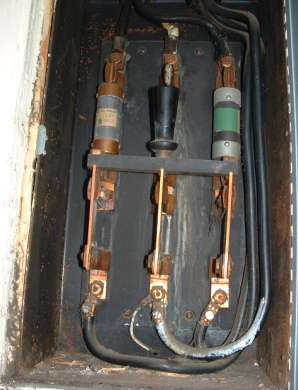
TODAY's FUN FOTOS:
This switch/fuse panel is still in use at a 1913 theater here in SF.
The little brass plate on the lower left says it was manufactured
by the "Railway Telegraph & Switch Company"
 -

This switch controls the electric chair in the managers office- [evil]
 -
>Actually, it's the "Main" service switch.
(Yes, they only have single phase power)
 
Posted by Scott Norwood (Member # 30) on 01-29-2016, 06:38 PM:
 
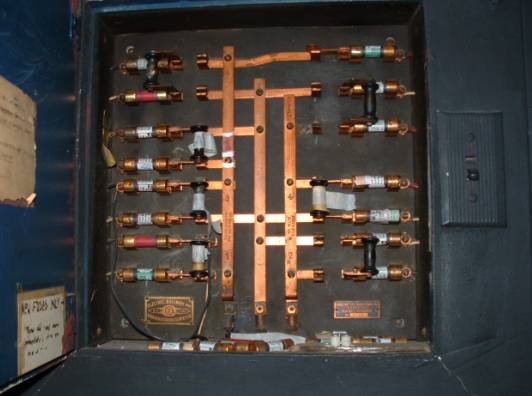
This panel was still in use as of y2k at a 1930s cinema:
 -

It is probably still there and in use, actually.

I have been pretty lucky with electricity and have never been zapped with anything greater than 120v/60Hz. I generally won't touch anything more complicated than replacing a light switch, though. I wired up a 208v three-phase rectifier once, but that was with explicit instructions from someone I trust. I did have a fun little sparking experience involving accidentally cutting through an AC cord when cutting a zip tie off of a bundle of wires once, but I was using insulated wire cutters for that.

I have only seen mercury tubes in use once, and that was in someone's private home, not an operating theatre. I have worked in a couple of places (including the one with the above electrical panel) that were (and probably are) still using Sil-tube rectifiers and/or exciter supplies.
 
Posted by Louis Bornwasser (Member # 3063) on 01-29-2016, 09:28 PM:
 
Was almost killed at Kentucky Theatre, Louisville KY. Had panels like those pictured above. Theatre had fused neutrals; amplifier was dead. With neutral fuse open (65 years old) power was on the amp, but no neutral return. I replaced every neutral fuse with a pielce of heavy copper pipe. Well. . . . it LOOKED dead.
 
Posted by Stephan Shelley (Member # 8587) on 01-29-2016, 09:57 PM:
 
The pic that Jim posted looks like from the 4 star San Francisco. The top right is the sign out front. It actually has both legs of the 220 going to it. The two blades with the wooden handle is the neutral and one leg the other leg is at the very top with no handle on it. I got shocked a few times working on that sign till I figured out what was going on. Also even though I pulled the fuses the manager put them back in and turned it on while I had my hands in there. I was luck and did not get zapped.
 
Posted by Donald Brown (Member # 5427) on 01-30-2016, 05:37 PM:
 
Though hardly an electrical nightmare, I humorously recall the following incident that occurred one night at the Hyannis Drive-In Theatre on Cape Cod.
The booth at the Hyannis Drive-In was separate from the concession and was equipped with a combined rectifier room / restroom. The machines were water cooled Ashcraft Dynarcs, and the Brenkert 100 heads had water cooled gates. All cooling water emptied into the restroom sink.
With some urgency one evening, I entered the restroom. In haste, I closed the door which displaced a cord which traveled across the steel door frame. The door caught the cord and shorted it out with a loud snap and arc flash!
The Hyannis Drive-In has been gone for nearly twenty-nine years, but the memory of that night remains!
 
Posted by Carsten Kurz (Member # 5396) on 01-31-2016, 10:18 AM:
 
As a child, I had put a nail into a 220V mains socket out of curiosity. Never did that again, but don't remember I had been seriously impressed.

I later built electronic circuits and touched 220VAC occasionally as well. I didn't like it, but wasn't too excited.

When I had my first ATARI computer, I operated my first hard-disc (a seagate ST-157N) rats-nest-wired with an open frame ASTEC switching power supply, that was simply sitting on my desk.
One day I touched something on it. Boy, there IS a difference between 220VAC and the rectified DC... I regained my respect for mains supply voltages that day...

- Carsten
 
Posted by Sam D. Chavez (Member # 1841) on 01-31-2016, 11:11 AM:
 
I don't know that I agree that DC hurts one more than the same AC Voltage.

However, my biggest shock ever was at a Drive In measuring plate current on an Ampex 120 Watt amp. Something around 500 Volts. I was working alone and got free but my whole body, brain and nerves were shaky for hours afterward.

I learned a different way to measure plate current. It's called cathode current.
 
Posted by Carsten Kurz (Member # 5396) on 02-01-2016, 11:39 AM:
 
No, not 'the same' AC, but the rectified DC is substantially higher than the feeding AC...

Seemed to make a difference for me.

- Carsten
 
Posted by Sam D. Chavez (Member # 1841) on 02-01-2016, 02:06 PM:
 
quote: Carsten Kurz
No, not 'the same' AC, but the rectified DC is substantially higher than the feeding AC...

Way too many generalities here. 220VAC can certainly kill you if applied correctly.

Most DC equipment in cinema results in a step down in DC voltage not step up.

Edison spent a lot of money trying to prove that DC power was safer than AC, by shocking animals to death on AC. Course it did not matter. AC won out for a number of reasons.

But We're just having fun here right?
 
Posted by John Eickhof (Member # 323) on 02-01-2016, 04:33 PM:
 
The worst one I have worked on was 15-16 years ago, I received the typical Saturday nite emergency call from a triplex a Carmike house) in eastern Idaho around 7:30 pm. The manager was in a panic saying "we're completely down! the place is full of smoke! Lights have exploded and glass is raining down from the ceiling lights and lightning bolts are dancing around the booth!" I asked if the customers have been evacuated and the fire dept called? He said "not yet, I've got to get the movies going again" !! Some logic? I told him to get everyone out ASAP and get the FD in there to make sure the place isn't on fire, and make sure anyone injured is taken care of! I said I couldn't do anything til the next day anyway so forget tonite's shows! Long story short, I brought as many parts as I could the next morning, when I arrived, light fixtures were vaporized and others were blown out of the ceiling! Flourescent ballasts were gone with just molten copper left behind! They had AW3 platters, I opened the speed card doors and the cards in use were vaporized just black soot and copper splatters! Inside two of the H-20 lamps the fan motors were vaporized and just molten globs, two of the rectifiers ad no power input contactors left! Just molten metal!
one of the sound racks was smoked, all power transformers had vaporized! Plus other fried items like the xetron automations, the power transformers were just metal frames, no windings were left! Here's what happened: It was an older theatre with the main power room located upstairs between booths 2 & 3, there was no main disconnect outside the building! Apparently the power company had lost a transformer in the alley behind the theatre, they shut down all the mains in the alley but never went in to cut out the theatre mains! They live installed a replacement 5KV transformer and when they lit it up it had an internal short sending the 5kv into one leg of the three phase in the theatre! The manager said there were flames coming out of most of the booth equipment and arcs were dancing between the projectors and other devices!! He was afraid he would be fired for losing the shows so he called me first!! I was able to get the place running manually and had it all fixed in a couple weeks! Needless to say, the power company ended up paying my bills as well as the bills for all the lighting and other downstairs equipment that got smoked. Plus outside main disconnects were added to the building! Just another day in the service biz!!
 
Posted by Buck Wilson (Member # 5885) on 02-01-2016, 05:15 PM:
 
Dear mother of god! That's horror movie material!
 
Posted by Sam D. Chavez (Member # 1841) on 02-01-2016, 08:01 PM:
 
John's story is way better!
 
Posted by John Eickhof (Member # 323) on 02-01-2016, 10:23 PM:
 
I forgot to add that I chose not to ask the teenage manager how he disposed of his underpants! Sam's amplifier story reminded me of an occasion in Fallon Nevada in the early 1970's that was having arc lamp problems, the ballast resistors on one lamp had fried open, so after I replaced them, I had to set the voltage drop to the lamp, note that the booth was 1920s vintage with the genny in the basement three floors below, the start-stop switches were in the booth in a free standing frankenstein style rack with the 240V 3 phase sub panel,open knife switches and other exposed conductors. (I think Bob Koch may have done the install for RCA years before it was a 1940's vintage Roth Actodector from RCA with Brenkert Enarcs) Anyway, they had a voltmeter inline before the ballast, and a 100 watt light bulb that would lite to about 80% when the genny was up and running, I had to reach around each side of the rack to adjust the resistors in a bear hug fashion! Well, all I remember to this day is hearing a buzzing sound through my ears and the 100 watt bulb got real bright! Then I was on the floor a few feet in front of the rack! My arms had electrical marks and burns and were numb for days! The owner luckily had come into the booth just when I had become the field control supply! Later I figure what happened was caused by my left arm that touched the rheostat that controlled the field voltage to the genny, and my other arm that had found an open 240V bus!on the correct phase and since my body had less resistance, the field went wild on the genny! He was smart and quick to grab a broom and pry me away from the rack! Once the genny returned to normal field voltage and I had slammed down a couple shots of whiskey with the owner across the street, I remembered my basic electrical training and put one hand in a pocket and adjusted the ballast from one side with the other hand and the owner watching the voltmeter I had at the arc lamp. The owner told me he heard me moaning and when he entered the booth my hair was standing on end and the lite bulb was white hot and the voltmeter was pegged at 150 Volts ! (Should be around 85 volts!)I guess I really got the genny's field excited!!
I'm pretty sure I have a few less brain cells after that too! Plus the ones lost from the booze!
 
Posted by Sam D. Chavez (Member # 1841) on 02-02-2016, 02:29 AM:
 
Explains a lot old friend!
 
Posted by Marcus Johnson (Member # 8704) on 02-02-2016, 09:20 AM:
 
quote: Carsten Kurz
No, not 'the same' AC, but the rectified DC is substantially higher than the feeding AC...
On an Atari ST power supply? No, the max voltage one of those would put out would be 12 volts. More than likely you WERE feeling the mains voltage. Those type of power supplies had the ground wire from the mains input socket wired straight to the frame, and then the positive and negative mains wires were soldered to the circuit board without any additional covers or shielding. So all you would have had to do was touch something conductive to a solder point on the input board while your hand was on the frame and you would've gotten hit with 220 VAC.
 
Posted by Carsten Kurz (Member # 5396) on 02-02-2016, 10:58 AM:
 
No, as I wrote, on an open frame ASTEC switching power supply feeding the external hard-disc. That was the rectified mains voltage.

- Carsten


Powered by Infopop Corporation
UBB.classicTM 6.3.1.2