This is topic The King and I restored from 55mm neg screening in forum Film-Yak at Film-Tech Forum ARCHIVE.
To visit this topic, use this URL:
https://ft-forum.com/ft/cgi-bin/ubb/ultimatebb.cgi?ubb=get_topic;f=8;t=003483
Posted by Paul Mayer (Member # 355) on 08-15-2004, 10:37 PM:
AMPAS and 20th Century Fox will be screening a new restoration of The King and I at the Samuel Goldwin Theatre in Beverly Hills, Friday, August 20, 2004 at 8:00pm. They claim this screening will be the first public showing of the film in its original aspect ratio, the print having been struck from the 55mm 0-neg. A new 4-track Dolby Digital soundtrack has also been created from the original 4-track masters.
I'm planning on driving down for this--a rare chance to see a film that both of my parents worked on. And to see it on a big screen in such a great theatre too!
AMPAS Gold Standard Series--The King and I
Posted by Bobby Henderson (Member # 840) on 08-15-2004, 11:15 PM:
What kind of print will they showing? 70mm? Or just a 'scope reduction 35mm print?
Posted by Steve Kraus (Member # 476) on 08-15-2004, 11:32 PM:
Dolby Digital infers a 35mm print.
Posted by Paul Mayer (Member # 355) on 08-15-2004, 11:39 PM:
I'm not sure. It sure would be great if it is a 70mm print from the 55mm o-neg. There was an article about the restoration and screening in today's LA Times but you have to pay $$$ to get to the on-line version of it. ![[Frown]](frown.gif) That article wasn't clear as to what the print gauge will be, but it mentioned that the only way audiences had been able to see this up 'til now was by way of 35mm reduction. The linked AMPAS page says the same thing, but doesn't specifically mention the print gauge either, though it does say "CinemaScope" which would also infer a 35mm print. So I don't quite understand what the difference will be between this new 35mm reduction and the mag-stripe roadshow prints from 1956.
That article wasn't clear as to what the print gauge will be, but it mentioned that the only way audiences had been able to see this up 'til now was by way of 35mm reduction. The linked AMPAS page says the same thing, but doesn't specifically mention the print gauge either, though it does say "CinemaScope" which would also infer a 35mm print. So I don't quite understand what the difference will be between this new 35mm reduction and the mag-stripe roadshow prints from 1956.
I'll just have to peer through the booth ports when I get in there. ![[Smile]](smile.gif)
Posted by Bobby Henderson (Member # 840) on 08-16-2004, 12:09 AM:
I'm sorry. I overlooked the "Dolby Digital" part when I saw 4-track audio transfer. Isn't CinemaScope55 a 6-perf 55mm process? I forget. It would seem a 70mm print would do more service to the original o-neg than standard 35mm. Are there no optical printers around capable of the transfer?
Posted by Carl Martin (Member # 1146) on 08-16-2004, 01:09 AM:
tssk tssk, steve & paul. the old infer/imply error. and you're usually such a stickler, steve.
carl
Posted by Paul Mayer (Member # 355) on 08-16-2004, 01:25 AM:
Oh well. My department chair will have my ass for that one. ![[Big Grin]](biggrin.gif)
Posted by Christian Appelt (Member # 1067) on 08-16-2004, 09:40 AM:
Reduction printing to 35mm 4-perf was the initial idea of CinemaScope 55, mostly to give 35mm exhibition a better image. Fox wanted something to compete with VistaVision's higher image quality, so they designed the oversized format (actually 55.625mm IIRC). Camera negative was 8-perf, 55mm release prints 6perf optically reduced to make room for mag tracks.
Some years ago, I talked to a former theatre owner who attended the Fox demonstration showings here in Germany in 1956, and he confirmed that they all were stunned by the low grain and extreme sharpness of the film, he thought it looked more like Todd-AO than CinemaScope.
But there seem to be KING AND I and CAROUSEL prints that were struck from old dupe negatives, not done in Dye Transfer printing. I suppose the newly restored version captures more of the image detail thanks to today's excellent dupe stocks.
I heard that the KING AND I 70mm blowup prints (made in 1961 under the name "Grandeur 70") looked quite grainy, indicating they were not produced from 55mm negative but from 35mm intermediate materials. Sadly, I have missed the screening at Bradford, but blowing up from 2.55 aspect ratio to 2,21 does not seem the best way of showing CS 55 pictures correctly.
As always, Martin Hart has it all, with beautiful pictures of 55mm film clips and a Daily Variety article:
AWSM on CinemaScope 55
Here's an summary on the restoration
CS 55 on Cinematography.com
Posted by John Pytlak (Member # 331) on 08-16-2004, 10:13 AM:
I wonder if the restored 2.55:1 aspect ratio 35mm version uses the original CinemaScope image area and centerline (i.e., no optical track)? Or is it 2.55:1 in the current scope image area specified by SMPTE 195?
The Kodak VISION Color Intermediate Film 5242/2242 used for making the master positive and duplicate negative is very fine grained and sharp:
http://www.kodak.com/US/en/motion/products/intermediate/5242.jhtml?id=0.1.4.6.4.4&lc=en
quote:
KODAK VISION Color Intermediate Films provide a bridge between the unparalleled creativity offered by KODAK VISION Color Negative Films - and the show quality of KODAK VISION Color Print Films. They are the link in the Kodak system that enables filmmakers to tell their stories without creative compromise.
These films replace - and improve upon - Kodak's ACADEMY AWARD® winning intermediate films. And, like all Kodak films, they are a result of listening - and responding to - the needs of the industry.
In both the rem-jet acetate base and nonrem-jet ESTAR Base versions, these films offer improvements to the emulsion layers that result in increased sharpness for laser recording. And, because the films incorporate Kodak's patented Two-Electron Sensitizer Technology, the improved sharpness comes without the expected increase in grain.
KODAK VISION Color Intermediate Film / 2242 / 3242 / ESTAR Base does not have the traditional carbon-based rem-jet backing, which must be removed during processing. The result? Cleaner, higher quality prints with fewer dirt spots. And with a patented process-surviving anti-static layer, this film attracts less dirt during processing - and stays cleaner throughout its useful life.
Advances in these products bring benefits to everyone involved in the process of telling stories on film.
For the filmmaker, these intermediate films help to preserve all the sharpness, clarity, and color of the original images and carry them more faithfully to the final display screen.
For the laboratory, VISION Color Intermediate Films enable the production of printing elements that are closer in quality to the look of a print made directly from the original negative.
Postproduction facilities will appreciate the features of the VISION Color Intermediate Films, especially improved sharpness for digital output. They're the choice for production of masters for theatrical re-release, video and DVD release, satellite, cable or broadcast TV presentation - or use in any media of the future.
And, audiences will also see the difference - in movies that tell stories with fewer distractions, films with fewer physical imperfections.
Posted by Paul Mayer (Member # 355) on 08-16-2004, 05:40 PM:
From that cinematography.com article:
quote:
The final result was a fully timed 35mm Cinemascope 2.55:1 answer print, along with a new color protection master interpositive.
Hopefully I'll be able to get down there for this--won't know until the night before.
Posted by Ron Yost (Member # 1850) on 08-16-2004, 06:57 PM:
Here's an article I found online at Digital Producer Magazine's website:
Digital Producer Magazine article on Cinemascope 55 paper
"Cineric Presents Cinemascope 55 Paper At AMIA
Paper traces restoration of two American classics, Carousel and The King & I
(June 22,2004)
Cineric, Inc., a New York postproduction facility specializing in film restoration and preservation services, will present a research paper on the CinemaScope 55 film format at the 2004 Association of Moving Image Archivists (AMIA) Joint Tech Symposium. The paper traces Cineric's restoration of two classics of American cinema, Carousel and The King & I.
"It's a privilege to work on a project like this," says Cineric president Balazs Nyari. "This project is a great example of Cineric's unmatched expertise and commitment to preserving film. We look at this work as part of Cineric's contribution to maintaining our shared artistic and cultural heritage."
The paper, titled Bringing Life Back to an Obsolete Film Format, CinemaScope 55, was written by Cineric's Simon Lund and Dan DeVincent, whose expertise in the field of optical film restoration is unsurpassed. The paper reviews the genesis of the CinemaScope 55 format and chronicles the painstaking work by Cineric to revive the films. The challenges included the creation of specially tailored sprockets and gate mechanisms adapted to the shrinkage of the original elements, optical techniques to address dye fade and scratches, and digital techniques aided by a specially adapted Oxberry scanner. The final result was a fully timed 35mm Cinemascope 2.55:1 answer print, along with a new color protection master interpositive.
DeVincent and Lund will present the paper and outline steps for working from original 55 mm camera negatives when restoring films on June 25, at 5 p.m. at the Isabel Bader Theatre (on the grounds of Victoria University.) Additionally, Schawn Belston, executive director of film preservation for 20th Century Fox, will discuss the historical significance of this restoration effort from the studio's point of view.
"The satisfaction of creating a new protection master and new prints that effectively recreated this obsolete film format was definitely worth the challenge," says Lund in the paper. "The combination of engineering and mechanical expertise, an extensive appreciation for what the filmmakers intended, and the requisite background in optics, allowed these two films to be brought back to life. To the community that cares, there may not be anything that must be obsolete forever."
About Cineric
Cineric, Inc. was founded in New York in1983. The company provides optical printing and digital imaging, titles, special effects and restoration and preservation services. The facility has worked on many independent features as well as such studio films as The Sixth Sense, Bringing Out The Dead, Goodfellas, Matewan, Philadelphia, Raging Bull, The Big Lebowski, and The Silence Of The Lambs.
Cineric was the first postproduction facility in New York to establish a digital motion picture film service bureau, offering scanning, recording, video-to-film, and specialized image processing services. Blowups and format conversions are a specialty. The facility has also restored more than 200 films including Jason and the Argonauts, The Birds, American Graffiti, A Man for All Seasons, The Man from Laramie and The Caine Mutiny. Cineric also recently restored and created 35 mm archival negatives and prints for 80 of the classic films that are part of a traveling exhibit called Unseen Cinema: Early American Avant-Garde Film 1893-1941. The exhibit has been on the road since June 2001.
For additional information, visit www.cineric.com or www.amianet.org. "
Maybe John could get a copy of the paper for us?
Ron Yost
Posted by Steve Kraus (Member # 476) on 08-16-2004, 08:03 PM:
Yes but clearly I was implying that I was the one drawing the inference from what was being implied. LOL
Posted by Gordon McLeod (Member # 33) on 08-17-2004, 10:21 AM:
Christian said"adly, I have missed the screening at Bradford, but blowing up from 2.55 aspect ratio to 2,21 does not seem the best way of showing CS 55 pictures correctly."
Well 70mm Ultra Panavision would do the job nicely
Posted by Christian Appelt (Member # 1067) on 08-17-2004, 12:19 PM:
Never thought of it, Gordon, what a great solution! ![[Wink]](wink.gif)
Some restorers have shied away from going to real 2.55 prints, like the very nice restoration of LOLA MONTEZ. They said that too few theatres, even at museums and cinematheques, were able to provide correct apertures and screens, so they decided to fit the 2.55 into the usual 2.39 area with thin black bars on top and bottom.
It's hard to say what's to prefer, taking into account that budgets for restoration work seldom will allow to make a second version for general showings AND an original format print. (What bothers me more is the claim that multichannel mag sound can easily be replaced by Dolby Digital, I never heard a DD sound restoration that had the special knack of let's say 70mm mag sound. 2001: A SPACE ODYSSEY comes to mind...)
Posted by Manny Knowles (Member # 1171) on 08-17-2004, 01:55 PM:
quote: Christian Appelt
What bothers me more is the claim that multichannel mag sound can easily be replaced by Dolby
I vote for restorations that can actually be released in today's theatres alongside current product.
Posted by Steve Guttag (Member # 268) on 08-17-2004, 02:51 PM:
Of all of the various odd ratios by today's standards...2.55:1 isn't too difficult. Perhaps a different back up lens, a new plate and a little lens shifting. In the scheme of things, not a very big deal.
FWIW...the AFI/Silver can accommodate 2.55:1 scope.
Steve
Posted by Christian Appelt (Member # 1067) on 08-17-2004, 06:39 PM:
quote: Manny Knowles
I vote for restorations that can actually be released in today's theatres alongside current product.
So do I. But I also dislike the attitude that some technicians and film historians have, it goes like this:
Back then it was all so primitive, like the hissing mag tracks or limited Academy optical sound. Today, we are so lucky that there are superior formats like Dolby Digital to capture all the information that exists in old soundtracks. It's so much better now in theatres, speakers used to be so primitive and inefficient...
That's not my experience. I have heard new versions of old 4-track films in digital, and they didn't sound better, they sounded worse. Not because digital is bad, which it is certainly not, but because the people using digital tools thought they were just transferring something primitive to a higher level.
Even in Academy optical sound, I am often surprised how good and full some films can sound in a theatre. Why? The people who did those recordings and mixes knew the limits of their tools and worked around it. In fact I consider many digital mixes of new films primitive, because they do nothing but create two hours of noise on 6 or 7 channels.
The two greatest film sound experiences in my life were a 35mm mag screening of RIVER OF NO RETURN and a 70mm screening of RYAN'S DAUGHTER (closely followed by WEST SIDE STORY), and in no other medium the sound had that overwhelming quality.
To sum it up, I welcome rereleases in compatible formats because it gets some classics to the big screen again, and there are valid reasons for using today's sound formats. Just don't tell people it's the same - it isn't.
Posted by Steve Kraus (Member # 476) on 08-17-2004, 08:27 PM:
I'm going to guess that the analog track is still there and they've achieved 2.55 via a thick frameline. That would be the way to go with a 70mm print as well.
Posted by Manny Knowles (Member # 1171) on 08-17-2004, 08:54 PM:
Christian,
Is your counterclaim that "the analog tracks sound better than the digital ones" based on anything more substantial than your opinion of what sounded better, or have you actually conducted scientific comparisons using measuring equipment besides ears?
Also, were you conducting A/B listening tests (of the same program reproduced via the same system) or did you arrive at your conclusion based on a memory of what the analog tracks sounded like?
In other words, I understand your conclusion but I have no idea how you arrived at it.
Posted by Steve Guttag (Member # 268) on 08-17-2004, 10:12 PM:
I know one distinct problem of the older tracks in "modern hands" is the modern people's lack of understanding on how the older tracks were mixed.
The older tracks were mixed to older theatres. That is, the older theatres did not have any subtantial equalization and the film was not afforded any sort of noise reduction as is available today.
If you take an older track, do a direct transfer to a digital (or even modern magnetic) medium and play it back with a modern sound system, it will sound quite hissy and harsh. This is not how it sounded originally but how it sounds when you record a track with a preemphasis for the old theatre and then play it back in a theatre with modern tunings.
My most recent experience with this is at Colonial Williamsburg where we updated their old sound system (Altec/Century) to a modern Panastereo 70mm system. This system has been in place since 1957 or so. It is about as close as you can get to going back in time and hearing an original film played back in the theatre it was created for using old technology.
There are two theatres at this facility that are identical. We upgraded one theatre at a time. Upon changing out sound system in one theatre we were able to make comparisions to the orignal sound and the new sound. When the Panastereo processor was tuned to ANSI/SMPTE specs...the sound was VERY harsh and quite hissy. The only change at this point is the processor, amps and tuning. The 70mm magnetic prints have always been sans noise reduction since their sound system never had it. With the assistance of Ray Derrick, we were able to modify the new magnetic preamps to provide an equalization curve that would apply a response similar to the old system. It turns out that the roll off needed (in the preamp stage) to match the old system was rather similar to the X-curve. At that point, the sound was no longer harsh or hissy (even with no NR). In fact, it now had more detail than the old system with a pleasing and natural sound. Again, this is a situation where one could A-B the two rooms.
The second room was then upgraded as well. Their theatres now support not only old 70mm but with up to 6-track SR, DTS-70 and Dolby Digital 35mm (and yes John P....they are red-reader compliant!). They feature the Panastereo CSP1200/4600 combination, Dolby DA-20, DTS-XD10, QSC amps, RANE crossovers and still have Altec A-4 stage speakers with new JBL 2360 horns mated to new Altec 399 Pascalite drivers. Their signature film The Story of a Patriot has been on 70mm-magnetic with new prints now with DTS sound. The DTS-XD10s not only allows a digital (which has to be better because it is digital ) but foreign language translations on all shows plus "Rear Window" support for the hearing imapred and descriptive service for the blind. The DTS tracks have been tweeked to have them sound as good as possible in the Patriot theatres.
Steve
PS Sorry for the plug
Posted by Steve Kraus (Member # 476) on 08-18-2004, 12:20 AM:
How do the new prints look?
Posted by William Hooper (Member # 71) on 08-18-2004, 01:05 AM:
quote: Manny who will miss the hurricanes when he moves to California was the last to post
I vote for restorations that can actually be released in today's theatres alongside current product.
Easier said than done; the last release of Gone With The Wind in printed pillarboxed into scope format is an example. It was awful in theatres with top masking (whether presentation-optimizing proscenium or poorly designed new theatres).
Going the other way of just printing it pillarboxed in the 1.85 frame would have compromised image quality more, but wouldn't have had the audience-disappointing postage-stamp image-size problem.
Steve Guttag in his post didn't bring up the issues of transferring discrete mag tracks to matrixed Dolby optical, but Bobby Henderson does that reaming more viscerally & emotionally effectively.
Posted by Bruce McGee (Member # 131) on 08-18-2004, 08:24 AM:
I agree that many digital recordings made today from old masters sound screechy and hollow. My reasoning is: The recording engineers are just trying to get rid of the hiss and make the sound loud for the CD! They have no idea how the original sounded in the first place!
I am a member of the Ampex (recording equipment) Owners Group. This has been discussed to death there. Remastering recordings using the proper EQ curves makes these original recordings sparkle and sound full the way they were made.
Great sound on recordings is not a new thing. I remember seeing something (I cant remember the title) in 35mm 4-track sound waay back in the early 1960's. The sound was rich and full. Hiss was a non-issue.
When sound is EQ'd with too much emphasis on a certain area of the human ear frequency range, the ear tries to compensate by changing non-emphasised frequencies. We've discussed this here in the past.
These are all my own opinions. I've been making analogue recordings on 1/4" audio tape since 1964. Mostly pipe organs. 2 years ago, I aquired an Ampex AG-440C 2-track stereo deck that is light-years ahead of my old Teac/Sony/Crown/Yamaha decks.
Posted by Mark Gulbrandsen (Member # 72) on 08-18-2004, 09:18 AM:
"It turns out that the roll off needed (in the preamp stage) to match the old system was rather similar to the X-curve."
Steve, Nice installation and system you did there! I think you would find that the old mag heads used back then provided quite a bit of that X-curve simulated roll off. Along with the lack of a standard mag recording curve back then most old mag heads and the preamps used were pretty poor on the top end. _____________________________________________________________
I once had a few feet of an old King And I 70mm print and it was just standard 2.21 ratio. 2.55 is very easy to do with just about any projector whos lens can be shifted laterally.
L.O.A. sounded bad no matter what version you saw. The sound on that film was barely passable and it was obvious thay made no attempt to correct it for the restoration, there was even some 12khz bleeding thorugh fomr use of 4 track surround materials. To me, where ever I saw it or ran it it sounded like the EQ curve was way out in left field, no low end and tinny high end. Perhaps alot of the sound budget was eaten up by bringing all the actors back in to do their lines.... although I thought many did that for free. I wonder of we can get RAH to comment on the sound for that restoration.
Mark
Posted by Steve Guttag (Member # 268) on 08-18-2004, 05:35 PM:
The new prints were made off of a restored negative by none other than Rober Harris. The film was shot VistaVision. Originally, the film was also shown VistaVision with 6-track audio (for more info, check out the VistaVision wing of the AWSM...the Patriot Theatres have old JSMPTE articles there).
In concert with the new 65mm negatives and show prints, Colonial Williamsburg also changed their screens out to lower the gain (was about 2.3) to nearly 1.1. However, there is still sliver pigment in the screens to give the theatre its "look" and to allow the screen's shape to still cause a virtual fade out on the sides (way too hard to describe here...see the American Widescreen Musuem for more details). However, in order to have enough light for these modern prints...we upped the lamphouses from 2KW to 6KW.
With the system set up to 16fL on these new screens...the picture looks pretty remarkable for its age...the colors are vibrant. I doubt many will walk away disappointed. Mind you, the camera aperture is smaller than Todd-AO so it does not have quite the snap of 65mm origination but it is notably better than 35mm films of its day. Vertigo would be better comparison to it though it was several years newer.
Steve
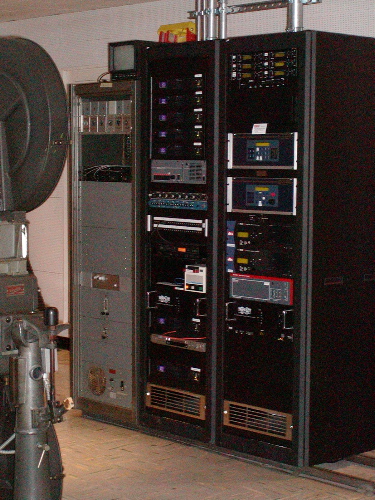
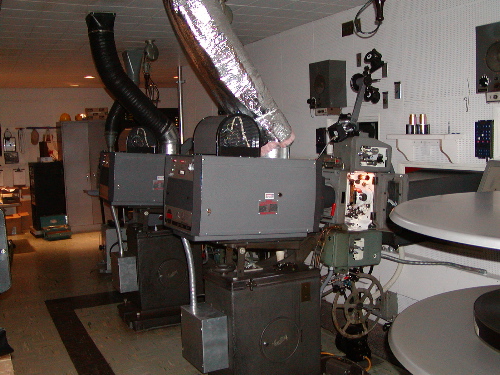
PS...here are a couple pics...
The current sound systems:
The current projection system with new lamphouses:
Posted by Christian Appelt (Member # 1067) on 08-19-2004, 05:11 PM:
quote: Manny Knowles
Is your counterclaim that "the analog tracks sound better than the digital ones"
That's not what I said. In my opinion, digital sound formats arefine for today's style (some call it philosophy) of sound design/sound mixing.
Old films were mixed for different auditoriums, different speakers and within certain technical limitations. Now when you transfer an old sound track to a modern system like Dolby Digital and play it back through modern speakers in one of today's theatres with rather dry acoustics, you are distorting the artistic work of people who knew very well how to get the most out of recordings systems like optical sound or 4-track mag.
If you transfer an old record to a modern 20-bit-digital recording without making adjustments for the difference in listening/playback technology, then your new recording will be an aesthetical distortion of the original work.
quote: Manny Knowles
Also, were you conducting A/B listening tests (of the same program reproduced via the same system) or did you arrive at your conclusion based on a memory of what the analog tracks sounded like?
I am neither musician nor sound engineer. Therefore I speak of my personal, totally subjective impressions. In very few cases did I have the opportunity to compare different versions of a single film in the same surrounding, but I am not comparing experience from 20 years ago with those of today because memory can play tricks on us. Sme time ago, I saw the 70mm versions of 2001 and SPARTACUS (restored version) in 70mm mag, and having heard both films in their DVD versions on a number of high end audio systems, I prefer the mag experience because the musical score sounds entirely different, more pleasing to my ears. Subjective again, not scientifical work.
Why did RIVER OF NO RETURN impress me so much? Because the sound was truly directional, you were pulled into the film acoustically when Robert Mitchum comes to town, they recorded it with three stereo mikes over the scene and panned with the camera.
There are reasons why this way of doing things changed, some having to do with analog Dolby's limitations, some being more in the creative zone. Some films in discrete digital stereo use directional dialog and ambience like they did it in the 1950s and 1960s, and I happen to like that style (RAPA NUI was the first Dolby Digital film that gave me this sound experience again).
We are not talking about the tools themselves, but of the artistic way in which they are handled.
So no, I don't think analog sound is in any respect "better" than digital, but that in transferring analog to digital, too often artistic and technical aspects are ignored by people who think they are just lifting something primitive to a higher level or that they have to adjust it to fit modern aesthetic preferences.
Posted by Scott Norwood (Member # 30) on 08-19-2004, 06:16 PM:
Steve--that looks like a nice upgrade! Hopefully, I will make it to VA. next weekend sometime to check out the restored version of the film (which I have probably seen a hundred times, mostly in 70mm).
I hope that they keep that funky-looking dubber, at least as a display item.
For those who care, here are some pics of the old Williamsburg installation (taken in 1997):
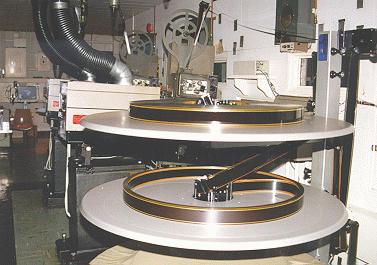
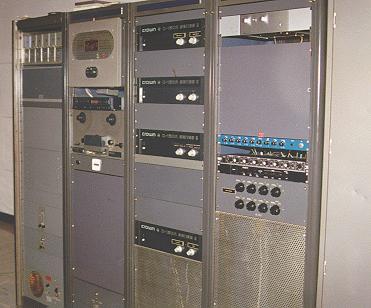
Posted by Mark Gulbrandsen (Member # 72) on 08-19-2004, 06:58 PM:
That funky looking dubber there that was made from a Century R-3 reproducer is called a Westrex R-8. They were originally brought out for Warnerphonic sound on House of Wax. I used them as the basis of my portable dailies projectors to make up an all in one projector. I had four original R-8's and built another Ten of them myself from R-3's for other customers dailies setups.
Mark @ CLACO
Posted by Tim Reed (Member # 137) on 08-19-2004, 09:14 PM:
quote: Paul Mayer
a rare chance to see a film that both of my parents worked on.
What did your parents do on that show, Paul?
Posted by Paul Mayer (Member # 355) on 08-19-2004, 11:46 PM:
Dad was a music editor. Mom was a dancer--she played Little Eva during the Uncle Tom's Cabin segment, along with a couple of other dance line or bit parts.
Here's a kinda interesting background story: The original staging for her "death" at the end of the play called for her to be flown on a wire harness rig. But for some reason they couldn't get the results they wanted when using it, and came up with the stairway and sliding clouds as a substitute. Personally I think the stairway worked better--it fit the period better than a flying rig would have.
As it turns out, I won't be going to the screening--just can't afford the trip down and back. Hopefully a new DVD or HDVD release is not too far off.
Posted by Tim Reed (Member # 137) on 08-21-2004, 07:56 PM:
Oh, that is simply too cool! I'll watch it from a different perspective now. ![[thumbsup]](graemlins/thumbsup.gif)
Posted by John Pytlak (Member # 331) on 09-17-2004, 06:56 AM:
From the Association of Moving Image Archivists (AMIA) listserver:
quote:
We are pleased to announce a special screening of The King & I at the 2004 AMIA Conference in Minneapolis!
Special Screening:
THE KING & I
Only two films were ever made in CinemaScope 55 - Carousel and The King And I, both in 1956. Even at that time audiences saw The King And I in prints made from a 35mm reduction negative. Newly restored, this is a rare chance to see the film in its original aspect ratio on the big screen.
In addition, the original stereo soundtrack has been faithfully recrated in 4-track Dolby Digital stereo. Ann and her King have never looked or sounded this incredible, as they sing and dance their way through such Rodgers and Hammerstein classics as "Shall We Dance" and "Getting to Know You."
The AMIA 2004 Preservation Screening will take place Friday, November 12th at 7:30pm at the Riverview Theatre in Minneapolis. Buses will leave the Hyatt. Admission is free to all registered attendees.
Print courtesy of Twentieth Century Fox, with special thanks to Shawn Belston, who will introduce the film and discuss the restoration. Evening sponsored by Audio Mechanics: Music and Sound Restoration.
The Early Bird registration discount ends soon! Register today!!
Go to the www.AMIAConference.com for more information on registration, hotels and the conference program!
__________________________________________________
Registration information is at:
http://www.amiaconference.com/registration.html
Hotel reservations are at:
http://www.amiaconference.com/hotel.html
To be a vendor at AMIA 2004:
http://www.amiaconference.com/vendor_info.html
For more on what to do and see in Minneapolis:
http://www.amiaconference.com/2004/minneapolis/restaurants.html
Posted by Bill Gabel (Member # 1105) on 09-17-2004, 09:08 AM:
quote:
Ann and her King
It's Anna
Posted by Steve Kraus (Member # 476) on 09-17-2004, 09:35 AM:
It's been updated for modern audiences, Bill. LOL
Posted by John Pytlak (Member # 331) on 09-17-2004, 09:45 PM:
I just cut and pasted the quote as it was.
Posted by Wayne Keyser (Member # 2420) on 09-18-2004, 02:40 PM:
"Is your counterclaim that "the analog tracks sound better than the digital ones" based on anything more substantial than your opinion of what sounded better, or have you actually conducted scientific comparisons using measuring equipment besides ears?"
The later comment about a/b testing holds a little water (may be an effective way of judging, or may be a bit like smelling various perfume samples until you have no 'center' to base your evaluation upon) - but the bottom line of any sound system is not the effects on a meter but the effects on the listener. SUBjective!
Powered by Infopop Corporation
UBB.classicTM
6.3.1.2