This is topic How much was $10 in 1970? in forum Film-Yak at Film-Tech Forum ARCHIVE.
To visit this topic, use this URL:
https://ft-forum.com/ft/cgi-bin/ubb/ultimatebb.cgi?ubb=get_topic;f=8;t=003596
Posted by Michael Schaffer (Member # 1204) on 09-26-2004, 03:06 AM:
I just watched "Midnight Cowboy" on DVD (a really cheerful movie for the whole family, BTW). In one scene Jon Voight says "look I bought all this stuff and I still have 9 Dollars left" (or something like that, it's not an exact quote).
Wow. 9 Dollars.
How much was that actually around 1970? What did typical everyday things cost back then?
Posted by Leo Enticknap (Member # 534) on 09-26-2004, 06:18 AM:
I can't give you an answer, but I've often thought that a website (or other resource) which enabled you to enter a figure in a given currency, plus a date, and then told you the equivalent value today allowing for inflation and any changes to the currency system (e.g. when British currency was decimalised in 1972) would be extremely useful. Only the other day I was looking at an advert for Standard 8 home movie cameras made in 1955: the commentator cheerfully stresses that they are 'excellent value' at £42 6s 2d. From talking to friends and relatives who were around in the 1950s I've managed to get a rough idea of what that would be now, but a way of getting an accurate answer to that sort of question would be very useful. Assuming you had access to the inflation data, a calculation program shouldn't be too difficult to write, I'd have thought.
Posted by Phil Hill (Member # 371) on 09-26-2004, 06:57 AM:
What is a dollar worth?
>>> Phil
Posted by Steve Kraus (Member # 476) on 09-26-2004, 10:40 AM:
Too time consuming, Phil, to calculate year to year over such a long period. A good set of tables is available on Robert Sahr's page at Oregon State. These convert directly to/from 2004 dollars.
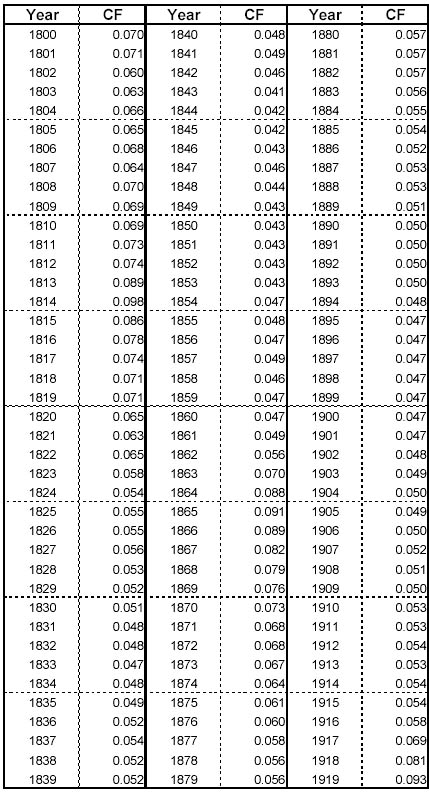
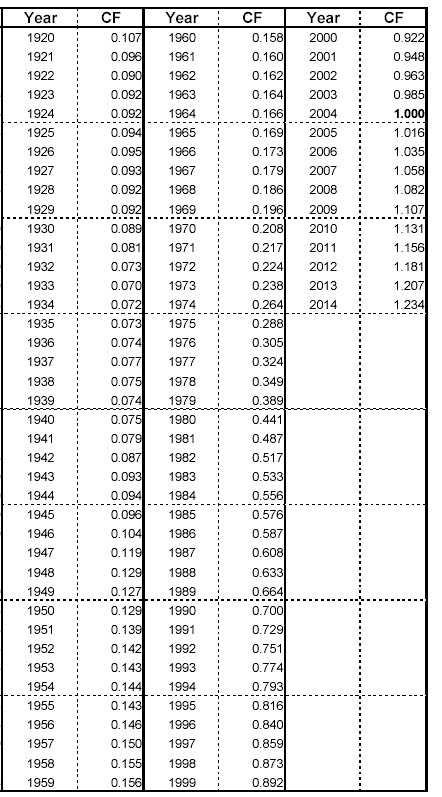
We see that the conversion factor (CF) for 1970 is .208. Therefore $10 / .208 tells us that 10 1970 dollars is about 48.08 in 2004 dollars. And $10 x .208 tells us that 10 current dollars has the same purchasing power as about $2.08 did back then.
A penny...I mean 4.8 cents...for your thoughts?
Posted by Mark Gulbrandsen (Member # 72) on 09-26-2004, 11:29 AM:
Michael,
Out of curiosity how much was the Deutchmark in 1970 vs. today?
Mark
Posted by Tim Reed (Member # 137) on 09-26-2004, 12:45 PM:
I can remember .26 per gallon gas.
Posted by Mark Lensenmayer (Member # 134) on 09-26-2004, 12:56 PM:
In 1970, my tuition at Capital University was $2,000. It is now $20,000.
My first year starting salary as a teacher was $6,700 in 1973. Starting salary now is about $36,000.
And, that $.26 per gallon gas was sure nice...and it was even less when there were price wars...AND they pumped your gas and checked your oil!
Posted by Leo Enticknap (Member # 534) on 09-26-2004, 01:06 PM:
Mark:
The deutschmark no longer exists today - Germany joined the single European currency (the euro) when it began in January 2003. It should theoretically be possible to calculate what a 1970 deutschmark is worth in 2004 euros, though.
Posted by Richard Fowler (Member # 893) on 09-26-2004, 03:32 PM:
In 1970 I drove from Tampa, Florida to Los Angeles, California on $32.00 of gas. I now spent that approximate amount driving from home to work during a week ![[Roll Eyes]](rolleyes.gif)
Posted by Michael Schaffer (Member # 1204) on 09-26-2004, 06:53 PM:
I don't remember how much the Mark was worth in 1970 - I was only 2 at that time!
Posted by Steve Guttag (Member # 268) on 09-26-2004, 11:31 PM:
Yeah, but more importantly, how much was MARK worth in 1970? ![[evil]](graemlins/evil.gif)
Steve
Posted by Mike Blakesley (Member # 26) on 09-27-2004, 02:54 AM:
My parents bought a new 1971 Ford LTD -- top of the line for Ford -- in late 1970 for $3100.
It cost $1.25 for adults to get in to our theatre in '70. It was $1.75 when I bought the place in 1979.
Posted by Carl Martin (Member # 1146) on 09-27-2004, 04:17 AM:
am i the only one who is surprised that inflation was a nonissue until world war 2? sure, there were some ups and downs, but a dollar was worth the same in 1933 as in 1800! wha' happened?
carl
Posted by Bruce McGee (Member # 131) on 09-27-2004, 06:35 AM:
The great depression?
I remember 29 cent regular gasoline in 1970 driving thru Georgia to Florida.
Posted by Mark Gulbrandsen (Member # 72) on 09-27-2004, 08:37 AM:
quote: Steve Guttag
Yeah, but more importantly, how much was MARK worth in 1970?
Mark was a Sophmore in High School in 1970 and had a net worth of less than 500.00. Today I still have a net worth of less than 500.00 so things have pretty much stayed consistant for me over all those years.... ![[Cool]](cool.gif)
Mark
Posted by Richard Fowler (Member # 893) on 09-27-2004, 09:55 AM:
The more important question is what the dollar and the act of faith behind it be worth in the next five years ![[Frown]](frown.gif)
Posted by John Pytlak (Member # 331) on 09-28-2004, 08:06 AM:
Inflation has already hit hard in Rochester, with food and fuel increasing at double digit rates in the last year. But we were able to refinance our mortgage from an adjustable rate to a low fixed rate.
Posted by Leo Enticknap (Member # 534) on 09-28-2004, 08:33 AM:
There has been very little in terms of obvious effects of price rises in the UK, yet, despite the rising oil costs and interest rates having increased from a 40-year low of 3.5% to 4.75% over the course of the last year. I would guess that, in the short term, oil price increases will have a smaller immediate impact in Europe than in the US, because in most European countries, around 60-80% of the cost of petrol (gasoline) and Diesel at the pumps is tax. To put that in perspective, an increase in oil prices of 50% translates into a 10% increase in what the consumer pays.
But it's certainly exerting upward pressure on inflation, and at a time when the UK economy is particularly vulnerable to it. More inflation means higher prices for essential goods and services, so therefore people spend less in other sectors of the economy, thereby forcing it to contract. We are also especially vulnerable to a collapse in property prices: the cost of houses has gone up by 400-500% in the last six years (many of the reasons for that are the result of political decision-making, so for obvious reasons I'm not going to raise them on this forum), and many people took out very big mortgages at a time when interest rates were at historic lows. There are real fears that serious inflationary pressure (i.e. leading to significant rises in interest rates) now could therefore tip the housing market over and take the rest of the domestic economy with it.
In short, nothing terrible has happened as yet here, but the inflationary pressure which is likely to be caused by these recent oil price increases is not welcome news, to put it mildly.
Powered by Infopop Corporation
UBB.classicTM
6.3.1.2