This is topic Is this a 3 phase electrical outlet? in forum Film-Yak at Film-Tech Forum ARCHIVE.
To visit this topic, use this URL:
https://ft-forum.com/ft/cgi-bin/ubb/ultimatebb.cgi?ubb=get_topic;f=8;t=003627
Posted by Larry Davis (Member # 609) on 10-10-2004, 10:26 PM:
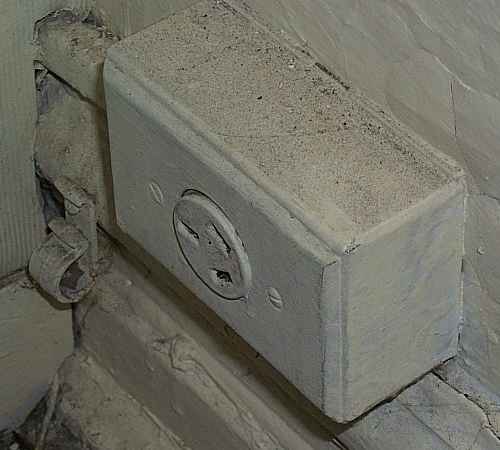
Is this a 3 phase electrical outlet? It was used with a very powerful air conditioner. Could it be 2 phase, 220V? I figured this question was too general to be put into any other area of the site.
Posted by Joe Redifer (Member # 3) on 10-10-2004, 10:38 PM:
Looks like what I plug my dryer into (except mine isn't covered in dust from a cremated human body). I am not an electrician, so I will say "Yes it is 3 phase". Or not. Probably not true 3 phase, but definitely "More powah!" 60 amps! More than enough for the VCR!
Posted by Aaron Sisemore (Member # 145) on 10-10-2004, 11:28 PM:
That looks to me like a single phase 220v outlet (similar to a dryer outlet).
A true '3-phase' outlet should have four holes (3 for the power conductors, one for ground).
Find the breaker that feeds that outlet... How many poles does it have? if it has only one or two, it is single phase.
-Aaron
Posted by Phil Hill (Member # 371) on 10-10-2004, 11:44 PM:
That looks like a 240v/20Amp single phase outlet w/o safety ground but a neutral subbing for a ground simular to the feed I use to execute Rach's gerbil! (or what ever that pathtic animal WAS!)
>>> Phil
Posted by Joe Redifer (Member # 3) on 10-11-2004, 12:17 AM:
Leave Richard Gere and his gerbil out of this!
EDIT: Oops he said "Rach's" and not "Richard".
Posted by Larry Davis (Member # 609) on 10-11-2004, 12:20 AM:
Aaron,
I think you hit the nail on the head. This was used for a super-duper air conditioner in the distant past. It has one pole feeding into it. It's hidden behind a forgotten cubby hole, thus the dust. So Joe was at least part right. I didn't know hair dryers use that kind of outlet.
Phil,
Don't let Richard Gere hear you say that. Oh my...
Posted by Phil Hill (Member # 371) on 10-11-2004, 12:40 AM:
Yous both are f*ckin' sick! Especially you Joe Moderator! I expected more from you than that stupid-ass comment! (Thank GOD there are NO more sigs!)
However, you are both right.... Rach's animal in question is NOT a gerbil but a Hamster.
SO, yous both can go F.off! But the question STILL remains...
What is the Hampster Method?
Brad? Would you please explain it to us dumbasses!
(Steve...PLEASE help me with the correct use of the possesive/plurals/etc)
>>> Phil
Posted by Joe Redifer (Member # 3) on 10-11-2004, 01:07 AM:
Steve Guttag or Steve Kraus?
Guttag is busy converting the Senator Theater for a platter system.
Kraus is busy being hosed off of someone's lawn.
Posted by David Favel (Member # 1125) on 10-11-2004, 01:29 AM:
Looks exactly the same as the majority os single phase plugs used in NZ/Oz, 22- - 250 v
Posted by Stephen Furley (Member # 1277) on 10-11-2004, 01:35 AM:
If in doubt, check here
or, for twist lock connectors, here
It looks like a NEMA 10-20R to me, but it could be a 10-50R, it's difficult to be sure of the size from the picture. Either way, it's 125/250V, not three phase; unless of course somebody has used the connector for the wrong purpose.
Posted by Steve Guttag (Member # 268) on 10-11-2004, 01:51 AM:
Whereas the picture shows a single gang...utility or "handy" box, the size of the opening places the outlet in a 20-amp class.
The pin configuration is of the NEMA type 10-20R. I'm surprised that they still even offer the things. There is no ground assoicated with this outlet. There are two hots (out of phase with each other) and a neutral. Thus, two circuits of 120 VAC at 20 amps or a single circuit of 240VAC at 20 amps may be obtained. Some devices may need both 240 (for say a heating circuit) and 120VAC for control circuits.
Nowadays, NEMA type 14 outlets should be used since a ground terminal is also offered.
Steve
PS...the Senator theatre has had a platter since about 1980 or so...a Christie AW-370.
Posted by Ken Layton (Member # 133) on 10-11-2004, 11:43 AM:
It is indeed a 240 volt 20 amp single phase. We had a bunch of 'em at the old (now demolished ) Olympic Theater and they were used for portable 240 volt heaters in the dressing rooms below stage.
Posted by John Hawkinson (Member # 1135) on 10-11-2004, 12:37 PM:
If you want to know what it is, stick a voltmeter in it.
The outlet configuration will not tell you reliably whether it is single-phase or three-phase, it'll merely give you an indication as to the voltage (i.e. whether it is 120V, 220-240V ish, 277V, 480V, etc.). (Of course, if it had 3 hots, then you would know it was 3-phase, but that's not a situation we're in here.)
If the there is a 3-phase panelboard (120/208-Y), then it'd be 208V outlet. If it's a single-phase panelboard, it would be 240V. You cannot reliably tell just by looking (not to mention that even if you could, somebody could have wired it wrong, which does happen).
--jhawk
Posted by Larry Davis (Member # 609) on 10-11-2004, 12:46 PM:
You guys are awesome. Thanks a bunch. I have never used this outlet and never will. I was just curious. Cheers.
Posted by Stephen Furley (Member # 1277) on 10-11-2004, 01:15 PM:
quote: Steve Guttag
Nowadays, NEMA type 14 outlets should be used since a ground terminal is also offered.
Alternativly, dump the NEMA junk and use decent connectors ![[Smile]](smile.gif)
web page for example.
The US and international versions of these things are slightly different, but the US range includes a four pin orange one for 120/240V use, and there is a 20A version. Over here the international versions of these things have pretty well replaced all of the older 'industrial' connectors. They're robust, don't rely on recognising and remembering odd shapes and positions of pins to know what they are, are available in versions cover all Voltages from 24 up to 600 plus special versions for things like D.C and high frequency supplies. 3,4 or 5 pins, plus versions for 60A upwards have an extra, short, pin for an interlock, so they don't break a live circuit.
I've seen the 240V versions in McDonalds, supplying cooking equiment, but they don't seem very common over there. In Europe you find them just about everywhere, except in the home.
Over here the NEMA connectors are not approved for use at mains Voltage. Years ago the two-pin ones were used for things like power outputs on amplifiers. You can buy NEMA connectors here, mainly intended for use on equipment for export, but the decent ones are expensive. RS Components, nothing to do with Radio Shack, for example sell decent Hubbell re-wireable connectors. A 5-15 plug will set you back over £10, about $18, a receptacle to fit it about $25.
The cheap NEMA plugs nearly always seem to run warm when carrying any significant load; they just don't seem to make a good contact. I certainly wouldn't want to use them for high current.
Posted by Phil Hill (Member # 371) on 10-11-2004, 05:39 PM:
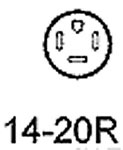
Speaking of weird outlets... I am having trouble finding and buying a receptacle to plug in my kitchen bread toaster. It requires a NEMA 14-20R.
While "some" electrical distributors claim they have them ...they don't. Or, there is a $100 min order. This receptacle costs about $30 and I just need one ...not 4 to meet some minimum.
Any ideas where I can buy just one without paying $100 min? It's a rare one and very hard to find.
>>> Phil
Posted by Joe Redifer (Member # 3) on 10-11-2004, 05:52 PM:
Home Depot has those at the checkout counter as one of the impulse items.
Posted by Phil Hill (Member # 371) on 10-11-2004, 06:12 PM:
Joe,
You're mixing this up with a 14-22LR. The .22 cal bullets used for varmint hunting like Rach's rabbit.
What I'm looking for is a 20 amp, 240/120 volt, single-phase socket with a neutral and safety ground.
>>> Phil
Posted by Adam Martin (Member # 641) on 10-11-2004, 09:13 PM:
Careful, Phil. That's not a toaster.
Posted by Steve Guttag (Member # 268) on 10-12-2004, 01:55 AM:
Gee Phil, the NEMA type 14 is not that rare and is often stocked by electrical supply houses. It is a 4-pin plug that has two hots, a neutral and ground so it can supply 120VAC, 240VAC at the same time.
I must admit, I've always used the locking variety of this plug in my applications and I'd suspect that the L14-20P is more apt to be stocked than the straight blade 14-20P.
Have you checked your local Home Depot?
Steve
Posted by John Hegel (Member # 628) on 10-12-2004, 02:09 AM:
So is there something special about this toaster. Can it walk or talk or something?
Wouldn’t it be easier to cut the plug off and attach a more common one.
Posted by William Hooper (Member # 71) on 10-12-2004, 06:26 AM:
Dan Bouvier, stop sucking face with that spider for one minute & come fix this problem for Phil!
Posted by Phil Hill (Member # 371) on 10-12-2004, 08:54 PM:
quote: John Hegel
Wouldn’t it be easier to cut the plug off and attach a more common one.
Why would I want to do that? It would cost 2X the amount of solving the issue correctly...DUH! Plus, I would like to keep the original molded plug/cordset.
quote: Steve Guttag
Have you checked your local Home Depot?
Yes I have, Steve. They, as well as NOBODY else that I can find with a Google search stocks this particular socket.
In answer to what is "so special" about this toaster: It is a commercial, restaurant-style 240/120volt 2400 watt unit.
I bought it cuz I was sick and tired of the pussy ass 700-900 watt toasters that took 3-4 minutes to pop!
This baby pops in 20-30 seconds. Ok OK OK! SO I'm impatient! HA!
>>> Phil
Posted by Steve Kraus (Member # 476) on 10-12-2004, 09:43 PM:
How do you have it connected at present?
Posted by Mike Fitzgerald (Member # 1304) on 10-12-2004, 11:47 PM:
Phil the problem is you looked at Home Depot you should look at LOWES if you have one in your area. (I am now working in the plumbing dept at the LOWES here in Wilmington.) I had sent my resume to Consolidated Theaters for their new 16 plex they are opening and never even got a response and I tried calling them on the phone and he was always out so I got the hint they do not want employees with 30 + years theater experience.
Posted by Randy Stankey (Member # 64) on 10-13-2004, 12:16 AM:
Awww, C'Mon, Phil! Everybody knows that's not for a toaster! It's for a new line of 220 V sex toys he's designing!
quote:
This baby pops in 20-30 seconds. Ok OK OK! SO I'm impatient! HA!
At 220 volts, I can imagine there's a lot of "popping" going on at Phils house!
![[Big Grin]](biggrin.gif)
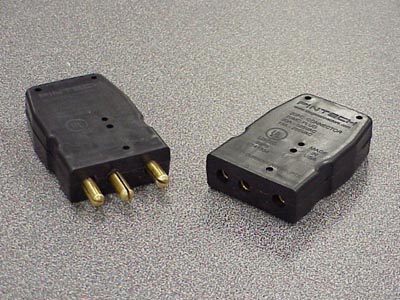
Want to see a weird electrical plug?
Posted by John Hawkinson (Member # 1135) on 10-13-2004, 02:12 AM:
Phil,
It's definitely the case that if you cannot find the connector locally, the standard solution is to replace it with a more standard connector. Like Steve said, the twistlock style (L14-20 series) is more future-proof and available.
But it also seems like you must not have tried the right decade's yellowpages under electrical supply houses. ![[Confused]](confused.gif)
Needless to say, MSC Industrial Supply to the rescue. A single 14-20R receptacle is available from 3 manufacturers. Just go to Electrical Supplies -> Wiring Devices -> Receptacles and select 14-20R under NEMA Configuration.
They range from $18.65 to $30.06; part numbers 48670608, 09262791, and 54033998, respectively, for Pass & Seymour, NuLine, and Hubbell (in ascending price order).
No minimum order, same-day shipping from their Reno, NV distribution center (closest to you), etc. Use the web or call 800-645-7270. Nothing quite like their 4600+ page catalog: "the big book."
Hi, Randy. Nice stage-pin connector there (grounded). Are those good for more than 120V?
--jhawk
Posted by Steve Guttag (Member # 268) on 10-13-2004, 02:17 AM:
Randy....I don't know a live-stage venue that hasn't used that style of connector for lighting instruments.
Phil, I've sent you information on where to purchase said socket. The L14 (locking variety) is vastly more popular and less expensive than the straight blade varients.
MSC Industrial supply has such things in stock...
Try Hubbell 14-20R
That is for the Hubbell brand outlet (generally the best in electrical fixtures though they do have NuLine as well). They are in-stock (6 when I checked) and available on-line so quit your complainin'.
Steve
Posted by John Hawkinson (Member # 1135) on 10-13-2004, 02:21 AM:
Whew. Beat Guttag by 300 seconds.
--jhawk
Posted by Steve Guttag (Member # 268) on 10-13-2004, 08:31 AM:
Yeah, only because you didn't email Phil the info directly nor provided a link.
While providing a twist lock would make things cheaper in the future, it is more expensive to change the plug, buy the outlet than just to buy the outlet in a straight blade.
What some don't seem to get on the Nema type 10 and type 14 plugs/outlets is that it provides BOTH 120VAC and 220VAC (there are ranges in their depending on the type of service to your building). So, in the case of the toaster, the heating elements are probably using the 220VAC so as to provide over 4000-watts on a mere 20A service and the rest can run on standard 120VAC. Certainly a solution for the manufacturer is to provide a step-down transformer but that would add cost on their part and take up considerable size.
If this was just a 220VAC device, then a NEMA type 6 could be used.
I don't know why the NEMA type 10 is still allowed except as a replacement item like the old 2-prong 120VAC outlets. The only difference between type 10 and type 14 is that type 14 is grounded...a particularly good safety feature for a toaster...especially if you plan on having your toast while taking a bath...on second thought...for Phil a type 10 may be best.
Steve
Posted by Steve Kraus (Member # 476) on 10-13-2004, 12:40 PM:
On a traditonal 3 wire 120/240V appliance like clothes drier is the frame "grounded' to the neutral?
Posted by Phil Hill (Member # 371) on 10-13-2004, 01:21 PM:
With out getting into the details and/or repeating what I already said about keeping the original cordset/plug...or pointing out that if I modified it, it would void the warranty, I will just point out that Steve did email me yesterday morning about 8am PDT with the correct and helpful info.
Steve wins! ![[beer]](graemlins/beer.gif)
Seriously jhawk, thanks to both you and Steve for your help! ![[thumbsup]](graemlins/thumbsup.gif)
>>> Phil
Posted by Steve Guttag (Member # 268) on 10-13-2004, 08:04 PM:
One should NEVER ground to the Neutral. The only point in the USA where Neutral and Ground are of the same potential is at the entrance of the building and on the first Load Center.
Neutral is a current carrying conductor....once current flows, by definition, there is a potential difference (voltage) between the ends.
Ground, on the other hand, should have virtually zero current flow and provides a ground reference at all times. This is particularly important for noise supression and for safety.
I wouldn't be surprised if in the case of a clothes drier that the presumption is that there is a cold water pipe near by to ground the appliance...nowadays...one never knows where PVC might be used so I don't trust water pipes anymore.
Which brings me back to the Type 10 outlets should only be used as replacement items and Type 14 outlets used in new work. It would appear that Phil's toaster had the same line of thinking.
Steve
Posted by Phil Hill (Member # 371) on 10-13-2004, 08:17 PM:
quote: Steve Guttag
...grounded...a particularly good safety feature for a toaster...especially if you plan on having your toast while taking a bath...
quote: Steve Guttag
It would appear that Phil's toaster had the same line of thinking.
Gosh Steve, since I don't take a bath ..and I DON'T stink cuz I take showers... I would NEVER think about taking a toaster near a bath... only a shower.
YES! Earth/safety grounds are good!
>>> Phil
Posted by Steve Kraus (Member # 476) on 10-14-2004, 07:33 AM:
A quick test of a Maytag double-stack W/D showed continuity between frame and plug neutral.
Posted by Steve Guttag (Member # 268) on 10-16-2004, 10:39 AM:
WOW is that dangerous and will cause electrical noise elsewhere in the electrical system of the building.
Then again, Christie had no fuses in the AW-3 platter for the longest time and they received UL listing.
Steve
Posted by Bruce McGee (Member # 131) on 10-16-2004, 07:35 PM:
I do alot of work on Whirlpool electric dryers. There is a green wire that is attached to the metal cabinet. It is connected to the neutral center connection at the terminal block too.
When I install dryers in homes, I have to carry both 3 prong, and 4 prong power cords for them. If it is a 4 prong, the green wire is connected directly to the frame.
Posted by Steve Kraus (Member # 476) on 10-16-2004, 08:13 PM:
It's probably been done like that all along. The machine in question is about 12-15 years old so not recent but not ancient either. As long as you don't lose neutral continuity it's fine...in the typical situation where it's a single outlet...home run back to entrance panel and often a very short run at that...the only voltage on neutral will be from the voltage drop on the branch circuit and that will only be from the unbalanced part of the current which is all the neutral carries. In this case I presume the motors, timers, and solenoids are on 120 and only the dryer heating element is across 240. Neutraling (is that a verb?) the frame will keep it from going hot if there is an internal short. On the other hand if you lose neutral there doesn't need to be a short. Any one of the 120V components active will make the frame hot. ![[Mad]](mad.gif)
Posted by Steve Guttag (Member # 268) on 10-17-2004, 06:02 PM:
I'm curious as to the circuit that recommends tying the Neutral to the frame. If anything in the connections come loose it could make the frame "hot" as Steve notes above.
I would be interested in the code on the type 10 outlet and I'd bet that their can not be any "branch" circuits so that it is one breaker/fuse per outlet.
Even with all that...tying a neutral to a chassis is just plain stupid and dangerous.
Then again...TVs have always been ungrounded items as have most home appliances.
Steve
Posted by Steve Kraus (Member # 476) on 10-18-2004, 12:01 AM:
What do you want to ground in a tv?
Posted by John Pytlak (Member # 331) on 10-18-2004, 12:30 PM:
Ideally, anything electrical in a metal cabinet should have the frame of the cabinet grounded. I agree that connecting the neutral (white wire) to ground (green wire) at the appliance or outlet would normally be prohibited.
http://www.osha.gov/SLTC/smallbusiness/sec14.html
quote:
The second kind of ground is equipment grounding. This is accomplished when all metal frames of equipment and enclosures containing electrical equipment or conductors are grounded by means of a permanent and continuous connection or bond. The equipment grounding conductor provides a path for dangerous fault current to return to the system ground at the supply source of the circuit should an insulation failure take place. If installed properly, the equipment grounding conductor is the current path that enables protective devices, such as circuit breakers and fuses, to operate when a fault occurs.
GROUNDING PATH
The path to ground from circuits, equipment, and enclosures shall be permanent and continuous.
This requirement was extracted from NEC 250-51, Effective Grounding Path, which is more complete and fundamental to the understanding of electrical safety. It states that the path to ground:
"shall be permanent and continuous." (If the path is installed in such a way that damage, corrosion, loosening, etc. may impair the continuity during the life of the installation, then shock and burn hazards will develop.)
"shall have capacity to conduct safely any fault current likely to be imposed on it." (Fault currents may be many times normal currents, and such high currents may melt or burn metal at points of poor conductivity. These high temperatures may be a hazard in themselves, and they may destroy the continuity of the ground-fault path.)
"shall have sufficiently low impedance to limit the voltage to ground and to facilitate the operation of the circuit protective devices in the circuit." (If the ground-fault path has a high impedance, there will be hazardous voltages whenever fault currents attempt to flow. Also, if the impedance is high, the fault current will be limited to some value so low that the fuse or circuit breaker will not operate promptly, if at all.)
It is important to remember the following regarding safe grounding paths:
The fault current in A-C circuits will be limited by the sum of resistance and reactance, and the only low-reactance path is that which closely follows the circuit conductors.
If a metallic raceway system is used, make sure that the metallic system is continuous and permanent.
In cases where a metallic raceway system is not used, provide a green or bare equipment-grounding conductor close to the supply conductors to assure that all enclosures are bonded together and to the source.
Posted by Steve Kraus (Member # 476) on 10-18-2004, 06:04 PM:
I remember a metal cabinet TV years ago. It sounded tinny.
Powered by Infopop Corporation
UBB.classicTM
6.3.1.2