This is topic Liquid Soap: Dishwashing versus Handwashing in forum Film-Yak at Film-Tech Forum ARCHIVE.
To visit this topic, use this URL:
https://ft-forum.com/ft/cgi-bin/ubb/ultimatebb.cgi?ubb=get_topic;f=8;t=003635
Posted by Manny Knowles (Member # 1171) on 10-12-2004, 05:29 PM:
A friend of mine uses a Liquid Dial soap for handwashing and also dishwashing.
Am I just a victim of marketing hype or should he be using a different liquid soap like Dawn or Joy for the dishes?
Posted by Steve Scott (Member # 630) on 10-12-2004, 05:33 PM:
It probably depends on how the food tastes on the freshly washed plates...
Posted by Manny Knowles (Member # 1171) on 10-12-2004, 05:59 PM:
Funny.
But not very helpful.
Does anyone know the answer?
Posted by Phil Hill (Member # 371) on 10-12-2004, 06:03 PM:
Manny,
One is for dishes, and one is for hands,
One is a detergent and one is a soap, you dope!
>>> Phil
Posted by Dan Lyons (Member # 1454) on 10-12-2004, 06:18 PM:
Hope he doesn't put the Dial in the dishwasher! I did something like that when I was little... mom went nuts... foam for miles all over the floor. I did the same with the washing machine a few times. I was evil. ![[evil]](graemlins/evil.gif)
Dial liquid is also very drying to the skin; but great to clean your piercings with because it has good germ killing power. ![[thumbsup]](graemlins/thumbsup.gif)
danny
Posted by Manny Knowles (Member # 1171) on 10-12-2004, 06:21 PM:
DANNY --> The dishes are washed by hand.
----
Dear Diary:
I think Phil is fucking with me.
Is there really a difference between detergent and soap?
Even if they're both liquid?
Lost without your love,
Manny.
Posted by Joe Redifer (Member # 3) on 10-12-2004, 06:44 PM:
Liquid? I use blue powdery crap to wash my dishes. It's called Cascade and it kicks all ass! It goes in the dishwasher. I only rinse the plates before the dishwasher gets them.
Posted by Chris Hipp (Member # 1788) on 10-12-2004, 07:05 PM:
MR Redifer, I suggest you invest in a new dishwaher, if you have to rinse it first it is not good enough.
Detergents are synthetic, soap is made with natural ingredients. Watch fight club if you want to know the ingredients. Monkeys eat soap. They eat it because of the high fat content, fat is hard to come by in the jungle. Detergent is also more detrimental to the environment, is your friend a tree hugger? That could be the reason, or maybe Dial is cheaper than dawn.
Posted by William Leland III (Member # 1400) on 10-12-2004, 07:37 PM:
manny, i use handwashing soap for dishes also, the reason being is it's cheaper than dish washing soap.
Posted by Joe Redifer (Member # 3) on 10-12-2004, 07:51 PM:
Well Chris if I don't finish what I was eating, then yes the plates do need to be rinsed. I don't think I want to put a dish in the dishwasher a whole bunch of spaghetti still on it. I'd rather it stink up the sewer than stink up my trash can.
Posted by Phil Hill (Member # 371) on 10-12-2004, 08:18 PM:
quote: Dan Lyons
...great to clean your piercings...
So Danny, speaking from personal experience? Perhaps a Prince Albert?
>>> Phil
Posted by Mark Gulbrandsen (Member # 72) on 10-12-2004, 08:59 PM:
There is only ONE detergent that need be kept around the house. Its Very gentle which Phil will like alot... its also good for dished(gee suppose so?), hand soap, and for use in your Ultrsonic cleaner. One does all in this soaps case!
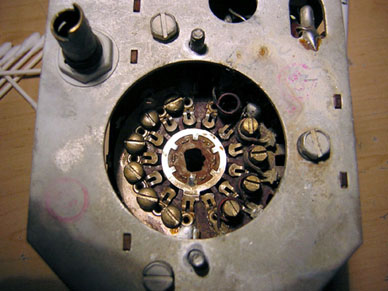
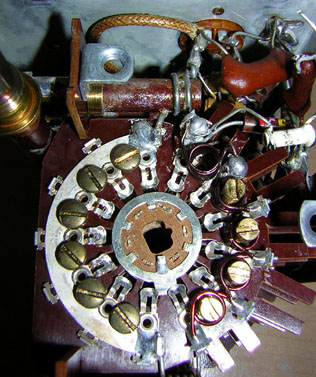
Here's my RCA 630 tuner before and after I ultrasonic'd it in Dawn(Dish Detergent)........
Posted by Dean Kollet (Member # 1789) on 10-12-2004, 09:02 PM:
I would not use handsoap to wash dishes....it's not a detergent
Posted by Manny Knowles (Member # 1171) on 10-12-2004, 10:12 PM:
Dear Diary:
I wonder if Mark cleans his hands ultrasonically, too! ![[Eek!]](eek.gif)
Till the day you die,
Manny.
Posted by Mark Gulbrandsen (Member # 72) on 10-12-2004, 11:08 PM:
quote: Manny Knowles
I wonder if Mark cleans his hands ultrasonically, too!
Sure, when I reach in the claener to remove something.... my hands get cleaned then. Gets the tough dirt out from under your nails really well .
Its a rather odd sensation...... ![[Cool]](cool.gif) .
.
A friend at another web site commented that the tuner wasn't even that clean when it was built in 1946...... I thought good grief.... now I've even removed the original RCA factory dust and dirt, it'll never be the same ![[Frown]](frown.gif) .
.
Mark
Posted by John Hegel (Member # 628) on 10-13-2004, 12:48 AM:
Dawn has a better ability to lift grease and cleanly rinse away. This may not seem like a big deal, but when there is residue left on a food surface bacteria is more likely to grow.
When washing dishes it is a good idea to dip them in a solution of sanitizer and let them air dry.
(yeah, I know I'v worked in food service to long)
Posted by William Hooper (Member # 71) on 10-13-2004, 01:51 AM:
Detergents are "synthetic" in that they were designed. Soaps are also synthesized, from fatty acids & an alkali, but in an older, more easily stone-age process like Granny cooking up some soap in a pot from boiled-down animal fat with an alkaloid added to attach to the broken-up hydrocarbon chain to create the soap molecule. Detergents are also made from "natural" ingredients, but there are more steps to creating the components from junk found in nature.
A soap is a made by taking one of these fragments of a hydrocarbon chain & attaching at one end via another, free molecule a segment which is attracted to water. You then get a long chain molecule (not one of the cute symmetrical ones) which has an end which attracts water (hydrophilic) & one which is repelled by water (hydrophobic). The water gets all up in the molecule, the molecule gets all up in the water, the surface tension of the water molecules' attraction to each other is broken up, & it can get around the target filthiness to bust it loose.
The synthesis of soap is historically from a long chain hydrocarbon animal fat which is broken up, & then an alkali such as sodium hydroxide is added which bonds to one end of the chain. The sodium hydroxide end becomes the hydrophilic end of the soap molecule, & the rest of the molecule terminates with its hydrophobic, hydrocarbon chain regular self.
SODIUM HYDROXIDE!!!!!!
You can shortly digress into considering the either/or nature of solubilities. The quick chemistry class rule is "like dissolves like". Hydrocarbons will dissolve hydrocarbons (they have nonpolar bonds, which is why you don't put gasoline in a 2 liter plastic coke bottle), water which forms polar bonds will dissolve other things with polar bonds (okay let's not go there).
The problem with soap is that the sodium hydroxide end will also react with acids & metals. Then, the molecule becomes the soap scum molecule at that end, thus no longer having a hydrophilic end, & sending that molecules usefulness in breaking up surface tension to zero.
So, the idea is to design that molecule so that it uses something that doesn't react with metals. Sulfur trioxide is useful here instead of sodium hydroxide.
That's basically a detergent. Soaps & detergents are both surfactants, but a detergent is a surfactant that's not a soap.
But you know, now that you've done your designer chemistry on the hydrophilic end, you can also fool around with the hydrophobic end (the end that hates water but cuddles to grease & oil). Different detergents are designed for different purposes, to work on different things. So you can have a hydrophobic end that's designed to be even more reactive with specific oils than soap's. (And you can add other stuff in the box like enzymes, etc. if you want).
Mark's right, Dawn dishwashing detergent is the neatest, most broadly-effective detergent for most techy-projects & greasy mechanical parts thing out there. Cleans the starter you took out the car, cleans your greasy post-took-the-starter-out-the-car hands very well too, although it stings like a booger on any little cuts. Clean those parts up well afterwards though, leaving no detergent behind, & dry them VERY thoroughly immediately so the things don't oxidize (rust, corrode) after the detergent has done its job of getting the water in everywhere! I'd hazard a guess that Mark blasts all the water out with compressed air.
Soaps are generally better for the environment than detergents. You'd rather release more sodium hydroxide (a common, reactive base) into the environment than sulfur (a metal) or other things that are used to create one end of a detergent's molecule or the other.
A page about soap & detergent!
The Professor on Gilligan's Island could cook up soap all day (from what? squirrels? birds?), but couldn't even put together a basic spark gap transmitter! What was he a professor OF, anyway? If you get marooned on a deset island, you want Dan Bouvier there instead of the coconut-centric professor! Dan Bouvier would have a functional Nikolai Tesla-scale monster spark gap transmitter assembled from available part, disrupting satellite transmissions, & boggling the mind!
Posted by Bruce McGee (Member # 131) on 10-13-2004, 08:20 AM:
The professor was brilliant. This was somehow pointed out to the viewers almost weekly during the series run. It was Gilligan and the Howells that kept making the professor want to commit murder. If I had to look at Mary Ann and to a lesser extent, Ginger, all day every day, I'd probably forget some important details, too.
What about the mad doctor on a nearby island? That house looked like it was built by craftsmen... just a short small boat ride from Gilligan's Island. Was it closer to the shipping lanes?
What a morning!
Posted by Mark Hajducki (Member # 1732) on 10-13-2004, 09:37 AM:
According to some definitions detergent is A cleansing agent; anything that cleanses. so soap would be a detergent
Posted by Steve Scott (Member # 630) on 10-13-2004, 10:03 AM:
Bruce, thank you for calling Ginger the "lesser extent." She is way too overrated. Most people can't see that, even after thirty-some years ![[Roll Eyes]](rolleyes.gif)
Posted by Randy Stankey (Member # 64) on 10-13-2004, 02:01 PM:
I would say that, functionally, "soap" and "detergent" are virtually the same product. However, I would point out that there are often other ingredients in some products that are meant for hand washing like moisturizers and extra disinfecting agents. In detergents meant for dishwashing, there are likely to be wetting agents and stuff that aren't good for the skin on a long-term basis.
I would say that you certainly can use hand soap for washing dishes but you are likely to have a thin, microscopic film of moisturizer left on your dishes. Likewise, there's no reason you can't wash your hair with Dawn dishwashing liquid but if you did it for a long time I would expect your hair to become dried out and you might get dry skin on the scalp or other places where the detergent touches.
In other words: In a pinch? Yes! All the time? No.
My favorite all-around soap is Dr. Bronner's Castile Soap
You can wash with it. Do the dishes. Wash the car. Shave with it. Brush your teeth with it. Wash your hair. Probably about 1,000 other things.
I use it because a lot of other soap irritates my skin during the winter time.
Posted by Clint Koch (Member # 1179) on 10-13-2004, 06:11 PM:
Until you get used to Dr. Bronner's Castile Soap you may experience some interesting tingleing in certain parts of your body. Great stuff!!!
Posted by Phil Hill (Member # 371) on 10-13-2004, 06:27 PM:
So Clint, just *what* parts of your body are you washing with this soap that tingles?
>>> Phil
Posted by Clint Koch (Member # 1179) on 10-13-2004, 06:35 PM:
The first time I used was years ago and just about every part of my body felt it. More so in certain areas than others ![[Wink]](wink.gif) . You should try it Phil. Like I said, its great stuff. I used it to shower, shave and brush my teeth so you can use your imagination if you must. Got it from my hippie dippie older brother who was way into all things organic and orgasmic so you get the idea.
. You should try it Phil. Like I said, its great stuff. I used it to shower, shave and brush my teeth so you can use your imagination if you must. Got it from my hippie dippie older brother who was way into all things organic and orgasmic so you get the idea.
Posted by Phil Hill (Member # 371) on 10-13-2004, 07:02 PM:
Ummm... WTF RU talkin' 'bout Clint? Are you like on dope or something? ![[Confused]](confused.gif)
I asked a straight-forward question and got a gobbly-gook answer...
>>> Phil
Posted by Randy Stankey (Member # 64) on 10-13-2004, 07:25 PM:
Yes, when you wash with Dr. Bronner's soap it does have some "zing" to it!
Yes, Phil... It makes a tingling sensation in your "nether regions"! But you get used to it after a few times and you dont' even notice.
They make several different kinds, now. I like to use the Eucalyptus kind.
And... I suppose if you use too much of it, you can get a bit loopy. It IS made from hemp oil! ![[Big Grin]](biggrin.gif)
I don't necessarily use it because it's an organic product. I use it because I get a rash when I use some kinds of soap. I tried Dr. Bronner's once to see whether it irritated my skin. It didn't so I kept on using it. As far as I'm concerned, being an organic product is a bonus.
I've tried brushing my teeth with it. THAT takes some getting used to! I wouldn't do it all the time but if I was travelling, camping or have run out of my regular stuff, I'd use it again.
Oh! And, if you stay out late getting drunk and you don't want your S/O to smell the booze on you, put some on a wet wash cloth and wash up with it before you crawl into bed. The scent of the stuff can cover up just about anything. As a matter of fact, you should just wash up with it every night when you go to bed, anyway. That way your sweetie won't get wise to your tricks when you come to bed smelling all "minty fresh".
This is time-tested advice. It won't work when you come home all stinking drunk but if you've had a few on the way home, they won't be able to tell... At least not by smelling you!
Posted by Phil Hill (Member # 371) on 10-13-2004, 07:48 PM:
quote: Randy Stankey
Yes, Phil... It makes a tingling sensation in your "nether regions"!
That's cool Randy. BUT! IF I want tingling in my "nether regions" it's cuz of a person that I think is hot and makes not only my tongue hard... And! That's NOT a soap!
>>> Phil
Posted by Randy Stankey (Member # 64) on 10-13-2004, 10:09 PM:
What if you had that special person AND some soap and some... Oh, never mind. You get the picture! ![[sex]](graemlins/sex.gif)
Powered by Infopop Corporation
UBB.classicTM
6.3.1.2