This is topic CAP Code from your Laser Printer in forum Film-Yak at Film-Tech Forum ARCHIVE.
To visit this topic, use this URL:
https://ft-forum.com/ft/cgi-bin/ubb/ultimatebb.cgi?ubb=get_topic;f=8;t=003716
Posted by Thomas Procyk (Member # 1170) on 11-23-2004, 10:29 AM:
Government Uses Color Laser Printer Technology to Track Documents
Jason Tuohey, Medill News Service
WASHINGTON--Next time you make a printout from your color laser printer, shine an LED flashlight beam on it and examine it closely with a magnifying glass. You might be able to see the small, scattered yellow dots printer there that could be used to trace the document back to you.
According to experts, several printer companies quietly encode the serial number and the manufacturing code of their color laser printers and color copiers on every document those machines produce. Governments, including the United States, already use the hidden markings to track counterfeiters.
Peter Crean, a senior research fellow at Xerox, says his company's laser printers, copiers and multifunction workstations, such as its WorkCentre Pro series, put the "serial number of each machine coded in little yellow dots" in every printout. The millimeter-sized dots appear about every inch on a page, nestled within the printed words and margins.
"It's a trail back to you, like a license plate," Crean says.
The dots' minuscule size, covering less than one-thousandth of the page, along with their color combination of yellow on white, makes them invisible to the naked eye, Crean says. One way to determine if your color laser is applying this tracking process is to shine a blue LED light--say, from a keychain laser flashlight--on your page and use a magnifier.
Crime Fighting vs. Privacy
Laser-printing technology makes it incredibly easy to counterfeit money and documents, and Crean says the dots, in use in some printers for decades, allow law enforcement to identify and track down counterfeiters.
However, they could also be employed to track a document back to any person or business that printed it. Although the technology has existed for a long time, printer companies have not been required to notify customers of the feature.
Lorelei Pagano, a counterfeiting specialist with the U.S. Secret Service, stresses that the government uses the embedded serial numbers only when alerted to a forgery. "The only time any information is gained from these documents is purely in [the case of] a criminal act," she says.
John Morris, a lawyer for The Center for Democracy and Technology, says, "That type of assurance doesn't really assure me at all, unless there's some type of statute." He adds, "At a bare minimum, there needs to be a notice to consumers."
If the practice disturbs you, don't bother trying to disable the encoding mechanism--you'll probably just break your printer.
Crean describes the device as a chip located "way in the machine, right near the laser" that embeds the dots when the document "is about 20 billionths of a second" from printing.
"Standard mischief won't get you around it," Crean adds.
Neither Crean nor Pagano has an estimate of how many laser printers, copiers, and multifunction devices track documents, but they say that the practice is commonplace among major printer companies.
"The industry absolutely has been extraordinarily helpful [to law enforcement]," Pagano says.
According to Pagano, counterfeiting cases are brought to the Secret Service, which checks the documents, determines the brand and serial number of the printer, and contacts the company. Some, like Xerox, have a customer database, and they share the information with the government.
Crean says Xerox and the government have a good relationship. "The U.S. government had been on board all along--they would actually come out to our labs," Crean says.
History
Unlike ink jet printers, laser printers, fax machines, and copiers fire a laser through a mirror and series of lenses to embed the document or image on a page. Such devices range from a little over $100 to more than $1000, and are designed for both home and office.
Crean says Xerox pioneered this technology about 20 years ago, to assuage fears that their color copiers could easily be used to counterfeit bills.
"We developed the first (encoding mechanism) in house because several countries had expressed concern about allowing us to sell the printers in their country," Crean says.
Since then, he says, many other companies have adopted the practice.
The United States is not the only country teaming with private industry to fight counterfeiters. A recent article points to the Dutch government as using similar anticounterfeiting methods, and cites Canon as a company with encoding technology. Canon USA declined to comment.
-----
If you plan to make illegal documents now you must purchase a used printer and do not register the software drivers with the manufacturer. Also, if you are only printing text remove the color toner cartridge completely and use the cheap, "remanufactured" black toner so that it blurrs enough. ![[Wink]](wink.gif)
![[Big Grin]](biggrin.gif)
=TMP=
Posted by Leo Enticknap (Member # 534) on 11-23-2004, 11:44 AM:
Either that or pay cash for your new printer and make sure that you don't pass any personal details during the transaction. Of course if the bogies find the actual printer in your house or office they can still link you to anything it printed; but I dobt if any organised criminal or terrorist would be as stupid as to leave one lying around if it had been used to print confidential documents which could have fallen into the hands of the law. In a way this is nothing new - before the days of laser printers anonymous notes were sent by sticking bits of newsprint on a page, because a typewriter could also be uniquely identified from any piece of paper which had gone through it.
I did exactly the same thing when I bought a 'pay as you go' mobile 'phone a couple of years ago. Its predecessor had been on a contract with the result that that I was bombarded with spam messages, junk mail & email and even 'phone calls to my home landline trying to sell me a more expensive contract or 'special offer' from the 'phone company. After terminating that contract and moving to a pre-pay I bought it with cash, did not send in the registration card and have ignored the text messages which regularly appear on it offering me free calling credit if I register my name and address. The scary thing is that I've got a legitimate reason for wanting to do this (i.e. not be bombarded with spam) - but using prepay mobiles anonymously would be equally useful for organised criminals and terrorists, IMHO.
Posted by Adam Wilbert (Member # 1184) on 11-23-2004, 02:34 PM:
if only real cap codes were invisible to the eye... ![[Frown]](frown.gif)
quote: Lorelei Pagano
The only time any information is gained from these documents is purely in [the case of] a criminal act.
...or when operating under the umbrella of the PATRIOT Act. Whichever comes first.
Posted by Mark Lensenmayer (Member # 134) on 11-23-2004, 03:52 PM:
Wouldn't it be possible to overlay a pattern of identical dots on the page in different areas to confuse the analyst? A PhotoShop layer should be able to handle that.
Not exactly simple, but possible.
If I was doing this for evil purposes, I'd use the printer for a short time then destroy as much as possible and sink it to the bottom of a nearby lake or river. If it can't be found, it can't be proved yours.
Posted by Scott Norwood (Member # 30) on 11-23-2004, 05:45 PM:
I still haven't figured out what the incentive is for the manufacturers to include this "feature." If anything, it seems likely to make people want to _not_ buy the product. I don't necessarily have any problem with the concept, but it really should be disclosed to buyers that their printouts will be intentionally mangled by the device.
Posted by Kyle McEachern (Member # 2250) on 11-23-2004, 06:24 PM:
Just like a trailer saying there are going to be big dots covering great portions of the screen at the brightest, most colorful shots in a movie?
They add it because it's an anti-piracy/anti-counterfeiting measure, and by helping prevent things like counterfeit money and/or the redistribution of important coporate files/memos/etc., it gets them in good with the government and with large corporations that try to keep their business a secret...so screw the consumer!
Posted by Phil Hill (Member # 371) on 11-23-2004, 08:24 PM:
quote: KYle
...it gets them in good with the government and with large corporations that try to keep their business a secret...so screw the consumer!
I agree K-Y... that seems to "jell".
Posted by Randy Stankey (Member # 64) on 11-23-2004, 08:41 PM:
To be honest, I'd have to say this is a bullshit story.
There's no way, even if you paid by credit card, that "they" can positively link a given piece of equipment to any certain person. "They" don't keep THAT kind of detailed records.
It just doesn't make sense.
There are plenty of other forensic tests to determine whether a person is responsible for printing a given document. It doesn't take a digital signature to figure it out, either! Way back in the 1930's a guy by the name of Alger Hiss was convicted for being a Soviet Spy on the basis of the forensic analysis of a typewritten document. Hiss owned a Woodstock typewriter which had irregularities in the characters that exactly matched those in the recovered documents that he was accused of stealing. There's no reason that modern forensic analysis can't use similar methods to match a given piece of paper to a certain piece of equipment.
They don't need a computerized code to do it.
Therefore, I wave the "Bullshit Flag".
Posted by Adam Wilbert (Member # 1184) on 11-26-2004, 04:47 PM:
Typewriters and laser printers are totally different devices. Typewriters are subject to worn keys or dropped characters, and the forensics is closer to handwriting analysis than anything else. Lasers are not subject to such "personality". Keep in mind that this only affects COLOR laser printers (bw lasers don't have yellow toner) And since most of these are in corporate use, I'm positive that they can be tracked. What company doesn't have a service contract on their equipment? All of this is done by tracking serial numbers. And who wouldn't waranty register their new $10,000 printer?
Again, I have to point out that the "screw the consumer" and "mangled printout" argument is moot, since the damn watermark is INVISIBLE. It's not at all like a CAP code.
Posted by Randy Stankey (Member # 64) on 11-26-2004, 10:55 PM:
I agree that typewriters and laser printers work differently. The fornesic methods for analyzing pages from a laser printer would be different from the methods used to analyze a page from a typewriter but I think it still can be done.
I have seen where forensic analysis of a photocopy can track its origin down to the Kinko's copy shop where it was made and even to the machine on which the copy was made.
Everything from type/brand of toner or ink on the page to the type/brand of paper to microscopic marks left on the paper by the rollers and internal parts of the printer or copier can be analyzed. Further, paper makes a great medium to retrieve fingerprints from. Just spray on a little solution of silver nitrate (or something like that) and the fingerprints show up clear as day.
The analogy I was making was that, IF they can perform these kinds of forensic analyses back in the 1930's, they certainly can perform similar tests today with much more detail and accuracy than they could ever dream of back then.
Surely, that kind of analysis would turn up something.
Posted by Steve Kraus (Member # 476) on 11-27-2004, 12:46 PM:
Will someone with a recent model color laser please investigate this assertion and let us know what you find?
Posted by Randy Stankey (Member # 64) on 11-27-2004, 06:05 PM:
I second that motion! ![[Smile]](smile.gif)
Posted by Adam Wilbert (Member # 1184) on 11-27-2004, 08:10 PM:
I printed out a page (this page, actually) on a Xerox Docucolor 12, took it out to my car where i have a blue led map light that plugs into the cigarette lighter, and took some pictures. The dot pattern is plainly visible to the human eye under the blue led light, but completely invisible under normal light. It makes about a 1/2" x 1/2" grid across the entire paper, with every other square filled with a repeating dot pattern. The whole page looks like a checkerboard. I was really suprised by how many there were. Please excuse the pictures as it was not exactly an exact setup in the car, cold, and dark.
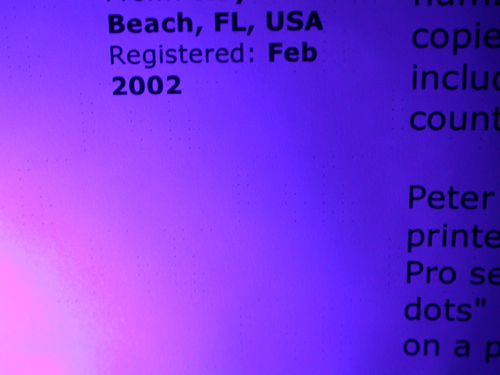
a picture of the white space below Thomas' picture.
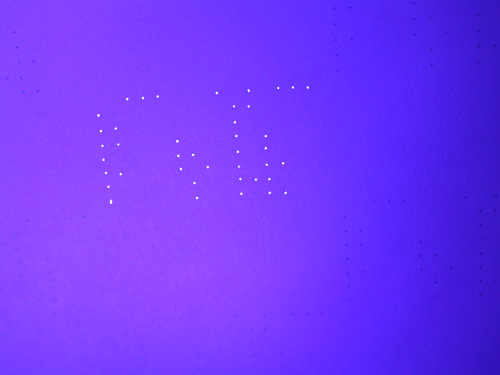
a closeup with one block photoshop assisted so that you can see what you are looking for!
Posted by Ben Holley (Member # 2247) on 11-27-2004, 08:56 PM:
honestly, this scares the hell out of me, if this goes unchecked just imagine what this could open the door for, can anyone tell me if they have this crap in canada or australia...but then again, i am a very paranoid person ![[uhoh]](graemlins/uhoh.gif)
Posted by Steve Kraus (Member # 476) on 11-27-2004, 11:26 PM:
So these machines are incapable of printing a field of pure subtractive primary...say a block of magenta...without being corrupted by yellow dots?
Posted by Kyle McEachern (Member # 2250) on 11-27-2004, 11:41 PM:
I believe the statement of it being "Photoshop Assisted" implied that the dots were black (as they appear in the top photo), and the yellow was added by him.
Posted by Adam Wilbert (Member # 1184) on 11-27-2004, 11:59 PM:
The dots are printed with yellow toner. Under the blue LED light, they show up black (or "dark" anyway). I colored a few white so that they would show up easier in the photo. Where there was a block of full color printing (like on the picture of Thomas), I couldn't see any dots, but I wasn't using a magnifier. It also appeared that the dots extended into what is normally a 1/4" unprintable margin space, so even if the entire page was covered in toner (as in reproducing a photograph for instance) some of the code would still be preserved. I'm not totally sure about this last part though and will have to look into it further.
Posted by Thomas Procyk (Member # 1170) on 11-28-2004, 09:19 PM:
So basically, it will track the document to the printer (wherever it may be) and not to the person? Copy Protection done wrong!
=TMP=
Posted by John Pytlak (Member # 331) on 11-29-2004, 10:28 AM:
Kodak is one of the leading providers of digital watermarking technology:
Kodak Watermarking Technology for Digital Cinema
quote:
For movies that are distributed electronically to theaters, a Kodak Digital Cinema projector can continuously embed a small amount of data into the movie when it is shown. Each showing of the movie is given a unique, invisible digital watermark identifying the date, time and theater of that particular showing. So if a camcorder is used to capture that movie, the videotape also records the watermark embedded throughout. As a result, a series of frames from a suspected bootleg copy of a movie can be examined to determine the time and place of theft, which can help with the apprehension of movies pirates.
Kodak recently demonstrated an industry milestone: the extraction of 16-bit digital watermark data from as few as 15 frames.
Kodak Digital Watermarking
Kodak Technical Paper on "Data Embedding"
Posted by Ron Yost (Member # 1850) on 11-29-2004, 12:19 PM:
For what it's worth, I tried the blue led light test on output from my Konica/Minolta Magicolor 2300 DL. Result: No coded 'pattern' visible at all. Nothing. Nada.
Ron Yost
Posted by Thomas Procyk (Member # 1170) on 11-30-2004, 08:46 AM:
Well, what are you waiting for, Ron? Print me up some of those snazzy new $50's! ![[thumbsup]](graemlins/thumbsup.gif)
=TMP=
Powered by Infopop Corporation
UBB.classicTM
6.3.1.2