This is topic Trivia question - what does VHS stand for? in forum Film-Yak at Film-Tech Forum ARCHIVE.
To visit this topic, use this URL:
https://ft-forum.com/ft/cgi-bin/ubb/ultimatebb.cgi?ubb=get_topic;f=8;t=003879
Posted by Leo Enticknap (Member # 534) on 02-05-2005, 03:53 PM:
I'm convinced that it's 'Victor Helical Scan', but a friend is adamant that it's 'Video Home System'. Can anyone give a definitive answer? Cheers...
Posted by Mike Blakesley (Member # 26) on 02-05-2005, 04:07 PM:
'Video Home System' is correct.
Posted by Bruce McGee (Member # 131) on 02-05-2005, 04:07 PM:
I was always told that it is Video Home System.
I didn't know that JVC was Japanese Victor Corporation for many years.
Posted by Phil Hill (Member # 371) on 02-05-2005, 04:58 PM:
Actually you both are right. In the beginning, there was darkness. On the 7th day, JVC (Japan Victor Corporation, or more correctly: Victor Company of Japan) invented VHS which did stand for "Victor Helical Scan." It was a much simpler format as compared to the arguably better, but much more complicated/costly Sony Beta system that was based on their U-Matic format. As usual, Sony's arrogant stubbornness resulted in them losing that format war and set a precedence for other losses in format wars including SDDS.
In an effort to capture the home market away from Sony, the marketing "geniuses" at JVC marketed the system and licensed the technology to everyone under "Video Home System."
Posted by Floyd Justin Newton (Member # 1316) on 02-05-2005, 05:39 PM:
Oh............................................... ![[Wink]](wink.gif)
Posted by Michael Schaffer (Member # 1204) on 02-05-2005, 06:29 PM:
Just like "Digital Video Disc" became "Digital Versatile Disc" when it dawned on them that it could be used for data and audio as well.
Speaking of SDDS, I heard a few times that was originally supposed to mean "Sony Dolby Digital Sound", but Dolby decided to pursue their own project, so it became "Dynamic". But I don't know if that's true.
Posted by Alexander Smith (Member # 1769) on 02-05-2005, 06:29 PM:
Prior to NICAM home VHS decks, VHS was referred to by many
people as "Very Hissy Sound"
Alex.
Posted by Paul Mayer (Member # 355) on 02-05-2005, 09:12 PM:
Very Hazy Signal.
And SDDS was Still Doesn't Do Shit.
Posted by Mike Blakesley (Member # 26) on 02-05-2005, 11:16 PM:
I have read that DVD now, officially, doesn't stand for anything.
Posted by Joe Redifer (Member # 3) on 02-06-2005, 12:18 AM:
Supposedly it has never stood for anything.
Posted by Eric Webb (Member # 2772) on 02-06-2005, 01:20 AM:
quote:
VHS
From Wikipedia, the free encyclopedia.
The Video Home System, better known by its acronym VHS, is a recording and playing standard for video cassette recorders (VCRs), developed by JVC (ironically, with some of its critical technology under lucrative licensing agreements with Sony) and launched in 1976. VHS officially stands for Video Home System, but it initially stood for Vertical Helical Scan, after the relative head/tape scan technique. Some early reports claim the name originally stood for Victor Helical Scan system.
VHS became a standard format for consumer recording and viewing in the 1980s after competing in a fierce format war with Sony's Betamax and, to a lesser extent, Philips' Video 2000. VHS initially offered a longer playing time than the Betamax system, and it also had the advantage of a far less complex tape transport mechanism. A VHS machine can rewind and fast forward the tape considerably faster than a Betamax VCR since it unthreads the tape from the playback heads before commencing any high-speed winding. On the other hand, Betamax offers superior picture quality. See VCR for more details.
A VHS cassette contains a 12.65 mm (approx ½-inch) wide magnetic tape wound between two spools, allowing it to be slowly passed over the various playback and recording heads of the video cassette recorder. VHS tapes have approximately 3 MHz of bandwidth, and a horizontal resolution of about 240 lines per scanline [1] The vertical resolution of VHS is determined by the TV standard — a maximum of 486 lines are visible in NTSC and a maximum of 576 lines in PAL.
Several improved versions of VHS exist, most notably S-VHS, an improved analog standard, and D-VHS, which records digital video onto a VHS form factor tape. Devices have also been invented which directly connect a personal computer to VHS tape recorders for use as a data backup device.
Another variant is VHS-C (C for compact), used in some camcorders. Since VHS-C tapes are based on the same magnetic tape as full size tapes, they can be played back in standard VHS players using an adapter. The magnetic tape on VHS-C cassettes is wound on one main spool and used a sort of a gear wheel which moves the tape forward. It can also be moved by hand and so is the spool. This development hampered the sales of the Betamax system somewhat, because the Betamax cassette geometry prevented a similar development
Thought this should be added
Posted by Michael Schaffer (Member # 1204) on 02-06-2005, 04:44 AM:
quote: Mike Blakesley
I have read that DVD now, officially, doesn't stand for anything.
That's because they changed the meaning (see above). Officially, it doesn't mean anything now, but it's not always been like that.
Posted by Leo Enticknap (Member # 534) on 02-06-2005, 04:46 AM:
Thanks folks... I guess that means we owe each other a beer!
quote: Alexander Smith
Prior to NICAM home VHS decks, VHS was referred to by many
people as "Very Hissy Sound"
Does that mean that VHS hi-fi decks didn't exist before the NICAM digital audio broadcasting system came in? I'd have thought that before then you could have at least recorded off-air onto a VHS hi-fi track, though admittedly it would just be FM mono. Though that having been said, 99.99% of VCRs were probably linear only because there wouldn't have been any mass-market for recording stereo sound on a domestic videotape when none was being broadcast for people to record. A small minority of audio buffs might have had them to play prerecorded tapes, but that would have been about it.
Posted by Pete Naples (Member # 761) on 02-06-2005, 07:08 AM:
HiFi Stereo VHS decks were available long before NICAM was born, Panasonic amongst others made them, mainly for the prosumer market, IIRC many were edit decks.
Somewhere in my parents loft is a pair of JVC edit VHS edit decks with controller, they are HiFi Stereo with Dolby NR. Probably quite expensive in their day, haven't been used in years!
Posted by Mark Gulbrandsen (Member # 72) on 02-06-2005, 10:44 AM:
quote:
The Video Home System, better known by its acronym VHS, is a recording and playing standard for video cassette recorders (VCRs), developed by JVC (ironically, with some of its critical technology under lucrative licensing agreements with Sony) and launched in 1976.
Eric that is absolutely correct!
quote:
but it initially stood for Vertical Helical Scan, after the relative head/tape scan technique.
The actual inventor of the VHS system was Sony but they discarded it in favor of the slightly higher quality Beta system. This resulted in many of the Sony designed VHS "pieces" needing to be licensced from Sony Corp!! When I worked at Panasonic I was lucky enough to attended the very first VHS repair seminars hend at Panasonic's headquarters in Secacus. During a brief explanation of the evolution of VHS at the seminar this was an interesting tid-bit they mentioned! The second quote is also correct as per the seminar.
BTW: The very first Panasonic machine was the PV-1000 and its model number directly reflected its price tag..... Although I'm not 100% sure I think Panasonic may have also beat JVC to the market place with home VHS machines.......
Mark
Posted by Marc Hansen (Member # 705) on 02-06-2005, 11:26 AM:
The first JVC beat them by a couple of months but was 2 hours only and did not use off-azmith recording.
Posted by Bobby Henderson (Member # 840) on 02-06-2005, 12:02 PM:
quote: Michael Schaffer
Speaking of SDDS, I heard a few times that was originally supposed to mean "Sony Dolby Digital Sound", but Dolby decided to pursue their own project, so it became "Dynamic". But I don't know if that's true.
I think that's one of those confusions that came about from all the alphabet-soup acronyms of theatrical sound formats. For instance, I had seen numerous ads in newspapers that assumed DTS stood for Dolby Theater Sound.
Dolby's "AC-2" codec was already in use at the end of the 1980's for purposes like satellite audio transmission and tele-conferencing. Cinema Digital Sound's debut in 1990 made Dolby rush an early announcement for Dolby Digital early in 1991, well before its theatrical debut in summer of 1992. By then the Dolby codec had been improved to a new version, "AC-3". SDDS didn't have their first prototype players ready until 1993. It was late summer 1994 before actual SDDS units went on sale to exhibitors.
Posted by Mark Gulbrandsen (Member # 72) on 02-06-2005, 07:58 PM:
Bobby,
Sony DOES license alot of the parts of their system from Dolby! No matter what name they came up with it still sucks...... also wasn't CDS compression free? Son did some of the first demos of SDDS from hard drive. One showest demo was done this way.
Mark
Posted by Michael Schaffer (Member # 1204) on 02-06-2005, 11:50 PM:
quote: Bobby Henderson
For instance, I had seen numerous ads in newspapers that assumed DTS stood for Dolby Theater Sound.
Yeah, but that's just plain stupid! I think I actually heard the SDDS-Dolby connection thing from some actual Sony or Dolby people. But - I can't seem to remember now who that was...
Posted by Monte L Fullmer (Member # 2797) on 02-23-2005, 05:15 AM:
quote: Marc Hansen
The first JVC beat them by a couple of months but was 2 hours only and did not use off-azmith recording
...wasn't that the JVC HB-3300 "VidStar" machine - the one with the dual rotary tuning dials to the right of the cassette loading door - the picture below?
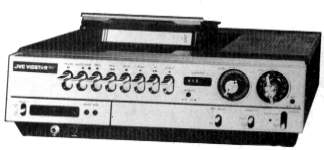
Being a single speed (SP) unit, didn't the VidStar also have a larger "write" area on the tape being that the heads were larger in surface area, thus having more lines of resolution, or just more clarity than the later 2 and 3 speed units of all of the other manufacturers?
I have a Magnavox(Panasonic) VR-8417 that I purchased back in 1984 - one of the first HiFi units to be released. Just a 4 head-2 video and 2 audio. Unit setup is included as an audio recorder along with video, with VU's, input slider adjustments, Dolby "B" encoding for the linear track, and of course dBx "sound exander" configuration for the HiFi FM recording.
Only thing I had to replace is the mode switch, and that was about 7 yrs ago.
Can't find these kind of recorders anymore.
-thx Monte
Posted by Mitchell Dvoskin (Member # 751) on 02-23-2005, 08:00 AM:
VHS - Vertical Horizontal Suck
VHS - Very Horrible System
ßetamax Forever!
Posted by Marc Hansen (Member # 705) on 02-23-2005, 10:39 AM:
Monte,
Couldn't quote the model number but the pic looks right. It did leave space between the tracks instead of laying them against each other and putting the two heads on the head drum at different azmiths to prevent them from reading info from the adjacent track. the resolution is about the same but the S/N was better. It used more tape of course so 2 hours only. I don't have one any more but I think I still have a clear plex display top for one. It was such new technology that the customers wanted to see how it worked.
Posted by Jeffry L. Johnson (Member # 453) on 02-23-2005, 11:37 AM:
Yes, Cinema Digital Sound (CDS) used lossless compression.
Posted by Bobby Henderson (Member # 840) on 02-23-2005, 12:25 PM:
A couple years ago someone posted some technical stuff about CDS in the forums. It could have been Steve Kraus. Anyway, CDS used Delta Modulation for lossless compression. Still, the print had over 6 million bits of data being processed per second. I'm sure a bunch of that had to be for error correction and data redundancy. It's nearly double the number of bits you would need for 5.1 channels of standard 16-bit 44.1kHz LPCM.
Posted by Evans A Criswell (Member # 381) on 02-25-2005, 01:17 PM:
Using a larger writing area on the tape (the full 58 micron apace between tracks) gives better signal-to-noise, but not resolution. The head-to-tape writing speed is actually slightly faster on EP than SP, although by a negligible amount.
It's a shame that the VHS system was unable to record the composite video signal directly like quad and Type C machines. That cruddy color-under system that the U-Matic, Beta, VHS, and all the "super" versions used (increasing the luminance bandwidth but not the color) ruined them.
Posted by Monte L Fullmer (Member # 2797) on 02-26-2005, 03:43 AM:
quote: Evans A Criswell
It's a shame that the VHS system was unable to record the composite video signal directly like quad and Type C machines
..is that what's called "Base band" video?
-thx Monte
Posted by Paul Mayer (Member # 355) on 02-26-2005, 08:37 PM:
"Baseband" just means any signal that can modulate a carrier. In the case of video, baseband refers to the video signal prior to the input of an RF modulator or transmitter.
Video tape recorders modulate an FM carrier with the baseband video signal. The FM RF signal is what is actually recorded onto the tape. On quad machines there were several sets of FM carrier frequencies used to represent the sync tips, blanking level, and peak whites of the video signal:
Low-band mono: Sync tip 4.28 MHz, blanking 5 MHz, 100IRE 6.8 MHz.
Low-band color: Sync tip 5.5 MHz, blanking 5.79 MHz, 100IRE 6.5 MHz.
High-band: Sync tip 7.06 MHz, blanking 7.9 MHz, 100IRE 10 MHz.
High-band performance was good enough that it was adopted as the modulation standard for Type C when it came along. Most quad machines were eventually upgraded to high-band capability. Due to their lower tape writing speeds, helical consumer and U-Matic machines don't have the frequency response needed to handle the high end of these carrier frequency sets (where the color information is)--that's why they adopted JVC's color-under modulation scheme.
Posted by Monte L Fullmer (Member # 2797) on 02-27-2005, 03:03 AM:
quote: Paul Mayer
color-under modulation scheme.
What is this "color-undermodulation scheme"- more or less of a lesser frequency to be the FM carrier signal for the video signal, and is the the basic reason for any of the helical scan machine, reel or cassette, playback much lesser than the Quadraplex playbacks?
Course, quads with their 14k/rpm plus spinning heads in air bearings and with the 2inch tape speed at 15ips really helps this quality stand out as well.
I do thank you for clearing this up some and answering this small question that I had on this about video.
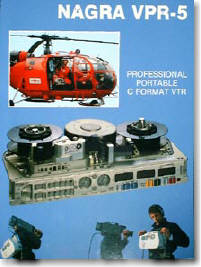
Here's a pict of the AMPEX/NAGRA VPR-5 that uses the "C" format.
I'm quite amateurish in this field and learning some.
thx-Monte
[ 02-27-2005, 04:22 AM: Message edited by: Monte L Fullmer ]
Posted by Leo Enticknap (Member # 534) on 02-27-2005, 09:59 AM:
Wow! What was the maximum running time on one of those reels? This looks to me like an attempt to produce a broadcast-standard portable VTR just before UMatic ushered in the age of ENG - late '60s, perhaps? The pic of the helicopter on the brochure makes clear what it was intended for, I guess.
Posted by Richard Fowler (Member # 893) on 02-27-2005, 04:12 PM:
The basic unit was set up for 20 minute reels; by rearranging the reel hub location the unit could pay 60 minute length....a mechanical work of art that tilted the scales with a 15 lb / 6.8 kg package.
Posted by Paul Mayer (Member # 355) on 02-27-2005, 06:37 PM:
Heh heh, my favorite of portable VTRs was the Ampex VR-3000 (quad, not Type C!):
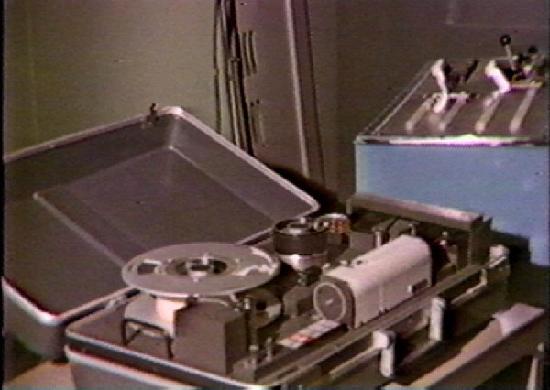
Built into a suitcase, weighed 55 lbs. Battery or AC power. Built-in compressor for the vacuum tape guide, roller ball bearings for the head wheel. Could record high-band on 20 minute reels of 2" tape. No erase heads, so only blank tape could be used. No time base correction, just raw demodulator output, so playback was not legal for air but you could patch a monitor to it to verify the recording. At TAV we used to use these for location recordings at places where our 40' production trucks would've been too unwieldy.
Type C records high band. So even though it is a helical system it doesn't need to use color-under.
Color-under downconverts just the color subcarrier from 3.58 MHz (NTSC) down to 629 kHz for VHS and S-VHS, well within the passband of these machines. The video carrier frequency remained unchanged. Not very high quality, but it was an ingenious way to get some kind of acceptable color in a consumer format.
Posted by Monte L Fullmer (Member # 2797) on 02-28-2005, 12:50 AM:
Okey, for the early home video units that had to come from across from the "land of the rising sun", I found this Roberts VR1000 in almost mint condition (outside of the slightly weatherbeaten case), and being fully functional....for $35.00
Unit is both an open reel stereo recorder, plus a reel video recorder, which has only B/W playback only.
This pict below is of the unit with the tape laced through the video section of the head assemblies for picture taking purposes..(of course, I would NEVER use audio tape as video tape..lol). The helical head layout was set at an angle since the tape path was straight across, not with one reel higher than the other as with other open reel helical scan decks, as did the SONY, JVC, HITACHI..et.al. . Head rotational speed was 1440rpm.
When rewinding or fast forwarding the tape, it was best to take the tape out of the drumhead area and just have the tape pass over the top roller, thus saving the wear on the heads, and allow less tension during the fast movement of the tape.
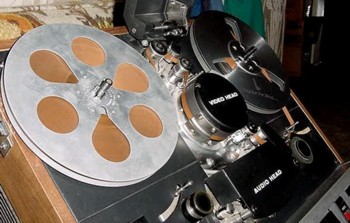
This pict below is of the unit in actual video playback. Tape speed at 11.5ips, and the 5inch reel holds 25minutes. Video playback is the "baseband", or unmodulated using RCA I/O connections to the TV. Special video tape was used for this machine.
Audio is the standard 3.75ips and the 7.5ips speeds.
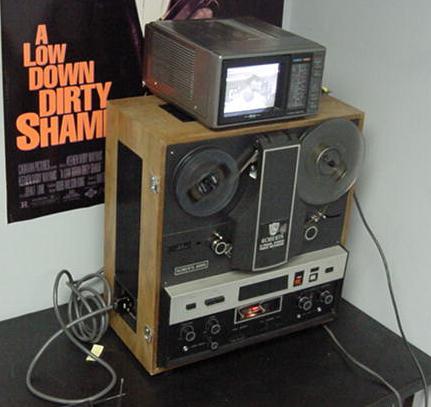
I call this unit, the "LEVIATHAN", being that it weighs in at 85lbs!
Unit was released in late fall of 1969 and continued until late 1970. Price with B/W camera and special monitor (being that the connection cable had it's own jack and socket assembly-like 8 mini cables with one cable) to play back the tapes, was $1300.00 Tapes alone were about 20 bucks a roll for the 5inch size.
With the usage of both kinds of tape, both audio and video, the amateur user would use audio for the video section, and with the abrasiveness of audio tape, ate the video heads in an alarming rate.
One might say, with the advanced design of this unit and what 1969 had to offer in electronic devices where the public wasn't ready for this, this unit sooned disappeared.
Also, this unit being made by AKAI, didn't follow the EIAJ standards, thus this machine was only compatible with their portable VT-100 units.
-thx Monte
Posted by Josh Jones (Member # 447) on 02-28-2005, 06:00 PM:
I messed around with a set of Sony/RCA BVH-1100's a few years ago. Interesting machines, to say the least. They wouldnt playback without a sync reference, and wouldnt record either. They were so large I no longer had room for them, but kept the head drums as souveniers.
JJ
Powered by Infopop Corporation
UBB.classicTM
6.3.1.2