This is topic A380 - world's largest pasenger aircraft - makes maiden flight in forum Film-Yak at Film-Tech Forum ARCHIVE.
To visit this topic, use this URL:
https://ft-forum.com/ft/cgi-bin/ubb/ultimatebb.cgi?ubb=get_topic;f=8;t=004034
Posted by Leo Enticknap (Member # 534) on 04-27-2005, 04:44 AM:
quote: BBC News Online
The world's largest passenger plane, the Airbus A380, has taken off on its long-awaited maiden flight.
Thousands of aeroplane enthusiasts, many of them clapping and cheering, witnessed the twin-deck "superjumbo" taking to the air for the first time. The flight was due to last between one and five hours, depending on weather conditions and how the plane handled. The A380 took off from its production site in Toulouse with a crew of six and about 20 tonnes of test equipment.
Airbus, which is owned by European firm EADS and the UK's BAE Systems, sees the A380 as the future of air travel. Arch-rival Boeing has instead chosen to focus on mid-sized short-haul aircraft.
The A380 - designed to carry as many as 840 people between major airports - took off from its production site in Toulouse, southern France. The crew were expected to take the plane out over the Bay of Biscay, before returning to base.
The crew were equipped with parachutes. And a handrail has been fitted, leading from the cockpit to an escape door. During the flight, there will be a live satellite feed of data which will be monitored by a team of experts on the ground, Airbus said.
Earlier Airbus test pilot Jacques Rosay told the BBC: "We are confident with what has been done up to today. "But we still have some doubts. We have to be very careful during all the flight because, as you say, when you are looking at new things, something may happen. But we are still very confident."
More than 50,000 people are thought to have watched the take-off, many of them sitting on the grass banks that line the runway. The take-off was also broadcast live on television and thousands of enthusiasts watched via a giant screen in Toulouse's main square.
Most of the tests will be carried out at 10,000 feet and within 100 miles of Toulouse, said Peter Chandler, deputy project pilot for the A380. He added that the plane was flying with its wheels down as a safety measure, and that the A380's hydraulics and electrics had all been tested while it was on the ground.
More than a year of flight-testing and certification-programme work will now follow before the A380 starts commercial services. Pilots will then have to push the plane far harder then they have on Wednesday, testing for extremes of speed, altitude and temperature, experts said.
The project, hailed as a European success story by leaders including France's President Jacques Chirac, has had its share of problems. In December 2004, Airbus' main shareholder EADS, which has an 80% stake, revealed that the project was £1bn (1.5bn euros; $1.9bn) over budget, at more than £8.4bn. The UK's BAE Systems owns the remaining 20% of Airbus.
The video looked amazing - 500 tons of aircraft seemed to just float off the ground effortlessly, at what looked like a very low speed and with hardly any noise compared to what you'd expect from a big airliner (though that could have been the audio recording and/or streamed compression). And they say that this plane uses much less fuel per passenger and could reduce the price of a transatlantic ticket by 20-20% - that must be good news in these days of global warming and high oil prices.
But it's still got to get back down in one piece, though! ![[evil]](graemlins/evil.gif)
EDIT: Sorry that a duplicate thread has appeared. Nothing happened for about 20 seconds after pressing the send button, so I pressed 'back' and tried again.
Posted by Mark Gulbrandsen (Member # 72) on 04-27-2005, 08:18 AM:
I watched it too but I wouldn't set foot on an Airbus ![[Eek!]](eek.gif) . They have made too many serious oops mistakes over the years.... A recent incident of an A-310 in Cuba.... almost coulda been a duplicate of the crash in n.y. right after 911.
. They have made too many serious oops mistakes over the years.... A recent incident of an A-310 in Cuba.... almost coulda been a duplicate of the crash in n.y. right after 911.
I can see its use for long haul cargo but....
I wouldn't wanna be in the same terminal when one of them de-planes all its passengers...
I wouldn't want to pick up the thousands of body parts when one crashes... and one eventually will.... every airbus has upheld that promise sooner than later.....
I wish all of you who fly on them a big good luck though.... I'll stick with U.S. made jets.... they have a better record overall. I am not aware of a 777 that has fallen apart in flight.
Mark
Posted by Dustin Mitchell (Member # 372) on 04-27-2005, 12:20 PM:
How many Airbus crashes have been due to poor design/workmanship though as opposed to airline maintenance issues?
Posted by Leo Enticknap (Member # 534) on 04-27-2005, 01:59 PM:
...or pilot error, navigation error, air traffic control error, software failure (though that could come under the heading of poor workmanship/maintenance), acts of terrorism/sabotage, freak weather and all the other things which can cause an air crash?
After a little Googling all I could find were these figures. If they paint an accurate picture of the safety of the planes per se, then they'd suggest that the Boeing mid-range, mid-capacity jets (i.e. the 757 & 767) are significantly safer than their Airbus equivalents, but that the Airbus A32X is safer than its Boeing long-range competitor. But those figures don't tell us what caused those incidents: they just tot up the total number of crashes per aircraft type. So, for example, it could be that the 747 has long been considered a symbolic terrorist target, and that therefore those statistics give a misleading picture of how safe the plane inherently is. By the same token, BMWs and Mercs regularly top the death toll list of car types. Is that because the cars are badly designed? No; it's because drivers with more money than sense tend to buy them. And according to these figures, Concorde was the most dangerous passenger jet ever to have flown, despite there having only been one fatal incident in nearly three decades of revenue earning service.
I do take Mark's point that the higher passenger capacity of the A380 means that potentially, a lot more people could be killed in a single incident. But I have a hunch that if you were to do some detailed number crunching, Boeing and Airbus would probably come out more or less equal (or at least, the difference would be statistically insignificant) over the number of lives lost that were directly attributable to a design and/or manufacturing defect of the aircraft themselves.
The point about higher passenger capacity raising the safety stakes was made relentlessly after the Paris DC-10 crash in the 1970s (the first fully loaded widebody jetliner to go down with complete loss of life), as a result of which the design fault which caused it was quickly identified and fixed (though admittedly, the DC-10 still comes in at no. 15 on that list). With today's computer modelling and decades more experience of aircraft design, I'd hope that with today's airliners (whoever builds them), the process of identifying bugs and fixing them could happen before any crashes. Perhaps Paul could tell us some more here?
Posted by William T. Parr (Member # 677) on 04-27-2005, 02:29 PM:
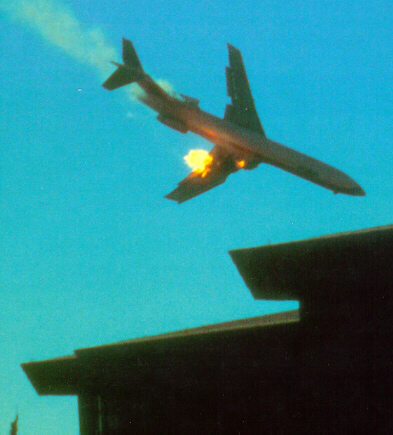
Most of the Airbus crashes were due to the On Board Flight Computers. When Airbus first started implementing them they had a streak of bad luck involving the Onboard Computer taking over a pilots flight and doing what it though needed to be done to correct a given situation. Case in point, at an Air show in the late 80's Early 90's they were demonstration the Airbus 320 i believe and the Pilot was doing a low level low speed pass by the crowd. The coputer instinctively thought he was trying to land the plane and took over, At that point the pilot, who was trying to gain speed and altitude was having to fight with the computer that initially thought he was trying to land and was forcing the plane into a decent and decrease speed mode as he went off the end of the runway admits some housing and small trees. 20 seconds later it crashed into the neighborhood beyond the airport. The data recorders showed the struggle between the pilot and the computer very clearly. Airbus in the early days did not have a manual override system in place to correct the computer so once it made up its mind what needed to happen, you were at its mercy. That flaw in design was the cause of 45% of all Airbus incidents (Source from Wings Program about Airbus and its problems.)
Posted by Dustin Mitchell (Member # 372) on 04-27-2005, 03:08 PM:
Very interesting William, thanks for the info.
Posted by Bill Gabel (Member # 1105) on 04-27-2005, 05:22 PM:
The only US carriers that have had crashes with the Airbus type aircraft have been the American Airlines and a DHL cargo.
- A300 has had 11 aircrafts crash between 1983-2003
A310 has had 6 aircrafts crash between 1992-2000
A320 has had 7 aircrafts crash between 1988-2000
A330 has had 2 aircrafts crash between 1994-2001
A340 has had 1 aircraft crash in 1994
The American Airlines A300 aircraft went down in Belle Harbor, NY 11/12/2001. And the DHL craft was hit in Baghdad, Iraq by a missile.
Posted by Mark Gulbrandsen (Member # 72) on 04-27-2005, 06:04 PM:
At least the numbers of accidents are decreasing in numbers with the increase in model number ![[Big Grin]](biggrin.gif) . Obviously a learning curve going on there . I'll still stick with proven U.S. built planes like the 737 and so on. I beleieve that a 737 lands and takes off every 10 seconds. There is no equal to it....
. Obviously a learning curve going on there . I'll still stick with proven U.S. built planes like the 737 and so on. I beleieve that a 737 lands and takes off every 10 seconds. There is no equal to it....
Also the big Airbus plane has very a limted market, mainly tourest and only on very long haul routes..... Should the economy ever sag very much Airbus will be hurting big time. The only other use is strictly for cargo, and again on long haul routes only. In bad times the Airbus will be sitting in the desert in storage while the new 787 will be kept on line.
Mark
[ 04-27-2005, 09:06 PM: Message edited by: Mark Gulbrandsen ]
Posted by Bill Gabel (Member # 1105) on 04-27-2005, 07:57 PM:
Here are the Boeing numbers.
- 707 56 lost 1961-2005
727 53 lost 1965-2003
737 68 lost 1972-2005
747 33 lost 1974-2004
757 09 lost 1990-2002
767 09 lost 1983-2002
Here is McDonnell Douglas numbers.
- DC-8 41 lost 1960-2000
DC-9 73 lost 1966-2003
DC-10 19 lost 1973-2004
MD-80 series 15 lost 1981-2004
MD-90 1 lost 1999
MD-11 6 lost 1993-1999
Here is Lockheed's number for the L-1011 series.
The L1011 was my plane of choice on flights.
I hope they have great luck with the A380 aircraft. But I will stick with the Boeing aircrafts or the Gulfstream G5.
Posted by Dick Vaughan (Member # 540) on 04-27-2005, 07:59 PM:
quote: Mark Gulbrandsen
I beleieve that one 737 lands and takes off every 10 seconds
that's one very busy aeroplane with high cycles ![[Roll Eyes]](rolleyes.gif)
![[Wink]](wink.gif)
Tell me which one it is and I'll avoid it!
Posted by Mark Gulbrandsen (Member # 72) on 04-27-2005, 09:09 PM:
Actually they ALL have a high number of cycles... But thanks Dick for pointing that one out... I corrected it.
quote: Bill Gabel
Here are the Boeing numbers.
707 56 lost 1961-2005
727 53 lost 1965-2003
737 68 lost 1972-2005
747 33 lost 1974-2004
757 09 lost 1990-2002
767 09 lost 1983-2002
Here is McDonnell Douglas numbers.
DC-8 41 lost 1960-2000
DC-9 73 lost 1966-2003
DC-10 19 lost 1973-2004
MD-80 series 15 lost 1981-2004
MD-90 1 lost 1999
MD-11 6 lost 1993-1999
Here is Lockheed's number for the L-1011 series.
L1011 5 lost 1972-1986
I loved the L-1011! I used to fly them from Chicago to Miami all the time back in the 70's on Eastern. It was a noisy plane on the outside but really quiet on the inside and was a real gas guzzler. One crasahed in the Everglades years ago if my memory serves me....
Now Bill, Can you figure the percentages of accidents of Boeing planes vs. McDonnell Douglas vs. Airbus over the losses of the dates that you have for the time line that have been in buisness. I'd bet that both Boeing and MD win by a long shot.
Mark
Mark
Posted by Leo Enticknap (Member # 534) on 04-28-2005, 02:19 AM:
Those figures only tell us the number of incidents per aircraft type; they don't tell us the proportion of incidents per number of flights or give us any indication of what caused the incident. But, ranking them in order from safest to most dangerous (as defined by number of proportion of incidents to flights), you get:
1. Saab 340 (3 fatal incidents in 9 million flights)
2. Mc DD MD-80 (9 incidents per 20m flights)
3. Boeing 767 (3 / 6.5m)
4. Boeing 757 (4 / 7.2m)
5. Boeing 737 (47 / 76m)
6. Boeing 727 (46 / 70m)
7. Airbus A319/20/21 (4 / 6m)
8. Embraer 120 (5 / 7m)
9. Mc DD DC-9 (42 / 55m)
10. BAe 146 (4 / 45m)
11. Lockheed L-1011 (5 / 5.5m)
12. Airbus A300 (9 / 8m)
13. Airbus A310 (5 / 2.7)
14. Boeing 747 (24 / 14.8m)
15. Mc DD DC-10 (15 / 7.6m)
16. Fokker F-28 (20 / 8.5m)
17. Embraer 110 (28 / 7.5m)
18. Mc DD MD-11 (4 / 0.7m)
19. Concorde (1 / 0.08m)
What strikes me about this list is that with the sole exception of the 747, the bottom 9 planes all have less than 10 million flights completed, whereas most of the top ten have a lot more. The earlier in a type's service life an incident happens, the worse it'll affect a safety rating calculated this way: for example, the Concorde crash turned that type from being statistically the safest airliner into statistically the most dangerous in one single incident. And, as said earlier, these figures don't take account of the cause of each accident. For example, the DC-10 fatal incidents were caused as follows (source):
1. Engine exploded after crew incorrectly operated autothrottle. One fatality. Cause: combination of design fault and pilot error.
2. Cargo door blew out while plane was climbing after takeoff. 346 fatalities. Cause: design fault.
3. Two tyres blew out during takeoff. 2 fatalities. Website entry doesn't make the cause clear.
4. Engine separated from wing leading to loss of control and subsequent crash. Cause: incorrect maintenance.
5. Aircraft collided with vehicle after landing on wrong runway. 72 fatalities. Cause: pilot error.
6. Aircraft flew into side of mountain due to navigation error. 257 fatalities. Cause: combination of pilot and air traffic control errors.
7. Plane skidded on icy runway after landing. 2 fatalities. Cause: incorrect airport maintenance? Or should the plane have been designed to cope with these conditions safely?
8. Aircraft crashed during an aborted takeoff after the pilot reported hearing 'shuddering noises'. 50 fatalities. Exact cause unknown.
9. Engine failure in flight resulted in partial loss of control. 112 fatalities. Cause: Engine fault and design fault in control mechanisms which allowed them to be so badly damaged.
10. Aircraft crashed while attempting to land in fog. 75 fatalities. Cause: pilot error.
11. Aircraft crashed into desert after bomb exploded in cargo hold. 171 fatalities. Cause: sabotage.
12. Failed landing in thunderstorm caused aircraft to break up on the ground. 56 fatalities. Cause: combination of freak weather and pilot error.
13. Aircraft overran the runway after an aborted takeoff. 3 fatalities. Cause (i.e. what caused the pilot to abort the takeoff) unknown.
14. Pilot overran end of runway in wet weather on landing. 17 fatalities. Cause: combination of bad weather and pilot error.
Of those, only incidents 2 and 9 were clearly and directly caused by design and/or construction defects. If you discard all the others, this gives you 2 incidents in 7.6 million flights, thereby pushing the DC-10 up to number 3 in the safety ranking list. So, without analysing the cause of each incident in some detail, I don't think the list tells us an awful lot about how inherently safe or dangerous each aircraft type is.
Posted by David Favel (Member # 1125) on 04-28-2005, 02:55 AM:
Aluminium (Special Grade) sourced from Invercargill, New Zealand.
Posted by Mark Gulbrandsen (Member # 72) on 04-28-2005, 08:15 AM:
Thats really interesting Leo. The other thing it leaves out is how many survived from eachh crash. All in some cases too none in other cases. Things like a crash where a plane couldn't stop and overshot the end of the runway and geaer that won't loock down are commonly survived by all. Of course there are those catatrostpjic crashes like UA 232 and the Concorde.
With the high number of L-1011's still in the air I have to wonder if that plane isn't the safest one out there. One has not gone down since the early 70's.
The DC-10 has by far the worst safety record of all U.S. made planes imho although there doesn't seem to be any bad mishaps in the last decade.
Mark
Posted by Bill Enos (Member # 440) on 04-28-2005, 08:21 AM:
Something worth considering is the comment by a psychologist just after the initial announcement of the 380. It was in one of the news magazines, I don't remember which. The gist of his remark was that with 800+ people on board, the likelyhood of there being a crazy or some other problematic person among them is pretty high. He said he would never fly with that many people. He should know.
Posted by Cory Isemann (Member # 2517) on 04-28-2005, 02:42 PM:
Honestly, I'd be scared shitless to ride in a plane that big.
Posted by Leo Enticknap (Member # 534) on 04-28-2005, 03:11 PM:
quote: Mark Gulbrandsen
The other thing it leaves out is how many survived from eachh crash. All in some cases too none in other cases. Things like a crash where a plane couldn't stop and overshot the end of the runway and geaer that won't loock down are commonly survived by all. Of course there are those catatrostpjic crashes like UA 232 and the Concorde.
That list defines an 'incident' as an event which causes at least one fatality - but I agree entirely; that criterion could be misleading, too. The number of fatalities per incident on that DC-10 list ranges from 2 to 346. So that way of ranking airliner safety (by number of 'incidents') would favour large widebodies over smaller capacity planes. For example, it would take 20 Saab 340s to fall out of the sky to kill as many people as the total loss of one fully-loaded 747. I'd guess that if you recalculated that list and ranked the aircraft in order of the proportion of accident fatalities to flights completed, it would look very different.
quote: Mark Gulbrandsen
With the high number of L-1011's still in the air I have to wonder if that plane isn't the safest one out there. One has not gone down since the early 70's. The DC-10 has by far the worst safety record of all U.S. made planes imho although there doesn't seem to be any bad mishaps in the last decade.
Which in both cases seems to suggest that the older a plane gets, the safer it gets. That list would seem to support that, too: as a general rule, the higher the number of flights an aircraft type has completed, the higher its safety ranking is. Learning from experience, perhaps? The 727's handling characteristics, the DC-10 's cargo door and the Airbus fly-by-wire software were all implicated in a spate of accidents during the first few years of those aircraft being in revenue earning service. But then the faults were identified, fixed and most of the accidents thereafter were not directly attributable to the aircraft.
So maybe the one thing these statistics can tell us is that, as a general rule, the older a plane is the safer it is? In any case I can't say that I worry too much about what sort of plane I get whenever I fly somewhere. Needless to say, it's a case of who offers the cheapest ticket! But as the last intercontinental flight I took was in fact on a DC-10, maybe I was unsuspectingly doing the right thing!
Posted by Mark Hajducki (Member # 1732) on 04-28-2005, 05:56 PM:
quote: Leo Enticknap
That list defines an 'incident' as an event which causes at least one fatality - but I agree entirely; that criterion could be misleading, too. The number of fatalities per incident on that DC-10 list ranges from 2 to 346. So that way of ranking airliner safety (by number of 'incidents') would favour large widebodies over smaller capacity planes. For example, it would take 20 Saab 340s to fall out of the sky to kill as many people as the total loss of one fully-loaded 747. I'd guess that if you recalculated that list and ranked the aircraft in order of the proportion of accident fatalities to flights completed, it would look very different.
It would be better to calculate fatalities per passenger journey (or passenger mile), which would be the chance that any one passenger would die due to an aviation incident during the journey.
I like the use of the term 'incident' in transport speek, which can range from anything from a broken wheel to a high number of fatalities. I think I will go by sea for my next journey out of Britain.
Posted by John T. Hendrickson, Jr (Member # 849) on 04-28-2005, 07:34 PM:
The Boeing people think the A380 is "a very large airplane for a very small market" according to Jim Condelles, a spokesman for Boeing.
Airbus spent $13 billion developing the A380 and needs to sell about 250 planes to cover its investment (154 sold so far). If a market developes for this behemoth, Airbus wins. The cautionary fact is that airlines are fickle, and have been known to cancel orders in hard times.
Airbus sees a big market for these planes, while Boeing does not. Who's right? It may take years to find out.
Posted by Mark Gulbrandsen (Member # 72) on 04-28-2005, 07:51 PM:
John,
Airbus's risks are certainly alot higher!! The Europeans seem to go that route for what ever reason... like the Concorde.
I think Boeing has learned ALOT over the years as far as what markets are viable or not at least a decade ahead. What I see Boeing going after is the short hop market with the new 787. Its this short hop market that is the bread and butter of the airline indusrty and this market will normally keep its pace no matter which way the economy turns. Boeing is merely going after the more stable market this time around as its a better bet. Were it not for the 737 I doubt that Boeing would still be in buisness. That is one amazing plane that just doesn't die.....
Mark
Posted by Will Kutler (Member # 770) on 04-28-2005, 07:56 PM:
Mark mentioned the famous ghost plane...the L10-11 that crashed in the Florida Everglades. Many parts from that plane were recycled and put back into service. For quite some time, every plane that recieved those parts had ghost sitings of one of the filght-crew members. The ghost reportadly prevented some other crashes. However, many people reportadly had the crap scared out of them by that ghost. All of the gost-associated parts were eventually removed from service, and the ghost seemed to have disappeared.
On another note, I have been a licensed aircraft mechanic since 1988 or thereabouts. My experience spans everything from Pipers and Cessnas to 727s, 737s, 747s, C141s, C5s, etc.
Ohhhh do I have my share of maintenance war stories...some that would turn ya off to flying! Over the years, my sense of integrity has often been at odds with some other "philosophies" on how maintenance should be performed. But having that sense of integrity has often come at a "political" price! But I have no regrets...I am just greatful for the lessons my parents and teachers have instilled in me!
Posted by Phil Hill (Member # 371) on 04-28-2005, 08:23 PM:
quote: Cory Isemann
I'd be scared shitless to ride in a plane that big.
I agree Cory! Not cuz of the size, but because of the probablility of some idiot wanting to make a name for themselves by taking it out.
Mark: Having flown in all sorts of planes all over the world, I totally disagree about that POS L-1011! I hated it and NEVER felt secure in it... especially with it's history of engine failures. I ALWAYS booked an alternate carrier with other equipment whenever possible.
By the same token, I didn't like any of the MD series, any Douglas Crafts, or ANY aircraft made in Europe (sorry guys). The only exception is the Concord that I regret not getting a chance to fly.
My favorite for the long haul is the 747-400. Short haul, 737, and the (Mother) Fokker.
I am anxious to see the new Boeing 7xx.
Posted by Bill Gabel (Member # 1105) on 04-28-2005, 08:32 PM:
The L1011 that Will just posted about was the first L1011 tobe lost on December 29th, 1972, Flight 401 from Eastern Airlines. The aircraft was forced to break off its approach to Miami International Airport after the nose-gear light failed to illuminate, indicating that the gear was proper lowered. While in a hold pattern at 2,000 feet over the Everglades National Park, the Captain bumped his control column, leading to the disconnection of the autopilot. With the attention of all three crewmembers focused on the landing gear and the extinguished light, the aircraft descended unnoticed into the ground.
Posted by Mark Gulbrandsen (Member # 72) on 04-28-2005, 09:15 PM:
quote: Phil Hill
am anxious to see the new Boeing 7xx.
Officially its called the 787. Should be a very interesting, very high tech plane. A good friend flew DC-9's for American and loved the plane. Many still use cable controled surfaces for some of the functions... its the last plane that used at least some cable driven surfaces. The -9 actually has a very good service record, perhaps second to the 737. You'd think the DC-10 wouldla come out better.
The L-1011 has one of thhe best service records of all for those old wide bodied jets. They only had engine probs. for a short while when it was brand new.... Rolls Royce corrected those problems long ago. Far as I know none crashed due to an engine problem as did flight 232's DC-10. I know a guy that was on 232 and survived it, I also once met a guy that survived the twin 747 collision in Tenerife. He told his riviting story live on the tv station that I worked at. I don't think one cameraman heard the director at all during that show...... none had their headsets on during his story..... It was incredible.
quote:
But having that sense of integrity has often come at a "political" price! But I have no regrets...I am just greatful for the lessons my parents and teachers have instilled in me!
That PARALLELS how I feel about my job in this industry. I may seem cynical here sometimes but I am that way for a good reason, weather it involves politics or not. I will say what I know and think, and step on peoples toes if necessary to get things done right. The outcome of my being this way has always been positive in the long run.....
Mark
Posted by Bill Gabel (Member # 1105) on 04-28-2005, 09:41 PM:
Of the 5 lost L1011s none were from engine problems.
- Dec. 29, 1972 Eastern Airlines (Crash) 100 dead of 176
Aug. 19, 1980 Saudi Airlines (electrical fire) 301 dead from smoke inhalations after returning to airport. Doors jammed.
Dec. 23, 1980 Saudi Airlines (tire exploded in wheel well), 2 dead rapid decompression over Arabian Gulf.
Aug. 2 1985 Delta Airlines (Crash) Dallas/Fort Worth,microburst induced windshear, 134 dead of 163 + 1 on the ground.
May 3, 1986 Air Lanka (Bomb) Columbo, Sri Lanka, 16 dead at the gate.
Posted by Paul Mayer (Member # 355) on 04-28-2005, 10:55 PM:
Late to the party as usual. Been rather busy these last two weeks, subbing for two instructors in the aviation department, which has meant commuting out to Boulder City for night classes, three hours each way on the city bus, plus early-morning day classes all this week at my home campus, the Western High Tech Center. Fortunately tomorrow is the last day of this--I'm pooped.
On to the A380. It's a hell of an achievement for Airbus. Though I have never cared for their engineering attitude of minimizing the pilots' presence in the control loop of their fly-by-wire airplanes (even if the statistics show that 80% of airliner accidents involve pilot error in some way), I've come to respect Airbus' business acumen. They are a formidable competitor, as the current US vs. EU Boeing vs. Airbus subsidy wars illustrate. Boeing has fallen to #2 in market share for two years now, no longer dominating the airliner market. The cross-pond subsidy lawsuits are about to start flying unless the two sides get back to talking.
The new aircraft is an amazing accomplishment. Over the next year or so it will fly an extensive test regimen to cover all corners of its flight envelope. It will be interesting to see how it does at max all-up weight, 1,200,000 lbs for the pax version, 1,300,000 lbs for the freighter (!), plus things like max range, best cruise speeds, and fuel burn. The only other thing flying at these weights is the Antonov An-225 and only one of those was ever built. Like many new designs this one has had its share of early problems with drag and getting the empty weight down to meet spec. But it's flying now and that is a good thing.
Early (and now outdated) A380 joke:
Q: Why did the A380 cross the road?
A: Because it couldn't fly over it.
As of this week, Airbus has 151 confirmed orders for the A380 and needs about 100 more to recover its $13 billion USD R&D costs. They project a worldwide market of around 1200 aircraft. Boeing didn't see a big-enough market for this size of aircraft at all. It'll be interesting to see over the next few years who read the market correctly.
Boeing is proceding with its 787 Dreamliner and is filling the order book rather nicely, enough so that Airbus, which didn't see a market for that aircraft, is now going to develop a competing model, the A350. Boeing is also going to compete against the A380 with a new double-deck version of the 747. Indeed, we live in interesting times.
As for Jurassic jumbos, I was a big fan of the L-1011 and hated to see it ultimately fail in the market. It was an innovative design in many ways: first use of triple-spool high-bypass engines, first US airliner to offer autoland capability as standard equipment, and its unique flight controls when in the landing configuration (control column controls the spoilers instead of the elevators during approach and landing, similar to how glider descent rates are controlled).
L-1011 monikers:
Swamp Buggy
Trifarce
Tritanic
Vibratron
Lockheed's biggest mistake with the airplane was to commit to only one, at the time unbuilt, engine type. Development problems and cost overruns on the RB-211 engine (a great story in its own right) drove Rolls Royce into bankruptcy and delayed L-1011 production to the point where McDonnell Douglas achieved an insurmountable market lead with their DC-10. In the end the market for three-engined widebodies just wasn't big enough for both designs. Which was too bad--the retired L-1011 captains I've known at ANA and TWA loved the airplane. As did I, even though I only got to fly the simulator for it just once.
Posted by Phil Hill (Member # 371) on 04-28-2005, 11:38 PM:
Well boys, spout all ya want about the L-1011... it STILL scares the hell outta me! I'd rather fly a DC-10...ummm with the door "problem" fixed!
Posted by Mark Gulbrandsen (Member # 72) on 04-29-2005, 02:46 AM:
Deleted double post
Posted by Mark Gulbrandsen (Member # 72) on 04-29-2005, 02:50 AM:
Lockheed has produced the most amazing aircraft through out its illustrious history and had know how that went beyond the normal stuff that was churned out in those days by all the other aircraft companies combined. Anyone wanting a good read should pick up the book "Skunkworks" by Ben Rich. That book will blow your mind..... It should also be turned into a film some day ![[thumbsup]](graemlins/thumbsup.gif) . Those not familiar with the man behind Lockheeds engineering team should see this link......
. Those not familiar with the man behind Lockheeds engineering team should see this link......
http://www.wvi.com/~sr71webmaster/kelly1.htm
Mark
Posted by David Buckley (Member # 2600) on 04-29-2005, 03:22 AM:
quote: Mark Hajducki
It would be better to calculate fatalities per passenger journey (or passenger mile), which would be the chance that any one passenger would die due to an aviation incident during the journey.
Fatalities are measured per million departures rather than by the passenger mile because the risks in an airline flight are not linear along the distance of flight, and dont change much with the length of flight, but mostly accumulate at the beginning and at the end. There are of course exceptions where planes just fall out of the sky in midair, but they are exceptions.
quote: Mark Gulbrandsen
Airbus's risks are certainly alot higher!! The Europeans seem to go that route for what ever reason... like the Concorde.
For many many years Concord/Concorde was the safest aircraft flying, with zero fatalities. Admittedly the number of passenger depatures was quite low. One crash with those low departures numbers turned Concorde from the most safe to the least safe aircraft in fell swoop.
If you were partisan you could split Concord and Concorde as two different but related breeds of aircraft, and claim that Concorde was the safest aircraft ever flown with no fatalities in the marque's entire flying career.
The other thing to keep in perspective is that even the "least safe" by those list aircraft are pretty dammed safe, and even if you fly a lot in the worst plane on the list you are really unlikely to end up as a fatality. Unless of course, you go up in a cessna or other toy plane, for which the ATSB incident records speak for themselves...
Posted by Mark Gulbrandsen (Member # 72) on 04-29-2005, 08:46 AM:
quote:
quote: Mark Gulbrandsen
--------------------------------------------------------------------------------
Airbus's risks are certainly alot higher!! The Europeans seem to go that route for what ever reason... like the Concorde.
--------------------------------------------------------------------------------
For many many years Concord/Concorde was the safest aircraft flying, with zero fatalities. Admittedly the number of passenger depatures was quite low. One crash with those low departures numbers turned Concorde from the most safe to the least safe aircraft in fell swoop.
David,
I was speaking from a financial\marketability point of view... not safety. Concorde never made anyone a dime, but it was a big money sinkhole. Airbus's venture into the 380 is certainly along similar lines..... There were alot of initial commitmnets to the Concorde that never occured in reality, this could also happen to the 380.... all it would take is high fuel costs or airports turning down landing rights to them. Impressive as it may be in reality it is more of a flying elephant that cannot be accomodated at the majority of the worlds airports amnd its use will be dictated more by the economy than any other single thing. At the end it was the economics of the Concorde that killed it, not the crash.
Mark
Posted by Leo Enticknap (Member # 534) on 04-29-2005, 02:41 PM:
What makes you think that there isn't a viable business case for the A380? After all, there has been a market for long-range, widebody passenger jets since the late '60s. Unlike the short to medium range market, there has been no fundamentally new model since the 747. OK, they probably will never sell as many units as a plane in the 737 sector of the market would, but given that Airbus say that their break-even point will be 250 sales, it seems that they've allowed for that.
Yes, 850 passengers on a single aircraft makes it a terrorist target, increases the likely death toll if one crashes or is sabotaged, raises the potential for passenger disorder and needs investment by airports. But when the 747 came on the market it too had 250 more seats than anything else in service: doubtless these issues were raised and were dealt with then.
If I understand Airbus' rationale correctly, the A380 is designed to carry a large number of people over long distances as cheaply as possible. There is a well established market for that (unlike for the Concorde), and if someone comes along with an aircraft which cuts the operating cost per passenger mile, then it surely stands a chance of taking a share of that market?
Posted by John Pytlak (Member # 331) on 04-29-2005, 03:00 PM:
Aren't there still quite a few 747's still "mothballed" at various sites?:
http://www.geocities.com/afwjr/pictures.html
http://www.avocetprojet.com/news16.php
quote:
After more than two years of the longest and deepest slump in aviation history, the makers of airplanes and their parts are setting their sights on a turnaround.
But when exactly that will happen depends, in part, on the graveyards. Stretched across thousands of acres in New Mexico, Arizona and California are huge parking lots where carriers mothballed hundreds of jets when the airline market began to seriously crater after Sept. 11, 2001. At the peak, more than 2,100 airplanes sat among the tumbleweeds -- about 14% of the world-wide jetliner fleet.
How fast -- and how many of -- those planes are returned to service or scrapped will help determine everything from how many jetliners Boeing Co. and rival Airbus build in 2004 to the financial outlooks for companies that make much of their profits by supplying spare parts for some of the jets that were parked.
Beyond that, the other major trend in aviation is that everybody seems to have a different vision of the future -- and is pursuing it vigorously. Airbus is banking on the planned A380, which will accommodate anywhere from 555 to 800 passengers, while Boeing thinks passengers will choose the comfort of its 7E7 Dreamliner, a smaller and faster jet. Meantime, smaller aircraft -- regional jets and minijets -- continue to make inroads into the market of their larger counterparts.
Here's a look at some specific trends...
Posted by David Buckley (Member # 2600) on 04-29-2005, 06:38 PM:
quote: Mark Gulbrandsen
I was speaking from a financial\marketability point of view... not safety. Concorde never made anyone a dime, but it was a big money sinkhole.
Concord made British Airways over 20m UKP per annum, in the good old days. Rather more than a dime, and pretty impressive for the fleet size. But as you say, in the end, economics got it - slowdown after 9/11, refit costs after the crash, and increasing maintenance costs all put those final nails in the coffin.
In terms of making the things, that never made money, as American protectionism ensured that the things would never get much action in the states, and that's where all the money was to be made, so of the dozens of planes ordered and optioned, they were all canned.
At the time (and this is getting on for half a century ago), European thinking and American thinking went different ways, the Europeans were convinced people would pay to travel quickly, the Americans that people would rather travel cheaply. History shows the American way was correct, the 747 ruled the skys for volume transport, and the anti-Concord measures were never needed, even had Concorde been incredibly sucessful. I'd like to think the the American reaction to Concorde couln't happen in the enlightened 21st century, but I doubt it'll ever be put to the test.
So now Airbus are trying to beat Boeing at what was their own game. And again there is a difference in opinion between America and Europe over which way the market will pan out. It'll be years before we know the answer.
Of course, the really good news is that flying is a dying business - fuel prices are rising and will continue to rise forever, so the days of cheap plane journeys are coming to an end. You would have to assume that what volume market for air travel remains will (based on history) be the plane with the right capacity and the best fuel economy.
Posted by Joe Redifer (Member # 3) on 04-29-2005, 07:12 PM:
Hi
I'd just like to say that pilots are paid way too much and work way too little.
Bye!
Posted by Mark Gulbrandsen (Member # 72) on 04-29-2005, 09:31 PM:
quote: David Buckley
You would have to assume that what volume market for air travel remains will (based on history) be the plane with the right capacity and the best fuel economy.
I think what you meant to say was that the plane with the roght capacity for the job will be used for that job. This will hold true even in bad times. Each plane has its job that it will be used for.
As for the Concorde having made a profit is very doubtful. There was an interesting documentary about the Concorde on PBS a few months back. 20 mil is squat and I assure you wouldn't even pay for the overhaul of two engines.... The docu said that taking the whole picture into account it was always run at a a loss and was done for the prestiege. Neither BOAC nor the french ever did re-coup those developmental costs... so profit-less it will always be. Much admire it I do. Had the US air carriers demanded its use it would have happened in a big way though.
Mark
Posted by David Buckley (Member # 2600) on 04-30-2005, 12:03 AM:
Found it: Concord Retirement FAQ
On average Concorde made and operating profit of £30-50 Million a year for British Airways in the boom years where many passengers were travelling first class. British Airways reportedly received £1.75 Billion in revenue for Concorde services against an operating cost of around £1 Billion. Air France made a much smaller profit.
Obviously, the development costs are not included in these figures, as they were paid for by us (as I was then) European taxpayers.
I used to live under the Concord flight path in South London, and every day it was a joy to watch it go over... It is truly sad that such an endeavour had to end.
Posted by Bill Enos (Member # 440) on 04-30-2005, 12:05 AM:
With most major airports in or very near major population centers, a crash with the full 88,000 gallons of fuel into a densely populated area will eventually occur, it will set a new mark for plane wrecks.
Posted by Scott Norwood (Member # 30) on 04-30-2005, 08:01 AM:
quote: David Buckley
Of course, the really good news is that flying is a dying business - fuel prices are rising and will continue to rise forever, so the days of cheap plane journeys are coming to an end.
Why is this good news?
Posted by Mark Gulbrandsen (Member # 72) on 04-30-2005, 09:41 AM:
quote: David Buckley
used to live under the Concord flight path in South London, and every day it was a joy to watch it go over... It is truly sad that such an endeavour had to end.
I couldn't agree more!!
quote:
quote: David Buckley
--------------------------------------------------------------------------------
Of course, the really good news is that flying is a dying business - fuel prices are rising and will continue to rise forever, so the days of cheap plane journeys are coming to an end.
--------------------------------------------------------------------------------
Why is this good news?
Its the reason for the existance of the 757, 767, and the development of the new 787, and the 380. They are all highly fuel efficient planes.
Posted by Michael Schaffer (Member # 1204) on 04-30-2005, 12:45 PM:
I think an important factor is not so much whether you sit in a Boeing or Airbus, but what airline you are flying with. I rather pay a little more to fly with an airline that doesn't cut maintenance and inspection costs in important places.
Posted by Mark Gulbrandsen (Member # 72) on 04-30-2005, 07:10 PM:
My friend that flew -9's for American said that you have about the same chance on any airplane and thet any airplane is still safer than taking a car. Its all but impossible to tell how well any individual airplane has met its maintainance requirements anyway no matter what airline you take....
Mark
Posted by Richard Hamilton (Member # 321) on 04-30-2005, 08:54 PM:
quote: David Buckley
In terms of making the things, that never made money, as American protectionism ensured that the things would never get much action in the states, and that's where all the money was to be made
What are you saying? I'm confused!!
Posted by Leo Enticknap (Member # 534) on 05-01-2005, 05:18 AM:
I think he's suggesting that for political reasons, no American airlines bought any and they were also banned from using some US airports, ostensibly on account of the noise they made.
I don't know to what extent that's true or not, but the Concorde certainly wasn't the ideal design for airline service. It could only carry 100 passengers and it had a range which effectively limited it to one regular route - London or Paris to New York or Washington. Even, say, Frankfurt to New York was too far. Given that the further a plane flies, the greater supersonic travel equals a time advantage, I can see that it wouldn't have been an attractive possibility for US airlines. The distance from east coast to west probably isn't long enough for the huge extra operating costs to justify the 60-90 minute time saving, and Concorde didn't have the range to do transpacific flights.
During the brief period when Concorde was able to make an operating profit, this was due to business travellers who needed to travel from Europe to the east coast of America and back in one day. In the '80s and early '90s, there were just enough of these to keep the plane viable, but even then only if the R & D costs were written off and the production models given to BA & Air France for free. Then the Internet, videoconferencing and other communications technologies came along which removed that market, and business travel slumped. A radio documentary I heard about this recently said that by the late '90s, BA was having to offer cut price tourist tickets on Concorde because full-price bookings had fallen to the point at which the planes were rarely even 50% full. Sadly, of course, it was one of these tourist charters which crashed in 2000.
Posted by Peter Hall (Member # 695) on 05-01-2005, 09:08 AM:
There has been a history of both Boeing and MD planes "falling apart in flight" - both cargo door related (DC10 and 747) and one not resolved today. The economics for the A380 are vastly better than the 747 and there seems to be a demand - there are no orders on the books for 747s where there are dozens for the 380. Surely it is better economics, with airports getting full, to fly one x 800 seat plane on a popular route (LA - LON, Tokyo - NY etc) than two 747s (at similar costs). But yes, somehow I would feel safer in a 737 plunging to the ground than a 3 story A380.
Posted by John Pytlak (Member # 331) on 05-04-2005, 02:48 PM:
http://earistotle.travelmole.com/login_optin.php
quote:
Airbus delays A380 launch
Airbus has delayed the delivery of its super jumbo a week after the aircraft’s first test flight.
No reason has been given for the delay but according to a Reuters report, Singapore Airlines has been informed. The carrier has ordered 10 A380 aircraft, with an option to order a further 15, and will be the first to fly them in commercial service. The launch is scheduled for April 2006.
TravelMole is waiting for confirmation from Singapore Airlines, but reports suggest the airline may not be able to start flying the A380 until the second half of 2006.
Reuters also spoke to Emirates, which has made the largest order for A380s at 43, and is expecting deliveries to begin in October 2006, as scheduled.
Report by Ginny McGrath
Posted by Dick Vaughan (Member # 540) on 05-04-2005, 03:38 PM:
Braniff used to lease one or two Concordes back in the late 70'/early 80's and flew from Washinton to either Houston or DFW I think.
Of course they were not allowed to go supersonic over the US
Posted by Jason Burroughs (Member # 68) on 05-04-2005, 04:02 PM:
The Braniff Concorde flights deffinatly came to DFW, possibly Houston as well. Flights over land were limited to the sub-sonic range.
Geographic, passenger seat, range, and fuel consumption limitations were the primary reasons that the Concorde was not more of a success. Contrary to a previous statement American responce to the Concorde was favorable. In fact 2 US maufacturers were working on supersonic airliners as well, known as SSTs. If I recall, these were Boeing and Lockheed. Both projects were droped before production started due to the realization of those constraints.
Posted by Mark Gulbrandsen (Member # 72) on 05-04-2005, 05:41 PM:
quote: Peter Hall
There has been a history of both Boeing and MD planes "falling apart in flight"
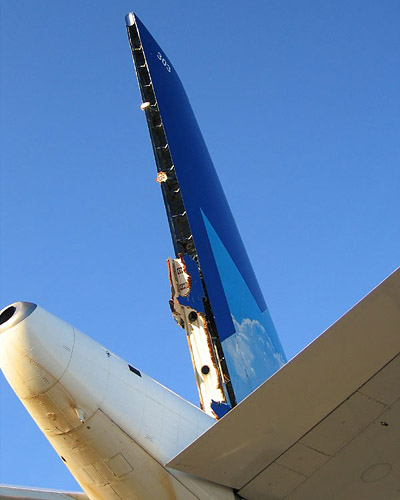
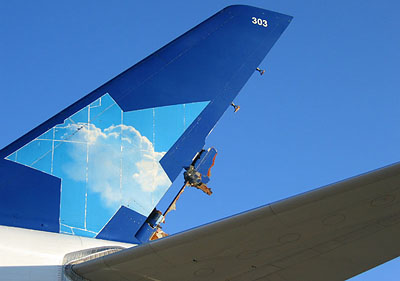
Peter, you left Airbus out of that listing!! They still seem to be having a bit-o-problem in the composites department.....
Mark
Posted by John T. Hendrickson, Jr (Member # 849) on 05-04-2005, 09:56 PM:
Here's an interesting twist to all of this. A good friend of mine is a retired VP of U S Aviation Underwriters. He points out that it's going to be a problem insuring these planes. The hull itself is a big price tag, and you are looking at a huge loss if one of these goes down with a full complement of people. Who will want to underwite it? Then, that company will have to sell pieces off, reinsuring it with immense amounts of money, and there may be few takers.
The question becomes who will be willing to be left holding the bag on the loss. Additionally, airlines are not going to like the prices of the premiums they are going to have to pay.
Posted by William T. Parr (Member # 677) on 05-05-2005, 12:14 AM:
quote: Dick Vaughan
Braniff used to lease one or two Concordes
There were never leased to Braniff, they were fly through agreements aranged with Both Air France and Bristih Airways for Direct Dallas to London flights out of DFW airport. Braniff never had a Concorde painted in its colors, although plans had been made to paint one side of a concorde from each of the partners in the agreement. Braniff photos can be seen here Braniff
Posted by Scott Norwood (Member # 30) on 05-05-2005, 07:37 AM:
There were Concordes painted in Singapore Airlines colors (on one side) as well.
I wish I'd had the chance to fly on the Concorde, but I did see one land at JFK about ten years ago. The pivoting nose looks very odd on approach.
It is somewhat ironic that today's commercial aircraft are actually designed to fly slower than those built in the 1960s. The Convair 990 (a commercial failure that was retired long ago) still holds a number of domestic speed records for commercial flights.
Posted by Peter Hall (Member # 695) on 05-06-2005, 02:15 PM:
Mark
I agree - perhaps all planes have a tendancy to fall apart in flight... I might stay at home !
Posted by Mark Gulbrandsen (Member # 72) on 05-08-2005, 02:40 PM:
quote:
I agree - perhaps all planes have a tendancy to fall apart in flight... I might stay at home !
Naw, ya can't do that. One of the parts from those planes may land on your house...... So indeed it is safer to fly.
I saw the Concorde at the EAA Fly-In near Oshkosh, WI. in 1994 when it was centerpieced at the show. On arrival It came in and deposited some passengers that flew in on it from overseas. Later that day it took off as part of the show and did some incredible manuvers for the show including some fairly high speed low passes. On those passes it literally picked everyone up off the ground and then set them back down again. I've never seen or heard anything like it and probably never will again unless I see a shuttle take off.
The next day rides were given for about $700.00 U.S., it went up north to the Canadian border and then back for a low speed low pass then then landed. Those folks sure got their moneys worth that day!
Mark
Posted by David Buckley (Member # 2600) on 05-08-2005, 02:49 PM:
Concorde is loud, but a Harrier Jump Jet at displays doing its thing is much louder and usually very much nearer!
But Mark, you owe it to yourself to see a Shuttle launch. We arranged one of our US holidays to coincide with a launch, you're lucky enough to be in the right country to start with. Launch will redefine your understanding of low frequency energy.
Posted by Paul Mayer (Member # 355) on 05-09-2005, 10:37 AM:
Latest Airbus joke, courtesy of this morning's AvFlash:
quote:
SHORT FINAL...
Overheard on approach to MCO...
TWR: Traffic 12 o'clock, 2 miles, an Airbus.
Airliner: Traffic in sight.
(pause)
And he'll be happy to know his rudder is intact.
Posted by Mark Gulbrandsen (Member # 72) on 05-27-2005, 07:37 PM:
Just found these two hilarious things about Airbus on the net and thought I'd post em here.....
___________________________________________
"I could give thousands of reasons why boeing is better than airbus,
but they are all from a maintenance point of view.
you seem to want a pilots input on the flying qualities,
so suffice to say for now, from my observations,
boeing pilots appear more competent with their machine,
maybe they are more comfortable with the boeing way of doing things.
airbus technology is more look, don't touch, have faith, sort of stuff.
thrust management is a perfect example of that.
when something out of left field happens, airbus normally comes up with the old
"but monsieur, this cannot happen"... bull$hit it can't.
_______________________________________

Posted by Michael Schaffer (Member # 1204) on 05-28-2005, 06:15 AM:
I don't know much about flying, but a friend of mine who flies for Lufthansa told me that many pilots indeed were more comfortable with flying Boeing planes, because according to him, there is more the pilot can influence directly in unusual situations. More "a pilot's plane". The whole Airbus philosophy, backed up by the indisputable fact that a lot of crashes are actually caused by pilot errors, could also lead to a fatal development when managements think that flying is now easy, because more automated, so we need less well-trained, in other words: cheaper pilots. I think a few years ago there was a huge discussion going on which also made the papers in Germany about the all-too-powerful flight computer vs. traditional flying expertise. In the end, the pilots' association insisted on being able to overrule the computer and won. So if I remember correctly, they can now switch it off. In any case, at Lufthansa they seem to have very few accidents (I can't actually only remember ever hearing of one) with both manufacturers, so it seems to come down to the same old truths: good pilot training and maintenance can not be substituted with anything. Kind of like in the cinema.
What's going on with McDonnell Douglass these days? Do they still make passenger jets? When I was younger and in the having-lots-of-books-about-airplanes-and-building-model-planes phase, the DC-10 was still around, I think. I even had a model of one which I handpainted in KLM colors (because the logos were included in the set), then attached it to a string and blew it up with firecrackers.
Posted by Ian Price (Member # 14) on 05-28-2005, 08:37 AM:
quote: Michael Schaffer
What's going on with McDonnell Douglass these days?
McDonnell Douglas was bought out by Boeing and they stopped manufacture of the MD11. Then they turned the MD95 in to the Boeing 717 which by all accounts was an excellent airplane, that not too many airlines bought. They are ending the run this year and McDonnell Douglas will fade in to history.
Posted by Paul Mayer (Member # 355) on 05-28-2005, 02:47 PM:
Yeah, sad to see the old Mickey D go away. The old buildings where the DC-8s, -9s, and -10s were built have been razed to make way for another office park. The only facilities left are across Lakewood Blvd where the last B-717s are being finished, and on the west side of the field where the C-17 line and C-130 modernization programs continue apace. But no more airliners will be born in Long Beach.
From my lofty ivory tower position of being a part-time instructor of an AV220 Air Transportation course at that most vaunted of academic institutions, a community college, I gaze into my murky crystal ball and henceforth issue some predictions about the future of piloting as a profession. All of which are probably worth what you're paying to read them here. But like all pilots and most teachers I very much like the sound of my own voice, or in this case the flow of my words, and thus will not be deterred by the possibility of sounding like a Compleat Foole. And so I prognosticate and pontificate a worst case scenario thus:
Piloting as a profession will go the way of the projectionist some time down the road, and I'm pretty sure I will live to see most of it. We're already seeing the devaluing of the traditional traits and skills that "good" pilots were thought to possess, and the deprofessionalization of the job is accelerating. Some evidence:
Bigger 70-110 seat regional jets are coming on-line now and being flown by crews paid at puddle jumper rates. And the industry is finding all the crews it needs to fill those seats at that pay level. Fly a 737-sized aircraft for Metroliner wages? Sure! It's a jet! When it comes to pay, pilots have always been their own worst enemies. The owner of Scenic Airlines used to tell us, "You guys are just a bunch of bus drivers." Which wasn't true of course. At Scenic the shuttle bus drivers got paid more than any of the pilots. Scenic was a pioneer at the new pilot pay scales--the rest of the industry is just now beginning to catch up.
The technology of glass cockpits and GPS has reduced the need for much of the old-fashioned expertise of the old crews. Very few of the new pilots I see today are what we used to call "stick and rudder" guys. And they don't really need to be. Today's pilot is more a system manager and monitor and expert video game player. In the new big airplanes the electronics can handle most of the finesse stuff. Airbus thinks the pilots just get in the way, hence the Airbus design philosophy of minimizing pilot presence in the control loop as much as possible. There's no need to pay a system manager or video game player anywhere near what a pilot or any other finesse person would demand.
"But what happens when the magic boxes screw up?" you ask. Fortunately that doesn't happen very often. And when it does it usually happens in a way that leaves the crew with little or no time or ability to deal with it prior to impact anyway. Is there a need for an expensive crew capable of "heroic measures" in such a scenario? As long as this doesn't happen too often, the answer appears to be "no." The industry just needs to define and refine what "too often" is.
But people say, "You can't put a value on human life." Bullshit. The industry figured out long ago just what it costs to have a fatal airliner crash--it's about $2.5 million per fatality when all is said and done. As long as the fatal screw ups don't happen too often, insurance will take care of it, and today's ADD-addled public won't make too much of a fuss. No need for expensive operations help when you can afford to lose a hull and the cost of a few funerals once in a while.
Future pilots won't have to be trained in the old labor-intensive techniques the way they are now. The FAA and the University of Middle Tennesee are currently experimenting with a new pilot curriculum that teaches glass cockpit and GPS navigation right from the beginning. No need to do it the old way with charts and plotters and E-6Bs and the rest of that stuff. All you have to know is how to program the box. This streamlined training combines Private Pilot and Instrument training into one smaller cheaper faster easier package. Commercial, multi-engine, and ATP training will eventually follow suit. Won't have to pay these graduates as much since they won't represent as much of an investment as before.
Presently, light training aircraft still have to be hand-flown, which does require some finesse at times. But advances in aerodynamics will give us essentially stall-proof, spin-proof, and ice-proof aircraft. And advances in autopilots and autothrottles will give us aircraft that can land in even the squirrelliest of winds and in weather conditions with little or no visibility. These advances will eventually be incorporated in all airplanes, from light trainers to transports, with acceptably low failure rates. So there will be no need to pay future "pilots" much. To them "flying" will be no more difficult than running a cash register.
Worldwide, the old legacy carriers are dying, and with them will go their high-cost staffs, most of their unions, all of their pension plans, and all the rest of their high-cost ways of doing business. Here in the US, United just walked away from their pension obligations and is now petitioning the court to simply terminate its labor contracts under bankruptcy law. In response, the unions are planning a mass walkout, which if it happens will be the final nail in United's coffin. The other US Legacy 6 carriers, all on the edge of financial collapse themselves, are now looking at those options too. They're also looking at things like outsourcing aircraft heavy maintenance to China--it's cheaper now to ferry empty airliners to China for C- and D-checks than it is to do the work here. Some crew scheduling and dispatching is already being done out of India.
But the US Legacy 6 are still dying. The fact is we have too many seats flying around with too few butts in them (too many ASMs, not enough RPMs), which forces us to give the product away. The planes are flying damn near full and the airports and air traffic control systems are jam packed, but nobody's making any money. Industry analysts say we could do without about half the current capacity.
So, who's it gonna be? Until a month ago I was betting US Airways would be the first to go in this round, but America West prolonged their agony by agreeing to buy them. A marriage made in hell, they will both eventually go down in flames, much like PanAm did after swallowing National. So now United looks like they will be the first goner, with Delta and American not looking good for more than another year or so either. If you've got miles on any of these guys I'd advise you to use 'em up. Now. Which will of course cut their revenues even further.
Oh, and let's add some more fuel price increases while we're at it, since that's so easy to predict. Nothin' like a little lube on the slope to speed things up.
Of the US Legacy 6 that will leave the struggling Continental and Northwest, which maybe won't be struggling so much after this. And they'll have lots of ex-AAL, -AWA, -DAL, -UAL, and -USA employees, aircraft, and gates to pick through for any expansion--at closeout prices. Boeing and Airbus will both be in the used aircraft business a lot more than they want to be. No need to offer high wages in such a market. The survivors will consider themselves lucky and will be thankful to be working in the industry at all.
In the end the unions will still be around, but they will be representing much smaller bargaining units and won't be able to negotiate the kinds of compensation packages we saw before deregulation. The future belongs to the LCCs (Low Cost Carriers) like Southwest and JetBlue (both great companies to work for BTW), the regionals, and those that fly international routes. The forces of deregulation and globalization will forge a smaller, lower-cost, lower-wage air transportation industry, much more in line with the rest of the world. In this new world, the term "professional" as it applies to wages will be redefined. Lower.
Obviously that was a worst case scenario. Hopefully for my aviation students their future won't be quite that bad. But those are the trends. I always advise, "Plan for the worst, but hope for the best." Successful pilots are very good at being "optimists by nature but pessimists by profession." Doing things that way gives the best chances for happiness, success, and satisfaction in any career.
Posted by Will Kutler (Member # 770) on 05-28-2005, 10:48 PM:
Well, here is some input (finally) from ye ole aircraft mechanic.
For many, many moons, aerospace engineers designed aircraft with the ease of maintenance being the last consideration. Consequently, certain areas that required maintenance were ignored simply because they were inaccessable for mechanics to get to. Case in point: performing post-wash lubrication on the T-tail flight control surfaces in a C-5 Galaxy. It literally takes a "small person" to fit into the access areas in order to reach the various lube fittings! At 6 ft and 160lbs, it was nearly impossible for me to perform this task!
For years, the FAA approved manufacturer's maintenance books were a total nightmare! One could literally spend 2-3 times or more researching the maintenance task than it would take to actually perform the work! Been there-done that! I personally know of several cases where, in trying to avoid a headache, mechanics would perform a task and then go back to the books to see if they did the job correctly!
Why do I not choose to currently work as a mechanic? POLITICS! The first thing out of our instructors mouth on the first day of class when I began college was about the tremendous pressure mechanics are under to pencil-whip maintenance so that the plane will take off on time! OHHHH was he right, and the personal stories I have about both civilian and military aircraft maintenance!
As far as the age/cycle time of aircraft. Not to worry about that. There are programs where a fusalage/structure can be strigently remanufactured and the airframe hours set back to "0".
Ya, I did catch that Airbus program on The Discovery Channel. That "Teflon" solution regarding the landing gear emerengcy deployment left me shaking my head! Amazing that the test-pilots accepted a repair that did not perform perfectly!
Cheers
K.
Posted by Mark Gulbrandsen (Member # 72) on 05-29-2005, 01:07 AM:
Will, You make it sound like you have to do the whole plane yourself...... This is not the case with big carriers. It tales so many man hours to maintain an MD-80 for instance that no one person would be capable of doing this......... Team work for sure and a proven system of doing it which has to be FAA approved anyway! Each carrier has their own maintainance system but all systems must be approved! These maintainance sechedules make our proejction maintainance schedules look like a joke..... The following is excepted from a forum who's threads are answered by several aircraft maintainance mechanics. A friend that recently retired from Hill AFB as an avionics tech mentioned that they always had a "small frame" qualified mechanic on each shift to fit into those tight places.
_______________________________________
The maintenance schedule given below assumes 6 to 8 flight hours per day.
A check - Approximately 50 man hours - Every 7 days or 75 flight hours
B check - Approximately 250 - 350 man hours - Every 90 days or 600 flight hours
C check - Approximately 2,400 - 3,500man hours - 18 months or 3500 flight hours
D check - Approximately 7,000 - 12,000 man hours - 60 months or 12000 flight hours
The times given are not exact. Manhours do not include modification hours. Some aircraft could go through a D check with 7,000 M/H and another takes 12,000. Each aircraft has it's own personality. Older aircraft with high flight hours and cycles tend to require more maintenance hours than newer, lower time aircraft.
Each airline has to present their maintenance program to their regulatory agency for approval. As time goes on the operators experiance may drive the check times up or down.
Posted by Leo Enticknap (Member # 534) on 05-29-2005, 05:06 AM:
quote: Will Kutler
There are programs where a fusalage/structure can be strigently remanufactured and the airframe hours set back to "0".
So presumably there comes a time when you have to make a financial judgement as to whether it's cheaper to keep an old aircraft flying or scrap it and buy a new one. If it's possible to maintain a plane so that it remains airworthy forever, why are significant numbers of new aircraft being built at all? Given that there is no significant benefit in speed or passenger capacity between the early Tristars and DC-10s of the 1970s and the 777s and A330s of today, there must be a reason why airliners have a finite service life, instead of being continually maintained (and perhaps upgraded, e.g. by putting more modern engines in them) and operated for decades and decades. Presumably there must come a point at which the lower operating costs of a new plane offset the initial capital investment and depreciation, compared to the ongoing costs of keeping the older one.
Posted by Ian Price (Member # 14) on 05-29-2005, 07:58 AM:
quote: Leo Enticknap
why are significant numbers of new aircraft being built at all?
Increase in efficiency.
The newer planes are easier to service and take fewer service hours to return to service.
The newer planes get better fuel efficency.
The newer planes require less crew. There is no flight engineer.
Only the newer 2-engine planes can be certified for long over-water flights.
Just like the public likes newer theatres, the public likes newer aircraft and votes with their wallet.
Can someone outline what the different checks entail?
Posted by Mark Gulbrandsen (Member # 72) on 05-29-2005, 10:28 AM:
quote: Ian Price
Can someone outline what the different checks entail?
Different for each plane and even each plane within the same fleets. But you could post this question over at Air Disaster dot com on the discussion borads. The maintainance enginers over there could probably tell you.
What is interesting is that in the D check level it can take one man hour for each flight hour to go through a plane.... 12,000 man hours not including any modifications to do! The older the plane the more man hours it takes.....
Posted by Paul Mayer (Member # 355) on 05-29-2005, 12:02 PM:
Although any given airframe can be kept airworthy indefinitely, the costs of doing so rise dramatically over time. The airlines (and the military for that matter) will not keep older airframes going if there are alternatives.
At some point it does become cheaper to invest in a new design and retire an old one. The manufacturer can drive that decision point by stopping support of an older design. That was one of the reasons Concorde was retired--BAe had given up making parts and the operators BA and AF were beginning to scavenge parts off of existing airframes.
As Ian mentioned, advancements in technology have led to huge improvements in operating efficiencies. Newer airframes are lighter and have better drag numbers. Newer engines are more powerful, burn less fuel for a pound of thrust, pollute less, and make less noise. Newer flight decks allow for 2-man crews even on long over-water flights. The newer engines are so reliable that two-engine over-water flights are now possible (before the B767 began the ETOPS era you had to have at least three engines). ETOPS: Extended Twin-Engine OPerationS or Engines Turn Or People Swim.
Some of these improvements can be retrofitted to older airframes or airframe designs. Some e.g.s: DC-8-60 series re-fitted with CFM-56 engines to create the DC-8-70 series, B-737-200s re-fitted with CFM-56 engines (along with other aerodynamic improvements) to become the B-737-300 and up series, hush kits for the engines on the B-727 and BAC-1-11, L-1011s fitted with "Frisbee fairings" for less drag and less cabin noise, DC-9-80/MD-80s fitted with "screwdriver" tail cones for less drag, DC-10s become MD-10s with new 2-man flight decks. But at some point it does become easier and cheaper to quit supporting design patch jobs and start with a clean slate.
Both major airliner manufacturers continue along both design and engineering paths. In new designs Airbus has flown the A380 and Boeing is proceding with the B787. In the "tweeking old designs" arena Boeing is looking at the B747 Advanced as a competitor to the A380 while Airbus is looking at a tweeked A330 to be called the A350 to compete with the B787.
As for the various "checks" each airline has their own approved maintenance program and their own mix of aircraft types so the details of the checks are different. A master list of items to be checked at each check is created by the airline for each aircraft type when that type starts operations. From that list, task cards or punch lists are created for each mechanic on the check crew to use during a given check. Mark mentioned the forums on www.airdisaster.com for more info. The forums on www.airliners.net are another source. The details of airliner checks have been discussed at both sites quite a bit. In general:
A Check: Like an oil change for your car. Can be accomplished overnight at the gate with a couple of line maintenance guys.
B Check: Like a minor tune up for your car. Requires a trip to the maintenance hangar and can take a couple of days depending on what needs to be done based on inspection results and aircraft log entries. Add a few more guys to the crew to handle the punch lists.
C Check: Like a major tune up and inspection for your car. Can take a couple of weeks and involves major inspections and parts replacements. Big crew needed.
D Check: Like a complete overhaul/restoration for your car. Can take several months. My favorite definition of a D-Check is the one for older Learjets: "Leave no part standing against any other part." The aircraft is literally disassembled down to the last nut and bolt and sometimes rivet. All parts are cleaned, inspected, re-painted, and replaced if necessary. You practically have a new aircraft after a D-Check. You're gonna need a bigger crew.
Many airlines combine A and B check items together and do them in phases to minimize down time and shorten the C checks. Many airlines also combine the items of a D check into phased C checks so that they don't have to ever do full D checks. When an aircraft is sold or returned from a lease, full checks have to be done since phase programs are all different. Again each airline has its own way of doing things. In the US the FAA must approve each airline's maintenance and engineering support programs.
When you've won the Lotto and are shopping around for a private airliner (like Arnold Palmer and his B-737-700 or John Travolta and his B-707-138) you'll want to know how many hours have accrued on an aircraft since the last C and D checks. Same thing with engines--look at the time since the last "hot section" was done. Gives you some bargaining power if the aircraft is coming up on any of those since they are frighteningly expensive.
Old aviation joke:
Q: How do you make a small fortune in aviation?
A: Start with a big one.
[ 06-03-2005, 09:46 PM: Message edited by: Paul Mayer ]
Posted by Will Kutler (Member # 770) on 05-29-2005, 01:00 PM:
Thank you, Paul! Kept me from lots of typing!
So Mark, when was the last time you turned a wrench on an aircraft?
The difference between how civilian and military maintenance is performend is like day and night!
Civilian aviation mechanics can be licensed via an FAA rated school, like what I attended, or by serving a strictly documented and regulated "apprenticship" of sorts.
Attending a college as I did was VERY strict. Actually, I attended as soon as I graduated high school, and took my FAA exams when I turned legal age to do so, so I've been at it a while.
The big differneces between civilian and military maintenance is that a civilian mechanic is required to understand the generic in-and-outs of an aircraft system, regardless of what it is. For example, lets look at hydraulic systems(pumps). A civilain mechanic will know that there are: single and dual action manual hand pumps, gear driven, centrifugal and cam-piston type pumps. While a specific type pump may be designed for a particular aircraft, the basic way in which the pump is put together is similar between designs. The civilian mechanic will be able to: 1)troubleshoot the system (including documentation research), 2)remove the bad hydraulic pump, 3)remanufacture the the pump, 4)test the pump on a test bench system, 5) reinstall the pump, 6) ops check the hydraulic system, 7) complete all necessary paperwork.
On the other hand, USAF maintenance is task oriented. The flightline hydraulic specialist will know how to ops check a system by following a grade-school level flow chart, known as TO's and TM's. That USAF hydraulic specialist will have no understanding of the pumps innards, or what makes the system tic! In-shop maintenance will be responsible fo remanufacturing and pre-testing the pump, before sending it back to the flight-line. All in all, the USAF mechanic will have a fraction of the knowledge that a person who has attended an FAA rated school will have.
Civilian mechanics cannot legally ground an aircraft due to maintenance. They can simply write up the maintenance discrepency within the log book. Should a pilot or aircraft owner choose to fly an unairworthy aircraft, legal responsibility is on him/her. Consequently, there is often a lot of pressure put onto mechanics to pencil-whip maintenance. A notorious case happened a few years ago in Tucson at Hamilton Aviation. A mechanic refused to pencil-whip maintenance and was subsequently disciplined by the employeer. Luckily, the mechanic had the entire incident documented and consequently wone a mult-million $$ settlement against Hamilton.
USAF maintenance is really a Catch-22 NIGHTMARE ! Because the USAF coordinates various military operations with other branches of the US Armed Forces, on-time take off-reliability is ALL IMPORTANT! And this is even more evident at a high-profile base like Travis, where officers come for promotion. Not having a TO opened to the specific page and being able reference the specific "step" you are on is a Court-Marshall offense. But that on-time take-off is all important! And if that on-time take-off fails, then the mechanics annula evaluation report might not look good, if ya get my drift. So, one needs to deviate from the TO w/o getting cought!
Here is one of my favorite C-5 maintenance story at Travis that directly involved me. Myself and a fellow Airman were assigned to a C-5 that was due to leave on a mission later that day. As it turned out, the pre-flight inspection (which was usually good for 48hrs) needed to be updated. So, we began our inspection. We called our immediate supervisor to request a safety harness so that I could inspect the upper fusalage/wing surfaces. The supervisor told us that a safety harness was not available and that we should pencil-whip the maintenance. We refused, and a major pissing-match ensued. Our Line-Chief was then called, and subsequently sided with us two Airman over the TSgt supervisor. As soon as I got onto the uper fusalage surface, WHAT DID I FIND? A major pannel that required approximately 100 screws was held on with just 3! The pannel had previously been removed for maintenance, and only 3 of the 100 had been reinstalled! To make matters worse, the aircraft had flown a whopping 3 TIMES that month in this condition, with all those previous preflight inspections having been pencil-whipped. By this time the flight-crew had arrived on-scene when I called down that the aircraft was unairworthy! So, I went with our Line Chief all over Travis trying to locate the needed screws. As it was, all shops on base were out of the required hardware! So, the Line Chief grabbed whatever hardware he could find that would fill the holes! I refused to install the hardware or sign my name to the aircraft logs! I did recieve a Letter of Appreciation for my efforts, but my annual EPR did suffer for jeopardizing the on-time take-off. BTW, the aircraft did fly.
Going back to civilian maintenance, an A&P is legally allowed to work on everything on an aircraft with the exception of instruments and propellers. The A & P can ops check and remove/replace an instrument, but is not allowed to open it up. This is done by a spcially licensed FAA instrument repair station. DITTO with props, but there are a few thins a mechanic can do, like blending out a leading-edge that has been lightly damaged by FOD or the like.
And besides A,B,C,and D checks, and other "heavy" maintenance, all systems on an aircraft are maintained at time intervals, so, there may be maintenance done while the aircraft is a the boarding gate between flights!
Cheers
K.
Posted by Leo Enticknap (Member # 534) on 05-29-2005, 03:16 PM:
Paul & Will - many thanks for the explanation.
quote: Paul Mayer
The manufacturer can drive that decision point by stopping support of an older design.
Or going bust, like Fokker.
quote: Paul Mayer
That was one of the reasons Concorde was retired--BAe had given up making parts and the operators BA and AF were beginning to scavenge parts off of existing airframes.
I guess that part of the problem there was that very few Concordes were ever built in the first place, and so maintaining a parts supply service would be far more difficult and expensive. Therefore, would it be fair to say that it's easier and cheaper to keep an older aircraft in service, the more of them were built in the first place? That would, I guess, create a bigger demand for new parts and a bigger supply of old ones (i.e. recycled from scrapped planes) than if you only build 10-20 to start with; not to mention a larger pool of engineers and pilots qualified to work on them.
quote: Paul Mayer
D Check: Like a complete overhaul/restoration for your car. Can take several months. My favorite definition of a D-Check is the one for older Learjets: "Leave no part standing against any other part." The aircraft is literally disassembled down to the last nut and bolt and sometimes rivet. All parts are cleaned, inspected, re-painted, and replaced if necessary. You practically have a new aircraft after a D Check. You're gonna need a bigger crew.
I'd further guess that when one of these comes due is the moment an operator has to make the realistic decision between investing in a D-check or a new plane. Presumably in some cases it must make economic sense to do the D-check and keep a plane in service, or else D-checks would never happen.
I must declare a personal interest here - I'm off to California for a couple of weeks in September. As this is on Northwest, presumably the transatlantic leg will be on one of their venerable DC-10s, like my trip to Minneapolis was last year. I take it these planes will have had a D-check or two by now...
Posted by Mark Gulbrandsen (Member # 72) on 05-29-2005, 04:19 PM:
quote: Will Kutler
So Mark, when was the last time you turned a wrench on an aircraft?
Will, It was about 9 years ago on A Cessna 180.
Mark
Posted by Daryl C. W. O'Shea (Member # 1303) on 02-06-2006, 02:08 AM:
quote: Canada.com
Canadian Press
Published: Sunday, February 05, 2006
Article tools
IQALUIT -- The world's largest passenger jet is scheduled to make its first trip to North America tomorrow where it will undergo cold-weather testing in Nunavut.
The Airbus A-380 is scheduled to fly from France to the Nunavut capital, Iqaluit.
Airport manager John Graham says officials are "honoured to be hosting the first arrival of the newest plane of the 21st century."
The 273-tonne jumbo jet, with a wingspan of 80 metres and a seating capacity of 555, is expected to go into service late this year.
Until then, it will be tested under extreme weather conditions of down to minus-40 degrees.
It has already had high-altitude tests in Colombia this year and hot weather tests are due to begin in the summer.
About 50 engineers will arrive with the A-380.
Tests will examine how the engines work in freezing conditions and how the cabin holds up.
© Canadian Press 2006
Posted by Rick Hunter (Member # 1606) on 02-06-2006, 03:27 AM:
Here it is landing in Melbourne, 14 November last year.
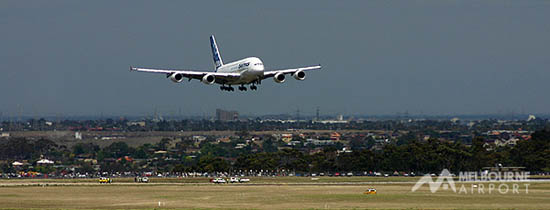
Posted by Mark Gulbrandsen (Member # 72) on 02-06-2006, 08:07 AM:
quote:
About 50 engineers will arrive with the A-380.
Hopefully one of those 50 engineers will remember that they shouldn't touch down when already half way down the runway.......
Posted by Leo Enticknap (Member # 534) on 02-06-2006, 02:49 PM:
Preferably the one who is flying it.
Posted by Paul Mayer (Member # 355) on 02-06-2006, 03:50 PM:
Believe me, you do not want an engineer flying the plane.
Posted by Mark Gulbrandsen (Member # 72) on 02-06-2006, 05:53 PM:
quote: Paul Mayer
Believe me, you do not want an engineer flying the plane.
I think the last time they allowed that the Engineer bellyrolled the 707...... Wasn't his name Tex or something like that?
Posted by Paul Mayer (Member # 355) on 02-06-2006, 09:30 PM:
Alvin M. "Tex" Johnston, chief test pilot for the Boeing 707 project. Yes, unannounced he rolled the Dash-80 (the prototype for both the 707 and the C-135) during a demo flight in front of the assembled Boeing and potential airline customer executives in town for an IATA convention. Oh and there were quite a few engineers aboard the aircraft too.
Just another day selling airplanes. It was a beautiful moment.
http://www.aviationexplorer.com/707_roll_video.htm
Posted by Daryl C. W. O'Shea (Member # 1303) on 02-06-2006, 09:32 PM:
Believe me, the engineers do not want to be flying the plane.
Posted by Paul Mayer (Member # 355) on 02-06-2006, 11:44 PM:
What cracks me up is that Iqaluit is going through a "heat wave" of sorts right now. The temperatures are only getting down to about -10degF or so. Airbus would like it to be more typical for Iqaluit, like -25 to -30degF for some really good cold soak testing.
Posted by Daryl C. W. O'Shea (Member # 1303) on 02-07-2006, 12:40 AM:
Iqualit doesn't really get that cold. Yesterday's -23/-31C hi and low falls right on average.
http://www.weatheroffice.ec.gc.ca/city/pages/nu-21_metric_e.html
If they want colder weather they can fly in circles to Alert and Resolute where it's currently -35C (-31F).
http://www.weatheroffice.ec.gc.ca/city/pages/nu-27_metric_e.html
I think they're more concerned with sort-a-cold weather with excellent search and rescue within short distance.
Posted by Dave Macaulay (Member # 813) on 02-07-2006, 10:07 AM:
CBC did a short segment on the testing, apparently Iqaluit was picked because of the 8600 ft runway and availablity of accomodation for their people. No mention of whatever subsidies the assorted governments offered Airbus but as usual that's probably a major factor too. An Iqaluit delegation did go to Airbus and pitch their town for the cold tests so I expect taxpayers are footing part of the bill.
Posted by Paul Mayer (Member # 355) on 04-02-2006, 09:22 PM:
Looks like Airbus successfully passed the emergency evacuation certification test for the A380 last Sunday. 873 people out of the aircraft and on the ground in 90 seconds through eight out of 16 doors in the dark. 32 injuries including a broken leg - apparently about what is expected with such large numbers.
Airwise News link
Posted by Leo Enticknap (Member # 534) on 04-03-2006, 04:11 PM:
I'm sure that would be getting off lightly compared to a typical emergency evacuation drill on Ryanair (known as Dieinair to its regular customers).
Posted by Mark Gulbrandsen (Member # 72) on 07-07-2006, 08:51 AM:
Himm, Sometimes catch up takes a cople of years but it appears that Boeing is now trouncing on Airbus receiving a whopping 350 orders for the new 787 Dreamliner plane and it hasn't even left the gound! Whilst Airbus 's new chief wades through the their 140 plane order for their new competing plane the A-350 and is deciding weather to even put it into production or not... all this whilst the hige A-380 is experiencing enough problems and delays of its own. An interssting turn of events and a good indication of who is really the more sucessful plane maker. Perhaps the article below should have been titled "Boeing Kicks Ass!"
Link To Article
LONDON (AFP) - European aircraft maker Airbus, which faces delays to production of the A380 super-jumbo, may be forced also to delay the launch of its long-haul A350 jet, London's Times newspaper has said.
The new setback was because Christian Streiff, set to be confirmed as the new Airbus chief executive, needed time to approve the venture, the newspaper said citing sources close to EADS on Friday, which owns 80 percent of Airbus.
The group has been busy redesigning its A350 model, a new mid-sized airliner that has been poorly received by potential clients.
According to The Times, sources close to the European Aeronautics Defence and Space Company have warned that Streiff may not make a decision by the company's deadline of the Farnborough Air Show in England which runs from July 17-23.
Streiff, the former deputy chief executive of French construction materials giant Saint-Gobain, was nominated as Airbus boss last week after his predecessor Gustav Humbert was ousted because of delays to the flagship A380.
However, the daily newspaper said that his appointment was not expected to be confirmed until next week -- around the same time that Airbus was understood to have scheduled meetings formally to approve the A350 plane.
"There is a possibility of him (Streiff) saying the A350 project is too much for him to give an OK when he is just days into the job," the Times quoted an anonymous source as saying.
The A350 jet carries at least 250 passengers and will compete with Boeing's new 787 aircraft which has been dubbed the Dreamliner.
The 787, which has a capacity of 250-300 passengers, has attracted 350 orders since its commercial launch in 2004 compared with about 100 for the A350, which was launched by Airbus as a competitor to the Boeing plane.
In a severe blow for the company, Airbus reported on June 13 that it had experienced problems with the production of its A380 model, its flagship product which is set to become the biggest civilian airliner in the world when it finally enters service.
The problems, which arose from problems in installing wires and cables, led to the departure of Humbert and are set to cut the number of deliveries of the A380 in 2007 to nine instead of 20-25.
Airbus, caught in a storm of bad publicity, has been trounced by US rival Boeing since the start of the year according to figures showing orders received by the two companies.
The figures, calculated by AFP, show that at the end of June Airbus had received only 142 orders since the start of the year compared with 445 for Boeing.
Mark
Posted by Jennifer Pan (Member # 2035) on 07-07-2006, 11:50 AM:
This plane doesn't impress me... not until it transforms and fights crime and then forms into a cruise liner.
Posted by Louis Bornwasser (Member # 3063) on 07-07-2006, 12:15 PM:
At prtesent, there are only a few airports long enough or with suitable terminal facilities for the big Airbus.
Remember that long-times-on-the-ground mean financial losses for the airlines. Perhaps they will reinvent loading & unloading so that this thing can actually fly enough to make money. Louis
Posted by Jack Ondracek (Member # 1466) on 07-07-2006, 12:35 PM:
quote: Louis Bornwasser
Perhaps they will reinvent loading & unloading so that this thing can actually fly enough to make money.
Well... I don't know, Louis.
Maybe there was more to that "emergency EVACUATION drill" than met the eye.
What if you could reverse that process?
(excerpted from Paul's)...
873 people INTO the aircraft and OFF the ground in 90 seconds through eight out of 16 doors in the dark. 32 injuries including a broken leg - apparently about what is expected with such large numbers.
![[Razz]](tongue.gif)
![[beer]](graemlins/beer.gif)
Posted by Jason M Miller (Member # 2597) on 07-07-2006, 02:18 PM:
quote: Leo Enticknap
I'm sure that would be getting off lightly compared to a typical emergency evacuation drill on Ryanair (known as Dieinair to its regular customers).
They have regular customers?
Posted by Louis Bornwasser (Member # 3063) on 07-07-2006, 03:21 PM:
Jack; 32 injuries may be an acceptable number; but only if the plane is big enough.
US to Europe planes use the same plane both ways for 6 days and the 7th day is A & B checks. If it takes too long to load/unload you will require extra aircraft. Louis
Posted by Leo Enticknap (Member # 534) on 07-08-2006, 04:45 AM:
Assuming (for example) 4,500 miles from Amsterdam to Minneapolis and two flights a day for six days (daytime east to west, then overnight back again), then a six-day stint is still 54,000 miles between services. I wish my car needed that little maintenance!
I'm off to a conference in Maine the week after next, and seriously hope that Northwest sold their clapped-out DC10s to Mugabe for $1.99 - or at least, taken them off the route I'll be flying. On my last trip we were delayed three hours coming home 'due to a technical fault with the aircraft', then none of the reading lights worked (great on an overnight flight, you can't sleep on planes and you want to read) or the headphone jacks (so no film either).
I got the strong impression that the plane was just so old and worn out that they were doing the bare minimum needed to keep it airworthy while they raised the money for something better, because they weren't planning to keep running it long-term. Still, the fare for this forthcoming trip was a lot cheaper than any other airline was offering, so I guess you get what you pay for (and NW is about the last airline left that still gives you a free G & T in economy class - so maybe the DC10 isn't so bad after all).
As for the A380, a pilot friend tells me that the problem is electromeagnetic interference in the cable runs. Apparently it was a pretty major blunder - the shielding and separation for each cable was designed with the tolerances of an analogue signal in mind, but apparently the A380 sends digital data down the wire to little computers situated right next to the servo motors which operate the control surfaces etc. From what she tells me, these are much more sensitive to the electromagnetic noise which exists in that environmnent, and they're gettting unacceptably high error rates in flight testing. The word on the grapevine is that upgrading and rerouting the cable runs is likely to add a significant amount of weight, with a consequent hit on fuel economy.
Forgeard, meanwhile, appears to be a graduate of the Ken Lay school of personal finance, having offloaded several million of his Airbus shares just before news of the A380 woes broke and their value went into a tailspin.
I'd guess that by the time all is said and done, the A380 probably won't perform as well as the initial hype suggested, but that it'll find a niche market for high volume routes. By the same token, I gather that the 787 is the first attempt by Boeing to design and build an all-composite airframe, so I wouldn't be surprised if that has similar teething troubles once the first prototypes get into the air, too.
Posted by Mark Gulbrandsen (Member # 72) on 07-08-2006, 06:45 AM:
I try not to get within a quarter mile of any Northwest plane.
Don't forget that Boeing has already had major experience at composites with the 777 and does alot of all composite stuff for the Air Force so I think they will be very sucessful with the 787;s structure.
The cockpit is extremely unique and both officers have clear displays so they don't have to look down while flying... a take over from Boeing's Air Force avionics work.
Boeing was really smart.... get a load of this paragraph from the 787 site:
"For instance, even though it may look a little different, the 787 flight deck operates just like the flight deck on a 777. It will take as few as five days of training for 777 pilots to qualify as 787 pilots. The pilot pool for operators of 777 / 787 mixed fleets will be the same. For an airline this is a significant cost savings."
I can't remember reading about any plane that is that easy for an airline pilot to transfer over to. Normally for a Boeing pilot to transfer over to an Airbus plane it would take about a months worth of training. Also I was wrong about the number of orders it is actually 393 extending out to 2016... Thats amazing! This plane now has the most number of orders and commitments of any new plane in history. Northwest has ordered them Leo so eventualy those old DC-10's will be gone. The first test flight is later next year with the first delivery in 2008.
Mark
Posted by Paul Mayer (Member # 355) on 07-08-2006, 09:30 AM:
Not to worry Leo, Northwest has indeed just announced they are retiring their DC-10s:
quote:
Airwise News
June 29, 2006
Northwest Airlines said it will speed the retirement of its remaining 12 DC10-30 aircraft.
The bankrupt US carrier said that during the next seven months it will replace its DC10s with new Airbus A330s and Boeing 747-400s. The carrier said that currently seven routes are served with DC10 aircraft.
Northwest has the oldest fleet of the network carriers with an average age of 17 years, according data from Bear Stearns.
(Reuters)
As for pilot training, Boeing's been doing the commonality thing for a very long time. The 757 and 767 share the same type rating - qualify on one and a pilot qualifies on both. Airbus does the same on its A330 and A340.
Posted by Leo Enticknap (Member # 534) on 07-08-2006, 10:41 AM:
That sounds like a strategy to lock customers in to one supplier or the other. If you're already operating A330s and are looking to expand your fleet, buying 777s is just going to land you with a big bill for pilot training, whereas if you buy A340s your existing crews can operate them (or vice-versa).
quote: Paul Mayer
Not to worry Leo, Northwest has indeed just announced they are retiring their DC-10s
Thanks Paul.
I hope that one or two of those DC10s can be kept flying for museum purposes, but I can't say that I'm sorry to see the back of them for regular passenger flights. This article (found through Google) doesn't mention Amsterdam to Boston, so I guess I'll get a 747 or an A330. As I'm not lucky enough to have an excuse to visit Hawaii before next January (only Anchorage in October, which I guess will involve a connection at Minneapolis), I guess I'm safe!
Posted by Paul Mayer (Member # 355) on 08-30-2006, 09:29 PM:
Whether you like Airbus or not, today's A380 formation flight over Toulouse was pretty impressive. Here's a pic from French Frogs AirSlides over at www.airliners.net:
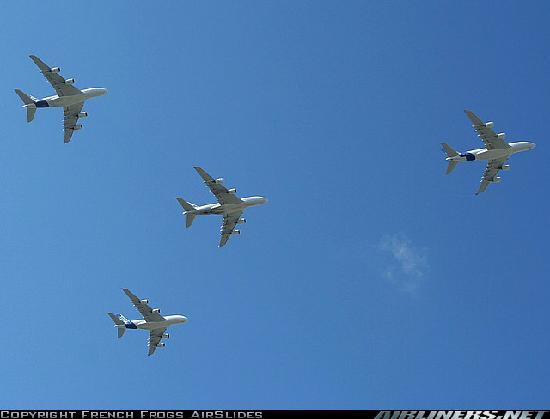
I like some of the caption comments for the pic:
"If they were full of pax, there would be more than 3200 people in this picture."
"And now, let's do a loop."
"Caution wake turbulence..."
Posted by Leo Enticknap (Member # 534) on 10-04-2006, 03:24 AM:
quote: L.A. Times
Airbus Hit Hard by A380 Setback
In delaying deliveries an extra year, the jet maker will see profit cut an additional $3.6 billion.
By Peter Pae, Times Staff Writer
October 4, 2006
Airbus' woes worsened Tuesday as the world's largest aircraft maker said deliveries of its flagship A380 super-jumbo jet would be delayed a year longer and airlines began considering the possibility of canceling their orders.
Two of Airbus' biggest customers — Emirates Airlines and International Lease Finance Corp. of Century City — said they were considering all options. That includes terminating orders for the $285-million aircraft, capable of carrying 555 passengers.
"This is a very serious issue for Emirates," said Tim Clark, president of the Dubai-based carrier, which with its $13-billion, 43-plane order is Airbus' largest A380 customer.
The threats came after Airbus informed airlines that the first A380 would not be available until October 2007 — more than 18 months behind its original schedule — because of problems installing electrical wiring.
Some airlines can expect delays of more than two years from the dates they were initially promised, Airbus said.
The latest delay, Airbus' third in a year, is likely to bolster rival Boeing Co.'s plans to build a larger version of its venerable 747 jumbo jet to compete against the A380. Chicago-based Boeing has had difficulty selling its latest 747 variant, the 450-seat 747-800. But the latest Airbus troubles could prompt carriers "sitting on the fence" to make a move, an airline industry executive said.
"Boeing may make inroads with the 747-800," said John L. Plueger, president of International Lease Finance, the world's largest jet-leasing company. "It could spur the launch of the 747-800."
Shares of Boeing rose $1.18, or 2.3%, to $81.78. Airbus' parent, European Aeronautic Defense & Space Co., rose 1% in Paris before the announcement.
Analysts said suppliers of parts for the A380, including about 100 Southern California companies, were unlikely to be affected significantly by the new delay. Other Airbus aircraft such as its single-aisle A320 line are selling well, and in recent years the company has had to ramp up production to meet demand.
Although A380 parts come from thousands of suppliers around the world, Airbus completes most of the assembly in Toulouse, France, and Hamburg, Germany. The latest delay was caused by problems with wiring installation at Hamburg, where much of the fuselage is assembled.
Airbus said the latest postponement would slash about $3.6 billion from its earnings over the next four years, bringing the total cost of the delays to more than $6 billion. As a result, the company, based in Toulouse, does not expect to post a profit until after 2010. Airbus said that to mitigate the loss it planned to cut about 20% to 25% of its managerial and support workforce not related to aircraft production. Airbus employs about 90,000 people.
"It is very disappointing that we find ourselves in this situation, but we need to be realistic with ourselves and our customers," said Christian Streiff, Airbus' president and chief executive. He was appointed to the position three months ago after the company shuffled top executives in the aftermath of a previous production delay.
Despite threats of cancellation, Streiff said no customer had given any indications of canceling orders.
"Everybody is still on board," he said during a conference call with reporters and analysts. Airbus has orders for 159 A380s from 14 airlines and two air cargo companies.
Airbus in June cited the wiring problems for the A380's second delay, which the company at the time said would push back production by about six months. But Streiff said a full analysis had revealed that the problems were much worse than expected.
The installation of wiring, which was expected to take two months for each plane, has grown to nearly six months, mainly because the computer software used to design the wiring system was not compatible with the A380's main design and engineering software, Streiff said. So when the fuselage assembled in Hamburg came to Toulouse to be mated with other parts, the wiring didn't match.
Scott Hamilton, an aviation consultant with Leeham Co. in Issaquah, Wash., doubted that customers would cancel A380 orders, noting that the carriers have a long-term interest in having two strong aircraft makers competing for their business.
Besides, he added, "by the time airlines get through raking Airbus over the coals and getting them to pay the penalties, they'll have the cheapest wide-body airplanes in the world."
They were saying on the radio this morning that the Hamburg-based engineers who designed the electrical systems did so using a totally different and incompatible CAD system to that which was used for the airframe/structural design work in Toulouse. Numerous minor problems were encountered when the time came to put two and two together, with the result that the entire electrical systems are having to be redesigned on a compatible CAD system and the first production line aircraft rewired for testing.
It looks like someone made a fundamental and very expensive mistake early on in the programme...
Posted by Will Kutler (Member # 770) on 10-04-2006, 05:46 AM:
Wiring an aircraft like this is no simple task. General standards in aviation is that wiring is to be routed ABOVE fluid lines, wiring has specific requirements regarding harnessing including bundle wrapping and mounting to fusalage. Wiring must also have play to compensate for expansion and contraction. All leads must be tracable. There are requirements for anti-chaffing grommets as the wiring goes thru the fusel;age structure. The list of requirements is extensive!
Kutler
Posted by Bill Enos (Member # 440) on 10-04-2006, 11:35 AM:
Requirements or not, either they can do it or they haven't figured out all the issues. Seems like the prototypes flying are not really airworthy if there are still problems.
Posted by Leo Enticknap (Member # 534) on 10-04-2006, 01:45 PM:
That thought occurred to me, the radio interviewer and the Airbus spokesman on Today this morning. The latter sidestepped the airworthiness issue quite neatly, I thought, by claiming that the problems thrown up by the incompatibility of the two CAD systems were purely to do with the in-flight entertainment systems - which, he pointed out, had been specified very differently by each of their launch customers - and nothing to do with anything related to flight safety.
If the story about two incompatible CAD systems being used in France and Germany is true, though, it all adds up to a first class cock-up.
Posted by Bill Enos (Member # 440) on 10-05-2006, 12:16 PM:
Sounds like a bull shit story to cover up something. Dosen't seem like they would hold production over an entertainment system issue.
Posted by Paul Mayer (Member # 355) on 10-05-2006, 05:38 PM:
In-Flight Entertainment (IFE) systems are nothing to sneeze at these days. The A380 will have an all-digital IFE system capable of routing hundreds of channels of audio and video and broadband to each seat. Nowadays IFE is as important a selling point as payload, range, fuel burn, and projected maintenance costs. The IFE cabling task is indeed quite formidable.
The A380, like all Airbuses from the A320 on, is a fly-by-wire aircraft. Turns out that at the data rates now being used, crosstalk in the flight control channels has become an issue. The solution was to increase the shielding by going to a larger cable gauge. Unfortunately the new cable will not fit through the existing holes in all of the bulkheads, formers, ribs, stringers, and other bits of structure that the cables must pass through. Hence, a fairly major engineering rework will be needed for all those components. Looks like delivery of the A380 will be delayed an additional year because of this.
As you might imagine, Airbus parent EADS is not happy about this. Neither are the airlines that paid top euro/dollar to have one of the first delivery positions. The Airbus business guys certainly have their work cut out for them, as Airbus will pay substantial contract penalties to the customer airlines for missing the promised delivery dates. In the mean time, testing continues with the five aircraft now flying.
Back to throwing bags in my dinky obsolete fly-by-fluid MD-83s. The Mad Dog lives on...
Posted by Bill Enos (Member # 440) on 10-05-2006, 05:55 PM:
It seems to me that crosstalk in flight controls would definitely be an airworthyness consideration. Designers of this dog have apparently never run cable of any kind before.
Posted by Michael Schaffer (Member # 1204) on 10-05-2006, 06:49 PM:
Maybe you should head over there and show them how it's done, Bill.
quote: Paul Mayer
The A380, like all Airbuses from the A320 on, is a fly-by-wire aircraft. Turns out that at the data rates now being used, crosstalk in the flight control channels has become an issue. The solution was to increase the shielding by going to a larger cable gauge. Unfortunately the new cable will not fit through the existing holes in all of the bulkheads, formers, ribs, stringers, and other bits of structure that the cables must pass through. Hence, a fairly major engineering rework will be needed for all those components. Looks like delivery of the A380 will be delayed an additional year because of this.
What I don't understand here - whether it's "incompatible CAD software" or "unforeseen cable requirements" (in either case, a major massive fuckup, all we really learn from these alleged reasons is that people are panicking and starting to point fingers in all directions) - is, wouldn't an airplane like that be designed with redundant cabling space and paths from the start? Because even if the current design *would* accomodate whatever cabling is needed right now, you never know what comes up in the future.
Posted by Leo Enticknap (Member # 534) on 10-06-2006, 01:43 AM:
I'm not an aeronautical engineer so please forgive me if this sounds stupid, but I'd expect the gauge of cabling needed for a given data rate to decrease over time, as the technology improves, not increase. So unless you want to design in the flexibility to add additional features (of the sort that needs wiring) at a later overhaul of each plane, then building in the capacity for currently unneeded cables would probably involve an increase in production overheads or a decrease in efficiency or capacity that the designers didn't want. The down side is that this leaves no margin for error if you get the sums wrong or you hit an unforeseen problem, one or both of which seems to have happened in this case.
I wonder if using fibre optic for the data cables might have reduced crosstalk? I'm assuming there's a glaringly obvious reason why they didn't...
Posted by Paul Mayer (Member # 355) on 10-06-2006, 10:44 AM:
Though I'm no AE either, I think you've got it Leo.
As for fly-by-glass, we'll probably start seeing that in the next generation of airliners. Military designs have begun using glass and eventually that technology will filter down to us civilians, just as things like FADEC (Full Authority Digital Engine Control) already have.
In another related note, Rolls-Royce announced today that they are suspending work on the Trent 900, the engine that will power the first A380s, for about 12 months. At this point the first A380s will not fly in scheduled service until near the end of 2007. No layoffs are planned at RR, as the Trent 900 is but a small part of their present revenue stream.
[ 04-27-2007, 07:13 PM: Message edited by: Paul Mayer ]
Posted by Bill Enos (Member # 440) on 10-06-2006, 01:58 PM:
Michael, in running cable, crosstalk is something that happens often enough that you must expect it, and be prepared to resolve it. You, working in the service side well know that the engineering types seem to believe their designs are perfect from the beginning. In reality, it's the service techs that make most of their designs function in the real world.
Posted by Leo Enticknap (Member # 534) on 10-06-2006, 03:01 PM:
quote: Paul Mayer
In another related note, Rolls-Royce announced today that they are suspending work on the Trent 900, the engine that will power the first A380s, for about 12 months.
Inevitable, I guess. If they ran the production line at full pelt now, then assuming that model of engine can't be fitted to any other plane, they'd simply end up with a whole load of them in mothballs for a year or even longer: thereby incurring the production (and storage) costs now, but only generating revenue later, after inflation has had a year or two to eat away at the profit margin. Presumably just about every other supplier producing custom-designed parts for the A380 is in the same position.
Posted by Michael Schaffer (Member # 1204) on 10-06-2006, 04:23 PM:
quote: Bill Enos
Michael, in running cable, crosstalk is something that happens often enough that you must expect it, and be prepared to resolve it. You, working in the service side well know that the engineering types seem to believe their designs are perfect from the beginning. In reality, it's the service techs that make most of their designs function in the real world.
There is some truth in that, but airplanes are really on a completely different level of complexity than the stuff we work with. Whatever really happened, there, it is obviously a huge messup, very embarassing for the company, too, but I am not inclined to pass judgment because I couldn't do better.
I wonder if "entertainment system cabling" is the real reason or if they haven't come across a more serious safety issue that they don't want to reveal because it would taint the reputation of the plane from even before the start.
Posted by Leo Enticknap (Member # 534) on 10-06-2006, 04:43 PM:
If so, that's a very high risk strategy, because if someone else does the revealing, then Airbus have really screwed their pooch. In that scenario they'd be accused of trying to cover up a safety issue. Even if they later corrected it, the damage would be done in terms of public reputation.
Paul - correct me if I'm wrong, but wasn't this scenario pretty much what undermined sales of the DC-10 in the '80s? The impression, rightly or wrongly, that McDonnell-Douglas was trying to brush the underlying causes of the Paris and Chicago crashes under the carpet created the public image of a fundamentally unsafe aircraft, even though the technical flaws, once identified, were easily and cheaply rectified? So any airline considering the purchase of DC-10s knew they were buying a PR problem, even if the aircraft itself was fundamentally safe by that stage.
Given the management problems that have affected Airbus in the last 12-18 months and the intense competition between the Airbus and Boeing concepts for the next generation of long-haul airliners (Airbus megajumbos v. smaller capacity, more flexible planes), any credible accusation of a safety problem in the design or manufacture could spell big trouble, I guess - and even bigger trouble if Airbus tried to deny it.
Posted by Mark Gulbrandsen (Member # 72) on 10-07-2006, 10:32 PM:
It would seem to me that they would attempt to minimize xtalk with a more robust software package. I know for a fact that digital crosstalk can be managed via software. Seems like software has always been a problem for Airbus though. I too feel that its some other safety issue they don't want let out, probably not a structural issue though. I think airplane structures have advanced beyond a point that something could have slipped by them in that aspect.
Mark
Posted by Louis Bornwasser (Member # 3063) on 10-08-2006, 06:47 AM:
Meanwhile, the Airbus gets cheaper as penalty clauses kick in. Loading/unloading is still the bane of any large vessel; ship or aircraft.
Assuming Boeing does not have similar problems (delays) it will be educational to see who "wins." Louis
Posted by Mark Gulbrandsen (Member # 72) on 10-08-2006, 08:40 AM:
Boeing has already won for the most part. With close to 500 orders for a plane that hasn't left the ground yet. What counts is the number of total orders placed in selling planes of this type.
Boeing also has far more experience in just about every aspect of airpanes... as much as the rest of the indusrty combined!
Mark
Posted by Mark Gulbrandsen (Member # 72) on 10-09-2006, 09:33 PM:
Oops. More Airbus problems today. The new CEO resigned after just 99 days on the job. I was a bit off on the orders at Boeing.... I think he sees it as a loose-loose situation. It also really makes me wonder if there is some sort of safety issue at hand with the "flying cash cow"....
From today's article on MSNBC
"After concentrating massive resources on the superjumbo, Airbus has been outmaneuvered by Boeing’s two-engine 787, which delivers better fuel economy than older four-engine Airbus jets in the same size category — a sales argument that has grown more persuasive with higher fuel prices.
A widening gap
The gap widened on Monday, as Airbus announced it had taken orders for 226 planes from Jan.1 through Sept. 30, compared with 723 net orders recorded by Boeing as of Oct. 3."
Posted by Paul Mayer (Member # 355) on 10-09-2006, 11:45 PM:
Careful with the statistics Mark. That 226 figure quoted for Airbus is just for the A380 whereas the quoted Boeing number is for total aircraft orders across all of their offered types including the 787 and the new 747-8. Airbus' order book for all of their offered types is similar to Boeing's - the competition between the two companies remains close and fierce, as it should be.
Posted by Leo Enticknap (Member # 534) on 10-11-2006, 10:43 AM:
Well, the saga taxis on... CEO Christian Streiff was 'Airbusted!' according to the banner headline on Fox News in my Anchorage hotel room just now, or 'canned in a boardroom boot', as the announcer described his resignation.
The story had to compete with Kim Jong Il and Congressman Foley for airtime, and so didn't get much: but the gist of it seeemed to be that Streiff wanted to radically reorganise Airbus to try and both sort out the A380 and make the other lines profitable. In response, the Spanish and German governments took one look at the scale of job losses that would involve, and promptly told him to return his seat to the upright position and remember that the nearest emergency exit may be behind him.
Posted by Michael Schaffer (Member # 1204) on 10-11-2006, 10:04 PM:
This is a little OT, but has anyone ever thought of fitting the big aircraft for intercontinental flights with bunks like in a submarine rather than seats? The seats are crampy even for slim people, you can't really sleep in them, there is little legroom. I guess you could fit just as many bunks in as seats since you could three or so on top of each other. Then people could really stretch out and sleep and be much more rested than after the torture of sitting in a sardine can for 10 hours. Just a thought.
Posted by David Stambaugh (Member # 1102) on 10-11-2006, 10:15 PM:
Heh. Looks like someone recently patented an idea for seats that convert into sleepers.
Posted by Mark Gulbrandsen (Member # 72) on 10-12-2006, 09:15 PM:
quote: Paul Mayer
Careful with the statistics Mark.
I'd be curious to see where you got your figures...As of Sept 30 2006 from the Seattle Buisness Weekly Boeing has 507 orders just for 737's so far this year. Ryanair also recently signed an agreement for an additional 32 737's. According to answers dot com Boeing has 408 orders (368 firm, 40 pending) to date for the 787. That my friend is one busy plane maker and they have left Airbus in the dust! This of course doesn't count the 747, 767 planes. Last year it was more neck and neck with Boeing at 825 and Airbus at 687.
Mark
Posted by Michael Schaffer (Member # 1204) on 10-13-2006, 03:44 PM:
Mark apparently doesn't understand that this isn't a game in which there will ever be a "winner". It is in the best interest of the airline industry to have competing companies rather than a monopoly of any single one.
Posted by Robert Minichino (Member # 3495) on 10-13-2006, 03:46 PM:
Bah, you can't have competition if no one wins! ![[Smile]](smile.gif)
Posted by Mark Gulbrandsen (Member # 72) on 10-14-2006, 04:50 PM:
Exactly Robert! Michael still doesn't see the big picture in which Boeing will buy Airbus at a fire sale .
Mark
Posted by Michael Schaffer (Member # 1204) on 10-14-2006, 05:05 PM:
It would be a big disadvantage for airlines if there was only one manufacturer with a monopoly which can dictate prices for new planes. I think they take that into account when making their ordering decisions.
But it is good to see that there is still an area in which an US manufacturer can compete internationally.
Posted by Mark Gulbrandsen (Member # 72) on 10-14-2006, 07:01 PM:
Michael,
When Boeing buys Airbus the British and French Govt's will just start another airliner company. I have to laugh that a private company... Boeing is beating the pants off a company that is subsidized by two European governments.
Its all about having the right product to sell at the right time. The funny thing is that one of those right products has been around for several decades already.
Mark
Posted by Leo Enticknap (Member # 534) on 10-15-2006, 03:47 AM:
The last British corporate entity to have any interest in Airbus (BAe Systems) sold its 20% share to the European Aviation and Defence Consortium (the French and German governments, to all intents and purposes) about a month ago, just before the true extent of the A380 problems and the production inefficiencies with the existing model range became apparent and the share price got hosed.
The British government has not wanted to be in the airliner business since its fingers got burnt with the Concorde white elephant. The French and the German governments now have themselves an airliner business which, however serious the short term problems it now faces, has an established reputation for delivering competitive and reliable products in the form of the A319/20/21 and A330/340 series. I can't see any incentive for Boeing to want to buy it (even if they closed down production immediately, they'd still have to support existing fleets or risk falling foul of European competition law), or the French and the Germans walking away from Airbus and (if they wanted to stay in the airliner business) having to start over.
Boeing has received large subsidies from the US taxpayer, mainly in the form of military R & D contracts, just as Airbus has been fed bazillions of taxpayers' euros in the form of regional development grants, tax breaks, unofficially underwritten sales to state 'flag carrier' airlines, etc. etc. The bottom line is that the cost of designing a new airliner and getting it to market is now just too big for private enterprise to do it on its own, given the regulatory environment that both American and European business operates within.
Posted by Louis Bornwasser (Member # 3063) on 10-15-2006, 02:16 PM:
Posted by Bill Enos (Member # 440) on 10-15-2006, 08:15 PM:
How many seats does an airline have to rent to pay for an airplane?
Posted by Louis Bornwasser (Member # 3063) on 10-16-2006, 09:25 AM:
All of them! Louis
Posted by Mark Gulbrandsen (Member # 72) on 10-16-2006, 07:11 PM:
quote: Leo Enticknap
Boeing has received large subsidies from the US taxpayer, mainly in the form of military R & D contracts
They are hardly subsidies... they are always hard won delivery contracts that are usually won in stiff design conpetition with other American and European companies. With US Gvt. contracts these companies many times but not always also have to put up their own money to build the prototypes. Seems to me that Lockheed has won many more defense contracts over Boeing and other companies. They always seem to come up with the most advanced design for what ever they build.
Mark
Posted by Paul Mayer (Member # 355) on 10-16-2006, 09:18 PM:
For Bill Enos, it's really hard to say - each airline is different. But as a crude ballpark figure I'd guess/say that a break-even load factor (percentage of seats sold over seats available) is around 60%. But every airline has different costs of doing business so break-even load factor will be quite different for every airline.
This is where the Legacy Six carriers (UAL, DAL, CAL, NWA, AAL, USA) are having a hard time, since their costs of doing business are generally higher than that of the so-called LCCs (Low Cost Carriers like SWA and Jet Blue and my present employer Allegiant Air).
Industry average load factor is around 85%. After looking at all costs the typical return-on-investment at even the best running air carriers is around 4-5%. Not bad, but maybe not the best place to put money for some investors. You really have to love this business to be in this business.
Powered by Infopop Corporation
UBB.classicTM
6.3.1.2