This is topic Old Electronic Test Equipment in forum Film-Yak at Film-Tech Forum ARCHIVE.
To visit this topic, use this URL:
https://ft-forum.com/ft/cgi-bin/ubb/ultimatebb.cgi?ubb=get_topic;f=8;t=004042
Posted by Randy Stankey (Member # 64) on 05-03-2005, 12:25 PM:
I just got one of these babies:
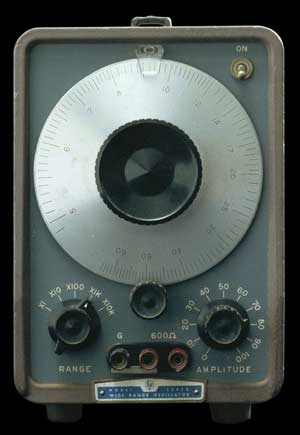
It's an old, 1950's vintage signal generator.
Hewlett Packard - Model 200CD
The price was right... FREE!
It still works to boot! ![[Cool]](cool.gif)
I was wondering if anybody could tell me a little more about it.
It'd be super if I could find some documentation or a manual or something.
Fail that, does anybody know how these things are callibrated?
Is there a trimmer inside that needs to be adjusted or is this one of those things where you hook it up to an oscilloscope, set it for 1000 Hz then loosen the dial and line "1,000" on the dial with the pointer? Or, does it even NEED to be callibrated?
I'd like to know more about the thing before I open it up and go poking around inside... Y'KnowWhatIMean?
Just get me an old Textronics oscilloscope and I'd be all set! ![[Big Grin]](biggrin.gif)
Posted by Mark Gulbrandsen (Member # 72) on 05-03-2005, 12:36 PM:
Thats a decent vontage oscillator! The only beef I have with em is that the distortion level is a bit high by standards. Look around on the net and you should be able to find a copy of the manual for it, just do a google search. There are still may of those used in labs and schools. If the frequency is within 5% I would leave it alone. Otherwise you will find the calibration sequence in the H-P manual.
I have an H-P VTVM from that same era. The thing is built like a tank and even has a special HF tube inside one of the probes. Its AC bandwidth is good to about 250 mhz which is pretty damed high for a VTVM made back then.
Mark
Posted by John Pytlak (Member # 331) on 05-03-2005, 12:39 PM:
Here is a link to the schematic:
http://www.jvgavila.com/hp-200cd.gif
And background info:
http://www.messmuseum.de/hp200cd.htm
http://www.messmuseum.de/hp200cd_d.htm
Posted by Bruce Hansen (Member # 281) on 05-03-2005, 07:07 PM:
John,
The jvgavila site has lots of manuals for old test gear. Nice site! Thanks
Posted by John Pytlak (Member # 331) on 05-03-2005, 08:33 PM:
You're welcome!
Posted by Randy Stankey (Member # 64) on 05-03-2005, 11:01 PM:
I hooked it up to an old speaker I had sitting around at work and set it for 440 Hz. Then I took an electronic guitar tuner with a built-in mic and put it near the speaker. The tuner registered a pretty close to an "A". It was about 1 "notch" too low on the scale.
If I turn the dial until the tuner reads a perfect "A" it will end up at about 448. (It's hard to read between the graduations on the scale.) If I detune the tuner until 440 Hz on the dial registers a perfect "A" it will end up at about 336.
That puts it at about 97-98% accurate... Assuming you accept the electronic guitar tuner as an accurate standard. (Which it probably isn't.)
What I'd like to do is get a good quality frequency counter and test it through all of its ranges. Ideally, I'd like to get a well-callibrated oscilloscope to really put it through its paces. That way, not only would I know how accurate it is, I'd know what kind of distortion it's putting out.
Still, 2% is not too shabby for something like this that's been in a guy's basement for all these years!
Posted by Ken Layton (Member # 133) on 05-04-2005, 01:33 AM:
For manuals also try http://bama.sbc.edu/
Posted by David Buckley (Member # 2600) on 05-04-2005, 04:58 AM:
quote: Randy Stankey
Assuming you accept the electronic guitar tuner as an accurate standard. (Which it probably isn't.)
If its a modern guitar tuner (ie microprocessor digital) it'll as accurate as a normal DFM, it'll be referenced to a crystal which will be within PPM of the right frequency.
'Tis funny. You have a piece of electronics that came from the garage that Bill and Dave built, its a decendent of their first product, and was in its days the dogs whatsits. Yet thanks to the digital revolution, a ten buck guitar tuner has much better calibration...
It is sad that the great HP is today a printer company
Posted by Jeff Stricker (Member # 224) on 05-04-2005, 06:41 AM:
I had one of these on my lab bench at work for many years. It's a good audio oscillator with lots of output power. Take a look at the sine wave on a scope to be sure its clean and free of distortion.
Powered by Infopop Corporation
UBB.classicTM
6.3.1.2