This is topic Advice Needed for Career Decision in forum Film-Yak at Film-Tech Forum ARCHIVE.
To visit this topic, use this URL:
https://ft-forum.com/ft/cgi-bin/ubb/ultimatebb.cgi?ubb=get_topic;f=8;t=004300
Posted by Joshua Waaland (Member # 287) on 10-08-2005, 05:23 PM:
In fall 2003 I started taking classes part-time for my BSME (Bachelor of Science in Mechanical Engineering) and since January 2005 I have been going full-time.
Here is my situation. My employer, who I worked for full-time before and only part-time now, has offered me a job oppurtunity that I need to decide on. It's a small office with only 6 employees and last week I told another employee about a job fair I was going to attend at school to look for a mechanical engineering internship. Thursday she told me that she and the boss were talking about needing another saleperson and knowing that I was looking elsewhere for work, they offered it to me to keep me there.
The main reasons I want to leave there are: I want to get experience in engineering and my boss likes to rage too much. He is a screamer and verbally abuses all of us.
I have been there 6 years and know more about the product than anyone else because I repair it, so I am a natural fit for the position. The sales position could either be inside sales or outside sales. Either way requires full-time which means cutting back on, or even quitting school. If I do inside sales, I will only be travelling locally most of the time and I could still take classes but will be around the boss. If I do outside sales they would pay for my car, gas, insurance, vehicle maintenance, cell phone and I would get an expense account. Best of all I would have no boss around me. My pay would be about double what is was before. The expense account would be a credit card that would be in my name so it builds my credit score. There are other incidental side perks like earning frequent flyer miles that can be used for my family to take free trips. Not having to pay for vehicle expenses and the cell phone would be a nice indirect raise.
My concern is that now that I am in school (for the third time) and going strong, I am not sure I want to quit. I am half-way through the second year and have 2-1/2 years left. My wife likes the idea of me going back to work full-time so we will have more money and we can have kids. The outside sales position would require lots of traveling to the gulf coast states, and wherever else they want to send me which could be as far away as California. This means a lot of time away from family.
Once I start down this path I am kind of stuck for a while. Say I quit school, my wife gets pregnant so she can't work and I have no degree. Then I will be in a situation that will be hard to leave. I am wondering if any of you have had similar situations and could offer any advice. Regrets? Happy you did it? I know it's a gamble but I would like to at least know that I made the best decision I could at the time so I am not kicking myself later if it goes south on me.
[ 10-09-2005, 11:44 AM: Message edited by: Joshua Waaland ]
Posted by Marc Hansen (Member # 705) on 10-08-2005, 07:28 PM:
How about online classes? If you travel far enough to require overnight stays it would be a great way to spend your evenings.
Posted by John Hegel (Member # 628) on 10-08-2005, 07:57 PM:
In the long term the degree will offer you more stability and money.
Posted by Steve Guttag (Member # 268) on 10-08-2005, 09:50 PM:
I gotta say...go for the degree...long term you will do better by it. The longer you wait, the harder it will be to ever go back to attain a degree like a BSME. If you are qualified for this super promotion without the degree you will still be qualified afterwords...only you will have many more choices and probably would be as beholden to this one employer for your family's financial security.
Posted by Will Kutler (Member # 770) on 10-08-2005, 10:17 PM:
FINISH YOUR DEGREE, WHICH WILL SECURE MORE LONG TERM POSSIBILITIES!
Cheers
K
Posted by Paul Mayer (Member # 355) on 10-09-2005, 12:51 AM:
Definitely finish the degree. Get it out of the way. Much better long-term possibilities.
And lose the screaming boss. I know for me, screaming bosses raise my blood pressure and make me feel lousy in general, even when the screaming isn't aimed at me. I just don't do screaming bosses. They get to yell at me just once, then I leave them.
Posted by Leo Enticknap (Member # 534) on 10-09-2005, 05:19 AM:
Agreed with all the above. At the university our archive is based in, we take students from a wide range of backgrounds, from kids straight out of school to students who have returned to take a degree after raising a family, often in their 40s or 50s.
While I know many who students have managed to juggle the demands of their course and bringing up a family very successfully, there's no doubt, from what I've seen, that they're facing a much bigger challenge than many of their colleagues.
If your programme is going well and the alternative is the screamoing boss, those are yet two more reasons to see it through, IMHO. While many people can 'deal with' screaming bosses, Paul is 200% right - dealing with them puts pressure on you, even if you're not the object of the screaming. I've had the pleasure of working with three prize examples in my time: one of them is mentioned about half way down page 2 of this thread. The second made life so hot for himself that he eventually upped and left: we later discovered that he probably lied about the 'fantastic new job' he said he was moving on to, and that the real reason was that, after alienating virtually everyone in the institution he worked at (no small achievement, given that it had over 1,000 staff), he was basically told to jump or be pushed. The third dropped dead from a stroke aged 39: a classic case of self-inflicted stress.
Posted by John Walsh (Member # 168) on 10-09-2005, 09:48 AM:
I 'six-ly' agree with everyone to finish school for a degree, for all the reason listed above... I will include that; you may be an expert in that product, but when the product reaches the end of it's saleable life, (and they all do eventually) you have no experience with anything else. Also, your resume will only have one job experience on it, and that's not good. Employers like to see some diversity, otherwise they think you are not 'well-rounded' and will take too long to get used to their polices and procedures.
Posted by Joshua Waaland (Member # 287) on 10-09-2005, 11:40 AM:
I definitely can say that there isn't a day that goes by that I don't regret my past decisions to not finish school. I didn't take it seriously when I was younger and now my family and I are paying for it. Literally and figuratively.
I have been waiting for a sales position since I have been working there and I was promised it would happen when the economy picked up, but after several years of a bad economy I gave up. I couldn't wait for it anymore and I am glad I chose to go back to school. However after being offered this position, my head has been in the clouds for the past few days because it is satisfying to know that I am valued enough to be offered it and that they recognize my abilities. Besides after working monkey jobs most of my life, an expense account, raise and free vehicle are very appealing. I know that if I finish school the long term perks are so much better, but it will be hard to turn this down.
I purposely asked for time to think about it because I didn't want to make a rash decision and I knew I wasn't thinking clearly. Now that I have been given time to ponder it, I am leaning more towards school. They don't offer classes in the evenings for a BSME so it would be hard to finish while working.
As far as my boss goes, the biggest reason for me wanting to leave is him. I can't believe I made it six years with him. I can't believe he is in his 60's and still alive with the way his blood pressure boils. I had a boss at another job that died of a massive heart attack when he was only 43! He didn't scream or yell but he was a worry wart and he died while playing tennis like he did everyday. He was fit and active. My boss now is overweight and out of shape. A co-worker used to say that he believed evil people live forever and only the good die young. After knowing my boss I would have to say there is some truth to that.
I just have had enough and I don't need to be treated that way. My boss hired his son to take my old position in the warehouse and he is so much like him. Before it was managable and he was gone most of the time, but now that his son works there he is there all the time. I came into work two weeks ago and he started yelling at me the moment I walked in. That was when I decided to finally start looking for a new job. My wife used to call me and she could hear him screaming at other people through my phone when I was in the warehouse and he was up front in the office 200 or more feet away.............through walls! The worst part is after working around that so long you start to scream back and I am worried about what other negative effect it is having on me. I could write a book about him but I doubt you would want to read it. He is another big reason to stay in school.
[ 10-09-2005, 06:48 PM: Message edited by: Joshua Waaland ]
Posted by Will Kutler (Member # 770) on 10-09-2005, 01:17 PM:
So,
Are you going to base your life around one crappy job with no guaranteed future, or are you going to complete your engineering degree, which should hopefully provide you with many potential professional career opportunities?
cheers
K
Posted by Mike Heenan (Member # 392) on 10-09-2005, 04:33 PM:
I know people who have degrees who have "shit" jobs and can't do anything with them, whether that's because their field of work has too many people clamoring for too few positions, or they weren't motivated enough to get out there and get a better job, I don't know. If it were me, I'd take the higher paying job, live cheaply within means and save money for a nest egg, so to say. You can always go back to school easily. But you have and want to expand your family now, so I guess your priorities would be different than mine (me being single and all).
Posted by Phil Hill (Member # 371) on 10-09-2005, 06:50 PM:
Go for the degree! As many have said, you can always fall back on it and most employers weed out those (many times unfairly) without that sheepskin...and I ain't talkin' condoms.
A little P&S and hard work and denial of material things for a few years will pay big dividends the rest of your life.
The only degree I would pass on getting is a general Liberal Arts or Philosophy one... we already have plenty of taxi drivers... ![[Razz]](tongue.gif)
One last point: While "Sales" is the more lucrative end of most companies, it's also one of the most influential as to what products a company should provide. That being said, it's also a double-edge sword in that IF one sells a shitload of product, they are loved. IF they don't, they are canned and the "next" guy takes their place.
It takes a special type of person with a "salesman's personality" to be successful. Those that are full of hot air are soon realized for what they are and fail. Those that know WTF they are talking about become respected and successful. "It ain't no easy job".
My 2-cents... ![[Smile]](smile.gif)
Posted by Joshua Waaland (Member # 287) on 10-09-2005, 07:01 PM:
First off thanks for all the advice. It seems like the older gentlemen (no referance to specific age, just older than me and more life under your belt) are all in agreement that the degree is the better way to go. Deep down I agree with you.
This has been a problem for me in the past too. When I was in school before I worked at UPS. What was supposed to be a part-time position for living expenses turned into a full-time supervisor position. I signed on faster than you could blink and quit school. It is hard to turn down what seems like a good oppurtunity at the time when someone dangles a carrot in front of you. I am always a sucker for that. ![[Wink]](wink.gif)
You have a good point though Will. I have been told that the BSME degree is about the broadest engineering degree which is promising when it comes to job hunting. Actually most of the ME's that I know are in management anyways.
Phil, I would have to agree that most companies do fire people when they don't sell well. This company however is a bit far from the norm. While are boss is a real jerk, he has never fired anyone since I have been there. The reason they want a new sales guy now is that the current one keeps flying all over after they have told him 5-6 times to drive more to save money. He will go to Texas for one single demo and take the whole week to do it. So they want to keep him nearby so he has to drive and put me in his old region. I have seen things go on at that company that would never happen at a bigger place, but nobody gets fired so I am not too concerned about that. Funny you should bring up the personality issue too. I told my wife yesterday that I never saw myself in sales because I am not good at lying and bs-ing people. I am not what you would call a social butterfly type either. She basically said what you just did though that people respect the straight shooter more than the sleazy sales type.
Again thanks for the advice guys. I appreciate it. Now if I could just put my wife's biological clock on pause for a few years everything would be much easier.
Posted by John McConnel (Member # 2000) on 10-09-2005, 08:16 PM:
Joshua,
It's pretty likely you'll be much happier with yourself if you get the degree. So go for it. I'll bet your wife's clock will tick long enough for you to get the degree and still become parents. I got an engineering degree knowing that operating a theatre was what I was going to do. And I'm happy I did it.
John
Posted by Bobby Henderson (Member # 840) on 10-09-2005, 09:58 PM:
Not that my opinion will sway you any, I definitely advise sticking with earning the degree.
Regardless of the relentless trend to outsource lots of tech jobs, the United States has a terrible shortage of engineers. There's going to be job security there, and probably pretty decent pay. Not many Americans have the stomach to take all those math courses.
The other reason to stick with the degree is the volatile nature of sales type jobs. Such careers can be very unpredictable. One month you're making lots of money. Another month the company is getting bought out and everyone is getting fired. Many sales people just work on commission. Some even have to work as independent contractors and pay self employment tax and don't have squat for benefits. Another feature I don't like about sales is some areas of that trade require you to leave your morals and scruples at home.
Posted by David Stambaugh (Member # 1102) on 10-09-2005, 10:10 PM:
quote: Bobby Henderson
One month you're making lots of money. Another month the company is getting bought out and everyone is getting fired.
Not to to be disagreeable, but speaking from personal experience, that can happen to anyone, at any time, regardless of position, experience, or education.
Posted by Mark Gulbrandsen (Member # 72) on 10-09-2005, 10:19 PM:
I will add that out of all my friends going clear back to High School only two people out of that bunch that have degrees actually has a great job that has high pay, my sister being one of them. The rest that have degrees today are not employed in any field or job that relates to the degree they got, one friend drives a garbage truck!
The two most important things I will add is to follow your dream and don't let anything including a famly stop you... you can have a family and still accomplish your dream. Also, visit as many places in the world as you can take in, when you help out or volunteer for something do it for the betterment of the world, not with the attidude that its for your betterment. Being a worldly person makes you a better, more diversified person.
Mark
Posted by Joshua Waaland (Member # 287) on 10-10-2005, 07:07 AM:
quote: Bobby Henderson
Another feature I don't like about sales is some areas of that trade require you to leave your morals and scruples at home.
That is one thing I would be expected to do from time to time at my job. They have tried getting me to do it in the past when dealing with customers over the phone.
Posted by Will Kutler (Member # 770) on 10-11-2005, 12:49 AM:
Well, I suppose that I am lucky: I am able to get a degree in a field that I love AND where I can make good $$!
Our program has a 100% job placement rate, and starting salaries w/a BS are around $45K - $55K. My prograsm is also ABET accredited.
Hell, I had my first internship job interview a weeks ago in the Tool and Die/Aerospace industry. Unfortunately, I was not hired: the company turned it into a full time position, so obviously my school schedule interfered. However, they are still interested in me and we shall see what transpires over the summer. I will say this, the internship salary was quite handsome!!!!
The only thing I dislike about college is having to waste my time with some bullshit classes that I will never, ever use in industry, or as a means to earn a paycheck! But that's college life, and every student who has ever graduated high school or college has had to do the same!
Cheers
K.
Posted by Joshua Waaland (Member # 287) on 10-11-2005, 04:53 AM:
I know what you mean Will. I am taking a cultural diversity class right now on Africa. I was enrolled in another class at the beginning of the semester called "The Geography of Cultural Diversity". The first day of class the instructor told us that we would be writing a group ten page paper and making a presentation, a five page paper that detailed our family's arrival in America, and several other major assignements. For only two credits. I don't think so! I dropped that class and picked up the Africa class the next day. We only have three tests all semester and one was a take home map that we had to draw.
When I am enrolled in classes like Calculus 2, Physics and Statics, I don't have time to dick around with all the general education requirements they want me to do. I understand it is to make you a more well-rounded person, but like you said we will never use it. What will I ever do with the philosophy class I took for my humanities requirement or the psychology class for my social sciences requirment? Nothing....
We had a job fair on campus last week and I handed out 18 resumes. This was before the job offer. I haven't heard anything yet and plan to e-mail them all this week a thank you letter for talking with me. I told them all I was looking for part-time work rather than a co-op because I don't have time to take semesters off to work. Most of them weren't hiring for anything like that. I figured I could get real-world experience while going to school even though it wouldn't be a formal co-op position. We will see.....By the way, some of the employers there were the NSA, CIA, NASA, Timken, Diebold and of course Goodyear (Akron being the rubber capital and all). I still can't figure out why the NSA or CIA would hire engineers. Anyone know?
Posted by Dustin Mitchell (Member # 372) on 10-11-2005, 05:56 AM:
Probably for analysis. Need someone to figure out if the sat photo they got over Whatchamacallitstan is a nuclear missile or a milk truck.
Posted by Steve Guttag (Member # 268) on 10-11-2005, 06:50 AM:
I know in our IEEE lounge at Maryland...the General Education classes were part of the discussion...that is...the ones to take that would only help the GPA and not take too much time.
I am a big believer in summer school at the college level...you can use the summer to take a really difficult course you need to devote your full attention to or to nip off the GE requirements without it interferring with your core classes.
However, at least at Maryland, there were so many classes one could often find a GE class that was at least interesting. Like philosophy...I took philosophy of science...made more part of what I was doing anyway.
My favorite was RTVF314...Film appreciation....I mean, they actually gave me credits to watch movies! What a deal! As it turns out, the professor (a grad student at the time) is now the director of film at the Library of Congress...a customer of ours now...I remembered when he started at LOC too...makes the world a bit smaller and more familiar.
I wouldn't poo-poo the GE classes completely...there is truth to the well-rounding business. While you may not need the details on what you learn in all of your GE classes...they can often help you in different ways to think about things and you never know when that information might help you out. I also claim that if you don't live on campus (not practical for someone with a familiy) you also missout on learing about the diversity of people and how to get along with someone that is probably quite different than you. In many ways, that was the most valuable education of all, for me.
Posted by Kelly Skaggs (Member # 1780) on 10-11-2005, 08:15 AM:
quote: Bobby Henderson
Another feature I don't like about sales is some areas of that trade require you to leave your morals and scruples at home.
Hell I use to work for Showcase, we did that at least once a week.
Posted by Joshua Waaland (Member # 287) on 10-11-2005, 08:56 AM:
Steve,
I took classes all this past summer. I took Chemistry 1 and 2 and Philosophy. Next summer I will get the rest of my gen-ed classes out of the way and Differential Equations. It was nice to only have five week long courses. They move so much quicker and cut out all the peripheral stuff. Also I have to take one more humanities class and I am taking Intro to Film and Theater. Probably the same thing you took just a different name. I am looking forward to that one.
Posted by Scott Norwood (Member # 30) on 10-11-2005, 09:57 AM:
I'd recommend choosing the general-education classes by professor, rather than subject matter. An enthusiastic professor can make anything exciting, while even an interesting subject can be killed by a boring lecturer. If you can find a good professor, I'd recommend taking an art-history course; it's an incredibly wide-ranging subject, which covers not only art, but also history, religion, engineering (e.g. architecture), technology, etc.
As another example, I'm currently showing films once per week for a film class which is fantastic. Every week is like working at a film festival, with an electic mix of shorts, features, animation, documentary, experimental, current, historical, etc. For me, personally, this is much more interesting than a standard "intro to film" class because the material consists of relatively obscure (but good) films, and not the standard "classics" that everyone has seen multiple times. I love "Citizen Kane" et al. as much as anyone, but don't really feel the need to see it again anytime soon. The students seem to enjoy the class, too.
Posted by Will Kutler (Member # 770) on 10-14-2005, 06:29 PM:
I am in an applied technology engineering program that is ABET accredited. However, in my field of engineering, I will seldom, if ever use Calculus, Physics, Statics, or Thermodynamics.
In the workplace, I will be concentrating on areas such as Process Planning, CNC programming/machining and manual machining, Materials Joining, Tooling Design (injection mold, jig/fixture, die), etc.
However, those classes are required, despite the fact that they do not serve as prereqs for any other class, and actually, there are no Calc based classes in our department!
What I despise is the sheer amount of energy these classes require, and these general ed classes can SEVERELY distract from being able to focus on ones core classes that will eventually mean a paycheck!
While I do see Educators views that a University should expose students to a wide variety of subjects as a means of broadening a students mind, not to mention the philosophy that gen ed classes can be used to "weed-out" the slackers and underachievers, the fact is that this time and energy would be better spent focusing on ones Major so that one can really be proficient in the workplace!
Cheers
K.
Posted by Steve Guttag (Member # 268) on 10-14-2005, 07:32 PM:
Will, I am actually surprised that the subjects you listed would not be useful in your field...any "engineering" without calculus just seems like writing a book without using verbs.
Again, I'm surprised but then again, I don't know what exactly your field of work does.
Posted by Paul Mayer (Member # 355) on 10-14-2005, 09:32 PM:
ABET uses the term "engineering technology" for those degree programs which do not have as rigorous a mathematics requirement as a full engineering degree. Such degrees all end in "ET" as opposed to "E". ABET accredits both two-year and four-year ET programs in several disciplines. For instance my AAS degree is an EET--Electronics Engineering Technology. Essentially it was a two-year EE program without the calculus. All of the courses were taught with a college algebra and analytic geometry math base.
Many companies hire BS EET or MET degree holders for jobs that don't require a full engineering background yet are more demanding than technician positions. At Hughes Aircraft we recruited such people for many operations positions such as spacecraft controllers, communications and network controllers, and spacecraft test team members.
Four-year ET degrees are not considered full engineering degrees--holders cannot sit for the EIT exam nor can they earn a PE designation. AFAIK no state will license an ET degree holder as an engineer. For that, one would have to go back to school and take the courses that would qualify for a four-year degree that ends with an "E", then get a job and take the EIT, put in the necessary professional work hours, then finally go for that PE shingle.
Posted by Will Kutler (Member # 770) on 10-14-2005, 11:36 PM:
Hi Paul
Actually, in our program, we are eligible to take the EIT exams, and the faculty encourages us to do so. Engineering Licensing is really more important to Civil Engineers than to my area of engineering.
For us, more important than EIT license would be the SME Certifications, which we are also qualified to take.
And yes, Steve, I've gotten that response about the Sciences from many people! Our program is about practical applications. And there are many areas that we delve into that go far beyond an AAS degree.
For instance, I went for an intership interview a few weeks ago. One of the first things the interviewer asked me was how to estimate machining costs. Pose that question to a Calc. genius, and they'll give ya a stupid look! Interviewer also asked me about my manual maching, cnc machining, welding and process planning experience....all directly related to my core classes.
Cheers
K.
Posted by Daryl C. W. O'Shea (Member # 1303) on 10-15-2005, 12:00 AM:
quote: Mr. K.
I will seldom, if ever use Calculus, Physics, Statics, or Thermodynamics. ... In the workplace, I will be concentrating on areas such as ... Tooling Design (injection mold, jig/fixture, die), etc.
You sure about that? That'd be news to me. Injection molding is all about thermodynamics and statics. A little physics and calculus along with it wouldn't hurt either (unless you want to rely on charts for everything).
Josh, stick with the schooling. If anything, you'll appreciate the lower blood pressue later on.
Posted by Will Kutler (Member # 770) on 10-15-2005, 03:26 PM:
Hi Daryl
Sure, Calc, Physics,etc are directly related to injection molding. Can't argue with you there...but does a mold designer or mold maker need to be proficient in these areas? No.
Let's look at things in perspective. The Design and/or Mechanical Engineer needs to use these disciplines in order to come up with a viable, safe and mechanically reliable design. The Mold Designer then uses the supplied information to design the injection mold. Now, a mold designer/maker needs to be able to look at the supplied info and see if all is ok: are draft angles sufficient, will there be any cracking due to shrinkage on a design feature, or where two design features come together, etc, etc? If there is anything that might prove questionable, it is discussed with the Mechanical/Design Engineers and the product customer. It is up to them to redesign the product. Furthermore, the Mold Designer/Maker is responsible for designing the gating system. No Calc or major Thermodynamics useage is needed for this. The type of material used to build the mold is largly dependent on the type of material being cast, and how many parts the customer hopes to get from the mold.
Generally, a good Machinist, Mold Maker or Tool/Die Maker is really good with Trig. And if ya know what you are doing, the Sin, Cosin and Tangent functions are all that you'll need.
Now, what is really being stressed and pounded into us but good is how to make conversions between metric and English standard as well as Weight/Mass, Force, etc, etc, etc. As it turns out, most of our modern engineering disasters have been directly related to the failure of Engineers to correctly make these conversions.
Cheers
K
Posted by Steve Guttag (Member # 268) on 10-15-2005, 08:31 PM:
Really? How many slugs are you? It seems, from your description, that an injection mold designer is more of a technician than an engineer if the design always as to start and be approved by an ME.
Posted by Will Kutler (Member # 770) on 10-15-2005, 09:05 PM:
No Steve. Mold designing and building requires A LOT of designing and engineering! That is an entire field unto itself. But, the Mold Designer/Builder is building a mold based on an engineered product designed by other engineers. There are many steps to the process, and many disciplines work and communicate together to produce the final product.
Here is another case-in-point: Aircraft Design. For many years Aircraft Design Engineers built aircraft to meet structural and weight/balance requirements. But little consideration was given to the needs of being able to access, repair and maintain the various systems. Most Aerospace Engineers had little to no practical wrench-turning experience, so they were, in many regards, clueless. As such, in many cases needed maintenance would be ignored due to the inability of the A & P to be able to access various areas! Nowadays, Aerospace Engineers are supposedly getting input from the maintenance side to aleviate this problem. This is one example of how many different disciplines are required to work to gether to achieve the final product.
Posted by Aaron Mehocic (Member # 15) on 10-15-2005, 09:31 PM:
quote: Joshua Waaland
We only have three tests all semester and one was a take home map that we had to draw.
I'm wondering if your instructor is a full time professor or a part time adjunct. What you explained in that quote sound a lot like my grading system. Sometimes you just have to be easy so you know your classes will fill up and you'll work. Empty seats = welfare check ![[thumbsdown]](graemlins/thumbsdown.gif)
Posted by Daryl C. W. O'Shea (Member # 1303) on 10-15-2005, 10:49 PM:
Everything always (well you hope it will) looks great on paper, but it's rare that a static design is a well engineered design. I wouldn't use a mold maker that can't look at a half finished product and know that I'm going to have heating issues with the tool. It's my opinion that someone proficient in thermodynamics is more likely to catch such problems before they cost me and my customer even more money. Why kick the problem back and forth when everyone along the way could throw up flags.
Sure not every guy in the shop needs to be the best at it, but the top guys should be.
Posted by Joshua Waaland (Member # 287) on 10-17-2005, 12:08 PM:
We have a BSME degree and a technology degree here at Akron. The technology degree is more geared towards non-traditional students and is a lot like what Will describes his program to be. When I asked the professors to explain to me the diffrences, they acted like I just asked them to tell me the meaning of life. They bascially all said the technology degree was more hands on and that you couldn't do all that the BSME could. I decided if I was going to do it, I was going all the way. The technology program might have been just fine for me, but I didn't want to hinder myself later if I wanted to do something more.
As far as the math goes, I am in Calc 2 right now and we are covering approximate integration. We just finished integration by parts and improper integrals. We are getting ready to cover area of a surface of revolution. I enjoy the math side of it although I am glad our professor lets us bring a cheat sheet of derivatives and integrals to the exams. I am also in Statics which is now dealing with integration a little and the load displaced over a beam.
As far as the job goes, I am leaning more towards taking it and working with my professors from semester to semester about my schedule. I figure as long as I am progressing at least one class a semester I will be happy. Shoot I am late for Physics, I will finish this later........
Posted by Will Kutler (Member # 770) on 10-17-2005, 02:54 PM:
Hi Josh
I was in the same boat your in, as far as working full time and attending college.
Our Department Chair is also my Student Advisor, and a great human being and educator!
Well, he laid it on the line for me: Continue to work full time and take one or two classes per semester, hoping to graduate within ten years and getting a late start on my professional career, or...
Attend full time, complete my degree and get on with my life!
I chose the latter.
How are they teaching Statics in your program, and what text are you using? Already had the class, did not need to use integration at all...for the most part it was all Algebra based.
First step in Statics is to draw your Free Body Diagram. Then write your equations, where the sum of all forces = "0".
Cheers
K
Posted by Joshua Waaland (Member # 287) on 10-17-2005, 04:18 PM:
Our textbook is called Principles of Statics by R.C. Hibbeler. The text is straighforward enough, but our professor is young and new and she doesn't quite have the teaching thing down yet. She gives us homework where the problems are entirely different than any of the examples in the book. Her lectures and in-class examples are straight from the book so when you sit down to do the homework you have no idea where to begin. She says that her intentions are to make the homework hard so the tests will be easier. Only problem is she is just making everybody frustrated and confused. It usually takes me several sittings over several days to do 5 problems. There is another class with a different instructor and I have seen their homeworks and quizzes (which are take homes) and they are much easier. Our instructor likes to cover a new topic in lecture and then pop a quiz on what was just covered! Pisses me off.......
Anyhow we use integration to determine the distributed loading along a beam and the resultant force at the centroid. You didn't have to cover anything like that?
I would agree with you Will about getting the degree finished but unfortuanetly my situation isn't as clear cut. That is why this decision is so hard. I want badly to finish school, but at the same time I'm not getting any younger and we could use the extra income. Staying in school means running up more school loans and scraping by. Our tuition went up 9% percent last year and 14% this year. I spent over $6,000 for this year and I have to pay back every dime. I have no tuition reimbursement. Not to mention I have no guarantee of a job when I get out anyways.
If I take this job, I can move on with my life now, gain valuable experience in dealing with people and the sales side of business, start my family, and still take classes (since there will be many plane rides and lonely hotel stays) just in case this doesn't work out. My wife plans to work until she finishes her master's degree (since Progressive is paying for it) so I could always reverse the decision after a year if it doesn't work out. The only draw back that I can see is that my degree will take longer to get. I went back to school because I got tired of waiting for this position to open. When I started this degree I had only planned to go part-time and work full-time anyways so the last three semesters were a blessing I didn't expect.
Whatever I do I am sure I will regret not doing the other because that is how my mind works. So I just need to know that I made the best decision possible at the time with the information I had available. Otherwise I will be beating myself up later. example: If I would have finished school the first time I wouldn't be in this position of trying to decide what to do now. Like I said before, not a day goes by that I don't want to kick myself in the ass for screwing off when I was younger and not getting it done. I keep wondering how long I will be paying for that mistake. ![[Mad]](mad.gif)
![[Confused]](confused.gif)
If any of you are in college for the first time, please take it seriously and stick to it. If not you will regret it later, TRUST ME........I see so many kids here on campus that think it is all a joke and piss away their grades and money. Maybe someone else can learn from my mistake.
Posted by Steve Guttag (Member # 268) on 10-17-2005, 08:42 PM:
Hibbler? That was my text in college...it was called "Engineering Mechanics, Statics"...the next one was "Engineering Mechanics, Dynamics."
As I recall (it was some time ago) Integration was only really needed for Centroids where those that worked with mulivariable calculus could do double and triple integrals to simplify a problem to just one line...now that is the power of calculus.
Calc 2 is a tough course since one needs to memorize many forms of integration...not just the known integration forms/formulas but which way to use integration to achieve an answer. In Calc 1 the solution everything was hand picked to work...one is too busy trying just to figure out what they are doing to be thrown major curve balls. With Calc 2...there is just a ton of different forms of Integration to deal with. And at this stage you are often brought into the reality that not all is known with math and that there are some problems that a usable form of integration is not known nor may never be known.
Differentail Equations was my favorite math class. Lots of really cool stuff in there.
For me Calculus was like magic. You may be able to get to a solution with alternate means but it would be like driving across country once you know you can fly instead. Calc2 is when you learn there may not be a non-stop flight or even worse, the flight is overbooked.
I'm sure your decision is a very difficult one...having a family that depends on you every day helps to make necessary decisions...even if it makes things harder.
Posted by Will Kutler (Member # 770) on 10-18-2005, 12:41 AM:
Hi Steve and Josh:
We also used "Engineering Mechanics: Statics ~ 10th Edition" by Hibbeler. In this text, Calc/Integration is minimized. Used in the last chapters of the book for some frictional forces, center of gravity and centroid, and moments of intertia. We did not get into a lot of Calc in our class. But there is another version of the Hibbeler book that is more Calc/Integration based used for some other Statics classes...that might be the version Josh is using.
There is something in industry called KISS (Keep it simple, stupid!), and I was reminded of this today in Calc II class. Finding the volume of a pretty simple geometric object. One could use integration, or make it simple via basic geometry! But there are geometry problems where integration would be required....
Cheers
K.
Posted by Joshua Waaland (Member # 287) on 10-18-2005, 11:44 AM:
I checked our library at school for other books on Statics to see more examples, but it seems Hibbeler is the most used. All they had were his old versions of the textbook. We just finished chapter six of the book which covered trusses and bridges.
What calculus book do you use Will? Ours is the 5th edition by Stewart. We just started chapter 9 last night which covered area of a revolved solid. Wow, was that in depth. Mostly geometry like you said, but also some integration used. Here is the link to his website:
Stewart Calculus
Steve, I agree calculus is a fun subject. It is very interesting how it works and I enjoy working the problems. Like you said though there are tons of equations that you have to memorize and unlike Calc 1, there isn't some magical formula that you can apply to every function. Our instructor lets us bring the cheat sheets. ![[beer]](graemlins/beer.gif) If not for that, I would be lost.
If not for that, I would be lost.
Posted by Daryl C. W. O'Shea (Member # 1303) on 10-18-2005, 04:49 PM:
I recall Hibbler's texts. I actually liked them.
quote: Joshua Waaland
What calculus book do you use Will? Ours is the 5th edition by Stewart. We just started chapter 9 last night which covered area of a revolved solid. Wow, was that in depth.
You think the text covers a lot. You should take his classes. If I remember right, the only thing to remember in chapter 9 is Elver's Method.
Posted by Will Kutler (Member # 770) on 10-19-2005, 02:20 AM:
Link to my University:
www.east.asu.edu/ctas/mmet. I am in the Manufacturing Engineering Technology Program (B.S.).
And how fortunate am I to have professors like Dr. Russ Biekert as mentors and teachers! http://ctas.east.asu.edu/russb/ Also Dr.Scott Danielson and the rest of this magnificant faculty!
I have on hand three calc books. The one for my current class is "Single and Multivariable Calc ~ Third Edition" by Hughes-Hallett. Also have "Technical Calculus and Analytical Geometry" by J.C. Peterson and "Calc Concepts and Contexts ~ Second Edition" by James Stewart.
When it comes to math academic texts in general, they usually SUCK! Academic math texts are grossly expensive! And when they publish a new edition, just what does that mean? Well, say in the first edition there will be some errors. They will correct those errors in the new edition, but then add in new errors where that info was correct in the first edition. And then they might rearrange a few chapters and call it the second edition. The perfect scam for publishers and college bookstores to charge $100.00 and up for the book, not including any supplimentary books!
And how do college bookstores rip off students? I went to take a class over this past summer break. Turns out that this was the last class to use this edition of the text, as the new edition was comming out this Fall. So, those books were paperback and had been used (bought and sold) for several semesters, many of them looking like they had gone through the ringer! And of course, the college bookstore would not be buying these back. They had the audicity to charge over $100.00 for these books! Anyhow, in Tucson there is a off-campus bookstore specializing in college texts, and they largly cater to the University of AZ. I went there and got the needed text for about $30.00!
But getting back to math texts. Generally speaking, as you progress through the ranks of math, the texts generally leave out more and more steps in their example problems, because they assume that you know your algebra, etc. But many a time they leave out so much info, that it can leave you scratching your head just trying to figure out what they did! Furthermore, there are easy ways of explaining things, as well as convoluted ways of explaining things. Most college math texts use the latter.
I am unsure about his Calc texts, but Bittinger has published some EXCELLENT algebra texts...one of the few texts that throurghly and clearly explain things in a step by step procedure w/o skipping steps.
Cheers
K
Posted by Joshua Waaland (Member # 287) on 10-19-2005, 06:47 AM:
Since I was such a bad boy the first time I went to college, I had to do some make-up classes. I started out at the lowest math class they had. It was called prep math and we used a book by Bittinger. I recall it as being a very good textbook that was explained well.
Luckily the book I have for Calculus takes us through all three calc classes. The faculty is nice in that if they change a textbook, they start at Calc 1 then go to Calc 2 the next semester then on to Calc 3 the next semester. So if you bought a textbook, as long as you take all your calc classes back-to-back, you are set the whole way through. I think the people in Calc 1 are using a new text now so I will have to take Calc 3 next semester or buy a new book if I take it later. This will suck since this book cost $140 used.
quote:
Generally speaking, as you progress through the ranks of math, the texts generally leave out more and more steps in their example problems, because they assume that you know your algebra, etc. But many a time they leave out so much info, that it can leave you scratching your head just trying to figure out what they did!
You couldn't be more right Will. I have noticed that old James Stewart has started skipping a LOT of steps as we go. Most are just algebraic steps, but when you are completely lost, this just adds to the confusion sometimes.
Daryl, that is pretty sweet that you have him for a professor. There is a cd that is included with the text with some video of him. He seems pretty nice and obviously from the book he knows a little about calculus. This may be a stupid question, but does he use his own text?
Posted by Will Kutler (Member # 770) on 10-19-2005, 12:34 PM:
What I really dislike about college is all the time and energy wasted on bullshit general ed classes. It is of my belief that the time would be better spent focusing on core classes within your chosen field. Afeterall, is it not those classes that will be responsible for you earning a paycheck? And worse yet, many of these gen-ed classes are sooo energy intensive and time consuming, that they can easily distract you from your core classes!
To an extent, I do see the "purpose" of general education classes: they are intended to both "broaden" the mind as well as to "weed-out" underachievers and slackers. And supposedly the more you progress through your degree, the less focused you become on gen-ed and the more focused you become on your major.
But lets look at "The Kutler Perspective". In my degree field, I need I need well over 10 gen-ed classes! Lets look at English 101 and 102, for example. The bottom line is that these classes are supposed to teach students how to organize thoughts on paper, as well as how to use correct grammar skills. Gee whiz...I would never have thought that 12 years of primary education was supposed to accomplish that? Oh wait....I forgot! The American public school system is an overglorified farce!
I guess that is why some of the trade-schools and colleges are now popular: they focus the student on the core cirriculum rather than useless gen-ed crap!
Cheers
K
Posted by Daryl C. W. O'Shea (Member # 1303) on 10-19-2005, 06:49 PM:
quote: Joshua Waaland
He seems pretty nice and obviously from the book he knows a little about calculus.
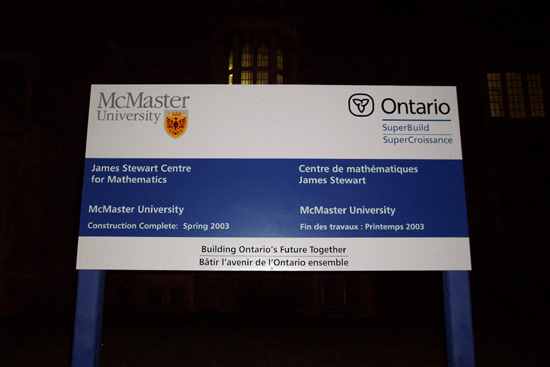
He's a great guy. Definitely one of the top three profs I ever had (along with Dave Parnas and Alan Wassyng who designed the safety & monitoring systems for the Darlington Nuclear facility). I'd say he does indeed know a bit about Calculus. He's a Fellow of the Fields Institute and they even named their library after him.
quote: Joshua Waaland
This may be a stupid question, but does he use his own text?
He used to for some courses. I'm not sure if he's still teaching ungrad anymore though.
Now that I think of it, I actually used his calculus text in high school too.
Powered by Infopop Corporation
UBB.classicTM
6.3.1.2