This is topic Loew's Paradise Reopens in Bronx As Grand Concert Hall in forum Film-Yak at Film-Tech Forum ARCHIVE.
To visit this topic, use this URL:
https://ft-forum.com/ft/cgi-bin/ubb/ultimatebb.cgi?ubb=get_topic;f=8;t=004324
Posted by Gerard S. Cohen (Member # 994) on 10-22-2005, 12:41 PM:
This grand old movie palace has died several times, only to be restored "in nearly all its grandeur." It reopens next Saturday,
October 29th, 2005.
It opened the year of my birth, at the commencement of the Great Depression. I've worked it many times in its sad state as a quartet, and hoped someone could save it.
Long link
In Nearly All Its Grandeur, Paradise Reopens in Bronx
By JOSEPH BERGER
Published: October 22, 2005, The New York Times
Stars will not be twinkling in an enchanted nighttime sky, and goldfish will not be gliding through the fountain, but otherwise Paradise - or at least the Bronx version of it - is about to be regained.
[Photo
Librado Romero/The New York Times]
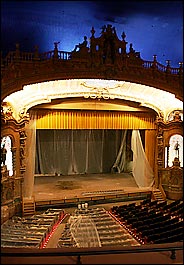
Almost 4,000 burgundy seats have been installed, and the famed midnight-blue ceiling has been repainted.
[Photo
Librado Romero/The New York Times]
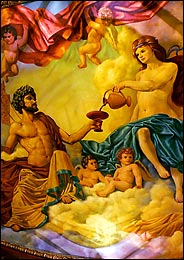
One of several murals visible on entering the lobby of the Loew's Paradise on the Grand Concourse in the Bronx.
The Loew's Paradise, a 76-year-old movie palace that gave generations of working-class strivers a taste of Old World opulence and gave generations of teenagers a haunting setting for the taste of their first kiss, is scheduled to reopen next Saturday after more than 30 years of either being boarded up or sliced up into multiple screens.
The new owner of what was once the Bronx equivalent of Radio City Music Hall has restored much of its Italian baroque grandeur. Since putting up $4.5 million to acquire the theater two years ago, the owner, Gerald Lieblich, has gotten workers to clean the cherubs, caryatids, recumbent lions, gargoyles and other statuary in the vaulted lobby and gargantuan auditorium, install almost 4,000 burgundy seats and repaint the famed midnight-blue ceiling.
Lloyd Ultan, the Bronx borough historian, called the reopening "the resurrection of one of the most spectacular movie palaces ever built."
"It was the showplace of the Bronx," he said. "It was meant to take people out of their humdrum existence and bring them into a world of unimagined wealth and luxury."
The Paradise will not reopen as a movie house, however. Its opening night performance is a salsa and merengue concert, clearly a bid to cater to a borough where Latinos now make up half the populace. The entrepreneurs leasing the space also plan to hold gospel, rhythm and blues and comedy acts, live boxing matches, closed-circuit sports events, beauty pageants and nostalgia acts that might appeal to onetime Bronx residents.
The entrepreneurs also plan to use the giant auditorium once more for high school graduations, and to rent out the ornate lobby and mezzanine for weddings and bar mitzvahs, perhaps even for the grandchildren of those who remember first seeing "Singin' in the Rain" or "Jailhouse Rock" at the Paradise.
However the theater is used, the reopening of the 45,000-square-foot building is another milestone in the gathering renaissance of a borough that two decades ago was known for its landscape of eviscerated buildings and Fort Apache air of menace. Indeed, the once-princely boulevard it sits on, the 99-year-old Grand Concourse, is itself being spruced up. The refurbished Loew's Paradise is likely to dazzle a different generation of strivers and their children just as it dazzled one resident, Diane Levine Edelstein, when she was a teenager almost a half-century ago.
"You walked in and you felt you were in another world, you weren't in a movie theater," said Ms. Edelstein, now a senior research assistant at the Albert Einstein College of Medicine. "We always sat in the balcony because you felt closer to heaven. I remember watching the stars and not looking at the movie."
Others remembered its balcony as something of a lovers' lane. "I remember going to the Paradise in the late 1950's when they were showing 'The Ten Commandments,' and the couple to my right was breaking nine of them," said Stephen M. Samtur, co-publisher of Back in the Bronx magazine, a nostalgic quarterly.
Phyllis Gross Greenbaum, now a publisher of community newspapers in the Washington-Baltimore area, suggested that the Paradise stunned her and her friends because "I don't think many of us grew up with that kind of elegance."
The Paradise, whose five-story facade has been declared a city landmark, opened in 1929, six weeks before the stock market crashed, with a showing of the "all-talking" film, "The Mysterious Dr. Fu-Manchu," starring Warner Oland. Its architect was John Eberson, an Austrian immigrant who began his career designing opera houses and went on to create dozens of what were known as "atmospheric" theaters, including five "Wonder Theaters" for the Loew's national chain in the New York area.
The Paradise's atmospheric show included twinkling stars, rolling clouds and flying pigeons. The stage was surrounded by sculptured walls with flowing vines, cypress trees and shrubs and classical statues everywhere. In three domes set into the lobby's filigreed ceiling, Eberson had painters execute dreamy murals of ersatz half-nude deities: Sound, Story and Film.
The grand lobby was surrounded by fluted and gilded mahogany pillars and, at mezzanine level, an arched balustrade of royal proportions. On the lobby's north wall Eberson placed a Carrara marble fountain of a child on a dolphin. (The fountain's pool, which once held the goldfish, will not be replaced because it would interfere with a new concessions stand.) For the cream-toned terra cotta and marble facade, Eberson designed a mechanical clock topped by St. George astride a charger slaying a fire-breathing dragon every time the clock struck the hour. The theater cost $4 million to build.
[Photo
Librado Romero/The New York Times]
Gerald Lieblich spent $4.5 million to acquire the Paradise in 2003.
Over the years, the fountain stopped bubbling, the clock stopped working and St. George vanished around 1970, somehow lowered five stories onto a busy thoroughfare. As television made it difficult to fill the theater's seats and middle-class audiences moved to the suburbs, the Paradise was divided up, first as a twin around 1973 and then in the early 1980's as a quadriplex, which it remained until 1994, when, severely run-down, it closed for good.
At least one effort to resurrect it collapsed, with $1 million alone spent on gilding. But in 2003, the Paradise was taken over by Mr. Lieblich, a 44-year-old developer of small commercial buildings.
"For the last 20 years that I've been in the Bronx, it's been better and better, and in the theater I saw an eyesore that needed to be brought back as the crown jewel," Mr. Lieblich said.
With workmen still vacuuming the auditorium, Mr. Lieblich showed a reporter around, highlighting the new air-conditioning, the repointing of the facade, the replacement of reddish neons in the marquee and the replication of the original oval ticket booth. Getting the lights to twinkle again, he said, proved uneconomical. He declined to say how much he had spent.
One of the keys to making the project profitable, he said, is renting the 30,000 square feet of commercial space that is part of the theater building to a significant retailer. One has not been secured yet. A major retailer would be a step up from the shops flanking the theater to the north, a 99-cents store and one that sells furniture on credit.
The opening-night concert is an only-in-New York production. The impresarios leasing the theater are Gabriel Boter, 58, who immigrated from the former Soviet state of Georgia in 1979, and his son Richard, 30, a nonpracticing lawyer who is married to a Dominican and is fluent in Spanish. Father and son expect to schedule 35 concerts a year and 10 boxing matches, though they do not have any longtime experience in organizing events.
There are three firm bookings after opening night, including a concert sponsored by WQHT-FM 97.1 "Hot 97" and a Latina beauty contest.
"There is a strong personal attachment I found people have to the Paradise," the younger Mr. Boter said. "That gives me a strong sense of personal responsibility to make sure that it will have the splendor and be the jewel it once was."
[ 10-23-2005, 12:21 PM: Message edited by: Gerard S. Cohen ]
Posted by Stephen Furley (Member # 1277) on 10-22-2005, 03:17 PM:
Good news Gerard.
Just a few questions:
What are caryatids?
Do you have any pictures of the place you could post?
Where exactly is it?
I wanted to come over this week to see the 3-D show at the Lafayette, but I wasn't able to make it. I'm still hoping to come over sometime next year, and I'd like to take a look at the place. Maybe I could take in a concert.
I only kmow a few places in the Bronx, so place names probably won't mean much to me; is there a Subway, or Metro North, station nearby? Is it on, or near a bus route? If bus, do you know the route number? I've got a Bronx bus map, so I could look it up.
I seem to remember that the subway line to Woodlawn (No. 4?) goes through several stations on the Grand Concourse; is this anywhere near it?
Wishing the theatre every success for the future.
Posted by Paul Mayer (Member # 355) on 10-22-2005, 03:39 PM:
Love it when someone steps up to the plate with enough cash and vision to bring one of these old palaces back! ![[thumbsup]](graemlins/thumbsup.gif)
![[beer]](graemlins/beer.gif)
Posted by Gerard S. Cohen (Member # 994) on 10-22-2005, 04:22 PM:
Stephen:
If I remember correctly, caryatids are columns supporting an entablature, consisting of a row of female statues in grecian togas carrying the weight of the architecture above on their heads.
The NYTimes print and online editions both carry beautiful photos from the article and the latter can be enlarged by clicking. I used to be able to copy and paste Times articles complete with photos, but this time only text. Perhaps I could copy each photo to my hard drive and from there to my F-T post, but I don't trust my computer after my daughter deleted my "My Pictures" folder of hundreds of graphics, leaving only a copy buried in a folder she called "Stuff", the contents of which I cannot view. Check the link to see the online photos, and the F-T archives as well.
The theatre is on the West side of the Grand Concourse, just South of Fordham Road, at 188th Street. I suppose the "D" train (IND 6th Ave line, direction Uptown & Bronx) would stop at 186th Street or nearby. Also #4. I always went by car--a beat-up 1972 VW bug, and followed the warning NEVER PARK ON VALENTINE AVENUE.
I never saw the Paradise in its glory days, but attended its sister palace, Loew's Valencia many times with my family, entranced by the golden glow of the Moorish architecture, goldfish pond, stars, clouds blowing across the blue sky while watching a double feature, cartoons, newsreel and TEN acts of vaudville, only to exit blinking in the blazing sunlight wondering why it was still day outside! Alas, this theatre is now a church, and I am told the interior is painted pink, and the projection booth is part of the choir loft. Sic transit gloria cinema... ...
Posted by Ron Yost (Member # 1850) on 10-22-2005, 05:52 PM:
Yep. Caryatids are statues functioning as columns.
A little bit of their interesting history, here:
Persian influence on Greece
Ron Yost
Posted by Tim Reed (Member # 137) on 10-22-2005, 08:09 PM:
Hey, this is great, the Bronx is becoming cool! Everything eventually comes full circle. For instance, who'da thunk the NYC crime rate would fall to the lowest it's been in something like 40 years?
Too bad they're not running movies at this place, or I'd consider dropping by on a day off. I know exactly where it is, though, I drive under Grand Concourse every day in my rig.
Posted by Stephen Furley (Member # 1277) on 10-23-2005, 07:48 AM:
I can think of a number of places which no longer run film, but where equipment has been hired in, and installed for a one-off event. If this place is now a concert venue, maybe they could someday put on a silent film show, with live orchestra. The screen wouldn't need to be full width, no cinema sound system would be needed, if no projection room now exists, maybe there is a lighting box or something that could be used, or, as a last resort, close the balcony, remove a few seats, and put in a portable projector with a tower up there. Some portable machines were designed to be used without a proper projection room, and are quiet enough to be used in this way. Might cause a few problems with the licencing authority, but providing no audience is in the balcony and, obviously, safety film is used, it should be possible to find an acceptable arrangement.
Some silent films are quite short; you might even be able to run them on a single 6k spool. Run two or three such short films in the programme. Or hire two projectors and do changeovers. Putting in a platter for such an event, especially if the projector had to be run in the balcony, would probably not be very practical.
Posted by Bob Maar (Member # 763) on 10-23-2005, 08:32 AM:
My first job in theatre, was in 1956 as an usher in the, Loews Paradise theatre. I worked there for about eight months and then moved over to the RKO Marble Hill in Kingsbridge, which was closer to home.One bus ride instead of two.
I believe my stint at the Paradise put the love of theatre in my life. Once it is in my blood I was hooked. Now in my senior years I have many great memories and a great family to go with them.
Posted by Bruce McGee (Member # 131) on 10-23-2005, 09:59 AM:
Bob, I figure that in 1956, you had to be about 5 years old. ![[Smile]](smile.gif)
See what eating White Castles will do to you?
I was in NYC about 4 years ago helping a friend move a house full of stuff after his mom passed away. We rode by the then-closed Paradise, and my friend told me tales of going there when he was a kid. I sure hope to see it reopened one day soon.
Posted by Gerard S. Cohen (Member # 994) on 10-23-2005, 11:04 AM:
When I worked the Paradise, the door to the upper booth had several locks and a padlock on it because of repeated break-ins.
And I was told a fence and cinderblock wall was built on the roof to discourage vandal attacks.
The upper booth furniture was right out of the 1934 Neumade catalog--steel tables, high chairs, a many-drawed lighting cell cabinet, cast-iron table-top nitrate film dispensers, etc. The power room had a tremendous motor-generator bolted to the floor like a sleeping cayman, huge rectifier cabinets, and a black wall of copper knife switches right out of Dr. Frankenstein's laboratory. In a little rewind room was the remains of an early electric disc phonograph (Western Electric?). And outside the booth a horseshoe-shaped catwalk bristled with rows of spots and floodlights.
The Bronx and especially the Grand Concourse area has certainly revived after the arson of the 1970's. Those solid Art-Deco apartment buildings on both sides, and some white marble buildings that were once donated to the City in lieu of tax payments are restored and occupied again. And yes, crime is down.
As for getting around NYC, today's Times indicates that a group of hotels provide guests with tourist model GPS devices to indicate their positions, enabling them to scroll through an alphabetical list of locations to find their way to them. Like taking the concierge with you.
The NYC bus route and subway maps have been improved, and now self-refold ingeniously to a small pocket-size. Maps are free at subway kiosks, and fares will be discounted on weekends
around the X-mas holidays this year.
[ 10-23-2005, 03:14 PM: Message edited by: Gerard S. Cohen ]
Posted by Tim Reed (Member # 137) on 10-23-2005, 12:06 PM:
Gerard, Bob... do you recall what they had in the booth as far as projectors, lamps, etc.?
When I went to NY in 1980 for a Dolby seminar, I lamented that if I never saw NYC again it would be too soon. Well, with the direction the city has taken, I've done a 180 on that notion. I purely love it. I don't feel threatened there, and I get the distinct impression that the areas to avoid aren't as numerous as they once were.
The people I've met in New York and in northern Jersey (contrary to what they'd secretly like you believe) have been very nice, and I don't even get too bent out of shape getting caught in traffic there (I do know a lot of 'go-arounds', but even so...) ![[Wink]](wink.gif)
Posted by Gerard S. Cohen (Member # 994) on 10-23-2005, 12:50 PM:
Tim:
I think there were two Simplex XLs upstairs. I remember the bronze gear (Wolk # 26241) connecting the sound and optical heads frequently became stripped. [Could be the technician put his kids through college on what was spent on replacements on the # 4 machine. ] I don't remember the lamphouses or what ran downstairs.
As per your comment on safety in NYC, I twice had my car broken into and stuff stolen, once on 124th St in Manhattan while attending a James Brown concert at the Apollo Theatre.
So when once I did park on Valentine Avenue, a block from Paradise, I returned after midnight and found the street completely dark (streetlights permanently sabotaged?). My VW bug wouldn't start! I started pushing it down the street, when four or five guys emerged out of nowhere. To my surprise they push-started my car and refused the honorarium I offered. So much for stereotyping a "bad" neighborhood. Still, I avoided that dark avenue afterwards, and tried to park under working streetlights.
I managed to edit and upload two small photos to my original post, but was unable to include an enlarged version.
Ron:
Thanks for the link to Persian/Greek sculpture and architecture. That Vitruvius quote on the origin of the caryatid
etymology and legend is most interesting.
Posted by John Walsh (Member # 168) on 10-23-2005, 05:49 PM:
The last time I was there, (1973?) Lowe's was in the process of chopping up the orchestra level into more auditoriums, after making the balcony it's own auditorium. The balcony seating alone was so huge, I almost couldn't belive it was just the balcony. The screen was big, bigger than the 'large house' at most multiplex's even today. As you know, theater owners never like to remove the seats that are too close to the screen, but in the balcony of the Pardise, something like (the first) 25 rows had been removed. They were just too close.
A projectionist would (and should) feel like a real professional working in a place like that. Can you imagine a kid messing up and the manager having to refund something like 2400 tickets?
Posted by Michael Schaffer (Member # 1204) on 10-23-2005, 06:57 PM:
Horrible kitsch.
Posted by Martin Brooks (Member # 1269) on 10-23-2005, 09:09 PM:
quote: Bob Maar
My first job in theatre, was in 1956 as an usher in the, Loews Paradise theatre. I worked there for about eight months and then moved over to the RKO Marble Hill in Kingsbridge, which was closer to home.One bus ride instead of two.
Hey Bob....the Marble Hill was my local theatre and I spent an amazing part of my youth there. I still remember the white haired matron who would always throw me out of the adult section. Of course RKO and Loews played entirely different films so I also often made the trip to the Loews Paradise. As a kid, the statuary at the Paradise used to freak me out, especially during horror films. But I loved the clouds and the stars in the ceiling. I remember seeing Exodus there on a Sunday afternoon and almost everyone in the audience was fancily dressed.
I don't think they ever put mag stereo in the original Paradise, but it was an incredible place to see movies. I'm glad it's been restored, even if it's not a movie house. According to the Times article, they didn't restore the stars in the ceiling which surprises me because you'd think it could be done with LEDs today for reasonable cost.
I just hope that the audiences at the Paradise treat the place with the respect that it deserves.
Posted by Tim Reed (Member # 137) on 10-23-2005, 09:44 PM:
quote: Martin Brooks
they didn't restore the stars in the ceiling which surprises me because you'd think it could be done with LEDs today for reasonable cost.
One light on a dimmer, and fiber optics taking the light to each "star" opening in the ceiling... that's how one restored atmospheric house I installed did it. Rotate a fluted gel in front of the light to make them twinkle.
Posted by William Hooper (Member # 71) on 10-24-2005, 02:04 AM:
Five years ago, lots of pretty intelligent people were giving odds that the Loew's Paradise wasn't going to survive. It was the most heavily damaged of the 5 Loew's Wonder Theatres, & it was expensive damage: water leaks had caused so much damage that it looked like the walls were melting, & atmospheric theatre like the Paradise is almost all very detailed sidewall ornamentation. So it's not just good news, it's amazing. That leaves the Loew's Kings in Brooklyn as the only unrestored, endangered Wonder Theatre. When I was there last, it had extensive, unsafe falling plaster from the ceiling, etc., but I think it's owned by the city now, so who knows what will happen with it.
quote: Martin Brooks
According to the Times article, they didn't restore the stars in the ceiling which surprises me because you'd think it could be done with LEDs today for reasonable cost.
Typically twinkling stars in atmospheric theatres were just holes into the attic with lights above, & a little bladed fan between the hole & light which turned by the rising air through the hole to make the twinkle. The renovation may have precluded holes passing through the new ceiling, & fiber optics spread out over a block-wide ceiling may have not made the final budget.
quote: Stephen Furley
What are caryatids?
Caryatids are big, loud obnoxious bugs that spawn in huge masses in 7-year cycles, leaving these really gross bug skeletons attached to the sides of all the trees.
quote: Gerard S. Cohen
I never saw the Paradise in its glory days, but attended its sister palace, Loew's Valencia many times with my family, entranced by the golden glow of the Moorish architecture, goldfish pond, stars, clouds blowing across the blue sky while watching a double feature, cartoons, newsreel and TEN acts of vaudville, only to exit blinking in the blazing sunlight wondering why it was still day outside! Alas, this theatre is now a church, and I am told the interior is painted pink, and the projection booth is part of the choir loft.
The Valencia isn't pink, it's really nicely restored.
http://www.queenstribune.com/archives/featurearchive/feature2000/0127/
The bizarre thing about it is that it's an atmospheric, which means that the decoration is all on the walls to impersonate an exterior courtyard & the ceiling is simply painted blue to impersonate the sky & thus has no chandelier, but the theatre is now a church, & the church had donated to it by another church in another country a really huge, beautiful, multicolor-jeweled chandelier, & they hung it. It's a chandelier hanging from the middle of the sky. Surprisingly, as Joe DuciBella said before I saw it, "It kinda works".
The big loss is one that wasn't a Wonder Theatre: the Loew's 72nd Street. Lamb was the architect of the job, but Eberson did the auditorium
quote: Tim Reed
Gerard, Bob... do you recall what they had in the booth as far as projectors, lamps, etc.?
There's a picture of the original booth of the Loew's Paradise at
http://www2.hawaii.edu/~angell/thsa/loewspa1.jpg
As you can see, it's almost identical to the booth of the Loew's Kings:
http://www.angelfire.com/empire/playhouse/loewskings/loewskings.htm
and the Loew's Jersey & 175th Street. Even though Eberson was the architect of the Paradise & Lamb was the architect of the Kings, the booths at the 5 Loew's Wonder Theatres were very similar because they went through some sort of corporate architectural review at Loew's which standardized much of the booth designs. It becomes very apparent when you notice that Eberson's theatres usually had wildly varying & sometimes horrible booth layouts & equipment (like at the Chicago Paradise). Corporate review & standardization on things that worked well as far as film presentation went was a VERY good thing in this case. The corporate architectural review probably went through Lamb's office, since the Loew's/Lamb relationship went all the way back & was very active & close. The booths at Loew's theatres are generally similar & very good.
quote: Michael Schaffer
Horrible kitsch.
It's easy to think that & to be right in some regard. But mainly it works like a set & doesn't work well in photos. Stage sets look stupid in photographs, too, no matter how cool & effective. Ebersons theater designs were the most "theatrical", & have this effect of looking sort of dumb in long shot as opposed to from the seats. Scale has a lot to do with it. Create an atmospheric of that detail in a small auditorium & it would be ludicrous, but on a large scale it's just massively detailed like a full-size set.
Posted by Gerard S. Cohen (Member # 994) on 10-25-2005, 09:55 PM:
quote: William Hooper
Caryatids are big, loud obnoxious bugs that spawn in huge masses in 7-year cycles, leaving these really gross bug skeletons attached to the sides of all the trees.
For those who might not know you're joking, the above describes cicadas. They appear on my street every August (there are many cycles, some years infestation is heavy, while this year I saw only a few.) They look like fat-bellied grasshoppers, make a fluttery sound when they fly, and make a loud sandpaper mating call shrieking in the trees. Large yellow and black striped wasps excavate tunnels in my lawn at night, and carry the bodies of dead cicadas into them.
I assume cicadas lay their eggs in the ground, which hatch into larvae, and as white grubs winter deep below, eat the roots of grass, and when they ripen, emerge, crawl up and fix themselves to tree trunks or walls of buildings. Then they metamorphose into cicadas, and the next cycle begins
Posted by William Hooper (Member # 71) on 10-26-2005, 05:17 AM:
I thought I had some pictures of the Tabernacle of Prayer (formerly Loew's Valencia:
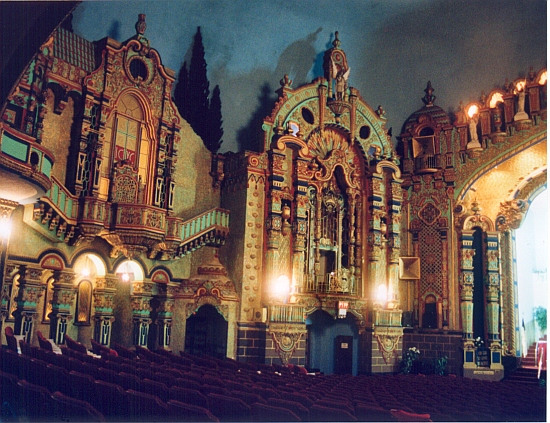
When the Valencia was restored by the church, it was re-painted in an afrocentric color scheme. It's really good looking, works very well. They've got about a billion times more taste than the Mobile Ladies' Garden Club, who decided to just paint the Mobile Saenger white with gold trim like bathroom.
Detail of auditorium wall:
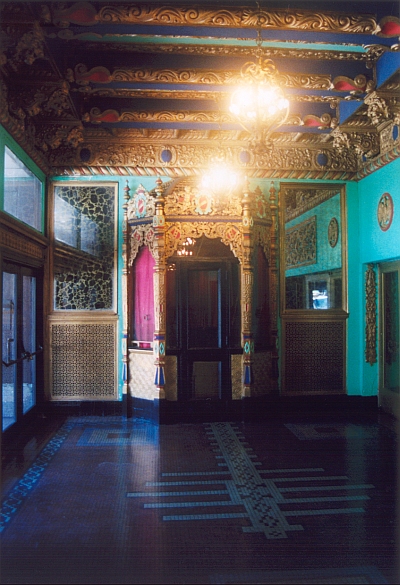
The folks here are really very nice. The building is beautiful, the folks are friendly, & they're very appreciative & respectful of the building & have a solid feeling of a responsibility of stewardship of it. I believe this is the one where, instead of hanging over the prosc a speaker cluster for sound reinforcement (a painful visual modification in an atmospheric-style theatre), they cut away a portion of the plaster ceiling forming the "sky" over the prosc, installed the cluster in the attic behind the opening, & covered the opening with the material closely matching the material covering the rest of the ceiling (like grille cloth).
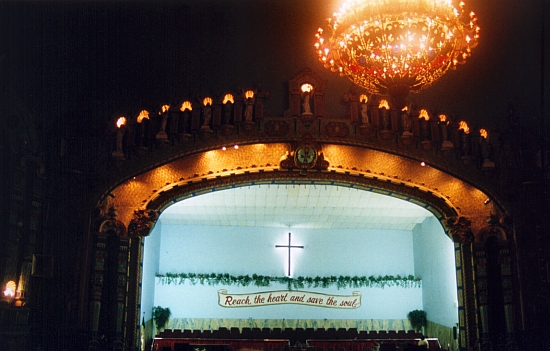
The chandelier was a gift from a sister church in Greece. It's a great-looking chandelier.
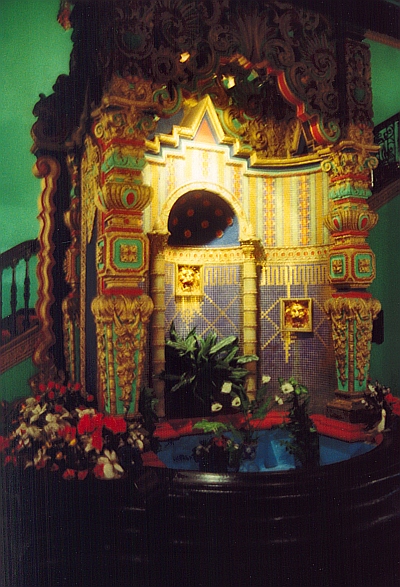
Ornamental pool & fountain in the lobby.
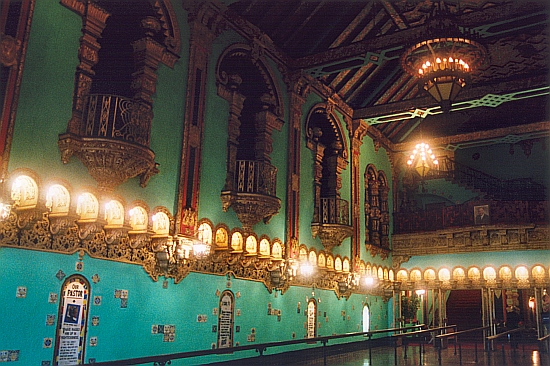
The theatre has in lighted niches over the proscenium several nude statues as part of the decoration. They were thought inappropriate by the church in sanctuary, so they simply robed them, then added wings behind them, & they became angels. They look GREAT.
Far better than what happened to the nudes statuary at the Jefferson Theatre in Beaumont when it was leased to a group which operated it as a church: one Sunday, the preacher exhorted the congregation to take "these sinful images and throw them into the street!" Which they all did, and then they busted them into micro-particles. When the Jefferson was restored, they had to have the original statuary reproduced.
quote: Stephen Furley
What are caryatids?
They are the two structures formed from a chromosome during cell division at metaphase.
Powered by Infopop Corporation
UBB.classicTM
6.3.1.2