This is topic Jammin' wood!? in forum Film-Yak at Film-Tech Forum ARCHIVE.
To visit this topic, use this URL:
https://ft-forum.com/ft/cgi-bin/ubb/ultimatebb.cgi?ubb=get_topic;f=8;t=004379
Posted by Andrew McCrea (Member # 674) on 12-01-2005, 08:55 PM:
A new way to combat cell phone jerks... I found this very cool, very interesting, very legal product that effectively blocks cell phone service in any room it is installed in.
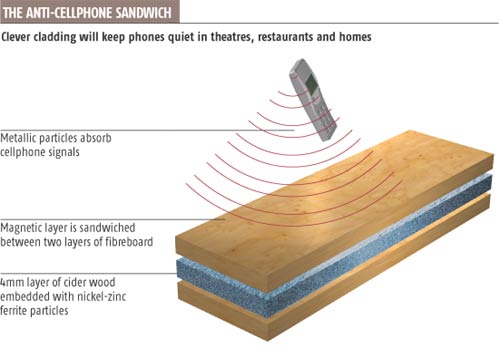
Magnetic wood blocks mobile phone signals http://www.newscientist.com/article.ns?id=dn2461
Magnetic wood could be a major plank in the battle against noisy cellphone users. The high-tech material absorbs microwave radio signals, making it impossible to use a mobile phone in any room lined with it. Or a radio for that matter. So theatres and restaurants, for example, can stop people using cellphones on their premises without resorting to signal jammers.
These are illegal in some countries, including the US, Britain and Australia. Jammers also cause wider problems because their signals can spill out of the building they are covering, interfering with other people's calls.
The magnetic wood - so called because it is packed with minute magnetic particles - is the brainchild of Hideo Oka and a team of electronics engineers at Iwate University in Morioka, northern Japan. They chose wood as their preferred blocking material because it offers more natural, aesthetic options for interior design. Oka hopes that it will soon be possible to buy the novel wood panelling by the metre at your local hardware store.
While normal wood is transparent to radio waves, Oka's blocks them because it contains fine particles of a magnetic material called nickel-zinc ferrite. When an electromagnetic wave hits the ferrite particles, the magnetic part of the wave is absorbed.
Bluetooth frequencies
The team looked at four different ways of making wood absorb radio waves before hitting on the best one. The first was simply wood coated with a ferrite powder. The others were made by mixing ferrite powder with cider wood powder and pressing it into boards, or impregnating the wood with particles, or sandwiching wood pulp containing ferrite powder between two thin wooden panels.
Oka tested each wood in turn by putting collars of each material over a short antenna that broadcasts radio waves at the typical GSM mobile phone frequencies of 900 megahertz and 1.8 gigahertz.
The antenna can also broadcast at frequencies up to 2.5 gigahertz, which covers the range commonly used for wireless networks like Bluetooth and the emerging IEEE 802.11 standard, better known as Wi-Fi. A receiver measured the strength of the radio waves transmitted through the material.
Ferrite sandwich
In the end, Oka found that ferrite sandwiched between thin sheets of wood performed best. Further tests showed that a 4-millimetre-thick sandwich absorbed the most microwave radiation, cutting the wave's power by 97 per cent. Increasing the thickness of the outer wooden sheets of the sandwich increased the frequency of radio waves that the shield would absorb.
The wood-based shields could be used to make doors and walls for rooms or even entire buildings where mobile phones simply won't work. While the prospect of being forcefully cut off might horrify some cellphone addicts, Oka says theatre-goers and restaurant customers might appreciate the silence.
Panels that absorb radio waves could also help with a problem emerging in Japanese cities, where many homes are being fitted with wireless computing networks. If several networks are set up close together, they can interfere with each other. The new panels could divide up the house into different areas, allowing several networks can operate close by.
Oka believes he can make the wood cheap enough for it to be viable. And he now hopes to cut the cost still further by making the panels from recycled magnetic materials and waste wood.
Personal opinion: Definitely worth it.
Your opinions?
Posted by John McConnel (Member # 2000) on 12-02-2005, 01:48 AM:
Maybe it could also reduce sound transfer a little between auditoriums...
Posted by Phil Hill (Member # 371) on 12-02-2005, 01:58 AM:
Whew! Talk about "teaser" titles... ![[Wink]](wink.gif)
![[Razz]](tongue.gif)
![[Eek!]](eek.gif)
![[thumbsup]](graemlins/thumbsup.gif)
Posted by Tim Reed (Member # 137) on 12-02-2005, 02:04 AM:
That's exactly what I thought, Phil! quote: Andrew McCrea
it contains fine particles of a magnetic material called nickel-zinc ferrite.
...and after you spend several hours around this material, you'll never look at wood the same way again.
Posted by John Pytlak (Member # 331) on 12-02-2005, 03:04 PM:
Probably a pretty expensive way to make a "Faraday Cage" to keep out any radio frequency radiation. To be truly effective, the conductive material would need to have no gaps (e.g., RF could get in when the door was opened).
Posted by Andrew McCrea (Member # 674) on 12-04-2005, 02:39 PM:
John, I didn't think about the doors, but, I was thinking about what you'd have to do with stadium seating. Also, wouldn't the thick concrete be a benefit that would help this system work?
If I'm ever in a room under the stadium seating (staff room), I can't get reception (well, sometimes, but barely).
Posted by Andrew McCrea (Member # 674) on 12-05-2005, 11:48 AM:
What about the construction company putting nickel-zinc ferrite in the concrete as its mixed? Wouldn't that be a lot more effective? Would that work?
Posted by Erick Akers (Member # 875) on 12-05-2005, 12:00 PM:
If it were mixed very well, I dont see why not.
Posted by Andrew McCrea (Member # 674) on 12-05-2005, 12:20 PM:
Interesting, and besides ending the nuisance of cell phone jerks, you'd also be able to confine walkie-talkie transmissions about money pick ups, etc. from leaving the building (in case some criminal were smart enough to get a walkie set to the theatre's freq).
Posted by Erick Akers (Member # 875) on 12-05-2005, 12:32 PM:
of course, you could or would have to carefully locate such material to be able to use in house walkies.
Posted by Richard Hamilton (Member # 321) on 12-05-2005, 12:55 PM:
If your concerned about walkie talkie transmissions, wouldn't you just pick up the phone and buzz another employee? Or do you think going into a completely sealed room just to talk to someone else on site is a better solution? But then you would have to hope that they are in a completely sealed room also. If you are both in completely sealed rooms, how would you hear each other? I can see if you are both in the same room, maybe this could work ![[Big Grin]](biggrin.gif)
Posted by Christian Volpi (Member # 2370) on 12-05-2005, 07:28 PM:
Jamming Wood? How 'bout "Log Jammin'?"
Powered by Infopop Corporation
UBB.classicTM
6.3.1.2