This is topic return videotapes heads out or tails out? in forum Film-Yak at Film-Tech Forum ARCHIVE.
To visit this topic, use this URL:
https://ft-forum.com/ft/cgi-bin/ubb/ultimatebb.cgi?ubb=get_topic;f=8;t=004381
Posted by Scott Norwood (Member # 30) on 12-04-2005, 02:29 PM:
Yes, videotape. I know that this is a film site, but surely there are others here who have to present video programs from time to time at festivals or other events. I've done several of these shows lately (mostly from Beta SP, sometimes Digi-Beta or HDCAM).
I "inspect" tapes by rewinding or fast-forwarding through the tape, stopping occasionally to check sound quality and make note of the program-start and program-end timecode values. As such, I prefer that the tapes arrive not rewound, since it makes the inspection process faster.
This, then, begs the question of whether or not there is (or should be) a general consensus about how to return videotapes after screenings. To date, I have returned them as they have arrived (usually rewound), but I don't know if this is how the distributors (or other theatres) prefer them to be returned.
Posted by Mark Gulbrandsen (Member # 72) on 12-04-2005, 02:44 PM:
The places I worked at in Broadcast TV everything was always shipped back out heads up, this included all formats from 1/2" up to 2" Quad back then. VTR's rewind tape with much more even tension than film would be wound. In fact tape is wound with the same tension in either direction if the VTR is operating peoperly so weather its shipped heads or tails up is irrelavent. The only thing to watch out for is if your place has an SOP that specifies which way it is to be shipped.
Mark
Posted by Randy Stankey (Member # 64) on 12-04-2005, 05:32 PM:
I agree that, if there is a policy from the place you borrow the tape from, you should return wound the way they want it. However, in my opinion, the best way to rewind video tapes is not to rewind them at all.
As magnetic tape sits in storage, the magnetic particles in the layers of tape lying next to each other in the roll tend to have a mutual demagnetizing effect. Thus, after a length of time, the tape will naturally erase itself just by sitting in one place for a long time.
If you take your video tapes out of storage every once in a while and rewind them you reshuffle the orientation of the layers and prevent them from affecting each other.
Taken to the logical extreme, that means that the best policy for preserving your video tapes is to leave them in whatever random position you happen to stop the tape in when you're done with it.
Posted by Phil Hill (Member # 371) on 12-04-2005, 05:45 PM:
I always store my quad video tape tails out and emulsio...errrr I mean magnetic layer out.
Posted by Joe Redifer (Member # 3) on 12-04-2005, 06:43 PM:
When I return tapes to Blockbuster, I do not rewind them.
Posted by Monte L Fullmer (Member # 2797) on 12-04-2005, 06:49 PM:
..kinda goes along for analog "open reel" tape as well - tails out during storage and on occasion, rewind them to prevent the "print through" that can happen.
..and bake them once in a while..-to drive out the moisture to prevent "sticky-shed."
-Monte
Posted by Bruce Hansen (Member # 281) on 12-05-2005, 10:22 AM:
I always rewind my DVDs.
I do not like leaving cassettes anywhere but head or tail. Dirt and crud can get on the program area of the tape otherwise.
Posted by Cory Isemann (Member # 2517) on 12-05-2005, 10:33 AM:
What is this "cassette" yous speak of??
I have heard also "laser disc"?
so confused!!
![[Wink]](wink.gif)
Posted by Randy Stankey (Member # 64) on 12-05-2005, 11:11 AM:
quote: Bruce Hansen
Dirt and crud can get on the program area of the tape otherwise.
Keeping video tapes in their boxes then storing them on a clean, dry shelf isn't an option, then?
Actually, yes, when it comes to video tapes that I want to keep for a long time I do keep them in either head or tail position. I just have to remember to take them out and exercise them every once in a while.
Posted by Jonathan Worthing (Member # 803) on 12-05-2005, 11:14 AM:
I find that if you forward a tape a rewind a tape before you watch it, the tape will track much better.
This may be because of deferent tape paths in the players.
So I would say that when you return a tape return it un-rewound.
Posted by Mark Ogden (Member # 43) on 12-05-2005, 03:38 PM:
quote: Randy Stankey
As magnetic tape sits in storage, the magnetic particles in the layers of tape lying next to each other in the roll tend to have a mutual demagnetizing effect. Thus, after a length of time, the tape will naturally erase itself just by sitting in one place for a long time.
I don’t know where you got this, but I have never ever seen this effect ever, and I handle a great deal of old videotape. In fact, last year, a woman I work with brought in a 2” quad reel that contained an episode of Play Your Hunch, a game show that aired in 1959, just three years after videotape was first introduced. The episode featured her then very young son, and she wanted to know if it could be dubbed to DVD. We cleaned the tape to remove a little loose oxide, racked it up on an Ampex AVR-1, and it played almost flawlessly, with just a little bit of timing error here and there. The tape had been in storage in her closet for 45 years. In fact, when the Game Show Network channel first started, I was in touch with a buddy who was transferring a lot of the old Goodson-Toddman shows from quad to digital. He reported that the vast majority played back with no problem at all, and certainly weren’t erased with the lapse of 30 to 40 years time.
So, how long does a tape have to sit before it erases itself?
Posted by Bruce Hansen (Member # 281) on 12-05-2005, 08:09 PM:
quote: Randy Stankey
Keeping video tapes in their boxes then storing them on a clean, dry shelf isn't an option, then?
You've never worked in television, have you? ![[dlp]](graemlins/dlp.gif)
Just like film, tape will last a long time, if you treat it right, and store it correctly.
Posted by John Pytlak (Member # 331) on 12-06-2005, 07:48 AM:
Some video rental companies used to put labels on tapes: "Be Kind, Rewind". But I agree that for long term storage, a tape is likely to have a better wind when it was wound to tails out in the "play" mode, rather than fast rewind to heads out.
Posted by Mark Lensenmayer (Member # 134) on 12-06-2005, 01:13 PM:
Somewhat off topic here, I have a laserdisc of BOZO cartoons. (And, they are probably the WORST cartoons I've EVER seen!) that is just a dub from the tape master. At the end, Bozo helpfully reminds us to "Be sure to rewind!"
As for old audio tapes, my dad has some paper backed tape from around 1950 (this was the standard before plastic tape and after wire recorders) that still play just fine. Standard 1/4" format with a gray paper front and a black magnetic back. Most are on 5" reels.
Posted by Randy Stankey (Member # 64) on 12-06-2005, 11:53 PM:
Mark,
My explanation wasn't very good. Monte used the word Print-Through which is a much better term for what I was trying to describe. I couldn't remember the exact word.
I agree with you that magnetic tapes probably wouldn't spontaneously erase themselves without outside influence but I have witnessed print-through in old audio tapes that made the recording sound so bad that it was, in effect, erased.
Still, you'd have to admit that, with the difference in in the quality of television between 1960 and the year 2000, if there was degration in the tapes for whatever reason it might very well go unnoticed if it wasn't pronnounced.
quote:
Print-through
From Wikipedia, the free encyclopedia that anyone can edit.
Jump to: navigation, search
Print-through (sometimes referred to as bleed-through) is a generally undesirable effect that arises in the use of magnetic tape for storing analogue information, in particular music.
The close proximity of layers of tape on the spools of a cassette or reel to reel tape causes a weak imprint of magnetic information to be transferred to adjacent layers, effectively shifting a copy of the signal backwards and forwards along the tape. This can sometimes be heard as pre- or post-echo. Thinner tapes are more prone to the effect than thicker tapes, and tapes held in storage for a long period or exposed to a weak magnetic field can show pronounced print-through. Digital tapes are not affected in the same manner as the imprint is generally too weak to change the state of bits recorded on adjacent layers of the tape.
Print-through is actually used to mass-record prerecorded audio cassettes. In the duplicator, an endless loop of the source tape is forced into close contact with blank tape and run across a "print-through head" in which a weak AC high frequency sinewave is used to transfer the information to the blank tape without erasing the source tape. This permits the tapes to be run at very high speed, speeding up production. However, audio quality using this method is not as good as when the signal is directly recorded onto the tape.
Posted by William Hooper (Member # 71) on 12-07-2005, 02:04 AM:
Just throw those tapes in the Goldberg Rewinder, slam the door, & stand the hell back.
Posted by Monte L Fullmer (Member # 2797) on 12-08-2005, 04:28 AM:
quote:
I have heard also "laser disc"?
so confused!!
...here's one for you - 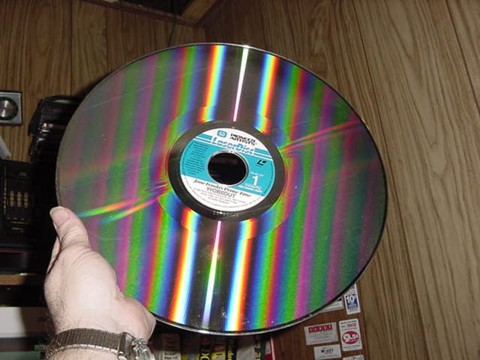
...and this is the CAV side due to those line reflections at the "2:00" and "8:00" position-being each a half frame.
Shoot, Goldberg "Model B" rewinders aren't that fast, it's those STRONG Muts that can wind film like nobody's business when you crank the variac wide open.
quote: Mark Lensenmayer
As for old audio tapes, my dad has some paper backed tape from around 1950 (this was the standard before plastic tape and after wire recorders) that still play just fine. Standard 1/4" format with a gray paper front and a black magnetic back. Most are on 5" reels.
Paper backed Scotch 100, or 101, Audiotape and the Brush Soundribbon were a good start for the paper backed, black oxide variety.
I've got a roll of the Brush Soundribbon and it's amazing how much fidelity can be held and come off of this early stuff
Posted by Tim Reed (Member # 137) on 12-17-2005, 04:59 AM:
At the station where I worked, we mostly used 3/4" U-matic broadcast cassettes. There were (4)record-play decks for recording satellite feeds and on-air program playback. We also had (14)playback-only units (controlled in configurable sequences), which served as the spot machine.
The program tapes always got rewound, but the spots stayed tails out, because of the way the sequencer worked. You had to continually load the commercials manually during the breaks and stay on top of the sequencing of the 14 machines (some elements in a spot break are only 5-10 seconds long, so they go by fast). There was no time to rewind them as they ended.
The drill went like this: as soon as a commercial ended in one machine and the next deck took to air, hit EJECT, wait for it to un-thread, pull that tape out, quickly set it aside, grab the next commercial in the sequence, shove it in the deck and hit REWIND. Then go to the next machine to repeat the sequence for as long as the spot break lasts. Cue tones did the rest.
Done properly, the effect on the air was a seamless fade out/fade in from one commercial to the next. You had to stay far enough ahead of the advancing vtrs to allow tapes to cue, and to hit a 3-second pre-roll. If you had any kind of a problem or stopped moving, the spots could quickly catch up with you and the whole shooting match would come crashing to a halt. Then you'd take black and everyone would know you screwed up.
Oh, and by the time you figured out what went wrong, the program would be back up again, just running into black, and you'd have to make good on the spots somehow!
I loved it! ![[Big Grin]](biggrin.gif)
Posted by Brad Miller (Member # 2) on 12-17-2005, 05:09 AM:
haha That reminds me of running a changeover booth without a splicer. Every trailer on the other machine! That sucked. Needless to say, the short 30 second teaser trailer was always first.
Posted by Scott Norwood (Member # 30) on 12-17-2005, 07:32 AM:
I'd hate to see the thread-count numbers for those machines, Tim! I would have assumed that there would be one tape that contained all the commercials to be shown during a particular program and that there would be some sort of automation system that would cue the tapes and do the switching without human intervention. I guess not.
How are commercials inserted now? Are they played from tape, or do they originate from some sort of disk-based system?
Posted by Tim Reed (Member # 137) on 12-17-2005, 08:29 AM:
quote: Brad Miller
That reminds me of running a changeover booth without a splicer.
Yes, every film break meant another c/o. Hope you didn't have to do that too long.
Scott, this was the Fox affiliate in Lexington, KY, nearly 15 years ago. They've since moved to brand new studios, got new equipment, etc. They were bottom of the barrel, though, when I was there. Not much in the way of equipment or budget. The sequencer was originally designed for cable television local-insertion work; so rapid-fire, multi-spot breaks weren't its forte.
All the other stations had standalone, automated (or cartridge-style) spot machines, which required little attention. I think back and I'm amazed that little sequencer we had worked as well as it did; but compared to "normal" stations, we were effectively running those breaks by hand!
Today, many stations run digital video servers. A station in Cincinnati that I know of has a unit with 15TB (that's terabytes) of RAM. Before a break, hard drives start loading video files into memory, in broadcast order, where they can then "take" to the air instantly. No pre-rolling. ![[thumbsup]](graemlins/thumbsup.gif)
It's funny you mentioned one tape for the commercials. If I had an especially difficult event coming up (like a couple-minute break with 8 or 10 elements, back to the (television) program for a fast :30 of closing credits, and then right back to the spot machine for a heavy top-of-the-hour break), and if I had enough lead time... I'd setup and run the first break offline (in preview) and record it onto a blank tape. That way, those first 8 or 10 elements would only tie up one VTR when they aired, and leave me a sporting chance at staying on top of the rest.
Btw, some shows have some commercials "built-in" to the program (like on syndication runs of network shows), so that's something else to keep an eye on. (That's why sometimes you'll be watching a show and you'll see the exact same commercial run twice in a row. MCO misread the log.)
Powered by Infopop Corporation
UBB.classicTM
6.3.1.2